Old Testament
Scripture
The Book of Exodus Exodus 6:2-3
“And God said to Moses, “I am the Lord. I appeared to Abraham, to Isaac, and to Jacob, as God Almighty, but by my name the Lord I did not make myself known to them.”
Start page / Objections / Authority
Verses cited for this objection: Gal. 1:8-9, Jude 3, Rev. 22:18-19
Short answer
The Church agrees that the faith was delivered once for all. She teaches that no new public revelation is to be expected and that she may add nothing to what the apostles handed on. Defining a doctrine states in fixed words something already held, as the Council of Nicaea did in 325 with a word that is not in Scripture. Understanding of the faith grows over time, and the faith stays the same. St. Vincent of Lerins gave the rule for this in 434. Pius IX repeats his words in the definition of 1854, and Pius XII says in 1950 that the Church adds nothing to the revealed truths and takes nothing away.
At the Last Supper Jesus tells the apostles that he has more to say than they can yet bear, and that the Spirit of truth will guide them into all the truth.
““I have yet many things to say to you, but you cannot bear them now. When the Spirit of truth comes, he will guide you into all the truth; for he will not speak on his own authority, but whatever he hears he will speak, and he will declare to you the things that are to come.”
JesusJohn 16:12-13Read it in the source: Bible Gateway, RSV Catholic Edition
The Church holds that the faith was delivered once for all and that she may add nothing to it. A definition does not add to what Christ gave. It states in fixed words something already held, as the Church comes to understand more fully what she received from him.
Drafted from primary sources. Every quotation is checked against the page it links to.
A work in progress. The quotations below are not all the evidence on this matter. More are being added.
“And God said to Moses, “I am the Lord. I appeared to Abraham, to Isaac, and to Jacob, as God Almighty, but by my name the Lord I did not make myself known to them.”
“I have yet many things to say to you, but you cannot bear them now. When the Spirit of truth comes, he will guide you into all the truth; for he will not speak on his own authority, but whatever he hears he will speak”
“But even if we, or an angel from heaven, should preach to you a gospel contrary to that which we preached to you, let him be accursed. As we have said before, so now I say again, If any one is preaching to you a gospel contrary to that which you received, let him be accursed.”
“Beloved, being very eager to write to you of our common salvation, I found it necessary to write appealing to you to contend for the faith which was once for all delivered to the saints.”
“Nor will any one of the rulers in the Churches, however highly gifted he may be in point of eloquence, teach doctrines different from these (for no one is greater than the Master); nor, on the other hand, will he who is deficient in power of expression inflict injury on the tradition. For the faith being ever one and the same, neither does one who is able at great length to discourse regarding it, make any addition to it, nor does one, who can say but little diminish it.”
“It does not follow because men are endowed with greater and less degrees of intelligence, that they should therefore change the subject-matter [of the faith] itself … But the fact referred to simply implies this, that one may [more accurately than another] bring out the meaning of those things which have been spoken in parables, and accommodate them to the general scheme of the faith”
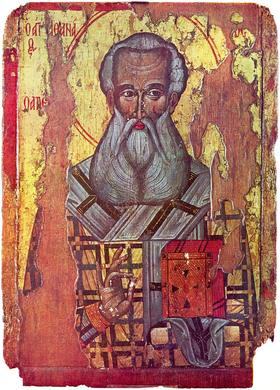
“…if a person is interested in the question, let him know, that, even if the expressions are not in so many words in the Scriptures, yet, as was said before, they contain the sense of the Scriptures, and expressing it, they convey it to those who have their hearing unimpaired for religious doctrine.”
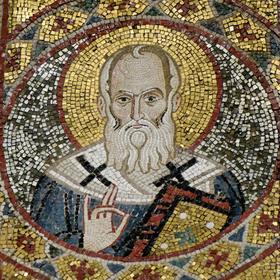
“The Old Testament proclaimed the Father openly, and the Son more obscurely. The New manifested the Son, and suggested the Deity of the Spirit. Now the Spirit Himself dwells among us, and supplies us with a clearer demonstration of Himself. For it was not safe, when the Godhead of the Father was not yet acknowledged, plainly to proclaim the Son; nor when that of the Son was not yet received to burden us further (if I may use so bold an expression) with the Holy Ghost”
“But some one will say, perhaps, Shall there, then, be no progress in Christ's Church? Certainly; all possible progress. … Yet on condition that it be real progress, not alteration of the faith. … The intelligence, then, the knowledge, the wisdom, as well of individuals as of all, as well of one man as of the whole Church, ought, in the course of ages and centuries, to increase and make much and vigorous progress; but yet only in its own kind; that is to say, in the same doctrine, in the same sense, and in the same meaning.”
“But the Church of Christ, the careful and watchful guardian of the doctrines deposited in her charge, never changes anything in them, never diminishes, never adds … This, I say, is what the Catholic Church, roused by the novelties of heretics, has accomplished by the decrees of her Councils — this, and nothing else — she has thenceforward consigned to posterity in writing what she had received from those of olden times only by tradition, comprising a great amount of matter in a few words, and often, for the better understanding, designating an old article of the faith by the characteristic of a new name.”
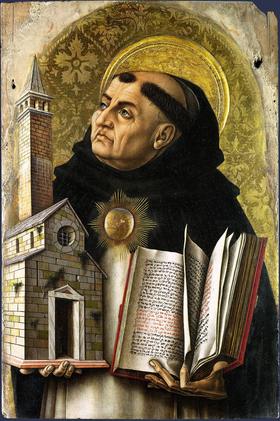
“Accordingly we must conclude that, as regards the substance of the articles of faith, they have not received any increase as time went on: since whatever those who lived later have believed, was contained, albeit implicitly, in the faith of those Fathers who preceded them. But there was an increase in the number of articles believed explicitly, since to those who lived in later times some were known explicitly which were not known explicitly by those who lived before them.”
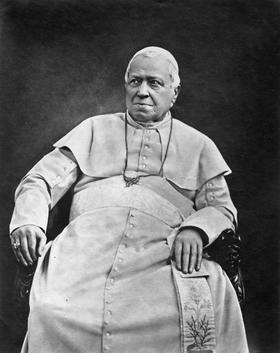
“…this doctrine always existed in the Church as a doctrine that has been received from our ancestors, and that has been stamped with the character of revealed doctrine. For the Church of Christ, watchful guardian that she is, and defender of the dogmas deposited with her, never changes anything, never diminishes anything, never adds anything to them”
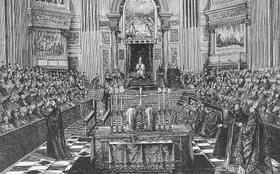
“For the doctrine of the faith which God has revealed is put forward not as some philosophical discovery capable of being perfected by human intelligence, but as a divine deposit committed to the spouse of Christ to be faithfully protected and infallibly promulgated. … May understanding, knowledge and wisdom increase as ages and centuries roll along, and greatly and vigorously flourish, in each and all, in the individual and the whole church: but this only in its own proper kind, that is to say, in the same doctrine, the same sense, and the same understanding”
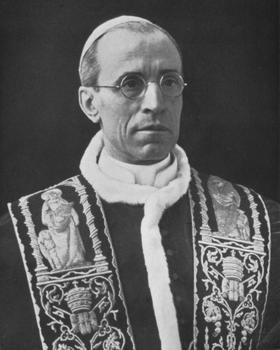
“Certainly this teaching authority of the Church, not by any merely human effort but under the protection of the Spirit of Truth, and therefore absolutely without error, carries out the commission entrusted to it, that of preserving the revealed truths pure and entire throughout every age, in such a way that it presents them undefiled, adding nothing to them and taking nothing away from them.”
“Therefore the Apostles, handing on what they themselves had received, warn the faithful to hold fast to the traditions which they have learned either by word of mouth or by letter (see 2 Thess. 2:15), and to fight in defense of the faith handed on once and for all (see Jude 1:3) … This tradition which comes from the Apostles develops in the Church with the help of the Holy Spirit. For there is a growth in the understanding of the realities and the words which have been handed down.”
“"The Christian economy, therefore, since it is the new and definitive Covenant, will never pass away; and no new public revelation is to be expected before the glorious manifestation of our Lord Jesus Christ." Yet even if Revelation is already complete, it has not been made completely explicit; it remains for Christian faith gradually to grasp its full significance over the course of the centuries.”
“The Church's Magisterium exercises the authority it holds from Christ to the fullest extent when it defines dogmas, that is, when it proposes truths contained in divine Revelation or also when it proposes in a definitive way truths having a necessary connection with them.”
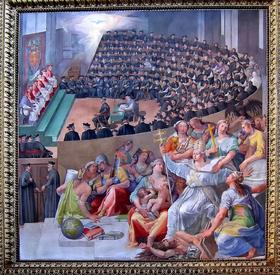 The Magisterium“The Catholic Church claims its Magisterium is an infallible teaching authority. But no body of men stands over Scripture, and every teaching has to be tested by the Bible.”
 Scripture and Tradition“Tradition is man-made. The Bible alone is the Christian's authority.”
 Constantine and the Church“The Catholic Church was started by the emperor Constantine in the fourth century. It is not the church that Jesus and the apostles founded.”Papal infallibility“The Pope cannot be infallible. Jesus rebuked Peter and called him Satan, and Paul had to oppose him to his face at Antioch.”
 The inspiration of Scripture“The Bible was written by men, like any other book. Quoting the Bible to show that God inspired it is arguing in a circle.”