Tradition Timeline Leave an objection

Start page / The ages of the Church

The Middle Ages

The Middle Ages, 800 to 1500: all 270 quotations on this site dated to it, from every timeline and every kind of source, in date order.

Each mark is one quotation. Touch the timeline to read it.

Why the Middle Ages matter

This age runs from the year 800 to the eve of the Reformation. In it the churches of East and West parted, and St. Thomas Aquinas and the other teachers of the schools set the faith out in order. Many Catholic teachings are said to have been invented in these centuries. Set what is quoted here beside the earlier ages and judge whether it was new.

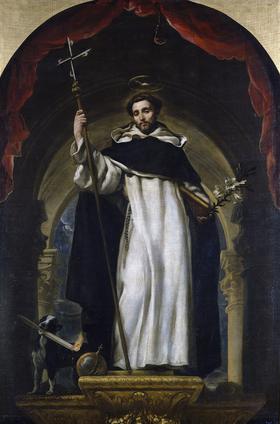
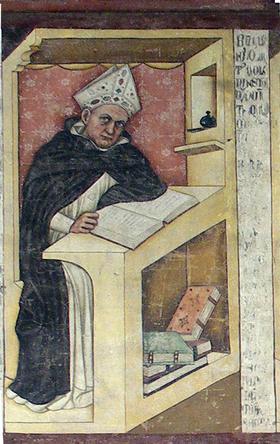
  1. A Dominican friar with a tonsure and a gold halo holds an open book and a small church, with a shining sun on his chest

    St. Thomas Aquinas says the substance of the faith did not grow as time went on. Later ages stated openly what earlier ages already held.

    “Accordingly we must conclude that, as regards the substance of the articles of faith, they have not received any increase as time went on: since whatever those who lived later have believed, was contained, albeit implicitly, in the faith of those Fathers who preceded them. But there was an increase in the number of articles believed explicitly, since to those who lived in later times some were known explicitly which were not known explicitly by those who lived before them.”

    St. Thomas AquinasSumma Theologiae II-II, q. 1, a. 7, I answer that, c. 1271Read it in the source: New Advent

The break with the Orthodox East, usually dated to 1054, is marked on the timeline at the top of the page.

270 quotations in date order

A work in progress. The quotations below are not all the evidence on this matter. More are being added.

The 800s800 to 899
826
Saint

St. Theodore the Studite, abbot

Pope Benedict XVI General Audience, 27 May 2009

“Between 815 and 821, Theodore was scourged, imprisoned and exiled to various places in Asia Minor. In the end he was able to return to Constantinople but not to his own monastery. He therefore settled with his monks on the other side of the Bosporus. He is believed to have died in Prinkipo on 11 November 826, the day on which he is commemorated in the Byzantine Calendar.”

Read it in the source: vatican.va

See it on the timeline: Saints of the early Middle Ages, 605 to 1050

865
Saint

St. Ansgar, bishop and missionary

St. Ansgar Saying reported by Rimbert, Life of Anskar, ch. 39, in the wording of the translator's introduction on the linked page

“Were I worthy of such a favour from my God, I would ask that He would grant to me this one miracle, that by His grace He would make of me a good man.”

Read it in the source: Fordham Sourcebook

See it on the timeline: Saints of the early Middle Ages, 605 to 1050

865
Miracle

St. Ansgar, bishop and missionary

St. Rimbert Life of Anskar, ch. 39 (written c. 870)

“It is impossible to count the number of those who were healed by his prayers and by his anointing. For, according to the statement made by many persons, sick people came eagerly to him, not only from his own diocese, but from a great distance, demanding from him healing medicine. He, however, preferred that this should be kept quiet rather than that it should be noised abroad.”

Read it in the source: Fordham Sourcebook

See it on the timeline: Saints of the early Middle Ages, 605 to 1050

866
Magisterium
Pope Nicholas I Responses to the Questions of the Bulgars, ch. 41

“Therefore, no communion should be shared with those who do not believe and who adore idols. Yet, violence should by no means be inflicted upon them to make them believe. For everything which is not voluntary, cannot be good”

Read it in the source: Fordham Sourcebook

See it on the timeline: Violence in the Church's history

866
Magisterium

Pope Nicholas I on the see of Constantinople

Pope St. Nicholas I Responses to the Questions of the Bulgarians, ch. 92 (866)

“The bishops of Constantinople and of Jerusalem, although they are called patriarchs, do not possess as much authority as the above [sees]. For, as regards the church of Constantinople, none of the apostles founded it nor did the synod of Nicaea, which is more venerable and celebrated than all other synods, make any mention of it; rather its bishop was given the title of patriarch more through the favor of princes than by reason, since Constantinople was called "New Rome."”

Read it in the source: Fordham Sourcebook

See it on the timeline: The tradition of the papacy

866
Magisterium

Rome and Constantinople both send teachers to the Bulgarians

Pope St. Nicholas I Responses to the Questions of the Bulgarians, ch. 106 (866)

“you claim that many people from different places come into your country who say many different things according to their wishes, i.e. the Greeks, the Armenians, and those from other places. You therefore ask to be told whether you should obey all of them in their various senses or what you should do. Truly we are not enough in these matters, but our sufficiency is from God; … and the blessed Peter, who lives and presides in his see, offers the truth of the faith to those who seek it. Indeed, the holy Roman Church has always been without spot or wrinkle, obviously because it was established by the man whose confession of faith was divinely approved.”

Read it in the source: Fordham Sourcebook

See it on the timeline: The East-West Schism

869A painting set in a red banner embroidered with the letters C and M, showing two churchmen standing before a cross
Saint

St. Cyril, monk and apostle of the Slavs

Pope Benedict XVI General Audience, 17 June 2009, quoting the prayer of St. Cyril

“He addressed this prayer to God: "Lord, my God... hear my prayers and keep the flock you have entrusted to me faithful .... Free them from the heresy of the three languages, gather them all in unity and make the people you have chosen agree in the true faith and confession". He died on 14 February 869.”

Read it in the source: vatican.va

See it on the timeline: Saints of the early Middle Ages, 605 to 1050

869-870
Council

Fourth Council of Constantinople

Fourth Council of Constantinople Canon 2

“So, having both the most blessed pope Nicholas as the instrument of the holy Spirit and his successor, the most holy pope Hadrian, we declare and order that everything which has been expounded and promulgated by them in a synod at various times, both for the defence and well-being of the church of Constantinople and of its chief priest, namely Ignatius, its most holy patriarch, as well as for the expulsion and condemnation of Photius, the upstart and usurper, should be maintained and observed together with the canons there set forth, unchanged and unaltered”

Read it in the source: Papal Encyclicals Online

See it on the timeline: The ecumenical councils

869-870
Council

Fourth Council of Constantinople: the pope's judgment on Photius upheld

Fourth Council of Constantinople Canon 2

“So, having both the most blessed pope Nicholas as the instrument of the holy Spirit and his successor, the most holy pope Hadrian, we declare and order that everything which has been expounded and promulgated by them in a synod at various times, both for the defence and well-being of the church of Constantinople and of its chief priest, namely Ignatius, its most holy patriarch, as well as for the expulsion and condemnation of Photius, the upstart and usurper, should be maintained and observed”

Read it in the source: Papal Encyclicals Online

See it on the timeline: The tradition of the papacy

869-870
Council

The dispute with Photius

Fourth Council of Constantinople Canon 21

“Furthermore, nobody else should compose or edit writings or tracts against the most holy pope of old Rome, on the pretext of making incriminating charges, as Photius did recently and Dioscorus a long time ago. Whoever shows such great arrogance and audacity, after the manner of Photius and Dioscorus, and makes false accusations in writing or speech against the see of Peter, the chief of the apostles, let him receive a punishment equal to theirs.”

Read it in the source: Papal Encyclicals Online

See it on the timeline: The East-West Schism

885A painting set in a red banner embroidered with the letters C and M, showing two churchmen standing before a cross
Saint

St. Methodius, bishop and apostle of the Slavs

Pope St. John Paul II Encyclical Slavorum Apostoli (2 June 1985), 6

“He devoted the last years of his life principally to making further translations of the Sacred Scriptures, the liturgical books, the works of the Fathers of the Church and also the collection of ecclesiastical and Byzantine civil laws called the Nomocanon. Concerned for the survival of the work which he had begun, he named as his successor his disciple Gorazd. He died on 6 April 885 in the service of the Church established among the Slav peoples.”

Read it in the source: vatican.va

See it on the timeline: Saints of the early Middle Ages, 605 to 1050

The 900s900 to 999
c. 935
Saint

St. Wenceslaus, duke of Bohemia and martyr

Pope Benedict XVI Homily at Stará Boleslav, 28 September 2009, quoting the first Old Slavonic Life

“In the first Old Slavonic “narration”, we read that “he assisted God’s ministers and he also adorned many churches” and that “he was benevolent to the poor, clothed the naked, gave food to the hungry, welcomed pilgrims, just as the Gospel enjoins. He did not allow injustice to be done to widows, he loved all people, whether poor or rich”.”

Read it in the source: vatican.va

See it on the timeline: Saints of the early Middle Ages, 605 to 1050

942
Saint

St. Odo, abbot of Cluny

Pope Benedict XVI General Audience, 2 September 2009

“Fascinated by the Benedictine ideal, Odo left Tours and entered the Benedictine Abbey of Baume as a monk; he later moved to Cluny, of which in 927 he became abbot. From that centre of spiritual life he was able to exercise a vast influence over the monasteries on the continent. … He actually fell ill in Rome in the summer of 942. Feeling that he was nearing his end, he was determined, and made every effort, to return to St Martin in Tours, where he died, in the Octave of the Saint's feast, on 18 November 942.”

Read it in the source: vatican.va

See it on the timeline: Saints of the early Middle Ages, 605 to 1050

948, by legend
Miracle

Our Lady at Einsiedeln: the vision of Bishop Conrad

Benedictine Abbey of Einsiedeln “Engelweih-Legende”, history pages of the abbey's website

“In the year 948 the monks of the young monastery asked Bishop Conrad of Constance to consecrate their new monastery church. So far the historically established facts. At this point the legend of the Angels' Consecration begins, which describes a marvellous event in fantastic images: On the night before the consecration Bishop Conrad went into the little chapel to pray. There he saw in a vision Jesus Christ coming down from heaven. He is accompanied by hosts of angels and many saints, and the Virgin Mary appears as if wrapped in light. In a solemn service Jesus Christ consecrates the chapel in honour of his mother Mary. She was to be honoured in a special way at Einsiedeln and to show people the way to her Son.”

Our translation. The words as written, in German:

“Im Jahr 948 baten die Mönche des jungen Klosters Bischof Konrad von Konstanz, ihre neue Klosterkirche feierlich zu weihen. Soweit die historisch gesicherten Fakten. An dieser Stelle setzt nun die Engelweih-Legende ein, die in fantastischen Bildern ein wundersames Ereignis beschreibt: In der Nacht vor der Weihe begab sich Bischof Konrad in die kleine Kapelle, um dort zu beten. Da sah er in einer Vision, wie Jesus Christus vom Himmel herabsteigt. Er wird begleitet von Scharen von Engeln sowie vielen Heiligen und die Jungfrau Maria erscheint wie in Licht gehüllt. In einem feierlichen Gottesdienst weiht Jesus Christus die Kapelle zu Ehren seiner Mutter Maria. Sie sollte in Einsiedeln ganz besonders verehrt werden und den Menschen den Weg zu ihrem Sohn weisen.”

Witnesses
Bishop Conrad of Constance, in a vision on the night before the consecration, according to the legend as the abbey tells it
Church ruling
None stated. The page separates the established facts from the legend

Read it in the source: kloster-einsiedeln.ch

See it on the timeline: Marian apparitions

969
Saint

St. Olga, princess of Kyiv

Pope St. John Paul II Apostolic Letter Euntes in Mundum (25 January 1988), 3

“In this setting, already prepared, Princess Olga had herself freely and publicly baptized about 955, and afterwards remained always faithful to her baptismal promises.”

Our translation. The words as written, in Italian:

“In questo ambiente, già preparato, la principessa Olga si fece liberamente e pubblicamente battezzare verso il 955, rimanendo poi sempre fedele alle promesse battesimali.”

Read it in the source: vatican.va

See it on the timeline: Saints of the early Middle Ages, 605 to 1050

997
Saint

St. Adalbert of Prague, bishop and martyr

Pope St. John Paul II Homily at Gniezno, 3 June 1997

“Adalbert followed Christ. He made a long journey which took him from his native Libice to Prague, and from Prague to Rome. Then, after facing resistance from his fellow countrymen in Prague, he left as a missionary for the Pannonian Plain and from there, through the Moravian Gate to Gniezno and the Baltic. His mission in a sense was the crowning point of the evangelization of the lands of the Piast. And this was precisely because Adalbert bore witness to Christ by undergoing a martyr's death. Boleslaw the Brave ransomed the body of the Martyr and had it brought here, to Gniezno.”

Read it in the source: vatican.va

See it on the timeline: Saints of the early Middle Ages, 605 to 1050

The 1000s1000 to 1099
April 1001, by traditionAn elderly pope in green vestments and a white and gold mitre raises his hand in greeting, holding his staff with the crucifix
Miracle

Madonna dell'Incoronata, Foggia, Italy

Pope St. John Paul II Address to families, Shrine of the Incoronata (Foggia), 24 May 1987, 1

“The history of this shrine is bound up, according to the accounts of tradition, with a particular spiritual presence of the Virgin. In the month of April of the year 1001 the Madonna with the Child, seated on an oak tree, appeared to a peasant and to the Count of Ariano, and presented herself to them as the "Mother of God", asking that a church be built in her honour at that place.”

Our translation. The words as written, in Italian:

“La storia di questo santuario è legata, secondo i racconti della tradizione, ad una particolare presenza spirituale della Vergine. Nel mese di aprile dell’anno 1001 la Madonna con il Bambino, seduta su una quercia, apparve ad un contadino e al Conte di Ariano, e ad essi si presentò come la “Madre di Dio”, chiedendo che in quel luogo si costruisse in suo onore una chiesa.”

Witnesses
A peasant and the Count of Ariano, according to the accounts of tradition the Pope reports
Where it can be seen
The Shrine of the Incoronata, Foggia

Read it in the source: vatican.va

See it on the timeline: Marian apparitions

c. 1003
Saint

St. Gregory of Narek, monk and Doctor

Pope Francis Message to the Armenians, 12 April 2015

“Saint Gregory of Narek, a monk of the tenth century, knew how to express the sentiments of your people more than anyone. He gave voice to the cry, which became a prayer, of a sinful and sorrowful humanity, oppressed by the anguish of its powerlessness, but illuminated by the splendour of God’s love and open to the hope of his salvific intervention, which is capable of transforming all things.”

Read it in the source: vatican.va

See it on the timeline: Saints of the early Middle Ages, 605 to 1050

c. 1003
Doctor of the Church

St. Gregory of Narek, monk and Doctor

St. Gregory of Narek Book of Lamentations, 83, as quoted by Pope Francis, Message to the Armenians, 12 April 2015

“Remember, [Lord,]… those of the human race who are our enemies as well, and for their benefit accord them pardon and mercy… Do not destroy those who persecute me, but reform them, root out the vile ways of this world, and plant the good in me and them”

Read it in the source: vatican.va

See it on the timeline: The Doctors of the Church

1015A prince stands in a stone font inside a church while a bishop in gold vestments baptizes him, with nobles and clergy around
Saint

St. Vladimir, prince of Kyiv

Pope St. John Paul II Homily at Kyiv, 24 June 2001, 3

“Saint Volodymyr and the inhabitants of Rus’ were baptized by missionaries sent from Constantinople, the greatest centre of Christianity in the East. Thus the new-born Church entered the sphere of the exceedingly rich patrimony of faith and culture of the Byzantine Church. This was at the end of the first millennium. While living according to two different traditions, the Church of Constantinople and the Church of Rome were still in full communion.”

Read it in the source: vatican.va

See it on the timeline: Saints of the early Middle Ages, 605 to 1050

1024
Saint

St. Henry II, emperor

Pope Benedict XVI Letter for the millennium of Bamberg Cathedral, 3 May 2012

“Let us then pause in front of the extraordinary funerary monument of St Henry and St Kunigunda (or St Cunegonde), a work by Riemenschneider. In them we find Christians, to us exemplary, who from the sacraments of Baptism to Confirmation and Matrimony, received the mandate and mission to serve the Kingdom of God in the world.”

Read it in the source: vatican.va

See it on the timeline: Saints of the early Middle Ages, 605 to 1050

1027
Saint

St. Romuald, abbot and founder of the Camaldolese

Pope Benedict XVI Homily at Vespers, San Gregorio al Celio, 10 March 2012

“Through the faithfulness and benevolence of the Lord, the Congregation of Camaldolese monks of the Order of Saint Benedict has completed a thousand years of history, feeding daily on the word of God and the Eucharist, as their founder Saint Romuald taught them, according to the triplex bonum of solitude, community life and evangelization.”

Read it in the source: vatican.va

See it on the timeline: Saints of the early Middle Ages, 605 to 1050

1030
Saint

St. Olaf, king of Norway and martyr

Pope St. John Paul II Homily at Trondheim, 2 June 1989

“You have come, like the pilgrims of old, to this revered city of Nidaros (now Trondheim) and shrine of Saint Olav, who heralded a new era of Christianity and unification in this land even though he did not live to see the fruits of his labour. His son, Magnus the Good, built the first wooden church on this site and it quickly became a place of pilgrimage. Already by the year 1060 a liturgy dedicated to Saint Olav was in use as far away as Northumberland in Britain.”

Read it in the source: vatican.va

See it on the timeline: Saints of the early Middle Ages, 605 to 1050

1030
Miracle

St. Olaf, king of Norway and martyr

Pope St. John Paul II Homily at Trondheim, 2 June 1989

“In the Orthodox Church too, the memory of Saint Olav is greatly venerated: to his intercession was attributed the survival of the Imperial Guard of Constantinople in an hour of danger when it went into battle with Emperor Alexos against the Bulgars.”

Read it in the source: vatican.va

See it on the timeline: Saints of the early Middle Ages, 605 to 1050

1038A young deacon with a halo against a gold ground, in a richly patterned vestment, holding a red book
Saint

St. Stephen, king of Hungary

Pope St. John Paul II Apostolic Letter for the conclusion of the Hungarian Millennium, 25 July 2001, 3

“Stephen did not accept the crown as an honour, but a service; he therefore, always and in all circumstances, sought the good of the community entrusted to him, both by organizing and defending the kingdom and by promulgating new decrees, as well as by fostering the development of the two cultures, the human and the divine.”

Read it in the source: vatican.va

See it on the timeline: Saints of the early Middle Ages, 605 to 1050

1049
Saint

St. Odilo, abbot of Cluny

Pope St. John Paul II Letter for the millennium of the Commemoration of All the Faithful Departed, 2 June 1998, 1

“on the day after the feast of All Saints, when the Church joyfully celebrates the communion of saints and human salvation, St Odilo urged his monks to say special prayers for all the dead, thus mysteriously contributing to their entry into beatitude; the custom of solemnly interceding for the dead in a celebration which St Odilo called All Souls Day gradually spread from the Abbey of Cluny and is now the practice throughout the universal Church.”

Read it in the source: vatican.va

See it on the timeline: Saints of the early Middle Ages, 605 to 1050

1054A wide view up into the great dome and half domes of Hagia Sophia, ringed with windows
Orthodox

The patriarch of Constantinople: the pope is cut off from our church

Michael Cerularius, Patriarch of Constantinople Letter to Peter, Patriarch of Antioch, 9 (June or July 1054)

“For you know that from the sixth holy and ecumenical council to the present the commemoration of the pope has been excised from the sacred diptychs of our holy churches. … And from then until now the pope has been cut off from our holy and catholic church.”

Read it in the source: Fordham Sourcebook

See it on the timeline: The tradition of the papacy

1054
Orthodox

The addition to the Creed rejected

Michael Cerularius, Patriarch of Constantinople Letter to Peter, Patriarch of Antioch, 12 (June or July 1054)

“reasoning badly and dangerously, they have made some sort of addition to the holy creed, so that it is as follows: "...and in the Holy Spirit, the Lord, the giver of life, who proceeds from the Father and the Son."”

Read it in the source: Fordham Sourcebook

See it on the timeline: The East-West Schism

1054
Orthodox

The patriarch of Antioch answers: the pope was named within living memory

Peter III, Patriarch of Antioch Letter to Michael Cerularius, Patriarch of Constantinople, 5 (1054)

“And when I went to Constantinople 45 years ago, under the Lord Patriarch Sergios [Sergios II, 1001-1019] of blessed memory, I found that the pope at that time was being commemorated in the divine service along with the other patriarchs. How the commemoration of the pope was later cut off and for what reason, I do not know.”

Read it in the source: Fordham Sourcebook

See it on the timeline: The tradition of the papacy

1054A wide view up into the great dome and half domes of Hagia Sophia, ringed with windows
Orthodox

The patriarch of Constantinople: the Latins are not to be counted orthodox

Michael Cerularius, Patriarch of Constantinople Letter to Peter, Patriarch of Antioch, 14 (June or July 1054)

“Therefore, if they live in such a way and, enfeebled by such customs, dare these things which are obviously lawless, forbidden, and abominable, then will any right-thinking person consider that they are at all to be included in the category of the orthodox? I think not.”

Read it in the source: Fordham Sourcebook

See it on the timeline: The East-West Schism

1054
Orthodox

What Cerularius found hardest to bear

Michael Cerularius, Patriarch of Constantinople Letter to Peter, Patriarch of Antioch, 15 (June or July 1054)

“But more grave and more insupportable than all of these, that which also displays most clearly their dementia, is the following: they say that they will not travel here so that they might be taught or hold discussions, but rather for teaching and persuading us to hold their dogmas.”

Read it in the source: Fordham Sourcebook

See it on the timeline: The tradition of the papacy

1054A colour photograph of a pope in a red cape trimmed with white fur and an embroidered stole
Magisterium

The excommunications of 1054

Pope St. Paul VI and Ecumenical Patriarch Athenagoras I Joint Catholic-Orthodox Declaration, 7 December 1965, 2

“the decisions, actions and painful incidents which in 1054 resulted in the sentence of excommunication leveled against the Patriarch Michael Cerularius and two other persons by the legate of the Roman See under the leadership of Cardinal Humbertus, legates who then became the object of a similar sentence pronounced by the patriarch and the Synod of Constantinople.”

Read it in the source: vatican.va

See it on the timeline: The tradition of the papacy

1054
Orthodox

The patriarch of Antioch warns against making the tear worse

Peter III, Patriarch of Antioch Letter to Michael Cerularius, Patriarch of Constantinople, 21 (July or August 1054)

“And I exhort, entreat, ask, and mentally embrace your holy feet, that Your Divine Blessedness might lack too great a strictness and concur in those matters. For it is to be feared that while you wish to mend that which is torn, you will make the tear worse, and, while you are zealous to set right that which has fallen, you will cause a worse fall. But consider if it is not clearly for this reason--that is, for this long separation and dissension which has divided this great apostolic see from our holy church--that all evil has multiplied in life and the whole cosmos fares ill”

Read it in the source: Fordham Sourcebook

See it on the timeline: The East-West Schism

1054
Orthodox

The patriarch of Antioch: one thing only stands in the way

Peter III, Patriarch of Antioch Letter to Michael Cerularius, Patriarch of Constantinople, 22 (July or August 1054)

“As for me, I will make my opinion clear: if ever they would correct the addition to the holy creed, I would demand nothing else, leaving as a matter of indifference, along with all the other matters, even their fault regarding the unleavened bread. … And this also I exhort Your Divine Blessedness to accept, so that you may not, by demanding everything, lose everything.”

Read it in the source: Fordham Sourcebook

See it on the timeline: The East-West Schism

1054A colour photograph of a pope in a red cape trimmed with white fur and an embroidered stole
Magisterium

Each side excommunicated the other

Pope St. Paul VI Apostolic letter Ambulate in dilectione, 7 December 1965

“Indeed it came to this, that the papal legates pronounced a sentence of excommunication against Michael Cerularius, Patriarch of Constantinople, and two churchmen, and that he and his synod in like manner passed sentence on them. … we declare that We regret the words and deeds, which cannot be approved, that were said and done at that time. Moreover We wish to tear the sentence of excommunication then passed out of the memory of the Church and to remove it from her midst, and We wish it covered over and buried in oblivion.”

Our translation. The words as written, in Latin:

“Immo eo perventum est, ut Legati Pontificii adversus Michaelem Caerularium, Patriarcham Constantinopolitanum ac duos viros ecclesiasticos, excommunicationis sententiam pronuntiarent, hic vero eiusque Synodus pari modo in illos animadverterent. … affirmamus Nos aegre ferre ea verba et facta, quae probari non possunt, tempore illo dicta et patrata. Praeterea sententiam excommunicationis tunc latam ex Ecclesiae memoria evellere volumus ac de eius medio removere, atque eam volumus oblivione contectam et obrutam.”

Read it in the source: vatican.va

See it on the timeline: The East-West Schism

1054
Magisterium

The censures of 1054 were aimed at persons, not at the Churches

Pope St. Paul VI and Ecumenical Patriarch Athenagoras I Joint Catholic-Orthodox Declaration, 7 December 1965, 3

“Thus it is important to recognize the excesses which accompanied them and later led to consequences which, insofar as we can judge, went much further than their authors had intended and foreseen. They had directed their censures against the persons concerned and not the Churches. These censures were not intended to break ecclesiastical communion between the Sees of Rome and Constantinople.”

Read it in the source: vatican.va

See it on the timeline: The East-West Schism

1054
Magisterium

How communion came to be broken: events before and after 1054

Pope St. Paul VI and Ecumenical Patriarch Athenagoras I Joint Catholic-Orthodox Declaration, 7 December 1965, 4 C

“Finally, they deplore the preceding and later vexing events which, under the influence of various factors—among which, lack of understanding and mutual trust—eventually led to the effective rupture of ecclesiastical communion.”

Read it in the source: vatican.va

See it on the timeline: The East-West Schism

1061
Miracle

Our Lady of Walsingham, England

Vatican News “England to be re-dedicated as the Dowry of Mary” (March 2020)

“The village of Walsingham in Norfolk, England, became a famous pilgrimage site after a rich widow, named Richeldis, received visions of the Virgin Mary- and the house of the Holy Family in Nazareth. Later, she built a replica of the house of Jesus, Mary and Joseph from Nazareth. The shrine was established in 1061 to serve as a perpetual reminder of the Annunciation.”

Witnesses
Richeldis, a rich widow, who received the visions according to the page
Where it can be seen
Walsingham, Norfolk; the page says the shrine was established in 1061

Read it in the source: vaticannews.va

See it on the timeline: Marian apparitions

1072
Saint

St. Peter Damian, monk, bishop and Doctor

St. Peter Damian Sermon 47, 14, as quoted by Benedict XVI, General Audience, 9 September 2009

“O Blessed Cross … You are venerated, preached and honoured by the faith of the Patriarchs, the predictions of the Prophets, the senate that judges the Apostles, the victorious army of Martyrs and the throngs of all the Saints”

Read it in the source: vatican.va

See it on the timeline: Saints of the high Middle Ages, 1050 to 1500

1072
Doctor of the Church

St. Peter Damian, monk, bishop and Doctor

St. Peter Damian Sermon 8, 5, as quoted by Benedict XVI, General Audience, 9 September 2009

“May Christ be heard in our language, may Christ be seen in our life, may he be perceived in our hearts”

Read it in the source: vatican.va

See it on the timeline: The Doctors of the Church

1074
Magisterium

Twenty years on, a pope calls the Christians of the East brethren

Pope St. Gregory VII Letter to all who are willing to defend the Christian faith, 1074 (Patrologia Latina 148:329)

“If we love God and wish to be recognized as Christians, we should be filled with grief at the misfortune of this great empire [the Greek] and the murder of so many Christians. But simply to grieve is not our whole duty. The example of our Redeemer and the bond of fraternal love demand that we should lay down our lives to liberate them.”

Read it in the source: Fordham Sourcebook

See it on the timeline: The East-West Schism

1075
Magisterium

The Dictatus Papae: the claims of the reforming popes

The register of Pope St. Gregory VII Dictatus Papae, 1075, the first statements

“That the Roman church was founded by God alone. That the Roman pontiff alone can with right be called universal. That he alone can depose or reinstate bishops. That, in a council his legate, even if a lower grade, is above all bishops, and can pass sentence of deposition against them.”

Read it in the source: Fordham Sourcebook

See it on the timeline: The tradition of the papacy

Eleventh century, by legend
Miracle

The Mother of God and the builders of the Kyiv-Pechersk Lavra

Vatican News “Kyiv-Pechersk Lavra monastery in Ukraine: A heritage of faith and culture” (July 2026), with the historian Dmytro Hordienko

“An ancient tradition links the Cathedral of the Dormition to the special protection of the Virgin Mary. "According to legend, the Mother of God appeared to Greek master builders at the Blachernae shrine in Constantinople, telling them that she wished to establish her dwelling on the hills of Kyiv," Hordienko recounts. The Virgin herself is said to have designated the site where the monastery would be built, making it her sanctuary dedicated to the Dormition.”

Witnesses
Greek master builders at the Blachernae shrine in Constantinople, according to the legend as the historian tells it
Where it can be seen
The Cathedral of the Dormition at the Kyiv-Pechersk Lavra

Read it in the source: vaticannews.va

See it on the timeline: Marian apparitions

1076
Magisterium
Pope St. Gregory VII Letter of 1076 to a Muslim prince in North Africa, as quoted by Pope Benedict XVI, Address to the President of the Religious Affairs Directorate, Ankara, 28 November 2006

“because we believe in one God, albeit in a different manner, and because we praise him and worship him every day as the Creator and Ruler of the world.”

Read it in the source: vatican.va

See it on the timeline: Islam and the one God

1079
Magisterium
Pope St. Gregory VII Oath prescribed for Berengarius of Tours, as quoted by Pope St. Paul VI, Mysterium Fidei 52

“I believe in my heart and openly profess that the bread and wine that are placed on the altar are, through the mystery of the sacred prayer and the words of the Redeemer, substantially changed into the true and proper and lifegiving flesh and blood of Jesus Christ our Lord…”

Read it in the source: vatican.va

See it on the timeline: Transubstantiation

1085
Saint

St. Gregory VII, pope

Pope Pius XII Radio message for the recognition of the relics of St. Gregory VII, 11 July 1954

“What then appeared supremely necessary, and what Gregory VII tenaciously willed, was to restore the Church to the independence, the unity and the holiness with which her divine Founder had endowed her. The Church needed to be free. And so Gregory VII accepted the conflict forced on him in order to free her, like an agile and healthy body, from the chains and hindrances set by earthly powers, especially in the freedom to choose her Pastors.”

Our translation. The words as written, in Italian:

“Ciò che appariva allora sommamente necessario, e che Gregorio VII tenacemente volle, era di ristabilire la Chiesa nella indipendenza, nella unità e nella santità, di cui il suo divino Fondatore l'aveva dotata. Occorreva che la Chiesa fosse libera. Ecco quindi Gregorio VII accettare il conflitto impostogli per affrancarla, quasi corpo agile e sano, dalle catene e dagl'intralci mossi dalle potestà terrene, specialmente nella libertà di scelta dei suoi Pastori.”

Read it in the source: vatican.va

See it on the timeline: Saints of the high Middle Ages, 1050 to 1500

1095
Magisterium
Pope Urban II, as reported by Fulcher of Chartres Speech at the Council of Clermont, 27 November 1095

“On this account I, or rather the Lord, beseech you as Christ's heralds to publish this everywhere and to persuade all people of whatever rank, foot-soldiers and knights, poor and rich, to carry aid promptly to those Christians and to destroy that vile race from the lands of our friends. I say this to those who are present, it meant also for those who are absent. Moreover, Christ commands it. "All who die by the way, whether by land or by sea, or in battle against the pagans, shall have immediate remission of sins. This I grant them through the power of God with which I am invested.”

Read it in the source: Fordham Sourcebook

See it on the timeline: Violence in the Church's history

1095
Magisterium

Pope Urban II calls Christians to the East

Pope Urban II, as reported by Fulcher of Chartres Speech at the Council of Clermont, according to Fulcher of Chartres

“For your brethren who live in the east are in urgent need of your help, and you must hasten to give them the aid which has often been promised them. For, as the most of you have heard, the Turks and Arabs have attacked them and have conquered the territory of Romania [the Greek empire] as far west as the shore of the Mediterranean and the Hellespont, which is called the Arm of St. George. … O what a disgrace if such a despised and base race, which worships demons, should conquer a people which has the faith of omnipotent God and is made glorious with the name of Christ!”

Read it in the source: Fordham Sourcebook

See it on the timeline: Islam and the Church

The 1100s1100 to 1199
Middle AgesA colour photograph of a pope in a red cape trimmed with white fur and an embroidered stole
Magisterium

The Roman custom of anointing the five senses

Pope Paul VI Apostolic Constitution Sacram Unctionem Infirmorum (1972)

“During the Middle Ages, in the Roman Church there prevailed the custom of anointing the sick on the five senses, using the formula: "Per istam Sanctam unctionem et suam Piissimam misericordiam, indulgeat tibi Dominus quidquid deliquisti," adapted to each sense.”

Read it in the source: vatican.va

See it on the timeline: The Anointing of the Sick

1101
Saint

St. Bruno, founder of the Carthusians

Pope Benedict XVI Homily at Vespers, Charterhouse of Serra San Bruno, 9 October 2011

“However, the charterhouse is a special oasis in which silence and solitude are preserved with special care, in accordance with the form of life founded by St Bruno and which has remained unchanged down the centuries. “I live in a rather faraway hermitage... with some religious brothers”, is the concise sentence that your Founder wrote (Letter to Rudolph “the Green”, n. 4).”

Read it in the source: vatican.va

See it on the timeline: Saints of the high Middle Ages, 1050 to 1500

c. 1100
Muslim

A Muslim theologian on how children come to their religion

Al-Ghazali Munkidh min al-Dalal (Deliverance from Error), opening

“Having noticed how easily the children of Christians become Christians, and the children of Muslims embrace Islam, and remembering also the traditional saying ascribed to the Prophet, “Every child has in him the germ of Islam, then his parents make him Jew, Christian, or Zarathustrian,” I was moved by a keen desire to learn what was this innate disposition in the child”

Read it in the source: Fordham Sourcebook

See it on the timeline: Islam and the Church

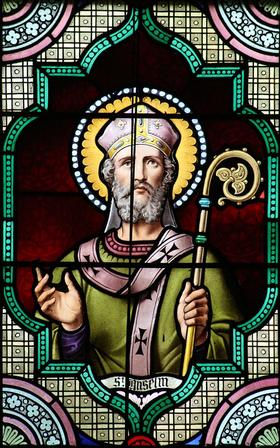
1109A stained-glass window of a bearded archbishop in a mitre holding a crozier and raising his hand
Saint

St. Anselm of Canterbury, archbishop and Doctor

St. Anselm Proslogion, ch. 1, as quoted by Benedict XVI, General Audience, 23 September 2009

“I do not endeavour, O Lord, to penetrate your sublimity, for in no wise do I compare my understanding with that; but I long to understand in some degree your truth, which my heart believes and loves. For I do not seek to understand that I may believe, but I believe in order to understand.”

Read it in the source: vatican.va

See it on the timeline: Saints through the centuries

1109
Saint

St. Anselm of Canterbury, archbishop and Doctor

Pope Benedict XVI General Audience, 23 September 2009

“He died on 21 April 1109, accompanied by the words of the Gospel proclaimed in Holy Mass on that day: "You are those who have continued with me in my trials; as my Father appointed a kingdom for me, so do I appoint for you that you may eat and drink at my table in my kingdom..." (Lk 22: 28-30). So it was that the dream of the mysterious banquet he had had as a small boy, at the very beginning of his spiritual journey, found fulfilment.”

Read it in the source: vatican.va

See it on the timeline: Saints of the high Middle Ages, 1050 to 1500

1109
Doctor of the Church

St. Anselm of Canterbury, archbishop and Doctor

St. Anselm Proslogion, as quoted by Benedict XVI, General Audience, 23 September 2009

“I pray, O God, to know you, to love you, that I may rejoice in you. And if I cannot attain to full joy in this life may I at least advance from day to day, until that joy shall come to the full”

Read it in the source: vatican.va

See it on the timeline: The Doctors of the Church

1123
Council
First Lateran Council Canon 10

“To those who set out for Jerusalem and offer effective help towards the defence of the christian people and overcoming the tyranny of the infidels, we grant the remission of their sins, and we place their houses and families and all their goods under the protection of blessed Peter and the Roman church, just as has been decreed by our lord pope Urban.”

Read it in the source: Papal Encyclicals Online

See it on the timeline: Violence in the Church's history

1123
Council

First Lateran Council

First Lateran Council Canon 8

“We further resolve, in accordance with the statute of the most blessed pope Stephen, that lay persons, however religious they may be, have no power to dispose of any ecclesiastical business; but following the apostolic canons, let the bishop have the care of all ecclesiastical matters, and let him manage them as in the sight of God.”

Read it in the source: Papal Encyclicals Online

See it on the timeline: The ecumenical councils

c. 1130
Muslim

A Muslim commentator on the Qur'an and the earlier Scriptures

Al-Zamakhshari The Discoverer of Truth (a commentary on the Qur'an), Preface

“a lecture written in the Arabic language, and free from all faults, which is the key to open the treasures of all spiritual and temporal blessings, and which confirms and witnesses the truth of all the Holy Books which have preceded it … the illustrious Prophet whose name has been inscribed in the Law and the Gospel!”

Read it in the source: Fordham Sourcebook

See it on the timeline: Islam and the Church

1139
Council
Second Lateran Council Canon 7

“…we decree that where bishops, priests, deacons, subdeacons, canons regular, monks and professed lay brothers have presumed to take wives and so transgress this holy precept, they are to be separated from their partners. For we do not deem there to be a marriage which, it is agreed, has been contracted against ecclesiastical law.”

Read it in the source: Papal Encyclicals Online

See it on the timeline: Priestly celibacy

1139
Council

Second Lateran Council

Second Lateran Council Canon 30

“We render void the ordinances enacted by Peter Leoni and other schismatics and heretics, and deem them null.”

Read it in the source: Papal Encyclicals Online

See it on the timeline: The ecumenical councils

c. 1140
Jewish

What a Jewish rabbi says he believes

Judah Ha-Levi The Kuzari, Part I, sect. 11

“The Rabbi replied: I believe in the God of Abraham, Isaac and Israel, who led the children of Israel out of Egypt with signs and miracles; who fed them in the desert and gave them the land, after having made them traverse the sea and the Jordan in a miraculous way; who sent Moses with His law, and subsequently thousands of prophets, who confirmed His law by promises to the observant. and threats to the disobedient. Our belief is comprised in the Torah -- a very large domain.”

Read it in the source: Fordham Sourcebook

See it on the timeline: Judaism and the Church

c. 1148
Orthodox

A Byzantine view: the primacy passed to Constantinople

Anna Comnena The Alexiad, Book 1, ch. 13 (written c. 1148)

“For when the imperial seat was transferred from Rome hither to our native Queen of Cities, and the senate, and the whole administration, there was also transferred the arch-hieratical primacy. And the Emperors from the very beginning have given the supreme right to the episcopacy of Constantinople, and the Council of Chalcedon emphatically raised the Bishop of Constantinople to the highest position, and placed all the dioceses of the inhabited world under his jurisdiction.”

Read it in the source: Fordham Sourcebook

See it on the timeline: The East-West Schism

1153
Saint

St. Bernard of Clairvaux, abbot and Doctor

St. Bernard of Clairvaux Sermons on the Song of Songs 15, 6, as quoted by Benedict XVI, General Audience, 21 October 2009

“All food of the soul is dry … unless it is moistened with this oil; insipid, unless it is seasoned with this salt. What you write has no savour for me unless I have read Jesus in it”

Read it in the source: vatican.va

See it on the timeline: Saints of the high Middle Ages, 1050 to 1500

1153
Doctor of the Church

St. Bernard of Clairvaux, abbot and Doctor

St. Bernard of Clairvaux Homily 2 on the words Missus est, 17, as quoted by Benedict XVI, General Audience, 21 October 2009

“In danger, in distress, in uncertainty … think of Mary, call upon Mary. She never leaves your lips, she never departs from your heart; and so that you may obtain the help of her prayers, never forget the example of her life. If you follow her, you cannot falter; if you pray to her, you cannot despair; if you think of her, you cannot err.”

Read it in the source: vatican.va

See it on the timeline: The Doctors of the Church

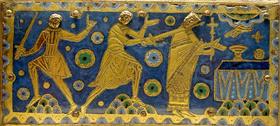
1170Gilded figures on a deep blue enamel ground: knights with swords strike an archbishop standing at an altar
Saint

St. Thomas Becket, archbishop and martyr

Pope Benedict XVI General Audience on John of Salisbury, 16 December 2009

“In fact, King Henry II wished to impose his authority on the internal life of the Church, curtailing her freedom. This stance provoked John of Salisbury to react and, in particular, prompted the valiant resistence of St Thomas Becket, Theobald's successor on the episcopal throne of Canterbury, who for this reason was exiled to France. … In 1170, when both John and Thomas Becket had returned to England, Thomas was attacked and murdered in his cathedral. He died a martyr and was immediately venerated as such by the people.”

Read it in the source: vatican.va

See it on the timeline: Saints of the high Middle Ages, 1050 to 1500

1179
Council

Third Lateran Council

Third Lateran Council Canon 1

“Therefore we decree that if by chance, through some enemy sowing tares, there cannot be full agreement among the cardinals on a successor to the papacy, and though two thirds are in agreement a third party is unwilling to agree with them or presumes to appoint someone else for itself, that person shall be held as Roman pontiff who has been chosen and received by the two thirds.”

Read it in the source: Papal Encyclicals Online

See it on the timeline: The ecumenical councils

1179
Council

Third Lateran Council: election by two thirds of the cardinals

Third Lateran Council Canon 1

“Although clear enough decrees have been handed down by our predecessors to avoid dissension in the choice of a sovereign pontiff, nevertheless in spite of these, because through wicked and reckless ambition the church has often suffered serious division, we too, in order to avoid this evil, on the advice of our brethren and with the approval of the sacred council, have decided that some addition must be made. … that person shall be held as Roman pontiff who has been chosen and received by the two thirds.”

Read it in the source: Papal Encyclicals Online

See it on the timeline: All the popes in order, from St. Peter to today

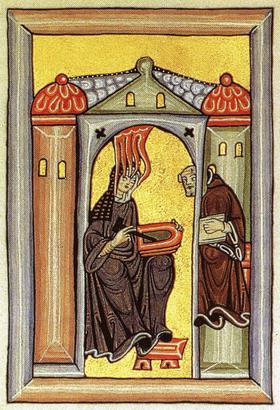
1179A nun sits in a small building with flames reaching down to her head, writing on a tablet, while a monk looks in from the side
Saint

St. Hildegard of Bingen, abbess and Doctor

St. Hildegard of Bingen Letter to St. Bernard, as quoted by Benedict XVI, General Audience, 8 September 2010

“The vision fascinates my whole being: I do not see with the eyes of the body but it appears to me in the spirit of the mysteries.... I recognize the deep meaning of what is expounded on in the Psalter, in the Gospels and in other books, which have been shown to me in the vision. This vision burns like a flame in my breast and in my soul and teaches me to understand the text profoundly”

Read it in the source: vatican.va

See it on the timeline: Saints of the high Middle Ages, 1050 to 1500

1179
Doctor of the Church

St. Hildegard of Bingen, abbess and Doctor

St. Hildegard of Bingen Explanation of the Athanasian Creed, as quoted by Benedict XVI, Apostolic Letter proclaiming St. Hildegard of Bingen a Doctor of the Church, 7 October 2012

“For this very reason, because man is wise, knowledgeable and intelligent, he knows creation; he knows God — whom he cannot see except by faith — through creation and his great works, even if with his five senses he barely comprehends them”

Read it in the source: vatican.va

See it on the timeline: The Doctors of the Church

1179
Council

The Third Lateran Council calls for arms against the Cathars

Third Lateran Council Canon 27

“As St. Leo says, though the discipline of the church should be satisfied with the judgment of the priest and should not cause the shedding of blood, yet it is helped by the laws of catholic princes so that people often seek a salutary remedy when they fear that a corporal punishment will overtake them. For this reason, since in Gascony and the regions of Albi and Toulouse and in other places the loathsome heresy of those whom some call the Cathars, others the Patarenes, others the Publicani, and others by different names, has grown so strong … we declare that they and their defenders and those who receive them are under anathema, and we forbid under pain of anathema that anyone should keep or support them in their houses or lands or should trade with them. … Meanwhile we receive under the protection of the church, as we do those who visit the Lord’s sepulchre, those who fired by their faith have taken upon themselves the task of driving out these heretics, and we decree that they should remain undisturbed from all disquiet both in their property and persons.”

Read it in the source: Papal Encyclicals Online

See it on the timeline: The Inquisition and the use of force against heresy

c. 1180
Jewish

The Messiah in Jewish law, and a Torah that does not change

Moses Maimonides Mishneh Torah, Laws of Kings, ch. 11 (Laws Concerning Mashiach)

“This Torah, with its statutes and laws, is everlasting. We may neither add to them nor detract from them. … If a king will arise from the House of David who delves deeply into the study of the Torah and, like David his ancestor, observes its mitzvos as prescribed by the Written Law and the Oral Law; if he will compel all of Israel to walk in [the way of the Torah] and repair the breaches [in its observance]; and if he will fight the wars of G-d; - we may, with assurance, consider him Mashiach. If he succeeds in the above, builds the [Beis Ha]Mikdash on its site, and gathers in the dispersed remnant of Israel, he is definitely the Mashiach.”

Read it in the source: Fordham Sourcebook

See it on the timeline: Judaism and the Church

The 1200s1200 to 1299
1204
Orthodox

The sack of Constantinople by the Fourth Crusade

Nicetas Choniates History, on the capture of Constantinople in April 1204

“How shall I begin to tell of the deeds wrought by these nefarious men! Alas, the images, which ought to have been adored, were trodden under foot! Alas, the relics of the holy martyrs were thrown into unclean places! … For the sacred altar, formed of all kinds of precious materials and admired by the whole world, was broken into bits and distributed among the soldiers, as was all the other sacred wealth of so great and infinite splendor.”

Read it in the source: Fordham Sourcebook

See it on the timeline: The East-West Schism

1204
Magisterium

Pope Innocent III rebukes his legate for the sack

Pope Innocent III Letter 136, to Peter, Cardinal Priest of St. Marcellus, Legate of the Apostolic See (12 July 1205)

“How, indeed, is the Greek church to be brought back into ecclesiastical union and to a devotion for the Apostolic See when she has been beset with so many afflictions and persecutions that she sees in the Latins only an example of perdition and the works of darkness, so that she now, and with reason, detests the Latins more than dogs? As for those who were supposed to be seeking the ends of Jesus Christ, not their own ends, whose swords, which they were supposed to use against the pagans, are now dripping with Christian blood, they have spared neither age nor sex.”

Read it in the source: Fordham Sourcebook

See it on the timeline: The East-West Schism

1204An elderly pope in green vestments and a white and gold mitre raises his hand in greeting, holding his staff with the crucifix
Magisterium

Pope John Paul II in Athens: deep regret for the sack

Pope St. John Paul II Address to His Beatitude Christodoulos, Archbishop of Athens and Primate of Greece, 4 May 2001, 2

“I am thinking of the disastrous sack of the imperial city of Constantinople, which was for so long the bastion of Christianity in the East. It is tragic that the assailants, who had set out to secure free access for Christians to the Holy Land, turned against their own brothers in the faith. The fact that they were Latin Christians fills Catholics with deep regret.”

Read it in the source: vatican.va

See it on the timeline: The East-West Schism

1212, by tradition
Miracle

Our Lady of the Rosary and St. Dominic

Vatican News Memorial of Our Lady of the Rosary (liturgical holidays, 7 October)

“The Holy Rosary originated in 1212 when Saint Dominic de Guzman saw the Virgin Mary who gave him the Rosary as a response to his prayer to understand how to combat the Albigensian heresy.”

Witnesses
Saint Dominic de Guzman, according to the page
Church ruling
None stated on the vision. The page is the Holy See's note for the memorial of Our Lady of the Rosary on 7 October

Read it in the source: vaticannews.va

See it on the timeline: Marian apparitions

1214, by tradition
Saint

Our Lady gives the Rosary to St. Dominic, as St. Louis de Montfort retells it from Bl. Alan de la Roche

St. Louis Marie de Montfort The Secret of the Rosary, Second Rose, 11 (written before 1716; Montfort Missionaries)

“It was given to the Church by St. Dominic, who had received it from the Blessed Virgin as a means of converting the Albigensians and other sinners. I will tell you the story of how he received it, which is found in the very well-known book De Dignitate Psalterii, by Blessed Alan de la Roche. … At this point our Lady appeared to him, accompanied by three angels, and she said, “Dear Dominic, do you know which weapon the Blessed Trinity wants to use to reform the world?” … Then our Lady replied, “I want you to know that, in this kind of warfare, the principal weapon has always been the Angelic Psalter, which is the foundation-stone of the New Testament. Therefore, if you want to reach these hardened souls and win them over to God, preach my Psalter.””

Read it in the source: montfort.org.uk

See it on the timeline: The Rosary

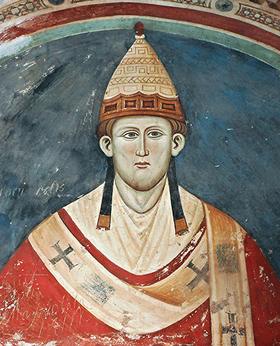
1215A medieval wall painting of a young beardless pope in a tall pointed tiara and a pallium marked with crosses
Council
Fourth Lateran Council Constitution 1, On the Catholic Faith

“His body and blood are truly contained in the sacrament of the altar under the forms of bread and wine, the bread and wine having been changed in substance, by God's power, into his body and blood, so that in order to achieve this mystery of unity we receive from God what he received from us.”

Read it in the source: Papal Encyclicals Online

See it on the timeline: Transubstantiation

1215
Council
Fourth Lateran Council Constitution 18, Clerics to dissociate from shedding blood

“No cleric may decree or pronounce a sentence involving the shedding of blood, or carry out a punishment involving the same, or be present when such punishment is carried out. … A cleric may not write or dictate letters which require punishments involving the shedding of blood, in the courts of princes this responsibility should be entrusted to laymen and not to clerics. Moreover no cleric may be put in command of mercenaries or crossbowmen or suchlike men of blood”

Read it in the source: Papal Encyclicals Online

See it on the timeline: Violence in the Church's history

1215
Council
Fourth Lateran Council Constitution 1, Confession of Faith

“His body and blood are truly contained in the sacrament of the altar under the forms of bread and wine … Nobody can effect this sacrament except a priest who has been properly ordained according to the church's keys, which Jesus Christ himself gave to the apostles and their successors.”

Read it in the source: Papal Encyclicals Online

See it on the timeline: The priest and the Eucharist

1215
Council
Fourth Lateran Council Constitution 21

“All the faithful of either sex, after they have reached the age of discernment, should individually confess all their sins in a faithful manner to their own priest at least once a year … The priest shall be discerning and prudent, so that like a skilled doctor he may pour wine and oil over the wounds of the injured one.”

Read it in the source: Papal Encyclicals Online

See it on the timeline: Confession to a priest

1215
Council
Fourth Lateran Council Constitution 62

“Let those who are sent to seek alms be modest and discreet, and let them not stay in taverns or other unsuitable places or incur useless or excessive expenses, being careful above all not to wear the garb of false religion. Moreover, because the keys of the church are brought into contempt and satisfaction through penance loses its force through indiscriminate and excessive indulgences, which certain prelates of churches do not fear to grant, we therefore decree that when a basilica is dedicated, the indulgence shall not be for more than one year”

Read it in the source: Papal Encyclicals Online

See it on the timeline: Indulgences

1215
Council
Fourth Lateran Council Constitution 1, Confession of Faith

“There is indeed one universal church of the faithful, outside of which nobody at all is saved, in which Jesus Christ is both priest and sacrifice.”

Read it in the source: Papal Encyclicals Online

See it on the timeline: Other religions

1215
Council
Fourth Lateran Council Constitution 1, Confession of Faith

“…one principle of all things, creator of all things invisible and visible, spiritual and corporeal; who by his almighty power at the beginning of time created from nothing both spiritual and corporeal creatures, that is to say angelic and earthly, and then created human beings composed as it were of both spirit and body in common.”

Read it in the source: Papal Encyclicals Online

See it on the timeline: Evolution and Genesis

1215
Council

Fourth Lateran Council

Fourth Lateran Council Constitution 1, Confession of Faith

“His body and blood are truly contained in the sacrament of the altar under the forms of bread and wine, the bread and wine having been changed in substance, by God’s power, into his body and blood, so that in order to achieve this mystery of unity we receive from God what he received from us.”

Read it in the source: Papal Encyclicals Online

See it on the timeline: The ecumenical councils

1215
Council

Fourth Lateran Council: a primacy of ordinary power

Fourth Lateran Council Constitution 5

“Renewing the ancient privileges of the patriarchal sees, we decree, with the approval of this sacred universal synod, that after the Roman church, which through the Lord's disposition has a primacy of ordinary power over all other churches inasmuch as it is the mother and mistress of all Christ's faithful, the church of Constantinople shall have the first place”

Read it in the source: Papal Encyclicals Online

See it on the timeline: The tradition of the papacy

1215
Liturgy

Different rites and languages within the one faith

Fourth Lateran Council Constitution 9, On different rites within the same faith

“Since in many places peoples of different languages live within the same city or diocese, having one faith but different rites and customs, we therefore strictly order bishops of such cities and dioceses to provide suitable men who will do the following in the various rites and languages : celebrate the divine services for them, administer the church’s sacraments, and instruct them by word and example.”

Read it in the source: Papal Encyclicals Online

See it on the timeline: The Mass through the centuries

1215
Council
Fourth Lateran Council Constitution 21

“All the faithful of either sex, after they have reached the age of discernment, should individually confess all their sins in a faithful manner to their own priest at least once a year, and let them take care to do what they can to perform the penance imposed on them. Let them reverently receive the sacrament of the eucharist at least at Easter unless they think, for a good reason and on the advice of their own priest, that they should abstain from receiving it for a time.”

Read it in the source: Papal Encyclicals Online

See it on the timeline: The Eucharist

1215
Council
Fourth Lateran Council Constitution 21

“Let him take the utmost care, however, not to betray the sinner at all by word or sign or in any other way. If the priest needs wise advice, let him seek it cautiously without any mention of the person concerned. For if anyone presumes to reveal a sin disclosed to him in confession, we decree that he is not only to be deposed from his priestly office but also to be confined to a strict monastery to do perpetual penance.”

Read it in the source: Papal Encyclicals Online

See it on the timeline: Penance and Reconciliation

Before 1216, as the Golden Legend tells it
Miracle

A monk's vision of the Virgin pleading for the world, before the Order of Preachers

Bl. Jacobus de Voragine The Golden Legend (c. 1275; Caxton's English), Life of St. Dominic

“There was a monk, before the establishment of this order, which was ravished in spirit and saw the Blessed Virgin our Lady S. Mary kneeling, with her hands joined, praying her son for the human lineage. And he oft withstood her request, and at the last he said to her that so busily required him: Mother, what may I do more for them? I have sent to them patriarchs and prophets, and little have they amended them.”

Witnesses
An unnamed monk, according to the Golden Legend
Church ruling
None stated

Read it in the source: Fordham Sourcebook

See it on the timeline: Marian apparitions

1215A medieval wall painting of a young beardless pope in a tall pointed tiara and a pallium marked with crosses
Council

The Fourth Lateran Council: the condemned handed to the secular power

Fourth Lateran Council Constitution 3, On Heretics

“We condemn all heretics, whatever names they may go under. … Let those condemned be handed over to the secular authorities present, or to their bailiffs, for due punishment. Clerics are first to be degraded from their orders. The goods of the condemned are to be confiscated, if they are lay persons … We add further that each archbishop or bishop, either in person or through his archdeacon or through suitable honest persons, should visit twice or at least once in the year any parish of his in which heretics are said to live. There he should compel three or more men of good repute, or even if it seems expedient the whole neighbourhood, to swear that if anyone knows of heretics there or of any persons who hold secret conventicles or who differ in their life and habits from the normal way of living of the faithful, then he will take care to point them out to the bishop.”

Read it in the source: Papal Encyclicals Online

See it on the timeline: The Inquisition and the use of force against heresy

1215
Council

The Fourth Lateran Council on the Greeks

Fourth Lateran Council Constitution 4, On the pride of the Greeks towards the Latins

“For, after the Greek church together with certain associates and supporters withdrew from the obedience of the apostolic see, the Greeks began to detest the Latins so much that, among other wicked things which they committed out of contempt for them, when Latin priests celebrated on their altars they would not offer sacrifice on them until they had washed them, as if the altars had been defiled thereby. The Greeks even had the temerity to rebaptize those baptized by the Latins; and some, as we are told, still do not fear to do this.”

Read it in the source: Papal Encyclicals Online

See it on the timeline: The East-West Schism

1215
Council

Three centuries before Luther: a council warns against the misuse of indulgences

Fourth Lateran Council Constitution 62

“Let those who are sent to seek alms be modest and discreet, and let them not stay in taverns or other unsuitable places or incur useless or excessive expenses, being careful above all not to wear the garb of false religion. Moreover, because the keys of the church are brought into contempt and satisfaction through penance loses its force through indiscriminate and excessive indulgences, which certain prelates of churches do not fear to grant, we therefore decree that when a basilica is dedicated, the indulgence shall not be for more than one year”

Read it in the source: Papal Encyclicals Online

See it on the timeline: Protestantism

1215
Council

Fourth Lateran Council: Jews to be marked out by their dress

Fourth Lateran Council Constitution 68, Jews appearing in public

“In order that the offence of such a damnable mixing may not spread further, under the excuse of a mistake of this kind, we decree that such persons of either sex, in every christian province and at all times, are to be distinguished in public from other people by the character of their dress … They shall not appear in public at all on the days of lamentation and on passion Sunday”

Read it in the source: Papal Encyclicals Online

See it on the timeline: The Church and the Jewish people

1215
Council

Fourth Lateran Council: Jews barred from public office

Fourth Lateran Council Constitution 69, Jews not to hold public offices

“It would be too absurd for a blasphemer of Christ to exercise power over Christians. We therefore renew in this canon, on account of the boldness of the offenders, what the council of Toledo providently decreed in this matter : we forbid Jews to be appointed to public offices, since under cover of them they are very hostile to Christians.”

Read it in the source: Papal Encyclicals Online

See it on the timeline: The Church and the Jewish people

1216, by traditionA smiling pope in white sits in a white chair with his hands folded
Miracle

The vision of Jesus and Mary at the Portiuncula, St. Francis of Assisi

Pope Leo XIV Angelus, 2 August 2026

“In these days the “Pardon of Assisi” is celebrated. Saint Francis obtained this Indulgence from Pope Honorius III in 1216, having been inspired — while praying at the Porziuncola — by a vision of Jesus and Mary surrounded by angels.”

Witnesses
Saint Francis, while praying at the Porziuncola, according to the Pope
Church ruling
The Pope says Francis obtained the indulgence from Pope Honorius III in 1216

Read it in the source: vatican.va

See it on the timeline: Marian apparitions

c. 1218, as the Golden Legend tells it
Miracle

Our Lady and the dying Reynold of Orleans

Bl. Jacobus de Voragine The Golden Legend (c. 1275; Caxton's English), Life of St. Dominic

“And suddenly the queen of mercy came with three maidens, and Reynold waking, and abiding the death, saw her come to him, and our Lady said to him: Be of good cheer, require of me what thou wilt and I shall give it to thee. And as he thought what he should require, one of the maidens said to him softly that he should require nothing but to commit him all to her will. And when he had so done, then she put forth her virginal hand and touched his ears, his nostrils, mouth, hands, feet, and reins, and anointed them with the ointment of health, which she had brought with her”

Witnesses
Reynold, dean of Orleans, who saw her while sick; St. Dominic, who saw the vision in prayer, according to the Golden Legend
Church ruling
None stated

Read it in the source: Fordham Sourcebook

See it on the timeline: Marian apparitions

1218, by tradition
Miracle

Our Lady of Mercy and St. Peter Nolasco

Vatican News “Mensaje de Mons. Romero en el día de Nuestra Señora de la Merced” (September 2018)

“The Blessed Virgin appeared to Saint Peter Nolasco, in 1218, recommending that he found a religious community devoted to helping the captives who were taken to distant places. This Marian title was born in Spain and spread through the rest of the world.”

Our translation. The words as written, in Spanish:

“La Santísima Virgen se le apareció a San Pedro Nolasco, en 1218, recomendándole que fundara una comunidad religiosa que se dedicara a auxiliar a los cautivos que eran llevados a sitios lejanos. Esta advocación mariana nace en España y se difunde por el resto del mundo.”

Witnesses
Saint Peter Nolasco, according to the page
Church ruling
None stated on the apparition

Read it in the source: vaticannews.va

See it on the timeline: Marian apparitions

1219A smiling pope in white waves with his right hand
Magisterium

St. Francis of Assisi goes to the Sultan

Pope Francis Fratelli Tutti 3 (3 October 2020), on St. Francis's visit to Sultan Malik-el-Kamil in 1219

“It was his visit to Sultan Malik-el-Kamil, in Egypt, which entailed considerable hardship, given Francis’ poverty, his scarce resources, the great distances to be traveled and their differences of language, culture and religion. That journey, undertaken at the time of the Crusades, further demonstrated the breadth and grandeur of his love, which sought to embrace everyone.”

Read it in the source: vatican.va

See it on the timeline: Islam and the Church

13th century, by tradition
Magisterium

St. Dominic and the Rosary, as St. Pius V reports it in 1569

Pope St. Pius V Consueverunt Romani Pontifices (17 September 1569)

“And so Dominic looked to that simple way of praying and beseeching God, accessible to all and wholly pious, which is called the Rosary, or Psalter of the Blessed Virgin Mary, in which the same most Blessed Virgin is venerated by the angelic greeting repeated one hundred and fifty times, that is, according to the number of the Davidic Psalter, and by the Lord’s Prayer with each decade. Interposed with these prayers are certain meditations showing forth the entire life of Our Lord Jesus Christ”

Read it in the source: Papal Encyclicals Online

See it on the timeline: The Rosary

13th century, by tradition
Magisterium

St. Dominic and the Rosary, as Leo XIII reports it

Pope Leo XIII Supremi Apostolatus Officio, 3 (1 September 1883)

“Our merciful God, as you know, raised up against these most direful enemies a most holy man, the illustrious parent and founder of the Dominican Order. … he proceeded undauntedly to attack the enemies of the Catholic Church, not by force of arms; but trusting wholly to that devotion which he was the first to institute under the name of the Holy Rosary, which was disseminated through the length and breadth of the earth by him and his pupils.”

Read it in the source: vatican.va

See it on the timeline: The Rosary

1221A friar in a white habit and black cloak stands in a niche holding a cross and a lily, with a dog carrying a torch at his feet
Saint

St. Dominic, founder of the Order of Preachers

Bl. Jordan of Saxony Libellus on the beginnings of the Order of Preachers, as quoted by Benedict XVI, General Audience, 3 February 2010

“All men were swept into the embrace of his charity, and, in loving all, he was beloved by all.... He claimed it his right to rejoice with the joyful and to weep with the sorrowful”

Read it in the source: vatican.va

See it on the timeline: Saints of the high Middle Ages, 1050 to 1500

1221, as the Golden Legend tells it
Miracle

Jesus and his mother seen at the death of St. Dominic

Bl. Jacobus de Voragine The Golden Legend (c. 1275; Caxton's English), Life of St. Dominic

“For as he slept a light sleep, the head inclined to a wall, he saw the heaven open, and put down to the earth two white ladders, of which Jesu Christ and his mother held the end on high, and the angels descended and ascended by the ladders, singing. In the midst of the ladders there was a seat set, and upon the seat sat S. Dominic with his head covered like a friar. And Jesu Christ and his mother drew up the ladders into heaven so high, that he that sat was lifted up into heaven, and then the opening of heaven was shut and closed.”

Witnesses
A friar, the prior of the preachers of Brescia and afterward bishop of that city, according to the Golden Legend
Church ruling
None stated

Read it in the source: Fordham Sourcebook

See it on the timeline: Marian apparitions

13th century, by traditionA black and white photograph of a very old, smiling pope in white with a pectoral cross
Magisterium

"By her command and counsel": Mary, St. Dominic and the Rosary

Pope Leo XIII Octobri Mense, 8 (22 September 1891)

“Moreover, we may well believe that the Queen of Heaven herself has granted an especial efficacy to this mode of supplication, for it was by her command and counsel that the devotion was begun and spread abroad by the holy Patriarch Dominic as a most potent weapon against the enemies of the faith at an epoch not, indeed, unlike our own, of great danger to our holy religion.”

Read it in the source: vatican.va

See it on the timeline: The Rosary

13th century, by traditionA thin pope in spectacles and a white skullcap, wearing a red cape and a gold embroidered stole
Magisterium

Mary teaches the Rosary to the Church through St. Dominic

Pope Benedict XV Fausto Appetente Die, 11 (29 June 1921)

“How pleased was the Heavenly Queen with her pious servant may be easily gathered from this, that she used his ministry to teach the Most Holy Rosary to the Church, the Spouse of her Son; that prayer which, being both vocal and mental, in the contemplation especially of the mysteries of religion, while the Lord's Prayer is fifteen times repeated together with as many decades of the Hail Mary, is most adapted to fostering widely piety and every virtue.”

Read it in the source: vatican.va

See it on the timeline: The Rosary

d. 1221
Magisterium

St. Dominic's legacy and the Rosary, as Benedict XVI puts it

Pope Benedict XVI General Audience, 3 February 2010

“In the very first place is Marian devotion which he fostered tenderly and left as a precious legacy to his spiritual sons who, in the history of the Church, have had the great merit of disseminating the prayer of the Holy Rosary, so dear to the Christian people and so rich in Gospel values: a true school of faith and piety.”

Read it in the source: vatican.va

See it on the timeline: The Rosary

1224A friar in a patched brown habit kneels in the dark with his hood over his face, holding a skull
Miracle

The stigmata of St. Francis of Assisi

Pope Benedict XVI General Audience, 27 January 2010

“In 1224, at the hermitage in La Verna, Francis had a vision of the Crucified Lord in the form of a seraph and from that encounter received the stigmata from the Seraph Crucifix, thus becoming one with the Crucified Christ. It was a gift, therefore, that expressed his intimate identification with the Lord.”

Read it in the source: vatican.va

See it on the timeline: Great miracles

14 September 1224
Miracle

The stigmata of St. Francis of Assisi

Pope Francis Address to the Friars Minor of La Verna and of the Tuscan Province, 5 April 2024

“I am happy to meet you, in the year in which we commemorate the eighth centenary of the gift of the stigmata, which Saint Francis received in Verna on 14 September 1224, two years before his death. Thank you for bringing here the relic of his blood, which is making a long pilgrimage in various communities”

Where it can be seen
A relic of the saint's blood, which the Pope says was brought to him and is being taken on pilgrimage to various communities

Read it in the source: vatican.va

See it on the timeline: Great miracles

1226A friar with a halo bends towards a flock of birds on the ground beneath a tree, with another friar behind him
Saint

St. Francis of Assisi, founder of the Friars Minor

Pope Benedict XVI General Audience, 27 January 2010

“The death of Francis his transitus occurred on the evening of 3 October 1226, in the Portiuncula. After having blessed his spiritual children, he died, lying on the bare earthen floor. Two years later Pope Gregory ix entered him in the roll of saints.”

Read it in the source: vatican.va

See it on the timeline: Saints through the centuries

1226
Saint

St. Francis of Assisi, founder of the Friars Minor

Pope Benedict XVI General Audience, 27 January 2010

“Three times Christ on the Cross came to life, and told him: "Go, Francis, and repair my Church in ruins". This simple occurrence of the word of God heard in the Church of St Damian contains a profound symbolism. At that moment St Francis was called to repair the small church, but the ruinous state of the building was a symbol of the dramatic and disquieting situation of the Church herself.”

Read it in the source: vatican.va

See it on the timeline: Saints of the high Middle Ages, 1050 to 1500

canonized 1228
Miracle

St. Francis of Assisi, founder of the Friars Minor

Pope Benedict XVI General Audience on St. Bonaventure, 3 March 2010

“He was called Giovanni di Fidanza. An episode that occurred when he was still a boy deeply marked his life, as he himself recounts. He fell seriously ill and even his father, who was a doctor, gave up all hope of saving him from death. So his mother had recourse to the intercession of St Francis of Assisi, who had recently been canonized. And Giovanni recovered.”

Read it in the source: vatican.va

See it on the timeline: Saints of the high Middle Ages, 1050 to 1500

1228
Miracle

The Host of Alatri

Pope Gregory IX Bull Fraternitatis tuae, 1228, in the Italian translation published by the Diocese of Anagni-Alatri

“We have received your letter, dearest brother, which informed us how a certain young woman, swayed by the bad advice of a wicked woman, after receiving the most holy Body of Christ from the hands of the priest, kept it in her mouth until, seizing a favourable moment, she was able to hide it in a cloth, where, after three days, she found the same body that she had received in the form of bread transformed into flesh, as anyone can still see with his own eyes. … In the first place we must give thanks, with all our strength, to him who, while working wonderfully in all things, nevertheless on some occasions repeats miracles and raises up new prodigies”

Our translation. The words as written, in Italian:

“Abbiamo ricevuto la tua lettera, fratello carissimo, che ci informava, come una certa giovane suggestionata dal cattivo consiglio di una malefica donna, dopo aver ricevuto dalle mani del Sacerdote il Corpo santissimo di Cristo, lo trattenne nella bocca fino al momento in cui, colta l'occasione favorevole, lo poté nascondere in un panno, dove, dopo tre giorni, ritrovò lo stesso corpo che aveva ricevuto in forma di pane, trasformato in carne, come tuttora ognuno può constatare con i propri occhi. … In primo luogo dobbiamo rendere grazie, con tutte le nostre forze, a colui che pur operando in ogni cosa in modo meraviglioso, tuttavia in qualche occasione ripete i miracoli e suscita nuovi prodigi”

Investigation
Bishop John of Alatri reported the event in writing to Pope Gregory IX and asked what to do. The Pope says both women had confessed it to the bishop
Church ruling
Gregory IX answered in 1228 with the bull Fraternitatis tuae. He gives thanks to God for the event as a miracle and sets a lighter penance for the young woman
Where it can be seen
In a reliquary kept on permanent display in a chapel of the right aisle of the Co-Cathedral Basilica of St Paul, Alatri

Read it in the source: diocesianagnialatri.it

See it on the timeline: Eucharistic miracles

1231A young friar in a grey habit holds a lily and an open book on which a tiny figure of the Christ Child appears
Saint

St. Anthony of Padua, friar and Doctor

St. Anthony of Padua Sermones Dominicales et Festivi III, as quoted by Benedict XVI, General Audience, 10 February 2010

“Christ who is your life is hanging before you, so that you may look at the Cross as in a mirror. There you will be able to know how mortal were your wounds, that no medicine other than the Blood of the Son of God could heal. If you look closely, you will be able to realize how great your human dignity and your value are.... Nowhere other than looking at himself in the mirror of the Cross can man better understand how much he is worth”

Read it in the source: vatican.va

See it on the timeline: Saints of the high Middle Ages, 1050 to 1500

1231A triangular gold panel of a woman in a veil gathering roses in the fold of her cloak
Saint

St. Elizabeth of Hungary, princess and servant of the poor

Pope Benedict XVI General Audience, 20 October 2010

“Once, on entering a church on the Feast of the Assumption, she took off her crown, laid it before the Crucifix and, covering her face, lay prostrate on the ground. When her mother-in-law reprimanded her for this gesture, Elizabeth answered: "How can I, a wretched creature, continue to wear a crown of earthly dignity, when I see my King Jesus Christ crowned with thorns?”.”

Read it in the source: vatican.va

See it on the timeline: Saints of the high Middle Ages, 1050 to 1500

1231A young friar in a grey habit holds a lily and an open book on which a tiny figure of the Christ Child appears
Doctor of the Church

St. Anthony of Padua, friar and Doctor

St. Anthony of Padua Sermones Dominicales et Festivi III, as quoted by Benedict XVI, General Audience, 10 February 2010

“If you preach Jesus, he will melt hardened hearts; if you invoke him he will soften harsh temptations; if you think of him he will enlighten your mind”

Read it in the source: vatican.va

See it on the timeline: The Doctors of the Church

canonized 1232
Miracle

St. Anthony of Padua, friar and Doctor

Pope Benedict XVI General Audience, 10 February 2010

“Pope Gregory IX himself, having heard him preach, described him as the "Ark of the Testament" and subsequent to miracles brought about through his intercession canonized him in 1232, only a year after his death.”

Church ruling
Canonized by Pope Gregory IX in 1232, a year after his death, after miracles through his intercession

Read it in the source: vatican.va

See it on the timeline: Saints of the high Middle Ages, 1050 to 1500

c. 1233, by tradition
Miracle

Our Lady and the Seven Holy Founders of the Servites, Florence

Alban Butler Butler's Lives of the Saints, Concise Edition (ed. Michael Walsh), The Seven Holy Founders of the Servite Order (EWTN Library)

“All of them came to realize the call to a life of renunciation, and they determined to have recourse to our Lady in their perplexity. On the feast of the Assumption, as they were absorbed in prayer, they saw her in a vision, and were inspired by her to withdraw from the world into a solitary place and to live for God alone.”

Witnesses
The seven founders, praying together on the feast of the Assumption, according to Butler
Church ruling
None stated on the vision

Read it in the source: EWTN Library

See it on the timeline: Marian apparitions

canonized 1235A triangular gold panel of a woman in a veil gathering roses in the fold of her cloak
Miracle

St. Elizabeth of Hungary, princess and servant of the poor

Pope Benedict XVI General Audience, 20 October 2010

“The miracle of the loaves that were changed into roses fits into this context: while Elizabeth was on her way with her apron filled with bread for the poor, she met her husband who asked her what she was carrying. She opened her apron to show him and, instead of bread, it was full of magnificent roses. This symbol of charity often features in depictions of St Elizabeth.”

Church ruling
Canonized by Pope Gregory IX four years after her death; the audience says the testimonies of her holiness were many

Read it in the source: vatican.va

See it on the timeline: Saints of the high Middle Ages, 1050 to 1500

1245
Council

First Council of Lyons

Pope Innocent IV, in the presence of the council Bull deposing the Emperor Frederick II, 17 July 1245

“We therefore, after careful discussion with our brother cardinals and the sacred council on his wicked transgressions already mentioned and many more besides, since though unworthy we hold on earth the place of Jesus Christ, and to us in the person of the blessed apostle Peter has been said, whatever you bind on earth etc., denounce the said prince, who has made himself so unworthy of the empire and kingdoms and every honour and dignity and who also, because of his crimes, has been cast out by God from kingdom and empire; we mark him out as bound by his sins, an outcast and deprived by our Lord of every honour and dignity; and we deprive him of them by our sentence.”

Read it in the source: Papal Encyclicals Online

See it on the timeline: The ecumenical councils

16 July 1251, by tradition
Miracle

Our Lady of Mount Carmel and the Scapular, St. Simon Stock

Vatican News Memorial of Our Lady of Mount Carmel (liturgical holidays, 16 July)

“This optional memorial of Our Lady of Mount Carmel was established to commemorate her apparition to Saint Simon Stock on 16 July 1251.”

Witnesses
Saint Simon Stock, according to the page
Church ruling
The page says the optional memorial of Our Lady of Mount Carmel was established to commemorate the apparition

Read it in the source: vaticannews.va

See it on the timeline: Marian apparitions

1251, by tradition
Miracle

Our Lady of Mount Carmel and the Scapular, St. Simon Stock

Order of Carmelites “St. Simon Stock, religious” (website of the Order's General Curia)

“The Order's tradition links the famous tale of the "vision of the Scapular" to the saint of the Order. To understand the details of this "vision"—of which nothing is known regarding place and date (although traditionally put in 1251)—it is necessary to consider that the story is presented as a literary genre common in the medieval period. The content is similar to that developed by a number of other religious orders: Our Lady told the saint that whoever died piously wearing the scapular would not go to hell. It is a theological truth "dressed up" with the typical form of medieval exempla.”

Witnesses
Saint Simon Stock, according to the Order's tradition
Investigation
The Order's page says nothing is known of the place and date of the vision, though it is traditionally put in 1251
Church ruling
None stated

Read it in the source: ocarm.org

See it on the timeline: Marian apparitions

1252
Magisterium

Ad extirpanda: rulers ordered to force confessions

Pope Innocent IV Bull Ad extirpanda, 15 May 1252, Law 25

“The head of state or ruler must force all the heretics whom he has in custody, … provided he does so without killing them or breaking their arms or legs, as actual robbers and murderers of souls and thieves of the sacraments of God and Christian faith, to confess their errors and accuse other heretics whom they know, and specify their motives, … and those whom they have seduced, and those who have lodged them and defended them, as thieves and robbers of material goods are made to accuse their accomplices and confess the crimes they have committed.”

Read it in the source: Documenta Catholica Omnia

See it on the timeline: The Inquisition and the use of force against heresy

1253A wall painting of a young woman with a halo in a pale habit and veil, holding a lily
Saint

St. Clare of Assisi, foundress of the Poor Clares

St. Clare of Assisi Blessing of St. Clare (FF 2856), as quoted by Benedict XVI, General Audience, 15 September 2010

“I give you my blessing now while living, and after my death, in as far as I may: nay, even more than I may, I call down on you all the blessings that the Father of mercies has bestowed and continues to bestow on his spiritual sons and daughters both in Heaven and on earth, and with which a spiritual father and mother have blessed and will bless their spiritual sons and daughters. Amen”

Read it in the source: vatican.va

See it on the timeline: Saints of the high Middle Ages, 1050 to 1500

canonized 1255
Miracle

St. Clare of Assisi, foundress of the Poor Clares

Pope Benedict XVI General Audience, 15 September 2010

“Her faith in the Real Presence of Christ in the Eucharist was so great that twice a miracle happened. Simply by showing to them the Most Blessed Sacrament distanced the Saracen mercenaries, who were on the point of attacking the convent of San Damiano and pillaging the city of Assisi. Such episodes, like other miracles whose memory lives on, prompted Pope Alexander IV to canonize her in 1255, only two years after her death, outlining her eulogy in the Bull on the Canonization of St Clare.”

Investigation
The audience says the Pope promoted the cause a few months after her death and that its Proceedings hold the depositions of those who had lived with her
Church ruling
Canonized by Pope Alexander IV in 1255, two years after her death

Read it in the source: vatican.va

See it on the timeline: Saints of the high Middle Ages, 1050 to 1500

c. 1256A Dominican friar with a tonsure and a gold halo holds an open book and a small church, with a shining sun on his chest
Doctor of the Church
St. Thomas Aquinas Summa Theologiae, Supplement, q. 25, a. 1, I answer that

“Hence we must say on the contrary that indulgences hold good both in the Church's court and in the judgment of God, for the remission of the punishment which remains after contrition, absolution, and confession, whether this punishment be enjoined or not. The reason why they so avail is the oneness of the mystical body in which many have performed works of satisfaction exceeding the requirements of their debts”

Read it in the source: New Advent

See it on the timeline: Indulgences

c. 1256
Doctor of the Church
St. Thomas Aquinas Summa Theologiae, Supplement, q. 27, a. 1, I answer that

“…although those merits which are applied by means of an indulgence, might possibly avail a person so that he could merit grace (by way of congruity and impetration), yet it is not for this reason that they are applied, but for the remission of punishment. Hence they do not avail those who are in mortal sin, and consequently, true contrition and confession are demanded as conditions for gaining all indulgences.”

Read it in the source: New Advent

See it on the timeline: Indulgences

1263A wall painting around a doorway: a priest at an altar holds up the Host while a kneeling pope and a crowd look on
Miracle

The Eucharistic miracle of Bolsena

Pope Benedict XVI General Audience, 17 November 2010

“Indeed, he ordered that the famous Corporal with the traces of the Eucharistic miracle which had occurred in Bolsena the previous year, 1263, be kept in Orvieto Cathedral — where it still is today. While a priest was consecrating the bread and the wine he was overcome by strong doubts about the Real Presence of the Body and Blood of Christ in the sacrament of the Eucharist. A few drops of blood began miraculously to ooze from the consecrated Host, thereby confirming what our faith professes.”

Witnesses
The priest who was celebrating the Mass
Church ruling
Pope Urban IV ordered the Corporal to be kept in Orvieto Cathedral
Where it can be seen
Orvieto Cathedral, where Benedict XVI says the Corporal still is today

Read it in the source: vatican.va

See it on the timeline: Eucharistic miracles

1263
Miracle

The Eucharistic miracle of Bolsena

Pope St. Paul VI Angelus, 8 August 1976

“Bolsena is famous for its miracle, which took place in 1263, when a Bohemian priest, a pilgrim passing through, celebrating Holy Mass on the altar of the martyr who is still so honoured at Bolsena, and tormented by doubt about the real presence of Jesus Christ in the Eucharist, that is, about the "transubstantiation" of the bread and wine into the Body and Blood of the Lord, sees that the Blood wets the small cloth, called the Corporal, on which the holy rite of the Eucharistic sacrifice is carried out. Wonder and amazement among those present. At once the sacred Corporal, stained with the divine Blood, was carried to nearby Orvieto, where the Pope then resided, our distant predecessor Urban IV (1261-1264), who, having verified the prodigy, instituted the feast of Corpus Christi”

Our translation. The words as written, in Italian:

“Bolsena è celebre per il suo miracolo, avvenuto nel 1263, quando un Sacerdote boemo pellegrino di passaggio, celebrando la S. Messa sull’altare della martire, ancora tanto onorata a Bolsena, tormentato dal dubbio circa la reale presenza di Gesù Cristo nell’Eucaristia, cioè circa la «transustanziazione» del pane e del vino nel Corpo e nel Sangue del Signore, vede che il Sangue bagna la piccola tovaglia, detta Corporale, sulla quale è compiuto il santo rito del sacrificio eucaristico. Meraviglia e stupore dei presenti. Subito il sacro Corporale, macchiato dal Sangue divino, fu portato alla vicina Orvieto, dove allora risiedeva il Papa, nostro lontano predecessore, Urbano IV (1261-1264), il quale, verificato il prodigio, istituì la festa del « Corpus Domini »”

Witnesses
A Bohemian priest on pilgrimage, and those present at his Mass
Investigation
Paul VI says Pope Urban IV verified the prodigy at Orvieto
Church ruling
Urban IV instituted the feast of Corpus Christi. On 8 August 1976 Paul VI gave the church of the miracle at Bolsena the title of minor basilica
Where it can be seen
Orvieto kept the Corporal of the miracle

Read it in the source: vatican.va

See it on the timeline: Eucharistic miracles
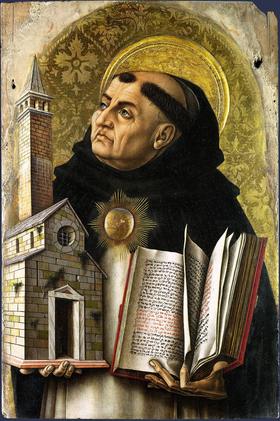
1263
Miracle

The Eucharistic miracle of Bolsena

Pope St. John Paul II Homily for Corpus Christi, Orvieto Cathedral, 17 June 1990, 3

“Even though its construction is not directly connected with the solemnity of Corpus Christi, instituted by Pope Urban IV with the bull Transiturus in 1264, nor with the miracle that took place at Bolsena the year before, it is nonetheless beyond doubt that the Eucharistic mystery is powerfully evoked here by the corporal of Bolsena, for which the chapel that now jealously guards it was specially built. Since then the city of Orvieto has been known throughout the world for this miraculous sign, which reminds everyone of the merciful love of God, who made himself the food and drink of salvation for humanity on pilgrimage on earth.”

Our translation. The words as written, in Italian:

“Anche se la sua costruzione non è collegata direttamente alla solennità del “Corpus Domini”, istituita dal Papa Urbano IV con la bolla Transiturus, nel 1264, né al miracolo avvenuto a Bolsena l’anno precedente, è però indubbio che il mistero eucaristico è qui potentemente evocato dal corporale di Bolsena, per il quale venne appositamente fabbricata la cappella, che ora lo custodisce gelosamente. La città di Orvieto è da allora conosciuta nel mondo intero per tale segno miracoloso, che a tutti ricorda l’amore misericordioso di Dio, fattosi cibo e bevanda di salvezza per l’umanità pellegrina sulla terra.”

Church ruling
Urban IV instituted the solemnity of Corpus Christi with the bull Transiturus in 1264, the year after the miracle
Where it can be seen
The chapel of Orvieto Cathedral built to hold the corporal of Bolsena

Read it in the source: vatican.va

See it on the timeline: Eucharistic miracles
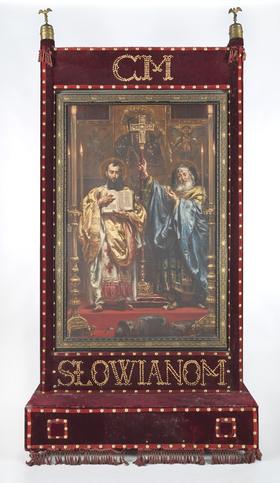
1263
Miracle

The Eucharistic miracle of Bolsena

Vatican News (Federico Piana) Miracoli eucaristici, faro di fede anche nei momenti di crisi, 13 June 2020

“The Basilica of St Christina at Bolsena, a small town in upper Lazio, is the extraordinary place where, in far-off 1263, a priest who doubted the real presence of the Lord in the consecrated host and wine saw the Eucharist bleed during the celebration of Mass. The place, which has become the sanctuary of the Eucharistic miracle, is usually the goal of many pilgrimages from every part of the world”

Our translation. The words as written, in Italian:

“La Basilica di Santa Cristina a Bolsena - cittadina dell’Alto Lazio- è lo straordinario luogo nel quale, nel lontano 1263, un sacerdote, dubbioso della reale presenza del Signore nell’ostia e nel vino consacrati, vide l’Eucaristia sanguinare durante la celebrazione della messa. Il luogo, divenuto santuario del miracolo eucaristico, è solitamente meta di copiosi pellegrinaggi da ogni parte del mondo”

Where it can be seen
The place of the event is the Basilica of St Christina at Bolsena, now the sanctuary of the miracle

Read it in the source: vaticannews.va

See it on the timeline: Eucharistic miracles
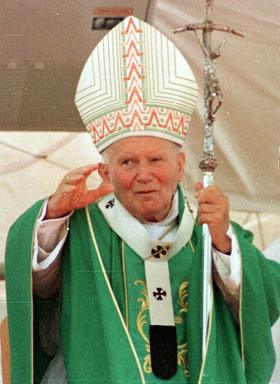
13th centuryA Dominican friar with a tonsure and a gold halo holds an open book and a small church, with a shining sun on his chest
Doctor of the Church
St. Thomas Aquinas Summa Theologiae, Supplement, q. 34, a. 1, I answer that

“God wished to produce His works in likeness to Himself, as far as possible, in order that they might be perfect, and that He might be known through them. Hence, that He might be portrayed in His works, not only according to what He is in Himself, but also according as He acts on others, He laid this natural law on all things, that last things should be reduced and perfected by middle things, and middle things by the first, as Dionysius says (Eccl. Hier. v). Wherefore that this beauty might not be lacking to the Church, He established Order in her so that some should deliver the sacraments to others, being thus made like to God in their own way, as co-operating with God; even as in the natural body, some members act on others.”

Read it in the source: New Advent

See it on the timeline: Holy Orders

c. 1267
Doctor of the Church
St. Thomas Aquinas Summa Theologiae I, q. 1, a. 10, I answer that

“Since the literal sense is that which the author intends, and since the author of Holy Writ is God, Who by one act comprehends all things by His intellect, it is not unfitting, as Augustine says (Confess. xii), if, even according to the literal sense, one word in Holy Writ should have several senses.”

Read it in the source: New Advent

See it on the timeline: The inspiration of Scripture

c. 1267
Doctor of the Church
St. Thomas Aquinas Summa Theologiae I, q. 1, a. 8, Reply to Objection 2

“Nevertheless, sacred doctrine makes use of these authorities as extrinsic and probable arguments; but properly uses the authority of the canonical Scriptures as an incontrovertible proof, and the authority of the doctors of the Church as one that may properly be used, yet merely as probable. For our faith rests upon the revelation made to the apostles and prophets who wrote the canonical books, and not on the revelations (if any such there are) made to other doctors.”

Read it in the source: New Advent

See it on the timeline: The authority of the Fathers

c. 1267
Doctor of the Church
St. Thomas Aquinas Summa Theologiae I, q. 68, a. 1, I answer that

“The first [rule] is, to hold the truth of Scripture without wavering. The second is that since Holy Scripture can be explained in a multiplicity of senses, one should adhere to a particular explanation, only in such measure as to be ready to abandon it, if it be proved with certainty to be false; lest Holy Scripture be exposed to the ridicule of unbelievers, and obstacles be placed to their believing.”

Read it in the source: New Advent

See it on the timeline: Evolution and Genesis

c. 1267
Doctor of the Church

Aquinas: hold an explanation of Scripture ready to give it up

St. Thomas Aquinas Summa Theologiae I, q. 68, a. 1, I answer that

“In discussing questions of this kind two rules are to observed, as Augustine teaches (Gen. ad lit. i, 18). The first is, to hold the truth of Scripture without wavering. The second is that since Holy Scripture can be explained in a multiplicity of senses, one should adhere to a particular explanation, only in such measure as to be ready to abandon it, if it be proved with certainty to be false; lest Holy Scripture be exposed to the ridicule of unbelievers, and obstacles be placed to their believing.”

Read it in the source: New Advent

See it on the timeline: The Galileo case

c. 1267
Doctor of the Church

Aquinas: Scripture describes what the senses see

St. Thomas Aquinas Summa Theologiae I, q. 70, a. 1, Reply to Objection 3

“In the opinion of Aristotle, however, the stars are fixed in their orbits, and in reality have no other movement but that of the spheres; and yet our senses perceive the movement of the luminaries and not that of the spheres (De Coel. ii, text. 43). But Moses describes what is obvious to sense, out of condescension to popular ignorance, as we have already said”

Read it in the source: New Advent

See it on the timeline: The Galileo case

c. 1270
Doctor of the Church
St. Thomas Aquinas Summa Theologiae I-II, q. 114, a. 5, I answer that

“The gift of grace may be considered in two ways: first in the nature of a gratuitous gift, and thus it is manifest that all merit is repugnant to grace, since as the Apostle says (Romans 11:6), "if by grace, it is not now by works." … Hence it is manifest that no one can merit for himself the first grace.”

Read it in the source: New Advent

See it on the timeline: Faith and works

c. 1270
Doctor of the Church
St. Thomas Aquinas Summa Theologiae I-II, q. 112, a. 5, I answer that

“There are three ways of knowing a thing: first, by revelation, and thus anyone may know that he has grace, for God by a special privilege reveals this at times to some, … Secondly, a man may, of himself, know something, and with certainty; and in this way no one can know that he has grace. … Thirdly, things are known conjecturally by signs; and thus anyone may know he has grace, when he is conscious of delighting in God, and of despising worldly things, and inasmuch as a man is not conscious of any mortal sin.”

Read it in the source: New Advent

See it on the timeline: Assurance of salvation

1270A king in armour and a crown, with an orange cloak, holds a sceptre topped with a fleur-de-lis, a boy beside him holding his helmet
Saint

St. Louis IX, King of France

St. Louis IX Spiritual Testament to his son, as quoted by Benedict XVI, Angelus, 29 August 2010

“If the Lord grant you some prosperity, not only must you humbly thank him but take care not to become worse by boasting or in any other way, make sure, that is, that you do not come into conflict with God or offend him with his own gifts”

Read it in the source: vatican.va

See it on the timeline: Saints of the high Middle Ages, 1050 to 1500

1270
Saint

St. Louis IX, King of France

Pope Benedict XVI Angelus, 29 August 2010

“St Louis IX, King of France whose Memorial was last Wednesday put into practice what is written in the Book of Sirach: "The greater you are, the more you must humble yourself; so you will find favour in the sight of the Lord" (3: 18).”

Read it in the source: vatican.va

See it on the timeline: Saints of the high Middle Ages, 1050 to 1500

c. 1271A Dominican friar with a tonsure and a gold halo holds an open book and a small church, with a shining sun on his chest
Doctor of the Church
St. Thomas Aquinas Summa Theologiae II-II, q. 122, a. 4, Reply to Objection 4

“In the New Law the observance of the Lord's day took the place of the observance of the Sabbath, not by virtue of the precept but by the institution of the Church and the custom of Christian people. … And again in the New Law, dispensation is more easily granted than in the Old”

Read it in the source: New Advent

See it on the timeline: The Sunday Mass obligation

c. 1271
Doctor of the Church
St. Thomas Aquinas Summa Theologiae II-II, q. 1, a. 9, On the contrary

“The universal Church cannot err, since she is governed by the Holy Ghost, Who is the Spirit of truth: for such was Our Lord's promise to His disciples [John 16:13]: "When He, the Spirit of truth, is come, He will teach you all truth."”

Read it in the source: New Advent

See it on the timeline: The Magisterium

c. 1271
Doctor of the Church
St. Thomas Aquinas Summa Theologiae II-II, q. 39, a. 1, I answer that

“Now the unity of the Church consists in two things; namely, in the mutual connection or communion of the members of the Church, and again in the subordination of all the members of the Church to the one head, … Now this Head is Christ Himself, Whose viceregent in the Church is the Sovereign Pontiff.”

Read it in the source: New Advent

See it on the timeline: Papal supremacy

c. 1271
Doctor of the Church
St. Thomas Aquinas Summa Theologiae II-II, q. 1, a. 10, I answer that

“Consequently to publish a new edition of the symbol belongs to that authority which is empowered to decide matters of faith finally, so that they may be held by all with unshaken faith. Now this belongs to the authority of the Sovereign Pontiff, … The reason of this is that there should be but one faith of the whole Church, … and this could not be secured unless any question of faith that may arise be decided by him who presides over the whole Church, so that the whole Church may hold firmly to his decision.”

Read it in the source: New Advent

See it on the timeline: Papal infallibility

c. 1271
Doctor of the Church
St. Thomas Aquinas Summa Theologiae II-II, q. 11, a. 1, I answer that

“Secondly, because, though he intends to assent to Christ, yet he fails in his choice of those things wherein he assents to Christ, because he chooses not what Christ really taught, but the suggestions of his own mind. Therefore heresy is a species of unbelief, belonging to those who profess the Christian faith, but corrupt its dogmas.”

Read it in the source: New Advent

See it on the timeline: Have popes been heretics?

c. 1271
Doctor of the Church
St. Thomas Aquinas Summa Theologiae II-II, q. 1, a. 7, I answer that

“Accordingly we must conclude that, as regards the substance of the articles of faith, they have not received any increase as time went on: since whatever those who lived later have believed, was contained, albeit implicitly, in the faith of those Fathers who preceded them. But there was an increase in the number of articles believed explicitly, since to those who lived in later times some were known explicitly which were not known explicitly by those who lived before them.”

Read it in the source: New Advent

See it on the timeline: Doctrines defined later

c. 1271
Doctor of the Church
St. Thomas Aquinas Summa Theologiae II-II, q. 39, a. 1, body

“Now the unity of the Church consists in two things; namely, in the mutual connection or communion of the members of the Church, and again in the subordination of all the members of the Church to the one head … Now this Head is Christ Himself, Whose viceregent in the Church is the Sovereign Pontiff.”

Read it in the source: New Advent

See it on the timeline: The one Church

c. 1271
Doctor of the Church
St. Thomas Aquinas Summa Theologiae II-II, q. 10, a. 8, I answer that

“Among unbelievers there are some who have never received the faith, such as the heathens and the Jews: and these are by no means to be compelled to the faith, in order that they may believe, because to believe depends on the will: nevertheless they should be compelled by the faithful, if it be possible to do so, so that they do not hinder the faith, by their blasphemies, or by their evil persuasions, or even by their open persecutions. It is for this reason that Christ's faithful often wage war with unbelievers, not indeed for the purpose of forcing them to believe, because even if they were to conquer them, and take them prisoners, they should still leave them free to believe, if they will, but in order to prevent them from hindering the faith of Christ.”

Read it in the source: New Advent

See it on the timeline: Violence in the Church's history

c. 1271
Doctor of the Church
St. Thomas Aquinas Summa Theologiae II-II, q. 18, a. 4, Reply to Objection 2

“Hope does not trust chiefly in grace already received, but on God's omnipotence and mercy, whereby even he that has not grace, can obtain it, so as to come to eternal life. Now whoever has faith is certain of God's omnipotence and mercy.”

Read it in the source: New Advent

See it on the timeline: Assurance of salvation

c. 1271
Doctor of the Church
St. Thomas Aquinas Summa Theologiae II-II, q. 24, a. 11, I answer that

“We can, accordingly, consider charity in three ways: first on the part of the Holy Ghost, Who moves the soul to love God, and in this respect charity is incompatible with sin through the power of the Holy Ghost, Who does unfailingly whatever He wills to do. … Thirdly, charity can be considered on the part of its subject, which is changeable on account of the free-will. … the charity of the wayfarer does not so fill the potentiality of its subject, because the latter is not always actually directed to God: so that when it is not actually directed to God, something may occur whereby charity is lost.”

Read it in the source: New Advent

See it on the timeline: Eternal security

c. 1271
Doctor of the Church
St. Thomas Aquinas Summa Theologiae II-II, q. 83, a. 4, body (I answer that)

“Prayer is offered to a person in two ways: first, as to be fulfilled by him, secondly, as to be obtained through him. On the first way we offer prayer to God alone, since all our prayers ought to be directed to the acquisition of grace and glory, which God alone gives … This is also clear from the very style employed by the Church in praying: since we beseech the Blessed Trinity "to have mercy on us," while we ask any of the saints "to pray for us."”

Read it in the source: New Advent

See it on the timeline: Praying to saints

c. 1271
Doctor of the Church
St. Thomas Aquinas Summa Theologiae II-II, q. 84, a. 1, Reply to Objection 1

“…the reverence which we pay to God, and which belongs to latria, differs from the reverence which we pay to certain excellent creatures; this belongs to dulia … And since external actions are signs of internal reverence, certain external tokens significative of reverence are offered to creatures of excellence, and among these tokens the chief is adoration: yet there is one thing which is offered to God alone, and that is sacrifice. … Accordingly it was with the reverence due to an excellent creature that Nathan adored David … It was with the reverence due to God that John was forbidden to adore the angel”

Read it in the source: New Advent

See it on the timeline: Honoring the Pope

c. 1271
Doctor of the Church
St. Thomas Aquinas Summa Theologiae II-II, q. 2, a. 7, Reply to Objection 3

“If, however, some were saved without receiving any revelation, they were not saved without faith in a Mediator, for, though they did not believe in Him explicitly, they did, nevertheless, have implicit faith through believing in Divine providence, since they believed that God would deliver mankind in whatever way was pleasing to Him”

Read it in the source: New Advent

See it on the timeline: Other religions

c. 1271
Doctor of the Church

St. Thomas Aquinas defends the death penalty for heresy

St. Thomas Aquinas Summa Theologiae II-II, q. 11, a. 3, I answer that

“On their own side there is the sin, whereby they deserve not only to be separated from the Church by excommunication, but also to be severed from the world by death. For it is a much graver matter to corrupt the faith which quickens the soul, than to forge money, which supports temporal life. Wherefore if forgers of money and other evil-doers are forthwith condemned to death by the secular authority, much more reason is there for heretics, as soon as they are convicted of heresy, to be not only excommunicated but even put to death. On the part of the Church, however, there is mercy which looks to the conversion of the wanderer, wherefore she condemns not at once, but "after the first and second admonition," as the Apostle directs: after that, if he is yet stubborn, the Church no longer hoping for his conversion, looks to the salvation of others, by excommunicating him and separating him from the Church, and furthermore delivers him to the secular tribunal to be exterminated thereby from the world by death.”

Read it in the source: New Advent

See it on the timeline: The Inquisition and the use of force against heresy

c. 1271
Doctor of the Church

The Church's custom: no baptism of Jewish children against their parents' will

St. Thomas Aquinas Summa Theologiae II-II, q. 10, a. 12, I answer that

“Now it was never the custom of the Church to baptize the children of the Jews against the will of their parents, although at times past there have been many very powerful catholic princes like Constantine and Theodosius, with whom most holy bishops have been on most friendly terms, as Sylvester with Constantine, and Ambrose with Theodosius, who would certainly not have failed to obtain this favor from them if it had been at all reasonable. It seems therefore hazardous to repeat this assertion, that the children of Jews should be baptized against their parents' wishes, in contradiction to the Church's custom observed hitherto.”

Read it in the source: New Advent

See it on the timeline: Judaism and the Church

c. 1271
Doctor of the Church
St. Thomas Aquinas Summa Theologiae II-II, q. 33, a. 4, Reply to Objection 2

“It must be observed, however, that if the faith were endangered, a subject ought to rebuke his prelate even publicly. Hence Paul, who was Peter's subject, rebuked him in public, on account of the imminent danger of scandal concerning faith, and, as the gloss of Augustine says on Galatians 2:11, "Peter gave an example to superiors, that if at any time they should happen to stray from the straight path, they should not disdain to be reproved by their subjects."”

Read it in the source: New Advent

See it on the timeline: Papal infallibility

c. 1271
Doctor of the Church
St. Thomas Aquinas Summa Theologiae I-II, q. 105, a. 2, Reply to Objection 7

“Secondly, a matter may be doubtful even among experts: and therefore, in order to remove doubts of this kind, the Law prescribed that all should foregather in some chief place chosen by God, where there would be both the high-priest, who would decide doubtful matters relating to the ceremonies of divine worship; and the chief judge of the people, who would decide matters relating to the judgments of men: just as even now cases are taken from a lower to a higher court either by appeal or by consultation.”

Read it in the source: New Advent

See it on the timeline: Papal supremacy

c. 1272
Doctor of the Church
St. Thomas Aquinas Summa Theologiae II-II, q. 83, a. 14, Reply to Objection 1

“As Augustine says (ad Probam. Ep. cxxx), "to pray with many words is not the same as to pray long; to speak long is one thing, to be devout long is another. For it is written that our Lord passed the whole night in prayer, and that He 'prayed the longer' in order to set us an example."”

Read it in the source: New Advent

See it on the timeline: The Rosary

c. 1272
Doctor of the Church
St. Thomas Aquinas Summa Theologiae II-II, q. 1, a. 9, On the contrary

“The universal Church cannot err, since she is governed by the Holy Ghost, Who is the Spirit of truth: for such was Our Lord's promise to His disciples (John 16:13): "When He, the Spirit of truth, is come, He will teach you all truth."”

Read it in the source: New Advent

See it on the timeline: Was the Church corrupted early?

c. 1272
Doctor of the Church
St. Thomas Aquinas Summa Theologiae II-II, q. 88, a. 11, body

“Now the obligation of observing continency is connected with Holy Orders, not essentially but by the institution of the Church; wherefore it seems that the Church can grant a dispensation from the vow of continency solemnized by the reception of Holy Orders.”

Read it in the source: New Advent

See it on the timeline: Priestly celibacy

c. 1272
Doctor of the Church
St. Thomas Aquinas Summa Theologiae II-II, q. 102, a. 1, I answer that

“Now just as a carnal father partakes of the character of principle in a particular way, which character is found in God in a universal way, so too a person who, in some way, exercises providence in one respect, partakes of the character of father in a particular way, since a father is the principle of generation, of education, of learning and of whatever pertains to the perfection of human life”

Read it in the source: New Advent

See it on the timeline: Calling priests "Father"

c. 1272
Doctor of the Church
St. Thomas Aquinas Summa Theologiae II-II, q. 154, a. 11, body

“This may occur in two ways: First, through being contrary to right reason, and this is common to all lustful vices; secondly, because, in addition, it is contrary to the natural order of the venereal act as becoming to the human race: and this is called "the unnatural vice." This may happen in several ways. … Thirdly, by copulation with an undue sex, male with male, or female with female, as the Apostle states (Romans 1:27)”

Read it in the source: New Advent

See it on the timeline: Homosexuality

c. 1272
Doctor of the Church
St. Thomas Aquinas Summa Theologiae II-II, q. 154, a. 1, body

“Now this same matter may be discordant with right reason in two ways. First, because it is inconsistent with the end of the venereal act. On this way, as hindering the begetting of children, there is the "vice against nature," which attaches to every venereal act from which generation cannot follow”

Read it in the source: New Advent

See it on the timeline: Contraception

c. 1272A medieval wall painting of a pope's head in a tall white tiara with a jewelled band, against a blue ground
Magisterium

Gregory X rejects the charge of ritual murder

Pope Gregory X Letter on the Jews (issued between 1271 and 1276)

“And most falsely do these Christians claim that the Jews have secretly and furtively carried away these children and killed them, and that the Jews offer sacrifice from the heart and blood of these children, since their law in this matter precisely and expressly forbids Jews to sacrifice, eat, or drink the blood, or to eat the flesh of animals having claws. … We decree, therefore, that Christians need not be obeyed against Jews in a case or situation of this type, and we order that Jews seized under such a silly pretext be freed from imprisonment”

Read it in the source: Fordham Sourcebook

See it on the timeline: The Church and the Jewish people

c. 1273A Dominican friar with a tonsure and a gold halo holds an open book and a small church, with a shining sun on his chest
Doctor of the Church
St. Thomas Aquinas Summa Theologiae III, q. 25, a. 5, body

“Since, therefore, the Blessed Virgin is a mere rational creature, the worship of "latria" is not due to her, but only that of "dulia": but in a higher degree than to other creatures, inasmuch as she is the Mother of God. For this reason we say that not any kind of "dulia" is due to her, but "hyperdulia."”

Read it in the source: New Advent

See it on the timeline: Honor given to Mary

c. 1273
Doctor of the Church
St. Thomas Aquinas Summa Theologiae III, q. 27, a. 4, body

“We must therefore confess simply that the Blessed Virgin committed no actual sin, neither mortal nor venial; so that what is written (Canticles 4:7) is fulfilled: "Thou art all fair, O my love, and there is not a spot in thee," etc.”

Read it in the source: New Advent

See it on the timeline: Mary without sin

c. 1273
Doctor of the Church
St. Thomas Aquinas Summa Theologiae III, q. 28, a. 3, body and Reply to Objection 5

“Without any hesitation we must abhor the error of Helvidius, who dared to assert that Christ's Mother, after His Birth, was carnally known by Joseph, and bore other children. … We must therefore simply assert that the Mother of God, as she was a virgin in conceiving Him and a virgin in giving Him birth, did she remain a virgin ever afterwards. … Wherefore the brethren of the Lord are so called, not by birth, as being born of the same mother; but by relationship, as being blood-relations of His.”

Read it in the source: New Advent

See it on the timeline: Perpetual virginity

c. 1273
Doctor of the Church
St. Thomas Aquinas Summa Theologiae III, q. 27, a. 1, body

“Nothing is handed down in the canonical Scriptures concerning the sanctification of the Blessed Mary as to her being sanctified in the womb; indeed, they do not even mention her birth. But as Augustine, in his tractate on the Assumption of the Virgin, argues with reason, since her body was assumed into heaven, and yet Scripture does not relate this; so it may be reasonably argued that she was sanctified in the womb.”

Read it in the source: New Advent

See it on the timeline: The Assumption

c. 1273
Doctor of the Church
St. Thomas Aquinas Summa Theologiae III, q. 26, a. 1, body

“And, consequently, Christ alone is the perfect Mediator of God and men, inasmuch as, by His death, He reconciled the human race to God. Hence the Apostle, after saying, "Mediator of God and man, the man Christ Jesus," added: "Who gave Himself a redemption for all." However, nothing hinders certain others from being called mediators, in some respect, between God and man, forasmuch as they cooperate in uniting men to God, dispositively or ministerially.”

Read it in the source: New Advent

See it on the timeline: Mary as Mediatrix

c. 1273
Doctor of the Church
St. Thomas Aquinas Summa Theologiae III, q. 75, a. 2, body

“Now it is evident that Christ's body does not begin to be present in this sacrament by local motion. First of all, because it would follow that it would cease to be in heaven: for what is moved locally does not come anew to some place unless it quit the former one.”

Read it in the source: New Advent

See it on the timeline: The Real Presence and the Ascension

c. 1273
Doctor of the Church
St. Thomas Aquinas Summa Theologiae III, q. 75, a. 4, body

“And this is done by Divine power in this sacrament; for the whole substance of the bread is changed into the whole substance of Christ's body, and the whole substance of the wine into the whole substance of Christ's blood. Hence this is not a formal, but a substantial conversion; nor is it a kind of natural movement: but, with a name of its own, it can be called "transubstantiation."”

Read it in the source: New Advent

See it on the timeline: Transubstantiation

c. 1273
Doctor of the Church
St. Thomas Aquinas Summa Theologiae III, q. 25, a. 2, body

“As stated above (Article 1) adoration is due to the subsisting hypostasis: yet the reason for honoring may be something non-subsistent, on account of which the person, in whom it is, is honored. And so the adoration of Christ's humanity may be understood in two ways. First, so that the humanity is the thing adored: and thus to adore the flesh of Christ is nothing else than to adore the incarnate Word of God: just as to adore a King's robe is nothing else than to adore a robed King. And in this sense the adoration of Christ's humanity is the adoration of "latria."”

Read it in the source: New Advent

See it on the timeline: Adoring the Eucharist

c. 1273
Doctor of the Church
St. Thomas Aquinas Summa Theologiae III, q. 83, a. 1, Reply to Objection 1

“As Ambrose says (commenting on Hebrews 10:1), "there is but one victim," namely that which Christ offered, and which we offer, "and not many victims, because Christ was offered but once: and this latter sacrifice is the pattern of the former. For, just as what is offered everywhere is one body, and not many bodies, so also is it but one sacrifice."”

Read it in the source: New Advent

See it on the timeline: The Mass as sacrifice

c. 1273
Doctor of the Church
St. Thomas Aquinas Summa Theologiae III, q. 25, a. 3, Reply to Objection 4

“The Apostles, led by the inward instinct of the Holy Ghost, handed down to the churches certain instructions which they did not put in writing, but which have been ordained, in accordance with the observance of the Church as practiced by the faithful as time went on. Wherefore the Apostle says [2 Thessalonians 2:14]: "Stand fast; and hold the traditions which you have learned, whether by word"—that is by word of mouth—"or by our epistle"—that is by word put into writing.”

Read it in the source: New Advent

See it on the timeline: Scripture and Tradition

c. 1273
Doctor of the Church
St. Thomas Aquinas Summa Theologiae III, q. 8, a. 6, Reply to Objection 3

“As Augustine says (Tract. xlvi in Joan.): "If the rulers of the Church are Shepherds, how is there one Shepherd, except that all these are members of one Shepherd?" So likewise others may be called foundations and heads, inasmuch as they are members of the one Head and Foundation.”

Read it in the source: New Advent

See it on the timeline: Peter the rock

c. 1273
Doctor of the Church
St. Thomas Aquinas Summa Theologiae III, q. 64, a. 2, Reply to Objection 3

“The apostles and their successors are God's vicars in governing the Church which is built on faith and the sacraments of faith. Wherefore, just as they may not institute another Church, so neither may they deliver another faith, nor institute other sacraments”

Read it in the source: New Advent

See it on the timeline: Constantine and the Church

c. 1273
Doctor of the Church
St. Thomas Aquinas Summa Theologiae III, q. 46, a. 3, I answer that

“But in this that man was delivered by Christ's Passion, many other things besides deliverance from sin concurred for man's salvation. In the first place, man knows thereby how much God loves him, and is thereby stirred to love Him in return, and herein lies the perfection of human salvation … Thirdly, because Christ by His Passion not only delivered man from sin, but also merited justifying grace for him and the glory of bliss”

Read it in the source: New Advent

See it on the timeline: Are Catholics Christians?

c. 1273
Doctor of the Church
St. Thomas Aquinas Summa Theologiae III, q. 73, a. 3, I answer that

“…the reality of the sacrament is the unity of the mystical body, without which there can be no salvation; for there is no entering into salvation outside the Church, just as in the time of the deluge there was none outside the Ark, which denotes the Church, according to 1 Peter 3:20-21. And it has been said above (III:68:2), that before receiving a sacrament, the reality of the sacrament can be had through the very desire of receiving the sacrament.”

Read it in the source: New Advent

See it on the timeline: No salvation outside the Church

c. 1273
Doctor of the Church
St. Thomas Aquinas Summa Theologiae III, q. 82, a. 1, Reply to Objection 2

“A devout layman is united with Christ by spiritual union through faith and charity, but not by sacramental power: consequently he has a spiritual priesthood for offering spiritual sacrifices … Hence, too, it is written (1 Peter 2:5): "A holy priesthood, to offer up spiritual sacrifices."”

Read it in the source: New Advent

See it on the timeline: The ordained priesthood

c. 1273
Doctor of the Church
St. Thomas Aquinas Summa Theologiae III, q. 82, a. 1, body

“…such is the dignity of this sacrament that it is performed only as in the person of Christ. Now whoever performs any act in another's stead, must do so by the power bestowed by such a one. But as the power of receiving this sacrament is conceded by Christ to the baptized person, so likewise the power of consecrating this sacrament on Christ's behalf is bestowed upon the priest at his ordination”

Read it in the source: New Advent

See it on the timeline: The priest and the Eucharist

c. 1273
Doctor of the Church
St. Thomas Aquinas Summa Theologiae III, q. 84, a. 3, Reply to Objection 3

“God alone absolves from sin and forgives sins authoritatively; yet priests do both ministerially, because the words of the priest in this sacrament work as instruments of the Divine power, as in the other sacraments”

Read it in the source: New Advent

See it on the timeline: Confession to a priest

c. 1273
Doctor of the Church
St. Thomas Aquinas Summa Theologiae III, q. 68, a. 2, I answer that

“Secondly, the sacrament of Baptism may be wanting to anyone in reality but not in desire: for instance, when a man wishes to be baptized, but by some ill-chance he is forestalled by death before receiving Baptism. And such a man can obtain salvation without being actually baptized, on account of his desire for Baptism, which desire is the outcome of "faith that worketh by charity," whereby God, Whose power is not tied to visible sacraments, sanctifies man inwardly.”

Read it in the source: New Advent

See it on the timeline: Baptism and salvation

c. 1273
Doctor of the Church
St. Thomas Aquinas Summa Theologiae III, q. 68, a. 9, Reply to Objection 3

“Just as a child, when he is being baptized, believes not by himself but by others, so is he examined not by himself but through others, and these in answer confess the Church's faith in the child's stead, who is aggregated to this faith by the sacrament of faith.”

Read it in the source: New Advent

See it on the timeline: Infant baptism

c. 1273
Doctor of the Church
St. Thomas Aquinas Summa Theologiae III, q. 66, a. 7, I answer that

“In the sacrament of Baptism water is put to the use of a washing of the body, whereby to signify the inward washing away of sins. Now washing may be done with water not only by immersion, but also by sprinkling or pouring. And, therefore, although it is safer to baptize by immersion, because this is the more ordinary fashion, yet Baptism can be conferred by sprinkling or also by pouring”

Read it in the source: New Advent

See it on the timeline: Baptism by pouring

c. 1273
Doctor of the Church
St. Thomas Aquinas Summa Theologiae III, q. 66, a. 7, Reply to Objection 2

“Christ's burial is more clearly represented by immersion: wherefore this manner of baptizing is more frequently in use and more commendable. Yet in the other ways of baptizing it is represented after a fashion, albeit not so clearly; for no matter how the washing is done, the body of a man, or some part thereof, is put under water, just as Christ's body was put under the earth.”

Read it in the source: New Advent

See it on the timeline: Baptism by pouring

c. 1273
Doctor of the Church
St. Thomas Aquinas Summa Theologiae III, q. 25, a. 3, Reply to Objection 1

“This commandment does not forbid the making of any graven thing or likeness, but the making thereof for the purpose of adoration, wherefore it is added: "Thou shalt not adore them nor serve them." … But because in the New Testament God was made man, He can be adored in His corporeal image.”

Read it in the source: New Advent

See it on the timeline: Images and statues

c. 1273
Liturgy

The parts of the medieval Roman Mass explained

St. Thomas Aquinas Summa Theologiae III, q. 83, a. 4, I answer that

“…the celebration of this mystery is preceded by a certain preparation in order that we may perform worthily that which follows after. The first part of this preparation is Divine praise, and consists in the "Introit" … The second part contains a reference to our present misery, by reason of which we pray for mercy, saying: "Lord, have mercy on us," thrice for the Person of the Father, and "Christ, have mercy on us," thrice for the Person of the Son, and "Lord, have mercy on us," thrice for the Person of the Holy Ghost”

Read it in the source: New Advent

See it on the timeline: The Mass through the centuries

1273
Doctor of the Church
St. Thomas Aquinas Summa Theologiae III, q. 72, a. 11 (I answer that)

“this sacrament of Confirmation is, as it were, the final completion of the sacrament of Baptism; in the sense that by Baptism man is built up into a spiritual dwelling, and is written like a spiritual letter; whereas by the sacrament of Confirmation, like a house already built, he is consecrated as a temple of the Holy Ghost, and as a letter already written, is signed with the sign of the cross. Therefore the conferring of this sacrament is reserved to bishops, who possess supreme power in the Church: just as in the primitive Church, the fulness of the Holy Ghost was given by the apostles, in whose place the bishops stand (Acts 8).”

Read it in the source: New Advent

See it on the timeline: Confirmation

1273
Doctor of the Church
St. Thomas Aquinas Summa Theologiae III, q. 80, a. 8, I answer that

“A thing may prevent the receiving of this sacrament in two ways: first of all in itself, like mortal sin, which is repugnant to what is signified by this sacrament, as stated above (Article 4): secondly, on account of the Church's prohibition; and thus a man is prevented from taking this sacrament after receiving food or drink, for three reasons. First, as Augustine says (Resp. ad Januar., Ep. liv), "out of respect for this sacrament," so that it may enter into a mouth not yet contaminated by any food or drink. Secondly, because of its signification. i.e. to give us to understand that Christ, Who is the reality of this sacrament, and His charity, ought to be first of all established in our hearts, according to Matthew 6:33: "Seek first the kingdom of God." Thirdly, on account of the danger of vomiting and intemperance, which sometimes arise from over-indulging in food, as the Apostle says (1 Corinthians 11:21): "One, indeed, is hungry, and another is drunk."”

Read it in the source: New Advent

See it on the timeline: The Eucharist

c. 1273
Doctor of the Church
St. Thomas Aquinas Summa Theologiae III, q. 84, a. 3, I answer that

“…this sacrament is perfected by that which is done by the priest. Wherefore the part taken by the penitent, whether it consist of words or deeds, must needs be the matter of this sacrament, while the part taken by the priest, takes the place of the form. … This removal is expressed by the priest saying: "I absolve thee": because sins are fetters, according to Proverbs 5:22.”

Read it in the source: New Advent

See it on the timeline: Penance and Reconciliation

c. 1273
Miracle

St. Thomas Aquinas on flesh or blood seen in the Host

St. Thomas Aquinas Summa Theologiae III, q. 76, a. 8, I answer that

“Such apparition comes about in two ways, when occasionally in this sacrament flesh, or blood, or a child, is seen. Sometimes it happens on the part of the beholders, whose eyes are so affected as if they outwardly saw flesh, or blood, or a child, while no change takes place in the sacrament. … But it sometimes happens that such apparition comes about not merely by a change wrought in the beholders, but by an appearance which really exists outwardly. And this indeed is seen to happen when it is beheld by everyone under such an appearance, and it remains so not for an hour, but for a considerable time”

Read it in the source: New Advent

See it on the timeline: Eucharistic miracles
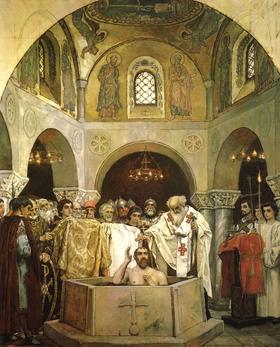
c. 1273
Doctor of the Church
St. Thomas Aquinas Summa Theologiae III, q. 75, a. 1, Reply to Objection 3

“Christ's body is not in this sacrament in the same way as a body is in a place, which by its dimensions is commensurate with the place; but in a special manner which is proper to this sacrament. Hence we say that Christ's body is upon many altars, not as in different places, but "sacramentally": and thereby we do not understand that Christ is there only as in a sign, although a sacrament is a kind of sign; but that Christ's body is here after a fashion proper to this sacrament, as stated above.”

Read it in the source: New Advent

See it on the timeline: The Real Presence and the Ascension

c. 1273
Doctor of the Church
St. Thomas Aquinas Summa Theologiae III, q. 77, a. 6, Reply to Objection 1

“After the consecration bread can be said to be in this sacrament in two ways. First, as to the species, which retain the name of the previous substance … Secondly, Christ's very body can be called bread, since it is the mystical bread "coming down from heaven."”

Read it in the source: New Advent

See it on the timeline: Transubstantiation

1274A medieval wall painting of a pope's head in a tall white tiara with a jewelled band, against a blue ground
Council

Second Council of Lyons

Second Council of Lyons Constitution II, 1, On the supreme Trinity and the catholic faith

“We profess faithfully and devotedly that the holy Spirit proceeds eternally from the Father and the Son, not as from two principles, but as from one principle; not by two spirations, but by one single spiration.”

Read it in the source: Papal Encyclicals Online

See it on the timeline: The ecumenical councils

1274
Council
Michael VIII Palaeologus, Emperor of the Romans Profession of faith, Second Council of Lyons, 1274 (DS 860)

“The same Holy Roman Church also holds and teaches that there are seven sacraments of the Church: one is baptism, which has been mentioned above; another is the sacrament of confirmation which bishops confer by the laying on of hands while they anoint the reborn; then penance, the Eucharist, the sacrament of order, matrimony and extreme unction which, according to the doctrine of the Blessed James, … is administered to the sick.”

Read it in the source: Fordham Sourcebook

See it on the timeline: The seven sacraments

1274A Dominican friar with a tonsure and a gold halo holds an open book and a small church, with a shining sun on his chest
Doctor of the Church
St. Thomas Aquinas Summa Theologiae, Supplement, Q. 30, Art. 1, I answer that

“Now this sacrament is conferred by way of a kind of medicament, even as Baptism is conferred by way of washing, and the purpose of a medicament is to expel sickness. Hence the chief object of the institution of this sacrament is to cure the sickness of sin. Therefore, just as Baptism is a spiritual regeneration, and Penance, a spiritual resurrection, so Extreme Unction is a spiritual healing or cure.”

Read it in the source: New Advent

See it on the timeline: The Anointing of the Sick

1274
Saint

St. Thomas Aquinas, friar and Doctor

Pope Benedict XVI General Audience, 2 June 2010

“While, as was his wont, the Saint was praying before the Crucifix in the early morning in the chapel of St Nicholas in Naples, Domenico da Caserta, the church sacristan, overheard a conversation. Thomas was anxiously asking whether what he had written on the mysteries of the Christian faith was correct. And the Crucified One answered him: "You have spoken well of me, Thomas. What is your reward to be?". And the answer Thomas gave him was what we too, friends and disciples of Jesus, always want to tell him: "Nothing but Yourself, Lord!"”

Read it in the source: vatican.va

See it on the timeline: Saints of the high Middle Ages, 1050 to 1500

1274
Saint

St. Bonaventure, friar, bishop and Doctor

St. Bonaventure Letter on three questions to an unnamed master, as quoted by Benedict XVI, General Audience, 3 March 2010

“I confess before God that the reason which made me love the life of blessed Francis most is that it resembled the birth and early development of the Church. The Church began with simple fishermen, and was subsequently enriched by very distinguished and wise teachers; the religion of Blessed Francis was not established by the prudence of men but by Christ”

Read it in the source: vatican.va

See it on the timeline: Saints of the high Middle Ages, 1050 to 1500

1274A Dominican friar with a tonsure and a gold halo holds an open book and a small church, with a shining sun on his chest
Doctor of the Church

St. Thomas Aquinas, friar and Doctor

St. Thomas Aquinas Summa Theologiae I, q. 1, a. 8, reply to objection 2

“Since therefore grace does not destroy nature but perfects it, natural reason should minister to faith as the natural bent of the will ministers to charity.”

Read it in the source: New Advent

See it on the timeline: The Doctors of the Church

1274
Doctor of the Church

St. Bonaventure, friar, bishop and Doctor

St. Bonaventure The Journey of the Mind into God 1, 15, as quoted by Benedict XVI, General Audience, 17 March 2010

“He who is not brightened by such splendours of created things is blind; he who does not awake at such clamours is deaf; he who does not praise God on account of all these effects is mute; he who does not turn towards the First Principle on account of such indications is stupid”

Read it in the source: vatican.va

See it on the timeline: The Doctors of the Church

1274A medieval wall painting of a pope's head in a tall white tiara with a jewelled band, against a blue ground
Council

The Second Council of Lyons on the procession of the Spirit

Second Council of Lyons Constitution II, 1, On the supreme Trinity and the catholic faith

“We profess faithfully and devotedly that the holy Spirit proceeds eternally from the Father and the Son, not as from two principles, but as from one principle; not by two spirations, but by one single spiration. This the holy Roman church, mother and mistress of all the faithful, has till now professed, preached and taught; this she firmly holds, preaches, professes and teaches; this is the unchangeable and true belief of the orthodox fathers and doctors, Latin and Greek alike.”

Read it in the source: Papal Encyclicals Online

See it on the timeline: The East-West Schism

1274
Council

The Second Council of Lyons: the emperor's profession on the primacy

Emperor Michael VIII Palaeologus Profession of faith read at the Second Council of Lyons, 1274, as quoted by the First Vatican Council, Pastor Aeternus, ch. 4 (1870)

“The holy Roman church possesses the supreme and full primacy and principality over the whole catholic church. She truly and humbly acknowledges that she received this from the Lord himself in blessed Peter, the prince and chief of the apostles, whose successor the Roman pontiff is, together with the fullness of power. And since before all others she has the duty of defending the truth of the faith, so if any questions arise concerning the faith, it is by her judgment that they must be settled.”

Read it in the source: Papal Encyclicals Online

See it on the timeline: The East-West Schism

The full Catholic answer: Papal supremacy

1274A Dominican friar with a tonsure and a gold halo holds an open book and a small church, with a shining sun on his chest
Doctor of the Church
St. Thomas Aquinas Summa Theologiae III, q. 65, a. 1, I answer that

“the sacraments of the Church were instituted for a twofold purpose: namely, in order to perfect man in things pertaining to the worship of God according to the religion of Christian life, and to be a remedy against the defects caused by sin. And in either way it is becoming that there should be seven sacraments.”

Read it in the source: New Advent

See it on the timeline: The seven sacraments

c. 1274
Doctor of the Church
St. Thomas Aquinas Summa Theologiae, Supplement, q. 42, a. 1, I answer that and Reply to Objection 1

“I answer that, A sacrament denotes a sanctifying remedy against sin offered to man under sensible signs. … Wherefore since this is the case in matrimony, it is reckoned among the sacraments. Reply to Objection 1. The words whereby the marriage consent is expressed are the form of this sacrament, and not the priest's blessing, which is a sacramental.”

Read it in the source: New Advent

See it on the timeline: Matrimony

1275
Saint

St. Raymond of Penyafort, Dominican and canon lawyer

Dicastery for the Causes of Saints Profile of St. Raymond of Penyafort, biography

“Death reaches him, when he is 100 years old, on 6 January 1275 in Barcelona, and it is said that during his funeral many miracles took place. He was made a saint in 1601 by Pope Clement VIII, and today his mortal remains are kept in the cathedral of the capital of Catalonia.”

Our translation. The words as written, in Italian:

“La morte lo raggiunge, quando ha 100 anni, il 6 gennaio 1275 a Barcellona, e si dice che durante le sue esequie avvennero molti miracoli. Fu fatto santo nel 1601 da Papa Clemente VIII e oggi i suoi resti mortali sono custoditi nella cattedrale della capitale della Catalogna.”

Read it in the source: Dicastery for the Causes of Saints

See it on the timeline: Saints of the high Middle Ages, 1050 to 1500

1280A wall painting of a Dominican bishop in a mitre seated at a desk with books
Saint

St. Albert the Great, bishop and Doctor

Pope Benedict XVI General Audience, 24 March 2010

“He died in his cell at the convent of the Holy Cross, Cologne, in 1280, and was very soon venerated by his confreres. The Church proposed him for the worship of the faithful with his beatification in 1622 and with his canonization in 1931, when Pope Pius XI proclaimed him Doctor of the Church.”

Read it in the source: vatican.va

See it on the timeline: Saints of the high Middle Ages, 1050 to 1500

1280
Saint

St. Albert the Great, bishop and Doctor

Pope Benedict XVI General Audience, 24 March 2010

“The Bible speaks to us of creation as of the first language through which God who is supreme intelligence, who is the Logos reveals to us something of himself. The Book of Wisdom, for example, says that the phenomena of nature, endowed with greatness and beauty, is like the works of an artist through which, by analogy, we may know the Author of creation (cf. Wis 13: 5).”

Read it in the source: vatican.va

See it on the timeline: Saints of the high Middle Ages, 1050 to 1500

1280
Magisterium

St. Albert the Great, bishop and Doctor

Pope Benedict XVI General Audience, 24 March 2010

“St Albert shows that there is no opposition between faith and science, despite certain episodes of misunderstanding that have been recorded in history. A man of faith and prayer, as was St Albert the Great, can serenely foster the study of the natural sciences and progress in knowledge of the micro- and macrocosm, discovering the laws proper to the subject, since all this contributes to fostering thirst for and love of God.”

Read it in the source: vatican.va

See it on the timeline: The Doctors of the Church

Late thirteenth century
Miracle

Our Lady places the Child Jesus in the arms of Brother Conrad of Offida

The Little Flowers of St. Francis The Little Flowers of St. Francis, ch. 42

“Having finished his prayer, the Virgin Mary obtained his request; and, behold! the Queen of Heaven appeared in great splendour, with her Blessed Son in her arms, and approaching Brother Conrad placed the Holy Child in his arms. He received him most reverently, and embracing him clasped him to his breast, his heart overflowing and burning with divine love and inexpressible consolation.”

Witnesses
Brother Conrad of Offida, and Brother Peter, who saw it from a distance, according to the text
Church ruling
None stated

Read it in the source: CCEL

See it on the timeline: Marian apparitions

1292
Saint

St. Kinga, princess of Kraków and Poor Clare

Pope St. John Paul II Homily at the canonization of Bl. Kinga, Stary Sącz, 16 June 1999

“During unrest within the state, during the struggle for power in a kingdom divided into regions, during the devastating invasions of the Tartars, Saint Kinga was able to rise to the needs of the moment. She worked zealously for the unity of the Piast heritage, and in order to raise the country from ruin she did not hesitate to give away the entire dowry received from her father. … First and foremost, however, she was attentive to the needs of her subjects. The old biographies written on her confirm this, testifying that the people called her their “comforter”, “physician”, “nurse”, “holy mother”.”

Read it in the source: vatican.va

See it on the timeline: Saints of the high Middle Ages, 1050 to 1500

The 1300s1300 to 1399
1302A worn wall painting of a pope in a tall tiara at a balcony hung with a patterned cloth, between two attendants
Magisterium
Pope Boniface VIII Unam Sanctam, opening and closing sentences

“Urged by faith, we are obliged to believe and to maintain that the Church is one, holy, catholic, and also apostolic. We believe in her firmly and we confess with simplicity that outside of her there is neither salvation nor the remission of sins … Furthermore, we declare, we proclaim, we define that it is absolutely necessary for salvation that every human creature be subject to the Roman Pontiff.”

Read it in the source: Papal Encyclicals Online

See it on the timeline: No salvation outside the Church

18 November 1302
Magisterium

Unam Sanctam

Pope Boniface VIII Bull Unam Sanctam, closing sentence

“Furthermore, we declare, we proclaim, we define that it is absolutely necessary for salvation that every human creature be subject to the Roman Pontiff.”

Read it in the source: Papal Encyclicals Online

See it on the timeline: The tradition of the papacy

1301 or 1302
Saint

St. Gertrude the Great, nun of Helfta

St. Gertrude the Great Spiritual Exercises, seventh Exercise, as quoted by Benedict XVI, General Audience, 6 October 2010

“O Jesus, you who are immensely dear to me, be with me always, so that my heart may stay with you and that your love may endure with me with no possibility of division; and bless my passing, so that my spirit, freed from the bonds of the flesh, may immediately find rest in you. Amen”

Read it in the source: vatican.va

See it on the timeline: Saints of the high Middle Ages, 1050 to 1500

1309
Saint

St. Angela of Foligno, Franciscan tertiary and mystic

St. Angela of Foligno The Book of Blessed Angela of Foligno, as quoted by Benedict XVI, General Audience, 13 October 2010

“The more you pray … the more illumined you will be and the more profoundly and intensely you will see the supreme Good, the supremely good Being; the more profoundly and intensely you see him, the more you will love him; the more you love him the more he will delight you; and the more he delights you, the better you will understand him and you will become capable of understanding him. You will then reach the fullness of light, for you will understand that you cannot understand”

Read it in the source: vatican.va

See it on the timeline: Saints of the high Middle Ages, 1050 to 1500

1311-1312
Council

Council of Vienne

Pope Clement V, with the approval of the council Decrees, 1

“Moreover, with the approval of the said council, we reject as erroneous and contrary to the truth of the catholic faith every doctrine or proposition rashly asserting that the substance of the rational or intellectual soul is not of itself and essentially the form of the human body, or casting doubt on this matter.”

Read it in the source: Papal Encyclicals Online

See it on the timeline: The ecumenical councils

1311-1312
Council

The Council of Vienne on abuses by inquisitors

Council of Vienne Decrees, no. 26

“The apostolic see has received many complaints that some inquisitors, appointed by it to suppress heresy, have overstepped the limits of the power given to them. They occasionally so enlarge their authority that what has been wisely provided by the apostolic see for the growth of the faith, oppresses the innocent under pretext of piety and results in harm to the faithful. … The bishop, however, without the inquisitor, or the inquisitor without the diocesan bishop or his officer or the delegate of the chapter when the see is vacant, may not commit to harsh or close imprisonment, which seems more like punishment than custody, or subject anyone to torture or pronounce sentence on anyone, if they can have access to each other within eight days after seeking it”

Read it in the source: Papal Encyclicals Online

See it on the timeline: The Inquisition and the use of force against heresy

1312
Council

The Council of Vienne founds schools of Arabic

Council of Vienne Decree on schools of languages (Constitution 24)

“we decree that in each of these places there should be catholic scholars with adequate knowledge of Hebrew, Arabic and Chaldaic. There are to be two experts for each language in each place. They shall direct the schools, make faithful translations of books from these languages into Latin, and teach others those languages with all earnestness”

Read it in the source: Papal Encyclicals Online

See it on the timeline: Islam and the Church

1312
Council

The Council of Vienne forbids the Muslim call to prayer in Christian lands

Council of Vienne Decree on the Saracens (Constitution 25)

“It is an insult to the holy name and a disgrace to the christian faith that in certain parts of the world subject to christian princes where Saracens live, sometimes apart, sometimes intermingled with Christians, the Saracen priests commonly called Zabazala, in their temples or mosques, in which the Saracens meet to adore the infidel Mahomet, loudly invoke and extol his name each day at certain hours from a high place, in the hearing of both Christians and Saracens and there make public declarations in his honour.”

Read it in the source: Papal Encyclicals Online

See it on the timeline: Islam and the Church

1330The white stone front of a church with two small towers under a deep blue sky
Miracle

The Eucharistic miracle of Cascia

Monastery of St. Rita, Cascia Il Beato Simone Fidati e il Miracolo eucaristico

“The Eucharistic miracle of Cascia took place in 1330, at Siena. In that year a priest, called to attend a dying peasant, put the consecrated host in the parchment of his breviary. After hearing the sick man's confession, he opened the book and saw that the host was giving out blood and had stuck to the page. The priest said he would come back later and went to speak with Brother Simon of Cascia, who was preaching in the city. … Brother Simon, with the priest's consent, took away with him the two bloodstained pages with the liquefied host.”

Our translation. The words as written, in Italian:

“Il miracolo eucaristico di Cascia è avvenuto nel 1330, a Siena. In quell’anno, un sacerdote, chiamato ad assistere un contadino moribondo, mise l’ostia consacrata nella pergamena del suo breviario. Dopo aver confessato il malato, aprì il libro e vide che l’ostia emanava sangue e si era attaccata alla carta. Il sacerdote disse che sarebbe tornato più tardi e andò a parlare con Fra Simone da Cascia, che stava predicando in città. … Fra Simone, con il consenso del sacerdote, portò con sé le due pagine insanguinate con l’ostia liquefatta.”

Witnesses
The priest, who brought the matter to Blessed Simon Fidati of Cascia, an Augustinian then preaching in Siena
Where it can be seen
The Lower Basilica of St. Rita at Cascia, where the page says the relic is venerated. The page says Blessed Simon left the other parchment at the convent of Perugia

Read it in the source: santaritadacascia.org

See it on the timeline: Eucharistic miracles
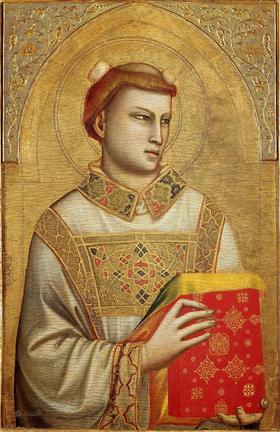
1336
Magisterium
Pope Benedict XII Apostolic Constitution Benedictus Deus (1336)

“By this Constitution which is to remain in force for ever, we, with apostolic authority, define the following: According to the general disposition of God, the souls of all the saints who departed from this world before the passion of our Lord Jesus Christ … Since the passion and death of the Lord Jesus Christ, these souls have seen and see the divine essence with an intuitive vision and even face to face”

Read it in the source: EWTN Library

See it on the timeline: Have popes been heretics?

1336
Magisterium
Pope Benedict XII Benedictus Deus

“According to the general disposition of God, the souls of all the saints who departed from this world before the passion of our Lord Jesus Christ and also of the holy apostles, martyrs, confessors, virgins and other faithful who died after receiving the holy baptism of Christ- provided they were not in need of any purification when they died, or will not be in need of any when they die in the future, or else, if they then needed or will need some purification, after they have been purified after death … all these souls, immediately (mox) after death and, in the case of those in need of purification, after the purification mentioned above, since the ascension of our Lord and Saviour Jesus Christ into heaven, already before they take up their bodies again and before the general judgment, have been, are and will be with Christ in heaven, in the heavenly kingdom and paradise, joined to the company of the holy angels.”

Read it in the source: Papal Encyclicals Online

See it on the timeline: Purgatory

1345
Saint

St. Peregrine Laziosi, Servite friar

Dicastery for the Causes of Saints Profile of St. Peregrine Laziosi

“A religious of the Order of the Servants of Mary who, in keeping with his condition as a servant of the Mother of God, shone in devotion to her Son Jesus and in care for the poor.”

Our translation. The words as written, in Italian:

“Religioso dell’Ordine dei Servi di Maria, che, in coerenza con la sua condizione di servo della Madre di Dio, rifulse nella devozione verso il Figlio Gesù e nella sollecitudine per i poveri”

Read it in the source: Dicastery for the Causes of Saints

See it on the timeline: Saints of the high Middle Ages, 1050 to 1500

1345An old coloured woodcut of a room with a fire in the hearth and figures kneeling, with lines of Dutch text beneath
Miracle

The Miracle of Amsterdam

Pope Francis Address to pilgrims from Amsterdam, 4 May 2024

“The founding and growth of Amsterdam are linked to our faith and the Catholic Church. A key moment in the city’s history is the Eucharistic miracle that took place in 1345 and is still commemorated today by a silent procession and adoration of the Blessed Sacrament.”

Church ruling
Pope Francis speaks of it as a Eucharistic miracle in this address. He cites no decree

Read it in the source: vatican.va

See it on the timeline: Eucharistic miracles
1373A woman in a white veil and wimple with a large gold halo, her head bowed
Saint

St. Bridget of Sweden, widow and foundress

Pope Benedict XVI General Audience, 27 October 2010

“In those years the Pontiffs lived at Avignon, a long way from Rome: Bridget addressed a heartfelt plea to them to return to the See of Peter, in the Eternal City. She died in 1373, before Pope Gregory XI returned to Rome definitively.”

Read it in the source: vatican.va

See it on the timeline: Saints of the high Middle Ages, 1050 to 1500

Before 1373A white-haired pope in a white cassock and skullcap, smiling
Miracle

The revelations of St. Bridget of Sweden

Pope Benedict XVI General Audience, 27 October 2010 (quoting John Paul II, Spes Aedificandi, 5)

“At times the revelations are presented in the form of dialogues between the divine Persons, the Virgin, the Saints and even demons; they are dialogues in which Bridget also takes part. At other times, instead, a specific vision is described; and in yet others what the Virgin Mary reveals to her concerning the life and mysteries of the Son. The value of St Bridget's Revelations, sometimes the object of criticism Venerable John Paul II explained in his Letter Spes Aedificandi: “The Church, which recognized Bridget's holiness without ever pronouncing on her individual revelations, has accepted the overall authenticity of her interior experience” (n. 5).”

Witnesses
Bridget herself
Church ruling
As John Paul II is quoted on this page: the Church recognized Bridget's holiness without ever pronouncing on her individual revelations

Read it in the source: vatican.va

See it on the timeline: Marian apparitions

1373
Miracle

Julian of Norwich sees Our Lady in her showings

Julian of Norwich Revelations of Divine Love, First Revelation, ch. 4 (tr. Grace Warrack)

“In this [Shewing] He brought our blessed Lady to my understanding. I saw her ghostly, in bodily likeness: a simple maid and a meek, young of age and little waxen above a child, in the stature that she was when she conceived. Also God shewed in part the wisdom and the truth of her soul: wherein I understood the reverent beholding in which she beheld her God and Maker, marvelling with great reverence that He would be born of her that was a simple creature of His making.”

Witnesses
Julian herself, describing the first of her showings

Read it in the source: CCEL

See it on the timeline: Marian apparitions

1380A nun in a white habit and black cloak kneels and holds out her hand to Christ, who stands among a group of saints with gold halos
Saint

St. Catherine of Siena, virgin and Doctor

Pope Benedict XVI General Audience, 24 November 2010

“When the fame of her holiness spread, she became the protagonist of an intense activity of spiritual guidance for people from every walk of life: nobles and politicians, artists and ordinary people, consecrated men and women and religious, including Pope Gregory xi who was living at Avignon in that period and whom she energetically and effectively urged to return to Rome.”

Read it in the source: vatican.va

See it on the timeline: Saints through the centuries

1380
Saint

St. Catherine of Siena, virgin and Doctor

St. Catherine of Siena Raymond of Capua, Legenda maior, n. 363, as quoted by Benedict XVI, General Audience, 24 November 2010

“in leaving my body, truly I have consumed and given my life in the Church and for the Holy Church, which is for me a most unique grace”

Read it in the source: vatican.va

See it on the timeline: Saints of the high Middle Ages, 1050 to 1500

1380
Doctor of the Church

St. Catherine of Siena, virgin and Doctor

St. Catherine of Siena Dialogue of Divine Providence, ch. 30, as quoted by Benedict XVI, General Audience, 24 November 2010

“out of mercy you have washed us in his Blood, out of mercy you have wished to converse with creatures. O crazed with love! It did not suffice for you to take flesh, but you also wished to die!... O mercy! My heart drowns in thinking of you: for no matter where I turn to think, I find only mercy”

Read it in the source: vatican.va

See it on the timeline: The Doctors of the Church

1395
Orthodox

A patriarch of Constantinople: the Latins "are not in communion with our church"

Anthony, Patriarch of Constantinople Letter to Vasily I, Grand Prince of Moscow, 1395

“Indeed he enjoys such great authority over all that even the Latins themselves, who are not in communion with our church, render him the same honor and submission which they did in the old days when they were united with us.”

Read it in the source: Fordham Sourcebook

See it on the timeline: The East-West Schism

1399
Saint

St. Hedwig (Jadwiga), Queen of Poland

Pope St. John Paul II Homily at the canonization of Bl. Queen Hedwig, Kraków, 8 June 1997

“Hedwig was also well aware that faith seeks rational understanding, that faith needs culture and forms cultures, that faith lives in the world of culture. And she spared nothing to enrich Poland with the whole spiritual heritage both of ancient times and of the middle ages. She gave to the University even her golden sceptre, using instead one of gilded wood.”

Read it in the source: vatican.va

See it on the timeline: Saints of the high Middle Ages, 1050 to 1500

The 1400s1400 to 1499
6 April 1415A man in a dark robe stands alone in the middle of a hall crowded with seated bishops and cardinals
Council

Council of Constance: a council above the pope

Council of Constance Session 5, decree Haec sancta

“First it declares that, legitimately assembled in the holy Spirit, constituting a general council and representing the catholic church militant, it has power immediately from Christ; and that everyone of whatever state or dignity, even papal, is bound to obey it in those matters which pertain to the faith, the eradication of the said schism and the general reform of the said church of God in head and members.”

Read it in the source: Papal Encyclicals Online

See it on the timeline: The tradition of the papacy

1415
Liturgy

The custom of Communion under one kind made law

Council of Constance Session 13, 15 June 1415

“…this sacrament was received by the faithful under both kinds in the early church, nevertheless later it was received under both kinds only by those confecting it, and by the laity only under the form of bread. For it should be very firmly believed, and in no way doubted, that the whole body and blood of Christ are truly contained under both the form of bread and the form of wine.”

Read it in the source: Papal Encyclicals Online

See it on the timeline: The Mass through the centuries

1415
Council

John Hus handed to the secular court at Constance

Council of Constance Session 15, 6 July 1415, sentence against John Hus

“this holy synod of Constance therefore declares and decrees that the same John Hus is to be deposed and degraded from the order of the priesthood and from the other orders held by him. … This holy synod of Constance, seeing that God’s church has nothing more that it can do, relinquishes John Hus to the judgment of the secular authority and decrees that he is to be relinquished to the secular court.”

Read it in the source: Papal Encyclicals Online

See it on the timeline: The Inquisition and the use of force against heresy

1414-1418
Council

Council of Constance

Council of Constance Session 37, 26 July 1417, sentence against Peter de Luna (Benedict XIII)

“This same holy synod, moreover, as a precautionary measure, since according to himself he actually holds the papacy, deprives, deposes and casts out the said Peter from the papacy and from being the supreme pontiff of the Roman church and from every title, rank, honour, dignity, benefice and office whatsoever. It forbids him to act henceforth as the pope or as the supreme and Roman pontiff.”

Read it in the source: Papal Encyclicals Online

See it on the timeline: The ecumenical councils

7 March 1426 and 1 August 1428
Miracle

Our Lady of Monte Berico, Vicenza, Italy

Sanctuary of Monte Berico Santuario, Origini (sanctuary website)

“The shrine of Santa Maria di Monte Berico arose from two Marian apparitions, on 7 March 1426 and 1 August 1428, on the hill south of the city of Vicenza, at that time planted with vineyards and orchards but without religious or civil settlements. The Madonna appeared to an elderly woman of humble origins: Vincenza Pasini (c. 1356 – 1431). She gave this witness a message of hope, at a time when the whole territory of Vicenza had for more than twenty years been struck by repeated waves of plague. To find again the light of hope, she asked the city, through donna Vincenza, as the seer was called for centuries, to commit itself to building a church dedicated to her on the place of the apparitions. The first stone was laid by Bishop Pietro Emiliani on 25 August 1428.”

Our translation. The words as written, in Italian:

“santuario di Santa Maria di Monte Berico nasce in seguito a due apparizioni mariane, avvenute il 7 marzo 1426 e il 1° agosto 1428, sul colle a sud della città di Vicenza, a quel tempo coltivato con vigne e frutteti, ma privo di insediamenti religiosi e civili. La Madonna apparve a una donna anziana e di umili origini: Vincenza Pasini (1356 ca. – 1431). Consegnò a questa testimone un messaggio di speranza, in un momento storico in cui tutto il territorio vicentino, per più di un ventennio, veniva flagellato da ondate continue della peste. Per ritrovare la luce della speranza, chiese alla città tramite donna Vicenza – come veniva chiamata per secoli la veggente – di impegnarsi nella costruzione di una chiesa a lei dedicata nel luogo delle apparizioni. La prima pietra venne posta dal vescovo Pietro Emiliani il 25 agosto 1428.”

Witnesses
Vincenza Pasini, an elderly woman of humble origins, according to the shrine
Where it can be seen
The Sanctuary of Santa Maria di Monte Berico, Vicenza

Read it in the source: monteberico.it

See it on the timeline: Marian apparitions

1428An elderly pope in green vestments and a white and gold mitre raises his hand in greeting, holding his staff with the crucifix
Miracle

Our Lady of Monte Berico, Vicenza, Italy

Pope St. John Paul II Address at the end of the Rosary, Monte Berico, 7 September 1991, 1

“I know that the Holy Mother of God has been honoured on this blessed Hill since that distant year 1428, when the Bishop of Vicenza recognized the authenticity of the message that Mary had addressed to a humble woman of the place, Vincenza Pasini. The Virgin called the people of the baptized to conversion and to a renewal of a higher commitment of Christian life.”

Our translation. The words as written, in Italian:

“So che la Santa Madre di Dio è onorata su questo Colle benedetto da quel lontano 1428, quando il Vescovo di Vicenza riconobbe l’autenticità del messaggio che Maria aveva rivolto ad un’umile donna del luogo, Vincenza Pasini. La Vergine richiamava il popolo dei battezzati alla conversione e alla ripresa di un più alto impegno di vita cristiana.”

Witnesses
Vincenza Pasini, a humble woman of the place, according to the Pope
Church ruling
In 1428 the Bishop of Vicenza recognized the authenticity of the message, according to the Pope

Read it in the source: vatican.va

See it on the timeline: Marian apparitions

1431A young woman in full armour stands beside an altar holding a white banner, her eyes raised
Saint

St. Joan of Arc, virgin

Pope Benedict XVI General Audience, 26 January 2011

“She asked one of the priests to hold up a processional Cross in front of the stake. Thus she died, her gaze fixed upon the Crucified Jesus and crying out several times the Name of Jesus (PNul, I, p. 457; cf. Catechism of the Catholic Church, n. 435). About 25 years later the Trial of Nullity, which opened under the authority of Pope Calixtus III, ended with a solemn sentence that declared the condemnation null and void (7 July 1456; PNul, II, pp. 604-610).”

Read it in the source: vatican.va

See it on the timeline: Saints of the high Middle Ages, 1050 to 1500

26 May 1432An elderly pope in green vestments and a white and gold mitre raises his hand in greeting, holding his staff with the crucifix
Miracle

Our Lady of Caravaggio, Italy

Pope St. John Paul II Address to the people of Caravaggio, 19 June 1992, 3

“To Giovannetta, a young wife busy gathering grass in the Mazzolengo meadow, "adorning her work with prayers and tears", Mary appeared as a "regal and gentle Lady". It was 26 May 1432. From that day the Shrine of "Our Lady of the Sacred Fountain" has entered the heart of the Lombards.”

Our translation. The words as written, in Italian:

“A Giovannetta, giovane sposa intenta a raccogliere erba sul prato Mazzolengo “ingemmando il suo lavoro di preghiere e di lacrime”, Maria apparve come “regale e soave Signora”. Era il 26 maggio 1432. Da quel giorno, il Santuario di “Nostra Signora del Sacro Fonte” è entrato nel cuore dei lombardi.”

Witnesses
Giovannetta, a young wife gathering grass in the Mazzolengo meadow, according to the Pope
Where it can be seen
The Shrine of Our Lady of the Sacred Fountain, Caravaggio

Read it in the source: vatican.va

See it on the timeline: Marian apparitions

1434
Council

Council of Basel: forced sermons, distinguishing dress, separate quarters

Council of Basel Session 19, 7 September 1434, Decree on Jews and neophytes

“They should not be given other public offices, or admitted to any academic degrees, or allowed to have on lease lands or other ecclesiastical rents. … They are to be compelled, under severe penalties, to wear some garment whereby they can be clearly distinguished from Christians. In order to prevent too much intercourse, they should be made to dwell in areas, in the cities and towns, which are apart from the dwellings of Christians and as far distant as possible from churches.”

Read it in the source: Papal Encyclicals Online

See it on the timeline: The Church and the Jewish people

1439A black and white photograph of a large parchment charter written in two columns, with seals hanging from its lower edge
Council
Council of Florence Session 6, 6 July 1439, definition of union with the Greeks (Laetentur Caeli)

“We also define that the holy apostolic see and the Roman pontiff holds the primacy over the whole world and the Roman pontiff is the successor of blessed Peter prince of the apostles, and that he is the true vicar of Christ, the head of the whole church and the father and teacher of all Christians, and to him was committed in blessed Peter the full power of tending, ruling and governing the whole church, as is contained also in the acts of ecumenical councils and in the sacred canons.”

Read it in the source: Papal Encyclicals Online

See it on the timeline: Papal supremacy

1439
Council
Council of Florence Session 6 (6 July 1439), Definition

“Also, if truly penitent people die in the love of God before they have made satisfaction for acts and omissions by worthy fruits of repentance, their souls are cleansed after death by cleansing pains; and the suffrages of the living faithful avail them in giving relief from such pains, that is, sacrifices of masses, prayers, almsgiving and other acts of devotion which have been customarily performed by some of the faithful for others of the faithful in accordance with the church's ordinances.”

Read it in the source: Papal Encyclicals Online

See it on the timeline: Purgatory

1439
Council

Council of Florence

Council of Florence Session 6, 6 July 1439, definition of union with the Greeks

“We also define that the holy apostolic see and the Roman pontiff holds the primacy over the whole world and the Roman pontiff is the successor of blessed Peter prince of the apostles, and that he is the true vicar of Christ, the head of the whole church and the father and teacher of all Christians, and to him was committed in blessed Peter the full power of tending, ruling and governing the whole church, as is contained also in the acts of ecumenical councils and in the sacred canons.”

Read it in the source: Papal Encyclicals Online

See it on the timeline: The ecumenical councils

6 July 1439
Council

Council of Florence: the primacy defined

Council of Florence Session 6, Laetentur Caeli, definition of union with the Greeks

“We also define that the holy apostolic see and the Roman pontiff holds the primacy over the whole world and the Roman pontiff is the successor of blessed Peter prince of the apostles, and that he is the true vicar of Christ, the head of the whole church and the father and teacher of all Christians, and to him was committed in blessed Peter the full power of tending, ruling and governing the whole church, as is contained also in the acts of ecumenical councils and in the sacred canons.”

Read it in the source: Papal Encyclicals Online

See it on the timeline: The tradition of the papacy

1439
Liturgy

Leavened or unleavened bread

Council of Florence Session 6, 6 July 1439, definition of union with the Greeks

“Also, the body of Christ is truly confected in both unleavened and leavened wheat bread, and priests should confect the body of Christ in either, that is, each priest according to the custom of his western or eastern church.”

Read it in the source: Papal Encyclicals Online

See it on the timeline: The Mass through the centuries

1439
Council
Council of Florence, Pope Eugenius IV Bull Exsultate Deo (Decree for the Armenians), 22 November 1439

“There are seven sacraments of the new Law, namely baptism, confirmation, Eucharist, penance, extreme unction, orders and matrimony, which differ greatly from the sacraments of the old Law. The latter were not causes of grace, but only prefigured the grace to be given through the passion of Christ; whereas the former, ours, both contain grace and bestow it on those who worthily receive them.”

Read it in the source: Papal Encyclicals Online

See it on the timeline: The seven sacraments

1439
Council
Council of Florence Decree for the Armenians (Exsultate Deo), on baptism

“Holy baptism holds the first place among all the sacraments, for it is the gate of the spiritual life; through it we become members of Christ and of the body of the church. Since death came into the world through one person, unless we are born again of water and the spirit, we cannot, as Truth says, enter the kingdom of heaven. The matter of this sacrament is true and natural water, either hot or cold. The form is: I baptize you in the name of the Father and of the Son and of the holy Spirit.”

Read it in the source: Papal Encyclicals Online

See it on the timeline: Baptism

1439
Council
Council of Florence Decree for the Armenians (Exsultate Deo), on baptism

“The minister of this sacrament is a priest, who is empowered to baptize in virtue of his office. But in case of necessity not only a priest or a deacon, but even a lay man or a woman, even a pagan and a heretic, can baptize provided he or she uses the form of the church and intends to do what the church does. The effect of this sacrament is the remission of all original and actual guilt, also of all penalty that is owed for that guilt.”

Read it in the source: Papal Encyclicals Online

See it on the timeline: Baptism

1439
Council
Council of Florence Decree for the Armenians (Exsultate Deo), 1439

“The second sacrament is confirmation. Its matter is chrism made from oil and balsam blessed by a bishop, the oil symbolizing the gleaming brightness of conscience and balsam symbolizing the odour of a good reputation. The form is: I sign you with the sign of the cross and I confirm you with the chrism of salvation in the name of the Father and of the Son and of the holy Spirit. The ordinary minister is a bishop. Whereas a simple priest can use other unctions, only a bishop ought to confer this one, because it is said only of the apostles, whose place is held by bishops, that they gave the holy Spirit by the imposition of hands”

Read it in the source: Papal Encyclicals Online

See it on the timeline: Confirmation

1439
Council
Council of Florence Exsultate Deo, Decree for the Armenians

“The fourth sacrament is penance. Its matter is the acts of the penitent, which are threefold. The first is contrition of heart, which includes sorrow for sin committed, with the resolve not to sin again. The second is oral confession, which implies integral confession to the priest of all sins that are remembered. The third is satisfaction for sins in accordance with the judgment of the priest which is ordinarily done by prayer, fasting and almsgiving. The form of this sacrament are the words of absolution which the priest pronounces when he says: I absolve you.”

Read it in the source: Papal Encyclicals Online

See it on the timeline: Penance and Reconciliation

1439
Council
Council of Florence Exsultate Deo, Decree for the Armenians, on the sacrament of orders

“The sixth is the sacrament of orders. Its matter is the object by whose handing over the order is conferred. So the priesthood is bestowed by the handing over of a chalice with wine and a paten with bread; the diaconate by the giving of the book of the gospels; the subdiaconate by the handing over of an empty chalice with an empty paten on it; and similarly for the other orders by allotting things connected with their ministry. The form for a priest is: Receive the power of offering sacrifice in the church for the living and the dead, in the name of the Father and of the Son and of the holy Spirit. The forms for the other orders are contained in full in the Roman pontifical. The ordinary minister of this sacrament is a bishop. The effect is an increase of grace to make the person a suitable minister of Christ.”

Read it in the source: Papal Encyclicals Online

See it on the timeline: Holy Orders

1439
Council
Council of Florence Decree for the Armenians, Exsultate Deo, 1439

“The seventh is the sacrament of matrimony, which is a sign of the union of Christ and the church according to the words of the apostle: This sacrament is a great one, but I speak in Christ and in the church. The efficient cause of matrimony is usually mutual consent expressed in words about the present. A threefold good is attributed to matrimony. The first is the procreation and bringing up of children for the worship of God. The second is the mutual faithfulness of the spouses towards each other. The third is the indissolubility of marriage, since it signifies the indivisible union of Christ and the church.”

Read it in the source: Papal Encyclicals Online

See it on the timeline: Matrimony

6 July 1439
Council

The Council of Florence: union declared with the emperor and the Eastern patriarchs' deputies

Council of Florence Session 6, 6 July 1439, Laetentur caeli, opening

“With the agreement of our most dear son John Palaeologus, illustrious emperor of the Romans, of the deputies of our venerable brothers the patriarchs and of other representatives of the eastern church, to the following. Let the heavens be glad and let the earth rejoice. For, the wall that divided the western and the eastern church has been removed, peace and harmony have returned, since the corner-stone, Christ, who made both one, has joined both sides with a very strong bond of love and peace”

Read it in the source: Papal Encyclicals Online

See it on the timeline: The East-West Schism

1439
Council

The Council of Florence: the procession of the Spirit

Council of Florence Session 6, 6 July 1439, Laetentur caeli

“We declare that when holy doctors and fathers say that the holy Spirit proceeds from the Father through the Son, this bears the sense that thereby also the Son should be signified, according to the Greeks indeed as cause, and according to the Latins as principle of the subsistence of the holy Spirit, just like the Father. … We define also that the explanation of those words “and from the Son” was licitly and reasonably added to the creed for the sake of declaring the truth and from imminent need.”

Read it in the source: Papal Encyclicals Online

See it on the timeline: The East-West Schism

1439
Council

The Council of Florence: the primacy of the Roman pontiff

Council of Florence Session 6, 6 July 1439, Laetentur caeli

“We also define that the holy apostolic see and the Roman pontiff holds the primacy over the whole world and the Roman pontiff is the successor of blessed Peter prince of the apostles, and that he is the true vicar of Christ, the head of the whole church and the father and teacher of all Christians, and to him was committed in blessed Peter the full power of tending, ruling and governing the whole church, as is contained also in the acts of ecumenical councils and in the sacred canons.”

Read it in the source: Papal Encyclicals Online

See it on the timeline: The East-West Schism

1440
Saint

St. Frances of Rome, wife, mother and foundress

Dicastery for the Causes of Saints Profile of St. Frances of Rome

“A religious who, married at a young age and having lived forty years in marriage, was a wife and mother of spotless virtue, admirable for piety, humility and patience. In times of hardship she gave her goods to the poor, served the sick and, at the death of her husband, withdrew among the oblates whom she herself had gathered in Rome under the rule of Saint Benedict.”

Our translation. The words as written, in Italian:

“Religiosa, che, sposata in giovane età e vissuta per quarant’anni nel matrimonio, fu moglie e madre di specchiata virtù, ammirevole per pietà, umiltà e pazienza. In tempi di difficoltà, distribuì i suoi beni ai poveri, servì i malati e, alla morte del marito, si ritirò tra le oblate che ella stessa aveva riunito a Roma sotto la regola di san Benedetto”

Read it in the source: Dicastery for the Causes of Saints

See it on the timeline: Saints of the high Middle Ages, 1050 to 1500

1442A black and white photograph of a large parchment charter written in two columns, with seals hanging from its lower edge
Council
Council of Florence Session 11, Bull of union with the Copts

“It professes that one and the same God is the author of the old and the new Testament … It accepts and venerates their books, whose titles are as follows. … Tobit, Judith, Esther, Job, Psalms of David, Proverbs, Ecclesiastes, Song of Songs, Wisdom, Ecclesiasticus, Isaiah, Jeremiah, Baruch, Ezechiel, Daniel; … two books of the Maccabees”

Read it in the source: Papal Encyclicals Online

See it on the timeline: The Old Testament canon

1442
Council
Council of Florence Session 11, Bull of union with the Copts (Cantate Domino)

“It firmly believes, professes and preaches that all those who are outside the catholic church, not only pagans but also Jews or heretics and schismatics, cannot share in eternal life and will go into the everlasting fire which was prepared for the devil and his angels, unless they are joined to the catholic church before the end of their lives … and that nobody can be saved, no matter how much he has given away in alms and even if he has shed his blood in the name of Christ, unless he has persevered in the bosom and the unity of the catholic church.”

Read it in the source: Papal Encyclicals Online

See it on the timeline: No salvation outside the Church

4 February 1442A large printed Bible lying open in a display case, each page in two columns of black type
Council

Before the Reformation: the Old Testament books a council named

Council of Florence Session 11, Bull of union with the Copts

“It accepts and venerates their books, whose titles are as follows. … Tobit, Judith, Esther, Job, Psalms of David, Proverbs, Ecclesiastes, Song of Songs, Wisdom, Ecclesiasticus, Isaiah, Jeremiah, Baruch, Ezechiel, Daniel; … two books of the Maccabees”

Read it in the source: Papal Encyclicals Online

See it on the timeline: Protestantism

The full Catholic answer: The Old Testament canon

1444A tall thin friar in a grey habit holds a staff topped with a shining disc, with three mitres on the ground beside him
Saint

St. Bernardine of Siena, Franciscan preacher

St. Bernardine of Siena Sermon 49, On the glorious Name of Jesus Christ, ch. 2, as given among the Holy See's Paths of the Spirit readings

“The name of Jesus is the glory of preachers, because the shining splendor of that name causes his word to be proclaimed and heard. And how do you think such an immense, sudden and dazzling light of faith came into the world, if not because Jesus was preached? … So this name must be proclaimed, that it may shine out and never be suppressed.”

Read it in the source: vatican.va

See it on the timeline: Saints of the high Middle Ages, 1050 to 1500

6 June 1453
Miracle

The Miracle of Turin

Archdiocese of Turin Memoria del «Miracolo di Torino» alla Basilica del Corpus Domini, Brevi cenni storici (June 2025)

“The stolen objects had been loaded on a mule which, according to the account, stopped in front of the church of San Silvestro, refusing to go on and sinking to the ground. The host, which came out of the baskets loaded on the mule, did not fall to the ground but, according to the testimonies, is said to have remained suspended in the air for a long time, until the bishop arrived, and to have come down again at the Gospel invocation "Lord, stay with us!". The basilica of Corpus Domini was built on the place where the miracle happened.”

Our translation. The words as written, in Italian:

“Gli oggetti trafugati erano stati caricati su un mulo che, secondo il racconto, si fermò davanti alla chiesa di San Silvestro, rifiutandosi di proseguire e accasciandosi al suolo. L’ostia, fuoriuscita dalle ceste caricate sul mulo, non cadde a terra ma, secondo e testimonianze, sarebbe rimasta sospesa in aria per lungo tempo, fino all’arrivo del vescovo, e sarebbe ridiscesa all’invocazione evangelica “Signore, resta con noi!”. Sul luogo dove avvenne il miracolo fu eretta la basilica del Corpus Domini.”

Witnesses
The page speaks of testimonies and of the bishop, who came to the place. It names no witness
Church ruling
The Archdiocese of Turin keeps the memorial of the Eucharistic miracle of Turin on 6 June
Where it can be seen
The Basilica of Corpus Domini in Turin stands on the place of the event

Read it in the source: diocesi.torino.it

See it on the timeline: Eucharistic miracles
1456
Saint

St. John of Capistrano, Franciscan preacher

Dicastery for the Causes of Saints Profile of St. John of Capistrano

“A priest of the Order of Friars Minor, who defended the observance of the rule and carried out his ministry through almost the whole of Europe in support of the Catholic faith and morals. With the fervour of his exhortations and prayers he encouraged the faithful people and worked for the defence of the freedom of Christians. He died near Ujlak on the bank of the Danube in the kingdom of Hungary.”

Our translation. The words as written, in Italian:

“Sacerdote dell’Ordine dei Minori, che difese l’osservanza della regola e svolse il suo ministero per quasi tutta l’Europa a sostegno della fede e della morale cattolica. Con il fervore delle sue esortazioni e delle sue preghiere incoraggiò il popolo dei fedeli e si impegnò nella difesa della libertà dei cristiani. Morì presso Ujlak sulla riva del Danubio nel regno di Ungheria”

Read it in the source: Dicastery for the Causes of Saints

See it on the timeline: Saints of the high Middle Ages, 1050 to 1500

1457The white stone front of a church with two small towers under a deep blue sky
Saint

St. Rita of Cascia, widow and Augustinian nun

Dicastery for the Causes of Saints Profile of St. Rita of Cascia

“A religious who, married to a violent man, bore his ill-treatment with patience and in the end reconciled him with God; afterwards, left without husband and sons, she entered the monastery of the Order of Saint Augustine at Cascia in Umbria, offering to all a sublime example of patience and compunction.”

Our translation. The words as written, in Italian:

“Religiosa, che sposata con un uomo violento, sopportò con pazienza i suoi maltrattamenti, riconciliandolo infine con Dio; in seguito, rimasta priva del marito e dei figli, entrò nel monastero dell’Ordine di Sant’Agostino a Cascia in Umbria, offrendo a tutti un sublime esempio di pazienza e di compunzione”

Read it in the source: Dicastery for the Causes of Saints

See it on the timeline: Saints of the high Middle Ages, 1050 to 1500

1463
Saint

St. Catherine of Bologna, Poor Clare abbess

Pope Benedict XVI General Audience, 29 December 2010

“After receiving the last Sacraments, she give her confessor the text she had written: The Seven Spiritual Weapons, and entered her agony; her face grew beautiful and translucent; she still looked lovingly at those who surrounded her and died gently, repeating three times the name of Jesus. It was 9 March 1463 … Catherine was to be canonized by Pope Clement XI on 22 May 1712. Her incorrupt body is preserved in the city of Bologna, in the chapel of the monastery of Corpus Domini.”

Read it in the source: vatican.va

See it on the timeline: Saints of the high Middle Ages, 1050 to 1500

15th century, by tradition
Saint

The promises of Our Lady of the Rosary, from the writings of Bl. Alan de la Roche

Attributed to Bl. Alan de la Roche General Prayer Promises of Our Lady of the Rosary, 1-4 (EWTN)

“1. Whoever shall faithfully serve me by the recitation of the Rosary shall receive signal graces. 2. I promise my special protection and great benefits to all those who shall recite the Rosary. 3. The Rosary shall be a shield against hell, it destroys vice, decreases sin, and defeats heresies. 4. The Rosary brings forth virtue and makes the souls worthy of divine mercy; it substitutes divine love for human love, it elevates great desires for heavenly things. It is, in short, the means which will make you holy.”

Read it in the source: EWTN Library

See it on the timeline: The Rosary

1482
Saint

St. Simon of Lipnica, Franciscan priest

Pope Benedict XVI Homily at the canonization of four saints, 3 June 2007

“The new Saint, Simon of Lipnica, a great son of Poland, a witness of Christ and a follower of the spirituality of St Francis of Assisi, lived in a distant age but precisely today is held up to the Church as a timely model of a Christian who - enlivened by the spirit of the Gospel - was ready to dedicate his life to his brethren. Thus, filled with the mercy he drew from the Eucharist, he did not hesitate to help the sick who were struck by the plague, and he himself contracted this disease which led to his death.”

Read it in the source: vatican.va

See it on the timeline: Saints of the high Middle Ages, 1050 to 1500

1487
Saint

St. Nicholas of Flüe, father of a family and hermit

St. Nicholas of Flüe Prayer, as quoted in CCC 226

“My Lord and my God, take from me everything that distances me from you. My Lord and my God, give me everything that brings me closer to you My Lord and my God, detach me from myself to give my all to you.”

Read it in the source: vatican.va

See it on the timeline: Saints of the high Middle Ages, 1050 to 1500

29 August 1490An elderly pope in green vestments and a white and gold mitre raises his hand in greeting, holding his staff with the crucifix
Miracle

Our Lady of the Guard, Genoa, Italy

Pope St. John Paul II Address at the Shrine of Nostra Signora della Guardia, 22 September 1985

“Here she appeared to the humble and privileged Benedetto Pareto on that distant 29 August 1490 and asked him to build a chapel in her honour. And she appeared to him again afterwards and made him the object of a miraculous healing, so that the devout seer might overcome the difficulties he first met and the authenticity of the apparition might thus be attested.”

Our translation. The words as written, in Italian:

“Qui apparve all’umile e privilegiato Benedetto Pareto nel lontano 29 agosto 1490 e gli domandò di erigere in suo onore una cappella. E gli riapparve successivamente e lo fece oggetto di una guarigione miracolosa affinché il pio veggente potesse superare le difficoltà inizialmente incontrate e fosse così attestata l’autenticità dell’apparizione.”

Witnesses
Benedetto Pareto, according to the Pope
Where it can be seen
The Shrine of Nostra Signora della Guardia, where the Pope spoke

Read it in the source: vatican.va

See it on the timeline: Marian apparitions

1490A white-haired pope in a white cassock and skullcap, smiling
Miracle

Our Lady of the Guard, Genoa, Italy

Pope Benedict XVI Angelus, Genoa, 18 May 2008

“Tradition tells that to Benedetto Pareto, anxious because he did not know how to answer the invitation to build a church in a place so far from the city, the Madonna, in her first apparition, said: "Trust in me! You will not lack the means. With my help everything will be easy for you. Only keep your will firm."”

Our translation. The words as written, in Italian:

“La tradizione narra che a Benedetto Pareto, inquieto perché non sapeva come rispondere all’invito di costruire una chiesa in quel luogo tanto remoto dalla città, la Madonna, nella sua prima apparizione, disse: "Confida in me! I mezzi non ti mancheranno. Con il mio aiuto tutto ti sarà facile. Mantieni solo ferma la tua volontà".”

Witnesses
Benedetto Pareto, as tradition tells it, according to the Pope

Read it in the source: vatican.va

See it on the timeline: Marian apparitions

3 May 1491
Miracle

Our Lady of the Three Ears of Wheat (Trois-Épis), Alsace, France

Diocese of Strasbourg “3 mai 2021 : 530 ans de l'apparition de Notre-Dame aux Trois-Épis” (diocesan website, 2021)

“On 3 May 1491, Thierry Schoéré, a blacksmith on his way to the market of Niedermorschwihr, sees an apparition of the Virgin Mary holding in her right hand three ears of wheat on a single stalk and in the other a piece of ice. Two versions exist of the account of her words. Both urge the inhabitants to choose a virtuous life, to pray and to flee sin, an attitude rewarded by a promise of abundant harvests, well-being and happiness in their homes, symbolised by the ears of wheat.”

Our translation. The words as written, in French:

“Le 3 mai 1491, Thierry Schoéré, un forgeron, qui se rend au marché de Niedermorschwihr voit une apparition de la Vierge Marie tenant dans sa main droite trois épis de blé sur une seule tige et dans l’autre, un glaçon. Deux versions existent du récit de ses propos. Toutes deux incitent les habitants à choisir une vie vertueuse, à prier et à fuir le péché, attitude récompensée par une promesse de récoltes abondantes, de bien-être et de bonheur dans les foyers, symbolisée par les épis de blé.”

Witnesses
Thierry Schoéré, a blacksmith, according to the diocese
Where it can be seen
The shrine of Trois-Épis, Alsace; the page says a wooden chapel was built in 1493

Read it in the source: alsace.catholique.fr

See it on the timeline: Marian apparitions

10 October 1492
Miracle

Our Lady of Gallivaggio, Italy

Diocese of Como Santuari diocesani, Gallivaggio – Apparizione di Maria Vergine (Diocese of Como shrines website)

“The present church is the third to be built on the place where the Madonna appeared to two girls from Lirone and Vhò while they were gathering chestnuts, on Wednesday 10 October 1492. The Virgin showed herself in an extraordinary light and entrusted to the two girls her message of warning, of hope and of a call to a renewed and genuine Christian life, inviting them to prayer and penance to obtain mercy from God. Immediately after the apparition a wooden chapel was built, later replaced by another in masonry.”

Our translation. The words as written, in Italian:

“L’attuale chiesa è la terza ad essere costruita, sul luogo dove a due ragazze di Lirone e Vhò, mentre raccoglievano castagne, apparve la Madonna, il mercoledì 10 ottobre 1492. La Vergine si mostrò in una luce straordinaria e affidò alle due ragazze il suo messaggio di avvertimento, di speranza e di richiamo a una vita cristiana rinnovata e autentica, invitando alla preghiera e alla penitenza per ottenere da Dio misericordia. Subito dopo l’apparizione fu costruita una cappella in legno, poi sostituita da un’altra in muratura.”

Witnesses
Two girls from Lirone and Vhò, gathering chestnuts, according to the diocese
Where it can be seen
The shrine at Gallivaggio

Read it in the source: santuari.diocesidicomo.it

See it on the timeline: Marian apparitions