Tradition Timeline Leave an objection

Start page / Sacraments

Confirmation

Each mark is one quotation. Touch the timeline to read it.
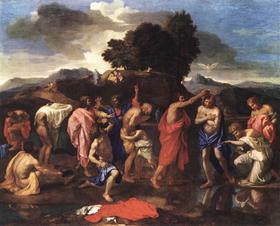
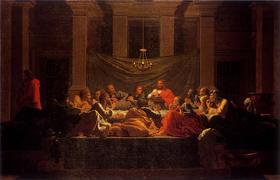
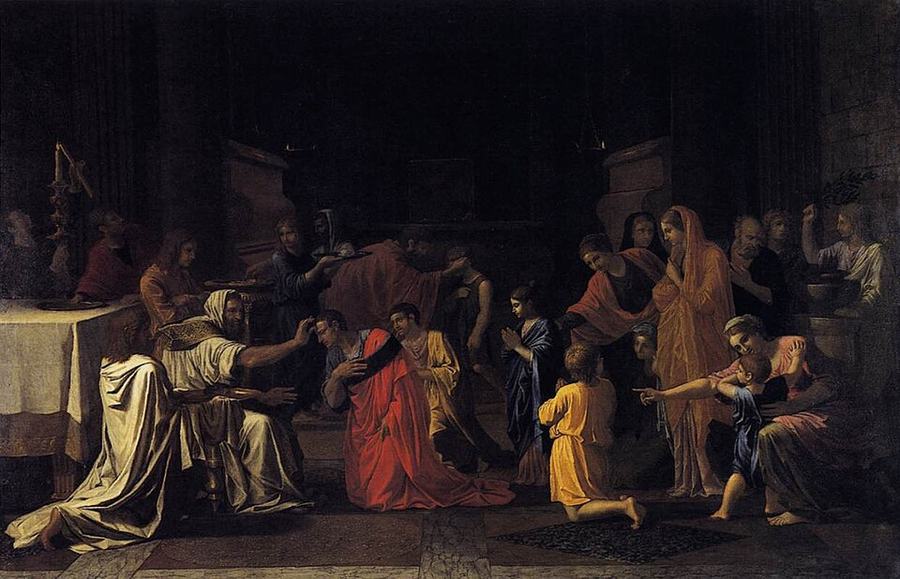
In a dark hall a seated man in white vestments marks the forehead of a kneeling youth, while children and their mothers wait their turn
Confirmation, from the Seven Sacraments by Nicolas Poussin. The young are brought forward to be anointed on the forehead. Painting: Nicolas Poussin, 1645, Public domain, via Wikimedia Commons. Resized.

Confirmation is the sacrament in which the baptized receive the gift of the Holy Spirit by the laying on of hands and anointing with chrism. This timeline begins with Christ's promise of the Spirit and the apostles' laying on of hands in Samaria and Ephesus. It follows the anointing after baptism in the early Church, then the way the West came to reserve the sacrament to the bishop and to separate it in time from Baptism, while the East kept the two together. It ends with the present rite and its words.

Where it starts with Jesus

On the night before he died, Jesus promised his disciples that the Father would give them another Counselor, the Spirit of truth, who would dwell with them and be in them.

“And I will pray the Father, and he will give you another Counselor, to be with you for ever, even the Spirit of truth, whom the world cannot receive, because it neither sees him nor knows him; you know him, for he dwells with you, and will be in you.”

JesusJohn 14:16-17Read it in the source: Bible Gateway, RSV Catholic Edition

How it points to Jesus

The Church holds that this promise was fulfilled at Pentecost and is passed on in Confirmation (CCC 1288). The word Christian means anointed, and the entries below show that the anointing of the baptized was understood from early on as sharing in the anointing of Christ himself. The sacrament does not add a second savior. It gives the Spirit whom Jesus promised, so that the baptized can bear witness to him.

Drafted from primary sources. Every quotation is checked against the page it links to. The way of celebrating Confirmation changed, and the entries show where: Cyprian and Tertullian describe it joined to Baptism, Jerome describes the bishop coming to those baptized by priests, and Florence and Trent name the bishop as its ordinary minister. The words of the rite changed in 1971; Paul VI's constitution is quoted in Latin, the language of the page on vatican.va, with our translation. The Eastern Churches are quoted only where a Catholic source describes their practice.

21 quotations in date order

A work in progress. The quotations below are not all the evidence on this matter. More are being added.

The Old Testamentbefore Christ
Old Testament
Scripture

The Spirit on the Messiah

The prophet Isaiah Isaiah 11:2

“And the Spirit of the Lord shall rest upon him, the spirit of wisdom and understanding, the spirit of counsel and might, the spirit of knowledge and the fear of the Lord.”

Read it in the source: Bible Gateway, RSV Catholic Edition

Old Testament
Scripture

The Spirit poured on all flesh

The prophet Joel Joel 2:28-29

““And it shall come to pass afterward, that I will pour out my spirit on all flesh; your sons and your daughters shall prophesy, your old men shall dream dreams, and your young men shall see visions. Even upon the menservants and maidservants in those days, I will pour out my spirit.”

Read it in the source: Bible Gateway, RSV Catholic Edition

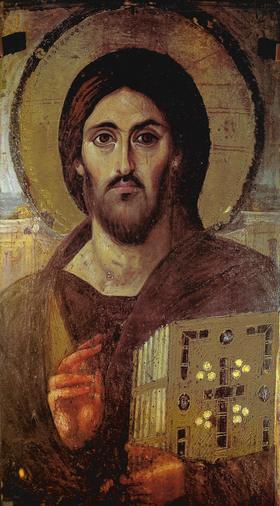
c. 30An ancient painted icon of Christ with a dark beard and a gold halo, his right hand raised in blessing and a jewelled book of the Gospels in his left
Scripture
Jesus Acts 1:8

“But you shall receive power when the Holy Spirit has come upon you; and you shall be my witnesses in Jerusalem and in all Judea and Samar′ia and to the end of the earth.”

Read it in the source: Bible Gateway, RSV Catholic Edition

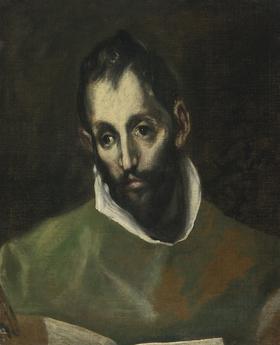
c. 30A dark-haired, bearded man in a green robe with a white collar, his head tilted, looking out at the viewer
Scripture
St. Luke Acts 2:1-4

“When the day of Pentecost had come, they were all together in one place. And suddenly a sound came from heaven like the rush of a mighty wind, and it filled all the house where they were sitting. And there appeared to them tongues as of fire, distributed and resting on each one of them. And they were all filled with the Holy Spirit and began to speak in other tongues, as the Spirit gave them utterance.”

Read it in the source: Bible Gateway, RSV Catholic Edition

c. 30An old man with white hair and beard in a cream cloak and a pallium, looking upward and holding two large keys
Scripture
St. Peter Acts 2:16-18

“but this is what was spoken by the prophet Joel: ‘And in the last days it shall be, God declares, that I will pour out my Spirit upon all flesh, and your sons and your daughters shall prophesy, and your young men shall see visions, and your old men shall dream dreams; yea, and on my menservants and my maidservants in those days I will pour out my Spirit; and they shall prophesy.’”

Read it in the source: Bible Gateway, RSV Catholic Edition

c. 36A dark-haired, bearded man in a green robe with a white collar, his head tilted, looking out at the viewer
Scripture
St. Luke Acts 8:14-17

“Now when the apostles at Jerusalem heard that Samar′ia had received the word of God, they sent to them Peter and John, who came down and prayed for them that they might receive the Holy Spirit; for it had not yet fallen on any of them, but they had only been baptized in the name of the Lord Jesus. Then they laid their hands on them and they received the Holy Spirit.”

Read it in the source: Bible Gateway, RSV Catholic Edition

c. 54
Scripture
St. Luke Acts 19:5-6

“On hearing this, they were baptized in the name of the Lord Jesus. And when Paul had laid his hands upon them, the Holy Spirit came on them; and they spoke with tongues and prophesied.”

Read it in the source: Bible Gateway, RSV Catholic Edition

c. 65
Scripture
Letter to the Hebrews Hebrews 6:1-2

“Therefore let us leave the elementary doctrines of Christ and go on to maturity, not laying again a foundation of repentance from dead works and of faith toward God, with instruction about ablutions, the laying on of hands, the resurrection of the dead, and eternal judgment.”

Read it in the source: Bible Gateway, RSV Catholic Edition

c. 200An engraving of a bearded man in a turban holding a scroll, set in a page of printed French text
Church Father
Tertullian On Baptism, ch. 8, Of the Imposition of Hands

“In the next place the hand is laid on us, invoking and inviting the Holy Spirit through benediction. … Then, over our cleansed and blessed bodies willingly descends from the Father that Holiest Spirit.”

Read it in the source: New Advent

c. 255An engraving of a bearded man in robes holding an open book, standing like a statue in a niche, with a small scene in a landscape on the base below
Church Father
St. Cyprian of Carthage Epistle 72, to Jubaianus, sec. 9

“viz., that prayer being made for them, and hands being imposed, the Holy Spirit should be invoked and poured out upon them, which now too is done among us, so that they who are baptized in the Church are brought to the prelates of the Church, and by our prayers and by the imposition of hands obtain the Holy Spirit, and are perfected with the Lord's seal.”

Read it in the source: New Advent

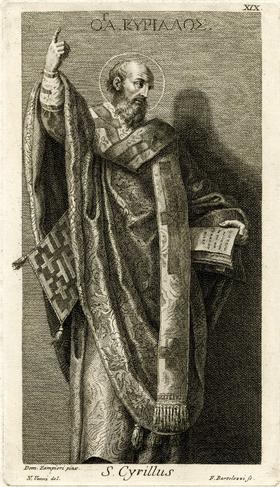
c. 350An engraving of a bearded bishop in Eastern vestments holding a book and raising his right hand in blessing
Church Father
St. Cyril of Jerusalem Catechetical Lecture 21 (Mystagogic Catechesis 3, On the Chrism), sec. 1

“And to you in like manner, after you had come up from the pool of the sacred streams, there was given an Unction, the anti-type of that wherewith Christ was anointed; and this is the Holy Ghost”

Read it in the source: New Advent

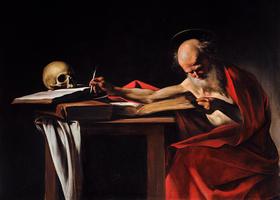
c. 382An old man with a bald head and a red cloak leans over a large book, pen in hand, with a skull resting on another book on the table
Church Father
St. Jerome Dialogue against the Luciferians, sec. 9 (spoken by Orthodoxus)

“But if you now ask how it is that a person baptized in the Church does not receive the Holy Ghost, Whom we declare to be given in true baptism, except by the hands of the bishop, let me tell you that our authority for the rule is the fact that after our Lord's ascension the Holy Ghost descended upon the Apostles. And in many places we find it the practice, more by way of honouring the episcopate than from any compulsory law.”

Read it in the source: New Advent

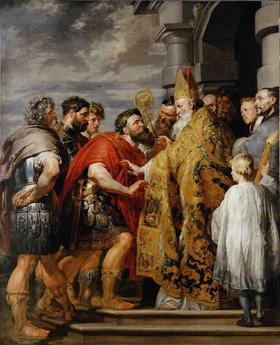
c. 390A bishop in a gold cope and mitre on the steps of a church holds out his hand to stop an emperor in armour and a red cloak
Church Father
St. Ambrose of Milan On the Mysteries, ch. 7, sec. 42

“And then remember that you received the seal of the Spirit; the spirit of wisdom and understanding, the spirit of counsel and strength, the spirit of knowledge and godliness, and the spirit of holy fear, … and preserved what you received. God the Father sealed you, Christ the Lord strengthened you, and gave the earnest of the Spirit in your heart”

Read it in the source: New Advent

The Middle Ages800 to 1500
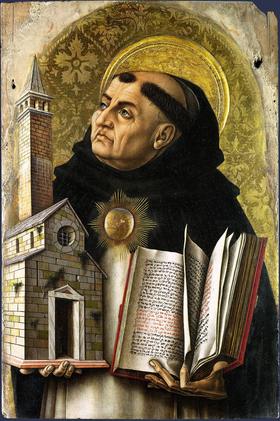
1273A Dominican friar with a tonsure and a gold halo holds an open book and a small church, with a shining sun on his chest
Doctor of the Church
St. Thomas Aquinas Summa Theologiae III, q. 72, a. 11 (I answer that)

“this sacrament of Confirmation is, as it were, the final completion of the sacrament of Baptism; in the sense that by Baptism man is built up into a spiritual dwelling, and is written like a spiritual letter; whereas by the sacrament of Confirmation, like a house already built, he is consecrated as a temple of the Holy Ghost, and as a letter already written, is signed with the sign of the cross. Therefore the conferring of this sacrament is reserved to bishops, who possess supreme power in the Church: just as in the primitive Church, the fulness of the Holy Ghost was given by the apostles, in whose place the bishops stand (Acts 8).”

Read it in the source: New Advent

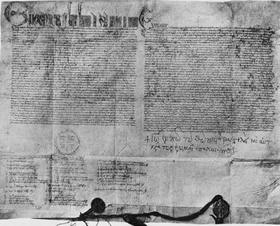
1439A black and white photograph of a large parchment charter written in two columns, with seals hanging from its lower edge
Council
Council of Florence Decree for the Armenians (Exsultate Deo), 1439

“The second sacrament is confirmation. Its matter is chrism made from oil and balsam blessed by a bishop, the oil symbolizing the gleaming brightness of conscience and balsam symbolizing the odour of a good reputation. The form is: I sign you with the sign of the cross and I confirm you with the chrism of salvation in the name of the Father and of the Son and of the holy Spirit. The ordinary minister is a bishop. Whereas a simple priest can use other unctions, only a bishop ought to confer this one, because it is said only of the apostles, whose place is held by bishops, that they gave the holy Spirit by the imposition of hands”

Read it in the source: Papal Encyclicals Online

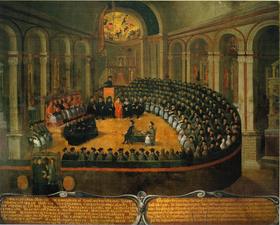
1547Rows of bishops in mitres sit in a great semicircle of benches inside a church, facing the presiding cardinals
Council
Council of Trent Session 7, Canons on Confirmation, Canon 3

“If any one saith, that the ordinary minister of holy confirmation is not the bishop alone, but any simple priest soever; let him be anathema.”

Read it in the source: Papal Encyclicals Online

The Modern Era1800 to today
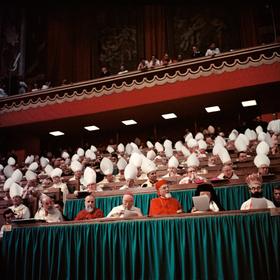
1964Rows of bishops in white mitres and copes sit in tiered stands hung with red and green cloth
Council
Second Vatican Council Lumen Gentium, 11

“They are more perfectly bound to the Church by the sacrament of Confirmation, and the Holy Spirit endows them with special strength so that they are more strictly obliged to spread and defend the faith, both by word and by deed, as true witnesses of Christ”

Read it in the source: vatican.va

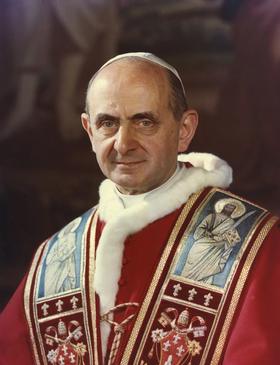
1971A colour photograph of a pope in a red cape trimmed with white fur and an embroidered stole
Magisterium
Pope Paul VI Apostolic Constitution Divinae consortium naturae, 15 August 1971

“we judge that the most ancient formula, proper to the Byzantine rite, should be preferred to it, by which the Gift of the Holy Spirit himself is expressed and the outpouring of the Spirit on the day of Pentecost is recalled (cf. Acts 2:1-4 and 38). … Therefore, so that the revision of the rite of Confirmation may also fittingly bear on the very essence of the sacramental rite, by Our supreme apostolic authority We decree and establish that the following be observed in the Latin Church from now on: The sacrament of Confirmation is conferred through the anointing with chrism on the forehead, which is done by the laying on of the hand, and through the words: "Be sealed with the Gift of the Holy Spirit."”

Our translation. The words as written, in Latin:

“ei tamen praeferendam censemus antiquissimam formulam ritus Byzantini propriam, qua Donum ipsius Spiritus Sancti exprimitur atque effusio Spiritus die Pentecostes peracta recolitur (cf Act 2,1-4 et 38). … Quapropter, ut ritus Confirmationis recognitio ad ipsam etiam ritus sacramentalis essentiam congruenter pertineat, Suprema Nostra Auctoritate Apostolica decernimus et constituimus, ut ea, quae sequuntur, in Ecclesia Latina in posterum serventur: SACRAMENTUM CONFIRMATIONIS CONFERTUR PER UNCTIONEM CHRISMATIS IN FRONTE, QUAE FIT MANUS IMPOSITIONE, ATQUE PER VERBA: «ACCIPE SIGNACULUM DONI SPIRITUS SANCTI».”

Read it in the source: vatican.va
1992
Magisterium
Catechism of the Catholic Church CCC 1290

“In the first centuries Confirmation generally comprised one single celebration with Baptism, forming with it a "double sacrament," according to the expression of St. Cyprian. Among other reasons, the multiplication of infant baptisms all through the year, the increase of rural parishes, and the growth of dioceses often prevented the bishop from being present at all baptismal celebrations. In the West the desire to reserve the completion of Baptism to the bishop caused the temporal separation of the two sacraments. the East has kept them united, so that Confirmation is conferred by the priest who baptizes. But he can do so only with the "myron" consecrated by a bishop.”

Read it in the source: vatican.va
1992
Magisterium
Catechism of the Catholic Church CCC 1286

“In the Old Testament the prophets announced that the Spirit of the Lord would rest on the hoped-for Messiah for his saving mission. The descent of the Holy Spirit on Jesus at his baptism by John was the sign that this was he who was to come, the Messiah, the Son of God. He was conceived of the Holy Spirit; his whole life and his whole mission are carried out in total communion with the Holy Spirit whom the Father gives him "without measure."”

Read it in the source: vatican.va
1992
Magisterium
Catechism of the Catholic Church CCC 1287

“This fullness of the Spirit was not to remain uniquely the Messiah's, but was to be communicated to the whole messianic people. On several occasions Christ promised this outpouring of the Spirit, a promise which he fulfilled first on Easter Sunday and then more strikingly at Pentecost. Filled with the Holy Spirit the apostles began to proclaim "the mighty works of God," and Peter declared this outpouring of the Spirit to be the sign of the messianic age. Those who believed in the apostolic preaching and were baptized received the gift of the Holy Spirit in their turn.”

Read it in the source: vatican.va
Related timelines

The seven sacramentsThe Church teaches that there are seven sacraments, that Christ instituted them, and that they give the grace they signify. This timeline begins with what Scripture shows of Christ acting through signs and sending the apostles. It then follows the early Fathers who spoke of the mysteries and the sacraments, the lists of seven in the Middle Ages, the definitions of Florence and Trent, and what the Second Vatican Council and the Catechism say today.19 quotations, from the Old Testament to 1992BaptismBaptism is the first sacrament, the gateway to life in the Spirit and to the other sacraments. This timeline begins with Christ's own baptism and his command to baptize. It then shows how the Church has baptized and taught baptism in each age: how she prepared those who came, the days she chose, the water and the Trinitarian words, who may baptize, and what the sacrament gives. It shows the dispute over the baptism of those outside the Church, where Pope Stephen and St. Cyprian took opposite sides, and how it was settled. It ends with the Council of Florence, Trent, the Second Vatican Council and the Catechism.20 quotations, from the Old Testament to 1992Baptism and salvation“Baptism does not save anyone. We are saved by grace through faith, and baptism is only an outward sign of a faith we already have.”17 quotations, from the Old Testament to 1992Infant baptism“The Bible says to repent and believe, and then be baptized. A baby can do neither, so infant baptism is not real baptism.”16 quotations, from the Old Testament to 1992The EucharistThe Eucharist is the sacrament in which the Church receives the body and blood of Christ. This timeline follows the Eucharist as a sacrament received: what Christ gave at the Last Supper, who may come to Communion and how they should prepare, Communion as the bond of the Church, Communion for the dying, and how often the faithful received. It shows where the practice changed, for the age of first Communion, the cup and the frequency of Communion, and what the Church says has stayed the same.23 quotations, from the Old Testament to 1992Baptism by pouring“Baptism means immersion. Jesus came up out of the water, and Paul says we are buried with Christ in baptism. Pouring water on someone's head is not baptism.”14 quotations, from the Old Testament to 1992