The Spirit over the waters
“In the beginning God created the heavens and the earth. The earth was without form and void, and darkness was upon the face of the deep; and the Spirit of God was moving over the face of the waters.”

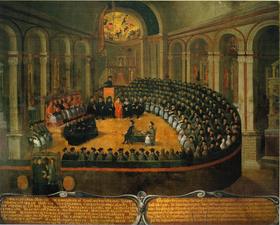
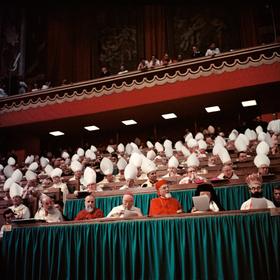
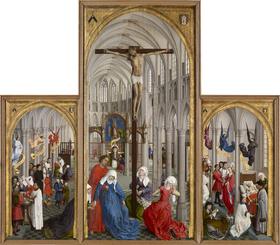
Baptism is the first sacrament, the gateway to life in the Spirit and to the other sacraments. This timeline begins with Christ's own baptism and his command to baptize. It then shows how the Church has baptized and taught baptism in each age: how she prepared those who came, the days she chose, the water and the Trinitarian words, who may baptize, and what the sacrament gives. It shows the dispute over the baptism of those outside the Church, where Pope Stephen and St. Cyprian took opposite sides, and how it was settled. It ends with the Council of Florence, Trent, the Second Vatican Council and the Catechism.
Jesus speaks of birth of water and the Spirit as the way into the kingdom of God. He was himself baptized in the Jordan, and after his resurrection he sent his disciples to baptize.
“Truly, truly, I say to you, unless one is born of water and the Spirit, he cannot enter the kingdom of God.”
JesusJohn 3:5Read it in the source: Bible Gateway, RSV Catholic Edition
The Church baptizes with water and in the name of the Father, the Son and the Holy Spirit because Christ commanded it. In the entries below, baptism joins a person to Christ, and the Church holds that its fruits come from him.
Drafted from primary sources. Every quotation is checked against the page it links to. The way of baptizing has changed in some details, such as the restored catechumenate of 1963, and the timeline shows each at its date. The Church holds that baptism is necessary for salvation, and that baptism of blood and the desire for baptism bring its fruits without being a sacrament. Whether baptism saves, infant baptism and baptism by pouring have their own objection timelines. The canon of Arles is quoted in Latin as it stands in an editor's note in the Schaff edition of Basil, since no preferred host carries the council's canons.
A work in progress. The quotations below are not all the evidence on this matter. More are being added.
“In the beginning God created the heavens and the earth. The earth was without form and void, and darkness was upon the face of the deep; and the Spirit of God was moving over the face of the waters.”
“Then Moses stretched out his hand over the sea; and the Lord drove the sea back by a strong east wind all night, and made the sea dry land, and the waters were divided. And the people of Israel went into the midst of the sea on dry ground, the waters being a wall to them on their right hand and on their left.”
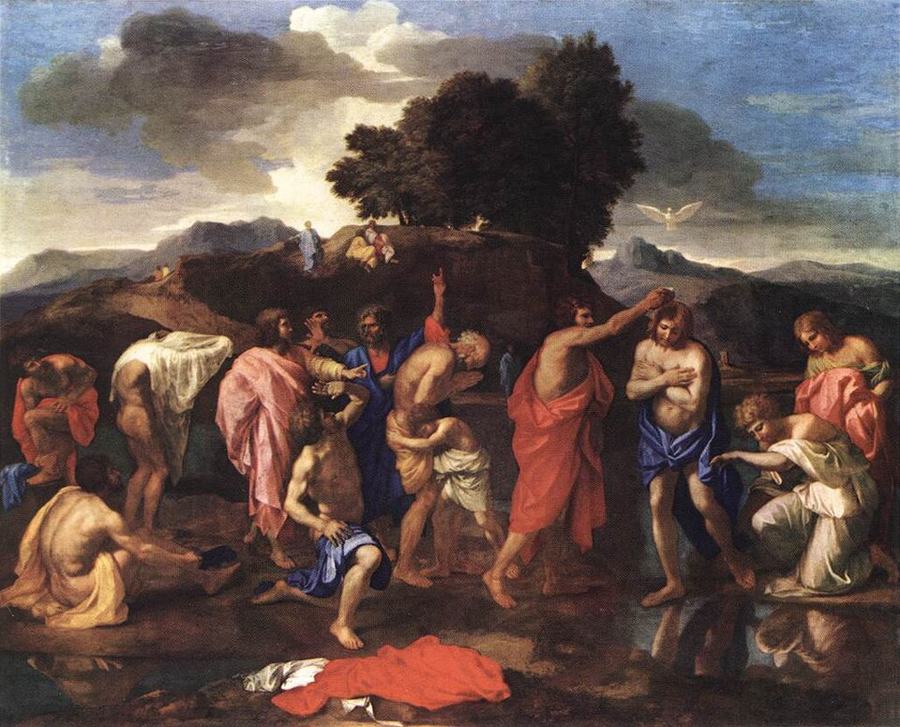
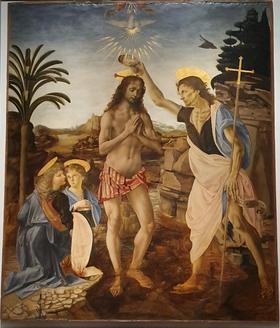
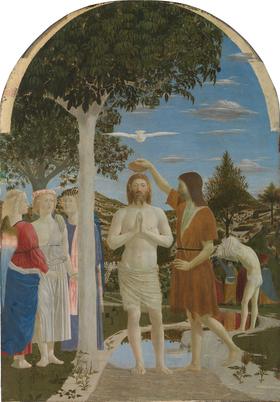
“Then Jesus came from Galilee to the Jordan to John, to be baptized by him. John would have prevented him, saying, “I need to be baptized by you, and do you come to me?” But Jesus answered him, “Let it be so now; for thus it is fitting for us to fulfil all righteousness.” Then he consented. And when Jesus was baptized, he went up immediately from the water, and behold, the heavens were opened and he saw the Spirit of God descending like a dove, and alighting on him; and lo, a voice from heaven, saying, “This is my beloved Son, with whom I am well pleased.””
“And Jesus came and said to them, “All authority in heaven and on earth has been given to me. Go therefore and make disciples of all nations, baptizing them in the name of the Father and of the Son and of the Holy Spirit, teaching them to observe all that I have commanded you; and lo, I am with you always, to the close of the age.””
“As many as are persuaded and believe that what we teach and say is true, and undertake to be able to live accordingly, are instructed to pray and to entreat God with fasting, for the remission of their sins that are past, we praying and fasting with them.”
“We have indeed, likewise, a second font, (itself withal one with the former,) of blood, to wit; concerning which the Lord said, I have to be baptized with a baptism, when He had been baptized already. … This is the baptism which both stands in lieu of the fontal bathing when that has not been received, and restores it when lost.”
“The Passover affords a more than usually solemn day for baptism; when, withal, the Lord's passion, in which we are baptized, was completed. … After that, Pentecost is a most joyous space for conferring baptisms”
“And now also, when we had met together, bishops as well of the province of Africa as of Numidia, to the number of seventy-one, we established this same matter once more by our judgment, deciding that there is one baptism which is appointed in the Catholic Church; and that by this those are not re-baptized, but baptized by us, who at any time come from the adulterous and unhallowed water to be washed and sanctified by the truth of the saving water.”
“If any one, therefore, come to you from any heresy whatever, let nothing be innovated (or done) which has not been handed down, to wit, that hands be imposed on him for repentance; since the heretics themselves, in their own proper character, do not baptize such as come to them from one another, but only admit them to communion.”
“Concerning the Africans, who use their own law to rebaptize: it has been decided that if anyone comes to the Church from heresy, they are to question him on the creed; and if they see that he was baptized in the Father, and the Son and the Holy Spirit, hands only are to be laid on him, that he may receive the Holy Spirit. But if on being asked he does not answer with this Trinity, let him be baptized.”
Our translation. The words as written, in Latin:
“De Afris, quod propria lege sua utuntur ut rebaptizent, placuit, ut, si ad ecclesiam aliquis de hæresi venerit, interrogent eum symbolum; et si perviderint eum in Patre, et Filio et Spiritu Sancto, esse baptizatum, manus ei tantum imponantur, ut accipiat spiritum sanctum. Quod si interrogatus non responderit hanc Trinitatem, baptizetur.”
“After this, you went up to the priest, consider what followed. Was it not that of which David speaks: Like the ointment upon the head, which went down to the beard, even Aaron's beard? … Consider now why this is done, for the eyes of a wise man are in his head; Ecclesiastes 2:14 therefore the ointment flows down to the beard, that is to say, to the beauty of youth; and therefore, Aaron's beard, that we, too, may become a chosen race, priestly and precious, for we are all anointed with spiritual grace for a share in the kingdom of God and in the priesthood.”
“so any one who uses baptism unlawfully, either because he lives in heresy, or because he lives the worst of lives, yet cannot cause that the baptism should be otherwise than good, or altogether null and void. And so, when he is converted either to Catholic unity, or to a mode of living worthy of so great a sacrament, he begins to have not another and a lawful baptism, but that same baptism in a lawful manner.”
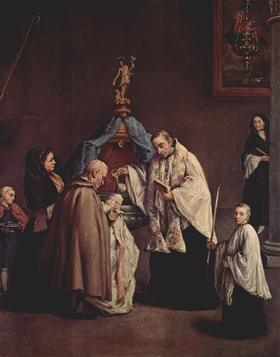
“Holy baptism holds the first place among all the sacraments, for it is the gate of the spiritual life; through it we become members of Christ and of the body of the church. Since death came into the world through one person, unless we are born again of water and the spirit, we cannot, as Truth says, enter the kingdom of heaven. The matter of this sacrament is true and natural water, either hot or cold. The form is: I baptize you in the name of the Father and of the Son and of the holy Spirit.”
“The minister of this sacrament is a priest, who is empowered to baptize in virtue of his office. But in case of necessity not only a priest or a deacon, but even a lay man or a woman, even a pagan and a heretic, can baptize provided he or she uses the form of the church and intends to do what the church does. The effect of this sacrament is the remission of all original and actual guilt, also of all penalty that is owed for that guilt.”
“If any one saith, that the baptism which is even given by heretics in the name of the Father, and of the Son, and of the Holy Ghost, with the intention of doing what the Church doth, is not true baptism; let him be anathema.”
“The catechumenate for adults, comprising several distinct steps, is to be restored and to be taken into use at the discretion of the local ordinary. By this, means the time of the catechumenate, which is intended as a period of suitable instruction, may be sanctified by sacred rites to be celebrated at successive intervals of time.”
“Since the beginning of the world, water, so humble and wonderful a creature, has been the source of life and fruitfulness.”
“But above all, the crossing of the Red Sea, literally the liberation of Israel from the slavery of Egypt, announces the liberation wrought by Baptism”
“The Church has always held the firm conviction that those who suffer death for the sake of the faith without having received Baptism are baptized by their death for and with Christ. This Baptism of blood, like the desire for Baptism, brings about the fruits of Baptism without being a sacrament.”
“Incorporated into Christ by Baptism, the person baptized is configured to Christ. Baptism seals the Christian with the indelible spiritual mark (character) of his belonging to Christ. No sin can erase this mark, even if sin prevents Baptism from bearing the fruits of salvation. Given once for all, Baptism cannot be repeated.”
The seven sacramentsThe Church teaches that there are seven sacraments, that Christ instituted them, and that they give the grace they signify. This timeline begins with what Scripture shows of Christ acting through signs and sending the apostles. It then follows the early Fathers who spoke of the mysteries and the sacraments, the lists of seven in the Middle Ages, the definitions of Florence and Trent, and what the Second Vatican Council and the Catechism say today.
ConfirmationConfirmation is the sacrament in which the baptized receive the gift of the Holy Spirit by the laying on of hands and anointing with chrism. This timeline begins with Christ's promise of the Spirit and the apostles' laying on of hands in Samaria and Ephesus. It follows the anointing after baptism in the early Church, then the way the West came to reserve the sacrament to the bishop and to separate it in time from Baptism, while the East kept the two together. It ends with the present rite and its words.
Baptism and salvation“Baptism does not save anyone. We are saved by grace through faith, and baptism is only an outward sign of a faith we already have.”
Infant baptism“The Bible says to repent and believe, and then be baptized. A baby can do neither, so infant baptism is not real baptism.”
Baptism by pouring“Baptism means immersion. Jesus came up out of the water, and Paul says we are buried with Christ in baptism. Pouring water on someone's head is not baptism.”
The EucharistThe Eucharist is the sacrament in which the Church receives the body and blood of Christ. This timeline follows the Eucharist as a sacrament received: what Christ gave at the Last Supper, who may come to Communion and how they should prepare, Communion as the bond of the Church, Communion for the dying, and how often the faithful received. It shows where the practice changed, for the age of first Communion, the cup and the frequency of Communion, and what the Church says has stayed the same.