Tradition Timeline Leave an objection

Start page / The ages of the Church

The Modern Era

The Modern Era, 1800 to today: all 756 quotations on this site dated to it, from every timeline and every kind of source, in date order.

Each mark is one quotation. Touch the timeline to read it.

Why the Modern Era matters

This age holds the First and Second Vatican Councils, the popes of the last two centuries and the Catechism of the Catholic Church of 1992. Here the Church says in today's words what she holds. Read beside the earlier ages, it shows whether she teaches now what she taught then.

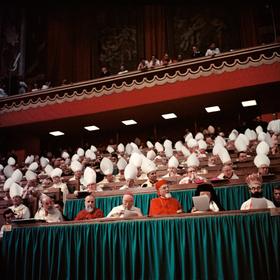
  1. Rows of bishops in white mitres and copes sit in tiered stands hung with red and green cloth

    The Second Vatican Council says the tradition that comes from the apostles develops in the Church, because understanding of what was handed down grows.

    “Therefore the Apostles, handing on what they themselves had received, warn the faithful to hold fast to the traditions which they have learned either by word of mouth or by letter (see 2 Thess. 2:15), and to fight in defense of the faith handed on once and for all (see Jude 1:3) … This tradition which comes from the Apostles develops in the Church with the help of the Holy Spirit. For there is a growth in the understanding of the realities and the words which have been handed down.”

    Second Vatican CouncilDei Verbum 8, 1965Read it in the source: vatican.va

Quotations from the Catechism and from recent popes are dated to the year they were published.

756 quotations in date order

A work in progress. The quotations below are not all the evidence on this matter. More are being added.

The 1800s1800 to 1899
canonized 1807
Miracle

St. Angela Merici, founder of the Company of St. Ursula

Dicastery for the Causes of Saints Profile of St. Angela Merici, biography

“But it is during the journey towards the origins of Christianity that a singular wonder takes place: suddenly, Angela loses her sight; she will regain it only on her return from the Holy Land, while praying before the Crucifix. Far from losing heart, Merici accepts the passing illness as a sign of Providence, so that she may look upon the Holy Places not with the eyes of the body but with those of the spirit.”

Our translation. The words as written, in Italian:

“Ma è proprio durante il viaggio verso le origini del cristianesimo che avviene un prodigio singolare: improvvisamente, Angela perde la vista; la riacquisterà solo al rientro dalla Terra Santa, pregando davanti al Crocifisso. Lungi dallo scoraggiarsi, la Merici accoglie la momentanea malattia come un segno della Provvidenza, così da poter guardare ai Luoghi Santi non con gli occhi del corpo, bensì con quelli dello spirito.”

Read it in the source: Dicastery for the Causes of Saints

See it on the timeline: Saints of reform and mission, 1500 to 1800
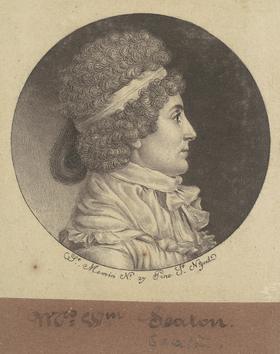
1821A round engraved portrait in profile of a young woman with curled hair tied with a band
Saint

St. Elizabeth Ann Seton, widow and foundress

Pope St. Paul VI Homily at the Canonization of Elizabeth Ann Seton, 14 September 1975

“Elizabeth Ann Bayley Seton is a Saint! She is the first daughter of the United States of America to be glorified with this incomparable attribute!”

Read it in the source: vatican.va

See it on the timeline: Saints of the modern age, 1800 to today

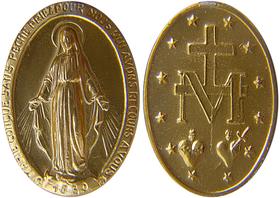
27 November 1830Two sides of an oval gold medal: the Virgin Mary with rays from her hands, and a letter M under a cross above two hearts, ringed with stars
Miracle

The Miraculous Medal, rue du Bac, Paris

Chapel of Our Lady of the Miraculous Medal The apparitions and the Miraculous Medal (chapel website)

“On November 27, 1830, the Blessed Virgin appeared to Catherine again in the chapel. … Then an oval formed around the apparition, and Catherine saw in a semi-circle this invocation: “O Mary conceived without sin, pray for us who have recourse to you,” emblazoned in gold letters. She then heard a voice saying, “Have a medal made according to this model. For those who wear it with confidence, there will be abundant graces.””

Witnesses
Sister Catherine Labouré, a novice of the Daughters of Charity, between July and December 1830

Read it in the source: chapellenotredamedelamedaillemiraculeuse.com

See it on the timeline: Marian apparitions

1830
Miracle

The Miraculous Medal, rue du Bac, Paris

Pope Pius XII Encyclical Le Pèlerinage de Lourdes, 9 (2 July 1957)

“To mention but a single instance, everyone is familiar today with the "miraculous medal." This medal, with its image of "Mary conceived without sin," was revealed to a humble daughter of Saint Vincent de Paul whom We had the joy of inscribing in the catalogue of Saints, and it has spread its spiritual and material wonders everywhere.”

Church ruling
Pius XII says in this encyclical that the medal was revealed to the seer, and that he himself canonized her

Read it in the source: vatican.va

See it on the timeline: Marian apparitions

1745 to 1862
Saint

St. Andrew Dung-Lac and the martyrs of Vietnam

Dicastery for the Causes of Saints Profile of the Martyrs of Vietnam, "I 117 martiri"

“From the first years, the seed of the Faith was mingled in the soil of Vietnam with the abundant blood of the Martyrs, of the missionary clergy as much as of the local clergy and of the Christian people of Vietnam.”

Our translation. The words as written, in Italian:

“Fin dai primi anni, il seme della Fede si è mescolato nella terra vietnamita con il sangue abbondante dei Martiri, tanto del clero missionario quanto del clero locale e del popolo cristiano del Viét-Nam.”

Read it in the source: Dicastery for the Causes of Saints

See it on the timeline: Saints of the modern age, 1800 to today

1839
Orthodox

The Russian catechism: many independent Churches, one Church

Philaret, Metropolitan of Moscow The Longer Catechism of the Orthodox, Catholic, Eastern Church, Q. 261

“How does it agree with the unity of the Church, that there are many separate and independent churches, as those of Jerusalem, Antioch, Alexandria, Constantinople, Russia? These are particular churches, or parts of the one Catholic Church: the separateness of their visible organization does not hinder them from being all spiritually great members of the one body of the Universal Church, from having one Head, Christ, and one spirit of faith and grace. This unity is expressed outwardly by unity of Creed, and by communion in prayer and Sacraments.”

Read it in the source: CCEL

See it on the timeline: The East-West Schism

1839
Orthodox

The Russian catechism: the faith of the seven councils kept unchanged in the East

Philaret, Metropolitan of Moscow The Longer Catechism of the Orthodox, Catholic, Eastern Church, Q. 273

“In the East, in the land of Judæa, our Lord Jesus Christ, having finished the work of our salvation, laid the foundation of his own proper Christian Church: from thence she spread herself over the whole universe; and to this day the orthodox Catholic œcumenical faith, confirmed by the seven œcumenical Councils, is preserved unchanged in its original purity in the ancient Churches of the East, and in such as agree with them, as does by God's grace the Church of Russia.”

Read it in the source: CCEL

See it on the timeline: The East-West Schism

1846A stone bust of a young man in a traditional Korean hat and robe, on a plinth marked with a cross, in front of trees
Saint

St. Andrew Kim Taegon and the martyrs of Korea

Pope St. John Paul II Homily at the Canonization of 103 Korean Martyrs, Seoul, 6 May 1984

“From this good seed was born the first Christian community in Korea, a community unique in the history of the Church by reason of the fact that it was founded entirely by lay people. This fledgling Church, so young and yet so strong in faith, withstood wave after wave of fierce persecution. Thus, in less than a century, it could already boast of some ten thousand martyrs.”

Read it in the source: vatican.va

See it on the timeline: Saints of the modern age, 1800 to today

19 September 1846
Miracle

Our Lady of La Salette, France

Sanctuary of Our Lady of La Salette The history (sanctuary website)

“On 19 September 1846, two children say they met a "Beautiful Lady" in the mountain pastures where they were grazing their cows, above the village of La Salette. Maximin Giraud is 11 and Mélanie Calvat is 14. At first seated and in tears, the "Beautiful Lady" stands and speaks to them at length, in French and in the local dialect, about "her Son", giving examples drawn from their own daily life. She leaves them a Message and charges them to "make it known to all her people".”

Our translation. The words as written, in French:

“Le 19 septembre 1846, deux enfants disent avoir rencontré une « Belle Dame » dans les alpages où ils faisaient paître leurs vaches, au dessus du village de La Salette. Maximin Giraud a 11 ans et Mélanie Calvat 14 ans. D’abord assise et toute en larmes, la « Belle Dame » se lève et leur parle longuement, en français et en patois, de « son Fils » tout en citant des exemples tirés du concret de leur vie. Elle leur laisse un Message en les chargeant de le « faire bien passer à tout son peuple ».”

Witnesses
Two shepherd children, Maximin Giraud, aged 11, and Mélanie Calvat, aged 14

Read it in the source: lasalette.cef.fr

See it on the timeline: Marian apparitions

19 September 1846
Miracle

Our Lady of La Salette, France

Sanctuary of Our Lady of La Salette The history, quoting the decree of Bishop Philibert de Bruillard of Grenoble, 19 September 1851 (sanctuary website)

“On 19 September 1851, after a long and rigorous inquiry, Bishop Philibert de Bruillard of Grenoble declared in a decree: "The apparition of the Blessed Virgin to two shepherds on the mountain of La Salette […] bears in itself all the marks of truth, and the faithful have grounds to believe it beyond doubt and certain."”

Our translation. The words as written, in French:

“Le 19 septembre 1851, après une enquête longue et rigoureuse, Mgr Philibert de Bruillard, l’évêque de Grenoble, déclarera dans un mandement : « L’apparition de la Sainte Vierge à deux bergers sur la montagne de La Salette […] porte en elle-même tous les caractères de la vérité et que les fidèles sont fondés à la croire indubitable et certaine ».”

Investigation
An inquiry of five years under the Bishop of Grenoble
Church ruling
Bishop Philibert de Bruillard of Grenoble, decree of 19 September 1851: the apparition bears all the marks of truth and the faithful have grounds to believe it. In 1855 his successor, Bishop Ginoulhiac, confirmed the decision after a new inquiry

Read it in the source: lasalette.cef.fr

See it on the timeline: Marian apparitions

1848
Orthodox

The Eastern patriarchs on Rome's place in the early Church

The Patriarchs of Constantinople, Alexandria, Antioch and Jerusalem Encyclical of the Eastern Patriarchs, A Reply to the Epistle of Pope Pius IX, § 13 (May 1848)

“Thus he [St. Irenaeus] who is cited by his Holiness as a witness of the primacy of the Roman Church, shows that its dignity is not that of a lordship, nor even appellate, to which St. Peter himself was never ordained, but is a brotherly privilege in the Catholic Church, and an honor assigned the Popes on account of the greatness and privilege of the City.”

Read it in the source: Fordham Sourcebook

See it on the timeline: The East-West Schism

1848
Orthodox

The Filioque rejected

The Patriarchs of Constantinople, Alexandria, Antioch and Jerusalem Encyclical of the Eastern Patriarchs, A Reply to the Epistle of Pope Pius IX, § 5 (May 1848)

“Wherefore the One, Holy, Catholic, and Apostolic Church, following in the steps of the holy Fathers, both Eastern and Western, proclaimed of old to our progenitors and again teaches today synodically, that the said novel doctrine of the Holy Ghost proceeding from the Father and the Son is essentially heresy, and its maintainers, whoever they be, are heretics, according to the sentence of Pope St. Damasus, and that the congregations of such are also heretical, and that all spiritual communion in worship of the orthodox sons of the Catholic Church with such is unlawful.”

Read it in the source: Fordham Sourcebook

See it on the timeline: The East-West Schism

1854A black and white photograph of an old pope in a white cassock seated in an armchair
Magisterium
Pope Pius IX Ineffabilis Deus, the definition

“We declare, pronounce, and define that the doctrine which holds that the most Blessed Virgin Mary, in the first instance of her conception, by a singular grace and privilege granted by Almighty God, in view of the merits of Jesus Christ, the Savior of the human race, was preserved free from all stain of original sin, is a doctrine revealed by God and therefore to be believed firmly and constantly by all the faithful.”

Read it in the source: Papal Encyclicals Online

See it on the timeline: Mary without sin

1854
Magisterium
Pope Pius IX Ineffabilis Deus, Testimonies of Tradition

“…this doctrine always existed in the Church as a doctrine that has been received from our ancestors, and that has been stamped with the character of revealed doctrine. For the Church of Christ, watchful guardian that she is, and defender of the dogmas deposited with her, never changes anything, never diminishes anything, never adds anything to them”

Read it in the source: Papal Encyclicals Online

See it on the timeline: Doctrines defined later

March 1858A rock cave under trees with a white statue in a niche above it and people gathered in front
Miracle

Lourdes: the cure of Louis Bouriette

Sanctuary of Our Lady of Lourdes Miracles et guérisons, list of the cures recognized as miraculous

“Louis BOURIETTE of Lourdes (France). Injury to the right eye dating back 20 years, with amaurosis (loss of sight) for 2 years. Aged 54 in March 1858. Diocese and date of recognition: Tarbes, 18 January 1862.”

Our translation. The words as written, in French:

“Louis BOURIETTE de Lourdes (France). Traumatisme de l’œil droit datant de 20 ans, avec amaurose depuis 2 ans. 54 ans en mars 1858. Diocèse et date de reconnaissance : Tarbes, 18-01-1862.”

Medical finding
The diagnosis on the sanctuary's list: an injury to the right eye twenty years old, with loss of sight for two years
Church ruling
Recognized as miraculous in the diocese of Tarbes, 18 January 1862

Read it in the source: lourdes-france.com

See it on the timeline: Great miracles

11 February to 16 July 1858
Miracle

Our Lady of Lourdes, France

Sanctuary of Our Lady of Lourdes The apparitions, entry for Thursday 25 March 1858 (sanctuary website)

“The vision finally revealed her name, but the wild rose bush, on which she stood during the Apparitions, did not bloom. Bernadette recounted : “She extended her arms towards the ground, then joined them as though in prayer and said Que soy era Immaculada Concepciou (I am the Immaculate Conception)”. The young visionary left and, running all the way, repeated continuously the words that she did not understand.”

Witnesses
Bernadette Soubirous saw the lady. The page counts the crowds who watched her: about one hundred people on 21 February and about eight thousand on 4 March
Investigation
The page records that the police commissioner questioned Bernadette on 21 February and that the parish priest, Fr. Peyramale, demanded the lady's name

Read it in the source: lourdes-france.com

See it on the timeline: Marian apparitions

1858
Miracle

Our Lady of Lourdes, France

Sanctuary of Our Lady of Lourdes The Medical Bureau of the Sanctuary, History (sanctuary website)

“At the time he signed his Decree of 18 January 1862 with the decision concerning the Lourdes Apparitions, Mgr Bertrand-Sévère Laurence, Bishop of Tarbes, used three criteria to establish that the Immaculate Conception had actually appeared to Bernadette Soubirous: reliability of the seer, spiritual fruits, cures of the body. On that same day (18 January 1862), he declared by Decree that seven cures, among the hundreds examined by Prof Henri Vergez, were “miraculous”.”

Medical finding
Seven cures, out of hundreds examined by Prof. Henri Vergez, were declared miraculous in the same decree
Scientific study
The Bureau des Constatations Médicales was established at the shrine in 1883 by Dr. Georges-Fernand Dunot de Saint-Maclou
Church ruling
Bishop Bertrand-Sévère Laurence of Tarbes, decree of 18 January 1862

Read it in the source: lourdes-france.com

See it on the timeline: Marian apparitions

1858
Miracle

Our Lady of Lourdes, France

Pope Pius XII Encyclical Le Pèlerinage de Lourdes, 11 (2 July 1957)

“You know, Beloved Sons and Venerable Brethren, the astonishing circumstances under which the voice of that child, the messenger of the Immaculate, compelled the world's recognition despite ridicule, doubt, and opposition. You know the steadfastness and purity of her testimony, wisely put to the test by episcopal authority and approved as early as 1862.”

Church ruling
Pius XII states that Bernadette's testimony was tested by episcopal authority and approved in 1862

Read it in the source: vatican.va

See it on the timeline: Marian apparitions

1858
Miracle

Our Lady of Lourdes, France

Sanctuary of Our Lady of Lourdes Miraculous healings (sanctuary website)

“Of the more than 7,000 cases of healing reported at Lourdes since the apparitions, 72 have so far been recognised as miraculous by the Church.”

Medical finding
More than 7,000 healings reported; 72 recognised as miraculous by the Church. The page lists each one with its date of recognition, the first seven on 18 January 1862

Read it in the source: lourdes-france.com

See it on the timeline: Marian apparitions

1858
Miracle

Our Lady of Lourdes, France

Pope Benedict XVI Homily at Lourdes for the 150th anniversary of the apparitions, 14 September 2008

““Go and tell the priests that people should come here in procession, and that a chapel should be built here.” This is the message Bernadette received from the “beautiful lady” in the apparition of 2 March 1858. For 150 years, pilgrims have never ceased to come to the grotto of Massabielle to hear the message of conversion and hope which is addressed to them.”

Read it in the source: vatican.va

See it on the timeline: Marian apparitions

1859
Saint

St. John Vianney, the Curé of Ars

Pope Benedict XVI General Audience, 5 August 2009

“St John Mary Vianney thus distinguished himself as an excellent, tireless confessor and spiritual director. Passing "with a single inner impulse from the altar to the confessional", where he spent a large part of the day, he did his utmost with preaching and persuasive advice to help his parishioners rediscover the meaning and beauty of the sacrament of Penance, presenting it as an inherent demand of the Eucharistic presence”

Read it in the source: vatican.va

See it on the timeline: Saints of the modern age, 1800 to today

October 1859A low brick chapel behind trees and a lawn on a sunny day
Miracle

Our Lady of Champion, Wisconsin

Bishop David L. Ricken of Green Bay Decree on the Authenticity of the Apparitions of 1859 at the Shrine of Our Lady of Good Help (2010)

“Incessant prayer has gone up in this place based upon the word of a young Belgian immigrant woman, Adele Brise, who in October 1859 said that the Blessed Mother, a Lady clothed in dazzling white, had appeared to her on this site. The Lady was elevated slightly in a bright light and gave words of solace and comfort and a bold and challenging mission for the young immigrant woman. The Lady gave her a two-fold mission of prayer for the conversion of sinners and catechesis.”

Witnesses
Adele Brise, a young Belgian immigrant, in October 1859
Medical finding
The decree says many physical healings are attributed to prayer at the shrine, and that none has been officially declared a miracle by the Church

Read it in the source: championshrine.org

See it on the timeline: Marian apparitions

October 1859
Miracle

Our Lady of Champion, Wisconsin

Bishop David L. Ricken of Green Bay Decree on the Authenticity of the Apparitions of 1859 at the Shrine of Our Lady of Good Help (2010)

“Three Marian experts have studied the history of this alleged apparition and all of the extant documents, letters, and written testimonies in order to determine whether or not there are inherent contradictions or objections to the veracity of the testimony given by Adele Brise with regard to the events of 1859 … The accounts of the apparitions and locutions are judged to be free from doctrinal error and consistent with the Catholic faith. There is nothing in the person and character of Adele Brise that would question the veracity of the substance of her account.”

Investigation
Three Marian experts studied the history and all the surviving documents, letters and written testimonies
Scientific study
The decree says documents from the early history of the shrine are not abundant, because Green Bay was frontier country at the time

Read it in the source: championshrine.org

See it on the timeline: Marian apparitions

October 1859
Miracle

Our Lady of Champion, Wisconsin

National Shrine of Our Lady of Champion Our Story (shrine website)

“The constant testimony of the Christian faithful since Our Lady’s appearance to Adele, along with numerous divine favors granted, led the bishop of the Diocese of Green Bay, after a formal investigation, to declare the apparition at Champion as ‘worthy of belief’ on December 8th, 2010.”

Investigation
Bishop David L. Ricken of Green Bay opened a formal Church investigation in 2009
Church ruling
Declared worthy of belief by the Bishop of Green Bay on 8 December 2010

Read it in the source: championshrine.org

See it on the timeline: Marian apparitions

18 January 1862A rock cave under trees with a white statue in a niche above it and people gathered in front
Miracle

Lourdes: the bishop's decree on the first seven cures

Sanctuary of Our Lady of Lourdes The Medical Bureau of the Sanctuary, History

“On that same day (18 January 1862), he declared by Decree that seven cures, among the hundreds examined by Prof Henri Vergez, were “miraculous”.”

Investigation
Hundreds of cures were examined by Prof Henri Vergez
Church ruling
Mgr Bertrand-Sévère Laurence, Bishop of Tarbes, declared seven cures miraculous by decree of 18 January 1862

Read it in the source: lourdes-france.com

See it on the timeline: Great miracles

1863A black and white photograph of an old pope in a white cassock seated in an armchair
Magisterium
Pope Pius IX Quanto Conficiamur Moerore 7-8

“Because God knows, searches and clearly understands the minds, hearts, thoughts, and nature of all, his supreme kindness and clemency do not permit anyone at all who is not guilty of deliberate sin to suffer eternal punishments. … Also well known is the Catholic teaching that no one can be saved outside the Catholic Church. Eternal salvation cannot be obtained by those who oppose the authority and statements of the same Church and are stubbornly separated from the unity of the Church and also from the successor of Peter, the Roman Pontiff”

Read it in the source: Papal Encyclicals Online

See it on the timeline: No salvation outside the Church

1863
Magisterium
Pope Pius IX Quanto Conficiamur Moerore 7

“Here, too, our beloved sons and venerable brothers, it is again necessary to mention and censure a very grave error entrapping some Catholics who believe that it is possible to arrive at eternal salvation although living in error and alienated from the true faith and Catholic unity. Such belief is certainly opposed to Catholic teaching. There are, of course, those who are struggling with invincible ignorance about our most holy religion. Sincerely observing the natural law and its precepts inscribed by God on all hearts and ready to obey God, they live honest lives and are able to attain eternal life by the efficacious virtue of divine light and grace.”

Read it in the source: Papal Encyclicals Online

See it on the timeline: Other religions

1870A black and white engraving of hundreds of bishops seated in tiers on either side of a hall, with the pope enthroned at the far end
Council
First Vatican Council Dei Filius, ch. 2, On Revelation

“These books the church holds to be sacred and canonical not because she subsequently approved them by her authority after they had been composed by unaided human skill, nor simply because they contain revelation without error, but because, being written under the inspiration of the holy Spirit, they have God as their author, and were as such committed to the church.”

Read it in the source: Papal Encyclicals Online

See it on the timeline: The inspiration of Scripture

1870
Council
First Vatican Council Dei Filius, ch. 2, On Revelation

“Now since the decree on the interpretation of holy scripture, profitably made by the council of Trent, with the intention of constraining rash speculation, has been wrongly interpreted by some, we renew that decree and declare its meaning to be as follows: that in matters of faith and morals, belonging as they do to the establishing of christian doctrine, that meaning of holy scripture must be held to be the true one, which holy mother church held and holds, since it is her right to judge of the true meaning and interpretation of holy scripture. In consequence, it is not permissible for anyone to interpret holy scripture in a sense contrary to this, or indeed against the unanimous consent of the fathers.”

Read it in the source: Papal Encyclicals Online

See it on the timeline: The authority of the Fathers

1870
Council
First Vatican Council Pastor Aeternus, ch. 1

“It was to Simon alone, to whom he had already said You shall be called Cephas, that the Lord, after his confession, You are the Christ, the son of the living God, spoke these words: Blessed are you, Simon Bar-Jona. For flesh and blood has not revealed this to you, but my Father who is in heaven. And I tell you, you are Peter, and on this rock I will build my church”

Read it in the source: Papal Encyclicals Online

See it on the timeline: Peter the rock

1870
Council
First Vatican Council Pastor Aeternus, ch. 3

“This power of the supreme pontiff by no means detracts from that ordinary and immediate power of episcopal jurisdiction, by which bishops, who have succeeded to the place of the apostles by appointment of the holy Spirit, tend and govern individually the particular flocks which have been assigned to them. On the contrary, this power of theirs is asserted, supported and defended by the supreme and universal pastor; for St Gregory the Great says: "My honour is the honour of the whole church. My honour is the steadfast strength of my brethren. Then do I receive true honour, when it is denied to none of those to whom honour is due."”

Read it in the source: Papal Encyclicals Online

See it on the timeline: Papal supremacy

1870
Council
First Vatican Council Pastor Aeternus, ch. 4

“For the holy Spirit was promised to the successors of Peter not so that they might, by his revelation, make known some new doctrine, but that, by his assistance, they might religiously guard and faithfully expound the revelation or deposit of faith transmitted by the apostles.”

Read it in the source: Papal Encyclicals Online

See it on the timeline: Papal infallibility

1870
Council
First Vatican Council Pastor Aeternus, ch. 4

“The Roman pontiffs, too, … defined as doctrines to be held those things which, by God’s help, they knew to be in keeping with sacred scripture and the apostolic traditions.”

Read it in the source: Papal Encyclicals Online

See it on the timeline: Have popes been heretics?

1870
Council
First Vatican Council Pastor Aeternus, ch. 2

“That which our lord Jesus Christ, the prince of shepherds and great shepherd of the sheep, established in the blessed apostle Peter, for the continual salvation and permanent benefit of the church, must of necessity remain for ever, by Christ’s authority, in the church which, founded as it is upon a rock, will stand firm until the end of time”

Read it in the source: Papal Encyclicals Online

See it on the timeline: Constantine and the Church

1870
Council
First Vatican Council Dei Filius, ch. 4, On faith and reason

“For the doctrine of the faith which God has revealed is put forward not as some philosophical discovery capable of being perfected by human intelligence, but as a divine deposit committed to the spouse of Christ to be faithfully protected and infallibly promulgated. … May understanding, knowledge and wisdom increase as ages and centuries roll along, and greatly and vigorously flourish, in each and all, in the individual and the whole church: but this only in its own proper kind, that is to say, in the same doctrine, the same sense, and the same understanding”

Read it in the source: Papal Encyclicals Online

See it on the timeline: Doctrines defined later

1870
Council
First Vatican Council Pastor Aeternus, ch. 4

“For the holy Spirit was promised to the successors of Peter not so that they might, by his revelation, make known some new doctrine, but that, by his assistance, they might religiously guard and faithfully expound the revelation or deposit of faith transmitted by the apostles.”

Read it in the source: Papal Encyclicals Online

See it on the timeline: Was the Church corrupted early?

1870
Council
First Vatican Council Dei Filius, ch. 2, On Revelation

“The same holy mother church holds and teaches that God, the source and end of all things, can be known with certainty from the consideration of created things, by the natural power of human reason … It was, however, pleasing to his wisdom and goodness to reveal himself and the eternal laws of his will to the human race by another, and that a supernatural, way.”

Read it in the source: Papal Encyclicals Online

See it on the timeline: Islam and the one God

1869-1870
Council

First Vatican Council

First Vatican Council Pastor Aeternus, ch. 4, the definition

“…we teach and define as a divinely revealed dogma that when the Roman pontiff speaks EX CATHEDRA, that is, when, in the exercise of his office as shepherd and teacher of all Christians, in virtue of his supreme apostolic authority, he defines a doctrine concerning faith or morals to be held by the whole church, he possesses, by the divine assistance promised to him in blessed Peter, that infallibility which the divine Redeemer willed his church to enjoy in defining doctrine concerning faith or morals.”

Read it in the source: Papal Encyclicals Online

See it on the timeline: The ecumenical councils

18 July 1870
Council

First Vatican Council: the primacy given to Peter by Christ

First Vatican Council Pastor Aeternus, ch. 1

“We teach and declare that, according to the gospel evidence, a primacy of jurisdiction over the whole church of God was immediately and directly promised to the blessed apostle Peter and conferred on him by Christ the lord.”

Read it in the source: Papal Encyclicals Online

See it on the timeline: The tradition of the papacy

18 July 1870
Council

First Vatican Council: whoever succeeds to the chair of Peter

First Vatican Council Pastor Aeternus, ch. 2

“Therefore whoever succeeds to the chair of Peter obtains by the institution of Christ himself, the primacy of Peter over the whole church. So what the truth has ordained stands firm, and blessed Peter perseveres in the rock-like strength he was granted, and does not abandon that guidance of the church which he once received”

Read it in the source: Papal Encyclicals Online

See it on the timeline: All the popes in order, from St. Peter to today

1870
Miracle

Miracles as signs of revelation

First Vatican Council Dei Filius, ch. 3, On Faith

“Nevertheless, in order that the submission of our faith should be in accordance with reason, it was God’s will that there should be linked to the internal assistance of the holy Spirit external indications of his revelation, that is to say divine acts, and first and foremost miracles and prophecies, which clearly demonstrating as they do the omnipotence and infinite knowledge of God, are the most certain signs of revelation and are suited to the understanding of all.”

Read it in the source: Papal Encyclicals Online

See it on the timeline: Great miracles

1870
Miracle

Miracles as signs of revelation

First Vatican Council Dei Filius, canons on faith, canon 4

“If anyone says that all miracles are impossible, and that therefore all reports of them, even those contained in sacred scripture, are to be set aside as fables or myths; or that miracles can never be known with certainty, nor can the divine origin of the christian religion be proved from them: let him be anathema.”

Read it in the source: Papal Encyclicals Online

See it on the timeline: Great miracles

1870
Council

Vatican I: faith and reason cannot really disagree

First Vatican Council Dogmatic Constitution Dei Filius, chapter 4, On faith and reason

“Even though faith is above reason, there can never be any real disagreement between faith and reason, since it is the same God who reveals the mysteries and infuses faith, and who has endowed the human mind with the light of reason. God cannot deny himself, nor can truth ever be in opposition to truth. The appearance of this kind of specious contradiction is chiefly due to the fact that either the dogmas of faith are not understood and explained in accordance with the mind of the church, or unsound views are mistaken for the conclusions of reason.”

Read it in the source: Papal Encyclicals Online

See it on the timeline: The Galileo case

1870
Council

The First Vatican Council: the pope's jurisdiction over the whole Church

First Vatican Council Session 4, Pastor Aeternus, ch. 3, canon

“if anyone says that the Roman pontiff has merely an office of supervision and guidance, and not the full and supreme power of jurisdiction over the whole church, and this not only in matters of faith and morals, but also in those which concern the discipline and government of the church dispersed throughout the whole world; or that he has only the principal part, but not the absolute fullness, of this supreme power; or that this power of his is not ordinary and immediate both over all and each of the churches and over all and each of the pastors and faithful: let him be anathema.”

Read it in the source: Papal Encyclicals Online

See it on the timeline: The East-West Schism

1870
Council

The First Vatican Council: papal infallibility

First Vatican Council Session 4, Pastor Aeternus, ch. 4

“we teach and define as a divinely revealed dogma that when the Roman pontiff speaks EX CATHEDRA, that is, when, in the exercise of his office as shepherd and teacher of all Christians, in virtue of his supreme apostolic authority, he defines a doctrine concerning faith or morals to be held by the whole church, he possesses, by the divine assistance promised to him in blessed Peter, that infallibility which the divine Redeemer willed his church to enjoy in defining doctrine concerning faith or morals.”

Read it in the source: Papal Encyclicals Online

See it on the timeline: The East-West Schism

1870
Council
First Vatican Council Pastor Aeternus, ch. 4, the definition

“…we teach and define as a divinely revealed dogma that when the Roman pontiff speaks EX CATHEDRA, that is, when, in the exercise of his office as shepherd and teacher of all Christians, in virtue of his supreme apostolic authority, he defines a doctrine concerning faith or morals to be held by the whole church, he possesses, by the divine assistance promised to him in blessed Peter, that infallibility which the divine Redeemer willed his church to enjoy in defining doctrine concerning faith or morals. Therefore, such definitions of the Roman pontiff are of themselves, and not by the consent of the church, irreformable.”

Read it in the source: Papal Encyclicals Online

See it on the timeline: Papal infallibility

1870
Council
First Vatican Council Pastor Aeternus, ch. 4

“This gift of truth and never-failing faith was therefore divinely conferred on Peter and his successors in this see so that they might discharge their exalted office for the salvation of all, and so that the whole flock of Christ might be kept away by them from the poisonous food of error and be nourished with the sustenance of heavenly doctrine.”

Read it in the source: Papal Encyclicals Online

See it on the timeline: Have popes been heretics?

18 July 1870
Council

First Vatican Council: full and supreme power of jurisdiction

First Vatican Council Pastor Aeternus, ch. 3, canon

“So, then, if anyone says that the Roman pontiff has merely an office of supervision and guidance, and not the full and supreme power of jurisdiction over the whole church, and this not only in matters of faith and morals, but also in those which concern the discipline and government of the church dispersed throughout the whole world … let him be anathema.”

Read it in the source: Papal Encyclicals Online

See it on the timeline: The tradition of the papacy

18 July 1870
Council

First Vatican Council: the bishops keep their own authority

First Vatican Council Pastor Aeternus, ch. 3

“This power of the supreme pontiff by no means detracts from that ordinary and immediate power of episcopal jurisdiction, by which bishops, who have succeeded to the place of the apostles by appointment of the holy Spirit, tend and govern individually the particular flocks which have been assigned to them. On the contrary, this power of theirs is asserted, supported and defended by the supreme and universal pastor; for St Gregory the Great says: "My honour is the honour of the whole church.”

Read it in the source: Papal Encyclicals Online

See it on the timeline: The tradition of the papacy

18 July 1870
Council

First Vatican Council: papal infallibility defined

First Vatican Council Pastor Aeternus, ch. 4, the definition

“we teach and define as a divinely revealed dogma that when the Roman pontiff speaks EX CATHEDRA, that is, when, in the exercise of his office as shepherd and teacher of all Christians, in virtue of his supreme apostolic authority, he defines a doctrine concerning faith or morals to be held by the whole church, he possesses, by the divine assistance promised to him in blessed Peter, that infallibility which the divine Redeemer willed his church to enjoy in defining doctrine concerning faith or morals.”

Read it in the source: Papal Encyclicals Online

See it on the timeline: The tradition of the papacy

3 January 1871
Saint

St. Kuriakose Elias Chavara, priest and founder in Kerala

Dicastery for the Causes of Saints Profile of St. Kuriakose Elias Chavara of the Holy Family, "Vita e opere", quoting his last words

“On 2 January 1871, knowing that his hour had come, he said to his brethren: "My time has come. Having always had the protection of the Holy Family, I have never lost the grace received in baptism. I dedicate our little congregation and each one of you to the Holy Family. May it reign in your hearts."”

Our translation. The words as written, in Italian:

“Il 2 gennaio 1871, sapendo che la sua ora era giunta, disse ai suoi confratelli: “È giunto il mio tempo. Avendo sempre avuto la protezione della Sacra Famiglia, non ho mai perso la grazia ricevuta nel battesimo. Dedico la nostra piccola congregazione e ciascuno di voi alla Sacra Famiglia. Possa essa regnare nei vostri cuori.””

Read it in the source: Dicastery for the Causes of Saints

See it on the timeline: Saints of the modern age, 1800 to today

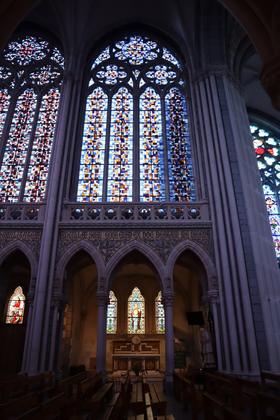
17 January 1871The tall nave of a Gothic church lit by blue stained-glass windows
Miracle

Our Lady of Pontmain, France

Sanctuary of Pontmain The account of the apparition (sanctuary website)

“For three hours, Eugène and Joseph Barbedette, Françoise Richer and Jeanne-Marie Lebossé gaze at the "Beautiful Lady", dressed in a blue robe strewn with stars, with a black veil on her head and a golden crown with a red band, and on her feet blue slippers with a golden buckle. She holds her hands out and smiles at the children. She appears within a triangle formed by three large golden stars in the open sky.”

Our translation. The words as written, in French:

“Pendant 3 heures, Eugène et Joseph Barbedette, Françoise Richer et Jeanne-Marie Lebossé vont contempler la « Belle Dame » vêtue d’une robe bleue parsemée d’étoiles, avec un voile noir sur la tête et une couronne d’or avec un liseré rouge, aux pieds des chaussons bleus avec une boucle d’or. Elle tend les mains en avant et sourit aux enfants. Elle apparaît dans un triangle formé par trois grosses étoiles d’or en plein ciel.”

Witnesses
Four children: Eugène and Joseph Barbedette, Françoise Richer and Jeanne-Marie Lebossé. The villagers and the parish priest, Fr. Michel Guérin, gathered and prayed with them

Read it in the source: sanctuaire-pontmain.fr

See it on the timeline: Marian apparitions

17 January 1871
Miracle

Our Lady of Pontmain, France

Sanctuary of Pontmain The history (sanctuary website)

“For three hours, Mary lights up the sky of Pontmain before a few children surrounded by the parish community and its priest, Fr. Guérin … The apparition is officially recognized by Bishop Wicart of Laval.”

Our translation. The words as written, in French:

“Pendant 3 heures, Marie illumine le ciel de Pontmain devant quelques enfants entourés de la communauté paroissiale et de son curé l’Abbé Guérin … L’apparition est reconnue officiellement par Monseigneur Wicart, évêque de Laval.”

Church ruling
Officially recognized by Bishop Wicart of Laval on 2 February 1872

Read it in the source: sanctuaire-pontmain.fr

See it on the timeline: Marian apparitions

7 April 1875A rock cave under trees with a white statue in a niche above it and people gathered in front
Miracle

Lourdes: the cure of Pierre De Rudder

Sanctuary of Our Lady of Lourdes Miracles et guérisons, list of the cures recognized as miraculous

“Pierre DE RUDDER of Jabbeke (Belgium). Open fracture of the left leg, with pseudarthrosis (a break that had failed to knit). Aged 52 on 7 April 1875. Diocese and date of recognition: Bruges (Belgium), 25 July 1908.”

Our translation. The words as written, in French:

“Pierre DE RUDDER de Jabbeke (Belgique). Fracture ouverte de la jambe gauche, avec pseudarthrose. 52 ans au 07-04-1875. Diocèse et date de reconnaissance : Bruges (Belgique) 25-07-1908.”

Medical finding
The diagnosis on the sanctuary's list: an open fracture of the left leg that had not united
Church ruling
Recognized as miraculous in the diocese of Bruges, 25 July 1908

Read it in the source: lourdes-france.com

See it on the timeline: Great miracles

1876
Miracle

Our Lady of Mercy, Pellevoisin, France

Dicastery for the Doctrine of the Faith Letter to the Archbishop of Bourges on the Spiritual Experience of Estelle Faguette, 22 August 2024

“During a serious and incurable illness, Estelle Faguette experienced at Pellevoisin the presence of the Virgin Mary, who spoke to her on several occasions about the love of Jesus Christ. Estelle’s healing, which surpassed all natural explanations, was confirmed to be miraculous by the Archbishop of Bourges on 8 September 1983, with the consent of the Holy See.”

Witnesses
Estelle Faguette
Medical finding
Her healing was confirmed to be miraculous by the Archbishop of Bourges on 8 September 1983, with the consent of the Holy See

Read it in the source: vatican.va

See it on the timeline: Marian apparitions

1876
Miracle

Our Lady of Mercy, Pellevoisin, France

Dicastery for the Doctrine of the Faith Letter to the Archbishop of Bourges on the Spiritual Experience of Estelle Faguette, 22 August 2024, conclusion

“not only can I say that there are no doctrinal, moral, or other objections to this spiritual event and that the faithful “are authorized to give to it their adherence in a prudent manner” (Norms, Art. 22 § 1),but, in this case, the devotion—which is already thriving—is also recommended especially for those who freely wish to adhere to it. … Therefore, it is now possible to issue the relevant decree of nihil obstat that you have proposed.”

Church ruling
Nihil obstat: the Dicastery for the Doctrine of the Faith, by letter of 22 August 2024 signed by Cardinal Víctor Manuel Fernández and marked with an audience with Pope Francis the same day, allowed the Archbishop of Bourges to issue the decree

Read it in the source: vatican.va

See it on the timeline: Marian apparitions

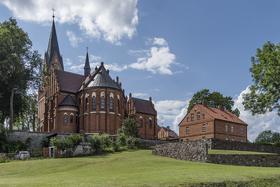
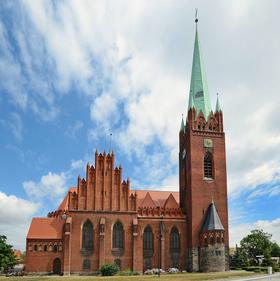
27 June to 16 September 1877A red brick church with a tall spire beside other brick buildings, across a lawn
Miracle

Our Lady of Gietrzwałd, Poland

Sanctuary of Our Lady of Gietrzwałd History: The apparitions of the Mother of God at Gietrzwałd (sanctuary website)

“Gietrzwałd became famous through the apparitions of the Mother of God, which took place nineteen years after the apparitions at Lourdes and lasted from 27 June to 16 September 1877. The chief visionaries were thirteen-year-old Justyna Szafryńska and twelve-year-old Barbara Samulowska. … To the girls' question, "Who are you?", she answered: "I am the Most Holy Virgin Mary, Immaculately Conceived!" To the question, "What do you ask, Mother of God?", the answer came: "I wish you to pray the rosary every day!"”

Our translation. The words as written, in Polish:

“Gietrzwałd stał się sławny dzięki Objawieniom Matki Bożej, które miały miejsce dziewiętnaście lat po Objawieniach w Lourdes i trwały od 27 czerwca do 16 września 1877 roku. Głównymi wizjonerkami były: trzynastoletnia Justyna Szafryńska i dwunastoletnia Barbara Samulowska. … Na zapytanie dziewczynek: Kto Ty Jesteś? Odpowiedziała: "Jestem Najświętsza Panna Maryja Niepokalanie Poczęta!" Na pytanie: Czego żądasz Matko Boża? Padła odpowiedź: "Życzę sobie, abyście codziennie odmawiali różaniec!".”

Witnesses
Justyna Szafryńska, aged thirteen, and Barbara Samulowska, aged twelve

Read it in the source: sanktuariummaryjne.pl

See it on the timeline: Marian apparitions

1877
Miracle

Our Lady of Gietrzwałd, Poland

Sanctuary of Our Lady of Gietrzwałd History: The apparitions of the Mother of God at Gietrzwałd, on the bishop's inquiry (sanctuary website)

“The then Bishop of Warmia, Filip Krementz, took an interest in the events at Gietrzwałd. First he required a detailed report from the parish priest, and then he sent canons of the Cathedral Chapter to Gietrzwałd to take part in the rosary devotions, to observe the state and conduct of the visionaries during the apparitions, to draw up records of their testimony and to gather the observations of pilgrims and clergy. The reports of the bishop's delegates confirmed that there could be no question of fraud or lying in the apparitions, and that the girls behaved normally.”

Our translation. The words as written, in Polish:

“Wydarzeniami gietrzwałdzkimi interesował się ówczesny biskup warmiński Filip Krementz. Najpierw zażądał szczegółowego sprawozdania proboszcza, a potem wydelegował do Gietrzwałdu kanoników Kapituły Katedralnej, aby uczestniczyli w nabożeństwach różańcowych, obserwowali stan i zachowanie wizjonerek w trakcie objawień i sporządzili protokoły ich zeznań oraz zgromadzili obserwacje pielgrzymów i duchownych. Doniesienia delegatów biskupich potwierdziły, że w objawieniach nie może być mowy o oszustwie i kłamstwie, a dziewczęta zachowują się normalnie.”

Investigation
Bishop Filip Krementz of Warmia required a report from the parish priest and sent canons of the Cathedral Chapter to observe the girls during the apparitions and record their testimony

Read it in the source: sanktuariummaryjne.pl

See it on the timeline: Marian apparitions

1877
Miracle

Our Lady of Gietrzwałd, Poland

Sanctuary of Our Lady of Gietrzwałd History: The apparitions of the Mother of God at Gietrzwałd, on the centenary of 11 September 1977 (sanctuary website)

“On 11 September 1977, preceded by the Fourth National Mariological Congress, the celebrations of the centenary of the apparitions of the Mother of God were held, presided over by Cardinal Karol Wojtyła, Metropolitan of Kraków. On that day Bishop Józef Drzazga, Bishop of Warmia, solemnly approved the cult of the apparitions of the Mother of God at Gietrzwałd.”

Our translation. The words as written, in Polish:

“11 września 1977 odbyły się, poprzedzone IV Ogólnopolskim Kongresem Mariologicznym, uroczystości 100-lecia objawień Matki Bożej, którym przewodniczył Ks. Karol Kardynał Wojtyła, metropolita krakowski. W tym dniu Ks. Biskup Józef Drzazga, biskup warmiński, uroczyście zatwierdził kult objawień Matki Bożej w Gietrzwałdzie.”

Church ruling
Bishop Józef Drzazga of Warmia solemnly approved the cult of the apparitions on 11 September 1977, at centenary celebrations led by Cardinal Karol Wojtyła

Read it in the source: sanktuariummaryjne.pl

See it on the timeline: Marian apparitions

26 August 1878
Saint

St. Mariam Baouardy (Mary of Jesus Crucified), Carmelite

Dicastery for the Causes of Saints Profile of St. Mary of Jesus Crucified Baouardy, "Morte e fama di santità"

“It was in the new Carmel of Bethlehem that she died, as she had foretold, before the end of her three years there, on 26 August 1878, not yet 33 years old. She was buried in the cemetery of the monastery.”

Our translation. The words as written, in Italian:

“Fu nel nuovo Carmelo di Betlemme che morì, come aveva preannunciato, prima dello scadere del triennio di permanenza, il 26 agosto 1878 all’età di 33 anni incompiuti. Venne seppellita nel cimitero del monastero.”

Read it in the source: Dicastery for the Causes of Saints

See it on the timeline: Saints of the modern age, 1800 to today

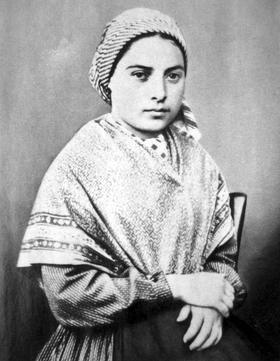
1879A black and white photograph of a young woman in a headscarf and a patterned shawl, seated
Saint

St. Bernadette Soubirous of Lourdes

Pope Francis Message for the 25th World Day of the Sick 2017 (8 December 2016)

“The humble maiden of Lourdes tells us that the Virgin, whom she called “the Lovely Lady”, looked at her as one person looks at another. Those simple words describe the fullness of a relationship. Bernadette, poor, illiterate and ill, felt that Mary was looking at her as a person.”

Read it in the source: vatican.va

See it on the timeline: Saints of the modern age, 1800 to today

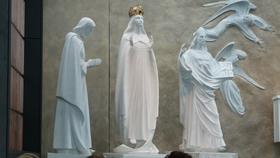
21 August 1879White marble statues of the Virgin Mary and two other figures beside an altar with a lamb and hovering angels
Miracle

Our Lady of Knock, Ireland

Pope Francis Video message on the elevation of the Shrine of Our Lady of Knock to an International Shrine, 19 March 2021

“Ever since the apparition of 21 August 1879, when the Blessed Virgin Mary appeared to some villagers in Knock together with Saint Joseph and Saint John the Apostle, the Irish people have expressed their devotion wherever they have been. … You know that in the apparition of Knock the Virgin does not say a word. But even her silence is a language; indeed, it is the most expressive language that is given to us.”

Witnesses
Some villagers of Knock, on 21 August 1879
Church ruling
The national Shrine of Our Lady of Knock was raised to an International Shrine of Special Eucharistic and Marian Devotion on 19 March 2021

Read it in the source: vatican.va

See it on the timeline: Marian apparitions

21 August 1879
Miracle

Our Lady of Knock, Ireland

Pope St. John Paul II Homily at the Shrine of Our Lady of Knock, 30 September 1979

“From that day of grace, 21 August 1879, until this very day, the sick and suffering, people handicapped in body or mind, troubled in their faith or their conscience, all have been healed, comforted and confirmed in their faith because they trusted that the Mother of God would lead them to her Son, Jesus.”

Church ruling
John Paul II came as a pilgrim for the shrine's centenary in 1979, gave its new church the title of basilica and presented a golden rose

Read it in the source: vatican.va

See it on the timeline: Marian apparitions

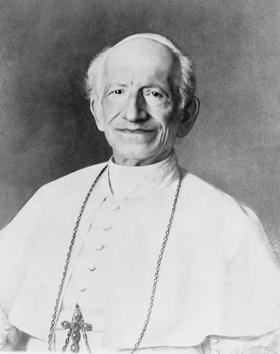
1883A black and white photograph of a very old, smiling pope in white with a pectoral cross
Magisterium
Pope Leo XIII Supremi Apostolatus Officio, 8

“He therefore so composed the Rosary as to recall the mysteries of our salvation in succession, and the subject of meditation is mingled and, as it were, interlaced with the Angelic salutation and with the prayer addressed to God, the Father of Our Lord Jesus Christ.”

Read it in the source: vatican.va

See it on the timeline: The Rosary

1883A rock cave under trees with a white statue in a niche above it and people gathered in front
Miracle

Lourdes: the Medical Bureau is founded

Sanctuary of Our Lady of Lourdes The miracles of Lourdes, History

“At the request of Father Rémi Sempé, Father of Garaison, first Rector of the Sanctuary, Dr Georges-Fernand Dunot de Saint-Maclou established the “Bureau des Constatations Médicales” (Medical Bureau of the Sanctuary), so that no one would leave Lourdes claiming to be “cured” without having submitted his or her healing story to a rigorous and collegiate medical assessment. In 1886, through the Archbishop of Cagliari, Monsignor Vincenzo Gregorio Berchialla, Pope Leo XIII gave his approval to the rigorous procedures of the Medical Bureau of Lourdes. And in 1905, the Bishop of Tarbes received confirmation from the Holy See of his right to use the procedures of the Medical Bureau of the Sanctuary to study the reported cures.”

Investigation
A permanent medical office at the shrine, founded in 1883, examines reported cures
Church ruling
Pope Leo XIII approved the Bureau's procedures in 1886. The Holy See confirmed the Bishop of Tarbes's right to use them in 1905

Read it in the source: lourdes-france.org

See it on the timeline: Great miracles

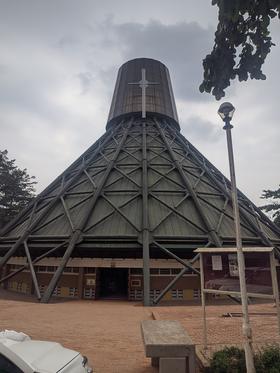
1886A round church with a tall cone-shaped roof of steel ribs
Saint

St. Charles Lwanga and the martyrs of Uganda

Pope Francis Homily at the Mass for the Martyrs of Uganda, Namugongo, 28 November 2015

“I think of Saints Joseph Mkasa and Charles Lwanga, who after being catechized by others, wanted to pass on the gift they had received. They did this in dangerous times. Not only were their lives threatened but so too were the lives of the younger boys under their care. Because they had tended to their faith and deepened their love of God, they were fearless in bringing Christ to others, even at the cost of their lives.”

Read it in the source: vatican.va

See it on the timeline: Saints of the modern age, 1800 to today

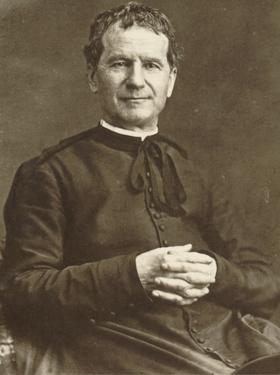
31 January 1888A sepia photograph of a priest with curly hair in a black cassock, his hands folded
Saint

St. John Bosco, priest and founder of the Salesians

Dicastery for the Causes of Saints Profile of St. John Bosco

“On 8 December 1844, inspired by Saint Philip Neri, he founded the oratory, naming it for Saint Francis de Sales, which he would later settle at Valdocco. … "To form honest citizens and good Christians" was the mission to which the saint gave himself until his death, which came on 31 January 1888.”

Our translation. The words as written, in Italian:

“L’8 dicembre 1844, ispirato da san Filippo Neri, fondò, intitolandolo a san Francesco di Sales, l’oratorio che in seguito stabilirà a Valdocco. … “Formare onesti cittadini e buoni cristiani” fu la missione a cui il santo si dedicò fino alla morte sopraggiunta il 31 gennaio 1888.”

Read it in the source: Dicastery for the Causes of Saints

See it on the timeline: Saints of the modern age, 1800 to today

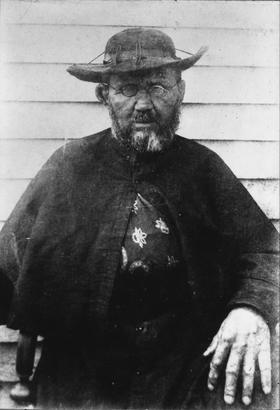
1889A black and white photograph of a priest in a hat and a black cloak, his face and hands marked by leprosy
Saint

St. Damien de Veuster of Molokai, priest

Pope Benedict XVI Homily at the Canonization of Five Saints, 11 October 2009

“Not without fear and repugnance, he chose to go to the Island of Molokai to serve the lepers who lived there, abandoned by all. Thus he was exposed to the disease from which they suffered. He felt at home with them. The servant of the Word consequently became a suffering servant, a leper with the lepers, for the last four years of his life.”

Read it in the source: vatican.va

See it on the timeline: Saints of the modern age, 1800 to today

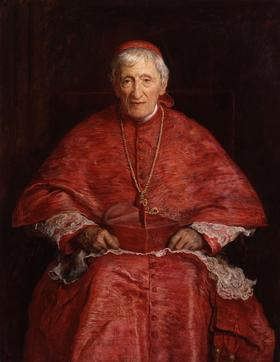
1890A frail old cardinal in scarlet robes and a red skullcap sits facing the viewer
Saint

St. John Henry Newman, priest and cardinal

Pope Benedict XVI Homily at the Beatification of John Henry Newman, Birmingham, 19 September 2010

“Cardinal Newman’s motto, Cor ad cor loquitur, or “Heart speaks unto heart”, gives us an insight into his understanding of the Christian life as a call to holiness, experienced as the profound desire of the human heart to enter into intimate communion with the Heart of God.”

Read it in the source: vatican.va

See it on the timeline: Saints of the modern age, 1800 to today

1890
Doctor of the Church

St. John Henry Newman, priest, cardinal and Doctor

St. John Henry Newman Meditations and Devotions, as quoted by Pope Leo XIV, Homily at the Proclamation of St. John Henry Newman as a Doctor of the Church, 1 November 2025

“God has created me to do Him some definite service; He has committed some work to me which He has not committed to another. I have my mission—I never may know it in this life, but I shall be told it in the next”

Read it in the source: vatican.va

See it on the timeline: The Doctors of the Church

1893A black and white photograph of a very old, smiling pope in white with a pectoral cross
Magisterium
Pope Leo XIII Providentissimus Deus, 19

“The unshrinking defence of the Holy Scripture, however, does not require that we should equally uphold all the opinions which each of the Fathers or the more recent interpreters have put forth in explaining it; for it may be that, in commenting on passages where physical matters occur, they have sometimes expressed the ideas of their own times, and thus made statements which in these days have been abandoned as incorrect. Hence, in their interpretations, we must carefully note what they lay down as belonging to faith, or as intimately connected with faith-what they are unanimous in. For "in those things which do not come under the obligation of faith, the Saints were at liberty to hold divergent opinions, just as we ourselves are,"”

Read it in the source: vatican.va

See it on the timeline: The authority of the Fathers

1893
Magisterium
Pope Leo XIII Providentissimus Deus, 18

“There can never, indeed, be any real discrepancy between the theologian and the physicist, as long as each confines himself within his own lines, and both are careful, as St. Augustine warns us, "not to make rash assertions, or to assert what is not known as known." … the sacred writers, or to speak more accurately, the Holy Ghost "Who spoke by them, did not intend to teach men these things (that is to say, the essential nature of the things of the visible universe), things in no way profitable unto salvation." Hence they did not seek to penetrate the secrets of nature, but rather described and dealt with things in more or less figurative language, or in terms which were commonly used at the time”

Read it in the source: vatican.va

See it on the timeline: Evolution and Genesis

1893
Magisterium

What the Rosary consists of

Pope Leo XIII Laetitiae Sanctae, 6 (8 September 1893)

“For evils such as these let us seek a remedy in the Rosary, which consists in a fixed order of prayer combined with devout meditation on the life of Christ and His Blessed Mother.”

Read it in the source: vatican.va

See it on the timeline: The Rosary

1893
Magisterium

Leo XIII: the sacred writers did not intend to teach the nature of the visible universe

Pope Leo XIII Encyclical Providentissimus Deus, 18 November 1893, no. 18

“There can never, indeed, be any real discrepancy between the theologian and the physicist, as long as each confines himself within his own lines, and both are careful, as St. Augustine warns us, "not to make rash assertions, or to assert what is not known as known." … To understand how just is the rule here formulated we must remember, first, that the sacred writers, or to speak more accurately, the Holy Ghost "Who spoke by them, did not intend to teach men these things (that is to say, the essential nature of the things of the visible universe), things in no way profitable unto salvation." Hence they did not seek to penetrate the secrets of nature, but rather described and dealt with things in more or less figurative language, or in terms which were commonly used at the time, and which in many instances are in daily use at this day, even by the most eminent men of science.”

Read it in the source: vatican.va

See it on the timeline: The Galileo case

1894
Liturgy

The Eastern rites to be preserved

Pope Leo XIII Orientalium Dignitas, 30 November 1894

“In point of fact there is more importance than can be believed in preserving the Eastern rites. Their antiquity is august, it is what gives nobility to the different rites, it is a brilliant jewel for the whole Church, it confirms the God-given unity of the Catholic Faith.”

Read it in the source: Papal Encyclicals Online

See it on the timeline: The Mass through the centuries

20 June 1894
Magisterium

Leo XIII calls the East to reunion

Pope Leo XIII Apostolic Letter Praeclara Gratulationis Publicae

“We hope it all the more, that the distance separating them from Us is not so great: nay, with some few exceptions, we agree so entirely on other heads that, in defense of the Catholic Faith, we often have recourse to reasons and testimony borrowed from the teaching, the Rites, and Customs of the East. The Principal subject of contention is the Primacy of the Roman Pontiff. But let them look back to the early years of their existence, let them consider the sentiments entertained by their forefathers, and examine what the oldest Traditions testify, and it will, indeed, become evident to them that Christ’s Divine Utterance, Thou art Peter, and upon this rock I will build My Church, has undoubtedly been realized in the Roman Pontiffs.”

Read it in the source: Papal Encyclicals Online

See it on the timeline: The East-West Schism

1895
Orthodox

Constantinople answers: the Church of the seven councils

Patriarch Anthimos of Constantinople and his synod Patriarchal Encyclical of 1895, A Reply to the Papal Encyclical of Pope Leo XIII on Reunion, XX

“In these sources we, the orthodox, find the old and divinely-transmitted doctrines, to which we carefully hold fast to the present time, and nowhere do we find the innovations which later times of empty mindedness brought forth in the West, and which the Papal Church having adopted retains till this very day. The orthodox Eastern Church then justly glories in Christ as being the Church of the seven Ecumenical Councils and of the first nine centuries of Christianity, and therefore the one holy, catholic and apostolic Church of Christ, 'the pillar and ground of the truth'”

Read it in the source: Fordham Sourcebook

See it on the timeline: The East-West Schism

1895
Orthodox

The pope's universal jurisdiction rejected

Patriarch Anthimos of Constantinople and his synod Patriarchal Encyclical of 1895, A Reply to the Papal Encyclical of Pope Leo XIII on Reunion, XIV

“But having recourse to the fathers and the Ecumenical Councils of the Church of the first nine centuries, we are fully persuaded that the Bishop of Rome was never considered as the supreme authority and infallible head of the Church, and that every bishop is head and president of his own particular Church, subject only to the synodical ordinances and decisions of the Church universal as being alone infallible, the Bishop of Rome being in no wise excepted from this rule, as Church history shows.”

Read it in the source: Fordham Sourcebook

See it on the timeline: The East-West Schism

1895
Orthodox

Papal infallibility rejected

Patriarch Anthimos of Constantinople and his synod Patriarchal Encyclical of 1895, XVIII

“The orthodox Eastern and catholic Church of Christ, with the exception of the Son and Word of God, who was ineffably made man, knows no one infallible upon earth.”

Read it in the source: Fordham Sourcebook

See it on the timeline: The East-West Schism

1895
Orthodox

The Immaculate Conception rejected

Patriarch Anthimos of Constantinople and his synod Patriarchal Encyclical of 1895, XIII

“The one holy, catholic and apostolic Church of the seven Ecumenical Councils teaches that the supernatural incarnation of the only-begotten Son and Word of God, of the Holy Ghost and the Virgin Mary, is alone pure and immaculate; but the Papal Church scarcely forty years ago again made an innovation by laying down a novel dogma concerning the immaculate conception of the Mother of God and ever-Virgin Mary, which was unknown to the ancient Church”

Read it in the source: Fordham Sourcebook

See it on the timeline: The East-West Schism

1896A black and white photograph of a very old, smiling pope in white with a pectoral cross
Magisterium
Pope Leo XIII Fidentem piumque animum, 3

“Undoubtedly the name and attributes of the absolute Mediator belong to no other than to Christ, for being one person, and yet both man and God, He restored the human race to the favour of the Heavenly Father: … And yet, as the Angelic Doctor teaches, there is no reason why certain others should not be called in a certain way mediators between God and man, that is to say, in so far as they cooperate by predisposing and ministering in the union of man with God … Such are the angels and saints, the prophets and priests of both Testaments; but especially has the Blessed Virgin a claim to the glory of this title.”

Read it in the source: Papal Encyclicals Online

See it on the timeline: Mary as Mediatrix

1896
Magisterium
Pope Leo XIII Satis Cognitum 4

“But when we consider what was actually done we find that Jesus Christ did not, in point of fact, institute a Church to embrace several communities similar in nature, but in themselves distinct, and lacking those bonds which render the Church unique and indivisible after that manner in which in the symbol of our faith we profess: "I believe in one Church."”

Read it in the source: vatican.va

See it on the timeline: The one Church

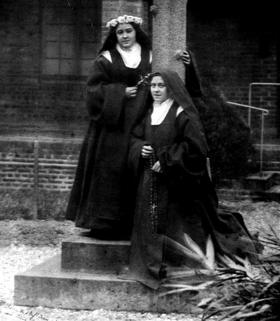
1897A black and white photograph of two Carmelite nuns on a stone step in a courtyard, one standing and one kneeling in front of her
Saint

St. Thérèse of Lisieux, Carmelite and Doctor

Pope Benedict XVI General Audience, 6 April 2011

“Thérèse died on the evening of 30 September 1897, saying the simple words, “My God, I love you!”, looking at the Crucifix she held tightly in her hands.”

Read it in the source: vatican.va

See it on the timeline: Saints through the centuries

1897
Saint

St. Thérèse of Lisieux, Carmelite and Doctor

Pope St. John Paul II Homily at the Proclamation of St. Thérèse as a Doctor of the Church, 5 (19 October 1997)

“She counters a rational culture, so often overcome by practical materialism, with the disarming simplicity of the "little way" which, by returning to the essentials, leads to the secret of all life: the divine Love that surrounds and penetrates every human venture.”

Read it in the source: vatican.va

See it on the timeline: Saints of the modern age, 1800 to today

1897
Doctor of the Church

St. Thérèse of Lisieux, Carmelite and Doctor

St. Thérèse of Lisieux Her autobiography, as quoted in CCC 826

“If the Church was a body composed of different members, it couldn't lack the noblest of all; it must have a Heart, and a Heart BURNING WITH LOVE. And I realized that this love alone was the true motive force which enabled the other members of the Church to act; if it ceased to function, the Apostles would forget to preach the gospel, the Martyrs would refuse to shed their blood.”

Read it in the source: vatican.va

See it on the timeline: The Doctors of the Church

The 1900s1900 to 1999
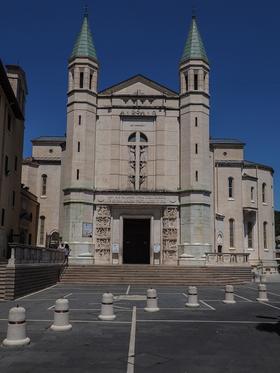
canonized 1900The white stone front of a church with two small towers under a deep blue sky
Miracle

St. Rita of Cascia, widow and Augustinian nun

Dicastery for the Causes of Saints Profile of St. Rita of Cascia, biography

“More and more immersed in the contemplation of Christ, Rita asks to be able to share in his Passion, and in 1432, absorbed in prayer, she finds on her forehead the wound of a thorn from the crown of the Crucified, which lasts until her death, for 15 years. In the winter before her death Rita, ill and confined to bed, asks a cousin who has come to visit from Roccaporena to bring her two figs and a rose from the garden of her father's house. It is the month of January, and the woman humours her, thinking her delirious from the illness. On returning home she finds, astonished, the rose and the figs, and takes them to Cascia.”

Our translation. The words as written, in Italian:

“Sempre più immersa nella contemplazione di Cristo, Rita chiede di poter partecipare alla sua Passione e nel 1432, assorta in preghiera, si ritrova sulla fronte la ferita di una spina della corona del Crocifisso che persiste fino alla morte, per 15 anni. Nell’inverno che precede la sua morte Rita, malata e costretta a letto, chiede a una cugina, venuta in visita da Roccaporena, di portarle due fichi e una rosa dall’orto della casa paterna. É il mese di gennaio, la donna l’asseconda, pensandola nel delirio della malattia. Rientrata, trova, stupefatta, la rosa e i fichi e li porta a Cascia.”

Church ruling
Beatified by Pope Urban VIII on 19 October 1626. Canonized by Pope Leo XIII on 24 May 1900

Read it in the source: Dicastery for the Causes of Saints

See it on the timeline: Saints of the high Middle Ages, 1050 to 1500

6 July 1902
Saint

St. Maria Goretti, virgin and martyr

Pope St. John Paul II Message to the Bishop of Albano for the Centenary of the Death of St. Maria Goretti, 1 (6 July 2002)

“A hundred years ago, on 6 July 1902, Maria Goretti died in the hospital at Nettuno, brutally stabbed the day before in the little village of Le Ferriere, in the Pontine Marshes. Her spiritual life, the strength of her faith, her ability to forgive her murderer have placed her among the best-loved saints of the 20th century.”

Read it in the source: vatican.va

See it on the timeline: Saints of the modern age, 1800 to today

1902A black and white photograph of a very old, smiling pope in white with a pectoral cross
Miracle

Leo XIII on prodigies in honour of the Eucharist

Pope Leo XIII Mirae Caritatis, 7 (28 May 1902)

“And this miracle, itself the very greatest of its kind, is accompanied by innumerable other miracles; for here all the laws of nature are suspended; the whole substance of the bread and wine are changed into the Body and the Blood; the species of bread and wine are sustained by the divine power without the support of any underlying substance; the Body of Christ is present in many places at the same time, that is to say, wherever the Sacrament is consecrated. And in order that human reason may the more willingly pay its homage to this great mystery, there have not been wanting, as an aid to faith, certain prodigies wrought in His honour, both in ancient times and in our own, of which in more than one place there exist public and notable records and memorials.”

Read it in the source: vatican.va

See it on the timeline: Eucharistic miracles

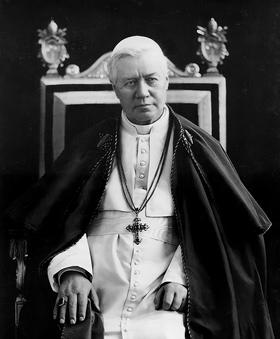
1903A black and white photograph of a white-haired pope seated on a throne, wearing a dark cape over a white cassock
Liturgy

St. Pius X on active participation

Pope St. Pius X Tra le Sollecitudini, 22 November 1903, introduction

“Since it is Our most ardent desire that the true Christian spirit flourish again in every way and be kept alive in all the faithful, it is necessary to provide before all else for the holiness and dignity of the temple, where the faithful gather to draw that spirit from its first and indispensable source, which is active participation in the most holy mysteries and in the public and solemn prayer of the Church.”

Our translation. The words as written, in Italian:

“Essendo, infatti, Nostro vivissimo desiderio che il vero spirito cristiano rifiorisca per ogni modo e si mantenga nei fedeli tutti, è necessario provvedere prima di ogni altra cosa alla santità e dignità del tempio, dove appunto i fedeli si radunano per attingere tale spirito dalla sua prima ed indispensabile fonte, che è la partecipazione attiva ai sacrosanti misteri e alla preghiera pubblica e solenne della Chiesa.”

Read it in the source: vatican.va

See it on the timeline: The Mass through the centuries

1904
Magisterium
Pope St. Pius X Ad diem illum laetissimum, 13-14

“It cannot, of course, be denied that the dispensation of these treasures is the particular and peculiar right of Jesus Christ, for they are the exclusive fruit of His Death, who by His nature is the mediator between God and man. Nevertheless, by this companionship in sorrow and suffering already mentioned between the Mother and the Son, it has been allowed to the august Virgin to be the most powerful mediatrix and advocate of the whole world with her Divine Son … We are then, it will be seen, very far from attributing to the Mother of God a productive power of grace - a power which belongs to God alone.”

Read it in the source: vatican.va

See it on the timeline: Mary as Mediatrix

canonized 1904
Miracle

St. Gerard Majella, Redemptorist brother

Dicastery for the Causes of Saints Profile of St. Gerard Majella, biography

“And indeed, one must read his life, full of wonders, to grasp the sublime virtues of the Saint, as well as the miracles he worked as though in play. In his short life the Saint won a glory that is still spreading, thanks to wonders of every sort, which the faithful obtain through his intercession.”

Our translation. The words as written, in Italian:

“E difatti, bisogna leggere la sua vita piena di prodigi per rendersi conto delle sublimi virtù del Santo, come pure dei miracoli che egli operava come se scherzasse. Nella sua breve vita, il Santo acquistò una gloria che tuttora si dilata, mercé di prodigi di ogni sorta, che i fedeli ottengono per la sua intercessione.”

Read it in the source: Dicastery for the Causes of Saints

See it on the timeline: Saints of reform and mission, 1500 to 1800
1909
Saint

St. Mary of the Cross MacKillop, teacher and foundress in Australia

Pope Benedict XVI Homily at the Canonization of Six Saints, 17 October 2010

“For many years countless young people throughout Australia have been blessed with teachers who were inspired by the courageous and saintly example of zeal, perseverance and prayer of Mother Mary MacKillop. She dedicated herself as a young woman to the education of the poor in the difficult and demanding terrain of rural Australia, inspiring other women to join her in the first women's community of religious sisters of that country. She attended to the needs of each young person entrusted to her, without regard for station or wealth, providing both intellectual and spiritual formation.”

Read it in the source: vatican.va

See it on the timeline: Saints of the modern age, 1800 to today

1910
Liturgy

First Communion at about seven

Sacred Congregation of the Discipline of the Sacraments, under St. Pius X Quam Singulari, 8 August 1910, rule 1

“The age of discretion, both for Confession and for Holy Communion, is the time when a child begins to reason, that is about the seventh year, more or less. From that time on begins the obligation of fulfilling the precept of both Confession and Communion.”

Read it in the source: Papal Encyclicals Online

See it on the timeline: The Mass through the centuries

1910
Magisterium
Sacred Congregation of the Discipline of the Sacraments, under St. Pius X Quam Singulari, 8 August 1910

“The Catholic Church, bearing this in mind, took care even from the beginning to bring the little ones to Christ through Eucharistic Communion, which was administered even to nursing infants. This, as was prescribed in almost all ancient Ritual books, was done at Baptism until the thirteenth century, and this custom prevailed in some places even later. It is still found in the Greek and Oriental Churches. But to remove the danger that infants might eject the Consecrated Host, the custom obtained from the beginning of administering the Eucharist to them under the species of wine only. … This practice later died out in the Latin Church, and children were not permitted to approach the Holy Table until they had come to the use of reason and had some knowledge of this august Sacrament.”

Read it in the source: Papal Encyclicals Online

See it on the timeline: The Eucharist

1914
Saint

St. José Gabriel Brochero, the "gaucho priest" of Argentina

Dicastery for the Causes of Saints Profile of St. José Gabriel del Rosario Brochero, summary

“A diocesan priest, pastor of a very large area without roads or schools, he gave himself to the poorest, building churches, schools and roads. Having caught leprosy through his visits to the sick, he died blind.”

Our translation. The words as written, in Italian:

“Sacerdote diocesano, pastore di una vastisima area senza strade né scuole, si dedicò ai più poveri, edificando chiese, scuole, strade. Ammalato di lebbra per le visite agli ammalati, morì cieco.”

Read it in the source: Dicastery for the Causes of Saints

See it on the timeline: Saints of the modern age, 1800 to today

20 August 1914A black and white photograph of a white-haired pope seated on a throne, wearing a dark cape over a white cassock
Saint

St. Pius X, pope

Pope Benedict XVI General Audience, Castel Gandolfo, 18 August 2010

“Pius X's Pontificate left an indelible mark on the Church's history and was distinguished by a considerable effort for reform that is summed up in his motto: Instaurare Omnia in Christo, "To renew all things in Christ".”

Read it in the source: vatican.va

See it on the timeline: Saints of the modern age, 1800 to today

1916
Saint

St. Charles de Foucauld, hermit of the Sahara

Pope Francis Encyclical Fratelli Tutti, 287 (3 October 2020), quoting a letter of Charles de Foucauld to Henry de Castries, 29 November 1901

“Blessed Charles directed his ideal of total surrender to God towards an identification with the poor, abandoned in the depths of the African desert. In that setting, he expressed his desire to feel himself a brother to every human being, and asked a friend to “pray to God that I truly be the brother of all”. He wanted to be, in the end, “the universal brother”.”

Read it in the source: vatican.va

See it on the timeline: Saints of the modern age, 1800 to today

22 December 1917A black and white photograph of a young nun in a black dress and bonnet with a cross at her breast
Saint

St. Frances Xavier Cabrini, missionary to emigrants

Dicastery for the Causes of Saints Profile of St. Frances Xavier Cabrini

“Proclaimed a Saint by Pius XII on 7 July 1946, thanks to her work she became in 1950 the "Heavenly Patroness of all Emigrants". She died on 22 December 1917 in the hospital for migrants that she had built in Chicago.”

Our translation. The words as written, in Italian:

“Proclamata Santa da Pio XII il 7 luglio 1946, grazie al suo impegno nel 1950 diventò la “Celeste Patrona di tutti gli Emigranti”. Morì il 22 dicembre 1917 nell’ospedale per i migranti che aveva costruito a Chicago.”

Read it in the source: Dicastery for the Causes of Saints

See it on the timeline: Saints of the modern age, 1800 to today

13 July 1917A black and white photograph of men and women kneeling and standing in a field, shading their eyes and gazing at the sky
Miracle

Fatima: a miracle announced three months ahead

Sister Lucia dos Santos Fourth Memoir, as given by the Shrine of Fatima, Narrative of the Apparitions, third apparition of Our Lady

“- I would like to ask you to tell us who you are, and to work a miracle so that everybody will believe that you are appearing to us. - Continue to come here every month. In October, I will tell you who I am and what I want, and I will perform a miracle for all to see and believe.”

Witnesses
The shrine gives the number present on 13 July as 4000 to 5000 or 2000 to 3000, and on 13 October as 50000 to 70000
Investigation
The shrine notes that parts of its narrative come from the parish priest's questioning of the children on 14 July 1917

Read it in the source: fatima.pt

See it on the timeline: Great miracles

13 October 1917
Miracle

Fatima: the miracle of the sun

Shrine of Our Lady of Fatima, quoting the newspaper O Século of 15 October 1917 Chronology of the three seers, 1917.10.13

“On the last apparition day, on October 13, the Cova da Iria is presented with a sea of people. The account of the newspaper O Século, October 15, describes what the 70 thousand people could see on the spot: “Before the dazzled eyes of those people, whose attitude transfers us to the biblical times, and which, dumbfounded, with the head uncovered, look up into the blue sky, the sun trembled, the sun had never seen sudden movements against all cosmic laws - the sun "danced", according to the typical expression of the peasants.””

Witnesses
70 thousand people, the figure the shrine gives with the account of O Século
Investigation
The account was printed in the Lisbon newspaper O Século two days later, written by Avelino de Almeida

Read it in the source: fatima.pt

See it on the timeline: Great miracles

13 October 1917
Miracle

Fatima: the miracle of the sun

Shrine of Our Lady of Fatima Chronology of the three seers, 1924.07.08

“The last seer of Fatima responds, in Oporto, to the official interrogation of the Diocesan Canonical Commission, named by José Alves Correia da Silva, Bishop of Leiria, about the events of Fatima. This statement was enclosed with the Diocesan Canonical Process. Following this process, the Bishop of Leiria declared on October 13, 1930, in the Pastoral Letter on the cult of Our Lady of Fatima, «worthy of belief the visions of the children in the Cova da Iria, parish of Fatima, of this Diocese, on 13 May through October 1917».”

Investigation
A Diocesan Canonical Commission named by the Bishop of Leiria. It questioned Lucia officially on 8 July 1924
Church ruling
The Bishop of Leiria declared the visions of the children worthy of belief in a pastoral letter of 13 October 1930

Read it in the source: fatima.pt

See it on the timeline: Great miracles

13 October 1917
Miracle

Our Lady of Fatima, Portugal

Shrine of Our Lady of Fatima Narrative of the Apparitions, sixth apparition of Our Lady, from Sister Lucia's Fourth Memoir (shrine website)

“I want to tell you that a chapel is to be built here in my honour. I am the Lady of the Rosary. Continue always to pray the Rosary every day. The war is going to end, and the soldiers will soon return to their homes. … Then, opening her hands, she made them reflect on the sun, and as she ascended, the reflection of her own light continued to be projected on the sun itself.”

Witnesses
The three children, Lucia, Francisco and Jacinta. The shrine gives the number of people present on 13 October 1917 as 50,000 to 70,000

Read it in the source: fatima.pt

See it on the timeline: Marian apparitions

1917
Miracle

Our Lady of Fatima, Portugal

Shrine of Our Lady of Fatima Chronology of the three seers, entry for 8 July 1924 (shrine website)

“The last seer of Fatima responds, in Oporto, to the official interrogation of the Diocesan Canonical Commission, named by José Alves Correia da Silva, Bishop of Leiria, about the events of Fatima. This statement was enclosed with the Diocesan Canonical Process. Following this process, the Bishop of Leiria declared on October 13, 1930, in the Pastoral Letter on the cult of Our Lady of Fatima, «worthy of belief the visions of the children in the Cova da Iria, parish of Fatima, of this Diocese, on 13 May through October 1917».”

Investigation
A Diocesan Canonical Commission named by the Bishop of Leiria questioned Lucia officially on 8 July 1924; her statement was placed in the diocesan canonical process
Church ruling
Bishop José Alves Correia da Silva of Leiria, Pastoral Letter of 13 October 1930: the visions of the children are worthy of belief

Read it in the source: fatima.pt

See it on the timeline: Marian apparitions

1917
Miracle

Our Lady of Fatima, Portugal

Pope Francis Homily at the canonization of Francisco and Jacinta Marto, Fatima, 13 May 2017

““So beautiful a Lady”, as the seers of Fatima said to one another as they returned home on that blessed day of 13 May a hundred years ago. That evening, Jacinta could not restrain herself and told the secret to her mother: “Today I saw Our Lady”. They had seen the Mother of Heaven. Many others sought to share that vision, but… they did not see her. The Virgin Mother did not come here so that we could see her.”

Church ruling
Pope Francis canonized Francisco and Jacinta Marto at Fatima on 13 May 2017, the hundredth anniversary of the first apparition

Read it in the source: vatican.va

See it on the timeline: Marian apparitions

1918 to 1968A black and white photograph of a young bearded Capuchin friar with his arms crossed, a dark wound on the back of each hand
Miracle

The stigmata of St. Pio of Pietrelcina

Holy See, Office of Liturgical Celebrations, quoting Pope St. Paul VI Biography of Padre Pio da Pietrelcina, published for his canonization, 16 June 2002

“Because he said Mass humbly, heard confessions from dawn to dusk and was – it is not easy to say it – one who bore the wounds of our Lord. He was a man of prayer and suffering”.”

Investigation
The biography says he had to submit to investigations and to restrictions on his priestly ministry, and accepted them

Read it in the source: vatican.va

See it on the timeline: Great miracles

canonized 1920A young woman in full armour stands beside an altar holding a white banner, her eyes raised
Miracle

St. Joan of Arc, virgin

Pope Benedict XV Bull of canonization Divina disponente, 16 May 1920, Italian text on the Dicastery's profile of St. Joan of Arc

“After the processes on the proposed miracles had been completed according to the rules, and after a third small additional process on one of them had been held in this City, on 6 April 1918 we solemnly declared: that two miracles are established, the first being the instantaneous and perfect healing of Maria Antonia Mirandelle from a perforating disease of the sole of the foot; and the other, the instantaneous and perfect healing of Teresa Belin from peritoneal and pulmonary tuberculosis and from an organic lesion of the mitral orifice. Then, on 17 June 1919, we decreed that it was safe to proceed to the solemn Canonization of Blessed Joan of Arc.”

Our translation. The words as written, in Italian:

“Dopo aver completato, secondo le regole, i processi sui miracoli proposti e aver fatto anche, riguardo ad uno, il terzo processetto addizionale in questa Urbe, il 6 aprile 1918 dichiarammo solennemente: Constare due miracoli, il primo, cioé la guarigione istantanea e perfetta di Maria Antonia Mirandelle da una malattia perforante la pianta del piede; e, l’altro, la guarigione istantanea e perfetta di Teresa Belin da tubercolosi peritoneale e polmonare e da lesione organica dell’orifizio mitralico. Poi, il 17 giugno 1919, decretammo che si poteva procedere con sicurezza alla solenne Canonizzazione della Beata Giovanna d’Arco.”

Cases
For the canonization: the healings of Maria Antonia Mirandelle and of Teresa Belin. For the beatification the bull names three approved healings, of Sister Teresa of St. Augustine, Sister Giulia Gauthier of St. Norbert and Sister Giovanna Maria Sagnier
Investigation
Processes on the proposed miracles, with a third additional process on one of them held in Rome
Church ruling
Pius X declared the three miracles for the beatification established in Advent 1908. Benedict XV declared the two miracles for the canonization established on 6 April 1918 and signed the bull of canonization on 16 May 1920

Read it in the source: Dicastery for the Causes of Saints

See it on the timeline: Saints of the high Middle Ages, 1050 to 1500

canonized 1920A nun in a black veil with a halo holds up a small picture of a heart surrounded by thorns
Miracle

St. Margaret Mary Alacoque, Visitation nun

Pope Benedict XV Address after the reading of the decree on the miracles attributed to Bl. Margaret Mary Alacoque, 6 January 1918, as given in the Dicastery's profile

“For a decree has been published which recognizes the truth of two instantaneous healings attributed to the intercession of Blessed Margaret Mary Alacoque. In the two wonders the reward given to devotion to the Most Sacred Heart of Jesus is manifest. For more than a year Luisa Agostini Coleschi had been afflicted by a disease judged incurable: in vain she had several times implored the intercession of a number of Saints. … To the relatives and friends who first came to visit her after the healing, Luisa Coleschi said: "The Most Sacred Heart of Jesus has granted me the grace"”

Our translation. The words as written, in Italian:

“Si è infatti pubblicato un decreto che riconosce la verità di due instantanee guarigioni attribuite alla intercessione della beata Margherita Maria Alacoque. Nei due prodigi è manifesto il premio dato alla devozione al Cuore Santissimo di Gesù. Da oltre un anno Luisa Agostini Coleschi era afflitta da morbo giudicato insanabile: invano avea più volte implorato l’intercessione di parecchi Santi. … Ai parenti e agli amici che primi si recarono a visitarla dopo la guarigione, Luisa Coleschi disse: « Il Cuore Santissimo di Gesù mi ha fatto la grazia »”

Cases
Luisa Agostini Coleschi, healed at Valle di Pompei of a disease judged incurable; and the Countess Astorri, widow Pavesi
Investigation
The Pope cites the sworn deposition of the Countess Astorri
Church ruling
A decree recognizing two instantaneous healings attributed to her intercession, read before Benedict XV on 6 January 1918

Read it in the source: Dicastery for the Causes of Saints

See it on the timeline: Saints of reform and mission, 1500 to 1800
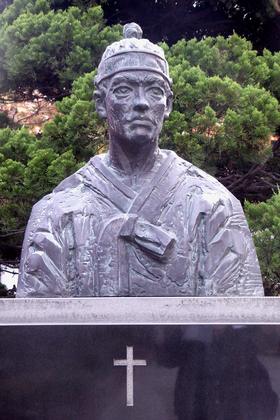
1919 and 1920
Saint

Sts. Francisco and Jacinta Marto, the shepherd children of Fatima

Pope St. John Paul II Homily at the Beatification of Francisco and Jacinta Marto, Fatima, 4 (13 May 2000), quoting Jacinta

“Little Jacinta felt and personally experienced Our Lady's anguish, offering herself heroically as a victim for sinners. One day, when she and Francisco had already contracted the illness that forced them to bed, the Virgin Mary came to visit them at home, as the little one recounts: "Our Lady came to see us and said that soon she would come and take Francisco to heaven. And she asked me if I still wanted to convert more sinners. I told her yes".”

Read it in the source: vatican.va

See it on the timeline: Saints of the modern age, 1800 to today

1923A rock cave under trees with a white statue in a niche above it and people gathered in front
Miracle

Lourdes: the cure of John Traynor

Sanctuary of Our Lady of Lourdes Miracles et guérisons, list of the cures recognized as miraculous

“John Jack Traynor (England). Seriously wounded during the First World War; [the cure] took place at Lourdes in 1923 during the first pilgrimage of the diocese of Liverpool (England). Diocese and date of recognition: Liverpool, 8 December 2024.”

Our translation. The words as written, in French:

“John Jack Traynor, (Angleterre). Grièvement blessé pendant la première guerre mondiale, survenue à Lourdes en 1923 à l’occasion du premier pèlerinage du diocèse de Liverpool (Angleterre) Diocèse et date de reconnaissance : Liverpool, 8-12-2024”

Church ruling
Recognized as miraculous, Liverpool, 8 December 2024

Read it in the source: lourdes-france.com

See it on the timeline: Great miracles

1925
Saint

St. Pier Giorgio Frassati, student of Turin

Pope Leo XIV Homily at the Canonization of Pier Giorgio Frassati and Carlo Acutis, 7 September 2025

“he bore witness to God with his joy of living and of being a Christian in prayer, friendship and charity. This was so evident that seeing him walking the streets of Turin with carts full of supplies for the poor, his friends renamed him “Frassati Impresa Trasporti” (Frassati Transport Company)! Even today, Pier Giorgio’s life is a beacon for lay spirituality.”

Read it in the source: vatican.va

See it on the timeline: Saints of the modern age, 1800 to today

d. 1926A white-haired pope in a white cassock and skullcap, smiling
Magisterium

Bartolo Longo, apostle of the Rosary at Pompeii

Pope Benedict XVI Pastoral Visit to Pompeii, Recitation of the Holy Rosary and Meditation, 19 October 2008

“Before entering the Shrine to recite the Holy Rosary with you, I paused briefly before the tomb of Bl. Bartolo Longo and, praying, I asked myself: “Where did this great apostle of Mary find the energy and perseverance he needed to bring such an impressive work, now known across the world, to completion? Was it not in the Rosary, which he accepted as a true gift from Our Lady's Heart?” Yes, that truly was how it happened! The experience of the Saints bears witness to it: this popular Marian prayer is a precious spiritual means to grow in intimacy with Jesus, and to learn at the school of the Blessed Virgin always to fulfil the divine will.”

Read it in the source: vatican.va

See it on the timeline: The Rosary

16 February 1926
Saint

St. Giuseppe Allamano, founder of the Consolata Missionaries

Dicastery for the Causes of Saints Profile of St. Giuseppe Allamano, summary

“A priest, Founder of the Institute of the Consolata Missions; aware that the Church of Turin lacked an Institute devoted specifically to the missions to the nations, he founded the Consolata Missions Institute. At the express request of Pope Saint Pius X, he also set up a women's branch, founding the Institute of the Consolata Missionary Sisters”

Our translation. The words as written, in Italian:

“Sacerdote Fondatore dell’Istituto delle Missioni della Consolata; consapevole che alla Chiesa torinese mancasse un Istituto che si occupasse specificatamente delle missioni ad gentes, fondò l’Istituto Missioni Consolata. Su esplicita richiesta del Papa San Pio X, costituì pure un ramo femminile fondando l’Istituto delle Suore Missionarie della Consolata”

Read it in the source: Dicastery for the Causes of Saints

See it on the timeline: Saints of the modern age, 1800 to today

1928A pope in round spectacles sits in a red-backed chair, in a white cassock and a red cape, holding a small book
Magisterium
Pope Pius XI Mortalium Animos 2

“Certainly such attempts can nowise be approved by Catholics, founded as they are on that false opinion which considers all religions to be more or less good and praiseworthy, since they all in different ways manifest and signify that sense which is inborn in us all, and by which we are led to God and to the obedient acknowledgment of His rule.”

Read it in the source: vatican.va

See it on the timeline: Other religions

10 February 1928
Saint

St. José Sánchez del Río, boy martyr of Mexico

Dicastery for the Causes of Saints Profile of St. José Sánchez del Río, "Vita e martirio"

“Just before he died, the leader of the soldiers asked him cynically whether he wanted to send any message to his father. To which the young martyr answered in a faint voice: "That we will see each other in paradise. Long live Christ the King! Long live Holy Mary of Guadalupe!" Then the military leader shot him in the head with his pistol.”

Our translation. The words as written, in Italian:

“Appena prima di morire, il capo dei soldati gli chiese cinicamente se volesse mandare qualche messaggio a suo padre. Al che il giovane martire rispose con un filo di voce: «Che ci vedremo in paradiso. Viva Cristo Re! Viva Santa Maria di Guadalupe!». Allora il capo militare con la sua pistola gli sparò in testa.”

Read it in the source: Dicastery for the Causes of Saints

See it on the timeline: Saints of the modern age, 1800 to today

1930A pope in round spectacles sits in a red-backed chair, in a white cassock and a red cape, holding a small book
Magisterium
Pope Pius XI Casti Connubii, 54

“But no reason, however grave, may be put forward by which anything intrinsically against nature may become conformable to nature and morally good. Since, therefore, the conjugal act is destined primarily by nature for the begetting of children, those who in exercising it deliberately frustrate its natural power and purpose sin against nature and commit a deed which is shameful and intrinsically vicious.”

Read it in the source: vatican.va

See it on the timeline: Contraception

1930
Magisterium
Pope Pius XI Casti Connubii, 63

“But another very grave crime is to be noted, Venerable Brethren, which regards the taking of the life of the offspring hidden in the mother's womb. Some wish it to be allowed and left to the will of the father or the mother; others say it is unlawful unless there are weighty reasons which they call by the name of medical, social, or eugenic "indication."”

Read it in the source: vatican.va

See it on the timeline: Abortion

1930
Magisterium
Pius XI Casti Connubii, 31

“But this accumulation of benefits is completed and, as it were, crowned by that blessing of Christian marriage which in the words of St. Augustine we have called the sacrament, by which is denoted both the indissolubility of the bond and the raising and hallowing of the contract by Christ Himself, whereby He made it an efficacious sign of grace.”

Read it in the source: vatican.va

See it on the timeline: Matrimony

1930A pope in round spectacles sits in a red-backed chair, in a white cassock and a red cape, holding a small book
Magisterium
Pope Pius XI Casti Connubii, 55

“Small wonder, therefore, if Holy Writ bears witness that the Divine Majesty regards with greatest detestation this horrible crime and at times has punished it with death. As St. Augustine notes, "Intercourse even with one's legitimate wife is unlawful and wicked where the conception of the offspring is prevented. Onan, the son of Juda, did this and the Lord killed him for it."”

Read it in the source: vatican.va

See it on the timeline: Contraception

1930
Magisterium
Pope Pius XI Casti Connubii, 56

“Since, therefore, openly departing from the uninterrupted Christian tradition some recently have judged it possible solemnly to declare another doctrine regarding this question, the Catholic Church … raises her voice in token of her divine ambassadorship and through Our mouth proclaims anew: any use whatsoever of matrimony exercised in such a way that the act is deliberately frustrated in its natural power to generate life is an offense against the law of God and of nature, and those who indulge in such are branded with the guilt of a grave sin.”

Read it in the source: vatican.va

See it on the timeline: Contraception

29 November 1932 to 3 January 1933A stone chapel and a paved square in the rain, with a hedge and small buildings around
Miracle

Our Lady of Beauraing, Belgium

Sanctuary of Our Lady of Beauraing Account of the apparitions (sanctuary website)

“It was in that year, in a plain country village, that the Virgin Mary chose to appear, thirty-three times, from 29 November 1932 to 3 January 1933, to five young children. They were brothers and sisters from two modest families: the Voisins, with Fernande (15), Gilberte (13) and Albert (11), and the Degeimbres, with Andrée (14) and Gilberte (9).”

Our translation. The words as written, in French:

“C’est cette année-là, dans un village de campagne sans relief, que la Vierge Marie choisit d’apparaître, à trente-trois reprises, du 29 novembre 1932 au 3 janvier 1933, à cinq jeunes enfants. Il s’agit de deux fratries issues de familles modestes : les Voisin, avec Fernande (15 ans), Gilberte (13 ans) et Albert (11 ans), et les Degeimbre, avec Andrée (14 ans) et Gilberte (9 ans).”

Witnesses
Five children of two families: Fernande, Gilberte and Albert Voisin, and Andrée and Gilberte Degeimbre. The page says no one else saw anything

Read it in the source: sanctuairedebeauraing.be

See it on the timeline: Marian apparitions

1932 to 1933
Miracle

Our Lady of Beauraing, Belgium

Sanctuary of Our Lady of Beauraing Account of the apparitions, on the recognition (sanctuary website)

“After thirty-three apparitions, and after so many studies by theologians and doctors, Bishop Thomas-Louis Heylen of Namur brought about the recognition of the devotion. On 16 May 1943 his successor, Bishop André-Marie Charue, obtained from Rome a decree authorizing the cult of Our Lady of Beauraing. Two healings were declared miraculous, and the authenticity of the events was recognized on 2 July 1949 by Bishop Charue.”

Our translation. The words as written, in French:

“Après trente-trois apparitions, après tant d’études de théologiens et de médecins, Mgr Thomas-Louis Heylen, évêque de Namur, fait aboutir la reconnaissance du culte. Le 16 mai 1943, son successeur, Mgr André-Marie Charue, obtient de Rome un décret autorisant le culte de Notre-Dame de Beauraing. Deux guérisons sont déclarées miraculeuses et l’authenticité des faits est reconnue le 2 juillet 1949 par Mgr Charue.”

Investigation
Studies by theologians and doctors under the Bishops of Namur
Medical finding
Two healings were declared miraculous
Church ruling
A decree from Rome authorizing the cult of Our Lady of Beauraing, 16 May 1943; the authenticity of the events recognized by Bishop André-Marie Charue of Namur on 2 July 1949

Read it in the source: sanctuairedebeauraing.be

See it on the timeline: Marian apparitions

15 January to 2 March 1933A white statue of the Virgin Mary stands above a round stone basin, with flowers along a wall behind
Miracle

Our Lady of Banneux, Belgium

Shrine of Banneux Notre-Dame The apparitions (1933) (shrine website)

“On Thursday, 19 January 1933, the weather was very bad. Mariette was on her knees in the path. The lady appeared to her. Mariette asked her, “Who are you, beautiful lady?” Mary replied, “I am the Virgin of the Poor.” The Virgin led the child to the way to the spring.”

Witnesses
Mariette Beco, born 25 March 1921, the eldest of seven children; eight apparitions between 15 January and 2 March 1933

Read it in the source: banneux-nd.be

See it on the timeline: Marian apparitions

1933
Miracle

Our Lady of Banneux, Belgium

Bishop Louis-Joseph Kerkhofs of Liège Pastoral letter of 22 August 1949, as given in English by the Shrine of Banneux

“We want to show that we truly believe that the Blessed Virgin appeared and spoke in Banneux. … Twice, first in 1942, then in 1947, we officially recognized, with some reservations, the reality of Banneux’s apparitions. Today, after two more years of prayer and observations, we believe in conscience that we can and must recognize this reality without reserve, namely, the reality of the eight apparitions of the Blessed Virgin to Mariette Beco, which took place on the 15th, January 18, 19 and 20, February 11, 15 and 20 and March 2, 1933.”

Church ruling
Bishop Louis-Joseph Kerkhofs of Liège recognized the apparitions with some reservations in 1942 and 1947, and without reserve in his pastoral letter of 22 August 1949. The page records that his successors, Bishops van Zuylen and Houssiau, confirmed this

Read it in the source: banneux-nd.be

See it on the timeline: Marian apparitions

canonized 1934A sepia photograph of a priest with curly hair in a black cassock, his hands folded
Miracle

St. John Bosco, priest and founder of the Salesians

Pope Pius XI Decretal Letter Geminata Laetitia proclaiming Don Bosco a saint (1934), first healing, as printed in the Dicastery's profile

“Mrs. Anna Maccolini in October 1930 was struck by influenzal bronchopneumonia, which lasted until February of the following year. Towards the middle of December of the same year 1930 there was added to that illness a phlebitis of the left leg and thigh, which spread through the whole limb so as to swell it to more than double and leave it immobile. … And then Mrs. Anna, one night towards the end of that same year, after making a triduum to Blessed John Bosco and placing a relic of him on the limb, found herself in an instant perfectly healed of the phlebitis, with no more pain and no swelling in the limb, its movement free and natural again and its bending free.”

Our translation. The words as written, in Italian:

“La signora Anna Maccolini nell’ottobre del 1930 fu colpita da bronco-polmonite influenzale che durò sino al febbraio dell’anno seguente. Verso la metà del dicembre dello stesso anno 1930 a detta malattia si aggiunse una flebite alla gamba ed alla coscia sinistra, la quale invase l’intiero arto sì da gonfiarlo oltre il doppio e immobilizzarlo. … Ed ecco che la signora Anna, una notte, sul finire dello stesso anno, dopo aver fatto un triduo al Beato Giovanni Bosco ed aver posto sull’arto una reliquia del medesimo, all’istante si trovò perfettamente guarita dalla flebite, senza più alcun dolore e senza gonfiezza all’arto, tornato libero e naturale il movimento e libera la flessione.”

Case
Anna Maccolini, aged 74, of Rimini: phlebitis of the left leg during bronchopneumonia, end of 1930
Medical finding
Her two doctors agreed on the diagnosis and gave a prognosis almost certainly fatal. Three experts chosen by the Sacred Congregation of Rites agreed on the diagnosis and the prognosis and recognized the healing as miraculous
Church ruling
Pius XI declared on 19 November of the year before the canonization that the two miracles were established

Read it in the source: Dicastery for the Causes of Saints

See it on the timeline: Saints of the modern age, 1800 to today

canonized 1934
Miracle

St. John Bosco, priest and founder of the Salesians

Pope Pius XI Decretal Letter Geminata Laetitia proclaiming Don Bosco a saint (1934), second healing, as printed in the Dicastery's profile

“When every treatment, begun as far back as 1903, had proved useless, she went twice on pilgrimage to Lourdes, but having not obtained healing from the Blessed Virgin even on the second pilgrimage, made in the first days of May 1931, before leaving Lourdes she prayed to Mary Most Holy in these words: "Since here at Lourdes I have not obtained healing, grant me at least, for the devotion I have to Blessed John Bosco, that he may obtain it for me in Turin." … Then, as if coming back to herself, she realizes that she is healed; without any help, from that moment, she walks freely to the amazement of those present, who knew she was unable to walk; she climbs in and out of the carriage and up and down the stairs with no hindrance.”

Our translation. The words as written, in Italian:

“Riuscite vane tutte le cure, incominciate fin dal 1903, per ben due volte peregrinò a Lourdes, ma non avendo ottenuta la guarigione dalla Beata Vergine nemmeno nel secondo pellegrinaggio compiuto ai primi del maggio 1931, prima di ripartire da Lourdes, così pregò Maria Santissima: « Poiché qui a Lourdes non ho ottenuto la guarigione, concedetemi almeno per la devozione che nutro verso il Beato Giovanni Bosco che egli me la possa ottenere in Torino ». … Allora, come tornando in sé, si accorge d’essere guarita; senza alcuno aiuto, da quel momento, cammina liberamente tra lo stupore dei presenti, che la sapevano impedita di camminare; sale e discende la carrozza e le scale senza alcun impedimento.”

Case
Caterina Lanfranchi, wife of Alessandro Pilenga: arthritis of the knees and feet, treated without success since 1903; healed on 6 May 1931 in the Basilica of Mary Help of Christians in Turin, before the urn holding Don Bosco's body
Medical finding
Three experts attested that the healing lasted. The treating doctors, the witnesses and the experts appointed by the Sacred Congregation of Rites attested the miracle
Church ruling
Pius XI declared on 19 November of the year before the canonization that the two miracles were established

Read it in the source: Dicastery for the Causes of Saints

See it on the timeline: Saints of the modern age, 1800 to today

1937A pope in round spectacles sits in a red-backed chair, in a white cassock and a red cape, holding a small book
Magisterium

"A powerful weapon to put the demons to flight"

Pope Pius XI Ingravescentibus Malis, 14 (29 September 1937)

“Nevertheless, if men in our century, with its derisive pride, refuse the Holy Rosary, there is an innumerable multitude of holy men of every age and every condition who have always held it dear. They have recited it with great devotion, and in every moment they have used it as a powerful weapon to put the demons to flight, to preserve the integrity of life, to acquire virtue more easily, and in a word to attain real peace among men.”

Read it in the source: vatican.va

See it on the timeline: The Rosary

1937A black and white photograph of an old man with white hair in a black cassock, seen from the side
Saint

St. André Bessette, doorkeeper of Montreal

Pope Benedict XVI Homily at the Canonization of Six Saints, 17 October 2010

“Bro. André Bessette, a native of Quebec in Canada, and a religious of the Congregation of the Holy Cross, experienced suffering and poverty at a very early age. They led him to have recourse to God through prayer and an intense inner life. As porter of the College of Notre Dame in Montreal, he demonstrated boundless charity and strove to relieve the distress of those who came to confide in him.”

Read it in the source: vatican.va

See it on the timeline: Saints of the modern age, 1800 to today

1937A pope in round spectacles sits in a red-backed chair, in a white cassock and a red cape, holding a small book
Magisterium

Pius XI condemns the idolatry of race

Pope Pius XI Encyclical Mit brennender Sorge, 14 March 1937, no. 8

“Whoever exalts race, or the people, or the State, or a particular form of State, or the depositories of power, or any other fundamental value of the human community - however necessary and honorable be their function in worldly things - whoever raises these notions above their standard value and divinizes them to an idolatrous level, distorts and perverts an order of the world planned and created by God; he is far from the true faith in God and from the concept of life which that faith upholds.”

Read it in the source: vatican.va

See it on the timeline: The Church and the Jewish people

1938A black and white photograph of a nun in a black habit and veil standing beside a pillar
Saint

St. Faustina Kowalska, religious

St. Faustina Kowalska Diary, 951, as quoted by John Paul II, Homily at the Shrine of Divine Mercy, Kraków-Łagiewniki, 17 August 2002

“O inconceivable and unfathomable Mercy of God, Who can worthily adore you and sing your praises? O greatest attribute of God Almighty, You are the sweet hope of sinners”

Read it in the source: vatican.va

See it on the timeline: Saints through the centuries

1938
Saint

St. Faustina Kowalska, apostle of divine mercy

Pope St. John Paul II Homily at the Canonization of Sr. Mary Faustina Kowalska, 2 (30 April 2000), quoting her Diary

“Jesus told Sr Faustina: "Humanity will not find peace until it turns trustfully to divine mercy" (Diary, p. 132). Through the work of the Polish religious, this message has become linked for ever to the 20th century”

Read it in the source: vatican.va

See it on the timeline: Saints of the modern age, 1800 to today

14 August 1941A black and white photograph of a Franciscan friar with round spectacles and a long beard
Saint

St. Maximilian Kolbe, priest and martyr of Auschwitz

Pope Benedict XVI General Audience, Castel Gandolfo, 13 August 2008

“The following words are attributed to St Maximilian Kolbe, who is said to have spoken them when the Nazi persecution was raging: "Hatred is not a creative force: only love is creative". And heroic proof of his love was the generous offering he made of himself in exchange for a fellow prisoner, an offer that culminated in his death in the starvation bunker on 14 August 1941.”

Read it in the source: vatican.va

See it on the timeline: Saints of the modern age, 1800 to today

1942A black and white photograph of a Carmelite nun in a black veil and white wimple
Saint

St. Teresa Benedicta of the Cross (Edith Stein), Carmelite and martyr

Pope St. John Paul II Homily at the Canonization of Edith Stein, 4 (11 October 1998), quoting her

“Because she was Jewish, Edith Stein was taken with her sister Rosa and many other Catholic Jews from the Netherlands to the concentration camp in Auschwitz, where she died with them in the gas chambers. Today we remember them all with deep respect. A few days before her deportation, the woman religious had dismissed the question about a possible rescue: “Do not do it! Why should I be spared? Is it not right that I should gain no advantage from my Baptism? If I cannot share the lot of my brothers and sisters, my life, in a certain sense, is destroyed”.”

Read it in the source: vatican.va

See it on the timeline: Saints of the modern age, 1800 to today

1943A black and white photograph of a thin pope in round spectacles wearing an embroidered stole
Magisterium
Pope Pius XII Mystici Corporis Christi 14

“Hence they err in a matter of divine truth, who imagine the Church to be invisible, intangible, a something merely “pneumatological” as they say, by which many Christian communities, though they differ from each other in their profession of faith, are united by an invisible bond.”

Read it in the source: Papal Encyclicals Online

See it on the timeline: The one Church

1943
Magisterium

Archaeology in the Holy Land and the Bible

Pope Pius XII Divino Afflante Spiritu 11

“when Our Predecessor published the Encyclical Letter Providentissimus Deus, hardly a single place in Palestine had begun to be explored by means of relevant excavations. Now, however, this kind of investigation is much more frequent and, since more precise methods and technical skill have been developed in the course of actual experience, it gives us information at once more abundant and more accurate. How much light has been derived from these explorations for the more correct and fuller understanding of the Sacred Books all experts know, as well as all those who devote themselves to these studies.”

Read it in the source: vatican.va

See it on the timeline: The life of Jesus Christ: the record inside and outside the Bible

5 April 1943
Miracle

Bl. Bartolo Longo: the healing of Carmen Rocco

Dicastery for the Causes of Saints Profile of St. Bartolo Longo, account of the cause

“With a view to the beatification of the Founder of the Shrine of Pompeii, the case was presented of Mrs. Carmen Rocco, married name Camera, healed perfectly and suddenly, on 5 April 1943, of an enterocolitic syndrome with malabsorption disorders and malnutrition, with severe hyperchromic anaemia, with motor disturbances and calculous cholecystitis. … The Medical Board, meeting on 22 March 1978, declared the healing scientifically inexplicable.”

Our translation. The words as written, in Italian:

“In vista della beatificazione del Fondatore del Santuario di Pompei fu presentato il caso della signora Carmen Rocco, coniugata Camera, guarita perfettamente ed improvvisamente, il 5 aprile 1943, da una sindrome enterocolitica con turbe da malassorbimento e malnutrizione, con anemia grave ipercromica con disturbi motori e colecistite calcolosa. … La Consulta Medica, riunitasi il 22 marzo 1978, dichiarò scientificamente inspiegabile la guarigione.”

Case
Carmen Rocco, married name Camera, healed on 5 April 1943
Investigation
Apostolic Process held at Naples in 1945, recognized as valid by decree of 24 October 1975
Medical finding
The Medical Board on 22 March 1978 declared the healing scientifically inexplicable
Church ruling
Theological consultors favourable on 10 April 1979; the Fathers gave a positive opinion on 29 May 1979; decree promulgated 13 June 1979. Beatified 26 October 1980

Read it in the source: Dicastery for the Causes of Saints

See it on the timeline: Miracles approved for canonizations

1945 to 1959
Miracle

Our Lady of All Nations, Amsterdam: judged not supernatural

Dicastery for the Doctrine of the Faith Press Release about Alleged Apparitions in Amsterdam from 1945 to 1959, 11 July 2024

“the Dicastery for the Doctrine of the Faith is making known the result of the Ordinary Session of the then Sacred Congregation for the Doctrine of the Faith, held on 27 March 1974, which reached the following decisions about the events in question: 1. As for a doctrinal judgment, OMNES: “constat de non supernaturalitate.” 2. As for whether to investigate the phenomenon further, OMNES: “negative.” These decisions were approved by the Holy Father, Pope Paul VI, during an audience granted to the Prefect of the Sacred Congregation for the Doctrine of the Faith, Cardinal F. Šeper, on 5 April 1974.”

Church ruling
Constat de non supernaturalitate (it is established that the events were not supernatural), decided unanimously by the Sacred Congregation for the Doctrine of the Faith on 27 March 1974 and approved by Pope Paul VI on 5 April 1974. It also decided not to investigate further. The Dicastery made this public on 11 July 2024

Read it in the source: vatican.va

See it on the timeline: Marian apparitions

March 1946A white-haired pope in a white cassock and skullcap, smiling
Magisterium

The Greek Catholic Church of Ukraine suppressed

Pope Benedict XVI Letter to Cardinal Lubomyr Husar, Major Archbishop of Kyiv-Halyč, 22 February 2006

“Unfortunately, in those sad days of March 1946, a group of clerics gathered in a Pseudo-Synod who unduly claimed to represent the Church seriously wounded ecclesial unity. Violence was intensified against those who remained faithful to unity with the Bishop of Rome, giving rise to further sufferings and forcing the Church to return underground.”

Read it in the source: vatican.va

See it on the timeline: The East-West Schism

1947A black and white photograph of a thin pope in round spectacles wearing an embroidered stole
Liturgy

Divine and human elements in the liturgy

Pope Pius XII Mediator Dei 50 (20 November 1947)

“The sacred liturgy does, in fact, include divine as well as human elements. The former, instituted as they have been by God, cannot be changed in any way by men. But the human components admit of various modifications, as the needs of the age, circumstance and the good of souls may require, and as the ecclesiastical hierarchy, under guidance of the Holy Spirit, may have authorized. This will explain the marvelous variety of Eastern and Western rites.”

Read it in the source: vatican.va

See it on the timeline: The Mass through the centuries

30 November 1947
Magisterium
Pope Pius XII Sacramentum Ordinis, Apostolic Constitution, 30 November 1947, 4

“Of the sacred orders of the diaconate, the presbyterate and the episcopate, the matter, and the only matter, is the laying on of hands. The form, likewise the only form, is the words that determine the application of this matter, by which the sacramental effects are unambiguously signified, namely the power of Order and the grace of the Holy Spirit, and which the Church receives and uses as such. It follows that we declare, to remove every controversy and to close the way to anxieties of conscience, by our apostolic authority, and, if anything has ever been legitimately ordered otherwise, we decree, that the handing over of the instruments is not necessary, at least in the future, for the validity of the sacred orders of the diaconate, the presbyterate and the episcopate.”

Our translation. The words as written, in Latin:

“Sacrorum Ordinum Diaconatus, Presbyteratus et Episcopatus materiam eamque unam esse manuum impositionem; formam vero itemque unam esse verba applicationem huius materiae determinantia, quibus univoce significantur effectus sacramentales, scilicet potestas Ordinis et gratia Spiritus Sancti, quaeque ab Ecclesia qua talia accipiuntur et usurpantur. Hinc consequitur ut declaremus, sicut revera ad omnem controversiam auferendam et ad conscientiarum anxietatibus viam praecludendam, Apostolica Nostra Auctoritate declaramus, et, si unquam aliter legitime dispositum fuerit, statuimus instrumentorum traditionem saltem in posterum non esse necessariam ad Sacrorum Diaconatus, Presbyteratus et Episcopatus Ordinum validitatem.”

Read it in the source: vatican.va

See it on the timeline: Holy Orders

canonized 1947
Miracle

St. Nicholas of Flüe, father of a family and hermit

Dicastery for the Causes of Saints Profile of St. Nicholas of Flüe, biography

“In the end the Lord fills him with the three graces he has asked for: the consent of his wife and children to his leaving, the absence of any temptation to turn back, and the ability to live without drinking and without eating. … For 20 years they will find him there, dressed in coarse cloth, barefoot, with the rosary in his hand, feeding only on Jesus in the Eucharist.”

Our translation. The words as written, in Italian:

“Alla fine il Signore lo ricolma delle tre grazie che ha richiesto: il parere favorevole di moglie e figli alla sua partenza, l’assenza di tentazione di tornare indietro, e la possibilità di vivere senza bere e senza mangiare. … Per 20 anni lo troveranno lì, vestito di panno grezzo, scalzo, con il rosario in mano, a nutrirsi solo di Gesù Eucaristia.”

Church ruling
Beatified by Pope Clement IX on 8 March 1669. Canonized by Pope Pius XII on 15 May 1947

Read it in the source: Dicastery for the Causes of Saints

See it on the timeline: Saints of the high Middle Ages, 1050 to 1500

1947
Saint

St. Josephine Bakhita, freed slave and religious sister

Pope Benedict XVI Encyclical Spe Salvi, 3 (30 November 2007)

“At the age of nine, she was kidnapped by slave-traders, beaten till she bled, and sold five times in the slave-markets of Sudan. … Now, however, she heard that there is a “paron” above all masters, the Lord of all lords, and that this Lord is good, goodness in person. She came to know that this Lord even knew her, that he had created her—that he actually loved her.”

Read it in the source: vatican.va

See it on the timeline: Saints of the modern age, 1800 to today

from 1947
Miracle

Mary the Mystical Rose, Fontanelle di Montichiari, Italy

Dicastery for the Doctrine of the Faith Letter to the Bishop of Brescia about the Devotion to Mary the “Rosa Mystica” (Montichiari, Italy), 5 July 2024

“the Dicastery for the Doctrine of the Faith has found no elements in the messages spread by Pierina Gilli that directly contradict the teaching of the Catholic Church on faith and morals. Nor can one find any negative moral aspects or other critical aspects in matters relating to this spiritual experience. … Considering the other elements of judgment proposed in your dossier, such as the diverse and rich spiritual and pastoral fruits of this devotion, we believe that you can easily reach the conclusion of your discernment according to the aforementioned Norms for Proceeding in the Discernment of Alleged Supernatural Phenomena.”

Witnesses
Pierina Gilli, whose Diaries the letter quotes, with entries dated 1947 onward
Church ruling
Doctrinal judgment of the Dicastery for the Doctrine of the Faith, letter of 5 July 2024: no element in the messages directly contradicts Catholic teaching on faith and morals. The letter leaves the conclusion of the discernment to the Bishop of Brescia

Read it in the source: vatican.va

See it on the timeline: Marian apparitions

1947A black and white photograph of a thin pope in round spectacles wearing an embroidered stole
Liturgy

Latin and the mother tongue

Pope Pius XII Mediator Dei 60 (20 November 1947)

“The use of the Latin language, customary in a considerable portion of the Church, is a manifest and beautiful sign of unity, as well as an effective antidote for any corruption of doctrinal truth. In spite of this, the use of the mother tongue in connection with several of the rites may be of much advantage to the people. But the Apostolic See alone is empowered to grant this permission.”

Read it in the source: vatican.va

See it on the timeline: The Mass through the centuries

1949
Magisterium
Holy Office Letter to the Archbishop of Boston, 8 August 1949

“Now, among those things which the Church has always preached and will never cease to preach is contained also that infallible statement by which we are taught that there is no salvation outside the Church. However, this dogma must be understood in that sense in which the Church herself understands it. … Therefore, no one will be saved who, knowing the Church to have been divinely established by Christ, nevertheless refuses to submit to the Church or withholds obedience from the Roman Pontiff, the Vicar of Christ on earth.”

Read it in the source: EWTN Library

See it on the timeline: No salvation outside the Church

21 October 1949
Saint

St. Laura Montoya, missionary and foundress in Colombia

Dicastery for the Causes of Saints Profile of St. Laura of St. Catherine of Siena (Laura Montoya y Upegui), "Vita e opere"

“After nine years in a wheelchair and after a long agony she died at Medellín on 21 October 1949. The Congregation grew quickly. While Mother Laura was still alive more than a hundred houses were opened in the territories of Colombia, Ecuador and Venezuela. Hundreds of young women, following her motto "to become indigenous with the indigenous so as to win them all for Christ", joined her.”

Our translation. The words as written, in Italian:

“Dopo nove anni in sedia a rotelle e dopo una lunga agonia morì a Medellín il 21 ottobre 1949. La Congregazione ebbe un rapido sviluppo. Mentre Madre Laura era ancora in vita furono aperte oltre cento case nei territori della Colombia, Ecuador e Venezuela. Centinaia di giovani, seguendo il suo motto «farsi indigene con gli indigeni per guadagnarli tutti per Cristo», si unirono a lei.”

Read it in the source: Dicastery for the Causes of Saints

See it on the timeline: Saints of the modern age, 1800 to today

1949
Magisterium
Holy Office Letter to the Archbishop of Boston, 8 August 1949

“Therefore, that one may obtain eternal salvation, it is not always required that he be incorporated into the Church actually as a member, but it is necessary that at least he be united to her by desire and longing. However, this desire need not always be explicit, as it is in catechumens; but when a person is involved in invincible ignorance God accepts also an implicit desire, so called because it is included in that good disposition of soul whereby a person wishes his will to be conformed to the will of God.”

Read it in the source: EWTN Library

See it on the timeline: No salvation outside the Church

1950A black and white photograph of a thin pope in round spectacles wearing an embroidered stole
Magisterium
Pope Pius XII Munificentissimus Deus, 4-5

“Yet, according to the general rule, God does not will to grant to the just the full effect of the victory over death until the end of time has come. And so it is that the bodies of even the just are corrupted after death, and only on the last day will they be joined, each to its own glorious soul. … Now God has willed that the Blessed Virgin Mary should be exempted from this general rule. She, by an entirely unique privilege, completely overcame sin by her Immaculate Conception, and as a result she was not subject to the law of remaining in the corruption of the grave, and she did not have to wait until the end of time for the redemption of her body.”

Read it in the source: vatican.va

See it on the timeline: The Assumption

1950
Magisterium
Pope Pius XII Munificentissimus Deus, 17

“Thus, to cite an illustrious example, this is set forth in that sacramentary which Adrian I, our predecessor of immortal memory, sent to the Emperor Charlemagne. These words are found in this volume: "Venerable to us, O Lord, is the festivity of this day on which the holy Mother of God suffered temporal death, but still could not be kept down by the bonds of death, who has begotten your Son our Lord incarnate from herself."”

Read it in the source: vatican.va

See it on the timeline: The Assumption

1950
Magisterium
Pope Pius XII Munificentissimus Deus, 39

“We must remember especially that, since the second century, the Virgin Mary has been designated by the holy Fathers as the new Eve, who, although subject to the new Adam, is most intimately associated with him in that struggle against the infernal foe which, as foretold in the protoevangelium, would finally result in that most complete victory over the sin and death which are always mentioned together in the writings of the Apostle of the Gentiles. Consequently, just as the glorious resurrection of Christ was an essential part and the final sign of this victory, so that struggle which was common to the Blessed Virgin and her divine Son should be brought to a close by the glorification of her virginal body…”

Read it in the source: vatican.va

See it on the timeline: The Assumption

1950
Magisterium
Pope Pius XII Munificentissimus Deus, 44

“…by the authority of our Lord Jesus Christ, of the Blessed Apostles Peter and Paul, and by our own authority, we pronounce, declare, and define it to be a divinely revealed dogma: that the Immaculate Mother of God, the ever Virgin Mary, having completed the course of her earthly life, was assumed body and soul into heavenly glory.”

Read it in the source: vatican.va

See it on the timeline: The Assumption

1950
Magisterium
Pope Pius XII Munificentissimus Deus, 12

“Certainly this teaching authority of the Church, not by any merely human effort but under the protection of the Spirit of Truth, and therefore absolutely without error, carries out the commission entrusted to it, that of preserving the revealed truths pure and entire throughout every age, in such a way that it presents them undefiled, adding nothing to them and taking nothing away from them.”

Read it in the source: vatican.va

See it on the timeline: Doctrines defined later

1950
Magisterium
Pope Pius XII Humani Generis, 36

“For these reasons the Teaching Authority of the Church does not forbid that, in conformity with the present state of human sciences and sacred theology, research and discussions, on the part of men experienced in both fields, take place with regard to the doctrine of evolution, in as far as it inquires into the origin of the human body as coming from pre-existent and living matter - for the Catholic faith obliges us to hold that souls are immediately created by God. However, this must be done in such a way that the reasons for both opinions, that is, those favorable and those unfavorable to evolution, be weighed and judged with the necessary seriousness, moderation and measure”

Read it in the source: vatican.va

See it on the timeline: Evolution and Genesis

1950
Magisterium
Pope Pius XII Humani Generis, 37

“For the faithful cannot embrace that opinion which maintains that either after Adam there existed on this earth true men who did not take their origin through natural generation from him as from the first parent of all, or that Adam represents a certain number of first parents. Now it is in no way apparent how such an opinion can be reconciled with that which the sources of revealed truth and the documents of the Teaching Authority of the Church propose with regard to original sin, which proceeds from a sin actually committed by an individual Adam and which, through generation, is passed on to all and is in everyone as his own.”

Read it in the source: vatican.va

See it on the timeline: Evolution and Genesis

1951
Magisterium
Pope Pius XII Address to Midwives, 29 October 1951

“Serious motives … may exempt husband and wife from the obligatory, positive debt for a long period or even for the entire period of matrimonial life. From this it follows that the observance of the natural sterile periods may be lawful, from the moral viewpoint: and it is lawful in the conditions mentioned.”

Read it in the source: EWTN Library

See it on the timeline: Contraception

1951
Magisterium

Its prayers and its meditation

Pope Pius XII Ingruentium Malorum, 8 (15 September 1951)

“What prayers are better adapted and more beautiful than the Lord's prayer and the angelic salutation, which are the flowers with which this mystical crown is formed? With meditation of the Sacred Mysteries added to the vocal prayers, there emerges another very great advantage, so that all, even the most simple and least educated, have in this a prompt and easy way to nourish and preserve their own faith.”

Read it in the source: vatican.va

See it on the timeline: The Rosary

1952
Liturgy
The Roman Ritual The Sacrament of Baptism, Rules for Administering Baptism, 10

“Although baptism can be administered validly by pouring the water or by immersion or by sprinkling, nevertheless, one should adhere to the first method or the second, or to the mixed form of these two, whichever is the more common practice and in harmony with the custom of the particular rite.”

Read it in the source: EWTN Library

See it on the timeline: Baptism by pouring

1953A black and white photograph of a thin pope in round spectacles wearing an embroidered stole
Liturgy

Evening Mass permitted

Pope Pius XII Christus Dominus, 6 January 1953, Rule VI

“If the circumstance calls for it as necessary, We grant to the local Ordinaries the right to permit the celebration of Mass in the evening, as we said, but in such wise that the Mass shall not begin before four o’clock in the afternoon”

Read it in the source: Papal Encyclicals Online

See it on the timeline: The Mass through the centuries

1955
Saint

St. Katharine Drexel, foundress

Pope St. John Paul II Homily at the Canonization of 123 Saints, 4 (1 October 2000)

“Mother Katharine Drexel was born into wealth in Philadelphia in the United States. But from her parents she learned that her family's possessions were not for them alone but were meant to be shared with the less fortunate. … With great courage and confidence in God's grace, she chose to give not just her fortune but her whole life totally to the Lord.”

Read it in the source: vatican.va

See it on the timeline: Saints of the modern age, 1800 to today

1957A black and white photograph of a thin pope in round spectacles wearing an embroidered stole
Magisterium
Pope Pius XII Encyclical Le Pèlerinage de Lourdes, 38

“But as was true for the crowds which pressed around Jesus, the healing of bodily ills is still a gesture of mercy and a sign of that power which the Son of Man has to forgive sins. The Virgin invites us to the blessed grotto in her Divine Son's name for the conversion of our hearts and in the hope of forgiveness.”

Read it in the source: vatican.va

See it on the timeline: Honor given to Mary

1959A colour photograph of a smiling elderly pope in a white skullcap and a red cape trimmed with white fur
Magisterium

A prayer of meditation on the Incarnation and the Redemption

Pope St. John XXIII Grata Recordatio, 2 (26 September 1959)

“For the rosary is a very commendable form of prayer and meditation. In saying it we weave a mystic garland of Ave Maria's, Pater Noster's, and Gloria Patri's. And as we recite these vocal prayers, we meditate upon the principal mysteries of our religion; the Incarnation of Jesus Christ and the Redemption of the human race are proposed, one event after another, for our consideration.”

Read it in the source: vatican.va

See it on the timeline: The Rosary

1959
Magisterium

St. John XXIII says the whole Rosary every day

Pope St. John XXIII Grata Recordatio, 3 (26 September 1959)

“These pleasant memories of Our younger days have not faded or vanished as the years of Our life have passed. On the contrary, We want to declare in complete frankness and simplicity that the years have made Mary's rosary all the dearer to Us. We never fail to recite it each day in its entirety and We intend to recite it with particular devotion during the coming month.”

Read it in the source: vatican.va

See it on the timeline: The Rosary

1960A portrait of a friar in a brown Franciscan habit with a tonsure
Miracle

Bl. Junípero Serra: a religious sister healed in St. Louis

Dicastery for the Causes of Saints Profile of St. Junípero Serra, account of the cause

“For the beatification of the Venerable Servant of God there was presented for study to the Congregation for the Causes of Saints the alleged miraculous healing of a sister, which took place in 1960 in Saint Louis (Missouri, USA). … The Experts of the Medical Board on 8 July 1987 were agreed in giving the diagnosis of "severe polymyositic connective tissue disease" with an unfavourable prognosis as to life, and in declaring the healing extremely rapid, complete and definitive, scientifically inexplicable.”

Our translation. The words as written, in Italian:

“Per la beatificazione del Venerabile Servo di Dio fu presentata allo studio della Congregazione delle Cause dei Santi la presunta guarigione miracolosa di una suora avvenuta nel 1960 in Saint Louis (Missouri-USA). … I Periti della Consulta Medica l’8 luglio 1987 furono concordi nell’emettere la diagnosi di “grave connettivite polimiositica” con prognosi infausta quoad vitam e nel dichiarare la guarigione estremamente rapida completa e definitiva, inspiegabile scientificamente.”

Case
A religious sister, St. Louis, Missouri, 1960
Investigation
Process in the Diocese of St. Louis in 1985, with a supplementary process in 1986
Medical finding
Medical Board, 8 July 1987: diagnosis agreed, healing declared extremely rapid, complete and definitive, scientifically inexplicable
Church ruling
Theological consultors 23 July 1987; cardinals and bishops 1 December 1987; decree on the miracle promulgated 11 December 1987

Read it in the source: Dicastery for the Causes of Saints

See it on the timeline: Miracles approved for canonizations

from 1961
Miracle

Garabandal, Spain: supernatural character not confirmed

Bishop José Vilaplana of Santander The Alleged Apparitions at Garabandal, letter of the Bishop of Santander (EWTN Library; the page shows no date)

“All the bishops of the diocese from 1961 through 1970 asserted that the supernatural character of the said apparitions, that took place around that time, could not be confirmed. [no constaba]. … On Nov. 28, 1992, the Congregation sent me its response, consisting in, that after having examined attentively the mentioned documentation, it did not consider it opportune to intervene directly, removing the ordinary jurisdiction of the Bishop of Santander”

Investigation
A study begun under Bishop del Val, which Bishop Vilaplana gave to the Congregation for the Doctrine of the Faith in 1991
Church ruling
The bishops of Santander from 1961 through 1970 held that the supernatural character of the apparitions could not be confirmed. The Congregation replied on 28 November 1992 that it would not intervene directly

Read it in the source: EWTN Library

See it on the timeline: Marian apparitions

1962
Saint

St. Gianna Beretta Molla, doctor and mother

Pope St. John Paul II Homily at the Canonization of Six Saints, 7 (16 May 2004), quoting a letter of Gianna to her future husband

“Gianna Beretta Molla was a simple, but more than ever, significant messenger of divine love. In a letter to her future husband a few days before their marriage, she wrote: "Love is the most beautiful sentiment the Lord has put into the soul of men and women".”

Read it in the source: vatican.va

See it on the timeline: Saints of the modern age, 1800 to today

1962
Church governance

Secrecy imposed on Church trials: Crimen sollicitationis

Supreme Sacred Congregation of the Holy Office Instruction on the Manner of Proceeding in Causes involving the Crime of Solicitation (Crimen sollicitationis), 1962, no. 11, unofficial English translation on vatican.va

“Since, however, in dealing with these causes, more than usual care and concern must be shown that they be treated with the utmost confidentiality, and that, once decided and the decision executed, they are covered by permanent silence … all those persons in any way associated with the tribunal, or knowledgeable of these matters by reason of their office, are bound to observe inviolably the strictest confidentiality, commonly known as the secret of the Holy Office, in all things and with all persons, under pain of incurring automatic excommunication, ipso facto and undeclared, reserved to the sole person of the Supreme Pontiff, excluding even the Sacred Penitentiary.”

Read it in the source: vatican.va

See it on the timeline: Clergy sexual abuse and the Church's response

1963Rows of bishops in white mitres and copes sit in tiered stands hung with red and green cloth
Council
Second Vatican Council Sacrosanctum Concilium 106

“By a tradition handed down from the apostles which took its origin from the very day of Christ's resurrection, the Church celebrates the paschal mystery every eighth day; with good reason this, then, bears the name of the Lord's day or Sunday. For on this day Christ's faithful are bound to come together into one place”

Read it in the source: vatican.va

See it on the timeline: The Sunday Mass obligation

1963
Council
Second Vatican Council Sacrosanctum Concilium 125

“The practice of placing sacred images in churches so that they may be venerated by the faithful is to be maintained. Nevertheless their number should be moderate and their relative positions should reflect right order. For otherwise they may create confusion among the Christian people and foster devotion of doubtful orthodoxy.”

Read it in the source: vatican.va

See it on the timeline: Images and statues

1963
Liturgy

All lawful rites of equal dignity

Second Vatican Council Sacrosanctum Concilium 4 (4 December 1963)

“Lastly, in faithful obedience to tradition, the sacred Council declares that holy Mother Church holds all lawfully acknowledged rites to be of equal right and dignity; that she wishes to preserve them in the future and to foster them in every way.”

Read it in the source: vatican.va

See it on the timeline: The Mass through the centuries

1963
Council
Second Vatican Council Sacrosanctum Concilium 59

“The purpose of the sacraments is to sanctify men, to build up the body of Christ, and, finally, to give worship to God; because they are signs they also instruct. They not only presuppose faith, but by words and objects they also nourish, strengthen, and express it; that is why they are called "sacraments of faith." They do indeed impart grace”

Read it in the source: vatican.va

See it on the timeline: The seven sacraments

1963
Council
Second Vatican Council Sacrosanctum Concilium 64

“The catechumenate for adults, comprising several distinct steps, is to be restored and to be taken into use at the discretion of the local ordinary. By this, means the time of the catechumenate, which is intended as a period of suitable instruction, may be sanctified by sacred rites to be celebrated at successive intervals of time.”

Read it in the source: vatican.va

See it on the timeline: Baptism

1963
Council
Second Vatican Council Sacrosanctum Concilium 73

“"Extreme unction," which may also and more fittingly be called "anointing of the sick," is not a sacrament for those only who are at the point of death. Hence, as soon as any one of the faithful begins to be in danger of death from sickness or old age, the fitting time for him to receive this sacrament has certainly already arrived.”

Read it in the source: vatican.va

See it on the timeline: The Anointing of the Sick

1963A colour photograph of a smiling elderly pope in a white skullcap and a red cape trimmed with white fur
Saint

St. John XXIII, pope

Pope Francis Homily at the Canonization of John XXIII and John Paul II, 27 April 2014

“In convening the Council, Saint John XXIII showed an exquisite openness to the Holy Spirit. He let himself be led and he was for the Church a pastor, a servant-leader, guided by the Holy Spirit.”

Read it in the source: vatican.va

See it on the timeline: Saints of the modern age, 1800 to today

1963Rows of bishops in white mitres and copes sit in tiered stands hung with red and green cloth
Liturgy

Unchangeable elements and elements open to change

Second Vatican Council Sacrosanctum Concilium 21 (4 December 1963)

“For the liturgy is made up of immutable elements divinely instituted, and of elements subject to change. These not only may but ought to be changed with the passage of time if they have suffered from the intrusion of anything out of harmony with the inner nature of the liturgy or have become unsuited to it.”

Read it in the source: vatican.va

See it on the timeline: The Mass through the centuries

1963
Liturgy

No innovation unless the good of the Church requires it

Second Vatican Council Sacrosanctum Concilium 23 (4 December 1963)

“Finally, there must be no innovations unless the good of the Church genuinely and certainly requires them; and care must be taken that any new forms adopted should in some way grow organically from forms already existing.”

Read it in the source: vatican.va

See it on the timeline: The Mass through the centuries

1963
Liturgy

Latin kept, the mother tongue extended

Second Vatican Council Sacrosanctum Concilium 36 (4 December 1963)

“Particular law remaining in force, the use of the Latin language is to be preserved in the Latin rites. 2. But since the use of the mother tongue, whether in the Mass, the administration of the sacraments, or other parts of the liturgy, frequently may be of great advantage to the people, the limits of its employment may be extended. This will apply in the first place to the readings and directives, and to some of the prayers and chants”

Read it in the source: vatican.va

See it on the timeline: The Mass through the centuries

1963
Liturgy

The rite of the Mass to be revised

Second Vatican Council Sacrosanctum Concilium 50 (4 December 1963)

“For this purpose the rites are to be simplified, due care being taken to preserve their substance; elements which, with the passage of time, came to be duplicated, or were added with but little advantage, are now to be discarded; other elements which have suffered injury through accidents of history are now to be restored to the vigor which they had in the days of the holy Fathers, as may seem useful or necessary.”

Read it in the source: vatican.va

See it on the timeline: The Mass through the centuries

1963
Liturgy

Communion under both kinds allowed again

Second Vatican Council Sacrosanctum Concilium 55 (4 December 1963)

“The dogmatic principles which were laid down by the Council of Trent remaining intact, communion under both kinds may be granted when the bishops think fit, not only to clerics and religious, but also to the laity, in cases to be determined by the Apostolic See”

Read it in the source: vatican.va

See it on the timeline: The Mass through the centuries

1964
Council
Second Vatican Council Lumen Gentium 62, 66

“For no creature could ever be counted as equal with the Incarnate Word and Redeemer. … This cult, as it always existed, although it is altogether singular, differs essentially from the cult of adoration which is offered to the Incarnate Word, as well to the Father and the Holy Spirit, and it is most favorable to it.”

Read it in the source: vatican.va

See it on the timeline: Honor given to Mary

1964
Council
Second Vatican Council Lumen Gentium 56

“It is no wonder therefore that the usage prevailed among the Fathers whereby they called the mother of God entirely holy and free from all stain of sin, as though fashioned by the Holy Spirit and formed as a new creature. … Adorned from the first instant of her conception with the radiance of an entirely unique holiness, the Virgin of Nazareth is greeted, on God's command, by an angel messenger as "full of grace"…”

Read it in the source: vatican.va

See it on the timeline: Mary without sin

1964
Council
Second Vatican Council Lumen Gentium 52, 57

“Joined to Christ the Head and in the unity of fellowship with all His saints, the faithful must in the first place reverence the memory "of the glorious ever Virgin Mary, Mother of our God and Lord Jesus Christ". … This union is manifest also at the birth of Our Lord, who did not diminish His mother's virginal integrity but sanctified it…”

Read it in the source: vatican.va

See it on the timeline: Perpetual virginity

1964
Council
Second Vatican Council Lumen Gentium 60

“There is but one Mediator as we know from the words of the apostle, "for there is one God and one mediator of God and men, the man Christ Jesus, who gave himself a redemption for all". The maternal duty of Mary toward men in no wise obscures or diminishes this unique mediation of Christ, but rather shows His power. For all the salvific influence of the Blessed Virgin on men originates, not from some inner necessity, but from the divine pleasure. It flows forth from the superabundance of the merits of Christ, rests on His mediation, depends entirely on it and draws all its power from it.”

Read it in the source: vatican.va

See it on the timeline: Mary as Mediatrix

1964
Council
Second Vatican Council Lumen Gentium 62

“Therefore the Blessed Virgin is invoked by the Church under the titles of Advocate, Auxiliatrix, Adjutrix, and Mediatrix. … This, however, is to be so understood that it neither takes away from nor adds anything to the dignity and efficaciousness of Christ the one Mediator. … The Church does not hesitate to profess this subordinate role of Mary.”

Read it in the source: vatican.va

See it on the timeline: Mary as Mediatrix

1964
Council
Second Vatican Council Lumen Gentium 12

“The entire body of the faithful, anointed as they are by the Holy One, cannot err in matters of belief. They manifest this special property by means of the whole peoples' supernatural discernment in matters of faith when "from the Bishops down to the last of the lay faithful" … they show universal agreement in matters of faith and morals. That discernment in matters of faith is aroused and sustained by the Spirit of truth. It is exercised under the guidance of the sacred teaching authority, in faithful and respectful obedience to which the people of God accepts that which is not just the word of men but truly the word of God.”

Read it in the source: vatican.va

See it on the timeline: The Magisterium

1964
Council
Second Vatican Council Lumen Gentium 20

“That divine mission, entrusted by Christ to the apostles, will last until the end of the world, since the Gospel they are to teach is for all time the source of all life for the Church. And for this reason the apostles, appointed as rulers in this society, took care to appoint successors. … Therefore, the Sacred Council teaches that bishops by divine institution have succeeded to the place of the apostles”

Read it in the source: vatican.va

See it on the timeline: Apostolic succession

1964
Council
Second Vatican Council Lumen Gentium 25

“And this infallibility with which the Divine Redeemer willed His Church to be endowed in defining doctrine of faith and morals, extends as far as the deposit of Revelation extends, which must be religiously guarded and faithfully expounded. … For then the Roman Pontiff is not pronouncing judgment as a private person, but as the supreme teacher of the universal Church, in whom the charism of infallibility of the Church itself is individually present, he is expounding or defending a doctrine of Catholic faith.”

Read it in the source: vatican.va

See it on the timeline: Papal infallibility

1964
Council
Second Vatican Council Unitatis Redintegratio 3

“For men who believe in Christ and have been truly baptized are in communion with the Catholic Church even though this communion is imperfect. … it remains true that all who have been justified by faith in Baptism are members of Christ's body … and have a right to be called Christian, and so are correctly accepted as brothers by the children of the Catholic Church.”

Read it in the source: vatican.va

See it on the timeline: Are Catholics Christians?

1964
Council
Second Vatican Council Lumen Gentium 8

“This Church constituted and organized in the world as a society, subsists in the Catholic Church, which is governed by the successor of Peter and by the Bishops in communion with him, … although many elements of sanctification and of truth are found outside of its visible structure. These elements, as gifts belonging to the Church of Christ, are forces impelling toward catholic unity.”

Read it in the source: vatican.va

See it on the timeline: The one Church

1964
Council
Second Vatican Council Unitatis Redintegratio 6

“Christ summons the Church to continual reformation as she sojourns here on earth. The Church is always in need of this, in so far as she is an institution of men here on earth. Thus if, in various times and circumstances, there have been deficiencies in moral conduct or in church discipline, or even in the way that church teaching has been formulated - to be carefully distinguished from the deposit of faith itself - these can and should be set right at the opportune moment.”

Read it in the source: vatican.va

See it on the timeline: Was the Church corrupted early?

1964
Council
Second Vatican Council Lumen Gentium 14, 16

“Whosoever, therefore, knowing that the Catholic Church was made necessary by Christ, would refuse to enter or to remain in it, could not be saved. … Nor does Divine Providence deny the helps necessary for salvation to those who, without blame on their part, have not yet arrived at an explicit knowledge of God and with His grace strive to live a good life.”

Read it in the source: vatican.va

See it on the timeline: No salvation outside the Church

1964
Council
Second Vatican Council Lumen Gentium 10

“Christ the Lord, High Priest taken from among men, made the new people "a kingdom and priests to God the Father". … Though they differ from one another in essence and not only in degree, the common priesthood of the faithful and the ministerial or hierarchical priesthood are nonetheless interrelated: each of them in its own special way is a participation in the one priesthood of Christ.”

Read it in the source: vatican.va

See it on the timeline: The ordained priesthood

1964
Council
Second Vatican Council Lumen Gentium 28

“Let them, as fathers in Christ, take care of the faithful whom they have begotten by baptism and their teaching.”

Read it in the source: vatican.va

See it on the timeline: Calling priests "Father"

1964
Council
Second Vatican Council Lumen Gentium 14

“He is not saved, however, who, though part of the body of the Church, does not persevere in charity. … All the Church's children should remember that their exalted status is to be attributed not to their own merits but to the special grace of Christ. If they fail moreover to respond to that grace in thought, word and deed, not only shall they not be saved but they will be the more severely judged.”

Read it in the source: vatican.va

See it on the timeline: Eternal security

1964
Council
Second Vatican Council Lumen Gentium 50

“For just as Christian communion among wayfarers brings us closer to Christ, so our companionship with the saints joins us to Christ, from Whom as from its Fountain and Head issues every grace and the very life of the people of God. … For every genuine testimony of love shown by us to those in heaven, by its very nature tends toward and terminates in Christ”

Read it in the source: vatican.va

See it on the timeline: Praying to saints

1964A colour photograph of a pope in a red cape trimmed with white fur and an embroidered stole
Magisterium
Pope St. Paul VI Ecclesiam Suam 107

“Then we have those worshipers who adhere to other monotheistic systems of religion, especially the Moslem religion. We do well to admire these people for all that is good and true in their worship of God. … Obviously we cannot agree with these various forms of religion, nor can we adopt an indifferent or uncritical attitude toward them on the assumption that they are all to be regarded as on an equal footing … Indeed, honesty compels us to declare openly our conviction that the Christian religion is the one and only true religion, and it is our hope that it will be acknowledged as such by all who look for God and worship Him.”

Read it in the source: vatican.va

See it on the timeline: Islam and the one God

1964Rows of bishops in white mitres and copes sit in tiered stands hung with red and green cloth
Council
Second Vatican Council Lumen Gentium 16

“But the plan of salvation also includes those who acknowledge the Creator. In the first place amongst these there are the Muslims, who, professing to hold the faith of Abraham, along with us adore the one and merciful God, who on the last day will judge mankind. … Wherefore to promote the glory of God and procure the salvation of all of these, and mindful of the command of the Lord, "Preach the Gospel to every creature", the Church fosters the missions with care and attention.”

Read it in the source: vatican.va

See it on the timeline: Islam and the one God

1962-1965
Council

Second Vatican Council

Second Vatican Council Lumen Gentium 1 (21 November 1964)

“Since the Church is in Christ like a sacrament or as a sign and instrument both of a very closely knit union with God and of the unity of the whole human race, it desires now to unfold more fully to the faithful of the Church and to the whole world its own inner nature and universal mission. This it intends to do following faithfully the teaching of previous councils.”

Read it in the source: vatican.va

See it on the timeline: The ecumenical councils

21 November 1964
Council

Second Vatican Council: the pope and the college of bishops

Second Vatican Council Lumen Gentium 22

“But the college or body of bishops has no authority unless it is understood together with the Roman Pontiff, the successor of Peter as its head. The pope's power of primacy over all, both pastors and faithful, remains whole and intact. In virtue of his office, that is as Vicar of Christ and pastor of the whole Church, the Roman Pontiff has full, supreme and universal power over the Church.”

Read it in the source: vatican.va

See it on the timeline: The tradition of the papacy

1964
Council
Second Vatican Council Lumen Gentium, 11

“They are more perfectly bound to the Church by the sacrament of Confirmation, and the Holy Spirit endows them with special strength so that they are more strictly obliged to spread and defend the faith, both by word and by deed, as true witnesses of Christ”

Read it in the source: vatican.va

See it on the timeline: Confirmation

1964
Council
Second Vatican Council Lumen Gentium 11 (21 November 1964)

“Taking part in the Eucharistic sacrifice, which is the fount and apex of the whole Christian life, they offer the Divine Victim to God, and offer themselves along with It. … Strengthened in Holy Communion by the Body of Christ, they then manifest in a concrete way that unity of the people of God which is suitably signified and wondrously brought about by this most august sacrament.”

Read it in the source: vatican.va

See it on the timeline: The Eucharist

21 November 1964
Council
Second Vatican Council Lumen Gentium 21

“the apostles were enriched by Christ with a special outpouring of the Holy Spirit coming upon them, and they passed on this spiritual gift to their helpers by the imposition of hands, and it has been transmitted down to us in Episcopal consecration. … And the Sacred Council teaches that by Episcopal consecration the fullness of the sacrament of Orders is conferred, that fullness of power, namely, which both in the Church's liturgical practice and in the language of the Fathers of the Church is called the high priesthood, the supreme power of the sacred ministry.”

Read it in the source: vatican.va

See it on the timeline: Holy Orders

21 November 1964
Council
Second Vatican Council Lumen Gentium 29

“the diaconate can in the future be restored as a proper and permanent rank of the hierarchy. It pertains to the competent territorial bodies of bishops, of one kind or another, with the approval of the Supreme Pontiff, to decide whether and where it is opportune for such deacons to be established for the care of souls. With the consent of the Roman Pontiff, this diaconate can, in the future, be conferred upon men of more mature age, even upon those living in the married state.”

Read it in the source: vatican.va

See it on the timeline: Holy Orders

21 November 1964
Council

The Second Vatican Council on the Churches of the East

Second Vatican Council Unitatis Redintegratio, 15

“These Churches, although separated from us, possess true sacraments, above all by apostolic succession, the priesthood and the Eucharist, whereby they are linked with us in closest intimacy. Therefore some worship in common (communicatio in sacris), given suitable circumstances and the approval of Church authority, is not only possible but to be encouraged.”

Read it in the source: vatican.va

See it on the timeline: The East-West Schism

21 November 1964
Council

The Second Vatican Council on separated Christians

Second Vatican Council Unitatis Redintegratio, 3

“But in subsequent centuries much more serious dissensions made their appearance and quite large communities came to be separated from full communion with the Catholic Church - for which, often enough, men of both sides were to blame. The children who are born into these Communities and who grow up believing in Christ cannot be accused of the sin involved in the separation, and the Catholic Church embraces upon them as brothers, with respect and affection. For men who believe in Christ and have been truly baptized are in communion with the Catholic Church even though this communion is imperfect.”

Read it in the source: vatican.va

See it on the timeline: Protestantism

1964
Council
Second Vatican Council Lumen Gentium 25

“Although the individual bishops do not enjoy the prerogative of infallibility, they nevertheless proclaim Christ's doctrine infallibly whenever, even though dispersed through the world, but still maintaining the bond of communion among themselves and with the successor of Peter, and authentically teaching matters of faith and morals, they are in agreement on one position as definitively to be held. … And this infallibility with which the Divine Redeemer willed His Church to be endowed in defining doctrine of faith and morals, extends as far as the deposit of Revelation extends, which must be religiously guarded and faithfully expounded. … but a new public revelation they do not accept as pertaining to the divine deposit of faith.”

Read it in the source: vatican.va

See it on the timeline: The Magisterium

1964
Council
Second Vatican Council Unitatis Redintegratio 3

“The children who are born into these Communities and who grow up believing in Christ cannot be accused of the sin involved in the separation, and the Catholic Church embraces upon them as brothers, with respect and affection. For men who believe in Christ and have been truly baptized are in communion with the Catholic Church even though this communion is imperfect. … For it is only through Christ's Catholic Church, which is "the all-embracing means of salvation," that they can benefit fully from the means of salvation.”

Read it in the source: vatican.va

See it on the timeline: No salvation outside the Church

1992
Magisterium

The call of Abraham

Catechism of the Catholic Church CCC 59

“In order to gather together scattered humanity God calls Abram from his country, his kindred and his father's house, and makes him Abraham, that is, "the father of a multitude of nations". "In you all the nations of the earth shall be blessed."”

Read it in the source: vatican.va

See it on the timeline: Islam and the Church

1965A colour photograph of a pope in a red cape trimmed with white fur and an embroidered stole
Magisterium
Pope St. Paul VI Mysterium Fidei 46

“For what now lies beneath the aforementioned species is not what was there before, but something completely different; and not just in the estimation of Church belief but in reality, since once the substance or nature of the bread and wine has been changed into the body and blood of Christ, nothing remains of the bread and the wine except for the species…”

Read it in the source: vatican.va

See it on the timeline: Transubstantiation

1965
Magisterium
Pope St. Paul VI Mysterium Fidei 55

“Moreover, the Catholic Church has held firm to this belief in the presence of Christ's Body and Blood in the Eucharist not only in her teaching but in her life as well, since she has at all times paid this great Sacrament the worship known as "latria," which may be given to God alone.”

Read it in the source: vatican.va

See it on the timeline: Adoring the Eucharist

1965Rows of bishops in white mitres and copes sit in tiered stands hung with red and green cloth
Council
Second Vatican Council Dei Verbum 11

“In composing the sacred books, God chose men and while employed by Him they made use of their powers and abilities, so that with Him acting in them and through them, they, as true authors, consigned to writing everything and only those things which He wanted.”

Read it in the source: vatican.va

See it on the timeline: The inspiration of Scripture

1965
Council
Second Vatican Council Dei Verbum 9

“For Sacred Scripture is the word of God inasmuch as it is consigned to writing under the inspiration of the divine Spirit, while sacred tradition takes the word of God entrusted by Christ the Lord and the Holy Spirit to the Apostles, and hands it on to their successors in its full purity … Consequently it is not from Sacred Scripture alone that the Church draws her certainty about everything which has been revealed.”

Read it in the source: vatican.va

See it on the timeline: Scripture and Tradition

1965
Council
Second Vatican Council Dei Verbum 8

“The words of the holy fathers witness to the presence of this living tradition, whose wealth is poured into the practice and life of the believing and praying Church. Through the same tradition the Church's full canon of the sacred books is known, and the sacred writings themselves are more profoundly understood and unceasingly made active in her”

Read it in the source: vatican.va

See it on the timeline: The authority of the Fathers

1965
Council
Second Vatican Council Dei Verbum 10

“But the task of authentically interpreting the word of God, whether written or handed on, has been entrusted exclusively to the living teaching office of the Church, whose authority is exercised in the name of Jesus Christ. This teaching office is not above the word of God, but serves it, teaching only what has been handed on, listening to it devoutly, guarding it scrupulously and explaining it faithfully in accord with a divine commission and with the help of the Holy Spirit, it draws from this one deposit of faith everything which it presents for belief as divinely revealed.”

Read it in the source: vatican.va

See it on the timeline: The Magisterium

1965
Council
Second Vatican Council Dei Verbum 8

“Therefore the Apostles, handing on what they themselves had received, warn the faithful to hold fast to the traditions which they have learned either by word of mouth or by letter (see 2 Thess. 2:15), and to fight in defense of the faith handed on once and for all (see Jude 1:3) … This tradition which comes from the Apostles develops in the Church with the help of the Holy Spirit. For there is a growth in the understanding of the realities and the words which have been handed down.”

Read it in the source: vatican.va

See it on the timeline: Doctrines defined later

1965
Council
Second Vatican Council Dei Verbum 25

“The sacred synod also earnestly and especially urges all the Christian faithful, especially Religious, to learn by frequent reading of the divine Scriptures the "excellent knowledge of Jesus Christ" (Phil. 3:8). "For ignorance of the Scriptures is ignorance of Christ."”

Read it in the source: vatican.va

See it on the timeline: Are Catholics Christians?

1965
Council
Second Vatican Council Presbyterorum Ordinis 16

“Indeed, it [perfect and perpetual continence] is not demanded by the very nature of the priesthood, as is apparent from the practice of the early Church and from the traditions of the Eastern Churches. where, besides those who with all the bishops, by a gift of grace, choose to observe celibacy, there are also married priests of highest merit. … celibacy, which first was recommended to priests, later in the Latin Church was imposed upon all who were to be promoted to sacred orders.”

Read it in the source: vatican.va

See it on the timeline: Priestly celibacy

1965
Council
Second Vatican Council Presbyterorum Ordinis 9

“Though priests of the New Testament, in virtue of the sacrament of Orders, exercise the most outstanding and necessary office of father and teacher among and for the People of God, they are nevertheless, together with all Christ's faithful, disciples of the Lord, made sharers in his Kingdom by the grace of God's call. … For priests are brothers among brothers … with all those who have been reborn at the baptismal font.”

Read it in the source: vatican.va

See it on the timeline: Calling priests "Father"

1965
Council
Second Vatican Council Nostra Aetate 3

“They adore the one God, living and subsisting in Himself; merciful and all-powerful, the Creator of heaven and earth, who has spoken to men; they take pains to submit wholeheartedly to even His inscrutable decrees, just as Abraham, with whom the faith of Islam takes pleasure in linking itself, submitted to God. Though they do not acknowledge Jesus as God, they revere Him as a prophet.”

Read it in the source: vatican.va

See it on the timeline: Islam and the one God

1965
Council
Second Vatican Council Nostra Aetate 2

“The Catholic Church rejects nothing that is true and holy in these religions. She regards with sincere reverence those ways of conduct and of life, those precepts and teachings which, though differing in many aspects from the ones she holds and sets forth, nonetheless often reflect a ray of that Truth which enlightens all men. Indeed, she proclaims, and ever must proclaim Christ "the way, the truth, and the life" (John 14:6), in whom men may find the fullness of religious life”

Read it in the source: vatican.va

See it on the timeline: Other religions

1965
Council
Second Vatican Council Gaudium et Spes, 50

“Let them thoughtfully take into account both their own welfare and that of their children, those already born and those which the future may bring. … The parents themselves and no one else should ultimately make this judgment in the sight of God. But in their manner of acting, spouses should be aware that they cannot proceed arbitrarily, but must always be governed according to a conscience dutifully conformed to the divine law itself”

Read it in the source: vatican.va

See it on the timeline: Contraception

1965
Council
Second Vatican Council Gaudium et Spes, 51

“For God, the Lord of life, has conferred on men the surpassing ministry of safeguarding life in a manner which is worthy of man. Therefore from the moment of its conception life must be guarded with the greatest care while abortion and infanticide are unspeakable crimes.”

Read it in the source: vatican.va

See it on the timeline: Abortion

1965
Council

The Church on the history in the Gospels

Second Vatican Council Dei Verbum 19

“Holy Mother Church has firmly and with absolute constancy held, and continues to hold, that the four Gospels just named, whose historical character the Church unhesitatingly asserts, faithfully hand on what Jesus Christ, while living among men, really did and taught for their eternal salvation until the day He was taken up into heaven”

Read it in the source: vatican.va

See it on the timeline: The life of Jesus Christ: the record inside and outside the Bible

1965
Council
Second Vatican Council Gaudium et Spes, 48

“Christ the Lord abundantly blessed this many-faceted love, welling up as it does from the fountain of divine love and structured as it is on the model of His union with His Church. For as God of old made Himself present to His people through a covenant of love and fidelity, so now the Savior of men and the Spouse of the Church comes into the lives of married Christians through the sacrament of matrimony.”

Read it in the source: vatican.va

See it on the timeline: Matrimony

1965
Council

Second Vatican Council: Nostra Aetate

Second Vatican Council Declaration Nostra Aetate, 28 October 1965, no. 4

“True, the Jewish authorities and those who followed their lead pressed for the death of Christ; still, what happened in His passion cannot be charged against all the Jews, without distinction, then alive, nor against the Jews of today. Although the Church is the new people of God, the Jews should not be presented as rejected or accursed by God, as if this followed from the Holy Scriptures. … Furthermore, in her rejection of every persecution against any man, the Church, mindful of the patrimony she shares with the Jews and moved not by political reasons but by the Gospel's spiritual love, decries hatred, persecutions, displays of anti-Semitism, directed against Jews at any time and by anyone.”

Read it in the source: vatican.va

See it on the timeline: The Church and the Jewish people

1965
Council

Vatican II: "no one is to be coerced into faith"

Second Vatican Council Declaration on Religious Freedom, Dignitatis Humanae, 7 December 1965, no. 12

“In the life of the People of God, as it has made its pilgrim way through the vicissitudes of human history, there has at times appeared a way of acting that was hardly in accord with the spirit of the Gospel or even opposed to it. Nevertheless, the doctrine of the Church that no one is to be coerced into faith has always stood firm.”

Read it in the source: vatican.va

See it on the timeline: The Inquisition and the use of force against heresy

1965
Council

Vatican II deplores a failure to respect the independence of science

Second Vatican Council Pastoral Constitution Gaudium et Spes, 7 December 1965, no. 36

“Therefore if methodical investigation within every branch of learning is carried out in a genuinely scientific manner and in accord with moral norms, it never truly conflicts with faith, for earthly matters and the concerns of faith derive from the same God. … Consequently, we cannot but deplore certain habits of mind, which are sometimes found too among Christians, which do not sufficiently attend to the rightful independence of science and which, from the arguments and controversies they spark, lead many minds to conclude that faith and science are mutually opposed.”

Read it in the source: vatican.va

See it on the timeline: The Galileo case

1965
Council

The Church received the Old Testament through Israel

Second Vatican Council Declaration Nostra Aetate, 28 October 1965, no. 4

“The Church, therefore, cannot forget that she received the revelation of the Old Testament through the people with whom God in His inexpressible mercy concluded the Ancient Covenant. Nor can she forget that she draws sustenance from the root of that well-cultivated olive tree onto which have been grafted the wild shoots, the Gentiles. Indeed, the Church believes that by His cross Christ, Our Peace, reconciled Jews and Gentiles. making both one in Himself.”

Read it in the source: vatican.va

See it on the timeline: Judaism and the Church

1965
Council

The Second Vatican Council on the quarrels of the past

Second Vatican Council Nostra Aetate 3

“Since in the course of centuries not a few quarrels and hostilities have arisen between Christians and Moslems, this sacred synod urges all to forget the past and to work sincerely for mutual understanding and to preserve as well as to promote together for the benefit of all mankind social justice and moral welfare, as well as peace and freedom.”

Read it in the source: vatican.va

See it on the timeline: Islam and the Church

The full Catholic answer: Islam and the one God

7 December 1965A colour photograph of a pope in a red cape trimmed with white fur and an embroidered stole
Magisterium

The excommunications of 1054 lifted

Pope St. Paul VI and Ecumenical Patriarch Athenagoras I Joint Catholic-Orthodox Declaration, 7 December 1965, 4

“They likewise regret and remove both from memory and from the midst of the Church the sentences of excommunication which followed these events, the memory of which has influenced actions up to our day and has hindered closer relations in charity; and they commit these excommunications to oblivion.”

Read it in the source: vatican.va

See it on the timeline: The East-West Schism

1965Rows of bishops in white mitres and copes sit in tiered stands hung with red and green cloth
Council

Vatican II: Christ refused to rule by force, as the servant of Isaiah

Second Vatican Council Declaration on Religious Freedom, Dignitatis Humanae, 7 December 1965, no. 11

“But He Himself, noting that the cockle had been sown amid the wheat, gave orders that both should be allowed to grow until the harvest time, which will come at the end of the world. He refused to be a political messiah, ruling by force: He preferred to call Himself the Son of Man, who came "to serve and to give his life as a ransom for the many" (Mark 10:45). He showed Himself the perfect servant of God, who "does not break the bruised reed nor extinguish the smoking flax" (Matt. 12:20).”

Read it in the source: vatican.va

See it on the timeline: The Inquisition and the use of force against heresy

1965
Council

The Church holds that revelation is complete in Christ

Second Vatican Council Dei Verbum 4

“The Christian dispensation, therefore, as the new and definitive covenant, will never pass away and we now await no further new public revelation before the glorious manifestation of our Lord Jesus Christ”

Read it in the source: vatican.va

See it on the timeline: Islam and the Church

1966A colour photograph of a smiling elderly pope in a white skullcap and a red cape trimmed with white fur
Miracle

Bl. John XXIII: a healing at Naples

Dicastery for the Causes of Saints Profile of St. John XXIII, account of the cause

“With a view to the beatification, the Postulation had meanwhile presented for study to the Congregation for the Causes of Saints an alleged miraculous healing which took place at Naples in 1966. The testimonial and documentary proofs of the event were gathered in the Process held at the ecclesiastical Curia of Naples. The Medical Board of 22 April 1999 declared the scientific inexplicability of the healing. The Theological Consultors, meeting in special Congress on 8 January 2000, and the Cardinal and Bishop Fathers, in the course of the Ordinary Congregation of the following 18 January, recognized that the conditions for a miracle were met. His Holiness John Paul II approved it by Decree of 27 January 2000.”

Our translation. The words as written, in Italian:

“In vista della beatificazione, la Postulazione aveva intanto presentato allo studio della Congregazione delle Cause dei Santi una presunta guarigione miracolosa avvenuta a Napoli nel 1966. Le prove testimoniali e documentarie dell’evento furono raccolte nel Processo svoltosi presso la Curia ecclesiastica di Napoli. La Consulta Medica del 22 aprile 1999 dichiarò l’inspiegabilità scientifica della guarigione. I Consultori Teologi, riuniti in Congresso peculiare l’8 gennaio 2000, e i Padri Cardinali e Vescovi, nel corso della Congregazione Ordinaria del 18 gennaio successivo, riconobbero gli estremi del miracolo. Sua Santità Giovanni Paolo II lo approvò con Decreto del 27 gennaio 2000.”

Case
A healing at Naples in 1966. The page gives no name or diagnosis
Investigation
Process held at the ecclesiastical Curia of Naples
Medical finding
Medical Board, 22 April 1999: declared the healing scientifically inexplicable
Church ruling
Theological consultors 8 January 2000; cardinals and bishops 18 January 2000; decree of John Paul II, 27 January 2000. Beatified 3 September 2000

Read it in the source: Dicastery for the Causes of Saints

See it on the timeline: Miracles approved for canonizations

1967A colour photograph of a pope in a red cape trimmed with white fur and an embroidered stole
Magisterium
Pope St. Paul VI Indulgentiarum Doctrina, 8

“Unfortunately, the practice of indulgences has at times been improperly used either through "untimely and superfluous indulgences" by which the power of the keys was humiliated and penitential satisfaction weakened, or through the collection of "illicit profits" by which indulgences were blasphemously defamed. But the Church, in deploring and correcting these improper uses "teaches and establishes that the use of indulgences must be preserved because it is supremely salutary for the Christian people and authoritatively approved by the sacred councils…"”

Read it in the source: vatican.va

See it on the timeline: Indulgences

1 January 1967
Magisterium

Pope Paul VI on the misuse of indulgences

Pope St. Paul VI Apostolic Constitution Indulgentiarum Doctrina, 8

“Unfortunately, the practice of indulgences has at times been improperly used either through "untimely and superfluous indulgences" by which the power of the keys was humiliated and penitential satisfaction weakened, or through the collection of "illicit profits" by which indulgences were blasphemously defamed.”

Read it in the source: vatican.va

See it on the timeline: Protestantism

d. 1968A black and white photograph of a young bearded Capuchin friar with his arms crossed, a dark wound on the back of each hand
Saint

St. Pio of Pietrelcina: "Always say your Rosary and say it well"

St. Pio of Pietrelcina, as the Bishop Emeritus of Foggia reports his words Padre Pio and the Immaculate Heart of Mary (EWTN Library)

““Love our Lady, make others love her. Always say your Rosary and say it well. Satan always tries to destroy this prayer, but he will never succeed. It is the prayer of her who triumphs over everything and everyone.” And two days before he died, he repeated: “Love our Lady and make her loved. Recite the Rosary and recite it always. And recite it as much as you can.””

Read it in the source: EWTN Library

See it on the timeline: The Rosary

1968A colour photograph of a pope in a red cape trimmed with white fur and an embroidered stole
Magisterium
Pope St. Paul VI Credo of the People of God, 26

“The unique and indivisible existence of the Lord glorious in heaven is not multiplied, but is rendered present by the sacrament in the many places on earth where Mass is celebrated.”

Read it in the source: vatican.va

See it on the timeline: The Real Presence and the Ascension

1968
Magisterium
Pope St. Paul VI Humanae Vitae, 11-12

“The Church, nevertheless, in urging men to the observance of the precepts of the natural law, which it interprets by its constant doctrine, teaches that each and every marital act must of necessity retain its intrinsic relationship to the procreation of human life. … This particular doctrine, often expounded by the magisterium of the Church, is based on the inseparable connection, established by God, which man on his own initiative may not break, between the unitive significance and the procreative significance which are both inherent to the marriage act.”

Read it in the source: vatican.va

See it on the timeline: Contraception

1968
Magisterium

Paul VI: the relics of St. Peter identified

Pope St. Paul VI General Audience, 26 June 1968

“The reply given at that time by the venerated Pontiff left the matter in suspense, in doubt. … New most patient and accurate investigations have been subsequently pursued with a result that, relying on the judgement of worthy and prudent persons, We believe to be positive: The relics also of St. Peter have been identified in a manner that We cannot but accept as convincing”

Read it in the source: EWTN Library

See it on the timeline: The tradition of the papacy

d. 1968A black and white photograph of a young bearded Capuchin friar with his arms crossed, a dark wound on the back of each hand
Magisterium

St. Pio of Pietrelcina: "His days were a Rosary lived"

Pope Benedict XVI Homily at San Giovanni Rotondo, 21 June 2009

“First of all prayer. Like all great men of God Padre Pio himself had become prayer, body and soul. His days were a Rosary lived, that is, a continuous meditation and assimilation of Christ's mysteries in spiritual union with the Virgin Mary.”

Read it in the source: vatican.va

See it on the timeline: The Rosary

1968
Saint

St. Pio of Pietrelcina (Padre Pio), Capuchin priest

Pope St. John Paul II Homily at the Canonization of Padre Pio of Pietrelcina, 2 (16 June 2002)

“Throughout his life, he always sought greater conformity with the Crucified, since he was very conscious of having been called to collaborate in a special way in the work of redemption. His holiness cannot be understood without this constant reference to the Cross.”

Read it in the source: vatican.va

See it on the timeline: Saints of the modern age, 1800 to today

1968A colour photograph of a pope in a red cape trimmed with white fur and an embroidered stole
Magisterium
Pope St. Paul VI Humanae Vitae, 16

“If therefore there are well-grounded reasons for spacing births, arising from the physical or psychological condition of husband or wife, or from external circumstances, the Church teaches that married people may then take advantage of the natural cycles immanent in the reproductive system and engage in marital intercourse only during those times that are infertile, thus controlling birth in a way which does not in the least offend the moral principles which We have just explained.”

Read it in the source: vatican.va

See it on the timeline: Contraception

1969
Liturgy

The Missal of St. Paul VI: three new Eucharistic Prayers

Pope St. Paul VI Apostolic Constitution Missale Romanum, 3 April 1969

“The major innovation concerns the Eucharistic Prayer. If in the Roman Rite, the first part of this Prayer, the Preface, has preserved diverse formulation in the course of the centuries, the second part, on the contrary, called "Canon of the Action," took on an unchangeable form during the fourth and fifth centuries; conversely, the Eastern liturgies allowed for this variety in their anaphoras. … we have decided to add three new Canons to this Prayer.”

Read it in the source: vatican.va

See it on the timeline: The Mass through the centuries

25 August 1969
Saint

St. Maria Troncatti, Salesian missionary in Ecuador

Dicastery for the Causes of Saints Profile of St. Maria Troncatti, biography, quoting her

“On 25 August 1969 Sister Troncatti takes leave of the community to go to Quito for the spiritual exercises. She reaches the airstrip when the small plane already has its engines running. … She is 86 years old, all spent as a gift of love. She used to write: "I am happier every day in my religious missionary vocation!" A few seconds after take-off a crash is heard, and in the accident she alone meets her death.”

Our translation. The words as written, in Italian:

“Il 25 di agosto 1969, suor Troncatti si congeda dalla comunità per recarsi a Quito agli esercizi spirituali. Giunge alla pista di volo quando il piccolo aereo ha già i motori accesi. … Ha 86 anni, tutti spesi in un dono d’amore. Scriveva: «Sono ogni giorno più felice della mia vocazione religiosa missionaria!». Pochi secondi dopo il decollo si ode uno schianto e nell’incidente solo lei trova la morte.”

Read it in the source: Dicastery for the Causes of Saints

See it on the timeline: Saints of the modern age, 1800 to today

1969A colour photograph of a pope in a red cape trimmed with white fur and an embroidered stole
Liturgy

The Missal of St. Paul VI: a three-year cycle of readings

Pope St. Paul VI Apostolic Constitution Missale Romanum, 3 April 1969

“…the readings for Sunday are divided into a cycle of three years. In addition, for Sunday and feasts, the readings of the Epistle and Gospel are preceded by a reading from the Old Testament or, during Paschaltide, from the Acts of the Apostles.”

Read it in the source: vatican.va

See it on the timeline: The Mass through the centuries

27 September 1970
Magisterium

Paul VI applies Sirach to a Doctor

Pope St. Paul VI Apostolic Letter Multiformis Sapientia Dei, 27 September 1970

“A woman of simple customs and ignorant of literary culture, she excelled so much in words and writings that these words can be referred to her: “in the full assembly she opened her mouth” (Sir 15:5), and she was rightly proclaimed a saint by holy men and also was venerated as a very sure guide and teacher by doctors of sacred sciences.”

Read it in the source: vatican.va

See it on the timeline: The Doctors of the Church

1971
Magisterium
Pope Paul VI Apostolic Constitution Divinae consortium naturae, 15 August 1971

“we judge that the most ancient formula, proper to the Byzantine rite, should be preferred to it, by which the Gift of the Holy Spirit himself is expressed and the outpouring of the Spirit on the day of Pentecost is recalled (cf. Acts 2:1-4 and 38). … Therefore, so that the revision of the rite of Confirmation may also fittingly bear on the very essence of the sacramental rite, by Our supreme apostolic authority We decree and establish that the following be observed in the Latin Church from now on: The sacrament of Confirmation is conferred through the anointing with chrism on the forehead, which is done by the laying on of the hand, and through the words: "Be sealed with the Gift of the Holy Spirit."”

Our translation. The words as written, in Latin:

“ei tamen praeferendam censemus antiquissimam formulam ritus Byzantini propriam, qua Donum ipsius Spiritus Sancti exprimitur atque effusio Spiritus die Pentecostes peracta recolitur (cf Act 2,1-4 et 38). … Quapropter, ut ritus Confirmationis recognitio ad ipsam etiam ritus sacramentalis essentiam congruenter pertineat, Suprema Nostra Auctoritate Apostolica decernimus et constituimus, ut ea, quae sequuntur, in Ecclesia Latina in posterum serventur: SACRAMENTUM CONFIRMATIONIS CONFERTUR PER UNCTIONEM CHRISMATIS IN FRONTE, QUAE FIT MANUS IMPOSITIONE, ATQUE PER VERBA: «ACCIPE SIGNACULUM DONI SPIRITUS SANCTI».”

Read it in the source: vatican.va

See it on the timeline: Confirmation

1972
Magisterium
Pope Paul VI Apostolic Constitution Sacram Unctionem Infirmorum, 30 November 1972, as quoted in CCC 1513

“The sacrament of Anointing of the Sick is given to those who are seriously ill by anointing them on the forehead and hands with duly blessed oil - pressed from olives or from other plants - saying, only once: "Through this holy anointing may the Lord in his love and mercy help you with the grace of the Holy Spirit. May the Lord who frees you from sin save you and raise you up."”

Read it in the source: vatican.va

See it on the timeline: The Anointing of the Sick

from 12 June 1973; the bishop's recognition is dated 22 April 1984
Miracle

Our Lady of Akita, Japan

EWTN Library, reporting Bishop John Shojiro Ito of Niigata EWTN Library, “A Message From Our Lady - Akita, Japan”, History of Ecclesiastical Approval

“April 22, 1984 — After eight years of investigations, Rev. John Shojiro Ito, Bishop of Niigata, Japan, recognizes "the supernatural character of a series of mysterious events concerning the statue of the Holy Mother Mary" and authorizes "throughout the entire diocese, the veneration of the Holy Mother of Akita, while awaiting that the Holy See publishes definitive judgment on this matter."”

Witnesses
Sr. Agnes Sasagawa, according to the page
Investigation
Eight years of investigations, by the page's account
Church ruling
Bishop Ito of Niigata, 22 April 1984, recognized the supernatural character of the events and authorized veneration of the Holy Mother of Akita in the diocese, while awaiting the Holy See's definitive judgment

Read it in the source: EWTN Library

See it on the timeline: Marian apparitions

1974A colour photograph of a pope in a red cape trimmed with white fur and an embroidered stole
Magisterium
Pope St. Paul VI Marialis Cultus, 46

“As a Gospel prayer, centered on the mystery of the redemptive Incarnation, the Rosary is therefore a prayer with a clearly Christological orientation. Its most characteristic element, in fact, the litany-like succession of Hail Mary's, becomes in itself an unceasing praise of Christ, who is the ultimate object both of the angel's announcement and of the greeting of the mother of John the Baptist: "Blessed is the fruit of your womb" (Lk. 1:42).”

Read it in the source: vatican.va

See it on the timeline: The Rosary

1974
Magisterium
Sacred Congregation for the Doctrine of the Faith Declaration on Procured Abortion, 7

“In the course of history, the Fathers of the Church, her Pastors and her Doctors have taught the same doctrine - the various opinions on the infusion of the spiritual soul did not introduce any doubt about the illicitness of abortion. It is true that in the Middle Ages, when the opinion was generally held that the spiritual soul was not present until after the first few weeks, a distinction was made in the evaluation of the sin and the gravity of penal sanctions. Excellent authors allowed for this first period more lenient case solutions which they rejected for following periods. But it was never denied at that time that procured abortion, even during the first days, was objectively grave fault. This condemnation was in fact unanimous.”

Read it in the source: vatican.va

See it on the timeline: Abortion

2 February 1974A colour photograph of a pope in a red cape trimmed with white fur and an embroidered stole
Magisterium

A Gospel prayer

Pope St. Paul VI Marialis Cultus, 44

“Thus, for instance, the Gospel inspiration of the Rosary has appeared more clearly: the Rosary draws from the Gospel the presentation of the mysteries and its main formulas. As it moves from the angel's joyful greeting and the Virgin's pious assent, the Rosary takes its inspiration from the Gospel to suggest the attitude with which the faithful should recite it.”

Read it in the source: vatican.va

See it on the timeline: The Rosary

1974
Magisterium
Pope St. Paul VI Marialis Cultus, 47

“Without this the Rosary is a body without a soul, and its recitation is in danger of becoming a mechanical repetition of formulas and of going counter to the warning of Christ: "And in praying do not heap up empty phrases as the Gentiles do; for they think that they will be heard for their many words" (Mt. 6:7).”

Read it in the source: vatican.va

See it on the timeline: The Rosary

2 February 1974
Magisterium

The mysteries follow the life of Christ

Pope St. Paul VI Marialis Cultus, 45

“The Rosary considers in harmonious succession the principal salvific events accomplished in Christ, from His virginal conception and the mysteries of His childhood to the culminating moments of the Passover-the blessed passion and the glorious resurrection-and to the effects of this on the infant Church on the day of Pentecost, and on the Virgin Mary when at the end of her earthly life she was assumed body and soul into her heavenly home.”

Read it in the source: vatican.va

See it on the timeline: The Rosary

2 February 1974
Magisterium

The four elements of the Rosary

Pope St. Paul VI Marialis Cultus, 49

“b) The Lord's Prayer, or Our Father, which by reason of its immense value is at the basis of Christian prayer and ennobles that prayer in its various expressions. c) The litany-like succession of the Hail Mary, which is made up of the angel's greeting to the Virgin (cf. Lk. 1;28), and of Elizabeth's greeting (cf. Lk. 1:42), followed by the ecclesial supplication, Holy Mary. The continued series of Hail Mary's is the special characteristic of the Rosary, and their number, in the full and typical number of one hundred and fifty, presents a certain analogy with the Psalter and is an element that goes back to the very origin of the exercise of piety.”

Read it in the source: vatican.va

See it on the timeline: The Rosary

1975
Magisterium
Congregation for the Doctrine of the Faith Declaration Persona Humana, 8

“For according to the objective moral order, homosexual relations are acts which lack an essential and indispensable finality. In Sacred Scripture they are condemned as a serious depravity and even presented as the sad consequence of rejecting God. … This judgment of Scripture does not of course permit us to conclude that all those who suffer from this anomaly are personally responsible for it, but it does attest to the fact that homosexual acts are intrinsically disordered and can in no case be approved of.”

Read it in the source: vatican.va

See it on the timeline: Homosexuality

from 25 March 1976; the bishop's judgment is dated 21 November 1987
Miracle

Our Lady of Betania, Venezuela

Bishop Pío Bello Ricardo of Los Teques Pastoral Instruction on the Apparitions of the Blessed Virgin in Finca Betania, 21 November 1987 (EWTN Library)

“I declare that to my judgement these apparitions are authentic and of a supernatural character. Therefore, I approve officially that the place where the apparitions have taken place should be considered as sacred, as a site for pilgrimages, as a place for prayer, meditation and worship … With these statements I do not intend to affirm that all and each one of the apparitions that have taken place in Finca Betania are authentic.”

Witnesses
Maria Esperanza Medrano de Bianchini saw the first apparition on 25 March 1976. On 25 March 1984 children and then about 150 people reported seeing the Virgin
Investigation
The bishop received written and oral testimonies and gave his judgment on 21 November 1987
Church ruling
Judgment of the Bishop of Los Teques, 21 November 1987: the apparitions are authentic and of a supernatural character, and the place is approved as sacred

Read it in the source: EWTN Library

See it on the timeline: Marian apparitions

1978
Miracle

The Holy See's rules for judging reported apparitions

Congregation for the Doctrine of the Faith Norms regarding the manner of proceeding in the discernment of presumed apparitions or revelations, Preliminary Note (25 February 1978)

“When Ecclesiastical Authority is informed of a presumed apparition or revelation, it will be its responsibility: a) first, to judge the fact according to positive and negative criteria (cf. infra, no. I); b) then, if this examination results in a favorable conclusion, to permit some public manifestation of cult or of devotion, overseeing this with great prudence (equivalent to the formula, “for now, nothing stands in the way”) (pro nunc nihil obstare). c) finally, in light of time passed and of experience, with special regard to the fecundity of spiritual fruit generated from this new devotion, to express a judgment regarding the authenticity and supernatural character if the case so merits.”

Read it in the source: vatican.va

See it on the timeline: Marian apparitions

10 November 1979An elderly pope in green vestments and a white and gold mitre raises his hand in greeting, holding his staff with the crucifix
Magisterium

John Paul II: Galileo suffered at the hands of men and bodies of the Church

Pope St. John Paul II Address to the Pontifical Academy of Sciences for the centenary of the birth of Albert Einstein, 10 November 1979, no. 6

“The greatness of Galileo is known to all, like that of Einstein; but unlike the one whom we honour today before the College of Cardinals in the apostolic palace, the former had much to suffer, we cannot hide it, at the hands of men and bodies of the Church. … To go beyond this position taken by the Council, I wish that theologians, scholars and historians, moved by a spirit of sincere collaboration, would examine the Galileo case more deeply and, in a loyal recognition of wrongs from whatever side they come, would remove the mistrust that this affair still sets, in many minds, against a fruitful concord between science and faith, between Church and world.”

Our translation. The words as written, in French:

“La grandeur de Galilée est connue de tous, comme celle d’Einstein; mais à la différence de celui que nous honorons aujourd’hui devant le Collège cardinalice dans le palais apostolique, le premier eut beaucoup à souffrir – nous ne saurions le cacher – de la part d’hommes et d’organismes de l’Eglise. … Pour aller au-delà de cette prise de position du Concile, je souhaite que des théologiens, des savants et des historiens, animés par un esprit de sincère collaboration, approfondissent l’examen du cas Galilée et, dans une reconnaissance loyale des torts de quelque côté qu’ils viennent, fassent disparaître les défiances que cette affaire oppose encore, dans beaucoup d’esprits, à une concorde fructueuse entre science et foi, entre Eglise et monde.”

Read it in the source: vatican.va

See it on the timeline: The Galileo case

1980
Magisterium
Congregation for the Doctrine of the Faith Instruction on Infant Baptism (Pastoralis Actio), 18

“It is beyond doubt that the preaching of the Apostles was normally directed to adults, and the first to be baptized were people converted to the Christian Faith. … However, as was mentioned above, the practice of baptizing children rests on an immemorial tradition originating from the Apostles, the importance of which cannot be ignored; besides, Baptism is never administered without faith: in the case of infants, it is the faith of the Church.”

Read it in the source: vatican.va

See it on the timeline: Infant baptism

1980A black and white photograph of a bishop in spectacles and a black cassock with a pectoral cross, his hands folded
Saint

St. Oscar Romero, archbishop and martyr

Pope Francis Homily at the Canonization of Paul VI, Oscar Romero and Five Others, 14 October 2018

“It is wonderful that together with him and the other new saints today, there is Archbishop Romero, who left the security of the world, even his own safety, in order to give his life according to the Gospel, close to the poor and to his people, with a heart drawn to Jesus and his brothers and sisters.”

Read it in the source: vatican.va

See it on the timeline: Saints of the modern age, 1800 to today

18 April 1980
Miracle

Bl. Artemide Zatti: a young Salesian healed of sepsis

Dicastery for the Causes of Saints Profile of St. Artemide Zatti, account of the cause

“The extraordinary event presented for his Beatification took place on 18 April 1980. It concerned the healing, unexpected and inexplicable, of a young Salesian from "severe infectious complications following purulent appendicitis, with multiple abdominal and pleural localizations; generalized sepsis and polymicrobial aetiology; a state of severe immune anergy".”

Our translation. The words as written, in Italian:

“Il fatto straordinario presentato per la sua Beatificazione si verificò il 18 aprile 1980. Riguardò la guarigione, inattesa ed inspiegabile, di un giovane salesiano da “gravi complicazioni infettive conseguenti ad appendicite purulenta, con localizzazioni multiple addominali e pleuriche; sepsi generalizzata ed eziologia polimicrobica; stato di grave anergia immunitaria”.”

Case
A young Salesian, 18 April 1980
Investigation
Diocesan inquiry at the Curia of Buenos Aires, 14 April to 14 May 1998, recognized as valid 20 November 1998
Medical finding
Positive outcome of the Medical Board, 9 March 2000
Church ruling
Theological consultors 27 October 2000; cardinals and bishops 6 February 2001; decree on the miracle promulgated 24 April 2001

Read it in the source: Dicastery for the Causes of Saints

See it on the timeline: Miracles approved for canonizations

1981An elderly pope in green vestments and a white and gold mitre raises his hand in greeting, holding his staff with the crucifix
Magisterium
St. John Paul II Familiaris Consortio, 13

“Christ renews the first plan that the Creator inscribed in the hearts of man and woman, and in the celebration of the sacrament of matrimony offers a "new heart": thus the couples are not only able to overcome "hardness of heart," but also and above all they are able to share the full and definitive love of Christ, the new and eternal Covenant made flesh.”

Read it in the source: vatican.va

See it on the timeline: Matrimony

28 November 1981 to 1983
Miracle

Our Lady of Kibeho, Rwanda

Bishop Augustin Misago of Gikongoro Declaration giving definitive judgment on the apparitions of Kibeho, 29 June 2001, as published by the Holy See Press Office

“Yes, the Virgin Mary appeared at Kibeho on 28 November 1981 and in the months that followed. There are more good reasons to believe it than to deny it. In this regard, only the first three visionaries deserve to be retained as authentic”

Our translation. The words as written, in French:

“Oui, la Vierge Marie est apparue à Kibeho dans la journée du 28 Novembre 1981 et au cours des mois qui ont suivi. Il y a plus de bonnes raisons d'y croire que de le nier. A cet égard, seules les trois voyantes du début méritent d'être retenues comme authentiques”

Witnesses
Three visionaries: Alphonsine Mumureke, Nathalie Mukamazimpaka and Marie Claire Mukangango. The events began at the college of Kibeho. Later claimed visionaries were not accepted
Investigation
Two commissions, one of doctors and one of theologians, set up by the local bishop and at work from April 1982
Church ruling
Public devotion approved by the local bishop on 15 August 1988. Definitive judgment by Bishop Augustin Misago of Gikongoro, read at Mass in his cathedral on 29 June 2001: the Virgin Mary appeared at Kibeho

Read it in the source: vatican.va

See it on the timeline: Marian apparitions

1981 to 1983
Miracle

Our Lady of Kibeho, Rwanda

Bishop Augustin Misago of Gikongoro Declaration giving definitive judgment on the apparitions of Kibeho, 29 June 2001, as published by the Holy See Press Office

“The recognition or denial of the authenticity of an apparition is in no way covered by infallibility; it rests more on proofs of probability than on demonstrative arguments … The recognition of these apparitions cannot be confused with an article of faith: for this reason every Christian remains free to adhere to it.”

Our translation. The words as written, in French:

“La reconnaissance ou la négation de l'authenticité d'une apparition n'est point couverte par l'infaillibilité; elle repose plus sur des preuves de probabilité que sur des arguments apodictiques … La reconnaissance de ces apparitions ne saurait être confondue avec un article de foi: pour cette raison chaque chrétien demeure libre d'y adhérer.”

Read it in the source: vatican.va

See it on the timeline: Marian apparitions

from 1981
Miracle

Medjugorje: permission for devotion, with no ruling that the events are supernatural

Dicastery for the Doctrine of the Faith “The Queen of Peace”: Note About the Spiritual Experience Connected with Medjugorje, 38 (19 September 2024)

“Through the Nihil obstat about a spiritual event, the faithful “are authorized to give it their adherence in a prudent manner” (Norms, art. 22, §1; cf. Benedict XVI, Verbum Domini, par. 14). While this does not imply a declaration of the supernatural character of the phenomenon in question (cf. Norms, art. 22, §2)—and recalling that the faithful are not obliged to believe in it—the Nihil obstat indicates that the faithful can receive a positive encouragement for their Christian life through this spiritual proposal, and it authorizes public acts of devotion.”

Church ruling
Nihil obstat from the Dicastery for the Doctrine of the Faith, 19 September 2024. The Note says this does not declare the events supernatural and that the faithful are not obliged to believe in them

Read it in the source: vatican.va

See it on the timeline: Marian apparitions

1983
Magisterium
Code of Canon Law Canon 1248 §2

“If participation in the eucharistic celebration becomes impossible because of the absence of a sacred minister or for another grave cause, it is strongly recommended that the faithful take part in a liturgy of the word if such a liturgy is celebrated in a parish church or other sacred place according to the prescripts of the diocesan bishop or that they devote themselves to prayer for a suitable time alone, as a family, or, as the occasion permits, in groups of families.”

Read it in the source: vatican.va

See it on the timeline: The Sunday Mass obligation

1983
Magisterium
Congregation for the Doctrine of the Faith Sacerdotium Ministeriale, III, 4

“Included among these powers which Christ entrusted exclusively to the Apostles and their successors is the power of confecting the Eucharist. To the Bishops alone, and to the priests they have made sharers in their ministry which they themselves have received, is reserved the power of renewing in the Mystery of the Eucharist what Christ did at the Last Supper.”

Read it in the source: vatican.va

See it on the timeline: The priest and the Eucharist

25 January 1983The front of St. Peter's Basilica and its dome under a grey sky, seen across the wet square
Miracle

How a miracle is tested: a board of medical experts

Pope St. John Paul II Apostolic Constitution Divinus Perfectionis Magister, II, nos. 12 and 14

“12) There is to be a board of medical experts in the Sacred Congregation whose responsibility is to examine healings which are proposed as miracles. … 14) The Congregation examines cases of alleged miracles in the following way: 1. The Relator assigned to this task is to prepare a Position on alleged miracles. They are discussed in a meeting of experts (in the case of healings, in a meeting of physicians), whose votes and conclusions are set forth in an accurate report. 2. Then the miracles are to be discussed in the special meeting of the theologians and, finally, in that of the Cardinals and Bishops.”

Investigation
A healing proposed as a miracle is discussed first in a meeting of physicians, whose votes and conclusions are set out in a report
Church ruling
The case then goes to the theologians and to the cardinals and bishops of the Congregation

Read it in the source: vatican.va

See it on the timeline: Miracles approved for canonizations

7 February 1983
Miracle

How a miracle is tested: the inquiry in the diocese

Congregation for the Causes of Saints Norms to be Observed in Inquiries Made by Bishops in the Causes of Saints, no. 34

“34. a) In the case of a cure from some disease, the Bishop or his delegate is to seek help from a physician, who is to propose questions to the witnesses in order to clarify matters according to necessity and circumstances. b) If the person healed is still alive, he is to be examined by experts so that the duration of the healing can be ascertained.”

Investigation
The bishop of the territory where the event took place conducts the inquiry (no. 5b). The physicians who treated the patient are called as witnesses (no. 22a)
Medical finding
A living healed person is examined by experts so that the duration of the healing can be ascertained (no. 34b)

Read it in the source: vatican.va

See it on the timeline: Miracles approved for canonizations

1984An elderly pope in green vestments and a white and gold mitre raises his hand in greeting, holding his staff with the crucifix
Magisterium
Pope St. John Paul II Reconciliatio et Paenitentia, 29

“Now this power to "forgive sins" Jesus confers through the Holy Spirit upon ordinary men, themselves subject to the snare of sin, namely his apostles: "Receive the Holy Spirit. Whose sins you shall forgive, they are forgiven; whose sins you shall retain, they are retained." This is one of the most awe-inspiring innovations of the Gospel!”

Read it in the source: vatican.va

See it on the timeline: Confession to a priest

1984
Magisterium
Pope St. John Paul II Reconciliatio et Paenitentia, 33

“The individual and integral confession of sins with individual absolution constitutes the only ordinary way in which the faithful who are conscious of serious sin are reconciled with God and with the church.”

Read it in the source: vatican.va

See it on the timeline: Penance and Reconciliation

1984 to 1985
Church governance

The Gauthe case in Louisiana puts abuse before the American bishops

Michael R. Merz, member of the National Review Board, in a history written for the United States Conference of Catholic Bishops A History of the National Review Board (2011), Background

“All this changed in 1984 with the civil and criminal trials of Father Gilbert Gauthe in Southwest Louisiana for sexual abuse of children. … After the Gauthe case, the USCCB began to focus as a body on clerical sexual abuse of minors, including it on their Spring 1985 general assembly agenda. … Despite the discussion, no national plan was adopted.”

Read it in the source: USCCB

See it on the timeline: Clergy sexual abuse and the Church's response

1985An elderly pope in green vestments and a white and gold mitre raises his hand in greeting, holding his staff with the crucifix
Magisterium
Pope St. John Paul II Address to Young Muslims, Casablanca, 19 August 1985, 10

“Both of us believe in one God the only God, who is all Justice and all Mercy … Loyalty demands also that we should recognize and respect our differences. Obviously the most fundamental is the view that we hold on the person and work of Jesus of Nazareth. You know that, for the Christians, this Jesus causes them to enter into an intimate knowledge of the mystery of God and into a filial communion by his gifts, so that they recognize him and proclaim him Lord and Saviour.”

Read it in the source: vatican.va

See it on the timeline: Islam and the one God

1985
Church governance

What the American bishops knew by 1985

John Jay College research team, in a study commissioned by the United States Conference of Catholic Bishops The Causes and Context of Sexual Abuse of Minors by Catholic Priests in the United States, 1950-2010 (2011), Executive Summary

“By 1985, bishops knew that the sexual abuse of minors by Catholic priests was a problem, but they did not know the scope of the problem. Though more than 80 percent of cases now known had already occurred by 1985, only 6 percent of those cases had been reported to the dioceses by that time. When allegations of abuse were made, most diocesan leaders responded. However, the response typically focused on the priest-abusers rather than on the victims. Data indicate that the majority of diocesan leaders took actions to help “rehabilitate” the abusive priests. There is little evidence that diocesan leaders met directly with victims before 2002; consequently, the understanding of the harm of sexual abuse to the victim was limited.”

Read it in the source: USCCB

See it on the timeline: Clergy sexual abuse and the Church's response

1986
Magisterium
Congregation for the Doctrine of the Faith Letter on the Pastoral Care of Homosexual Persons, 3

“Although the particular inclination of the homosexual person is not a sin, it is a more or less strong tendency ordered toward an intrinsic moral evil; and thus the inclination itself must be seen as an objective disorder.”

Read it in the source: vatican.va

See it on the timeline: Homosexuality

1986The stone front of a large synagogue with columns and tall windows against a blue sky
Magisterium

John Paul II at the Great Synagogue of Rome

Pope St. John Paul II Address at the Synagogue of Rome, 13 April 1986

“Nevertheless, a consideration of centuries-long cultural conditioning could not prevent us from recognizing that the acts of discrimination, unjustified limitation of religious freedom, oppression also on the level of civil freedom in regard to the Jews were, from an objective point of view, gravely deplorable manifestations. Yes, once again, through myself, the Church, in the words of the well-known Declaration Nostra Aetate (No. 4), «deplores the hatred, persecutions, and displays of anti-Semitism directed against the Jews at any time and by anyone"; I repeat: "by anyone».”

Read it in the source: vatican.va

See it on the timeline: The Church and the Jewish people

1986
Magisterium
Congregation for the Doctrine of the Faith Letter on the Pastoral Care of Homosexual Persons, 4

“One is a new exegesis of Sacred Scripture which claims variously that Scripture has nothing to say on the subject of homosexuality, or that it somehow tacitly approves of it, or that all of its moral injunctions are so culture-bound that they are no longer applicable to contemporary life. These views are gravely erroneous and call for particular attention here.”

Read it in the source: vatican.va

See it on the timeline: Homosexuality

1986
Magisterium
Congregation for the Doctrine of the Faith Letter on the Pastoral Care of Homosexual Persons, 10

“It is deplorable that homosexual persons have been and are the object of violent malice in speech or in action. Such treatment deserves condemnation from the Church's pastors wherever it occurs. It reveals a kind of disregard for others which endangers the most fundamental principles of a healthy society. The intrinsic dignity of each person must always be respected in word, in action and in law.”

Read it in the source: vatican.va

See it on the timeline: Homosexuality

1987An elderly pope in green vestments and a white and gold mitre raises his hand in greeting, holding his staff with the crucifix
Magisterium
Pope St. John Paul II Redemptoris Mater, 10

“According to the belief formulated in solemn documents of the Church, this "glory of grace" is manifested in the Mother of God through the fact that she has been "redeemed in a more sublime manner." By virtue of the richness of the grace of the beloved Son, by reason of the redemptive merits of him who willed to become her Son, Mary was preserved from the inheritance of original sin.”

Read it in the source: vatican.va

See it on the timeline: Mary without sin

1987
Magisterium
Pope St. John Paul II Redemptoris Mater, 38

“The Church knows and teaches with Saint Paul that there is only one mediator … In effect, Mary's mediation is intimately linked with her motherhood. It possesses a specifically maternal character, which distinguishes it from the mediation of the other creatures who in various and always subordinate ways share in the one mediation of Christ, although her own mediation is also a shared mediation.”

Read it in the source: vatican.va

See it on the timeline: Mary as Mediatrix

9 October 1987A rock cave under trees with a white statue in a niche above it and people gathered in front
Miracle

Lourdes: the cure of Jean-Pierre Bély

Sanctuary of Our Lady of Lourdes Miracles et guérisons, list of the cures recognized as miraculous

“Jean-Pierre BÉLY of La Couronne (France). Multiple sclerosis, progressing for 15 years. Aged 51 on 9 October 1987. Diocese and date of recognition: Angoulême, 9 February 1999.”

Our translation. The words as written, in French:

“Jean-Pierre BÉLY de La Couronne (France). Sclérose en plaques évolutive depuis 15 ans. 51 ans au 9.10.1987. Diocèse et date de reconnaissance : Angoulême 9.02.1999”

Medical finding
The diagnosis on the sanctuary's list: multiple sclerosis that had been progressing for fifteen years
Church ruling
Recognized as miraculous in the diocese of Angoulême, 9 February 1999

Read it in the source: lourdes-france.com

See it on the timeline: Great miracles

canonized 1988
Miracle

St. Andrew Dung-Lac and the martyrs of Vietnam

Dicastery for the Causes of Saints Profile of the Martyrs of Vietnam, account of the cause

“On 18 April 1986 the decree was issued by which the causes of all 117 martyrs were joined into one. Following the decree "de signis" of 5 June 1986, which confirmed the enduring reputation for signs and miracles relating to all those martyrs, Pope Saint John Paul II canonized them on 19 June 1988.”

Our translation. The words as written, in Italian:

“Il 18 aprile 1986 è stato emesso il decreto con cui le cause dei 117 martiri totali confluivano in una sola. In seguito al decreto “de signis” del 5 giugno 1986, che sanciva la perdurante fama di segni e di miracoli relativi a tutti quei martiri, il Papa san Giovanni Paolo II li ha canonizzati il 19 giugno 1988.”

Church ruling
Decree "de signis" of 5 June 1986, on the enduring reputation for signs and miracles of the whole group. Canonized 19 June 1988

Read it in the source: Dicastery for the Causes of Saints

See it on the timeline: Saints of the modern age, 1800 to today

canonized 1990
Miracle

St. Marguerite d'Youville, founder of the Grey Nuns of Montreal

Dicastery for the Causes of Saints Profile of St. Marie-Marguerite d'Youville, biography

“Pope John XXIII proclaimed her Blessed on 3 May 1959. The healing of a person struck by myeloblastic leukaemia, which took place in 1978, has been attributed to her intercession.”

Our translation. The words as written, in Italian:

“Papa Giovanni XXIII la proclamò Beata il 3 maggio 1959. La guarigione di una persona colpita da leucemia mieloblastica avvenuta nel 1978 è stata attribuita alla sua intercessione.”

Case
A person with myeloblastic leukaemia, healed in 1978
Church ruling
Canonized by John Paul II on 9 December 1990

Read it in the source: Dicastery for the Causes of Saints

See it on the timeline: Saints of reform and mission, 1500 to 1800
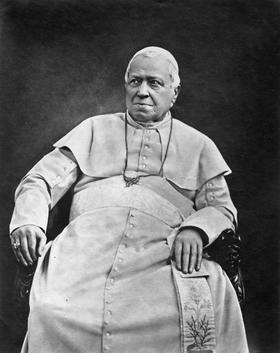
1990 to 1995
Miracle

Litmanová, Mount Zvir, Slovakia: permission for devotion

Dicastery for the Doctrine of the Faith “Let Jesus set you free.” Letter to the Archbishop of Prešov about the Spiritual Experience on Mount Zvir (Litmanová, Slovakia), 4 July 2025

“the alleged apparitions of the Blessed Virgin Mary in Litmanová between 1990 and 1995 … Although this declaration does not imply recognition of the supernatural authenticity of the alleged apparitions, it nevertheless permits the approval of public devotion and informs the faithful that they can safely approach this spiritual offering, it they so wish”

Church ruling
Nihil obstat for the Marian devotion on Mount Zvir, proposed by the Archbishop of Prešov and accepted by the Dicastery for the Doctrine of the Faith in the letter of 4 July 2025. The letter says it does not recognize the apparitions as supernatural

Read it in the source: vatican.va

See it on the timeline: Marian apparitions

3 May 1991
Saint

Born in London to Italian parents

Office for the Liturgical Celebrations of the Supreme Pontiff Booklet for the Mass with the Rite of Canonization, St. Peter's Square, 7 September 2025, profile of Carlo Acutis

“Carlo Acutis is the first saint of the millennial generation. He was born in London (United Kingdom) on 3 May 1991. At the time, his parents, both originally from Italy, were living in London, where his father was working. Carlo was baptized two weeks after his birth.”

Read it in the source: vatican.va

See it on the timeline: St. Carlo Acutis, 1991 to 2006

1991 to 1998
Saint

Baptism in London, home and school in Milan

Dicastery for the Causes of Saints Profile of St. Carlo Acutis, "Vita e opere", birth and family

“He was baptized on 18 May in the church of "Our Lady of Dolours" in London. In September 1991 the family returned to Milan. When he was four his parents enrolled him in nursery school, which he attended with great enthusiasm. When the time came for compulsory schooling, he was enrolled at the Istituto San Carlo in Milan. After three months he was moved to the primary school at the Istituto Tommaseo of the Marcelline Sisters, because it was closer to his home.”

Our translation. The words as written, in Italian:

“Venne battezzato il 18 maggio nella chiesa di “Our Lady of Dolours” a Londra. Nel settembre 1991 la famiglia rientrò a Milano. All’età di quattro anni i genitori lo iscrissero alla scuola materna, che frequentò con grande entusiasmo. Giunto il momento della scuola obbligatoria, venne iscritto all’Istituto San Carlo di Milano. Dopo tre mesi venne trasferito alle scuole elementari presso l’Istituto Tommaseo delle Suore Marcelline, perché era più vicino alla sua abitazione.”

Read it in the source: Dicastery for the Causes of Saints

See it on the timeline: St. Carlo Acutis, 1991 to 2006

1992
Magisterium
Catechism of the Catholic Church CCC 297

“Scripture bears witness to faith in creation "out of nothing" as a truth full of promise and hope. Thus the mother of seven sons encourages them for martyrdom: … Look at the heaven and the earth and see everything that is in them, and recognize that God did not make them out of things that existed. Thus also mankind comes into being.”

Read it in the source: vatican.va

See it on the timeline: Evolution and Genesis

1992
Magisterium

The chosen people, and the nations to be gathered

Catechism of the Catholic Church CCC 59-60

“In order to gather together scattered humanity God calls Abram from his country, his kindred and his father's house, and makes him Abraham, that is, "the father of a multitude of nations". "In you all the nations of the earth shall be blessed." … The people descended from Abraham would be the trustee of the promise made to the patriarchs, the chosen people, called to prepare for that day when God would gather all his children into the unity of the Church. They would be the root on to which the Gentiles would be grafted, once they came to believe.”

Read it in the source: vatican.va

See it on the timeline: Judaism and the Church

1992
Magisterium
Catechism of the Catholic Church CCC 2175

“Sunday is expressly distinguished from the sabbath which it follows chronologically every week; for Christians its ceremonial observance replaces that of the sabbath. In Christ's Passover, Sunday fulfills the spiritual truth of the Jewish sabbath and announces man's eternal rest in God. For worship under the Law prepared for the mystery of Christ, and what was done there prefigured some aspects of Christ:”

Read it in the source: vatican.va

See it on the timeline: The Sunday Mass obligation

1992
Magisterium
Catechism of the Catholic Church CCC 59

“In order to gather together scattered humanity God calls Abram from his country, his kindred and his father's house, and makes him Abraham, that is, "the father of a multitude of nations". "In you all the nations of the earth shall be blessed."”

Read it in the source: vatican.va

See it on the timeline: Islam and the one God

1992
Magisterium
Catechism of the Catholic Church CCC 355

“"God created man in his own image, in the image of God he created him, male and female he created them." Man occupies a unique place in creation: (I) he is "in the image of God"; (II) in his own nature he unites the spiritual and material worlds; (III) he is created "male and female"; (IV) God established him in his friendship.”

Read it in the source: vatican.va

See it on the timeline: Evolution and Genesis

1992
Magisterium
Catechism of the Catholic Church CCC 2335

“the union of man and woman in marriage is a way of imitating in the flesh the Creator's generosity and fecundity: "Therefore a man leaves his father and his mother and cleaves to his wife, and they become one flesh." All human generations proceed from this union.”

Read it in the source: vatican.va

See it on the timeline: Homosexuality

1992
Magisterium
Catechism of the Catholic Church CCC 2331

“"God created man in his own image . . . male and female he created them"; He blessed them and said, "Be fruitful and multiply"”

Read it in the source: vatican.va

See it on the timeline: Contraception

1992
Magisterium

Israel the priestly people, and the covenant looked for

Catechism of the Catholic Church CCC 62-64

“After the patriarchs, God formed Israel as his people by freeing them from slavery in Egypt. He established with them the covenant of Mount Sinai and, through Moses, gave them his law so that they would recognize him and serve him as the one living and true God, the provident Father and just judge, and so that they would look for the promised Saviour. … Israel is the priestly people of God, "called by the name of the LORD", and "the first to hear the word of God", The people of "elder brethren" in the faith of Abraham. … Through the prophets, God forms his people in the hope of salvation, in the expectation of a new and everlasting Covenant intended for all, to be written on their hearts.”

Read it in the source: vatican.va

See it on the timeline: Judaism and the Church

1992
Magisterium
Catechism of the Catholic Church CCC 359

“St. Paul tells us that the human race takes its origin from two men: Adam and Christ. . . the first man, Adam, he says, became a living soul, the last Adam a life-giving spirit.”

Read it in the source: vatican.va

See it on the timeline: Evolution and Genesis

1992
Magisterium
Catechism of the Catholic Church CCC 971

“The Church's devotion to the Blessed Virgin is intrinsic to Christian worship. … This very special devotion … differs essentially from the adoration which is given to the incarnate Word and equally to the Father and the Holy Spirit, and greatly fosters this adoration.”

Read it in the source: vatican.va

See it on the timeline: Honor given to Mary

1992
Magisterium
Catechism of the Catholic Church CCC 411

“Furthermore many Fathers and Doctors of the Church have seen the woman announced in the "Proto-evangelium" as Mary, the mother of Christ, the "new Eve". Mary benefited first of all and uniquely from Christ's victory over sin: she was preserved from all stain of original sin and by a special grace of God committed no sin of any kind during her whole earthly life.”

Read it in the source: vatican.va

See it on the timeline: Mary without sin

1992
Magisterium
Catechism of the Catholic Church CCC 2676

“"Rejoice . . . O Daughter of Jerusalem . . . the Lord your God is in your midst." Mary, in whom the Lord himself has just made his dwelling, is the daughter of Zion in person, the ark of the covenant, the place where the glory of the Lord dwells.”

Read it in the source: vatican.va

See it on the timeline: Mary without sin

1992
Magisterium
Catechism of the Catholic Church CCC 492-493

“The "splendour of an entirely unique holiness" by which Mary is "enriched from the first instant of her conception" comes wholly from Christ: she is "redeemed, in a more exalted fashion, by reason of the merits of her Son". … By the grace of God Mary remained free of every personal sin her whole life long.”

Read it in the source: vatican.va

See it on the timeline: Mary without sin

1992
Magisterium
Catechism of the Catholic Church CCC 499-500

“The deepening of faith in the virginal motherhood led the Church to confess Mary's real and perpetual virginity even in the act of giving birth to the Son of God made man. … Against this doctrine the objection is sometimes raised that the Bible mentions brothers and sisters of Jesus. The Church has always understood these passages as not referring to other children of the Virgin Mary. In fact James and Joseph, "brothers of Jesus", are the sons of another Mary, a disciple of Christ, whom St. Matthew significantly calls "the other Mary". They are close relations of Jesus, according to an Old Testament expression.”

Read it in the source: vatican.va

See it on the timeline: Perpetual virginity

1992
Magisterium
Catechism of the Catholic Church CCC 966

“"Finally the Immaculate Virgin, preserved free from all stain of original sin, when the course of her earthly life was finished, was taken up body and soul into heavenly glory, and exalted by the Lord as Queen over all things, so that she might be the more fully conformed to her Son, the Lord of lords and conqueror of sin and death." The Assumption of the Blessed Virgin is a singular participation in her Son's Resurrection and an anticipation of the resurrection of other Christians…”

Read it in the source: vatican.va

See it on the timeline: The Assumption

1992
Magisterium
Catechism of the Catholic Church CCC 2635

“Since Abraham, intercession - asking on behalf of another has been characteristic of a heart attuned to God's mercy. In the age of the Church, Christian intercession participates in Christ's, as an expression of the communion of saints.”

Read it in the source: vatican.va

See it on the timeline: Mary as Mediatrix

1992
Magisterium
Catechism of the Catholic Church CCC 970

“No creature could ever be counted along with the Incarnate Word and Redeemer; but just as the priesthood of Christ is shared in various ways both by his ministers and the faithful, and as the one goodness of God is radiated in different ways among his creatures, so also the unique mediation of the Redeemer does not exclude but rather gives rise to a manifold cooperation which is but a sharing in this one source.”

Read it in the source: vatican.va

See it on the timeline: Mary as Mediatrix

1992
Magisterium
Catechism of the Catholic Church CCC 2678

“Medieval piety in the West developed the prayer of the rosary as a popular substitute for the Liturgy of the Hours.”

Read it in the source: vatican.va

See it on the timeline: The Rosary

1992
Magisterium
Catechism of the Catholic Church CCC 1374

“In the most blessed sacrament of the Eucharist "the body and blood, together with the soul and divinity, of our Lord Jesus Christ and, therefore, the whole Christ is truly, really, and substantially contained." "This presence is called 'real' - by which is not intended to exclude the other types of presence as if they could not be 'real' too, but because it is presence in the fullest sense: that is to say, it is a substantial presence by which Christ, God and man, makes himself wholly and entirely present."”

Read it in the source: vatican.va

See it on the timeline: The Real Presence

1992
Magisterium
Catechism of the Catholic Church CCC 663

“Henceforth Christ is seated at the right hand of the Father: "By 'the Father's right hand' we understand the glory and honour of divinity, where he who exists as Son of God before all ages, indeed as God, of one being with the Father, is seated bodily after he became incarnate and his flesh was glorified."”

Read it in the source: vatican.va

See it on the timeline: The Real Presence and the Ascension

1992
Magisterium
Catechism of the Catholic Church CCC 1333

“the signs of bread and wine become, in a way surpassing understanding, the Body and Blood of Christ; they continue also to signify the goodness of creation. … the Church sees in the gesture of the king-priest Melchizedek, who "brought out bread and wine," a prefiguring of her own offering.”

Read it in the source: vatican.va

See it on the timeline: Transubstantiation

1992
Magisterium
Catechism of the Catholic Church CCC 1413

“By the consecration the transubstantiation of the bread and wine into the Body and Blood of Christ is brought about. Under the consecrated species of bread and wine Christ himself, living and glorious, is present in a true, real, and substantial manner: his Body and his Blood, with his soul and his divinity”

Read it in the source: vatican.va

See it on the timeline: Transubstantiation

1992
Magisterium
Catechism of the Catholic Church CCC 2113

“Idolatry not only refers to false pagan worship. It remains a constant temptation to faith. Idolatry consists in divinizing what is not God. Man commits idolatry whenever he honors and reveres a creature in place of God, whether this be gods or demons (for example, satanism), power, pleasure, race, ancestors, the state, money, etc.”

Read it in the source: vatican.va

See it on the timeline: Adoring the Eucharist

1992
Magisterium
Catechism of the Catholic Church CCC 1367, quoting the Council of Trent, Session 22, ch. 2

“The sacrifice of Christ and the sacrifice of the Eucharist are one single sacrifice: "The victim is one and the same: the same now offers through the ministry of priests, who then offered himself on the cross; only the manner of offering is different." "In this divine sacrifice which is celebrated in the Mass, the same Christ who offered himself once in a bloody manner on the altar of the cross is contained and is offered in an unbloody manner."”

Read it in the source: vatican.va

See it on the timeline: The Mass as sacrifice

1992
Magisterium
Catechism of the Catholic Church CCC 2181

“The Sunday Eucharist is the foundation and confirmation of all Christian practice. For this reason the faithful are obliged to participate in the Eucharist on days of obligation, unless excused for a serious reason (for example, illness, the care of infants) or dispensed by their own pastor. Those who deliberately fail in this obligation commit a grave sin.”

Read it in the source: vatican.va

See it on the timeline: The Sunday Mass obligation

1992
Magisterium
Catechism of the Catholic Church CCC 112

“Be especially attentive "to the content and unity of the whole Scripture". Different as the books which compose it may be, Scripture is a unity by reason of the unity of God's plan, of which Christ Jesus is the center and heart, open since his Passover.”

Read it in the source: vatican.va

See it on the timeline: The inspiration of Scripture

1992
Magisterium
Catechism of the Catholic Church CCC 83

“The Tradition here in question comes from the apostles and hands on what they received from Jesus' teaching and example and what they learned from the Holy Spirit. … Tradition is to be distinguished from the various theological, disciplinary, liturgical or devotional traditions, born in the local churches over time. … In the light of Tradition, these traditions can be retained, modified or even abandoned under the guidance of the Church's Magisterium.”

Read it in the source: vatican.va

See it on the timeline: Scripture and Tradition

1992
Magisterium
Catechism of the Catholic Church CCC 688

“The Church, a communion living in the faith of the apostles which she transmits, is the place where we know the Holy Spirit: - in the Scriptures he inspired; - in the Tradition, to which the Church Fathers are always timely witnesses; - in the Church's Magisterium, which he assists”

Read it in the source: vatican.va

See it on the timeline: The authority of the Fathers

1992
Magisterium
Catechism of the Catholic Church CCC 890

“It is this Magisterium's task to preserve God's people from deviations and defections and to guarantee them the objective possibility of professing the true faith without error. Thus, the pastoral duty of the Magisterium is aimed at seeing to it that the People of God abides in the truth that liberates. To fulfill this service, Christ endowed the Church's shepherds with the charism of infallibility in matters of faith and morals.”

Read it in the source: vatican.va

See it on the timeline: The Magisterium

1992
Magisterium
Catechism of the Catholic Church CCC 120

“It was by the apostolic Tradition that the Church discerned which writings are to be included in the list of the sacred books. This complete list is called the canon of Scripture. It includes 46 books for the Old Testament (45 if we count Jeremiah and Lamentations as one) and 27 for the New.”

Read it in the source: vatican.va

See it on the timeline: The Old Testament canon

1992
Magisterium
Catechism of the Catholic Church CCC 857

“The Church is apostolic because she is founded on the apostles, in three ways: - she was and remains built on "the foundation of the Apostles," the witnesses chosen and sent on mission by Christ himself; - with the help of the Spirit dwelling in her, the Church keeps and hands on the teaching, the "good deposit," the salutary words she has heard from the apostles; - she continues to be taught, sanctified, and guided by the apostles until Christ's return, through their successors in pastoral office: the college of bishops”

Read it in the source: vatican.va

See it on the timeline: Apostolic succession

1992
Magisterium
Catechism of the Catholic Church CCC 424

“Moved by the grace of the Holy Spirit and drawn by the Father, we believe in Jesus and confess: 'You are the Christ, the Son of the living God.' On the rock of this faith confessed by St. Peter, Christ built his Church.”

Read it in the source: vatican.va

See it on the timeline: Peter the rock

1992
Magisterium
Catechism of the Catholic Church CCC 754

“It is also the flock of which God himself foretold that he would be the shepherd, and whose sheep, even though governed by human shepherds, are unfailingly nourished and led by Christ himself, the Good Shepherd and Prince of Shepherds, who gave his life for his sheep.”

Read it in the source: vatican.va

See it on the timeline: The office of Peter

1992
Magisterium
Catechism of the Catholic Church CCC 881

“The Lord made Simon alone, whom he named Peter, the "rock" of his Church. He gave him the keys of his Church and instituted him shepherd of the whole flock. … This pastoral office of Peter and the other apostles belongs to the Church's very foundation and is continued by the bishops under the primacy of the Pope.”

Read it in the source: vatican.va

See it on the timeline: The office of Peter

1992
Magisterium
Catechism of the Catholic Church CCC 882

“The Pope, Bishop of Rome and Peter's successor, "is the perpetual and visible source and foundation of the unity both of the bishops and of the whole company of the faithful." "For the Roman Pontiff, by reason of his office as Vicar of Christ, and as pastor of the entire Church has full, supreme, and universal power over the whole Church, a power which he can always exercise unhindered."”

Read it in the source: vatican.va

See it on the timeline: Papal supremacy

1992
Magisterium
Catechism of the Catholic Church CCC 891

“"The Roman Pontiff, head of the college of bishops, enjoys this infallibility in virtue of his office, when, as supreme pastor and teacher of all the faithful - who confirms his brethren in the faith he proclaims by a definitive act a doctrine pertaining to faith or morals.... the infallibility promised to the Church is also present in the body of bishops when, together with Peter's successor, they exercise the supreme Magisterium," above all in an Ecumenical Council. … This infallibility extends as far as the deposit of divine Revelation itself.”

Read it in the source: vatican.va

See it on the timeline: Papal infallibility

1992
Magisterium
Catechism of the Catholic Church CCC 765

“The Lord Jesus endowed his community with a structure that will remain until the Kingdom is fully achieved. Before all else there is the choice of the Twelve with Peter as their head.”

Read it in the source: vatican.va

See it on the timeline: Constantine and the Church

1992
Magisterium
Catechism of the Catholic Church CCC 66

“"The Christian economy, therefore, since it is the new and definitive Covenant, will never pass away; and no new public revelation is to be expected before the glorious manifestation of our Lord Jesus Christ." Yet even if Revelation is already complete, it has not been made completely explicit; it remains for Christian faith gradually to grasp its full significance over the course of the centuries.”

Read it in the source: vatican.va

See it on the timeline: Doctrines defined later

1992
Magisterium
Catechism of the Catholic Church CCC 426

“"At the heart of catechesis we find, in essence, a Person, the Person of Jesus of Nazareth, the only Son from the Father. . .who suffered and died for us and who now, after rising, is living with us forever." … Catechesis aims at putting "people . . . in communion . . . with Jesus Christ: only he can lead us to the love of the Father in the Spirit and make us share in the life of the Holy Trinity."”

Read it in the source: vatican.va

See it on the timeline: Are Catholics Christians?

1992
Magisterium
Catechism of the Catholic Church CCC 816

“"The sole Church of Christ [is that] which our Savior, after his Resurrection, entrusted to Peter's pastoral care, commissioning him and the other apostles to extend and rule it.... This Church, constituted and organized as a society in the present world, subsists in … the Catholic Church, which is governed by the successor of Peter and by the bishops in communion with him."”

Read it in the source: vatican.va

See it on the timeline: The one Church

1992
Magisterium
Catechism of the Catholic Church CCC 889

“In order to preserve the Church in the purity of the faith handed on by the apostles, Christ who is the Truth willed to confer on her a share in his own infallibility. By a "supernatural sense of faith" the People of God, under the guidance of the Church's living Magisterium, "unfailingly adheres to this faith."”

Read it in the source: vatican.va

See it on the timeline: Was the Church corrupted early?

1992
Magisterium
Catechism of the Catholic Church CCC 846-848

“How are we to understand this affirmation, often repeated by the Church Fathers? Re-formulated positively, it means that all salvation comes from Christ the Head through the Church which is his Body … This affirmation is not aimed at those who, through no fault of their own, do not know Christ and his Church … "Although in ways known to himself God can lead those who, through no fault of their own, are ignorant of the Gospel, to that faith without which it is impossible to please him, the Church still has the obligation and also the sacred right to evangelize all men."”

Read it in the source: vatican.va

See it on the timeline: No salvation outside the Church

1992
Magisterium
Catechism of the Catholic Church CCC 827

“All members of the Church, including her ministers, must acknowledge that they are sinners. In everyone, the weeds of sin will still be mixed with the good wheat of the Gospel until the end of time. Hence the Church gathers sinners already caught up in Christ's salvation but still on the way to holiness”

Read it in the source: vatican.va

See it on the timeline: Violence in the Church's history

1992
Magisterium
Catechism of the Catholic Church CCC 1546-1547

“The whole community of believers is, as such, priestly. … While the common priesthood of the faithful is exercised by the unfolding of baptismal grace, a life of faith, hope, and charity, a life according to the Spirit, the ministerial priesthood is at the service of the common priesthood.”

Read it in the source: vatican.va

See it on the timeline: The ordained priesthood

1992
Magisterium
Catechism of the Catholic Church CCC 1441-1442

“Only God forgives sins. … Further, by virtue of his divine authority he gives this power to men to exercise in his name. … But he entrusted the exercise of the power of absolution to the apostolic ministry which he charged with the "ministry of reconciliation."”

Read it in the source: vatican.va

See it on the timeline: Confession to a priest

1992
Magisterium
Catechism of the Catholic Church CCC 1579-1580

“All the ordained ministers of the Latin Church, with the exception of permanent deacons, are normally chosen from among men of faith who live a celibate life and who intend to remain celibate "for the sake of the kingdom of heaven." … In the Eastern Churches a different discipline has been in force for many centuries: while bishops are chosen solely from among celibates, married men can be ordained as deacons and priests. This practice has long been considered legitimate”

Read it in the source: vatican.va

See it on the timeline: Priestly celibacy

1992
Magisterium
Catechism of the Catholic Church CCC 2010-2011

“Since the initiative belongs to God in the order of grace, no one can merit the initial grace of forgiveness and justification, at the beginning of conversion. Moved by the Holy Spirit and by charity, we can then merit for ourselves and for others the graces needed for our sanctification, for the increase of grace and charity, and for the attainment of eternal life. … The charity of Christ is the source in us of all our merits before God.”

Read it in the source: vatican.va

See it on the timeline: Faith and works

1992
Magisterium
Catechism of the Catholic Church CCC 2005

“Since it belongs to the supernatural order, grace escapes our experience and cannot be known except by faith. We cannot therefore rely on our feelings or our works to conclude that we are justified and saved. … "Asked if she knew that she was in God's grace, she replied: 'If I am not, may it please God to put me in it; if I am, may it please God to keep me there.'"”

Read it in the source: vatican.va

See it on the timeline: Assurance of salvation

1992
Magisterium
Catechism of the Catholic Church CCC 1821

“We can therefore hope in the glory of heaven promised by God to those who love him and do his will. In every circumstance, each one of us should hope, with the grace of God, to persevere "to the end" and to obtain the joy of heaven, as God's eternal reward for the good works accomplished with the grace of Christ.”

Read it in the source: vatican.va

See it on the timeline: Assurance of salvation

1992
Magisterium
Catechism of the Catholic Church CCC 1861

“Mortal sin is a radical possibility of human freedom, as is love itself. It results in the loss of charity and the privation of sanctifying grace, that is, of the state of grace. If it is not redeemed by repentance and God's forgiveness, it causes exclusion from Christ's kingdom and the eternal death of hell, for our freedom has the power to make choices for ever, with no turning back.”

Read it in the source: vatican.va

See it on the timeline: Eternal security

1992
Magisterium
Catechism of the Catholic Church CCC 1030-1031

“All who die in God's grace and friendship, but still imperfectly purified, are indeed assured of their eternal salvation; but after death they undergo purification, so as to achieve the holiness necessary to enter the joy of heaven. … The Church gives the name Purgatory to this final purification of the elect, which is entirely different from the punishment of the damned.”

Read it in the source: vatican.va

See it on the timeline: Purgatory

1992
Magisterium
Catechism of the Catholic Church CCC 1434

“Scripture and the Fathers insist above all on three forms, fasting, prayer, and almsgiving, which express conversion in relation to oneself, to God, and to others. Alongside the radical purification brought about by Baptism or martyrdom they cite as means of obtaining forgiveness of sins: effort at reconciliation with one's neighbor, tears of repentance, concern for the salvation of one's neighbor, the intercession of the saints, and the practice of charity "which covers a multitude of sins."”

Read it in the source: vatican.va

See it on the timeline: Indulgences

1992
Magisterium
Catechism of the Catholic Church CCC 1471, 1478

“An indulgence is a remission before God of the temporal punishment due to sins whose guilt has already been forgiven, which the faithful Christian who is duly disposed gains under certain prescribed conditions through the action of the Church … An indulgence is obtained through the Church who, by virtue of the power of binding and loosing granted her by Christ Jesus, intervenes in favor of individual Christians and opens for them the treasury of the merits of Christ and the saints to obtain from the Father of mercies the remission of the temporal punishments due for their sins.”

Read it in the source: vatican.va

See it on the timeline: Indulgences

1992
Magisterium
Catechism of the Catholic Church CCC 1215

“This sacrament is also called "the washing of regeneration and renewal by the Holy Spirit," for it signifies and actually brings about the birth of water and the Spirit without which no one "can enter the kingdom of God."”

Read it in the source: vatican.va

See it on the timeline: Baptism and salvation

1992
Magisterium
Catechism of the Catholic Church CCC 1257

“The Lord himself affirms that Baptism is necessary for salvation. … Baptism is necessary for salvation for those to whom the Gospel has been proclaimed and who have had the possibility of asking for this sacrament. … God has bound salvation to the sacrament of Baptism, but he himself is not bound by his sacraments.”

Read it in the source: vatican.va

See it on the timeline: Baptism and salvation

1992
Magisterium
Catechism of the Catholic Church CCC 1250, 1252

“Born with a fallen human nature and tainted by original sin, children also have need of the new birth in Baptism … The sheer gratuitousness of the grace of salvation is particularly manifest in infant Baptism. … The practice of infant Baptism is an immemorial tradition of the Church. There is explicit testimony to this practice from the second century on, and it is quite possible that, from the beginning of the apostolic preaching, when whole "households" received baptism, infants may also have been baptized.”

Read it in the source: vatican.va

See it on the timeline: Infant baptism

1992
Magisterium
Catechism of the Catholic Church CCC 1239

“Baptism is performed in the most expressive way by triple immersion in the baptismal water. However, from ancient times it has also been able to be conferred by pouring the water three times over the candidate's head.”

Read it in the source: vatican.va

See it on the timeline: Baptism by pouring

1992
Magisterium
Catechism of the Catholic Church CCC 1278

“The essential rite of Baptism consists in immersing the candidate in water or pouring water on his head, while pronouncing the invocation of the Most Holy Trinity: the Father, the Son, and the Holy Spirit.”

Read it in the source: vatican.va

See it on the timeline: Baptism by pouring

1992
Magisterium
Catechism of the Catholic Church CCC 2116

“All forms of divination are to be rejected: recourse to Satan or demons, conjuring up the dead or other practices falsely supposed to "unveil" the future. … They contradict the honor, respect, and loving fear that we owe to God alone.”

Read it in the source: vatican.va

See it on the timeline: Praying to saints

1992
Magisterium
Catechism of the Catholic Church CCC 2129-2130

“The divine injunction included the prohibition of every representation of God by the hand of man. … Nevertheless, already in the Old Testament, God ordained or permitted the making of images that pointed symbolically toward salvation by the incarnate Word: so it was with the bronze serpent, the ark of the covenant, and the cherubim.”

Read it in the source: vatican.va

See it on the timeline: Images and statues

1992
Magisterium
Catechism of the Catholic Church CCC 2096

“Adoration is the first act of the virtue of religion. To adore God is to acknowledge him as God, as the Creator and Savior, the Lord and Master of everything that exists, as infinite and merciful Love. "You shall worship the Lord your God, and him only shall you serve," says Jesus, citing Deuteronomy.”

Read it in the source: vatican.va

See it on the timeline: Honoring the Pope

1992
Magisterium
Catechism of the Catholic Church CCC 841

“The Church's relationship with the Muslims. "The plan of salvation also includes those who acknowledge the Creator, in the first place amongst whom are the Muslims; these profess to hold the faith of Abraham, and together with us they adore the one, merciful God, mankind's judge on the last day."”

Read it in the source: vatican.va

See it on the timeline: Islam and the one God

1992
Magisterium
Catechism of the Catholic Church CCC 846-847

“Basing itself on Scripture and Tradition, the Council teaches that the Church, a pilgrim now on earth, is necessary for salvation: the one Christ is the mediator and the way of salvation; he is present to us in his body which is the Church. … Those who, through no fault of their own, do not know the Gospel of Christ or his Church, but who nevertheless seek God with a sincere heart, and, moved by grace, try in their actions to do his will as they know it through the dictates of their conscience - those too may achieve eternal salvation.”

Read it in the source: vatican.va

See it on the timeline: Other religions

1992
Magisterium
Catechism of the Catholic Church CCC 337

“God himself created the visible world in all its richness, diversity and order. Scripture presents the work of the Creator symbolically as a succession of six days of divine "work", concluded by the "rest" of the seventh day.”

Read it in the source: vatican.va

See it on the timeline: Evolution and Genesis

1992
Magisterium
Catechism of the Catholic Church CCC 2357

“Basing itself on Sacred Scripture, which presents homosexual acts as acts of grave depravity, tradition has always declared that "homosexual acts are intrinsically disordered." They are contrary to the natural law. They close the sexual act to the gift of life. They do not proceed from a genuine affective and sexual complementarity. Under no circumstances can they be approved.”

Read it in the source: vatican.va

See it on the timeline: Homosexuality

1992
Magisterium
Catechism of the Catholic Church CCC 2368

“A particular aspect of this responsibility concerns the regulation of procreation. For just reasons, spouses may wish to space the births of their children. It is their duty to make certain that their desire is not motivated by selfishness but is in conformity with the generosity appropriate to responsible parenthood.”

Read it in the source: vatican.va

See it on the timeline: Contraception

1992
Magisterium
Catechism of the Catholic Church CCC 2270-2271

“Human life must be respected and protected absolutely from the moment of conception. … Since the first century the Church has affirmed the moral evil of every procured abortion. This teaching has not changed and remains unchangeable. Direct abortion, that is to say, abortion willed either as an end or a means, is gravely contrary to the moral law”

Read it in the source: vatican.va

See it on the timeline: Abortion

1992
Magisterium

What the Church confesses about Jesus of Nazareth

Catechism of the Catholic Church CCC 423

“We believe and confess that Jesus of Nazareth, born a Jew of a daughter of Israel at Bethlehem at the time of King Herod the Great and the emperor Caesar Augustus, a carpenter by trade, who died crucified in Jerusalem under the procurator Pontius Pilate during the reign of the emperor Tiberius, is the eternal Son of God made man.”

Read it in the source: vatican.va

See it on the timeline: The life of Jesus Christ: the record inside and outside the Bible

1992
Magisterium

The Catechism: the seventy elders prefigure the ordained ministry

Catechism of the Catholic Church CCC 1541

“The liturgy of the Church, however, sees in the priesthood of Aaron and the service of the Levites, as in the institution of the seventy elders, a prefiguring of the ordained ministry of the New Covenant.”

Read it in the source: vatican.va

See it on the timeline: The ecumenical councils

1992
Liturgy

The basic order has stayed the same

Catechism of the Catholic Church CCC 1345

“As early as the second century we have the witness of St. Justin Martyr for the basic lines of the order of the Eucharistic celebration. They have stayed the same until our own day for all the great liturgical families.”

Read it in the source: vatican.va

See it on the timeline: The Mass through the centuries

1992
Magisterium

"An epitome of the whole Gospel"

Catechism of the Catholic Church CCC 971

“The liturgical feasts dedicated to the Mother of God and Marian prayer, such as the rosary, an “epitome of the whole Gospel,” express this devotion to the Virgin Mary.”

Read it in the source: vatican.va

See it on the timeline: The Rosary

1992
Magisterium
Catechism of the Catholic Church CCC 1117

“Thus the Church has discerned over the centuries that among liturgical celebrations there are seven that are, in the strict sense of the term, sacraments instituted by the Lord.”

Read it in the source: vatican.va

See it on the timeline: The seven sacraments

1992
Magisterium
Catechism of the Catholic Church CCC 1218

“Since the beginning of the world, water, so humble and wonderful a creature, has been the source of life and fruitfulness.”

Read it in the source: vatican.va

See it on the timeline: Baptism

1992
Magisterium
Catechism of the Catholic Church CCC 1221

“But above all, the crossing of the Red Sea, literally the liberation of Israel from the slavery of Egypt, announces the liberation wrought by Baptism”

Read it in the source: vatican.va

See it on the timeline: Baptism

1992
Magisterium
Catechism of the Catholic Church CCC 1258

“The Church has always held the firm conviction that those who suffer death for the sake of the faith without having received Baptism are baptized by their death for and with Christ. This Baptism of blood, like the desire for Baptism, brings about the fruits of Baptism without being a sacrament.”

Read it in the source: vatican.va

See it on the timeline: Baptism

1992
Magisterium
Catechism of the Catholic Church CCC 1272

“Incorporated into Christ by Baptism, the person baptized is configured to Christ. Baptism seals the Christian with the indelible spiritual mark (character) of his belonging to Christ. No sin can erase this mark, even if sin prevents Baptism from bearing the fruits of salvation. Given once for all, Baptism cannot be repeated.”

Read it in the source: vatican.va

See it on the timeline: Baptism

1992
Magisterium
Catechism of the Catholic Church CCC 1290

“In the first centuries Confirmation generally comprised one single celebration with Baptism, forming with it a "double sacrament," according to the expression of St. Cyprian. Among other reasons, the multiplication of infant baptisms all through the year, the increase of rural parishes, and the growth of dioceses often prevented the bishop from being present at all baptismal celebrations. In the West the desire to reserve the completion of Baptism to the bishop caused the temporal separation of the two sacraments. the East has kept them united, so that Confirmation is conferred by the priest who baptizes. But he can do so only with the "myron" consecrated by a bishop.”

Read it in the source: vatican.va

See it on the timeline: Confirmation

1992
Magisterium
Catechism of the Catholic Church CCC 1094

“This catechesis unveils what lay hidden under the letter of the Old Testament: the mystery of Christ. It is called "typological" because it reveals the newness of Christ on the basis of the "figures" (types) which announce him in the deeds, words, and symbols of the first covenant. … Water from the rock was the figure of the spiritual gifts of Christ, and manna in the desert prefigured the Eucharist, "the true bread from heaven."”

Read it in the source: vatican.va

See it on the timeline: The Eucharist

1992
Magisterium
Catechism of the Catholic Church CCC 1333

“the signs of bread and wine become, in a way surpassing understanding, the Body and Blood of Christ; they continue also to signify the goodness of creation. … the Church sees in the gesture of the king-priest Melchizedek, who "brought out bread and wine," a prefiguring of her own offering.”

Read it in the source: vatican.va

See it on the timeline: The Eucharist

1992
Magisterium
Catechism of the Catholic Church CCC 1340

“By celebrating the Last Supper with his apostles in the course of the Passover meal, Jesus gave the Jewish Passover its definitive meaning. Jesus' passing over to his father by his death and Resurrection, the new Passover, is anticipated in the Supper and celebrated in the Eucharist, which fulfills the Jewish Passover and anticipates the final Passover of the Church in the glory of the kingdom.”

Read it in the source: vatican.va

See it on the timeline: The Eucharist

1992
Magisterium
Catechism of the Catholic Church CCC 1389

“The Church obliges the faithful "to take part in the Divine Liturgy on Sundays and feast days" and, prepared by the sacrament of Reconciliation, to receive the Eucharist at least once a year, if possible during the Easter season. But the Church strongly encourages the faithful to receive the holy Eucharist on Sundays and feast days, or more often still, even daily.”

Read it in the source: vatican.va

See it on the timeline: The Eucharist

1992
Magisterium
Catechism of the Catholic Church CCC 1390

“Since Christ is sacramentally present under each of the species, communion under the species of bread alone makes it possible to receive all the fruit of Eucharistic grace. For pastoral reasons this manner of receiving communion has been legitimately established as the most common form in the Latin rite. But "the sign of communion is more complete when given under both kinds, since in that form the sign of the Eucharistic meal appears more clearly." This is the usual form of receiving communion in the Eastern rites.”

Read it in the source: vatican.va

See it on the timeline: The Eucharist

1992
Magisterium
Catechism of the Catholic Church CCC 1449

“The formula of absolution used in the Latin Church expresses the essential elements of this sacrament: the Father of mercies is the source of all forgiveness. He effects the reconciliation of sinners through the Passover of his Son and the gift of his Spirit, through the prayer and ministry of the Church”

Read it in the source: vatican.va

See it on the timeline: Penance and Reconciliation

1992
Magisterium
Catechism of the Catholic Church CCC 1512

“From ancient times in the liturgical traditions of both East and West, we have testimonies to the practice of anointings of the sick with blessed oil. Over the centuries the Anointing of the Sick was conferred more and more exclusively on those at the point of death. Because of this it received the name "Extreme Unction." Notwithstanding this evolution the liturgy has never failed to beg the Lord that the sick person may recover his health if it would be conducive to his salvation.”

Read it in the source: vatican.va

See it on the timeline: The Anointing of the Sick

1992
Magisterium
Catechism of the Catholic Church CCC 1536

“Holy Orders is the sacrament through which the mission entrusted by Christ to his apostles continues to be exercised in the Church until the end of time: thus it is the sacrament of apostolic ministry. It includes three degrees: episcopate, presbyterate, and diaconate.”

Read it in the source: vatican.va

See it on the timeline: Holy Orders

1992
Magisterium
Catechism of the Catholic Church CCC 1623

“In the Latin Church, it is ordinarily understood that the spouses, as ministers of Christ's grace, mutually confer upon each other the sacrament of Matrimony by expressing their consent before the Church. In the Eastern liturgies the minister of this sacrament (which is called "Crowning") is the priest or bishop who, after receiving the mutual consent of the spouses, successively crowns the bridegroom and the bride as a sign of the marriage covenant.”

Read it in the source: vatican.va

See it on the timeline: Matrimony

1992
Miracle

Elijah's fire as a figure of the Holy Spirit

Catechism of the Catholic Church CCC 696

“Fire. While water signifies birth and the fruitfulness of life given in the Holy Spirit, fire symbolizes the transforming energy of the Holy Spirit's actions. the prayer of the prophet Elijah, who "arose like fire" and whose "word burned like a torch," brought down fire from heaven on the sacrifice on Mount Carmel. This event was a "figure" of the fire of the Holy Spirit, who transforms what he touches.”

Read it in the source: vatican.va

See it on the timeline: Great miracles

1992
Miracle

What moves us to believe

Catechism of the Catholic Church CCC 156

“What moves us to believe is not the fact that revealed truths appear as true and intelligible in the light of our natural reason: we believe "because of the authority of God himself who reveals them, who can neither deceive nor be deceived". So "that the submission of our faith might nevertheless be in accordance with reason, God willed that external proofs of his Revelation should be joined to the internal helps of the Holy Spirit." Thus the miracles of Christ and the saints, prophecies, the Church's growth and holiness, and her fruitfulness and stability "are the most certain signs of divine Revelation, adapted to the intelligence of all"; they are "motives of credibility" (motiva credibilitatis), which show that the assent of faith is "by no means a blind impulse of the mind".”

Read it in the source: vatican.va

See it on the timeline: Great miracles

1992
Miracle

What the miracles of Jesus are for

Catechism of the Catholic Church CCC 548

“The signs worked by Jesus attest that the Father has sent him. They invite belief in him. To those who turn to him in faith, he grants what they ask. So miracles strengthen faith in the One who does his Father's works; they bear witness that he is the Son of God. But his miracles can also be occasions for "offence"; they are not intended to satisfy people's curiosity or desire for magic Despite his evident miracles some people reject Jesus; he is even accused of acting by the power of demons.”

Read it in the source: vatican.va

See it on the timeline: Great miracles

1992
Miracle

Private revelations and the deposit of faith

Catechism of the Catholic Church CCC 67

“Throughout the ages, there have been so-called "private" revelations, some of which have been recognized by the authority of the Church. They do not belong, however, to the deposit of faith. It is not their role to improve or complete Christ's definitive Revelation, but to help live more fully by it in a certain period of history.”

Read it in the source: vatican.va

See it on the timeline: Marian apparitions

1992
Miracle

What the Church teaches about the Eucharist: the manna prefigured it

Catechism of the Catholic Church CCC 1094

“Water from the rock was the figure of the spiritual gifts of Christ, and manna in the desert prefigured the Eucharist, "the true bread from heaven."”

Read it in the source: vatican.va

See it on the timeline: Eucharistic miracles

1992
Miracle

What the Church teaches about the Eucharist: the real presence

Catechism of the Catholic Church CCC 1374

“In the most blessed sacrament of the Eucharist "the body and blood, together with the soul and divinity, of our Lord Jesus Christ and, therefore, the whole Christ is truly, really, and substantially contained." "This presence is called 'real' - by which is not intended to exclude the other types of presence as if they could not be 'real' too, but because it is presence in the fullest sense: that is to say, it is a substantial presence by which Christ, God and man, makes himself wholly and entirely present."”

Read it in the source: vatican.va

See it on the timeline: Eucharistic miracles

1992
Miracle

What the Church teaches about the Eucharist: transubstantiation

Catechism of the Catholic Church CCC 1376

“The Council of Trent summarizes the Catholic faith by declaring: "Because Christ our Redeemer said that it was truly his body that he was offering under the species of bread, it has always been the conviction of the Church of God, and this holy Council now declares again, that by the consecration of the bread and wine there takes place a change of the whole substance of the bread into the substance of the body of Christ our Lord and of the whole substance of the wine into the substance of his blood. This change the holy Catholic Church has fittingly and properly called transubstantiation."”

Read it in the source: vatican.va

See it on the timeline: Eucharistic miracles

November 1992
Miracle

Bl. Josemaría Escrivá: Dr. Manuel Nevado Rey healed of radiodermatitis

Dicastery for the Causes of Saints Profile of St. Josemaría Escrivá, account of the cause

“On 10 July 1997, the Medical Board of the Congregation for the Causes of Saints drew up, unanimously, this diagnosis: "Cancerization of severe chronic radiodermatitis at the 3rd stage, in an irreversible phase"; and therefore with a certainly unfavourable prognosis. The complete healing of the lesions, confirmed by objective examinations of the patient in 1992, 1994 and 1997, was declared by the Medical Board "very rapid, complete and lasting, scientifically inexplicable".”

Our translation. The words as written, in Italian:

“Il 10 luglio 1997, la Consulta Medica della Congregazione delle Cause dei Santi redasse, all’unanimità, questa diagnosi: “Cancerizzazione di radiodermite cronica grave al 3º stadio, in fase d’irreversibilità”; e pertanto con una prognosi sicuramente infausta. La guarigione completa delle lesioni, confermata dagli esami obiettivi del paziente nel 1992, 1994 e 1997, è stata dichiarata dalla Consulta Medica “molto rapida, completa e duratura, scientificamente inspiegabile”.”

Case
Dr. Manuel Nevado Rey, a Spanish orthopaedic surgeon born in 1932, with chronic radiodermatitis of the hands from years of exposure to X-rays. The lesions disappeared in about fifteen days in November 1992. He had received no treatment
Investigation
Canonical process in the Archdiocese of Badajoz, concluded in 1994
Medical finding
Medical Board, 10 July 1997, unanimously: healing "very rapid, complete and lasting, scientifically inexplicable", confirmed by examinations in 1992, 1994 and 1997
Church ruling
Theological consultors, unanimously affirmative, 9 January 1998; cardinals and bishops 21 September 2001; decree approved by John Paul II. Canonized 6 October 2002

Read it in the source: Dicastery for the Causes of Saints

See it on the timeline: Miracles approved for canonizations

1992
Magisterium

The Catechism: the Jews are not collectively guilty of the death of Jesus

Catechism of the Catholic Church CCC 597

“Hence we cannot lay responsibility for the trial on the Jews in Jerusalem as a whole, despite the outcry of a manipulated crowd and the global reproaches contained in the apostles' calls to conversion after Pentecost. … Still less can we extend responsibility to other Jews of different times and places, based merely on the crowd's cry: "His blood be on us and on our children!", a formula for ratifying a judicial sentence.”

Read it in the source: vatican.va

See it on the timeline: The Church and the Jewish people

1992
Magisterium

The Catechism on torture in the Church's own tribunals

Catechism of the Catholic Church CCC 2298

“In times past, cruel practices were commonly used by legitimate governments to maintain law and order, often without protest from the Pastors of the Church, who themselves adopted in their own tribunals the prescriptions of Roman law concerning torture. Regrettable as these facts are, the Church always taught the duty of clemency and mercy. She forbade clerics to shed blood. In recent times it has become evident that these cruel practices were neither necessary for public order, nor in conformity with the legitimate rights of the human person. On the contrary, these practices led to ones even more degrading. It is necessary to work for their abolition. We must pray for the victims and their tormentors.”

Read it in the source: vatican.va

See it on the timeline: The Inquisition and the use of force against heresy

1992
Church governance

The Porter and Kos cases, and five principles left to each bishop

Michael R. Merz, member of the National Review Board, in a history written for the United States Conference of Catholic Bishops A History of the National Review Board (2011), Background

“More national public attention came in 1992 with the cases of James Porter in Fall River, Massachusetts, and Rudy Kos in Dallas, Texas. In 1992, then USCCB President Archbishop Daniel E. Pilarczyk recommended that bishops apply the following Five Principles in dealing with these cases: 1. Respond promptly to allegations of abuse. 2. If the allegations are supported by evidence, remove the offender and refer him for evaluation. 3. Report abuse to civil authorities as required by law. 4. Reach out to victims. 5. Be as open as possible with the community. Some dioceses created child protection plans based on the Five Principles and some did not.”

Read it in the source: USCCB

See it on the timeline: Clergy sexual abuse and the Church's response

1992
Magisterium

The Jewish faith and the Church's faith

Catechism of the Catholic Church CCC 839

“The Jewish faith, unlike other non-Christian religions, is already a response to God's revelation in the Old Covenant.”

Read it in the source: vatican.va

See it on the timeline: Judaism and the Church

1992
Magisterium

What the Church teaches an indulgence is

Catechism of the Catholic Church CCC 1471

“An indulgence is a remission before God of the temporal punishment due to sins whose guilt has already been forgiven, which the faithful Christian who is duly disposed gains under certain prescribed conditions through the action of the Church which, as the minister of redemption, dispenses and applies with authority the treasury of the satisfactions of Christ and the saints.”

Read it in the source: vatican.va

See it on the timeline: Protestantism

1992
Magisterium

True God and true man

Catechism of the Catholic Church CCC 464

“The unique and altogether singular event of the Incarnation of the Son of God does not mean that Jesus Christ is part God and part man, nor does it imply that he is the result of a confused mixture of the divine and the human. He became truly man while remaining truly God. Jesus Christ is true God and true man.”

Read it in the source: vatican.va

See it on the timeline: The life of Jesus Christ: the record inside and outside the Bible

1992
Magisterium
Catechism of the Catholic Church CCC 129

“Besides, the New Testament has to be read in the light of the Old. Early Christian catechesis made constant use of the Old Testament. As an old saying put it, the New Testament lies hidden in the Old and the Old Testament is unveiled in the New.”

Read it in the source: vatican.va

See it on the timeline: The inspiration of Scripture

1992
Magisterium
Catechism of the Catholic Church CCC 762

“The remote preparation for this gathering together of the People of God begins when he calls Abraham and promises that he will become the father of a great people. Its immediate preparation begins with Israel's election as the People of God. By this election, Israel is to be the sign of the future gathering of All nations.”

Read it in the source: vatican.va

See it on the timeline: The one Church

1992
Magisterium
Catechism of the Catholic Church CCC 664

“Being seated at the Father's right hand signifies the inauguration of the Messiah's kingdom, the fulfilment of the prophet Daniel's vision concerning the Son of man: “To him was given dominion and glory and kingdom, that all peoples, nations, and languages should serve him; his dominion is an everlasting dominion, which shall not pass away, and his kingdom one that shall not be destroyed.””

Read it in the source: vatican.va

See it on the timeline: Was the Church corrupted early?

1992
Magisterium
Catechism of the Catholic Church CCC 845

“To reunite all his children, scattered and led astray by sin, the Father willed to call the whole of humanity together into his Son's Church. the Church is the place where humanity must rediscover its unity and salvation. the Church is "the world reconciled." She is that bark which "in the full sail of the Lord's cross, by the breath of the Holy Spirit, navigates safely in this world." According to another image dear to the Church Fathers, she is prefigured by Noah's ark, which alone saves from the flood.”

Read it in the source: vatican.va

See it on the timeline: No salvation outside the Church

1992
Magisterium

The first half of the Hail Mary

Catechism of the Catholic Church CCC 2676

“Hail Mary [or Rejoice, Mary]: the greeting of the angel Gabriel opens this prayer. It is God himself who, through his angel as intermediary, greets Mary. Our prayer dares to take up this greeting to Mary with the regard God had for the lowliness of his humble servant and to exult in the joy he finds in her. … After the angel's greeting, we make Elizabeth's greeting our own.”

Read it in the source: vatican.va

See it on the timeline: The Rosary

1992
Magisterium

One person, and that person is divine

Catechism of the Catholic Church CCC 466

“Christ's humanity has no other subject than the divine person of the Son of God, who assumed it and made it his own, from his conception.”

Read it in the source: vatican.va

See it on the timeline: The life of Jesus Christ: the record inside and outside the Bible

1992
Magisterium
Catechism of the Catholic Church CCC 2708

“Christian prayer tries above all to meditate on the mysteries of Christ, as in lectio divina or the rosary. This form of prayerful reflection is of great value, but Christian prayer should go further: to the knowledge of the love of the Lord Jesus, to union with him.”

Read it in the source: vatican.va

See it on the timeline: The Rosary

1992
Magisterium
Catechism of the Catholic Church CCC 1373

“"Christ Jesus, who died, yes, who was raised from the dead, who is at the right hand of God, who indeed intercedes for us," is present in many ways to his Church: in his word, in his Church's prayer, "where two or three are gathered in my name," in the poor, the sick, and the imprisoned, in the sacraments of which he is the author, in the sacrifice of the Mass, and in the person of the minister. But "he is present . . . most especially in the Eucharistic species."”

Read it in the source: vatican.va

See it on the timeline: The Real Presence and the Ascension

1992
Magisterium
Catechism of the Catholic Church CCC 1378

“In the liturgy of the Mass we express our faith in the real presence of Christ under the species of bread and wine by, among other ways, genuflecting or bowing deeply as a sign of adoration of the Lord. "The Catholic Church has always offered and still offers to the sacrament of the Eucharist the cult of adoration, not only during Mass, but also outside of it, reserving the consecrated hosts with the utmost care, exposing them to the solemn veneration of the faithful, and carrying them in procession."”

Read it in the source: vatican.va

See it on the timeline: Adoring the Eucharist

1992
Magisterium
Catechism of the Catholic Church CCC 1087

“By the power of the same Holy Spirit they entrusted this power to their successors. This "apostolic succession" structures the whole liturgical life of the Church and is itself sacramental, handed on by the sacrament of Holy Orders.”

Read it in the source: vatican.va

See it on the timeline: Apostolic succession

1992
Magisterium
Catechism of the Catholic Church CCC 552

“Our Lord then declared to him: "You are Peter, and on this rock I will build my Church, and the gates of Hades will not prevail against it." Christ, the "living Stone", thus assures his Church, built on Peter, of victory over the powers of death. Because of the faith he confessed Peter will remain the unshakeable rock of the Church.”

Read it in the source: vatican.va

See it on the timeline: Peter the rock

1992
Magisterium
Catechism of the Catholic Church CCC 830

“"Where there is Christ Jesus, there is the Catholic Church." In her subsists the fullness of Christ's body united with its head … the Church was, in this fundamental sense, catholic on the day of Pentecost and will always be so until the day of the Parousia.”

Read it in the source: vatican.va

See it on the timeline: Constantine and the Church

1992
Magisterium
Catechism of the Catholic Church CCC 88

“The Church's Magisterium exercises the authority it holds from Christ to the fullest extent when it defines dogmas, that is, when it proposes truths contained in divine Revelation or also when it proposes in a definitive way truths having a necessary connection with them.”

Read it in the source: vatican.va

See it on the timeline: Doctrines defined later

1992
Magisterium
Catechism of the Catholic Church CCC 819

“"Furthermore, many elements of sanctification and of truth" are found outside the visible confines of the Catholic Church: "the written Word of God; the life of grace; faith, hope, and charity, with the other interior gifts of the Holy Spirit, as well as visible elements." Christ's Spirit uses these Churches and ecclesial communities as means of salvation, whose power derives from the fullness of grace and truth that Christ has entrusted to the Catholic Church.”

Read it in the source: vatican.va

See it on the timeline: The one Church

1992
Magisterium
Catechism of the Catholic Church CCC 1544

“Everything that the priesthood of the Old Covenant prefigured finds its fulfillment in Christ Jesus, the "one mediator between God and men." The Christian tradition considers Melchizedek, "priest of God Most High," as a prefiguration of the priesthood of Christ, the unique "high priest after the order of Melchizedek"; "holy, blameless, unstained," "by a single offering he has perfected for all time those who are sanctified," that is, by the unique sacrifice of the cross.”

Read it in the source: vatican.va

See it on the timeline: The priest and the Eucharist

1992
Magisterium
Catechism of the Catholic Church CCC 1481

“The Byzantine Liturgy recognizes several formulas of absolution, in the form of invocation, which admirably express the mystery of forgiveness: "May the same God, who through the Prophet Nathan forgave David when he confessed his sins, who forgave Peter when he wept bitterly, the prostitute when she washed his feet with her tears, the Pharisee, and the prodigal son, through me, a sinner, forgive you both in this life and in the next”

Read it in the source: vatican.va

See it on the timeline: Confession to a priest

1992
Magisterium
Catechism of the Catholic Church CCC 1620

“Both the sacrament of Matrimony and virginity for the Kingdom of God come from the Lord himself. … Esteem of virginity for the sake of the kingdom and the Christian understanding of marriage are inseparable, and they reinforce each other”

Read it in the source: vatican.va

See it on the timeline: Priestly celibacy

1992
Magisterium
Catechism of the Catholic Church CCC 1032

“This teaching is also based on the practice of prayer for the dead, already mentioned in Sacred Scripture: “Therefore Judas Maccabeus] made atonement for the dead, that they might be delivered from their sin.” From the beginning the Church has honored the memory of the dead and offered prayers in suffrage for them, above all the Eucharistic sacrifice, so that, thus purified, they may attain the beatific vision of God.”

Read it in the source: vatican.va

See it on the timeline: Purgatory

1992
Magisterium
Catechism of the Catholic Church CCC 1473

“The forgiveness of sin and restoration of communion with God entail the remission of the eternal punishment of sin, but temporal punishment of sin remains.”

Read it in the source: vatican.va

See it on the timeline: Indulgences

1992
Magisterium
Catechism of the Catholic Church CCC 2358-2359

“They must be accepted with respect, compassion, and sensitivity. Every sign of unjust discrimination in their regard should be avoided. These persons are called to fulfill God's will in their lives and, if they are Christians, to unite to the sacrifice of the Lord's Cross the difficulties they may encounter from their condition. … Homosexual persons are called to chastity. By the virtues of self-mastery that teach them inner freedom, at times by the support of disinterested friendship, by prayer and sacramental grace, they can and should gradually and resolutely approach Christian perfection.”

Read it in the source: vatican.va

See it on the timeline: Homosexuality

1992
Magisterium
Catechism of the Catholic Church CCC 2370

“Periodic continence, that is, the methods of birth regulation based on self-observation and the use of infertile periods, is in conformity with the objective criteria of morality. These methods respect the bodies of the spouses, encourage tenderness between them, and favor the education of an authentic freedom. In contrast, "every action which, whether in anticipation of the conjugal act, or in its accomplishment, or in the development of its natural consequences, proposes, whether as an end or as a means, to render procreation impossible" is intrinsically evil”

Read it in the source: vatican.va

See it on the timeline: Contraception

1992
Magisterium
Catechism of the Catholic Church CCC 2272

“The Church attaches the canonical penalty of excommunication to this crime against human life. … The Church does not thereby intend to restrict the scope of mercy. Rather, she makes clear the gravity of the crime committed, the irreparable harm done to the innocent who is put to death, as well as to the parents and the whole of society.”

Read it in the source: vatican.va

See it on the timeline: Abortion

1992Christ, holding a white banner with a red cross, steps from the tomb above four sleeping soldiers
Magisterium

The Resurrection as a fact of history

Catechism of the Catholic Church CCC 643

“Given all these testimonies, Christ's Resurrection cannot be interpreted as something outside the physical order, and it is impossible not to acknowledge it as an historical fact. It is clear from the facts that the disciples' faith was drastically put to the test by their master's Passion and death on the cross, which he had foretold. The shock provoked by the Passion was so great that at least some of the disciples did not at once believe in the news of the Resurrection. Far from showing us a community seized by a mystical exaltation, the Gospels present us with disciples demoralized ("looking sad") and frightened.”

Read it in the source: vatican.va

See it on the timeline: The life of Jesus Christ: the record inside and outside the Bible

1992
Liturgy

No one may change the liturgy at will

Catechism of the Catholic Church CCC 1125

“For this reason no sacramental rite may be modified or manipulated at the will of the minister or the community. Even the supreme authority in the Church may not change the liturgy arbitrarily, but only in the obedience of faith and with religious respect for the mystery of the liturgy.”

Read it in the source: vatican.va

See it on the timeline: The Mass through the centuries

1992
Magisterium

The second half of the Hail Mary

Catechism of the Catholic Church CCC 2677

“Holy Mary, Mother of God: With Elizabeth we marvel, “and why is this granted me, that the mother of my Lord should come to me?” Because she gives us Jesus, her son, Mary is Mother of God and our mother; we can entrust all our cares and petitions to her: she prays for us as she prayed for herself: “Let it be to me according to your word.””

Read it in the source: vatican.va

See it on the timeline: The Rosary

1992
Magisterium
Catechism of the Catholic Church CCC 1286

“In the Old Testament the prophets announced that the Spirit of the Lord would rest on the hoped-for Messiah for his saving mission. The descent of the Holy Spirit on Jesus at his baptism by John was the sign that this was he who was to come, the Messiah, the Son of God. He was conceived of the Holy Spirit; his whole life and his whole mission are carried out in total communion with the Holy Spirit whom the Father gives him "without measure."”

Read it in the source: vatican.va

See it on the timeline: Confirmation

1992
Magisterium
Catechism of the Catholic Church CCC 1428

“Christ's call to conversion continues to resound in the lives of Christians. This second conversion is an uninterrupted task for the whole Church who, "clasping sinners to her bosom, (is) at once holy and always in need of purification, (and) follows constantly the path of penance and renewal." This endeavor of conversion is not just a human work. It is the movement of a "contrite heart," drawn and moved by grace to respond to the merciful love of God who loved us first.”

Read it in the source: vatican.va

See it on the timeline: Penance and Reconciliation

1992
Magisterium
Catechism of the Catholic Church CCC 1502

“The man of the Old Testament lives his sickness in the presence of God. It is before God that he laments his illness, and it is of God, Master of life and death, that he implores healing. Illness becomes a way to conversion; God's forgiveness initiates the healing. It is the experience of Israel that illness is mysteriously linked to sin and evil, and that faithfulness to God according to his law restores life: "For I am the Lord, your healer." The prophet intuits that suffering can also have a redemptive meaning for the sins of others. Finally Isaiah announces that God will usher in a time for Zion when he will pardon every offense and heal every illness.”

Read it in the source: vatican.va

See it on the timeline: The Anointing of the Sick

1992
Magisterium

The Old Testament roots of the ordained ministry

Catechism of the Catholic Church CCC 1539-1544

“…within the people of Israel, God chose one of the twelve tribes, that of Levi, and set it apart for liturgical service; God himself is its inheritance. A special rite consecrated the beginnings of the priesthood of the Old Covenant. … The liturgy of the Church, however, sees in the priesthood of Aaron and the service of the Levites, as in the institution of the seventy elders, a prefiguring of the ordained ministry of the New Covenant. … The Christian tradition considers Melchizedek, "priest of God Most High," as a prefiguration of the priesthood of Christ”

Read it in the source: vatican.va

See it on the timeline: Holy Orders

1992
Magisterium
Catechism of the Catholic Church CCC 1612

“The nuptial covenant between God and his people Israel had prepared the way for the new and everlasting covenant in which the Son of God, by becoming incarnate and giving his life, has united to himself in a certain way all mankind saved by him, thus preparing for "the wedding-feast of the Lamb."”

Read it in the source: vatican.va

See it on the timeline: Matrimony

1992
Magisterium

The Catechism: sinners were the authors of Christ's Passion

Catechism of the Catholic Church CCC 598

“Taking into account the fact that our sins affect Christ himself, The Church does not hesitate to impute to Christians the gravest responsibility for the torments inflicted upon Jesus, a responsibility with which they have all too often burdened the Jews alone”

Read it in the source: vatican.va

See it on the timeline: The Church and the Jewish people

31 October 1992An elderly pope in green vestments and a white and gold mitre raises his hand in greeting, holding his staff with the crucifix
Magisterium

John Paul II: most of the theologians did not know how to re-examine their reading of Scripture

Pope St. John Paul II Address to the Pontifical Academy of Sciences, 31 October 1992, no. 5

“Thus the new science, with its methods and the freedom of research that they imply, obliged the theologians to examine their own criteria for interpreting Scripture. Most of them did not know how to do so. Paradoxically, Galileo, a sincere believer, showed himself more perceptive on this point than his theologian adversaries.”

Our translation. The words as written, in French:

“Ainsi la science nouvelle, avec ses méthodes et la liberté de recherche qu’elles supposent, obligeait les théologiens à s’interroger sur leurs propres critères d’interprétation de l’Écriture. La plupart n’ont pas su le faire. Paradoxalement, Galilée, croyant sincère, s’est montré plus perspicace sur ce point que ses adversaires théologiens.”

Read it in the source: vatican.va

See it on the timeline: The Galileo case

1992
Magisterium

Two expectations of the Messiah

Catechism of the Catholic Church CCC 840

“But one awaits the return of the Messiah who died and rose from the dead and is recognized as Lord and Son of God; the other awaits the coming of a Messiah, whose features remain hidden till the end of time; and the latter waiting is accompanied by the drama of not knowing or of misunderstanding Christ Jesus.”

Read it in the source: vatican.va

See it on the timeline: Judaism and the Church

1992
Magisterium
Catechism of the Catholic Church CCC 2587

“The Psalter is the book in which the Word of God becomes man's prayer. … Christ will unite the two. In him, the psalms continue to teach us how to pray.”

Read it in the source: vatican.va

See it on the timeline: The Rosary

1992
Magisterium
Catechism of the Catholic Church CCC 1037

“God predestines no one to go to hell; for this, a willful turning away from God (a mortal sin) is necessary, and persistence in it until the end. In the Eucharistic liturgy and in the daily prayers of her faithful, the Church implores the mercy of God, who does not want "any to perish, but all to come to repentance"”

Read it in the source: vatican.va

See it on the timeline: The Sunday Mass obligation

1992
Magisterium
Catechism of the Catholic Church CCC 553

“Jesus entrusted a specific authority to Peter: "I will give you the keys of the kingdom of heaven, and whatever you bind on earth shall be bound in heaven, and whatever you loose on earth shall be loosed in heaven." The "power of the keys" designates authority to govern the house of God, which is the Church.”

Read it in the source: vatican.va

See it on the timeline: Peter the rock

1992
Magisterium
Catechism of the Catholic Church CCC 2089

“"Heresy is the obstinate post-baptismal denial of some truth which must be believed with divine and catholic faith, or it is likewise an obstinate doubt concerning the same; apostasy is the total repudiation of the Christian faith; schism is the refusal of submission to the Roman Pontiff or of communion with the members of the Church subject to him."”

Read it in the source: vatican.va

See it on the timeline: Have popes been heretics?

1992
Liturgy

The Offertory and Melchizedek's bread and wine

Catechism of the Catholic Church CCC 1333

“the Church sees in the gesture of the king-priest Melchizedek, who "brought out bread and wine," a prefiguring of her own offering.”

Read it in the source: vatican.va

See it on the timeline: The Mass through the centuries

1992
Magisterium
Catechism of the Catholic Church CCC 1150

“Signs of the covenant. the Chosen People received from God distinctive signs and symbols that marked its liturgical life. These are no longer solely celebrations of cosmic cycles and social gestures, but signs of the covenant, symbols of God's mighty deeds for his people. Among these liturgical signs from the Old Covenant are circumcision, anointing and consecration of kings and priests, laying on of hands, sacrifices, and above all the Passover. the Church sees in these signs a prefiguring of the sacraments of the New Covenant.”

Read it in the source: vatican.va

See it on the timeline: The seven sacraments

1992
Magisterium
Catechism of the Catholic Church CCC 1287

“This fullness of the Spirit was not to remain uniquely the Messiah's, but was to be communicated to the whole messianic people. On several occasions Christ promised this outpouring of the Spirit, a promise which he fulfilled first on Easter Sunday and then more strikingly at Pentecost. Filled with the Holy Spirit the apostles began to proclaim "the mighty works of God," and Peter declared this outpouring of the Spirit to be the sign of the messianic age. Those who believed in the apostolic preaching and were baptized received the gift of the Holy Spirit in their turn.”

Read it in the source: vatican.va

See it on the timeline: Confirmation

1992
Magisterium
Catechism of the Catholic Church CCC 1432

“The human heart is heavy and hardened. God must give man a new heart. Conversion is first of all a work of the grace of God who makes our hearts return to him: "Restore us to thyself, O LORD, that we may be restored!" God gives us the strength to begin anew.”

Read it in the source: vatican.va

See it on the timeline: Penance and Reconciliation

1992
Magisterium
Catechism of the Catholic Church CCC 1505

“Moved by so much suffering Christ not only allows himself to be touched by the sick, but he makes their miseries his own: "He took our infirmities and bore our diseases." But he did not heal all the sick. His healings were signs of the coming of the Kingdom of God.”

Read it in the source: vatican.va

See it on the timeline: The Anointing of the Sick

31 October 1992An elderly pope in green vestments and a white and gold mitre raises his hand in greeting, holding his staff with the crucifix
Magisterium

John Paul II: a question of science was wrongly made a question of faith

Pope St. John Paul II Address to the Pontifical Academy of Sciences, 31 October 1992, no. 9

“The majority of theologians did not perceive the formal distinction between Holy Scripture and its interpretation, which led them to transpose unduly into the domain of the doctrine of the faith a question of fact belonging to scientific investigation. … Cardinal Poupard has also reminded us how the sentence of 1633 was not irreformable and how the debate, which had not ceased to evolve, was closed in 1820 with the imprimatur granted to the work of Canon Settele”

Our translation. The words as written, in French:

“La majorité des théologiens ne percevaient pas la distinction formelle entre l’Écriture sainte et son interprétation, ce qui les conduisit à transposer indûment dans le domaine de la doctrine de la foi une question de fait relevant de l’investigation scientifique. … Le Cardinal Poupard nous a également rappelé comment la sentence de l633 n’était pas irréformable et comment le débat, qui n’avait cessé d’évoluer, fut clos en 1820 avec l’imprimatur accordé à l’ouvrage du chanoine Settele”

Read it in the source: vatican.va

See it on the timeline: The Galileo case

1992
Magisterium

The flock God foretold

Catechism of the Catholic Church CCC 754

“It is also the flock of which God himself foretold that he would be the shepherd, and whose sheep, even though governed by human shepherds, are unfailingly nourished and led by Christ himself, the Good Shepherd and Prince of Shepherds, who gave his life for his sheep.”

Read it in the source: vatican.va

See it on the timeline: The tradition of the papacy

1992
Magisterium

The Catechism: the bishop of Rome is the successor of Peter

Catechism of the Catholic Church CCC 936

“The Lord made St. Peter the visible foundation of his Church. He entrusted the keys of the Church to him. the bishop of the Church of Rome, successor to St. Peter, is "head of the college of bishops, the Vicar of Christ and Pastor of the universal Church on earth"”

Read it in the source: vatican.va

See it on the timeline: The tradition of the papacy

1992
Magisterium

The Catechism on faith and science

Catechism of the Catholic Church CCC 159

“Consequently, methodical research in all branches of knowledge, provided it is carried out in a truly scientific manner and does not override moral laws, can never conflict with the faith, because the things of the world and the things of faith derive from the same God.”

Read it in the source: vatican.va

See it on the timeline: The Galileo case

1992
Magisterium
Catechism of the Catholic Church CCC 956

“They do not cease to intercede with the Father for us, as they proffer the merits which they acquired on earth through the one mediator between God and men, Christ Jesus”

Read it in the source: vatican.va

See it on the timeline: Praying to saints

1992
Magisterium
Catechism of the Catholic Church CCC 2132

“The Christian veneration of images is not contrary to the first commandment which proscribes idols. Indeed, "the honor rendered to an image passes to its prototype," and "whoever venerates an image venerates the person portrayed in it." The honor paid to sacred images is a "respectful veneration," not the adoration due to God alone”

Read it in the source: vatican.va

See it on the timeline: Images and statues

1992
Magisterium
Catechism of the Catholic Church CCC 2197

“God has willed that, after him, we should honor our parents to whom we owe life and who have handed on to us the knowledge of God. We are obliged to honor and respect all those whom God, for our good, has vested with his authority.”

Read it in the source: vatican.va

See it on the timeline: Honoring the Pope

11 June 1993
Church governance

The first papal letter to the American bishops on the scandals

Pope St. John Paul II Letter to the Bishops of the United States of America, 11 June 1993

“During these last months I have become aware of how much you, the Pastors of the Church in the United States, together with all the faithful, are suffering because of certain cases of scandal given by members of the clergy. During the ad Limina visits many times the conversation has turned to this problem of how the sins of clerics have shocked the moral sensibilities of many and become an occasion of sin for others. … Therefore, I fully share your sorrow and your concern, especially your concern for the victims so seriously hurt by these misdeeds.”

Read it in the source: vatican.va

See it on the timeline: Clergy sexual abuse and the Church's response

1994
Magisterium
Pope St. John Paul II Apostolic Letter Tertio Millennio Adveniente, 10 November 1994, no. 35

“Another painful chapter of history to which the sons and daughters of the Church must return with a spirit of repentance is that of the acquiescence given, especially in certain centuries, to intolerance and even the use of violence in the service of truth. … Yet the consideration of mitigating factors does not exonerate the Church from the obligation to express profound regret for the weaknesses of so many of her sons and daughters who sullied her face, preventing her from fully mirroring the image of her crucified Lord, the supreme witness of patient love and of humble meekness.”

Read it in the source: vatican.va

See it on the timeline: Violence in the Church's history

22 May 1994
Magisterium
Pope St. John Paul II Ordinatio Sacerdotalis, Apostolic Letter, 22 May 1994, 4

“Wherefore, in order that all doubt may be removed regarding a matter of great importance, a matter which pertains to the Church's divine constitution itself, in virtue of my ministry of confirming the brethren (cf. Lk 22:32) I declare that the Church has no authority whatsoever to confer priestly ordination on women and that this judgment is to be definitively held by all the Church's faithful.”

Read it in the source: vatican.va

See it on the timeline: Holy Orders

inquiry 1994 to 1995
Miracle

Bl. Giovanni Battista Scalabrini: a religious sister healed of ovarian cancer

Dicastery for the Causes of Saints Profile of St. Giovanni Battista Scalabrini, account of the cause

“On 5 December of the following year the Medical Board reached a unanimous conclusion on the scientifically inexplicable character of the rapid, complete and lasting healing of the sister.”

Our translation. The words as written, in Italian:

“Il 5 dicembre dell’anno seguente la Consulta Medica giunse a conclusione unanime circa il carattere scientificamente inspiegabile della rapida, completa e duratura guarigione della religiosa.”

Case
A religious sister with poorly differentiated right ovarian adenocarcinoma at an advanced stage, diffuse peritoneal carcinosis, omental and hepatic metastases, and ascites
Investigation
Diocesan inquiry by the Bishop of Piacenza, 23 December 1994 to 5 June 1995, judged valid 13 October 1995
Medical finding
Medical Board, 5 December 1996, unanimously: rapid, complete and lasting healing, scientifically inexplicable
Church ruling
Theological consultors 21 March 1997; cardinals and bishops 3 June 1997; decree on the miracle authorized by John Paul II, 7 July 1997

Read it in the source: Dicastery for the Causes of Saints

See it on the timeline: Miracles approved for canonizations

1995An elderly pope in green vestments and a white and gold mitre raises his hand in greeting, holding his staff with the crucifix
Magisterium
Pope St. John Paul II Evangelium Vitae, 45

“And even more so, the value of the person from the moment of conception is celebrated in the meeting between the Virgin Mary and Elizabeth, and between the two children whom they are carrying in the womb. It is precisely the children who reveal the advent of the Messianic age: in their meeting, the redemptive power of the presence of the Son of God among men first becomes operative.”

Read it in the source: vatican.va

See it on the timeline: Abortion

1995
Magisterium
Pope St. John Paul II Evangelium Vitae, 61

“The texts of Sacred Scripture never address the question of deliberate abortion and so do not directly and specifically condemn it. But they show such great respect for the human being in the mother's womb that they require as a logical consequence that God's commandment "You shall not kill" be extended to the unborn child as well. … Even scientific and philosophical discussions about the precise moment of the infusion of the spiritual soul have never given rise to any hesitation about the moral condemnation of abortion.”

Read it in the source: vatican.va

See it on the timeline: Abortion

25 May 1995
Magisterium

John Paul II: a new way of exercising the primacy

Pope St. John Paul II Encyclical Ut Unum Sint, 95

“I am convinced that I have a particular responsibility in this regard, above all in acknowledging the ecumenical aspirations of the majority of the Christian Communities and in heeding the request made of me to find a way of exercising the primacy which, while in no way renouncing what is essential to its mission, is nonetheless open to a new situation.”

Read it in the source: vatican.va

See it on the timeline: The tradition of the papacy

1995
Magisterium

Where the question of the primacy stands

Pope St. John Paul II Ut Unum Sint, 95

“I am convinced that I have a particular responsibility in this regard, above all in acknowledging the ecumenical aspirations of the majority of the Christian Communities and in heeding the request made of me to find a way of exercising the primacy which, while in no way renouncing what is essential to its mission, is nonetheless open to a new situation. For a whole millennium Christians were united in "a brotherly fraternal communion of faith and sacramental life ... If disagreements in belief and discipline arose among them, the Roman See acted by common consent as moderator".”

Read it in the source: vatican.va

See it on the timeline: The East-West Schism

1995
Magisterium
Pope St. John Paul II Evangelium Vitae, 62

“Given such unanimity in the doctrinal and disciplinary tradition of the Church, Paul VI was able to declare that this tradition is unchanged and unchangeable. Therefore, by the authority which Christ conferred upon Peter and his Successors, in communion with the Bishops-who on various occasions have condemned abortion and who in the aforementioned consultation, albeit dispersed throughout the world, have shown unanimous agreement concerning this doctrine-I declare that direct abortion, that is, abortion willed as an end or as a means, always constitutes a grave moral disorder, since it is the deliberate killing of an innocent human being.”

Read it in the source: vatican.va

See it on the timeline: Abortion

1995
Magisterium
Pope St. John Paul II Evangelium Vitae, 99

“I would now like to say a special word to women who have had an abortion. The Church is aware of the many factors which may have influenced your decision, and she does not doubt that in many cases it was a painful and even shattering decision. The wound in your heart may not yet have healed. Certainly what happened was and remains terribly wrong. But do not give in to discouragement and do not lose hope. … The Father of mercies is ready to give you his forgiveness and his peace in the Sacrament of Reconciliation.”

Read it in the source: vatican.va

See it on the timeline: Abortion

September 1995
Magisterium

Rome clarifies the Filioque

Pontifical Council for Promoting Christian Unity The Greek and Latin Traditions regarding the Procession of the Holy Spirit (L'Osservatore Romano, English edition, 20 September 1995)

“The Catholic Church acknowledges the conciliar, ecumenical, normative and irrevocable value, as expression of the one common faith of the Church and of all Christians, of the Symbol professed in Greek at Constantinople in 381 by the Second Ecumenical Council. No profession of faith peculiar to a particular liturgical tradition can contradict this expression of the faith taught and professed by the undivided Church.”

Read it in the source: EWTN Library

See it on the timeline: The East-West Schism

1996An elderly pope in green vestments and a white and gold mitre raises his hand in greeting, holding his staff with the crucifix
Magisterium
Pope St. John Paul II Message to the Pontifical Academy of Sciences, 22 October 1996, no. 4

“Today, more than a half-century after the appearance of that encyclical, some new findings lead us toward the recognition of evolution as more than an hypothesis. … And to tell the truth, rather than speaking about the theory of evolution, it is more accurate to speak of the theories of evolution.”

Read it in the source: EWTN Library

See it on the timeline: Evolution and Genesis

1996
Magisterium
Pope St. John Paul II Message to the Pontifical Academy of Sciences, 22 October 1996, no. 5

“As a result, the theories of evolution which, because of the philosophies which inspire them, regard the spirit either as emerging from the forces of living matter, or as a simple epiphenomenon of that matter, are incompatible with the truth about man.”

Read it in the source: EWTN Library

See it on the timeline: Evolution and Genesis

22 February 1996
Magisterium

How a man becomes pope today

Pope St. John Paul II Apostolic Constitution Universi Dominici Gregis, 88

“After his acceptance, the person elected, if he has already received episcopal ordination, is immediately Bishop of the Church of Rome, true Pope and Head of the College of Bishops. He thus acquires and can exercise full and supreme power over the universal Church. If the person elected is not already a Bishop, he shall immediately be ordained Bishop.”

Read it in the source: vatican.va

See it on the timeline: All the popes in order, from St. Peter to today

inquiry 1996 to 1997A black and white photograph of a young bearded Capuchin friar with his arms crossed, a dark wound on the back of each hand
Miracle

Bl. Pio of Pietrelcina: the healing of Consiglia De Martino

Dicastery for the Causes of Saints Profile of St. Pio of Pietrelcina, account of the cause

“For the beatification of Padre Pio, the Postulation presented to the competent Dicastery the healing of Mrs. Consiglia De Martino of Salerno. A regular canonical Process on the case was held at the Ecclesiastical Tribunal of the archdiocese of Salerno-Campagna-Acerno from July 1996 to June 1997. On 30 April 1998 the examination by the Medical Board took place at the Congregation for the Causes of Saints, and on 22 June of the same year the special Congress of the Theological Consultors. On the following 20 October, in the Vatican, the ordinary Congregation of the Cardinals and Bishops, members of the Dicastery, met, and on 21 December 1998 the Decree on the miracle was promulgated in the presence of John Paul II.”

Our translation. The words as written, in Italian:

“Per la beatificazione di Padre Pio, la Postulazione ha presentato al competente Dicastero la guarigione della signora Consiglia De Martino di Salerno. Sul caso fu celebrato regolare Processo canonico presso il Tribunale Ecclesiastico dell'arcidiocesi di Salerno-Campagna-Acerno dal luglio 1996 al giugno 1997. Il 30 aprile 1998 si tenne, presso la Congregazione delle Cause dei Santi, l'esame della Consulta Medica e il 22 giugno dello stesso anno, il Congresso peculiare dei Consultori Teologi. Il giorno 20 ottobre seguente, in Vaticano, si riunì la Congregazione ordinaria dei Cardinali e dei Vescovi, membri del Dicastero, e il 21 dicembre 1998 fu promulgato, alla presenza di Giovanni Paolo II, il Decreto sul miracolo.”

Case
Consiglia De Martino of Salerno. The page gives no diagnosis
Investigation
Canonical process at the Ecclesiastical Tribunal of Salerno-Campagna-Acerno, July 1996 to June 1997
Medical finding
Examined by the Medical Board on 30 April 1998. The page does not quote its finding
Church ruling
Theological consultors 22 June 1998; cardinals and bishops 20 October 1998; decree on the miracle promulgated 21 December 1998

Read it in the source: Dicastery for the Causes of Saints

See it on the timeline: Miracles approved for canonizations

22 June 1996An elderly pope in green vestments and a white and gold mitre raises his hand in greeting, holding his staff with the crucifix
Magisterium

Pope John Paul II on the causes of the separation

Pope St. John Paul II Address at the ecumenical service in the Cathedral of Paderborn, 22 June 1996, 6

“Luther's call for the reform of the Church was, in its original intention, a call to repentance and renewal, which have to begin in the life of each individual. That separation nevertheless came out of this beginning has many causes. Among them is that failure in the Catholic Church which Pope Adrian VI already lamented in moving words, as well as the intrusion of political and economic interests, but also Luther's own passion, which drove him far beyond what he first intended into a radical criticism of the Catholic Church, of her order of life and of her teaching. We have all taken guilt upon ourselves.”

Our translation. The words as written, in German:

“Luthers Ruf nach Reform der Kirche war in seiner ursprünglichen Absicht ein Aufruf zu Buße und Erneuerung, die im Leben eines jeden einzelnen zu beginnen haben. Daß dennoch Trennung aus diesem Anfang geworden ist, hat viele Gründe. Dazu gehört jenes Versagen in der katholischen Kirche, das bereits Papst Hadrian VI. mit bewegenden Worten beklagt hat sowie das Hereintreten politischer und wirtschaftlicher Interessen, aber auch Luthers eigene Leidenschaft, die ihn weit über das anfangs Gewollte hinaus in eine radikale Kritik der katholischen Kirche, ihrer Lebensordnung und ihrer Lehre hineingetrieben hat. Wir alle haben Schuld auf uns geladen.”

Read it in the source: vatican.va

See it on the timeline: Protestantism

1997
Magisterium
Pope St. John Paul II General Audience, 25 June 1997, 1

“With this formula, the Dogmatic Constitution Lumen gentium, following my Venerable Predecessor Pius XII, made no pronouncement on the question of Mary's death. Nevertheless, Pius XII did not intend to deny the fact of her death, but merely did not judge it opportune to affirm solemnly the death of the Mother of God as a truth to be accepted by all believers. … a common tradition actually exists which sees Mary's death as her entry into heavenly glory.”

Read it in the source: vatican.va

See it on the timeline: The Assumption

1997
Magisterium
Pope St. John Paul II General Audience, 25 June 1997, 2

“One need only quote St Jacob of Sarug (†521), who wrote that when the time came for Mary "to walk on the way of all generations", the way, that is, of death, "the group of the Twelve Apostles" gathered to bury "the virginal body of the Blessed One" … St Modestus of Jerusalem (†634), after a lengthy discussion of "the most blessed dormition of the most glorious Mother of God", ends his eulogy by exalting the miraculous intervention of Christ who "raised her from the tomb", to take her up with him in glory…”

Read it in the source: vatican.va

See it on the timeline: The Assumption

1997
Magisterium
Pope St. John Paul II General Audience, 2 July 1997, 2

“The first trace of belief in the Virgin's Assumption can be found in the apocryphal accounts entitled Transitus Mariae, whose origin dates to the second and third centuries. These are popular and sometimes romanticized depictions, which in this case, however, pick up an intuition of faith on the part of God's People. Later, there was a long period of growing reflection on Mary's destiny in the next world. This gradually led the faithful to believe in the glorious raising of the Mother of Jesus, in body and soul, and to the institution in the East of the liturgical feasts of the Dormition and Assumption of Mary.”

Read it in the source: vatican.va

See it on the timeline: The Assumption

1997A smiling old woman in a white sari edged with blue stripes
Saint

St. Teresa of Calcutta, foundress

Pope John Paul II Homily at the Beatification of Mother Teresa of Calcutta, 3 (19 October 2003)

“She had chosen to be not just the least but to be the servant of the least. As a real mother to the poor, she bent down to those suffering various forms of poverty. Her greatness lies in her ability to give without counting the cost, to give "until it hurts".”

Read it in the source: vatican.va

See it on the timeline: Saints through the centuries

1997
Saint

St. Teresa of Calcutta, foundress

Pope St. John Paul II Homily at the Beatification of Mother Teresa of Calcutta, 3 (19 October 2003)

“The cry of Jesus on the Cross, "I thirst" (Jn 19: 28), expressing the depth of God's longing for man, penetrated Mother Teresa's soul and found fertile soil in her heart. Satiating Jesus' thirst for love and for souls in union with Mary, the Mother of Jesus, had become the sole aim of Mother Teresa's existence”

Read it in the source: vatican.va

See it on the timeline: Saints of the modern age, 1800 to today

as a child
Saint

A child who asked to receive Communion early

Congregation for the Causes of Saints (Cardinal Angelo Amato, prefect) Decree on the Virtues of the Servant of God Carlo Acutis, 5 July 2018

“He received an excellent upbringing in his family and attended primary school at religious institutes, showing from early childhood a calm and friendly temperament and an open and cheerful character. But above all his spiritual profile was taking shape: his irrepressible desire to receive the sacrament of the Eucharist led him to ask to receive his first Communion early. In view of his early maturity and spiritual preparation, his spiritual director gave him permission. To prepare well for the meeting with the Lord, Carlo studied the catechism and made it his own.”

Our translation. The words as written, in Italian:

“Ricevette un’ottima educazione nel contesto familiare e frequentò la scuola elementare presso alcuni istituti religiosi, manifestando fin dalla prima infanzia un temperamento sereno e affabile e un carattere aperto e gioviale. Ma, soprattutto, andava delineandosi il suo profilo spirituale: il suo desiderio incontenibile di ricevere il sacramento dell'Eucaristia lo spinse a chiedere in anticipo di ricevere la prima Comunione. Vista la sua precoce maturità e preparazione spirituale, il direttore spirituale gli concesse il permesso. Per ben prepararsi all'incontro con il Signore, Carlo studiò e assimilò il catechismo.”

Read it in the source: Dicastery for the Causes of Saints

See it on the timeline: St. Carlo Acutis, 1991 to 2006

1998An elderly pope in green vestments and a white and gold mitre raises his hand in greeting, holding his staff with the crucifix
Magisterium
Pope St. John Paul II Dies Domini 46

“When, during the persecution of Diocletian, their assemblies were banned with the greatest severity, many were courageous enough to defy the imperial decree and accepted death rather than miss the Sunday Eucharist. This was the case of the martyrs of Abitina, in Proconsular Africa, who replied to their accusers: "Without fear of any kind we have celebrated the Lord's Supper, because it cannot be missed; that is our law"; "We cannot live without the Lord's Supper".”

Read it in the source: vatican.va

See it on the timeline: The Sunday Mass obligation

1998An old photographic plate of a long cloth bearing the faint figure of a man, with a handwritten caption beneath
Magisterium

The Shroud of Turin: the Church leaves the question to science

Pope St. John Paul II Address in the Cathedral of Turin, 24 May 1998, no. 2

“The Shroud is a challenge to our intelligence. It first of all requires of every person, particularly the researcher, that he humbly grasp the profound message it sends to his reason and his life. The mysterious fascination of the Shroud forces questions to be raised about the sacred Linen and the historical life of Jesus. Since it is not a matter of faith, the Church has no specific competence to pronounce on these questions. She entrusts to scientists the task of continuing to investigate, so that satisfactory answers may be found to the questions connected with this Sheet, which, according to tradition, wrapped the body of our Redeemer after he had been taken down from the cross.”

Read it in the source: vatican.va

See it on the timeline: The life of Jesus Christ: the record inside and outside the Bible

1998An elderly pope in green vestments and a white and gold mitre raises his hand in greeting, holding his staff with the crucifix
Magisterium
Pope St. John Paul II Dies Domini 47

“It was only later, faced with the half-heartedness or negligence of some, that the Church had to make explicit the duty to attend Sunday Mass: more often than not, this was done in the form of exhortation, but at times the Church had to resort to specific canonical precepts. … The Code of Canon Law of 1917 for the first time gathered this tradition into a universal law. … This legislation has normally been understood as entailing a grave obligation”

Read it in the source: vatican.va

See it on the timeline: The Sunday Mass obligation

1998An old photographic plate of a long cloth bearing the faint figure of a man, with a handwritten caption beneath
Magisterium

The Shroud of Turin: "a mirror of the Gospel"

Pope St. John Paul II Address in the Cathedral of Turin, 24 May 1998, no. 3

“For the believer, what counts above all is that the Shroud is a mirror of the Gospel. In fact, if we reflect on the sacred Linen, we cannot escape the idea that the image it presents has such a profound relationship with what the Gospels tell of Jesus' passion and death, that every sensitive person feels inwardly touched and moved at beholding it. Whoever approaches it is also aware that the Shroud does not hold people's hearts to itself, but turns them to him, at whose service the Father's loving providence has put it. Therefore, it is right to foster an awareness of the precious value of this image, which everyone sees and no one at present can explain.”

Read it in the source: vatican.va

See it on the timeline: The life of Jesus Christ: the record inside and outside the Bible

16 June 1998
Saint

First Communion at the age of seven

Dicastery for the Causes of Saints Profile of St. Carlo Acutis, "Vita e opere", birth and family

“16 June 1998 marked a decisive stage in his life: he received his first Communion, earlier than the usual age, thanks to a special permission from his spiritual director, Fr. Ilio Carrai, and from Archbishop Pasquale Macchi, formerly private secretary to St. Paul VI. The celebration took place in the Monastery of the Hermit Sisters of the Order of St. Ambrose ad Nemus at Bernaga di Perego (Lecco).”

Our translation. The words as written, in Italian:

“Il 16 giugno 1998 segnò una tappa decisiva nella sua vita: ricevette la prima Comunione, in anticipo rispetto all’età consueta, grazie a uno speciale permesso del direttore spirituale, don Ilio Carrai e dell’Arcivescovo Pasquale Macchi, già segretario particolare di San Paolo VI. La celebrazione avvenne nel Monastero delle Romite dell’Ordine di Sant’Ambrogio ad Nemus a Bernaga di Perego (Lecco).”

Read it in the source: Dicastery for the Causes of Saints

See it on the timeline: St. Carlo Acutis, 1991 to 2006

from 16 June 1998A smiling pope in white waves with his right hand
Saint

"A race to heaven" that began at his First Communion

Pope Francis Address to the participants in the Alpha Youth Camp, 5 August 2022

“Carlo’s life on earth was brief, very brief, but it was a full life. It was like a race, a race to heaven. He set out on that race from the day of his First Holy Communion, when he encountered Jesus in the sacrament of his Body and Blood. Yes, because Jesus is not an idea, or a moral precept. Jesus is a person, a friend, a companion along the way.”

Read it in the source: vatican.va

See it on the timeline: St. Carlo Acutis, 1991 to 2006

from 1998
Saint

Mass every day: "my highway to heaven"

Office for the Liturgical Celebrations of the Supreme Pontiff Booklet for the Mass with the Rite of Canonization, St. Peter's Square, 7 September 2025, profile of Carlo Acutis

“Throughout his life, Carlo showed signs of a deep devotion to the Eucharist. He attended Mass every day and made a “spiritual communion” on the days he was busy with school. He often performed small sacrifices in reparation for the lack of love shown to Jesus in the Eucharist and told stories about it to his friends. His words, “The Eucharist is my highway to heaven,” have become famous.”

Read it in the source: vatican.va

See it on the timeline: St. Carlo Acutis, 1991 to 2006

1999An elderly pope in green vestments and a white and gold mitre raises his hand in greeting, holding his staff with the crucifix
Magisterium
Pope St. John Paul II Apostolic Exhortation Ecclesia in America, 11

“Mary is the sure path to our meeting with Christ. Devotion to the Mother of the Lord, when it is genuine, is always an impetus to a life guided by the spirit and values of the Gospel. … From the beginning — invoked as Our Lady of Guadalupe — Mary, by her motherly and merciful figure, was a great sign of the closeness of the Father and of Jesus Christ, with whom she invites us to enter into communion.”

Read it in the source: vatican.va

See it on the timeline: Honor given to Mary

1999
Magisterium
The Catholic Church and the Lutheran World Federation Joint Declaration on the Doctrine of Justification, 38

“According to Catholic understanding, good works, made possible by grace and the working of the Holy Spirit, contribute to growth in grace, so that the righteousness that comes from God is preserved and communion with Christ is deepened. When Catholics affirm the "meritorious" character of good works, they wish to say that, according to the biblical witness, a reward in heaven is promised to these works. Their intention is to emphasize the responsibility of persons for their actions, not to contest the character of those works as gifts, or far less to deny that justification always remains the unmerited gift of grace.”

Read it in the source: EWTN Library

See it on the timeline: Faith and works

1999An elderly pope in green vestments and a white and gold mitre raises his hand in greeting, holding his staff with the crucifix
Magisterium
Pope St. John Paul II General Audience, 5 May 1999, 2

“Today I would like to repeat what I said to young Muslims some years ago in Casablanca: “We believe in the same God, the one God, the living God, the God who created the world and brings his creatures to their perfection” … We know that in the light of the full Revelation in Christ, this mysterious oneness cannot be reduced to a numerical unity. The Christian mystery leads us to contemplate in God's substantial unity the persons of the Father, the Son and the Holy Spirit”

Read it in the source: vatican.va

See it on the timeline: Islam and the one God

studied from 1999
Miracle

Buenos Aires and Tixtla

Vatican News (Francesca Merlo) Eucharistic miracles: Faith is not humbled by science, 30 October 2018

“Ricardo Castañón Gómez, contacted in 1999 in Buenos Aires, Argentina, to study the host that had turned red after it had been placed in water, to this day is unable to explain this occurrence, at least not through science. One explanation, chosen by many, including the initially skeptical Mexican Bishop Alejo Zavala Castro, is simply that “this is what God wanted”, and that this is “Him, showing us He loves us”.”

Scientific study
Ricardo Castañón Gómez was contacted in 1999 in Buenos Aires to study a host that had turned red after being placed in water. The page gives no laboratory report
Church ruling
None is reported on the page

Read it in the source: vaticannews.va

See it on the timeline: Eucharistic miracles

inquiry 1999 to 2002A smiling old woman in a white sari edged with blue stripes
Miracle

Bl. Teresa of Calcutta: the healing of Monica Besra

Dicastery for the Causes of Saints Profile of St. Teresa of Calcutta, account of the cause

“The diocesan Inquiry into the alleged miracle was conducted at the diocesan Curia of Calcutta, from November 1999 to January 2002, and concerned the inexplicable healing of Mrs. Monica Besra from a tumorous abdominal swelling. The case was submitted to the examination of the Experts of the Medical Board on 19 June 2002 and to that of the Theological Consultors on 6 September 2002. The Cardinals and Bishops in the Ordinary Session of 1 October 2002 recognized the inexplicability of the event and the intercession of the Venerable Servant of God.”

Our translation. The words as written, in Italian:

“L’Inchiesta diocesana sul presunto miracolo è stata istruita presso la Curia diocesana di Calcutta, dal novembre 1999 al gennaio 2002, e riguardava l’inspiegabile guarigione da una tumorale tumefazione addominale della Sig.ra Monica Besra. Il caso fu sottoposto all’esame dei Periti della Consulta medica il 19 giugno 2002 e a quello dei Consultori Teologi il 6 settembre 2002. I Cardinali e Vescovi nella Sessione Ordinaria del 1° ottobre 2002 hanno riconosciuto l’inspiegabilità dell’evento e l’intercessione della Venerabile Serva di Dio.”

Case
Monica Besra, healed of a tumorous abdominal swelling
Investigation
Diocesan inquiry at the Curia of Calcutta, November 1999 to January 2002
Medical finding
Examined by the experts of the Medical Board on 19 June 2002
Church ruling
Theological consultors 6 September 2002; cardinals and bishops 1 October 2002; recognized as a true miracle by John Paul II on 20 December 2002. Beatified 19 October 2003

Read it in the source: Dicastery for the Causes of Saints

See it on the timeline: Miracles approved for canonizations

31 October 1999An elderly pope in green vestments and a white and gold mitre raises his hand in greeting, holding his staff with the crucifix
Magisterium

The Joint Declaration on the Doctrine of Justification

Pope St. John Paul II Angelus, 31 October 1999

“Representatives of the Catholic Church and the Lutheran World Federation are signing a Joint Declaration on one of the principal points which have divided Catholics and Lutherans: the doctrine of justification by faith. This is a milestone on the difficult path to re-establishing full unity among Christians, and it is highly significant that it is taking place in the exact city where in 1530 a decisive page in the Lutheran reform was written with the Augsburg Confession.”

Read it in the source: vatican.va

See it on the timeline: Protestantism

The full Catholic answer: Faith and works

1998 to 2006
Saint

The Real Presence at the centre of his days

Dicastery for the Causes of Saints Profile of St. Carlo Acutis, "Vita e opere", traits of his spirituality

“The real presence of Jesus Christ in the consecrated Host was for Carlo a reality from which every good came to him. It was also the guarantee that man is never left alone, not even in the hardest moments of trial. His days therefore came to be centred on the Mass and, when he could, he also stayed in Eucharistic adoration.”

Our translation. The words as written, in Italian:

“La presenza reale di Gesù Cristo nell’Ostia consacrata era per Carlo una realtà dalla quale derivava per lui ogni bene. Era anche la garanzia che l’uomo non è mai lasciato solo, neppure nei momenti più duri della prova. Le sue giornate divennero perciò incentrate intorno alla Messa e, quando poteva, sostava anche in adorazione eucaristica.”

Read it in the source: Dicastery for the Causes of Saints

See it on the timeline: St. Carlo Acutis, 1991 to 2006

1998 to 2006A smiling pope in white waves with his right hand
Saint

Prayer before the Tabernacle

Pope Francis Address to the confirmands of the Archdiocese of Bari-Bitonto, 27 January 2024

“Carlo Acutis lived out these things with great commitment: he spent a lot of time with Jesus, especially in Mass, which he attended every day, and he prayed before the Tabernacle, so as then to announce to everyone, with words and gestures of love, that God loves us and is always waiting for us.”

Read it in the source: vatican.va

See it on the timeline: St. Carlo Acutis, 1991 to 2006

The 2000s2000 to 2099
2000An elderly pope in green vestments and a white and gold mitre raises his hand in greeting, holding his staff with the crucifix
Magisterium
Pope St. John Paul II Homily, Day of Pardon, St. Peter's Basilica, 12 March 2000, no. 4

“we cannot fail to recognize the infidelities to the Gospel committed by some of our brethren, especially during the second millennium. Let us ask pardon for the divisions which have occurred among Christians, for the violence some have used in the service of the truth and for the distrustful and hostile attitudes sometimes taken towards the followers of other religions.”

Read it in the source: vatican.va

See it on the timeline: Violence in the Church's history

2000
Magisterium
Congregation for the Doctrine of the Faith Dominus Iesus 7

“For this reason, the distinction between theological faith and belief in the other religions, must be firmly held. … Thus, theological faith (the acceptance of the truth revealed by the One and Triune God) is often identified with belief in other religions, which is religious experience still in search of the absolute truth and still lacking assent to God who reveals himself.”

Read it in the source: vatican.va

See it on the timeline: Islam and the one God

2000
Magisterium
Congregation for the Doctrine of the Faith Dominus Iesus 21

“…it would be contrary to the faith to consider the Church as one way of salvation alongside those constituted by the other religions, seen as complementary to the Church or substantially equivalent to her, even if these are said to be converging with the Church toward the eschatological kingdom of God. Certainly, the various religious traditions contain and offer religious elements which come from God”

Read it in the source: vatican.va

See it on the timeline: Other religions

canonized 2000A black and white photograph of a nun in a black habit and veil standing beside a pillar
Saint

St. Faustina Kowalska, religious

Pope John Paul II Homily at the Canonization of Sr. Mary Faustina Kowalska, 5 (30 April 2000)

“Sr Faustina's canonization has a particular eloquence: by this act I intend today to pass this message on to the new millennium. I pass it on to all people, so that they will learn to know ever better the true face of God and the true face of their brethren.”

Read it in the source: vatican.va

See it on the timeline: Saints through the centuries

2000
Miracle

How the Church weighs an approved apparition

Congregation for the Doctrine of the Faith The Message of Fatima, Theological Commentary by Cardinal Joseph Ratzinger, 26 June 2000

“An assent of Catholic faith is not due to revelations approved in this way; it is not even possible. These revelations seek rather an assent of human faith in keeping with the requirements of prudence, which puts them before us as probable and credible to piety … Such a message can be a genuine help in understanding the Gospel and living it better at a particular moment in time; therefore it should not be disregarded. It is a help which is offered, but which one is not obliged to use.”

Read it in the source: vatican.va

See it on the timeline: Marian apparitions

inquiry 2000A black and white photograph of a young bearded Capuchin friar with his arms crossed, a dark wound on the back of each hand
Miracle

St. Pio of Pietrelcina: the healing of the child Matteo Pio Colella

Dicastery for the Causes of Saints Profile of St. Pio of Pietrelcina, account of the cause

“For the canonization of Blessed Pio of Pietrelcina, the Postulation presented to the competent Dicastery the healing of the little Matteo Pio Colella of San Giovanni Rotondo. A regular canonical Process on the case was held at the ecclesiastical Tribunal of the archdiocese of Manfredonia-Vieste from 11 June to 17 October 2000. On the following 23 October the documentation was delivered to the Congregation for the Causes of Saints. On 22 November 2001 the examination by the Medical Board took place at the Congregation for the Causes of Saints.”

Our translation. The words as written, in Italian:

“Per la canonizzazione del Beato Pio da Pietrelcina, la Postulazione ha presentato al competente Dicastero la guarigione del piccolo Matteo Pio Colella di San Giovanni Rotondo. Sul caso è stato celebrato regolare Processo canonico presso il Tribunale ecclesiastico dell'arcidiocesi di Manfredonia-Vieste dall'11 giugno al 17 ottobre 2000. Il 23 ottobre successivo la documentazione è stata consegnata alla Congregazione delle Cause dei Santi. Il 22 novembre 2001 si è tenuto, presso la Congregazione delle Cause dei Santi, l'esame della Consulta Medica.”

Case
The child Matteo Pio Colella of San Giovanni Rotondo. The page gives no diagnosis
Investigation
Canonical process at the ecclesiastical Tribunal of Manfredonia-Vieste, 11 June to 17 October 2000
Medical finding
Examined by the Medical Board on 22 November 2001. The page does not quote its finding
Church ruling
Theological consultors 11 December 2001; cardinals and bishops 18 December 2001; decree on the miracle promulgated 20 December 2001 in the presence of John Paul II

Read it in the source: Dicastery for the Causes of Saints

See it on the timeline: Miracles approved for canonizations

2000An elderly pope in green vestments and a white and gold mitre raises his hand in greeting, holding his staff with the crucifix
Liturgy

The Day of Pardon: sins committed in the service of truth

Pope St. John Paul II Universal Prayer, Confession of Sins and Asking for Forgiveness, Day of Pardon, St. Peter's Basilica, 12 March 2000, part II

“Lord, God of all men and women, in certain periods of history Christians have at times given in to intolerance and have not been faithful to the great commandment of love, sullying in this way the face of the Church, your Spouse. Have mercy on your sinful children and accept our resolve to seek and promote truth in the gentleness of charity, in the firm knowledge that truth can prevail only in virtue of truth itself.”

Read it in the source: vatican.va

See it on the timeline: The Inquisition and the use of force against heresy

2000
Church governance

McCarrick is made Archbishop of Washington: what the Holy See knew

Secretariat of State of the Holy See Report on the Holy See's institutional knowledge and decision-making process related to former Cardinal Theodore Edgar McCarrick (from 1930 to 2017), 10 November 2020, Executive Summary

“These allegations were generally summarized in a 28 October 1999 letter from Cardinal O’Connor, the Archbishop of New York, to the Apostolic Nuncio, and were shared with Pope John Paul II shortly thereafter. … Information regarding McCarrick’s conduct led to the conclusion that it would be imprudent to transfer him from Newark to another See on three occasions, namely Chicago (in 1997), … New York (1999/2000) … and, initially, Washington (July 2000). … However, Pope John Paul II seems to have changed his mind in August/September 2000, ultimately leading to his decision to appoint McCarrick to Washington in November 2000. … At the time of McCarrick’s appointment, and in part because of the limited nature of the Holy See’s own prior investigations, the Holy See had never received a complaint directly from a victim, whether adult or minor, about McCarrick’s misconduct.”

Read it in the source: vatican.va

See it on the timeline: Clergy sexual abuse and the Church's response

6 August 2000
Magisterium

True particular Churches

Congregation for the Doctrine of the Faith Declaration Dominus Iesus, 17

“The Churches which, while not existing in perfect communion with the Catholic Church, remain united to her by means of the closest bonds, that is, by apostolic succession and a valid Eucharist, are true particular Churches. Therefore, the Church of Christ is present and operative also in these Churches, even though they lack full communion with the Catholic Church, since they do not accept the Catholic doctrine of the Primacy, which, according to the will of God, the Bishop of Rome objectively has and exercises over the entire Church.”

Read it in the source: vatican.va

See it on the timeline: The East-West Schism

2000
Protestant, Baptist

Protestants divided today: true believers will never fall away, in the Southern Baptist confession

Southern Baptist Convention The Baptist Faith and Message 2000, Article V, God's Purpose of Grace

“All true believers endure to the end. Those whom God has accepted in Christ, and sanctified by His Spirit, will never fall away from the state of grace, but shall persevere to the end.”

Read it in the source: bfm.sbc.net

See it on the timeline: Protestantism

1998 to 2006A smiling pope in white sits in a white chair with his hands folded
Saint

"In front of the Eucharist, you become a saint"

Pope Leo XIV Homily at the Canonization of Pier Giorgio Frassati and Carlo Acutis, 7 September 2025, quoting Carlo

“Carlo used to say: “In front of the sun, you get a tan. In front of the Eucharist, you become a saint!” And again: “Sadness is looking at yourself; happiness is looking at God. Conversion is nothing more than shifting your gaze from below to above; a simple movement of the eyes is enough.””

Read it in the source: vatican.va

See it on the timeline: St. Carlo Acutis, 1991 to 2006

2000
Magisterium

Memory and Reconciliation: Christians and the Shoah

International Theological Commission Memory and Reconciliation: The Church and the Faults of the Past, 5.4, quoting the Commission for Religious Relations with the Jews, We Remember: A Reflection on the Shoah (1998)

“The Shoah was certainly the result of the pagan ideology that was Nazism, animated by a merciless anti-Semitism that not only despised the faith of the Jewish people, but also denied their very human dignity. Nevertheless, “it may be asked whether the Nazi persecution of the Jews was not made easier by the anti-Jewish prejudices imbedded in some Christian minds and hearts... Did Christians give every possible assistance to those being persecuted, and in particular to the persecuted Jews?” There is no doubt that there were many Christians who risked their lives to save and to help their Jewish neighbors. It seems, however, also true that “alongside such courageous men and women, the spiritual resistance and concrete action of other Christians was not that which might have been expected from Christ’s followers.””

Read it in the source: vatican.va

See it on the timeline: The Church and the Jewish people

2000, amended 2023
Protestant, Baptist

Protestants divided today: the office of pastor limited to men, in the Southern Baptist confession

Southern Baptist Convention The Baptist Faith and Message 2000, Article VI, The Church

“Its two scriptural offices are that of pastor/elder/overseer and deacon. While both men and women are gifted for service in the church, the office of pastor/elder/overseer is limited to men as qualified by Scripture.”

Read it in the source: bfm.sbc.net

See it on the timeline: Protestantism

2000An elderly pope in green vestments and a white and gold mitre raises his hand in greeting, holding his staff with the crucifix
Liturgy

The Day of Pardon: confession of sins against the people of Israel

Pope St. John Paul II and a representative of the Roman Curia Universal Prayer, Confession of Sins and Asking for Forgiveness, IV, St. Peter's Basilica, 12 March 2000

“Let us pray that, in recalling the sufferings endured by the people of Israel throughout history, Christians will acknowledge the sins committed by not a few of their number against the people of the Covenant and the blessings, and in this way will purify their hearts. … God of our fathers, you chose Abraham and his descendants to bring your Name to the Nations: we are deeply saddened by the behaviour of those who in the course of history have caused these children of yours to suffer, and asking your forgiveness we wish to commit ourselves to genuine brotherhood with the people of the Covenant.”

Read it in the source: vatican.va

See it on the timeline: The Church and the Jewish people

2000
Protestant, Baptist

Protestants divided today: marriage as one man and one woman, in the Southern Baptist confession

Southern Baptist Convention The Baptist Faith and Message 2000, Article XVIII, The Family

“Marriage is the uniting of one man and one woman in covenant commitment for a lifetime. It is God’s unique gift to reveal the union between Christ and His church and to provide for the man and the woman in marriage the framework for intimate companionship, the channel of sexual expression according to biblical standards, and the means for procreation of the human race.”

Read it in the source: bfm.sbc.net

See it on the timeline: Protestantism

1998 to 2006A smiling pope in white sits in a white chair with his hands folded
Saint

Frequent Confession

Pope Leo XIV Homily at the Canonization of Pier Giorgio Frassati and Carlo Acutis, 7 September 2025, quoting Carlo

“Another essential practice for them was frequent Confession. Carlo wrote: “The only thing we really have to fear is sin;” and he marveled because — in his own words — “people are so concerned with the beauty of their bodies and do not care about the beauty of their souls.””

Read it in the source: vatican.va

See it on the timeline: St. Carlo Acutis, 1991 to 2006

December 2001
Magisterium

A biblically inspired prayer centred on Christ

Congregation for Divine Worship and the Discipline of the Sacraments Directory on Popular Piety and the Liturgy, 197

“The Rosary, or Psalter of the Blessed Virgin Mary, is one of the most excellent prayers to the Mother of God. Thus, “the Roman Pontiffs have repeatedly exhorted the faithful to the frequent recitation of this biblically inspired prayer which is centred on contemplation of the salvific events of Christ's life, and their close association with the his Virgin Mother. The value and efficacy of this prayer have often been attested by saintly Bishops and those advanced in holiness of life”.”

Read it in the source: vatican.va

See it on the timeline: The Rosary

2001A colour photograph of a pope in a red cape trimmed with white fur and an embroidered stole
Miracle

Ven. Paul VI: a healing in the United States

Dicastery for the Causes of Saints Profile of St. Paul VI, account of the cause

“With a view to the beatification, the Postulation had meanwhile presented for study to the Congregation for the Causes of Saints an asserted miraculous healing, which took place in the United States in 2001, which the Medical Board of the Dicastery, on 12 December 2013, recognized as scientifically inexplicable. On 18 February 2014, the Theological Consultors, meeting in special Congress, found that this healing was to be attributed to the intercession of the Venerable Servant of God, and the Cardinal and Bishop Fathers, gathered in the Ordinary Session of 6 May 2014, judged it a true miracle. Finally, Pope Francis authorized the Congregation for the Causes of Saints to promulgate the relevant decree on 9 May 2014.”

Our translation. The words as written, in Italian:

“In vista della beatificazione, la Postulazione aveva intanto presentato allo studio della Congregazione delle Cause dei Santi un’asserita guarigione miracolosa, avvenuta negli Stati Uniti nel 2001, che la Consulta Medica del Dicastero, il 12 dicembre 2013, riconobbe scientificamente inspiegabile. Il 18 febbraio 2014, i Consultori Teologi, riuniti nel Congresso peculiare, constatarono che tale guarigione era da attribuirsi all’intercessione del Venerabile Servo di Dio e i Padri Cardinali e Vescovi, radunati nella Sessione Ordinaria del 6 maggio 2014 la giudicarono vero miracolo. Infine, Papa Francesco autorizzò la Congregazione delle Cause dei Santi a promulgare il relativo decreto il 9 maggio 2014.”

Case
A healing in the United States in 2001
Medical finding
Medical Board, 12 December 2013: recognized as scientifically inexplicable
Church ruling
Theological consultors 18 February 2014; cardinals and bishops 6 May 2014; decree authorized by Pope Francis, 9 May 2014. Beatified 19 October 2014

Read it in the source: Dicastery for the Causes of Saints

See it on the timeline: Miracles approved for canonizations

2001
Church governance

Abuse cases reserved to Rome

Congregation for the Doctrine of the Faith Letter on the more grave delicts reserved to the Congregation, 18 May 2001

“A delict against morals, namely: the delict committed by a cleric against the Sixth Commandment of the Decalogue with a minor below the age of 18 years. … As often as an ordinary or hierarch has at least probable knowledge of a reserved delict, after he has carried out the preliminary investigation he is to indicate it to the Congregation for the Doctrine of the Faith…”

Read it in the source: vatican.va

See it on the timeline: Clergy sexual abuse and the Church's response

2001
Magisterium

A Jewish reading of the Bible, and why Christians do not adopt it

Pontifical Biblical Commission The Jewish People and Their Sacred Scriptures in the Christian Bible, 12 February 2002 (approved 2001), no. 22

“In answer to the last question, a negative response must be given for hermeneutical reasons. For to read the Bible as Judaism does necessarily involves an implicit acceptance of all its presuppositions, that is, the full acceptance of what Judaism is, in particular, the authority of its writings and rabbinic traditions, which exclude faith in Jesus as Messiah and Son of God. As regards the first question, the situation is different, for Christians can and ought to admit that the Jewish reading of the Bible is a possible one, in continuity with the Jewish Sacred Scriptures from the Second Temple period, a reading analogous to the Christian reading which developed in parallel fashion. Both readings are bound up with the vision of their respective faiths, of which the readings are the result and expression. Consequently, both are irreducible.”

Read it in the source: vatican.va

See it on the timeline: Judaism and the Church

2001An elderly pope in green vestments and a white and gold mitre raises his hand in greeting, holding his staff with the crucifix
Magisterium

Pope John Paul II in the Umayyad Mosque at Damascus

Pope St. John Paul II Address at the Umayyad Mosque, Damascus, 6 May 2001, 3, 4 and 5

“When, on the occasion of weddings or funerals or other celebrations, Christians and Muslims remain in silent respect at the other’s prayer, they bear witness to what unites them, without disguising or denying the things that separate. … For all the times that Muslims and Christians have offended one another, we need to seek forgiveness from the Almighty and to offer each other forgiveness. … Islam too pays tribute to Mary and hails her as "chosen above the women of the world" (Quran, III:42).”

Read it in the source: vatican.va

See it on the timeline: Islam and the Church

The full Catholic answer: Islam and the one God

1998 to 2006
Saint

The daily Rosary

Dicastery for the Causes of Saints Profile of St. Carlo Acutis, "Vita e opere", love of the Eucharist and devotion to Our Lady

“The other fundamental pillar of Carlo's spirituality was devotion to Our Lady. It showed itself in the daily recitation of the Rosary, in consecration to her Immaculate Heart, and in the design of a layout for this prayer, which he made on his computer. He gave particular attention to the Last Things, which set his life in the reality of eternal life.”

Our translation. The words as written, in Italian:

“L’altra colonna fondamentale della spiritualità di Carlo fu la devozione alla Madonna. Essa si esprimeva nella recita quotidiana del Rosario, nella consacrazione al suo Cuore Immacolato e nella progettazione di uno schema del pio esercizio che riprodusse con il suo computer. Dedicò una particolare attenzione ai Novissimi, che proiettarono la sua esistenza nella realtà della vita eterna.”

Read it in the source: Dicastery for the Causes of Saints

See it on the timeline: St. Carlo Acutis, 1991 to 2006

2001
Magisterium

Jewish messianic expectation

Pontifical Biblical Commission The Jewish People and Their Sacred Scriptures in the Christian Bible, Part I, section 5

“Jewish messianic expectation is not in vain. It can become for us Christians a powerful stimulant to keep alive the eschatological dimension of our faith. Like them, we too live in expectation. The difference is that for us the One who is to come will have the traits of the Jesus who has already come and is already present and active among us.”

Read it in the source: vatican.va

See it on the timeline: Judaism and the Church

1998 to 2006
Saint

Our Lady, "the only woman in his life"

Cardinal Marcello Semeraro, Prefect of the Dicastery for the Causes of Saints Homily at the Mass of thanksgiving for the canonization of Carlo Acutis, St. Peter's Basilica, 8 September 2025

“His Marian devotion surely contributed to all this. Its chief expression was the recitation of the Holy Rosary: it was his daily appointment with her whom he called "the only woman in his life"! His very desire to visit the shrines of Mary (that of Pompeii was his favourite, for family reasons too) we can understand as the desire to meet the person one loves.”

Our translation. The words as written, in Italian:

“A tutto ciò ha di sicuro contribuito la sua devozione mariana, che aveva nella recita del Santo Rosario la sua qualificata manifestazione: era il suo quotidiano appuntamento con Colei, che chiamava «l’unica donna della sua vita»! Il suo stesso desiderio di visitare i Santuari mariani (quello di Pompei era, anche per ragioni famigliari, il suo prediletto) possiamo intenderlo come il desiderio d’incontrare la persona amata.”

Read it in the source: Dicastery for the Causes of Saints

See it on the timeline: St. Carlo Acutis, 1991 to 2006

2002An elderly pope in green vestments and a white and gold mitre raises his hand in greeting, holding his staff with the crucifix
Magisterium
Pope St. John Paul II Rosarium Virginis Mariae, 1

“The Rosary of the Virgin Mary, which gradually took form in the second millennium under the guidance of the Spirit of God, is a prayer loved by countless Saints and encouraged by the Magisterium. … The Rosary, though clearly Marian in character, is at heart a Christocentric prayer. In the sobriety of its elements, it has all the depth of the Gospel message in its entirety, of which it can be said to be a compendium.”

Read it in the source: vatican.va

See it on the timeline: The Rosary

16 October 2002
Magisterium

St. John Paul II: "my favourite prayer"

Pope St. John Paul II Rosarium Virginis Mariae, 2 (16 October 2002), quoting his own words of 29 October 1978

““The Rosary is my favourite prayer. A marvellous prayer! Marvellous in its simplicity and its depth. … Against the background of the words Ave Maria the principal events of the life of Jesus Christ pass before the eyes of the soul. They take shape in the complete series of the joyful, sorrowful and glorious mysteries, and they put us in living communion with Jesus through – we might say – the heart of his Mother.”

Read it in the source: vatican.va

See it on the timeline: The Rosary

July 2002A black and white photograph of a young Carmelite nun standing in a garden with her hands joined
Miracle

Bl. Elizabeth of the Trinity: a woman with Sjögren's syndrome

Dicastery for the Causes of Saints Profile of St. Elizabeth of the Trinity, account of the cause

“With a view to the Canonization, the Postulation presented to the Congregation for the Causes of Saints a diocesan Inquiry conducted at Dijon (France) in 2012 on the case of the alleged miraculous healing of a woman suffering from "Sjögren's syndrome", with salivary dryness (xerostomia), which prevented her from eating solid food, a neurogenic bladder which prevented normal urination, and motor impairment. During a pilgrimage made in July of the year 2002 to Flavignerot, where some decades ago the nuns moved from the Discalced Carmelite monastery of Dijon in which Blessed Elizabeth lived, to whom the healed woman is very devoted, she suddenly felt herself freed from her illness and could instantly resume the normal vital functions which by then were impeded. The Medical Board examined the case on 29 October 2015, unanimously holding the fact to be scientifically inexplicable.”

Our translation. The words as written, in Italian:

“In vista della Canonizzazione, la Postulazione ha presentato alla Congregazione delle Cause dei Santi un’Inchiesta diocesana istruita a Digione (Francia) nel 2012 sul caso della presunta guarigione miracolosa di una signora affetta dalla “Sindrome di Sjøgren”, con secchezza salivare (xerostomia), che le impediva di mangiare cibi solidi, vescica neurogena che le impediva una normale minzione, impacci motori. Durante un pellegrinaggio svolto nel luglio dell’anno 2002 a Flavignerot, dove da alcuni decenni si sono trasferite le monache del monastero carmelitano scalzo di Digione in cui visse la Beata Elisabetta, di cui la sanata è molto devota, improvvisamente si sentì liberare dalla sua malattia e poté istantaneamente riprendere le normali funzioni vitali che oramai le erano impedite. La Consulta Medica ha esaminato il caso il 29 ottobre 2015 ritenendo unanimemente il fatto scientificamente inspiegabile.”

Case
A woman with Sjögren's syndrome, at Flavignerot, France, July 2002
Investigation
Diocesan inquiry at Dijon in 2012
Medical finding
Medical Board, 29 October 2015, unanimously: scientifically inexplicable
Church ruling
Theological consultors, unanimously positive, 15 December 2015; cardinals and bishops 9 February 2016; decree on the miracle authorized by Pope Francis, 3 March 2016

Read it in the source: Dicastery for the Causes of Saints

See it on the timeline: Miracles approved for canonizations

his holidays
Saint

Assisi and the school of St. Francis

Dicastery for the Causes of Saints Profile of St. Carlo Acutis, "Vita e opere", at the school of St. Francis of Assisi

“One of the things that marked Carlo was that he spent most of his holidays in Assisi, in a family house. In the Umbrian town, besides enjoying himself with his friends, he came to know St. Francis and St. Clare. From the Poor Man of Assisi he learned to respect creation and to give himself to the poorest. The examples of the Seraphic Father and of St. Anthony of Padua moved him to practise charity towards the poor, the needy, the homeless and immigrants, whom he also helped with the money saved from his weekly pocket money.”

Our translation. The words as written, in Italian:

“Una delle caratteristiche di Carlo era quella di trascorrere la maggior parte delle sue vacanze ad Assisi in una casa di famiglia. Nella cittadina umbra, oltre a divertirsi con gli amici, imparò a conoscere San Francesco e Santa Chiara. Dal Poverello imparò a rispettare il creato e a dedicarsi ai più poveri. Gli esempi del Serafico e di Sant’Antonio di Padova lo spinsero a esercitare la carità nei confronti dei poveri, dei bisognosi, dei senzatetto, degli extracomunitari, che aiutava anche con i soldi risparmiati dalla sua paghetta settimanale.”

Read it in the source: Dicastery for the Causes of Saints

See it on the timeline: St. Carlo Acutis, 1991 to 2006

January 2002
Church governance

The Boston Globe and the Geoghan case

John Jay College research team, in a study commissioned by the United States Conference of Catholic Bishops The Causes and Context of Sexual Abuse of Minors by Catholic Priests in the United States, 1950-2010 (2011), Chapter 1

“In January 2002, the Boston Globe began publishing a series of investigative articles on the sexual abuse of minors by priests in the Archdiocese of Boston. The impetus for the articles was concern about actions taken by the diocese in response to the behavior of John Geoghan, a Boston priest with a long history of accusations of sexual abuse. Cardinal Law and other bishops had allowed him to serve in multiple parishes despite the many allegations of abuse that had been made against him. The Globe’s series of articles in 2002, as well as the growing number of reports nationally about priests who sexually abused minors, led to the understanding that there was a sexual abuse “scandal” or “crisis” in the Catholic Church.”

Read it in the source: USCCB

See it on the timeline: Clergy sexual abuse and the Church's response

2002An elderly pope in green vestments and a white and gold mitre raises his hand in greeting, holding his staff with the crucifix
Magisterium
Pope St. John Paul II Rosarium Virginis Mariae, 26

“It is a method based on repetition. This applies above all to the Hail Mary, repeated ten times in each mystery. If this repetition is considered superficially, there could be a temptation to see the Rosary as a dry and boring exercise. It is quite another thing, however, when the Rosary is thought of as an outpouring of that love which tirelessly returns to the person loved with expressions similar in their content but ever fresh in terms of the feeling pervading them.”

Read it in the source: vatican.va

See it on the timeline: The Rosary

16 October 2002
Magisterium

To recite the Rosary is to contemplate the face of Christ

Pope St. John Paul II Rosarium Virginis Mariae, 3 (16 October 2002)

“To recite the Rosary is nothing other than to contemplate with Mary the face of Christ. As a way of highlighting this invitation, prompted by the forthcoming 120th anniversary of the aforementioned Encyclical of Leo XIII, I desire that during the course of this year the Rosary should be especially emphasized and promoted in the various Christian communities. I therefore proclaim the year from October 2002 to October 2003 the Year of the Rosary.”

Read it in the source: vatican.va

See it on the timeline: The Rosary

16 October 2002
Magisterium

The saints who found holiness in the Rosary

Pope St. John Paul II Rosarium Virginis Mariae, 8 (16 October 2002)

“It would be impossible to name all the many Saints who discovered in the Rosary a genuine path to growth in holiness. We need but mention Saint Louis Marie Grignion de Montfort, the author of an excellent work on the Rosary, … and, closer to ourselves, Padre Pio of Pietrelcina, whom I recently had the joy of canonizing. As a true apostle of the Rosary, Blessed Bartolo Longo had a special charism.”

Read it in the source: vatican.va

See it on the timeline: The Rosary

16 October 2002
Magisterium

The Luminous Mysteries

Pope St. John Paul II Rosarium Virginis Mariae, 21 (16 October 2002)

“Moving on from the infancy and the hidden life in Nazareth to the public life of Jesus, our contemplation brings us to those mysteries which may be called in a special way “mysteries of light”. … In proposing to the Christian community five significant moments – “luminous” mysteries – during this phase of Christ's life, I think that the following can be fittingly singled out: (1) his Baptism in the Jordan, (2) his self-manifestation at the wedding of Cana, (3) his proclamation of the Kingdom of God, with his call to conversion, (4) his Transfiguration, and finally, (5) his institution of the Eucharist, as the sacramental expression of the Paschal Mystery.”

Read it in the source: vatican.va

See it on the timeline: The Rosary

2002
Church governance

"No place in the priesthood" stated to the American cardinals

Pope St. John Paul II Address to the Cardinals of the United States, 23 April 2002, no. 3

“It must be absolutely clear to the Catholic faithful, and to the wider community, that Bishops and superiors are concerned, above all else, with the spiritual good of souls. People need to know that there is no place in the priesthood and religious life for those who would harm the young.”

Read it in the source: vatican.va

See it on the timeline: Clergy sexual abuse and the Church's response

13 June 2002
Church governance

"We are the ones": the American bishops confess at Dallas

Bishop Wilton D. Gregory, President of the United States Conference of Catholic Bishops Statement by the President of the USCCB on Sexual Abuse, Dallas, 13 June 2002

“The crisis, in truth, is about a profound loss of confidence by the faithful in our leadership as shepherds, because of our failures in addressing the crime of the sexual abuse of children and young people by priests and church personnel. … It is we who need to confess, and so we do. We are the ones, whether through ignorance or lack of vigilance or, God forbid, with knowledge, who allowed priest abusers to remain in ministry and reassigned them to communities where they continued to abuse. We are the ones who chose not to report the criminal actions of priests to the authorities, because the law did not require this. We are the ones who worried more about the possibility of scandal than bringing about the kind of openness that helps prevent abuse. And we are the ones who, at times, responded to victims and their families as adversaries and not as suffering members of the church.”

Read it in the source: USCCB

See it on the timeline: Clergy sexual abuse and the Church's response

2002
Church governance

The Dallas Charter and the Essential Norms

United States Conference of Catholic Bishops Essential Norms for Diocesan/Eparchial Policies Dealing with Allegations of Sexual Abuse of Minors by Priests or Deacons, norms 8 and 11, with the decree of the Congregation for Bishops, 8 December 2002

“8. When even a single act of sexual abuse by a priest or deacon is admitted or is established after an appropriate process in accord with canon law, the offending priest or deacon will be removed permanently from ecclesiastical ministry, not excluding dismissal from the clerical state, if the case so warrants … 11. The diocese/eparchy will comply with all applicable civil laws with respect to the reporting of allegations of sexual abuse of minors to civil authorities and will cooperate in their investigation. In every instance, the diocese/eparchy will advise and support a person’s right to make a report to public authorities.”

Read it in the source: vatican.va

See it on the timeline: Clergy sexual abuse and the Church's response

2003An elderly pope in green vestments and a white and gold mitre raises his hand in greeting, holding his staff with the crucifix
Magisterium
Pope St. John Paul II Ecclesia de Eucharistia 25

“The worship of the Eucharist outside of the Mass is of inestimable value for the life of the Church. This worship is strictly linked to the celebration of the Eucharistic Sacrifice. The presence of Christ under the sacred species reserved after Mass – a presence which lasts as long as the species of bread and of wine remain – derives from the celebration of the sacrifice and is directed towards communion, both sacramental and spiritual. It is the responsibility of Pastors to encourage, also by their personal witness, the practice of Eucharistic adoration, and exposition of the Blessed Sacrament in particular, as well as prayer of adoration before Christ present under the Eucharistic species.”

Read it in the source: vatican.va

See it on the timeline: Adoring the Eucharist

2003
Magisterium
Pope St. John Paul II Ecclesia de Eucharistia 12

“The Mass makes present the sacrifice of the Cross; it does not add to that sacrifice nor does it multiply it. What is repeated is its memorial celebration, its "commemorative representation" (memorialis demonstratio), which makes Christ's one, definitive redemptive sacrifice always present in time.”

Read it in the source: vatican.va

See it on the timeline: The Mass as sacrifice

24 May 2003
Saint

Confirmation at Santa Maria Segreta

Dicastery for the Causes of Saints Profile of St. Carlo Acutis, "Vita e opere", birth and family

“Another important stage for Carlo was the Sacrament of Confirmation, on 24 May 2003, which was conferred on him in the church of Santa Maria Segreta by Monsignor Luigi Testore, formerly secretary to Cardinal Carlo Maria Martini and parish priest of San Marco in Milan.”

Our translation. The words as written, in Italian:

“Altra tappa importante per Carlo fu il Sacramento della Cresima, il 24 maggio 2003, che gli venne conferito nella chiesa di Santa Maria Segreta, da Monsignor Luigi Testore, già segretario del Cardinale Carlo Maria Martini e parroco di San Marco in Milano.”

Read it in the source: Dicastery for the Causes of Saints

See it on the timeline: St. Carlo Acutis, 1991 to 2006

23 July 2003
Civil inquiry

Boston: the Attorney General counts the victims

Office of the Attorney General of Massachusetts (Thomas F. Reilly) The Sexual Abuse of Children in the Roman Catholic Archdiocese of Boston, 23 July 2003, letter to the people of the Commonwealth

“According to the Archdiocese’s own files, 789 victims have complained of sexual abuse by members of the clergy; the actual number of victims is no doubt higher. The evidence to date also reveals that 250 priests and church workers stand accused of acts of rape or sexual assault … of children. This widespread assault on children has occurred for at least six decades under the administrations of three successive Archbishops; clearly, this massive assault is the responsibility of no one person or administration.”

Read it in the source: Attorney General of Massachusetts

See it on the timeline: Clergy sexual abuse and the Church's response

23 July 2003
Civil inquiry

Boston: leaders protected the institution and not the children

Office of the Attorney General of Massachusetts (Thomas F. Reilly) The Sexual Abuse of Children in the Roman Catholic Archdiocese of Boston, 23 July 2003, letter to the people of the Commonwealth

“For decades, Cardinals, Bishops and others in positions of … authority within the Archdiocese chose to protect the image and reputation of their institution rather than the safety and well-being of children. They acted with a misguided devotion to secrecy and a mistaken belief that they were accountable only to themselves.”

Read it in the source: Attorney General of Massachusetts

See it on the timeline: Clergy sexual abuse and the Church's response

23 July 2003
Civil inquiry

Boston: Cardinal Law and his senior managers knew

Office of the Attorney General of Massachusetts The Sexual Abuse of Children in the Roman Catholic Archdiocese of Boston, 23 July 2003, Finding No. 3

“There is overwhelming evidence that for many years Cardinal Law and his senior managers had direct, actual knowledge that substantial numbers of children in the Archdiocese had been sexually abused by substantial numbers of its priests. … Any claim by the Cardinal or the Archdiocese’s senior managers that they did not know about the abuse suffered by, or the continuing threat to, children in the Archdiocese is simply not credible.”

Read it in the source: Attorney General of Massachusetts

See it on the timeline: Clergy sexual abuse and the Church's response

23 July 2003
Civil inquiry

Boston: why no one in the hierarchy was charged

Office of the Attorney General of Massachusetts The Sexual Abuse of Children in the Roman Catholic Archdiocese of Boston, 23 July 2003, Finding No. 2

“The evidence gathered during the course of the Attorney General’s sixteen-month investigation does not provide a basis for bringing criminal charges against the Archdiocese or its senior managers. The investigation did not produce evidence that senior Archdiocese managers encouraged priests to abuse children, intended that priests would abuse children, intended to obstruct justice by helping abusive priests avoid arrest or punishment, interfered with the testimony or role of a witness in a judicial proceeding, or entered into unlawful agreements. … Although evidence gathered during the investigation establishes that senior Archdiocese managers did not report suspected child sexual abuse to public authorities, the state’s child abuse reporting law is not applicable because it was not expanded to include priests until 2002. The abuse of hundreds of children might have been prevented if the Archdiocese had adopted and followed a policy over the years of promptly disclosing allegations of child sexual abuse to public authorities.”

Read it in the source: Attorney General of Massachusetts

See it on the timeline: Clergy sexual abuse and the Church's response

2003 to 2006
Saint

A normal boy who played football and had many friends

Cardinal Agostino Vallini Homily at the Beatification of Carlo Acutis, Upper Basilica of St. Francis, Assisi, 10 October 2020

“He was a normal boy, simple, spontaneous, likeable (it is enough to look at his photograph). He loved nature and animals, he played football, he had many friends of his own age, he was drawn to the modern means of social communication, he was keen on computing, and, self-taught, he built programs "to transmit the Gospel, to communicate values and beauty" (Pope Francis). He had the gift of attracting others and was seen as an example.”

Our translation. The words as written, in Italian:

“Era un ragazzo normale, semplice, spontaneo, simpatico (basta guardare la sua fotografia), amava la natura e gli animali, giocava a calcio, aveva tanti amici suoi coetanei, era attratto dai mezzi moderni della comunicazione sociale, appassionato di informatica, e da autodidatta costruiva programmi “per trasmettere il Vangelo, per comunicare valori e bellezza” (Papa Francesco). Aveva il dono di attrarre e veniva percepito come un esempio.”

Read it in the source: Dicastery for the Causes of Saints

See it on the timeline: St. Carlo Acutis, 1991 to 2006

2004An elderly pope in green vestments and a white and gold mitre raises his hand in greeting, holding his staff with the crucifix
Magisterium
Pope St. John Paul II Letter to the Montfort Religious Family, 1 (dated 8 December 2003, published 13 January 2004)

“I myself, in the years of my youth, found reading this book a great help. "There I found the answers to my questions", for at one point I had feared that if my devotion to Mary "became too great, it might end up compromising the supremacy of the worship owed to Christ" … Under the wise guidance of St Louis Marie, I realized that if one lives the mystery of Mary in Christ this risk does not exist.”

Read it in the source: vatican.va

See it on the timeline: Honor given to Mary

2004
Miracle

Bl. Nunzio Sulprizio: a young man in a vegetative state after a motorcycle accident

Dicastery for the Causes of Saints Profile of St. Nunzio Sulprizio, account of the cause

“From 19 June to 15 July 2015, at the Curia of Taranto, the diocesan Inquiry was held into the alleged miraculous healing of a young man, from "severe cranio-encephalic trauma, coma, vegetative state", caused by multiple trauma from a road accident with a large-engined motorcycle (2004). On 22 March 2018 the Medical Board declared the healing inexplicable from the scientific point of view.”

Our translation. The words as written, in Italian:

“Dal 19 giugno al 15 luglio 2015, presso la Curia di Taranto, si svolse l’Inchiesta diocesana sulla presunta guarigione miracolosa di un giovane, da “trauma cranio-encefalico grave, coma, stato vegetativo”, causato da politrauma provocato da incidente stradale con moto di grossa cilindrata (2004). Il 22 marzo 2018 la Consulta Medica dichiarò inspiegabile dal punto di vista scientifico la guarigione.”

Case
A young man injured in a motorcycle accident in 2004
Investigation
Diocesan inquiry at the Curia of Taranto, 19 June to 15 July 2015
Medical finding
Medical Board, 22 March 2018: inexplicable from the scientific point of view
Church ruling
Theological consultors 26 April 2018; cardinals and bishops 5 June 2018; Pope Francis authorized the decree on the miracle (the page gives no date)

Read it in the source: Dicastery for the Causes of Saints

See it on the timeline: Miracles approved for canonizations

2004An elderly pope in green vestments and a white and gold mitre raises his hand in greeting, holding his staff with the crucifix
Magisterium

John Paul II on the Inquisition

Pope St. John Paul II Letter to Cardinal Roger Etchegaray on the presentation of the volume "L'Inquisizione", 15 June 2004, nos. 1, 3 and 4

“In public opinion, the image of the Inquisition is as it were the symbol of such counter-witness and scandal. How faithful to reality is this image? Before asking for forgiveness it is necessary to have exact knowledge of the facts … The institution of the Inquisition has been abolished. As I had an opportunity to say to the participants in the Symposium, the children of the Church cannot but return with a spirit of repentance to "the acquiescence given, especially in certain centuries, to intolerance and even the use of violence in the service of the truth" … The prayer I addressed to God on that occasion contains the reasons for a request for forgiveness that can also be applied to the tragedies associated with the Inquisition, as well as to the injuries to memory that result from it.”

Read it in the source: vatican.va

See it on the timeline: The Inquisition and the use of force against heresy

2003 to 2006
Saint

A school friend's testimony: pizza, films and "a great faith"

Cardinal Marcello Semeraro, quoting the testimony of a school friend in the canonical process Homily at the Mass of thanksgiving for the canonization of Carlo Acutis, Basilica of St. Mary of the Angels, Assisi, 5 October 2025

“"When we met we did the normal things friends of our age do: we went out for a pizza; we watched a film at his house; we spent some time chatting, and his house was something of a meeting place … Ordinary things, the ones good friends normally do. Carlo was a typical normal boy, simple, warm, likeable, ironic but never offensive …". Then, however, he at once added: "He had a great faith. When I think of Carlo, I think of the great faith he had … His faith certainly set him apart from the others … it was his real strength … it was a convinced, conscious faith."”

Our translation. The words as written, in Italian:

“«Quando ci trovavamo facevamo le cose normali tra amici della nostra età: si usciva a mangiare la pizza; si guardava un film a casa sua; si passava un po’ il tempo a chiacchierare e la sua casa era un po’ il punto di ritrovo … Cose nell’ordinario, quelle che dei buoni amici fanno normalmente. Carlo era un tipico ragazzo normale, semplice, cordiale, simpatico, ironico ma senza mai essere offensivo …». Dopo, però, subito aggiunse: «Aveva una grande fede. Quando io penso a Carlo, penso alla grande fede che aveva… La sua fede certamente lo distingueva dagli altri … era la sua vera forza … era una fede convinta, consapevole».”

Read it in the source: Dicastery for the Causes of Saints

See it on the timeline: St. Carlo Acutis, 1991 to 2006

February 2004
Church governance

The John Jay study: 4,392 priests accused, 1950 to 2002

John Jay College of Criminal Justice, in a study commissioned by the United States Conference of Catholic Bishops The Nature and Scope of Sexual Abuse of Minors by Catholic Priests and Deacons in the United States 1950-2002 (February 2004), sections 2.1 and 2.3

“the total number of Catholic priests and deacons in the United States who have been accused of sexual abuse of children is 4,392. … If the total of the accused priests (4,392) is divided by the total of all priests in ministry between 1950 and 2002 (109,694), the result is 4%”

Read it in the source: USCCB

See it on the timeline: Clergy sexual abuse and the Church's response

February 2004
Church governance

The John Jay study: 10,667 people made allegations

John Jay College of Criminal Justice, in a study commissioned by the United States Conference of Catholic Bishops The Nature and Scope of Sexual Abuse of Minors by Catholic Priests and Deacons in the United States 1950-2002 (February 2004), Executive Summary and section 4.3

“A total of 10,667 individuals made allegations of child sexual abuse by priests. … The largest group of alleged victims (50.9%) was between the ages of 11 and 14 … of all victims whose gender was reported, (Table 4.3.1) 81% were male and 19% were female.”

Read it in the source: USCCB

See it on the timeline: Clergy sexual abuse and the Church's response

February 2004
Church governance

The John Jay study: the police were told about one accused priest in four

John Jay College of Criminal Justice, in a study commissioned by the United States Conference of Catholic Bishops The Nature and Scope of Sexual Abuse of Minors by Catholic Priests and Deacons in the United States 1950-2002 (February 2004), Executive Summary, Reporting and Actions Taken

“To date, the police have been contacted about 1,021 priests with allegations of abuse, or 24% of our total. Nearly all of these reports have led to investigations, and 384 instances have led to criminal charges.”

Read it in the source: USCCB

See it on the timeline: Clergy sexual abuse and the Church's response

2003 to 2006
Saint

A friend to classmates and to the poor of his neighbourhood

Office for the Liturgical Celebrations of the Supreme Pontiff Booklet for the Mass with the Rite of Canonization, St. Peter's Square, 7 September 2025, profile of Carlo Acutis

“Carlo was a cheerful and outgoing teenager with a good heart. He did not hide his faith and his love for Jesus. He was always willing to help a classmate in need and was a friend to the poor in his neighbourhood, giving them some of his pocket money when they would ask for help.”

Read it in the source: vatican.va

See it on the timeline: St. Carlo Acutis, 1991 to 2006

2003 to 2006
Saint

He stopped in the street to listen

Cardinal Agostino Vallini Homily at the Beatification of Carlo Acutis, Upper Basilica of St. Francis, Assisi, 10 October 2020

“This certainty of his led him to a great charity towards his neighbour, above all towards the poor, the old who were alone and abandoned, the homeless, the disabled, and the people whom society pushed aside and hid. Carlo always welcomed those in need, and when he met them in the street on his way to school he stopped to talk, listened to their troubles and, as far as he was able, helped them.”

Our translation. The words as written, in Italian:

“Questa sua certezza di vita lo portava ad avere una grande carità verso il prossimo, soprattutto verso i poveri, gli anziani soli e abbandonati, i senza tetto, i disabili e le persone che la società emarginava e nascondeva. Carlo era sempre accogliente con quanti erano nel bisogno e quando, andando a scuola, li incontrava per strada si fermava a parlare, ascoltava i loro problemi e, nei limiti delle sue possibilità, li aiutava.”

Read it in the source: Dicastery for the Causes of Saints

See it on the timeline: St. Carlo Acutis, 1991 to 2006

2005A white-haired pope in a white cassock and skullcap, smiling
Magisterium
Pope Benedict XVI Deus Caritas Est, 1

“Being Christian is not the result of an ethical choice or a lofty idea, but the encounter with an event, a person, which gives life a new horizon and a decisive direction. Saint John's Gospel describes that event in these words: “God so loved the world that he gave his only Son, that whoever believes in him should ... have eternal life” (3:16).”

Read it in the source: vatican.va

See it on the timeline: Are Catholics Christians?

2005An elderly pope in green vestments and a white and gold mitre raises his hand in greeting, holding his staff with the crucifix
Saint

St. John Paul II, pope

Pope Benedict XVI Homily at the Beatification of John Paul II, 1 May 2011

“By his witness of faith, love and apostolic courage, accompanied by great human charisma, this exemplary son of Poland helped believers throughout the world not to be afraid to be called Christian, to belong to the Church, to speak of the Gospel.”

Read it in the source: vatican.va

See it on the timeline: Saints through the centuries

2005
Saint

St. John Paul II, pope

Pope St. John Paul II Homily at the Inauguration of his Pontificate, 5 (22 October 1978)

“Brothers and sisters, do not be afraid to welcome Christ and accept his power. … Do not be afraid. Open wide the doors for Christ. To his saving power open the boundaries of States, economic and political systems, the vast fields of culture, civilization and development. Do not be afraid. Christ knows "what is in man". He alone knows it.”

Read it in the source: vatican.va

See it on the timeline: Saints of the modern age, 1800 to today

2005
Miracle

Bl. Maria Elisabeth Hesselblad: a two-year-old boy in Cuba

Dicastery for the Causes of Saints Profile of St. Maria Elisabeth Hesselblad, account of the cause

“With a view to the Canonization, on 3 February 2014 the diocesan Tribunal was constituted in the diocese of Santa Clara, Cuba, for the canonical Inquiry into the alleged miraculous healing of a two-year-old boy from extrinsic bulbo-medullary compression complicating the neurosurgical operation for removal of a desmoplastic cerebellar medulloblastoma (2005). On 16 April 2015 the Medical Board unanimously recognized the scientific inexplicability of the healing.”

Our translation. The words as written, in Italian:

“In vista della Canonizzazione, il 3 febbraio 2014 fu costituito nella diocesi di Santa Clara, Cuba, il Tribunale diocesano per l’Inchiesta canonica sulla presunta guarigione miracolosa di un bambino di due anni da compressione estrinseca bulbo-midollare complicante l’intervento neurochirurgico di rimozione di medullo-blastoma desmoplastico cerebellare (2005). Il 16 aprile 2015 la Consulta Medica riconobbe all’unanimità l’inspiegabilità scientifica della guarigione.”

Case
A boy of two, diocese of Santa Clara, Cuba, 2005
Investigation
Diocesan tribunal constituted at Santa Clara on 3 February 2014
Medical finding
Medical Board, 16 April 2015, unanimously: scientifically inexplicable
Church ruling
Theological consultors, unanimously affirmative, 18 June 2015; cardinals and bishops 27 October 2015; decree on the miracle authorized by Pope Francis, 14 December 2015

Read it in the source: Dicastery for the Causes of Saints

See it on the timeline: Miracles approved for canonizations

2005
Protestant

Protestants divided today: marriage for couples regardless of gender, in the United Church of Christ

General Synod of the United Church of Christ Resolution In Support of Equal Marriage Rights for All, Twenty-fifth General Synod, Atlanta, 2005

“THEREFORE LET IT BE RESOLVED, that the Twenty-fifth General Synod of the United Church of Christ affirms equal marriage rights for couples regardless of gender and declares that the government should not interfere with couples regardless of gender who choose to marry and share fully and equally in the rights, responsibilities and commitment of legally recognized marriage … LET IT BE FURTHER RESOLVED, that the Twenty-fifth General Synod calls upon congregations, after prayerful biblical, theological, and historical study, to consider adopting Wedding Policies that do not discriminate against couples based on gender”

Read it in the source: ucc.org

See it on the timeline: Protestantism

at fourteen
Saint

High school with the Jesuits, catechist in his parish

Office for the Liturgical Celebrations of the Supreme Pontiff Booklet for the Mass with the Rite of Canonization, St. Peter's Square, 7 September 2025, profile of Carlo Acutis

“After middle school, he enrolled in the classical high school Istituto Leone XIII in Milan, founded by the Society of Jesus. In addition to his activities at school, he was a catechist in his parish, Santa Maria Segreta in Milan, where he learned how to design and create web pages while working on the parish website with a computer engineering student.”

Read it in the source: vatican.va

See it on the timeline: St. Carlo Acutis, 1991 to 2006

2003 to 2006
Saint

He defended the family and human life, against the current

Cardinal Agostino Vallini Homily at the Beatification of Carlo Acutis, Upper Basilica of St. Francis, Assisi, 10 October 2020

“Carlo also aroused great admiration for the ardour with which, in conversation, he defended the holiness of the family and the sacredness of life against abortion and euthanasia. The new Blessed, again, stands as a model of fortitude, a stranger to every kind of compromise, aware that to remain in the love of Jesus one must live the Gospel in practice (cf. Jn 15:10), even at the cost of going against the current.”

Our translation. The words as written, in Italian:

“Carlo suscitava poi grande ammirazione per l’ardore con cui nelle conversazioni difendeva la santità della famiglia e la sacralità della vita contro l’aborto e l’eutanasia. Il novello Beato, ancora, rappresenta un modello di fortezza, alieno da ogni forma di compromesso, consapevole che per rimanere nell’amore di Gesù, è necessario vivere concretamente il Vangelo (cf. Gv 15,10), anche a costo di andare controcorrente.”

Read it in the source: Dicastery for the Causes of Saints

See it on the timeline: St. Carlo Acutis, 1991 to 2006

2003 to 2006
Saint

A son of the Church who prayed for the Pope

Fr. Arturo Elberti, S.J., theological consultor of the Dicastery for the Causes of Saints "Carlo Acutis", paper published on the Dicastery's website (undated), "Annunciatore del Vangelo", quoting Carlo

“He was a true son of the Church, and for her he prayed and offered sacrifices. His thoughts turned continually to the Pope, in whom, whether John Paul II or Benedict XVI, he believed and saw the Vicar of Christ: for the Pope he offered penances and prayers. He was eager to listen to the teaching of the Pope and to follow it. "To criticize the Church means to criticize ourselves! The Church is the dispenser of the treasures for our salvation."”

Our translation. The words as written, in Italian:

“Era un vero figlio della Chiesa e per Lei pregava e offriva sacrifici. Il suo pensiero continuo era rivolto al Papa, nel quale, Giovanni Paolo II o Benedetto XVI che sia, credeva e vedeva il Vicario di Cristo: per il Papa offriva penitenze e preghiere. Si appassionava a ascoltare il Magistero del Papa e a seguirlo. “Criticare la Chiesa significa criticare noi stessi! La Chiesa è la dispensatrice dei tesori per la nostra salvezza””

Read it in the source: Dicastery for the Causes of Saints

See it on the timeline: St. Carlo Acutis, 1991 to 2006

2006
Saint

St. Carlo Acutis, schoolboy of Milan

Pope Leo XIV Homily at the Canonization of Pier Giorgio Frassati and Carlo Acutis, 7 September 2025, quoting Carlo

“Both Pier Giorgio and Carlo cultivated their love for God and for their brothers and sisters through simple acts, available to everyone: daily Mass, prayer, and especially Eucharistic Adoration. Carlo used to say: “In front of the sun, you get a tan. In front of the Eucharist, you become a saint!””

Read it in the source: vatican.va

See it on the timeline: Saints of the modern age, 1800 to today

before 2006
Miracle

St. Carlo Acutis and his exhibition of Eucharistic miracles

Dicastery for the Causes of Saints Carlo Acutis (1991-2006), biography

“So it was that, as an apostle of the Eucharist, Carlo chose to use his gift for computing to design and produce an international exhibition on "Eucharistic miracles". It is a large photographic survey with historical descriptions, which presents a number of the main Eucharistic miracles (about 136) that have occurred over the centuries in countries around the world and are recognized by the Church.”

Our translation. The words as written, in Italian:

“Fu così che quale apostolo dell’Eucaristia, Carlo scelse di utilizzare il suo genio informatico per progettare e realizzare una mostra internazionale sui “Miracoli eucaristici”. Si tratta di un’ampia rassegna fotografica con descrizioni storiche, che presenta diversi dei principali miracoli eucaristici (circa 136) verificatisi nel corso dei secoli in Paesi sparsi nel mondo e riconosciuti dalla Chiesa.”

Read it in the source: Dicastery for the Causes of Saints

See it on the timeline: Eucharistic miracles

12 Sept. 2006A white-haired pope in a white cassock and skullcap, smiling
Magisterium

Pope Benedict XVI at Regensburg, quoting a Byzantine emperor

Pope Benedict XVI, quoting the Byzantine emperor Manuel II Paleologus Lecture at the University of Regensburg, 12 September 2006

“he addresses his interlocutor with a startling brusqueness, a brusqueness that we find unacceptable, on the central question about the relationship between religion and violence in general, saying: "Show me just what Mohammed brought that was new, and there you will find things only evil and inhuman, such as his command to spread by the sword the faith he preached." … The emperor, after having expressed himself so forcefully, goes on to explain in detail the reasons why spreading the faith through violence is something unreasonable.”

Read it in the source: vatican.va

See it on the timeline: Islam and the Church

23 November 2006
Magisterium

Protestants divided: ordination and moral teaching within the Anglican Communion

Pope Benedict XVI Address to the Archbishop of Canterbury, Dr Rowan Williams, 23 November 2006

“Over the last three years you have spoken openly about the strains and difficulties besetting the Anglican Communion and consequently about the uncertainty of the future of the Communion itself. Recent developments, especially concerning the ordained ministry and certain moral teachings, have affected not only internal relations within the Anglican Communion but also relations between the Anglican Communion and the Catholic Church.”

Read it in the source: vatican.va

See it on the timeline: Protestantism

17 Sept. 2006
Magisterium

Pope Benedict XVI on the reaction to Regensburg

Pope Benedict XVI Angelus, Castel Gandolfo, 17 September 2006

“I am deeply sorry for the reactions in some countries to a few passages of my address at the University of Regensburg, which were considered offensive to the sensibility of Muslims. These in fact were a quotation from a medieval text, which do not in any way express my personal thought.”

Read it in the source: vatican.va

See it on the timeline: Islam and the Church

early 2006
Saint

Pointed out at school a few months before he died

Fr. Arturo Elberti, S.J., theological consultor of the Dicastery for the Causes of Saints "Carlo Acutis", paper published on the Dicastery's website (undated), opening

“In the first months of 2006 I happened to be passing through the Collegio Leone XIII in Milan, run by the Society of Jesus. It was the hour when lessons ended, and as I was with the Spiritual Father, he pointed out to me one among the young students, describing him as "a boy who is spiritually committed and has a sunny temperament". It was the young Carlo Acutis.”

Our translation. The words as written, in Italian:

“Nei primi mesi del 2006, mi trovai di passaggio presso il Collegio Leone XIII di Milano, retto dalla Compagnia di Gesù. Era l’orario del termine delle lezioni e trovandomi con il P. Spirituale, questi mi indicò, tra i giovani studenti, uno di loro, qualificandolo come un “ragazzo spiritualmente impegnato e dal temperamento solare”. Era il giovane Carlo Acutis.”

Read it in the source: Dicastery for the Causes of Saints

See it on the timeline: St. Carlo Acutis, 1991 to 2006

before 2006
Saint

The exhibition on the Eucharistic miracles

Congregation for the Causes of Saints (Cardinal Angelo Amato, prefect) Decree on the Virtues of the Servant of God Carlo Acutis, 5 July 2018

“In this way he carried out a precious work of apostolate among his schoolmates and friends and, as a true apostle of the Eucharist, he chose to use his talent for computing to design and produce an international exhibition on "Eucharistic miracles": a large photographic survey of the chief Eucharistic wonders that have taken place over the centuries in various countries of the world.”

Our translation. The words as written, in Italian:

“Compì così una preziosa opera di apostolato in mezzo ai compagni di scuola e agli amici e, da vero apostolo dell'Eucaristia, scelse di utilizzare il suo talento informatico per progettare e realizzare una mostra internazionale sui “Miracoli eucaristici”: un’ampia rassegna fotografica sui principali prodigi eucaristici verificatisi nel corso dei secoli in diversi Paesi del mondo.”

Read it in the source: Dicastery for the Causes of Saints

See it on the timeline: St. Carlo Acutis, 1991 to 2006

summer 2006
Saint

Websites for his parish, his school and a pontifical academy

Office for the Liturgical Celebrations of the Supreme Pontiff Booklet for the Mass with the Rite of Canonization, St. Peter's Square, 7 September 2025, profile of Carlo Acutis

“He developed such a passion for this kind of work that in the summer of 2006 he designed a website for a project promoting volunteer work at his school, and worked on the web page of the Pontifical Academy Cultorum Martyrum, in which his mother was involved. He also used the computer to design a layout for praying the Rosary.”

Read it in the source: vatican.va

See it on the timeline: St. Carlo Acutis, 1991 to 2006

2003 to 2006
Saint

The internet as a gift of God, to be used without becoming its slave

Cardinal Agostino Vallini Homily at the Beatification of Carlo Acutis, Upper Basilica of St. Francis, Assisi, 10 October 2020

“To communicate this spiritual need he used every means, including the modern means of social communication, which he knew how to use very well, and the Internet in particular, which he considered a gift of God and an important tool for meeting people and spreading Christian values. This way of thinking led him to say that the web is not only a means of escape but a space for dialogue, for knowledge, for sharing, for mutual respect, to be used responsibly, without becoming its slave and rejecting digital bullying; in the boundless virtual world one must know how to tell good from evil.”

Our translation. The words as written, in Italian:

“Per comunicare questo bisogno spirituale si serviva di ogni mezzo, anche dei mezzi moderni della comunicazione sociale, che sapeva usare benissimo, in particolare Internet, che considerava un dono di Dio ed uno strumento importante per incontrare le persone e diffondere i valori cristiani. Questo suo modo di pensare gli faceva dire che la rete non è solo un mezzo di evasione, ma uno spazio di dialogo, di conoscenza, di condivisione, di rispetto reciproco, da usare con responsabilità, senza diventarne schiavi e rifiutando il bullismo digitale; nello sterminato mondo virtuale bisogna saper distinguere il bene dal male.”

Read it in the source: Dicastery for the Causes of Saints

See it on the timeline: St. Carlo Acutis, 1991 to 2006

2003 to 2006
Saint

"A pioneer in this field"

Congregation for the Causes of Saints (Cardinal Angelo Amato, prefect) Decree on the Virtues of the Servant of God Carlo Acutis, 5 July 2018

“His mastery in using the computer makes him an example of a use of the internet and of social networks that is not only legitimate but fruitful in good. His apostolic insight, to carry the light and the joy of Christ through the new means of social communication, makes him a pioneer in this field.”

Our translation. The words as written, in Italian:

“La sua maestria nell'utilizzare il computer fanno di lui un esempio per l’uso non solo lecito, ma addirittura fecondo di bene, di internet e dei social network. L’intuizione apostolica di portare la luce e la gioia di Cristo attraverso i nuovi mezzi di comunicazione sociale fanno di lui un pioniere in questo campo.”

Read it in the source: Dicastery for the Causes of Saints

See it on the timeline: St. Carlo Acutis, 1991 to 2006

October 2006
Saint

Leukaemia, and the offering of his life

Dicastery for the Causes of Saints Profile of St. Carlo Acutis, "Vita e opere", illness and death

“In October 2006 Carlo fell ill with leukaemia of type M3, considered the most aggressive form, which was at first mistaken for a bad influenza. He was admitted to the De Marchi Clinic in Milan. Later, as his condition grew worse, he was moved to the San Gerardo hospital in Monza, where there is a centre specializing in that type of leukaemia. A few days before he was admitted he offered his life to the Lord for the Pope, for the Church, and to go to heaven.”

Our translation. The words as written, in Italian:

“Nell’ottobre 2006 Carlo si ammalò di leucemia di tipo M3, considerata la forma più aggressiva, che inizialmente venne scambiata per una forte influenza. Venne ricoverato alla Clinica De Marchi di Milano. Successivamente, per l’aggravarsi della situazione, fu trasferito all’ospedale San Gerardo di Monza, dove esiste un centro specializzato per quel tipo di leucemia. Pochi giorni prima del ricovero offrì la sua vita al Signore per il Papa, per la Chiesa, per andare in Paradiso.”

Read it in the source: Dicastery for the Causes of Saints

See it on the timeline: St. Carlo Acutis, 1991 to 2006

October 2006
Saint

"I want to offer all my sufferings to the Lord"

Cardinal Agostino Vallini, quoting Carlo from the documented biography in the acts of the cause Homily at the Beatification of Carlo Acutis, Upper Basilica of St. Francis, Assisi, 10 October 2020

“Carlo abandoned himself into the arms of Providence and, under the motherly gaze of Mary, he kept saying: "I want to offer all my sufferings to the Lord for the Pope and for the Church. I do not want to go through Purgatory; I want to go straight to heaven" (Positio, Documented Biography, 549). The one who spoke like this, let us remember, was a boy of fifteen, showing a surprising Christian maturity, which spurs us and encourages us to take the life of faith seriously.”

Our translation. The words as written, in Italian:

“Carlo si abbandonò tra le braccia della Provvidenza, e, sotto lo sguardo materno di Maria ripeteva: “Voglio offrire tutte le mie sofferenze al Signore per il Papa e per la Chiesa. Non voglio fare il Purgatorio; voglio andare dritto in Paradiso” (Positio, Biografia documentata, 549). Parlava così – ricordiamolo – un ragazzo di quindici anni, rivelando una sorprendente maturità cristiana, che ci stimola e ci incoraggia a prendere sul serio la vita di fede.”

Read it in the source: Dicastery for the Causes of Saints

See it on the timeline: St. Carlo Acutis, 1991 to 2006

October 2006
Saint

Calm and cheerful to the end

Congregation for the Causes of Saints (Cardinal Angelo Amato, prefect) Decree on the Virtues of the Servant of God Carlo Acutis, 5 July 2018

“He kept his serenity and cheerfulness to the end, even in the most critical moments of the illness, by now certain that he would soon meet God, and by his conduct and his words he built up those who were beside him.”

Our translation. The words as written, in Italian:

“Conservò la sua serenità e giovialità fino alla fine, anche nei momenti più critici del male, ormai certo del prossimo incontro con Dio, edificando con il suo comportamento e con le sue parole chi gli era accanto.”

Read it in the source: Dicastery for the Causes of Saints

See it on the timeline: St. Carlo Acutis, 1991 to 2006

12 October 2006
Saint

His death, at fifteen

Dicastery for the Causes of Saints Profile of St. Carlo Acutis, "Vita e opere", illness and death

“In hospital a priest gave him the Sacrament of the Anointing of the Sick. Some of the nurses and doctors who were caring for him were edified by his acceptance of illness and suffering. Brain death came on 11 October 2006; his heart stopped beating at 6:45 on 12 October.”

Our translation. The words as written, in Italian:

“In ospedale, un sacerdote gli amministrò il Sacramento dell’Unzione degli infermi. Alcuni tra le infermiere ed i medici che lo curavano rimasero edificati dall’accettazione della malattia e della sofferenza. La morte cerebrale avvenne l’11 ottobre 2006, il suo cuore smise di battere alle ore 6:45 del 12 ottobre.”

Read it in the source: Dicastery for the Causes of Saints

See it on the timeline: St. Carlo Acutis, 1991 to 2006

October 2006A smiling pope in white sits in a white chair with his hands folded
Saint

"Heaven has always been waiting for us"

Pope Leo XIV Homily at the Canonization of Pier Giorgio Frassati and Carlo Acutis, 7 September 2025

“Even when illness struck them and cut short their young lives, not even this stopped them nor prevented them from loving, offering themselves to God, blessing him and praying to him for themselves and for everyone. … Moreover, Carlo, who was even younger than Pier Giorgio, loved to say that heaven has always been waiting for us, and that to love tomorrow is to give the best of our fruit today.”

Read it in the source: vatican.va

See it on the timeline: St. Carlo Acutis, 1991 to 2006

14 October 2006
Saint

His funeral, and his burial at Assisi

Dicastery for the Causes of Saints Profile of St. Carlo Acutis, "Vita e opere", illness and death

“The news of his birth to heaven spread at once among his classmates and those who had known him. His body was laid out in his home, and a continual stream of people came to pay him their last respects. The funeral was celebrated in the church of Santa Maria Segreta in Milan on 14 October 2006. The body was buried in the family tomb at Ternengo (Biella), and then in February 2007 it was moved to the town cemetery of Assisi, to fulfil his wish to remain in the city of St. Francis.”

Our translation. The words as written, in Italian:

“La notizia della sua nascita al Cielo si diffuse immediatamente tra i suoi compagni di classe e tra chi l’aveva conosciuto. Esposta la salma nella sua abitazione, un continuo afflusso di persone gli rese l’ultimo saluto. I funerali vennero celebrati nella chiesa di Santa Maria Segreta a Milano, il 14 ottobre 2006. La salma venne sepolta nella tomba di famiglia a Ternengo (Biella), poi nel febbraio 2007 fu traslata nel cimitero comunale di Assisi per soddisfare il suo desiderio di rimanere nella città di San Francesco.”

Read it in the source: Dicastery for the Causes of Saints

See it on the timeline: St. Carlo Acutis, 1991 to 2006

2007
Magisterium
Congregation for the Doctrine of the Faith Responses to Some Questions Regarding Certain Aspects of the Doctrine on the Church, Second Question

“It is possible, according to Catholic doctrine, to affirm correctly that the Church of Christ is present and operative in the churches and ecclesial Communities not yet fully in communion with the Catholic Church, on account of the elements of sanctification and truth that are present in them. Nevertheless, the word “subsists” can only be attributed to the Catholic Church alone precisely because it refers to the mark of unity that we profess in the symbols of the faith (I believe... in the “one” Church); and this “one” Church subsists in the Catholic Church.”

Read it in the source: vatican.va

See it on the timeline: The one Church

2007A white-haired pope in a white cassock and skullcap, smiling
Magisterium
Pope Benedict XVI Spe Salvi, 1

“Redemption is offered to us in the sense that we have been given hope, trustworthy hope, by virtue of which we can face our present: the present, even if it is arduous, can be lived and accepted if it leads towards a goal, if we can be sure of this goal, and if this goal is great enough to justify the effort of the journey.”

Read it in the source: vatican.va

See it on the timeline: Assurance of salvation

2007
Magisterium
Pope Benedict XVI Spe Salvi, 47

“His gaze, the touch of his heart heals us through an undeniably painful transformation “as through fire”. But it is a blessed pain, in which the holy power of his love sears through us like a flame, enabling us to become totally ourselves and thus totally of God. … our defilement does not stain us for ever if we have at least continued to reach out towards Christ, towards truth and towards love. Indeed, it has already been burned away through Christ's Passion.”

Read it in the source: vatican.va

See it on the timeline: Purgatory

2007
Liturgy

The popes who revised the Missal between 1570 and 1962

Pope Benedict XVI Summorum Pontificum, 7 July 2007

““It was towards this same goal that succeeding Roman Pontiffs directed their energies during the subsequent centuries in order to ensure that the rites and liturgical books were brought up to date and, when necessary, clarified. From the beginning of this century they undertook a more general reform.” Such was the case with our predecessors Clement VIII, Urban VIII, Saint Pius X, Benedict XV, Pius XII and Blessed John XXIII.”

Read it in the source: vatican.va

See it on the timeline: The Mass through the centuries

canonized 2007
Miracle

St. Simon of Lipnica, Franciscan priest

Dicastery for the Causes of Saints Profile of St. Simon of Lipnica, account of the cause

“The cause for his canonization, taken up again by the Holy Father Pius XII on 25 June 1948, today reaches its happy conclusion, following the recognition of his heroic virtues and of the prodigious healing that took place in Kraków in 1943 and is attributed to the intercession of the Blessed. The respective Decrees were promulgated by the Holy Father Benedict XVI on 19 December 2005 and 16 December 2006.”

Our translation. The words as written, in Italian:

“La causa per la sua canonizzazione, ripresa dal Santo Padre Pio XII il 25 giugno 1948, giunge oggi alla sua felice conclusione, in seguito al riconoscimento delle sue virtù eroiche e della guarigione prodigiosa avvenuta a Cracovia nel 1943 e attribuita all’intercessione del Beato. I rispettivi Decreti furono promulgati dal Santo Padre Benedetto XVI il 19 dicembre 2005 e il 16 dicembre 2006.”

Case
A healing in Kraków in 1943
Church ruling
Cult confirmed by Innocent XI on 24 February 1685. Decree on heroic virtues 19 December 2005 and decree on the miracle 16 December 2006, both promulgated by Benedict XVI. Canonized 3 June 2007

Read it in the source: Dicastery for the Causes of Saints

See it on the timeline: Saints of the high Middle Ages, 1050 to 1500

17 May 2007The front of St. Peter's Basilica and its dome under a grey sky, seen across the wet square
Miracle

How a miracle is tested: the healed person is examined again

Congregation for the Causes of Saints Instruction Sanctorum Mater, arts. 109 §1 and 110 §1

“Art. 109 §1. If still alive, the person healed must be examined separately by two medical experts, called experts ab inspectione … Art. 110 §1. With all the clinical and technical means available, the two experts ab inspectione must verify only the present state of health of the person healed. Particular reference to the pathology from which the person was cured is to be made in order to ascertain the present state of health of the person healed and the duration of the healing”

Investigation
The bishop must nominate a Medical Expert for the inquiry (art. 60 §1). Medical and clinical documents and test results are necessary (art. 38 §2)
Medical finding
Two medical experts, called experts ab inspectione, each examine the healed person separately

Read it in the source: Dicastery for the Causes of Saints

See it on the timeline: Miracles approved for canonizations

reported 2007A young woman in a dark blue shawl and a long tunic stands holding a small cross, with a river and a church behind her
Miracle

Bl. Kateri Tekakwitha: the boy Jacob Finkbonner

Dicastery for the Causes of Saints Profile of St. Kateri Tekakwitha, account of the cause

“In the spring of 2007 there were sent to the Postulator of the Cause some documents concerning an extraordinary case of the healing of the boy Jacob Finkbonner from "necrotizing fasciitis of the face", which occurred at Seattle (USA) and was attributed to the intercession of Blessed Kateri Tekakwitha. … The Medical Board, meeting on 15 September 2011, pronounced unanimously on the "scientifically inexplicable" healing of the boy Jacob Finkbonner.”

Our translation. The words as written, in Italian:

“Nella primavera del 2007 vennero trasmessi al Postulatore della Causa alcuni documenti riguardanti un caso straordinario di guarigione del bambino Jacob Finkbonner da “fascite necrotizzante facciale” verifìcatosi a Seattle (USA) ed attribuita alla intercessione della Beata Kateri Tekakwitha. … La Consulta Medica, riunitasi il 15 settembre 2011, si pronunciò all’unanimità sulla “scientificamente inspiegabile” guarigione del bambino Jacob Finkbonner.”

Case
The boy Jacob Finkbonner, Seattle, necrotizing fasciitis of the face
Witnesses
Four specialist doctors of the Craniofacial Surgical Team of the Children's Hospital of Seattle were consulted by the Archbishop
Investigation
Diocesan inquiry at the Curia of Seattle, September 2007 to May 2008, and a supplementary inquiry, 28 August 2008 to 26 June 2009; recognized as valid 12 February 2010
Medical finding
Medical Board, 15 September 2011, unanimously: "scientifically inexplicable"
Church ruling
Theologians 8 November 2011; cardinals and bishops 13 December 2011; Benedict XVI authorized the decree on the miracle (the page gives no date)

Read it in the source: Dicastery for the Causes of Saints

See it on the timeline: Miracles approved for canonizations

2007A white-haired pope in a white cassock and skullcap, smiling
Liturgy

"Growth and progress, but no rupture"

Pope Benedict XVI Letter to the Bishops on the occasion of Summorum Pontificum, 7 July 2007

“There is no contradiction between the two editions of the Roman Missal. In the history of the liturgy there is growth and progress, but no rupture. What earlier generations held as sacred, remains sacred and great for us too, and it cannot be all of a sudden entirely forbidden or even considered harmful.”

Read it in the source: vatican.va

See it on the timeline: The Mass through the centuries

2008
Magisterium
Pope Benedict XVI General Audience, 19 November 2008

“For this reason Luther's phrase: "faith alone" is true, if it is not opposed to faith in charity, in love. Faith is looking at Christ, entrusting oneself to Christ, being united to Christ, conformed to Christ, to his life. And the form, the life of Christ, is love; hence to believe is to conform to Christ and to enter into his love.”

Read it in the source: vatican.va

See it on the timeline: Faith and works

12 October 2008A white and pale green altarpiece with columns and statues inside a church
Miracle

The Eucharistic event at Sokółka

Metropolitan Curia of Białystok (Fr. Andrzej Kakareko, chancellor) Communiqué, Białystok, 14 October 2009

“On 7 January 2009 a sample was taken from the Host, and it was then examined independently by two professors, specialists in pathomorphology, of the Medical University of Białystok. They gave a concordant finding, which reads: "the material sent for assessment (…) in the judgment of two independent pathomorphologists (…) indicates heart muscle tissue, or at least, of all the living tissues of the organism, it most resembles it". The Commission established that the Host from which the sample for the expert report was taken is the same one that was moved from the sacristy to the tabernacle in the chapel of the rectory. No interference by outside persons was found. The records of the case have been sent to the Apostolic Nunciature in Warsaw. The event at Sokółka does not contradict the faith of the Church, but rather confirms it.”

Our translation. The words as written, in Polish:

“Dnia 7 stycznia 2009 roku z Komunikantu pobrano próbkę, która następnie została niezależnie zbadana przez dwóch profesorów specjalistów patomorfologów z Uniwersytetu Medycznego w Białymstoku. Wydali oni zgodne orzeczenie, które brzmi: „przysłany do oceny materiał (…) w ocenie dwóch niezależnych patomorfologów (…) wskazuje na tkankę mięśnia sercowego, a przynajmniej, ze wszystkich tkanek żywych organizmu najbardziej ją przypomina”. Komisja ustaliła, że Komunikant, z którego została pobrana próbka do ekspertyzy jest tym samym, który został przeniesiony z zakrystii do tabernakulum w kaplicy na plebanii. Ingerencji osób postronnych nie stwierdzono. Akta sprawy zostały przekazane do Nuncjatury Apostolskiej w Warszawie. Wydarzenie z Sokółki nie sprzeciwia się wierze Kościoła, a raczej ją potwierdza.”

Witnesses
On 12 October 2008 a Host fell from the ciborium of a priest giving Communion and was put in water. On 19 October a stain that looked like blood was seen on it
Investigation
A Church Commission appointed by Archbishop Edward Ozorowski on 30 March 2009. It examined the witnesses and the pathologists' findings, and found no interference by outsiders
Scientific study
Sample taken 7 January 2009 and examined independently by two professors of pathomorphology at the Medical University of Białystok, who are not named in the communiqué
Church ruling
The Curia states that the event does not contradict the faith of the Church but rather confirms it. The records were sent to the Apostolic Nunciature in Warsaw

Read it in the source: sokolka.archibial.pl

See it on the timeline: Eucharistic miracles

12 October 2008
Miracle

The Eucharistic event at Sokółka

Shrine of the Blessed Sacrament, Sokółka Historia wydarzenia Eucharystycznego

“The Metropolitan of Białystok, Archbishop Edward Ozorowski, was informed of the event without delay, and he came to Sokółka with the Chancellor of the Curia, senior prelates and priest professors. All were deeply moved by what they saw. The Archbishop directed that the Host be secured, and that they wait and observe what would happen to it next. … The Host was kept in this way for three years, until it was solemnly transferred to the church on 2 October 2011.”

Our translation. The words as written, in Polish:

“Bezzwłocznie powiadomiono o wydarzeniu Metropolitę Białostockiego, księdza Arcybiskupa Edwarda Ozorowskiego, który przybył do Sokółki wraz z Kanclerzem Kurii, księżmi infułatami i księżmi profesorami. Wszyscy byli głęboko poruszeni tym, co zobaczyli. Ks. Arcybiskup zalecił Komunikant zabezpieczyć oraz czekać i obserwować, co dalej będzie się z Nim działo. … Komunikant był w ten sposób przechowywany przez trzy lata, aż do uroczystego przeniesienia go do kościoła 2 października 2011 roku.”

Witnesses
Sister Julia Dubowska, sacristan, of the Eucharistic Sisters, who opened the safe on 19 October 2008; the parish priest, Fr. Stanisław Gniedziejko; and Fr. Ryszard Górowski with the local priests
Investigation
In January 2009 the Archbishop ordered a pathomorphological examination, and on 30 March 2009 he appointed a Church Commission
Church ruling
On 9 April 2009 the Archbishop raised the church of St. Anthony of Padua to the rank of collegiate church
Where it can be seen
The church of St. Anthony of Padua in Sokółka, to which the Host was transferred on 2 October 2011

Read it in the source: sokolka.archibial.pl

See it on the timeline: Eucharistic miracles

2008
Miracle

Bl. Louis and Zélie Martin: a girl born prematurely in Spain

Dicastery for the Causes of Saints Profile of Sts. Louis Martin and Zélie Guérin, account of the cause

“on an alleged miraculous healing of a girl, born prematurely in 2008, suffering from a severe grade IV cerebral haemorrhage, which was followed by multiple complications. The girl's parents, having received an unfavourable diagnosis as to life, turned at once to God and to Our Lady. After coming to know the Discalced Carmelite nuns of the monastery of Serra, parents, relatives and friends began a novena of prayer to Blesseds Louis Martin and Marie Zélie Guérin. From that moment there was a rapid and progressive recovery of the girl up to her unhoped-for healing. … The Medical Board examined the case on 30 October 2014, unanimously holding the fact to be scientifically inexplicable.”

Our translation. The words as written, in Italian:

“su una presunta guarigione miracolosa di una bambina, nata prematura nel 2008, affetta da grave emorragia cerebrale di IV grado, cui fecero seguito molteplici complicazioni. I genitori della bambina, ricevuta una diagnosi infausta quoad vitam, si rivolsero immediatamente a Dio e alla Madonna. In seguito alla conoscenza delle monache Carmelitane Scalze del monastero di Serra, genitori, familiari e amici iniziarono una novena di preghiera ai beati Ludovico Martin e Maria Zelia Guérin. Da quel momento si verificò un rapido e progressivo recupero della bambina fino alla sua insperata guarigione. … La Consulta Medica ha esaminato il caso il 30 ottobre 2014 ritenendo unanimemente il fatto scientificamente inspiegabile.”

Case
A girl born prematurely in 2008 with a grade IV cerebral haemorrhage
Investigation
Diocesan inquiry at Valencia, Spain, in 2013
Medical finding
Medical Board, 30 October 2014, unanimously: scientifically inexplicable
Church ruling
Theological consultors, unanimously positive, 16 December 2014; cardinals and bishops 14 February 2015; decree on the miracle authorized by Pope Francis, 18 March 2015

Read it in the source: Dicastery for the Causes of Saints

See it on the timeline: Miracles approved for canonizations

2008
Church governance

"Sometimes very badly handled": Benedict XVI to the American bishops

Pope Benedict XVI Address to the Bishops of the United States, Washington, 16 April 2008

“Among the countersigns to the Gospel of life found in America and elsewhere is one that causes deep shame: the sexual abuse of minors. Many of you have spoken to me of the enormous pain that your communities have suffered when clerics have betrayed their priestly obligations and duties by such gravely immoral behavior. … Responding to this situation has not been easy and, as the President of your Episcopal Conference has indicated, it was “sometimes very badly handled”.”

Read it in the source: vatican.va

See it on the timeline: Clergy sexual abuse and the Church's response

2009
Liturgy

Anglican liturgical tradition received into the Catholic Church

Pope Benedict XVI Anglicanorum Coetibus, 4 November 2009, III

“Without excluding liturgical celebrations according to the Roman Rite, the Ordinariate has the faculty to celebrate the Holy Eucharist and the other Sacraments, the Liturgy of the Hours and other liturgical celebrations according to the liturgical books proper to the Anglican tradition, which have been approved by the Holy See, so as to maintain the liturgical, spiritual and pastoral traditions of the Anglican Communion within the Catholic Church, as a precious gift nourishing the faith of the members of the Ordinariate and as a treasure to be shared.”

Read it in the source: vatican.va

See it on the timeline: The Mass through the centuries

20 May 2009
Civil inquiry

Ireland, the Ryan Report: abuse "endemic" in boys' institutions

Commission to Inquire into Child Abuse (Ryan Commission), Ireland Report of the Commission to Inquire into Child Abuse, 2009, Vol. IV, Chapter 6 (Conclusions), paras 6.18-6.20

“Sexual abuse was endemic in boys’ institutions. The situation in girls’ institutions was different. Although girls were subjected to predatory sexual abuse by male employees or visitors or in outside placements, sexual abuse was not systemic in girls’ schools. … Perpetrators of abuse were able to operate undetected for long periods at the core of institutions. … Cases of sexual abuse were managed with a view to minimising the risk of public disclosure and consequent damage to the institution and the Congregation. This policy resulted in the protection of the perpetrator. When lay people were discovered to have sexually abused, they were generally reported to the Gardai. When a member of a Congregation was found to be abusing, it was dealt with internally and was not reported to the Gardaı́. The damage to the children affected and the danger to others were disregarded.”

Read it in the source: Commission to Inquire into Child Abuse, Ireland

See it on the timeline: Clergy sexual abuse and the Church's response

20 May 2009
Civil inquiry

Ireland, the Ryan Report: abusers were moved, and abused again

Commission to Inquire into Child Abuse (Ryan Commission), Ireland Report of the Commission to Inquire into Child Abuse, 2009, Vol. IV, Chapter 6 (Conclusions), paras 6.21-6.22

“The recidivist nature of sexual abuse was known to religious authorities. The documents revealed that sexual abusers were often long-term offenders who repeatedly abused children wherever they were working. … The risk, however, was seen by the Congregations in terms of the potential for scandal and bad publicity should the abuse be disclosed. The danger to children was not taken into account. … When confronted with evidence of sexual abuse, the response of the religious authorities was to transfer the offender to another location where, in many instances, he was free to abuse again.”

Read it in the source: Commission to Inquire into Child Abuse, Ireland

See it on the timeline: Clergy sexual abuse and the Church's response

26 November 2009
Civil inquiry

Ireland, the Murphy Report: abuse in the Archdiocese of Dublin

Commission of Investigation into the Catholic Archdiocese of Dublin (Murphy Commission), Ireland Report by Commission of Investigation into Catholic Archdiocese of Dublin, 2009, Part 1, Chapter 1 (Overview), paras 1.7-1.11

“This Commission had no remit to establish whether or not abuse occurred although it is abundantly clear, from the Commission’s investigation as revealed in the cases of the 46 priests in the representative sample (see Chapters 11 to 57), that child sexual abuse by clerics was widespread throughout the period under review. … The Commission received information about complaints, suspicions or knowledge of child sexual abuse in respect of 172 named priests and 11 unnamed priests. … The Commission examined complaints in respect of over 320 children against the 46 priests in the representative sample. … Of the 46 priests examined, 11 pleaded guilty to or were convicted in the criminal courts of sexual assaults on children.”

Read it in the source: Government of Ireland

See it on the timeline: Clergy sexual abuse and the Church's response

26 November 2009
Civil inquiry

Ireland, the Murphy Report: secrecy, scandal, reputation and assets

Commission of Investigation into the Catholic Archdiocese of Dublin (Murphy Commission), Ireland Report by Commission of Investigation into Catholic Archdiocese of Dublin, 2009, Part 1, Chapter 1 (Overview), para 1.15

“The Dublin Archdiocese’s pre-occupations in dealing with cases of child sexual abuse, at least until the mid 1990s, were the maintenance of secrecy, the avoidance of scandal, the protection of the reputation of the Church, and the preservation of its assets. All other considerations, including the welfare of children and justice for victims, were subordinated to these priorities. The Archdiocese did not implement its own canon law rules and did its best to avoid any application of the law of the State.”

Read it in the source: Government of Ireland

See it on the timeline: Clergy sexual abuse and the Church's response

11 December 2009
Church governance

The Pope "shares the outrage" after the Dublin report

Holy See Press Office Press release on the meeting of Benedict XVI with representatives of the Irish Episcopal Conference and senior officials of the Roman Curia, 11 December 2009

“After careful study of the Report, the Holy Father was deeply disturbed and distressed by its contents. He wishes once more to express his profound regret at the actions of some members of the clergy who have betrayed their solemn promises to God, as well as the trust placed in them by the victims and their families, and by society at large. The Holy Father shares the outrage, betrayal and shame felt by so many of the faithful in Ireland … The Holy See takes very seriously the central issues raised by the Report, including questions concerning the governance of local Church leaders with ultimate responsibility for the pastoral care of children.”

Read it in the source: vatican.va

See it on the timeline: Clergy sexual abuse and the Church's response

2010An old photographic plate of a long cloth bearing the faint figure of a man, with a handwritten caption beneath
Magisterium

The Shroud of Turin: what the cloth shows

Pope Benedict XVI Meditation before the Shroud, Turin, 2 May 2010

“Indeed it is a winding-sheet that was wrapped round the body of a man who was crucified, corresponding in every way to what the Gospels tell us of Jesus … The Shroud is an Icon written in blood; the blood of a man who was scourged, crowned with thorns, crucified and whose right side was pierced. The Image impressed upon the Shroud is that of a dead man, but the blood speaks of his life.”

Read it in the source: vatican.va

See it on the timeline: The life of Jesus Christ: the record inside and outside the Bible

2010A white-haired pope in a white cassock and skullcap, smiling
Miracle

What Church approval of a private revelation means

Pope Benedict XVI Apostolic Exhortation Verbum Domini, 14 (30 September 2010)

“Ecclesiastical approval of a private revelation essentially means that its message contains nothing contrary to faith and morals; it is licit to make it public and the faithful are authorized to give to it their prudent adhesion. A private revelation can introduce new emphases, give rise to new forms of piety, or deepen older ones. … It is a help which is proffered, but its use is not obligatory.”

Read it in the source: vatican.va

See it on the timeline: Marian apparitions

2010The stone front of a large synagogue with columns and tall windows against a blue sky
Magisterium

Benedict XVI at the Great Synagogue of Rome

Pope Benedict XVI Address at the Synagogue of Rome, 17 January 2010, no. 3

“The extermination of the people of the Covenant of Moses, at first announced, then systematically programmed and put into practice in Europe under the Nazi regime, on that day tragically reached as far as Rome. Unfortunately, many remained indifferent, but many, including Italian Catholics, sustained by their faith and by Christian teaching, reacted with courage, often at risk of their lives, opening their arms to assist the Jewish fugitives who were being hunted down, and earning perennial gratitude. The Apostolic See itself provided assistance, often in a hidden and discreet way.”

Read it in the source: vatican.va

See it on the timeline: The Church and the Jewish people

16 February 2010
Church governance

"The failure of Irish Church authorities for many years"

Holy See Press Office Press release on the meeting of the Holy Father with Irish bishops and senior members of the Roman Curia, 16 February 2010

“Together they examined the failure of Irish Church authorities for many years to act effectively in dealing with cases involving the sexual abuse of young people by some Irish clergy and religious. All those present recognized that this grave crisis has led to a breakdown in trust in the Church’s leadership and has damaged her witness to the Gospel and its moral teaching.”

Read it in the source: vatican.va

See it on the timeline: Clergy sexual abuse and the Church's response

13 March 2010
Church governance

Three thousand cases sent to Rome in nine years

Msgr. Charles J. Scicluna, Promoter of Justice of the Congregation for the Doctrine of the Faith Interview with Gianni Cardinale, 13 March 2010, as published on vatican.va

“In 2003 and 2004 a great wave of cases flooded over our desks. Many of them came from the United States and concerned the past. … Overall in the last nine years (2001-2010) we have considered accusations concerning around three thousand cases of diocesan and religious priests, which refer to crimes committed over the last fifty years.”

Read it in the source: vatican.va

See it on the timeline: Clergy sexual abuse and the Church's response

2010
Church governance

Letter to the Catholics of Ireland: to the victims

Pope Benedict XVI Pastoral Letter to the Catholics of Ireland, 19 March 2010, no. 6

“You have suffered grievously and I am truly sorry. I know that nothing can undo the wrong you have endured. Your trust has been betrayed and your dignity has been violated. Many of you found that, when you were courageous enough to speak of what happened to you, no one would listen. Those of you who were abused in residential institutions must have felt that there was no escape from your sufferings. It is understandable that you find it hard to forgive or be reconciled with the Church. In her name, I openly express the shame and remorse that we all feel.”

Read it in the source: vatican.va

See it on the timeline: Clergy sexual abuse and the Church's response

2010
Church governance

Letter to the Catholics of Ireland: to the bishops

Pope Benedict XVI Pastoral Letter to the Catholics of Ireland, 19 March 2010, no. 11

“It cannot be denied that some of you and your predecessors failed, at times grievously, to apply the long-established norms of canon law to the crime of child abuse. Serious mistakes were made in responding to allegations. I recognize how difficult it was to grasp the extent and complexity of the problem, to obtain reliable information and to make the right decisions in the light of conflicting expert advice. Nevertheless, it must be admitted that grave errors of judgement were made and failures of leadership occurred. All this has seriously undermined your credibility and effectiveness.”

Read it in the source: vatican.va

See it on the timeline: Clergy sexual abuse and the Church's response

1 May 2010
Church governance

The founder of the Legionaries of Christ: "real crimes"

Holy See Communiqué regarding the Apostolic Visitation of the Congregation of the Legionaries of Christ, 1 May 2010

“The very grave and objectively immoral actions of Father Maciel, confirmed by incontrovertible testimonies, in some cases constitute real crimes and manifest a life devoid of scruples and authentic religious meaning. This life was unknown to the great majority of the Legionaries, above all because of the system of relationships constructed by Father Maciel, who was able skilfully to create alibis for himself, to obtain trust, confidence and silence from those around him, and to reinforce his personal role as a charismatic founder. Not infrequently a deplorable discrediting and distancing of those who entertained doubts as to the probity of his conduct, as well as a misguided concern to avoid damaging the good that the Legion was accomplishing, created around him a defence mechanism that for a long time rendered him unassailable, making it very difficult, as a result, to know the truth about his life.”

Read it in the source: vatican.va

See it on the timeline: Clergy sexual abuse and the Church's response

2011A white-haired pope in a white cassock and skullcap, smiling
Magisterium
Pope Benedict XVI Address at the Day of Reflection, Dialogue and Prayer for Peace, Assisi, 27 October 2011

“As a Christian I want to say at this point: yes, it is true, in the course of history, force has also been used in the name of the Christian faith. We acknowledge it with great shame. But it is utterly clear that this was an abuse of the Christian faith, one that evidently contradicts its true nature.”

Read it in the source: vatican.va

See it on the timeline: Violence in the Church's history

1 May 2011An elderly pope in green vestments and a white and gold mitre raises his hand in greeting, holding his staff with the crucifix
Miracle

Bl. John Paul II: a woman with a cerebral aneurysm

Dicastery for the Causes of Saints Profile of St. John Paul II, account of the cause

“Among the testimonies received after the beatification there was identified the case of the healing of a Latin American woman, in whom a "fusiform cerebral aneurysm" was established. Following prayers raised through the intercession of John Paul II, on the very day of his beatification, the aneurysm disappeared totally. The diocesan inquiry was conducted from 20 November to 2 December 2012. The Congregation for the Causes of Saints recognized its validity by decree of 12 February 2013. The Medical Board of the Dicastery, in the meeting of 28 February 2013, expressed, unanimously, a favourable opinion on the scientific inexplicability of the healing.”

Our translation. The words as written, in Italian:

“Tra le testimonianze pervenute dopo la beatificazione è stato individuato il caso della guarigione di una donna latino-americana, alla quale fu accertato “aneurisma cerebrale fusiforme”. A seguito delle preghiere innalzate per intercessione di Giovanni Paolo II, il giorno stesso della sua beatificazione, l’aneurisma è scomparso totalmente. L’inchiesta diocesana fu istruita dal 20 novembre al 2 dicembre 2012. La Congregazione delle Cause dei Santi ne ha riconosciuto la validità con decreto del 12 febbraio 2013. La Consulta Medica del Dicastero, nella riunione del 28 febbraio 2013, ha espresso, all’unanimità, parere favorevole circa 1’inspiegabilità scientifica della guarigione.”

Case
A Latin American woman with a fusiform cerebral aneurysm, on the day of the beatification, 1 May 2011
Investigation
Diocesan inquiry, 20 November to 2 December 2012, recognized as valid 12 February 2013
Medical finding
Medical Board, 28 February 2013, unanimously favourable on the scientific inexplicability of the healing
Church ruling
Theological consultors, unanimously, 10 April 2013; cardinals and bishops 2 July 2013; decree on the miracle authorized by Pope Francis, 5 July 2013

Read it in the source: Dicastery for the Causes of Saints

See it on the timeline: Miracles approved for canonizations

2011
Church governance

Every bishops' conference told to write guidelines

Congregation for the Doctrine of the Faith Circular Letter to assist Episcopal Conferences in developing Guidelines for dealing with cases of sexual abuse of minors perpetrated by clerics, 3 May 2011, I, e

“Sexual abuse of minors is not just a canonical delict but also a crime prosecuted by civil law. Although relations with civil authority will differ in various countries, nevertheless it is important to cooperate with such authority within their responsibilities. Specifically, without prejudice to the sacramental internal forum, the prescriptions of civil law regarding the reporting of such crimes to the designated authority should always be followed.”

Read it in the source: vatican.va

See it on the timeline: Clergy sexual abuse and the Church's response

2011A white-haired pope in a white cassock and skullcap, smiling
Magisterium
Pope Benedict XVI Address at the Day of Reflection, Dialogue and Prayer for Peace, Assisi, 27 October 2011, a later paragraph

“The enemies of religion – as we said earlier – see in religion one of the principal sources of violence in the history of humanity and thus they demand that it disappear. But the denial of God has led to much cruelty and to a degree of violence that knows no bounds, which only becomes possible when man no longer recognizes any criterion or any judge above himself, now having only himself to take as a criterion. The horrors of the concentration camps reveal with utter clarity the consequences of God’s absence.”

Read it in the source: vatican.va

See it on the timeline: Violence in the Church's history

24 March 2011
Saint

His reputation for holiness grows, and his friends form an association

Dicastery for the Causes of Saints Profile of St. Carlo Acutis, account of the cause, in view of the beatification

“From the moment of his death, his reputation for holiness and for signs did nothing but grow, in Italy and on other continents. This reputation for holiness, which Carlo enjoyed in life, at his death and after his death, moved some priests and those who had known him to found in Milan, on 24 March 2011, the Association of Friends of Carlo Acutis, with the aim of promoting his cause of beatification. The cause was also given impetus by the many reports of graces and by the requests of the faithful that came from every part of the world.”

Our translation. The words as written, in Italian:

“Dal momento della morte, la sua fama di santità e di segni non ha fatto altro che aumentare in Italia e in altri Continenti. Tale fama di santità goduta da Carlo in vita, in morte e dopo la morte, ha spinto alcuni Sacerdoti e quanti l’avevano conosciuto a creare, il 24 marzo 2011, a Milano, l’Associazione Amici di Carlo Acutis con l’obiettivo di promuovere la sua Causa di beatificazione, che ha avuto un impulso anche per le numerose segnalazioni di grazie e per le richieste dei fedeli che giungevano da ogni parte del mondo.”

Read it in the source: Dicastery for the Causes of Saints

See it on the timeline: St. Carlo Acutis, 1991 to 2006

13 July 2011
Civil inquiry

Ireland, the Cloyne Report: the bishops' own rules not followed, and Rome's letter

Commission of Investigation into the Catholic Diocese of Cloyne, Ireland Report by Commission of Investigation into Catholic Diocese of Cloyne, 2011, Chapter 1 (Overview), paras 1.17-1.18

“Despite Bishop Magee’s stated position on the implementation of the Framework Document, the reality is that the guidelines set out in that document were not fully or consistently implemented in the Diocese of Cloyne in the period 1996 to 2009. The primary responsibility for the failure to implement the agreed procedures lies with Bishop Magee. … The reaction of the Vatican to the Framework Document was entirely unhelpful to any bishop who wanted to implement the agreed procedures (see Chapter 4). The Congregation for the Clergy told the bishops of Ireland that the document was “not an official document of the Episcopal Conference but merely a study document”.”

Read it in the source: Government of Ireland

See it on the timeline: Clergy sexual abuse and the Church's response

3 September 2011
Church governance

The Holy See answers the Cloyne Report

Holy See Response to Mr Eamon Gilmore, Tánaiste and Minister for Foreign Affairs and Trade of Ireland, concerning the Cloyne Report, 3 September 2011

“This Report has brought to light very serious and disturbing failings in the handling of accusations of sexual abuse of children and young people by clerics in the Diocese of Cloyne. At the outset, the Holy See wishes to state its abhorrence for the crimes of sexual abuse which took place in that Diocese, and indeed in other Irish Dioceses. The Holy See is sorry and ashamed for the terrible sufferings which the victims of abuse and their families have had to endure within the Church of Jesus Christ, a place where this should never happen. … The Holy See is deeply concerned at the findings of the Commission of Inquiry concerning grave failures in the ecclesiastical governance of the Diocese of Cloyne and the mishandling of allegations of abuse.”

Read it in the source: vatican.va

See it on the timeline: Clergy sexual abuse and the Church's response

7 October 2012A white-haired pope in a white cassock and skullcap, smiling
Magisterium

Meditating on the mysteries of Christ with Mary

Pope Benedict XVI Angelus, 7 October 2012

“Through the Rosary we allow ourselves to be guided by Mary, the model of faith, in meditating on the mysteries of Christ. Day after day she helps us to assimilate the Gospel, so that it gives a form to our life as a whole.”

Read it in the source: vatican.va

See it on the timeline: The Rosary

canonized 2012A young woman in a dark blue shawl and a long tunic stands holding a small cross, with a river and a church behind her
Miracle

St. Kateri Tekakwitha, Mohawk virgin

Dicastery for the Causes of Saints Profile of St. Kateri Tekakwitha, account of the cause

“On 23 August 1973, Pope Paul VI directed that the question be submitted to the judgment of the Cardinals and, having obtained a favourable opinion, on 19 December 1977 he made known his intention to proceed to the beatification with a dispensation from the two miracles, on the basis of a solid and proven "fama miraculorum" (reputation for miracles), since she is an important figure of the beginnings of the Church in North America. The Supreme Pontiff John Paul II, on 15 March 1980, therefore granted the dispensation from the specific proof of miracles and, the wide and documented "reputation for miracles" having been shown, celebrated the rite of beatification in St. Peter's on 22 June 1980.”

Our translation. The words as written, in Italian:

“Il 23 agosto 1973, Papa Paolo VI diede disposizione che la questione venisse sottoposta al giudizio dei Cardinali e, ottenuto parere favorevole, il 19 dicembre 1977 manifestò l’intenzione di procedere alla beatificazione con la dispensa dai due miracoli, sul fondamento di una solida e provata esistenza della “fama miraculorum”, trattandosi di una figura rilevante delle origini della Chiesa dell’America del Nord. Il Sommo Pontefice Giovanni Paolo II, il 15 marzo 1980, concesse quindi la dispensa della prova specifica dei miracoli e, dimostrata l’ampia e documentata “fama dei miracoli”, celebrò il rito di beatificazione in San Pietro il 22 giugno 1980.”

Investigation
Two processes on alleged miracles were held in 1942 and 1945, in the dioceses of Hamilton (Canada) and Marquette (USA)
Church ruling
Beatified on 22 June 1980 with a dispensation from the specific proof of miracles

Read it in the source: Dicastery for the Causes of Saints

See it on the timeline: Saints of reform and mission, 1500 to 1800
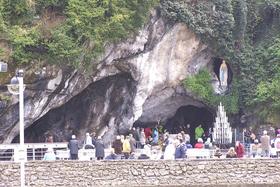
22 June 2012
Civil inquiry

Philadelphia: a Church official is convicted for sheltering an abuser

Superior Court of Pennsylvania Commonwealth v. Lynn, No. 1105 EDA 2020, memorandum filed 9 August 2021 (non-precedential)

“Monsignor William J. Lynn was convicted in 2012 of endangering the welfare of children (“EWOC”) while serving as an official for the Archdiocese of Philadelphia (“Archdiocese”). Specifically, he was convicted of sheltering a priest he knew had a history of grooming and sexually abusing children, thereby enabling the priest to prey on more children. This Court subsequently awarded Lynn a new trial after concluding that the trial court permitted the Commonwealth to present an unfairly prejudicial amount of evidence about Lynn’s and the Archdiocese’s response to allegations of child abuse against other priests.”

Read it in the source: Pennsylvania Courts

See it on the timeline: Clergy sexual abuse and the Church's response

2013A smiling pope in white waves with his right hand
Magisterium
Pope Francis Evangelii Gaudium 254

“Non-Christians, by God’s gracious initiative, when they are faithful to their own consciences, can live “justified by the grace of God”, and thus be “associated to the paschal mystery of Jesus Christ”. But due to the sacramental dimension of sanctifying grace, God’s working in them tends to produce signs and rites, sacred expressions which in turn bring others to a communitarian experience of journeying towards God. While these lack the meaning and efficacy of the sacraments instituted by Christ, they can be channels which the Holy Spirit raises up in order to liberate non-Christians from atheistic immanentism or from purely individual religious experiences.”

Read it in the source: vatican.va

See it on the timeline: Other religions

11 February 2013A white-haired pope in a white cassock and skullcap, smiling
Magisterium

Benedict XVI gives up the office

Pope Benedict XVI Declaratio, 11 February 2013

“For this reason, and well aware of the seriousness of this act, with full freedom I declare that I renounce the ministry of Bishop of Rome, Successor of Saint Peter, entrusted to me by the Cardinals on 19 April 2005, in such a way, that as from 28 February 2013, at 20:00 hours, the See of Rome, the See of Saint Peter, will be vacant and a Conclave to elect the new Supreme Pontiff will have to be convoked by those whose competence it is.”

Read it in the source: vatican.va

See it on the timeline: All the popes in order, from St. Peter to today

2013
Liturgy

St. Joseph named in the Eucharistic Prayers

Congregation for Divine Worship and the Discipline of the Sacraments Decree regarding the mention of the name of St. Joseph in Eucharistic Prayers II, III and IV, 1 May 2013

“For this reason Blessed Pope John XXIII, in the days of the Most Holy Second Ecumenical Council of the Vatican, decreed that Saint Joseph’s name be added to the ancient Roman Canon. In response to petitions received from places throughout the world, the Supreme Pontiff Benedict XVI deemed them worthy of implementation and graciously approved them. The Supreme Pontiff Francis likewise has recently confirmed them.”

Read it in the source: vatican.va

See it on the timeline: The Mass through the centuries

canonized 2013
Miracle

St. Laura Montoya, missionary and foundress in Colombia

Dicastery for the Causes of Saints Profile of St. Laura of St. Catherine of Siena (Laura Montoya y Upegui), account of the cause (canonization)

“For the canonization of Blessed Laura Montoya there was presented to the Congregation for the Causes of Saints the asserted inexplicable healing of Prof. Carlos Eduardo Restrepo from "perforation of the oesophagus and mediastinitis in a severely immunosuppressed patient with an overlap syndrome: systemic lupus erythematosus, nephrotic syndrome, autoimmune polymyositis resistant to therapy". … In the Session of 14 June 2012, after many specialist examinations had meanwhile been requested and carried out both on the nature of the illness and on the present state of health of the man healed, the Medical Board of the Congregation for the Causes of Saints, with all agreed, recognized the event as "scientifically inexplicable".”

Our translation. The words as written, in Italian:

“Per la canonizzazione della Beata Laura Montoya è stata presentata alla Congregazione delle Cause dei Santi l’asserita inspiegabile guarigione del Prof. Carlos Eduardo Restrepo da “perforazione esofagea e mediastinite in paziente gravemente immunosoppresso, portatore di sindrome da sovrapposizione: lupus eritematoso sistemico, sindrome nefrosica, polimiosite autoimmune refrattaria alla terapia”. … Nella Seduta del 14 giugno 2012, dopo che nel frattempo erano stati richiesti ed eseguiti molti esami specialistici sia sulla natura della malattia che sull’attuale stato di salute del sanato, la Consulta Medica della Congregazione delle Cause dei Santi all’unanimità ha riconosciuto l’evento “inspiegabile scientificamente”.”

Case
Professor Carlos Eduardo Restrepo: a perforated oesophagus and mediastinitis, in a patient whose immunity was severely suppressed and who had lupus, nephrotic syndrome and autoimmune polymyositis
Investigation
Diocesan inquiry at the Curia of Medellín, 2005 to 2006; juridical validity decreed 7 November 2008
Medical finding
Medical Board, 14 June 2012, all agreed: the event scientifically inexplicable
Church ruling
Theological consultors 22 September 2012 and cardinals and bishops 10 December 2012, all agreed. Benedict XVI authorized the decree on the miracle on 20 December 2012

Read it in the source: Dicastery for the Causes of Saints

See it on the timeline: Saints of the modern age, 1800 to today

25 December 2013A red brick church with a tall green spire under a sky of white clouds
Miracle

The Eucharistic event at Legnica

Fr. Bogusław Drożdż, quoting the communiqué of Bishop Zbigniew Kiernikowski Wydarzenie eucharystyczne w Legnicy – spojrzenie pastoralne, Perspectiva. Legnickie Studia Teologiczno-Historyczne 16 (2017) no. 1, pp. 35-37

“This communiqué, published on 10 April 2016, spoke "[…] of the event that took place in the parish of St. Hyacinth in Legnica and which has the hallmarks of a Eucharistic miracle" … The tests were carried out independently in two centres: the Department of Forensic Medicine in Wrocław and the Department of Forensic Medicine of the Pomeranian Medical University in Szczecin. In the communiqué Bishop Kiernikowski quoted the final finding of the Department of Forensic Medicine: In the histopathological image, tissue fragments were found containing fragmented parts of striated muscle. … is most similar to heart muscle […] with changes that often accompany the agony”

Our translation. The words as written, in Polish:

“Komunikat ten, ogłoszony 10 kwietnia 2016 r., mówił „[…] o wydarzeniu, jakie zaszło w parafii św. Jacka w Legnicy i które ma znamiona cudu eucharystycznego” … Badania zostały przeprowadzone niezależnie w dwóch ośrodkach: Zakładzie Medycyny Sądowej we Wrocławiu oraz w Zakładzie Medycyny Sądowej Pomorskiego Uniwersytetu Medycznego w Szczecinie. We wspomnianym komunikacie bp Kiernikowski zacytował ostateczne orzeczenie Zakładu Medycyny Sądowej: W obrazie histopatologicznym stwierdzono fragmenty tkankowe zawierające pofragmentowane części mięśnia poprzecznie prążkowanego. … jest najbardziej podobna do mięśnia sercowego […] ze zmianami, które często towarzyszą agonii”

Witnesses
On 25 December 2013 a Host fell from the ciborium of a priest giving Communion and was placed in water. On 5 January 2014 a stain that looked like blood was noticed on it
Investigation
Bishop Stefan Cichy of Legnica appointed a commission of four
Scientific study
The Department of Forensic Medicine in Wrocław and the Department of Forensic Medicine of the Pomeranian Medical University in Szczecin, independently. The article adds that genetic tests point to tissue of human origin
Church ruling
Communiqué of Bishop Zbigniew Kiernikowski, 10 April 2016: an event that "has the hallmarks of a Eucharistic miracle". The matter was presented to the Congregation for the Doctrine of the Faith
Where it can be seen
A reliquary in a side chapel of the sanctuary of St. Hyacinth in Legnica, shown to the faithful since 2 July 2016

Read it in the source: perspectiva.diecezja.legnica.pl

See it on the timeline: Eucharistic miracles

25 December 2013
Miracle

The Eucharistic event at Legnica

Vatican News (Karol Darmoros) Legnica: Relikwia Ciała Pańskiego przyciąga cały świat, 3 July 2026

“The Eucharistic Event in Legnica concerns a Host which fell to the floor on 25 December 2013 during the giving of Holy Communion. After it was placed in a vessel of water, red discolorations appeared. A commission appointed by the Bishop ordered tests, and in his communiqué the then diocesan bishop, Zbigniew Kiernikowski, stated that the histopathological image was "most similar to heart muscle", with changes that "often accompany the agony". Genetic tests pointed to tissue of human origin. In 2016, in keeping with the recommendations of the Holy See, the Bishop of Legnica directed that a place be prepared for the exposition of the Relic, so that the faithful could venerate it.”

Our translation. The words as written, in Polish:

“Wydarzenie Eucharystyczne w Legnicy wiąże się z Hostią, która 25 grudnia 2013 r. upadła na posadzkę podczas udzielania Komunii świętej. Po złożeniu jej w naczyniu z wodą pojawiły się czerwone przebarwienia. Powołana przez Biskupa komisja zleciła badania, a w komunikacie ówczesny ordynariusz Zbigniew Kiernikowski wskazał, że obraz histopatologiczny był „najbardziej podobny do mięśnia sercowego”, ze zmianami, które „często towarzyszą agonii”. Badania genetyczne wskazały na ludzkie pochodzenie tkanki. W 2016 r., zgodnie z zaleceniami Stolicy Apostolskiej, biskup legnicki polecił przygotowanie miejsca wystawienia Relikwii, aby wierni mogli oddawać jej cześć.”

Investigation
A commission appointed by the Bishop ordered the tests
Scientific study
The page gives the result in the bishop's words and adds that genetic tests pointed to human origin. It names no laboratory
Church ruling
In 2016 the Bishop of Legnica had a place prepared for veneration of the relic, in keeping with the recommendations of the Holy See
Where it can be seen
The Sanctuary of St. Hyacinth in Legnica, where the relic has been open to public veneration since 2016

Read it in the source: vaticannews.va

See it on the timeline: Eucharistic miracles

5 July 2013A colour photograph of a smiling elderly pope in a white skullcap and a red cape trimmed with white fur
Miracle

St. John XXIII: canonized without a second miracle

Dicastery for the Causes of Saints Profile of St. John XXIII, account of the cause

“the Postulation addressed to His Holiness Francis the petition that he would decree the hoped-for canonization of the Blessed, dispensing from the study of an alleged miracle, by favour of the Supreme Pontiff. … In the audience granted on 5 July 2013 to the Prefect of the Congregation for the Causes of Saints, Card. Angelo Amato, the Holy Father Francis approved the votes of the aforesaid Ordinary Session and decided to submit the canonization of Blesseds John XXIII and John Paul II to the next Consistory.”

Our translation. The words as written, in Italian:

“la Postulazione ha indirizzato a Sua Santità Francesco la supplica di voler decretare l’auspicata canonizzazione del Beato dispensando dallo studio di un presunto miracolo, pro gratia Summi Pontificis. … Nell’udienza concessa il 5 luglio 2013 al Prefetto della Congregazione delle Cause dei Santi, Card. Angelo Amato, il Santo Padre Francesco approvava i voti della suddetta Sessione Ordinaria e decideva di sottoporre la canonizzazione dei Beati Giovanni XXIII e Giovanni Paolo II al successivo Concistoro.”

Investigation
The Postulation delivered a Positio super Canonizatione to the Congregation on 7 June 2013
Church ruling
Cardinals and bishops in Ordinary Session, 2 July 2013; approved by Pope Francis, 5 July 2013. No second miracle was studied. Canonized 27 April 2014

Read it in the source: Dicastery for the Causes of Saints

See it on the timeline: Miracles approved for canonizations

undated page
Miracle

St. John XXIII: canonized without a second miracle

Dicastery for the Causes of Saints "I passi del cammino verso la santità", approfondimenti, section on canonization (undated page)

“Moreover, the Pope can always take particular decisions. Pope Francis did so in the case of John XXIII, who became a Saint on account of his reputation for holiness, spread for decades throughout the world, without a second miracle being recognized for him.”

Our translation. The words as written, in Italian:

“Inoltre, il Papa può sempre prendere decisioni particolari. Papa Francesco lo ha fatto nei confronti di Giovanni XXIII, che è diventato Santo per la sua fama di santità, diffusa da decenni in tutto il mondo, senza che gli venisse riconosciuto un secondo miracolo.”

Church ruling
Canonized by decision of Pope Francis without a second recognized miracle

Read it in the source: Dicastery for the Causes of Saints

See it on the timeline: Miracles approved for canonizations

15 May 2013A frail old cardinal in scarlet robes and a red skullcap sits facing the viewer
Miracle

Bl. John Henry Newman: a mother in Chicago

Dicastery for the Causes of Saints Profile of St. John Henry Newman, account of the cause

“For this further stage there was examined the alleged miraculous healing of a mother of a family from Chicago, who had for days been suffering from a copious abdominal haemorrhage with suspected miscarriage in progress. At the most dramatic moment she had only the strength to say "Cardinal Newman, help me", upon which there followed, in an instantaneous and scientifically inexplicable manner, the definitive stopping of the haemorrhage. It was 15 May 2013. The diocesan Inquiry was held from 22 June to 26 October 2015. The Medical Board of the Dicastery, in the meeting of 1 March 2018, expressed a favourable opinion on the healing examined, which was held to be instantaneous, perfect and lasting, not scientifically explicable.”

Our translation. The words as written, in Italian:

“Per questa successiva fase è stata presa in esame la presunta guarigione miracolosa di una mamma di famiglia di Chicago, la quale era affetta da giorni da una copiosa emorragia addominale con sospetto travaglio abortivo. Nel momento più drammatico ebbe solo la forza di dire “Cardinale Newman aiutami”, cui seguì, in modo istantaneo e scientificamente inspiegabile, il definito arresto dell’emorragia. Era il 15 maggio 2013. L’Inchiesta diocesana si è svolta dal 22 giugno al 26 ottobre 2015. La Consulta Medica del Dicastero, nella riunione del 1° marzo 2018, ha espresso parere favorevole circa la guarigione esaminata, che è stata ritenuta istantanea, perfetta e duratura, non spiegabile scientificamente.”

Case
A mother from Chicago with a heavy abdominal haemorrhage, 15 May 2013
Investigation
Diocesan inquiry, 22 June to 26 October 2015
Medical finding
Medical Board, 1 March 2018: instantaneous, perfect and lasting, not scientifically explicable
Church ruling
Theological consultors, unanimously affirmative, 11 October 2018; cardinals and bishops 15 January 2019; decree on the miracle authorized by Pope Francis, 12 February 2019

Read it in the source: Dicastery for the Causes of Saints

See it on the timeline: Miracles approved for canonizations

2013
Miracle

Bl. Francisco and Jacinta Marto: a boy in Brazil with a severe head injury

Dicastery for the Causes of Saints Profile of Sts. Francisco and Jacinta Marto, account of the cause

“With a view to the Canonization, from 5 to 13 August 2016 the diocesan Tribunal was constituted at Campo Mourão, Brazil, for the canonical Inquiry into an alleged miraculous healing of a boy from "severe cranio-encephalic trauma, with risk of death or of serious consequences" which took place at Campo Mourão in the year 2013. On 2 February 2017, the Medical Board unanimously recognized the scientific inexplicability of the healing.”

Our translation. The words as written, in Italian:

“In vista della Canonizzazione, dal 5 al 13 agosto 2016 fu costituito a Campo Mourão, Brasile, il Tribunale diocesano per l’Inchiesta canonica su una presunta guarigione miracolosa di un bambino da «trauma cranio-encefalico grave, con rischio di morte o di gravi conseguenze» avvenuta a Campo Mourão nell’anno 2013. Il 2 febbraio 2017, la Consulta Medica riconobbe all’unanimità l’inspiegabilità scientifica della guarigione.”

Case
A boy at Campo Mourão, Brazil, 2013
Investigation
Diocesan tribunal at Campo Mourão, 5 to 13 August 2016
Medical finding
Medical Board, 2 February 2017, unanimously: scientifically inexplicable
Church ruling
Theological consultors, unanimously affirmative, 21 February 2017; cardinals and bishops 21 March 2017; Pope Francis authorized the decree on the miracle (the page gives no date)

Read it in the source: Dicastery for the Causes of Saints

See it on the timeline: Miracles approved for canonizations

2013A smiling pope in white waves with his right hand
Magisterium

Judaism is not a foreign religion to the Church

Pope Francis Apostolic Exhortation Evangelii Gaudium, 24 November 2013, nos. 247 and 249

“We hold the Jewish people in special regard because their covenant with God has never been revoked, for “the gifts and the call of God are irrevocable” (Rom 11:29). The Church, which shares with Jews an important part of the sacred Scriptures, looks upon the people of the covenant and their faith as one of the sacred roots of her own Christian identity (cf. Rom 11:16-18). As Christians, we cannot consider Judaism as a foreign religion; nor do we include the Jews among those called to turn from idols and to serve the true God (cf. 1 Thes 1:9). … While it is true that certain Christian beliefs are unacceptable to Judaism, and that the Church cannot refrain from proclaiming Jesus as Lord and Messiah, there exists as well a rich complementarity which allows us to read the texts of the Hebrew Scriptures together and to help one another to mine the riches of God’s word.”

Read it in the source: vatican.va

See it on the timeline: Judaism and the Church

2013
Magisterium

Pope Francis on Islam, and on Christians in Muslim countries

Pope Francis Evangelii Gaudium 252-253

“The sacred writings of Islam have retained some Christian teachings; Jesus and Mary receive profound veneration and it is admirable to see how Muslims both young and old, men and women, make time for daily prayer and faithfully take part in religious services. … I ask and I humbly entreat those countries to grant Christians freedom to worship and to practice their faith, in light of the freedom which followers of Islam enjoy in Western countries!”

Read it in the source: vatican.va

See it on the timeline: Islam and the Church

2013 to 2018
Saint

The inquiry into his life at Milan

Dicastery for the Causes of Saints Profile of St. Carlo Acutis, account of the cause, in view of the beatification

“The diocesan inquiry into his life, virtues and reputation for holiness, begun on 12 October 2013 in the Archbishop's Palace in Milan, ended on 24 November 2016. The Congregation for the Causes of Saints recognized the acts of the process as valid by its decree of 26 May 2017. Once the Positio on the virtues had been prepared, the cause passed successfully through the special Congress of the Theological Consultors on 17 April 2018.”

Our translation. The words as written, in Italian:

“L’Inchiesta diocesana sulla vita, virtù e fama di santità, iniziata il 12 ottobre 2013 nel Palazzo Arcivescovile di Milano, si è conclusa il 24 novembre 2016. La Congregazione delle Cause dei Santi ha riconosciuto validi gli atti processuali con il decreto del 26 maggio 2017. Preparata la Positio super virtutibus, la Causa ha affrontato con esito felice il Congresso peculiare dei Consultori Teologi il 17 aprile 2018.”

Read it in the source: Dicastery for the Causes of Saints

See it on the timeline: St. Carlo Acutis, 1991 to 2006

canonized 2014An elderly pope in green vestments and a white and gold mitre raises his hand in greeting, holding his staff with the crucifix
Saint

St. John Paul II, pope

Pope Francis Homily at the Canonization of John XXIII and John Paul II, 27 April 2014

“Saint John XXIII and Saint John Paul II were not afraid to look upon the wounds of Jesus, to touch his torn hands and his pierced side. … These were two men of courage, filled with the parrhesia of the Holy Spirit, and they bore witness before the Church and the world to God’s goodness and mercy.”

Read it in the source: vatican.va

See it on the timeline: Saints through the centuries

canonized 2014
Miracle

St. Kuriakose Elias Chavara, priest and founder in Kerala

Dicastery for the Causes of Saints Profile of St. Kuriakose Elias Chavara of the Holy Family, account of the cause (canonization)

“On 10 July 2010 the Bishop set up a tribunal to inquire into an alleged healing from a squint of the eyes (alternating convergent esotropia) which came to a girl on 16 October 2007 without any therapy or any medicine or the use of glasses, but was attributed solely to the intercession of Blessed Kuriakose Elias Chavara. … In the Medical Board of 26 September 2013, the medical experts, with all agreed, judged the healing "rapid, complete, lasting and not scientifically explicable".”

Our translation. The words as written, in Italian:

“Il Vescovo costituì il 10 luglio 2010 un tribunale per l’indagine su una presunta guarigione da strabismo degli occhi (esotropia alterna convergente) avvenuta a favore di una bambina il 16 ottobre 2007 senza nessuna terapia o qualsiasi medicamento o l’uso degli occhiali, ma attribuita esclusivamente all’intercessione del Beato Kuriakose Elias Chavara. … Nella Consulta Medica del 26 settembre 2013, i periti medici, all’unanimità, hanno giudicato la guarigione “rapida, completa, duratura e non scientificamente spiegabile”.”

Case
A girl with a squint in both eyes, healed on 16 October 2007 without therapy, medicine or glasses
Investigation
Tribunal set up on 10 July 2010 by the Bishop of the Eparchy of Palai; diocesan inquiry held from 16 July to 16 August 2011
Medical finding
Medical Board, 26 September 2013, all agreed: the healing rapid, complete, lasting and not scientifically explicable
Church ruling
Theological consultors 10 December 2013, all agreed; cardinals and bishops 18 March 2014; Pope Francis authorized the decree on the miracle on 3 April 2014

Read it in the source: Dicastery for the Causes of Saints

See it on the timeline: Saints of the modern age, 1800 to today

canonized 2014
Miracle

St. Kuriakose Elias Chavara, priest and founder in Kerala

Dicastery for the Causes of Saints Profile of St. Kuriakose Elias Chavara of the Holy Family, account of the cause (beatification)

“The process on the alleged miraculous healing of the deformed feet (Talipes equinovarus) of a boy was held in the eparchy of Changanacherry. The favourable assessment of the Medical Board is dated 8 November 1984. The decree on the miracle was promulgated by the Congregation on 9 May 1985.”

Our translation. The words as written, in Italian:

“Il processo sulla presunta guarigione miracolosa dei piedi deformati (Talipes equinovarus) di un bambino fu istruito nell’eparchia di Changanacherry. La valutazione favorevole della Consulta Medica è dell’8 novembre 1984. Il decreto sul miracolo è stato promulgato dalla Congregazione il 9 Maggio 1985.”

Case
A boy with deformed feet (clubfoot)
Investigation
Process held in the eparchy of Changanacherry
Medical finding
Medical Board, 8 November 1984: favourable assessment
Church ruling
Decree on the miracle, 9 May 1985. Beatified by John Paul II at Kottayam, Kerala, on 8 February 1986

Read it in the source: Dicastery for the Causes of Saints

See it on the timeline: Saints of the modern age, 1800 to today

canonized 2014An elderly pope in green vestments and a white and gold mitre raises his hand in greeting, holding his staff with the crucifix
Miracle

St. John Paul II, pope

Dicastery for the Causes of Saints Profile of St. John Paul II, account of the cause (beatification)

“With a view to the beatification a healing was presented, attributed to the intercession of the Venerable Servant of God. The Medical Board of 21 October 2010 judged it scientifically inexplicable, and the Theological Consultors, gathered in the Special Congress of 14 December 2010, gave a favourable opinion, attributing this healing to his intercession. The Cardinal and Bishop Fathers, in the Ordinary Session of 11 January 2011, judged it a true miracle.”

Our translation. The words as written, in Italian:

“In vista della beatificazione fu presentata una guarigione, attribuita all’intercessione del Venerabile Servo di Dio. La Consulta Medica del 21 ottobre 2010 la ritenne scientificamente inspiegabile e i Consultori Teologi, radunati nel Congresso Peculiare del 14 dicembre 2010, diedero parere favorevole, attribuendo tale guarigione alla sua intercessione. I Padri Cardinali e Vescovi nella Sessione Ordinaria dell’11 gennaio 2011, la giudicarono vero miracolo.”

Case
A healing presented for the beatification. This paragraph gives no name, place or diagnosis
Medical finding
Medical Board, 21 October 2010: judged scientifically inexplicable
Church ruling
Theological consultors 14 December 2010; cardinals and bishops 11 January 2011; Benedict XVI authorized the decree on 14 January 2011

Read it in the source: Dicastery for the Causes of Saints

See it on the timeline: Saints of the modern age, 1800 to today

25 December 2014A colour photograph of a pope in a red cape trimmed with white fur and an embroidered stole
Miracle

Bl. Paul VI: a child born healthy after a high-risk pregnancy

Dicastery for the Causes of Saints Profile of St. Paul VI, account of the cause

“a further case of high-risk pregnancy with a probable unfavourable outcome on account of "premature preterm rupture of the membranes at the 13th week, complicated by anhydramnios", which ended favourably with the birth of a healthy baby girl on Christmas Day 2014. The diocesan Inquiry was conducted in the Curia of Verona from 7 January to 11 March 2017. The Congregation for the Causes of Saints recognized its validity by decree of 28 April 2017. The Medical Board of the Dicastery, in the meeting of the following 26 October, expressed a unanimous favourable opinion, holding that the birth and the normal development of the newborn are not explicable by current scientific knowledge.”

Our translation. The words as written, in Italian:

“un ulteriore caso di gravidanza ad alto rischio e a probabile esito infausto per “rottura prematura pretermine delle membrane alla 13settimana, complicata da anidramnios”, conclusosi favorevolmente con la nascita di una bambina sana il giorno di Natale del 2014. L’Inchiesta diocesana è stata istruita nella Curia di Verona dal 7 gennaio all’11 marzo 2017. La Congregazione delle Cause dei Santi ne ha riconosciuto la validità con decreto del 28 aprile 2017. La Consulta Medica del Dicastero, nella riunione del 26 ottobre successivo, ha espresso parere favorevole unanime, nel ritenere che la nascita e il normale sviluppo della neonata non sono spiegabili con le attuali conoscenze scientifiche.”

Case
A girl born healthy on 25 December 2014 after rupture of the membranes at the 13th week of pregnancy
Investigation
Diocesan inquiry at the Curia of Verona, 7 January to 11 March 2017, recognized as valid 28 April 2017
Medical finding
Medical Board, 26 October 2017, unanimously: the birth and normal development of the child are not explicable by current scientific knowledge
Church ruling
Theological consultors, unanimously affirmative, 14 December 2017; cardinals and bishops 6 February 2018; Pope Francis authorized the decree on the miracle (the page gives no date)

Read it in the source: Dicastery for the Causes of Saints

See it on the timeline: Miracles approved for canonizations

10 December 2014
Miracle

Bl. Dulce Lopes Pontes: sight restored to a blind right eye

Dicastery for the Causes of Saints Profile of St. Dulce Lopes Pontes, account of the cause

“There was presented to the Congregation for the Causes of Saints a scientifically inexplicable fact, which took place on 10 December 2014. It concerned the healing from "blindness of the right eye from optic atrophy due to terminal glaucoma". … On 10 January 2019 the Medical Board recognized the inexplicability of the case.”

Our translation. The words as written, in Italian:

“Venne presentato alla Congregazione delle Cause dei Santi un fatto scientificamente inspiegabile, avvenuto il 10 dicembre 2014. Si trattava della guarigione da “cecità occhio destro da atrofia ottica per glaucoma terminale”. … Il 10 gennaio 2019 la Consulta Medica ha riconosciuto l’inspiegabilità del caso.”

Case
Healing of blindness of the right eye, 10 December 2014
Investigation
The process was recognized as valid by decree of 3 November 2017
Medical finding
Medical Board, 10 January 2019: recognized the inexplicability of the case
Church ruling
Theological consultors, unanimously affirmative, 21 March 2019; cardinals and bishops 7 May 2019; Pope Francis authorized the decree on the miracle (the page gives no date)

Read it in the source: Dicastery for the Causes of Saints

See it on the timeline: Miracles approved for canonizations

7 July 2014
Church governance

Pope Francis meets victims: "sins of omission on the part of Church leaders"

Pope Francis Homily at Mass with a group of victims of clergy sexual abuse, Domus Sanctae Marthae, 7 July 2014

“Before God and his people I express my sorrow for the sins and grave crimes of clerical sexual abuse committed against you. And I humbly ask forgiveness. I beg your forgiveness, too, for the sins of omission on the part of Church leaders who did not respond adequately to reports of abuse made by family members, as well as by abuse victims themselves. This led to even greater suffering on the part of those who were abused and it endangered other minors who were at risk.”

Read it in the source: vatican.va

See it on the timeline: Clergy sexual abuse and the Church's response

canonized 2015
Miracle

St. Mariam Baouardy (Mary of Jesus Crucified), Carmelite

Dicastery for the Causes of Saints Profile of St. Mary of Jesus Crucified Baouardy, account of the cause (canonization)

“It concerned the alleged miraculous healing of a newborn, born on 17 April 2009 at Augusta. The child, because of the onset of persistent blueness around the mouth, mottling of the extremities and rapid, laboured breathing, had been admitted to the Policlinico of Catania with a diagnosis of pulmonary hypertension. Despite treatment, as the clinical condition remained grave, on 19 April he was admitted to the hospital of Taormina, where after an echocardiogram the diagnosis was made of obstructed total anomalous pulmonary venous return below the diaphragm. … The Medical Board, held on 12 May 2014, judged the healing scientifically inexplicable.”

Our translation. The words as written, in Italian:

“Riguardava la presunta guarigione miracolosa di un neonato, venuto alla luce il 17 aprile 2009 ad Augusta. Il bambino, per l’insorgenza di cianosi periorale persistente, marezzatura alle estremità e tachidispnea, era stato ricoverato presso il Policlinico di Catania con diagnosi di ipertensione polmonare. Nonostante le cure, persistendo la gravità delle condizioni cliniche, il 19 aprile fu ricoverato presso l’ospedale di Taormina, dove a seguito di un esame ecocardiografico veniva posta la diagnosi di ritorno venoso polmonare anomalo totale sottodiaframmatico ostruito. … La Consulta Medica, svolta il 12 maggio 2014, ha ritenuto la guarigione inspiegabile scientificamente.”

Case
A newborn boy, born 17 April 2009 at Augusta in Sicily, with a heart defect diagnosed at the hospital of Taormina
Investigation
Diocesan inquiry opened at Messina on 10 April 2013 by Archbishop Calogero La Piana
Medical finding
Medical Board, 12 May 2014: the healing judged scientifically inexplicable
Church ruling
Theological consultors 25 September 2014; cardinals and bishops 2 December 2014; Pope Francis authorized the decree on the miracle on 6 December 2014

Read it in the source: Dicastery for the Causes of Saints

See it on the timeline: Saints of the modern age, 1800 to today

canonized 2015
Miracle

St. Mariam Baouardy (Mary of Jesus Crucified), Carmelite

Dicastery for the Causes of Saints Profile of St. Mary of Jesus Crucified Baouardy, account of the cause (beatification)

“On 18 April 1983 the Medical Board of the Dicastery met, and on 31 May 1983 the special Congress of Theologians met to discuss a miracle attributed to the intercession of the Venerable Servant of God Mary of Jesus Crucified, for the purposes of her hoped-for Beatification, concerning the alleged miraculous healing of a girl of three years and eight months, which took place on 20 December 1929 at Schefamar, near Nazareth. All the Consultors recognized that the case was beyond the powers of nature.”

Our translation. The words as written, in Italian:

“Il 18 aprile 1983 ebbe luogo la Consulta Medica del Dicastero e il 31 maggio 1983 il Congresso peculiare dei Teologi si riunì per discutere circa un miracolo attribuito all’intercessione della Ven. Serva di Dio Maria di Gesù Crocifisso, agli effetti della sua auspicata Beatificazione, riguardante la presunta guarigione miracolosa di una bambina di tre anni e otto mesi, avvenuta il 20 dicembre 1929, a Schefamar, presso Nazareth. Tutti i Consultori riconobbero la preternaturalità del caso.”

Case
A girl aged three years and eight months, 20 December 1929, at Schefamar near Nazareth
Church ruling
Medical Board 18 April 1983; theologians 31 May 1983, all recognizing the case as beyond the powers of nature

Read it in the source: Dicastery for the Causes of Saints

See it on the timeline: Saints of the modern age, 1800 to today

2015A black and white photograph of a bishop in spectacles and a black cassock with a pectoral cross, his hands folded
Miracle

Bl. Oscar Romero: a mother in San Salvador

Dicastery for the Causes of Saints Profile of St. Oscar Romero, account of the cause

“With a view to the canonization, the Postulation presented to the Congregation for the Causes of Saints a diocesan Inquiry into the healing, held to be miraculous, of a woman from "severe pre-eclampsia in a patient with recurrent spontaneous miscarriage from Antiphospholipid Antibody Syndrome, complicated by HELLP Syndrome type 1" (Report of the Medical Board), which took place in the diocese of San Salvador, in 2015. The diocesan Inquiry was held from 31 January to 28 February 2017 and was declared valid by the Congregation for the Causes of Saints in the Congress of 7 April 2017. The Medical Board of the Dicastery, in the meeting of the following 26 October, expressed a unanimous favourable opinion on the healing of the woman, which was held to be complete and lasting and not explicable by current scientific knowledge.”

Our translation. The words as written, in Italian:

“In vista della canonizzazione, la Postulazione ha presentato alla Congregazione delle Cause dei Santi un’Inchiesta diocesana sulla guarigione ritenuta miracolosa di una signora da “grave preeclampsia in paziente con poliabortività spontanea per Sindrome da Anticorpi Antifosfolipidi, complicata da Sindrome HELLP tipo 1,” (Relazione Consulta Medica), avvenuta nella diocesi di San Salvador, nel 2015. L’Inchiesta diocesana si è svolta dal 31 gennaio al 28 febbraio 2017 ed è stata dichiarata valida dalla Congregazione delle Cause dei Santi nel Congresso del 7 aprile del 2017. La Consulta Medica del Dicastero, nella riunione del 26 ottobre successivo, ha espresso unanime parere favorevole circa la guarigione della signora, che è stata ritenuta completa e duratura e non spiegabile con le attuali conoscenze scientifiche.”

Case
A woman in the diocese of San Salvador, 2015
Investigation
Diocesan inquiry, 31 January to 28 February 2017, declared valid 7 April 2017
Medical finding
Medical Board, 26 October 2017, unanimously: complete and lasting, not explicable by current scientific knowledge
Church ruling
Theological consultors, unanimously affirmative, 14 December 2017; cardinals and bishops 6 February 2018; Pope Francis authorized the decree on the miracle (the page gives no date)

Read it in the source: Dicastery for the Causes of Saints

See it on the timeline: Miracles approved for canonizations

inquiry 2015A smiling old woman in a white sari edged with blue stripes
Miracle

Bl. Teresa of Calcutta: a man in Brazil with brain abscesses

Dicastery for the Causes of Saints Profile of St. Teresa of Calcutta, account of the cause

“With a view to the Canonization, there was presented to the Congregation for the Causes of Saints the alleged miraculous case of the rapid, complete and lasting recovery, without after-effects, of an adult man suffering from "multiple supra- and infratentorial abscesses with triventricular hydrocephalus." His healing was attributed to the intercession of the Blessed, and on the case a diocesan Inquiry was conducted at Santos in Brazil, from 19 to 26 June 2015, whose juridical validity was recognized by the Congregation for the Causes of Saints by Decree of 2 July 2015. The event was examined by the Medical Board of the Dicastery which, on 10 September 2015, held the healing to be scientifically inexplicable. The special Congress of the Theological Consultors took place on 8 October 2015. The Ordinary Session of the Cardinals and Bishops, on 15 December 2015, judged the healing to be a true miracle.”

Our translation. The words as written, in Italian:

“In vista della Canonizzazione, è stato presentato alla Congregazione delle Cause dei Santi il presunto caso miracoloso del recupero rapido, completo, duraturo e senza reliquati di un uomo adulto affetto da “ascessi multipli sopra e sotto-tentoriali con idrocefalo triventricolare.” La sua guarigione è stata attribuita all’intercessione della Beata e sul caso è stata istruita una Inchiesta diocesana a Santos in Brasile, dal 19 al 26 giugno 2015, la cui validità giuridica è stata riconosciuta dalla Congregazione delle Cause dei Santi con Decreto del 2 luglio 2015. L’evento fu esaminato dalla Consulta Medica del Dicastero che, il 10 settembre 2015, ha ritenuto la guarigione scientificamente inspiegabile. Il Congresso Peculiare dei Consultori Teologi si svolse l’8 ottobre 2015. La Sessione Ordinaria dei Cardinali e dei Vescovi, il 15 dicembre 2015, ha giudicato la guarigione come un vero miracolo.”

Case
An adult man with multiple brain abscesses and hydrocephalus
Investigation
Diocesan inquiry at Santos, Brazil, 19 to 26 June 2015, recognized as valid 2 July 2015
Medical finding
Medical Board, 10 September 2015: scientifically inexplicable
Church ruling
Theological consultors 8 October 2015; cardinals and bishops 15 December 2015; decree on the miracle authorized by Pope Francis, 17 December 2015

Read it in the source: Dicastery for the Causes of Saints

See it on the timeline: Miracles approved for canonizations

inquiry 2015
Miracle

Bl. Devasahayam Pillai: an unborn child in India

Dicastery for the Causes of Saints Profile of St. Devasahayam Pillai, account of the cause

“In 2015 there was held in the Diocese of Kottar the diocesan Inquiry into an alleged miracle obtained through the intercession of the Blessed, namely the resuscitation of a foetus at the 20th week of pregnancy of an Indian woman. The Medical Board of the Congregation for the Causes of Saints, in the meeting of 28 February 2019, unanimously recognized the healing as not explicable on the basis of current medical knowledge.”

Our translation. The words as written, in Italian:

“Nel 2015 si è svolta nella Diocesi di Kottar l’Inchiesta diocesana su un presunto miracolo ottenuto per intercessione del Beato, cioè la rianimazione di un feto alla 20 settimana di gravidanza di una signora indiana. La Consulta Medica della Congregazione delle Cause dei Santi, nella riunione del 28 febbraio 2019, all’unanimità ha riconosciuto la guarigione non spiegabile in base alle attuali conoscenze mediche.”

Case
A foetus at the 20th week of pregnancy of an Indian woman
Investigation
Diocesan inquiry in the Diocese of Kottar, 2015
Medical finding
Medical Board, 28 February 2019, unanimously: not explicable on the basis of current medical knowledge
Church ruling
Theological consultors 5 December 2019; cardinals and bishops 18 February 2020; decree on the miracle authorized by Pope Francis, 21 February 2020

Read it in the source: Dicastery for the Causes of Saints

See it on the timeline: Miracles approved for canonizations

30 June 2015
Protestant

Protestants divided today: gender identity and gender expression, in the United Church of Christ

General Synod of the United Church of Christ Resolution Reaffirming Our Commitment to Full Equality for Persons of Any Sexual Orientation, Gender Identity or Gender Expression, Thirtieth General Synod, Cleveland, 30 June 2015

“WHEREAS, General Synod and other settings of the United Church of Christ have repeatedly advocated for the equal rights and dignity of lesbian, gay, bisexual and transgender persons (LGBT) in the United States and abroad … THEREFORE BE IT RESOLVED that the Thirtieth General Synod of the United Church of Christ reaffirms its commitment to the full legal protection of the civil rights of all persons regardless of sexual orientation or gender identity and expression”

Read it in the source: ucc.org

See it on the timeline: Protestantism

8 October 2016A smiling pope in white waves with his right hand
Magisterium

The Rosary and the history of God's mercy

Pope Francis Marian Vigil on the occasion of the Jubilee of Mercy, 8 October 2016

“The prayer of the rosary is, in many ways, the synthesis of the history of God's mercy, which becomes a history of salvation for all who let themselves be shaped by grace. The mysteries we have contemplated are concrete events by which God’s intervention on our behalf develops. Through prayer and meditation on the life of Jesus Christ, we see once more his merciful countenance, which he shows to everyone in all the many needs of life.”

Read it in the source: vatican.va

See it on the timeline: The Rosary

canonized 2016A smiling old woman in a white sari edged with blue stripes
Saint

St. Teresa of Calcutta, foundress

Pope Francis Homily at the Canonization of Mother Teresa of Calcutta, 4 September 2016

“Mother Teresa, in all aspects of her life, was a generous dispenser of divine mercy, making herself available for everyone through her welcome and defence of human life, those unborn and those abandoned and discarded. … She bowed down before those who were spent, left to die on the side of the road, seeing in them their God-given dignity”

Read it in the source: vatican.va

See it on the timeline: Saints through the centuries

canonized 2016
Miracle

St. Stanislaus Papczyński, founder of the Marian Fathers

Dicastery for the Causes of Saints Profile of St. Stanislaus of Jesus and Mary, account of the cause

“In the years 2012 to 2014 there was held in the Diocese of Ełk in Poland the diocesan Inquiry into an alleged miracle, obtained through the intercession of the Blessed, namely a healing from "bilateral pneumonia from Streptococcus pneumoniae, complicated by ARDS (acute respiratory distress syndrome in the adult), MOF (multiple organ failure syndrome) and septic shock". The Medical Board of the Congregation examined the case on 17 September 2015, judging with one voice that the healing was very rapid, complete and lasting, and not scientifically explicable.”

Our translation. The words as written, in Italian:

“Negli anni 2012–2014 si è svolta nella Diocesi di Ełk in Polonia l’Inchiesta diocesana su un presunto miracolo, ottenuto per intercessione del Beato, e cioè una guarigione da “polmonite bilaterale da Streptococco Pneumoniae, complicata da ARDS (Sindrome da insufficienza respiratoria acuta nell’adulto), MOF (sindrome da insufficienza multiorgano) e shock settico”. La Consulta Medica della Congregazione ha esaminato il caso il 17 settembre 2015 ritenendo unanimemente la guarigione molto rapida, completa e duratura, non spiegabile scientificamente.”

Case
A healing from bilateral pneumonia with acute respiratory distress, multiple organ failure and septic shock
Investigation
Diocesan inquiry in the Diocese of Ełk, Poland, 2012 to 2014
Medical finding
Medical Board, 17 September 2015: healing very rapid, complete and lasting, not scientifically explicable
Church ruling
Theological consultors favourable on 10 November 2015; cardinals and bishops on 12 January 2016; Pope Francis authorized the decree on the miracle

Read it in the source: Dicastery for the Causes of Saints

See it on the timeline: Saints of reform and mission, 1500 to 1800
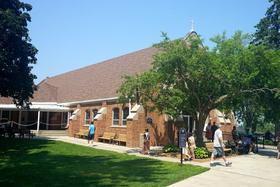
canonized 2016
Miracle

St. José Gabriel Brochero, the "gaucho priest" of Argentina

Dicastery for the Causes of Saints Profile of St. José Gabriel del Rosario Brochero, account of the cause (beatification)

“With a view to the Beatification an alleged miracle was presented, concerning the extraordinary healing of an 11-month-old boy from severe multiple head and brain injuries (with occipital fracture, acute subdural haematoma, subarachnoid haemorrhage, intraventricular haemorrhage, infarction in the left cerebral hemisphere, right frontoparietal subdural collection, bilateral vitreous haemorrhage and residual hydrocephalus) with two prolonged cardiorespiratory arrests (one of them lasting more than 25 minutes and the other with 15 minutes of advanced resuscitation) and complete recovery of cognitive, motor and language functions (2000).”

Our translation. The words as written, in Italian:

“In vista della Beatificazione fu presentato un presunto miracolo, riguardante la straordinaria guarigione di un bambino di 11 mesi, da politraumatismo cranioencefalico grave (con frattura occipitale, ematoma subdurale acuto, emorragia subaracnoidea, emorragia intraventricolare, infarto nell’emisfero cerebrale sinistro, raccolta subdurale frontoparietale destra, emorragia vitrea bilaterale e idrocefalia residua) con due arresti cardiorespiratori prolungati (di cui un arresto superiore ai 25 minuti e l’altro con rianimazione avanzata di 15 minuti) e recupero completo delle funzioni cognitive, motorie e del linguaggio (2000).”

Case
A boy of 11 months, in 2000: severe head injuries and two prolonged cardiorespiratory arrests, with complete recovery of cognitive, motor and language functions
Church ruling
Benedict XVI authorized the decree on the miracle on 20 December 2012. Beatified 14 September 2013

Read it in the source: Dicastery for the Causes of Saints

See it on the timeline: Saints of the modern age, 1800 to today

canonized 2016
Miracle

St. José Gabriel Brochero, the "gaucho priest" of Argentina

Dicastery for the Causes of Saints Profile of St. José Gabriel del Rosario Brochero, account of the cause (canonization)

“For the Canonization of Blessed José Gabriel del Rosario Brochero there was presented to the Congregation for the Causes of Saints the asserted inexplicable healing of a girl from a post-traumatic right fronto-temporo-parietal subdural haematoma, complicated by extensive cerebral infarction of the right hemisphere and left frontal ischaemia, with post-traumatic convulsions and severe functional insufficiency, and septic shock (2013). … On 12 January 2016 the Ordinary Session of the Cardinals and Bishops recognized the said healing as a miraculous event attributed to the effective intercession of the Blessed.”

Our translation. The words as written, in Italian:

“Per la Canonizzazione del Beato José Gabriel del Rosario Brochero è stata presentata alla Congregazione delle Cause dei Santi l’asserita inspiegabile guarigione di una bambina da ematoma subdurale fronto-temporo-parietale destro post-traumatico, complicato da esteso infarto cerebrale dell’emisfero destro ed ischemia frontale sinistra con convulsioni post-traumatiche e grave insufficienza funzionale, shock settico (2013). … Il 12 gennaio 2016 la Sessione Ordinaria dei Cardinali e Vescovi ha riconosciuto la menzionata guarigione come un fatto miracoloso attribuito alla efficace intercessione del Beato.”

Case
A girl, in 2013: bleeding on the brain after an injury, with a large stroke, convulsions and septic shock
Church ruling
Cardinals and bishops, 12 January 2016: recognized the healing as a miraculous event attributed to his intercession

Read it in the source: Dicastery for the Causes of Saints

See it on the timeline: Saints of the modern age, 1800 to today

canonized 2016
Miracle

St. José Sánchez del Río, boy martyr of Mexico

Dicastery for the Causes of Saints Profile of St. José Sánchez del Río, account of the cause

“On 4 September 2013 the diocesan Tribunal was set up at Zamora for the canonical Inquiry into the alleged miraculous healing of a girl from "pulmonary tuberculosis with secondary infarctions on both sides of the brain causing epilepsy (refractory status epilepticus)". When the Inquiry closed on 30 January 2015, the Congregation for the Causes of Saints recognized its juridical validity on 16 October of the same year. … On 21 December 2015 the Medical Board, with all its members agreed, found the healing scientifically inexplicable.”

Our translation. The words as written, in Italian:

“Il 4 settembre 2013 fu costituito a Zamora il Tribunale diocesano per l’Inchiesta canonica sulla presunta guarigione miracolosa di una bambina da “tubercolosi polmonare con secondarie localizzazioni infartuali intracerebrali bilaterali, epilettogene (stato di male epilettico refrattario)”. Conclusa l’Inchiesta il 30 gennaio 2015, la Congregazione delle Cause dei Santi riconobbe la sua validità giuridica il 16 ottobre dello stesso anno. … Il 21 dicembre 2015 la Consulta Medica all’unanimità ravvisò l’inspiegabilità scientifica della guarigione.”

Case
A girl with tuberculosis of the lungs and strokes on both sides of the brain causing continuous seizures
Investigation
Diocesan tribunal at Zamora, Mexico, 4 September 2013 to 30 January 2015; validity recognized 16 October 2015
Medical finding
Medical Board, 21 December 2015, all agreed: the healing scientifically inexplicable
Church ruling
Theological consultors 12 January 2016; cardinals and bishops 19 January 2016; Pope Francis authorized the decree on 21 January 2016

Read it in the source: Dicastery for the Causes of Saints

See it on the timeline: Saints of the modern age, 1800 to today

canonized 2016A smiling old woman in a white sari edged with blue stripes
Miracle

St. Teresa of Calcutta, foundress

Dicastery for the Causes of Saints Profile of St. Teresa of Calcutta, account of the cause (beatification)

“On 20 December 2002 the Holy Father John Paul II recognized that the case under examination had been a true miracle to be attributed to the intercession of the Venerable Mother Teresa of Calcutta, who was beatified by him in Rome in Saint Peter's Square on 19 October 2003.”

Our translation. The words as written, in Italian:

“Il 20 dicembre 2002 il Santo Padre Giovanni Paolo II riconobbe che il caso in esame era stato un vero miracolo da attribuirsi all’intercessione della Venerabile Madre Teresa di Calcutta, che fu beatificata da lui a Roma in Piazza San Pietro il 19 ottobre 2003.”

Case
The healing of Mrs. Monica Besra from a tumorous swelling of the abdomen; diocesan inquiry at Calcutta, November 1999 to January 2002
Church ruling
John Paul II recognized the case as a true miracle on 20 December 2002. Beatified 19 October 2003

Read it in the source: Dicastery for the Causes of Saints

See it on the timeline: Saints of the modern age, 1800 to today

24 August 2016The front of St. Peter's Basilica and its dome under a grey sky, seen across the wet square
Miracle

How a miracle is tested: two experts write independent opinions

Congregation for the Causes of Saints Regulations of the Medical Board (Consulta Medica), arts. 8 and 9 §1

“§ 1 The Secretary of the Congregation, upon the proposal of the Undersecretary, chooses, normally from among those inscribed in the Guild, two ex officio Experts who are specialists in the matter of the case under examination. § 2 Each ex officio Expert, bound by the obligation of the secret of office, prepares independently his own medical-legal opinion on the proposed case. … § 1 When at least one of the two ex officio expert opinions is affirmative, the case may be examined collegially by the Medical Board.”

Investigation
Two ex officio experts, specialists in the matter of the case, each prepare an opinion independently
Church ruling
If both opinions are negative, the postulator may ask for a third. If that is also negative the case may not proceed (art. 9 §2)

Read it in the source: Dicastery for the Causes of Saints

See it on the timeline: Miracles approved for canonizations

24 August 2016
Miracle

How a miracle is tested: diagnosis, prognosis, treatment, manner of healing

Congregation for the Causes of Saints Regulations of the Medical Board (Consulta Medica), art. 13

“The case is examined by the Medical Board in the following order: (a) the ex officio Experts and then each Medical Expert, who is to have prepared a written opinion, presents his own opinion, concluding with a precise answer regarding the diagnosis, the prognosis, the treatment and the modalities of the healing; (b) at the end of the presentation of the individual opinions, the discussion begins under the direction of the President of the Medical Board; (c) following group discussion, each Medical Expert expresses his definitive opinion.”

Medical finding
Each expert gives a precise answer on the diagnosis, the prognosis, the treatment and the modalities of the healing
Investigation
The board is valid if at least six of the seven experts attend (art. 11 §1, on the same page)

Read it in the source: Dicastery for the Causes of Saints

See it on the timeline: Miracles approved for canonizations

24 August 2016
Miracle

How a miracle is tested: the vote required of the doctors

Congregation for the Causes of Saints Regulations of the Medical Board (Consulta Medica), arts. 15 and 18

“The case may proceed further if the conclusions of the meeting of the Medical Board are affirmative with a qualified majority of at least five out of seven Experts or of four out of six Experts present at the same meeting. … A case, examined three times by the Medical Board with a suspended or negative conclusion may not be presented again.”

Medical finding
A qualified majority of at least five out of seven experts, or four out of six present, is required
Church ruling
A case examined three times by the board with a suspended or negative conclusion may not be presented again

Read it in the source: Dicastery for the Causes of Saints

See it on the timeline: Miracles approved for canonizations

23 September 2016
Miracle

How a miracle is tested: the stages up to the Pope

Archbishop Marcello Bartolucci, Secretary of the Congregation for the Causes of Saints Holy See Press Office, Bulletin of 23 September 2016, on the Regulation of the Medical Board

“Just as it is necessary for the legal checks to be complete, convergent and reliable, it is also necessary that their study be performed with serenity, objectivity and sure competence by highly specialised medical experts and then, at a different level, by the Congress of theological consulters and by the Session of cardinals and bishops, eventually reaching the decisive approval of the Holy Father, who has the exclusive competence of acknowledging an extraordinary event as a true miracle.”

Investigation
Study by medical experts, then by the Congress of theological consulters, then by the Session of cardinals and bishops
Church ruling
The Holy Father has the exclusive competence of acknowledging an extraordinary event as a true miracle

Read it in the source: vatican.va

See it on the timeline: Miracles approved for canonizations

undated page
Miracle

How a miracle is tested: complete, lasting, and judged by specialists

Dicastery for the Causes of Saints "I passi del cammino verso la santità", approfondimenti, section on beatification (undated page of the Dicastery's website)

“This miraculous event is generally a healing held to be scientifically inexplicable, judged to be so by a Medical Commission convened by the Dicastery for the Causes of Saints and made up of specialists, both believers and non-believers. What matters, for recognition, is that the healing be complete and lasting, and in many cases also rapid.”

Our translation. The words as written, in Italian:

“Questo evento miracoloso in genere è una guarigione ritenuta scientificamente inspiegabile, giudicata tale da una Commissione Medica convocata dal Dicastero delle Cause dei Santi e composta da specialisti, sia credenti sia non credenti. Importante, ai fini del riconoscimento, è che la guarigione sia completa e duratura, in molti casi anche rapida.”

Medical finding
Judged by a medical commission of specialists, believers and non-believers
Church ruling
After this the bishops and cardinals who are members of the Dicastery give their judgment and the Pope authorizes the decree. A martyr is beatified without a miracle

Read it in the source: Dicastery for the Causes of Saints

See it on the timeline: Miracles approved for canonizations

August 2016
Miracle

Bl. Artemide Zatti: a man in the Philippines after a stroke

Dicastery for the Causes of Saints Profile of St. Artemide Zatti, account of the cause

“The Postulation presented the alleged miraculous healing of a man from "right cerebellar ischaemic stroke, complicated by a voluminous haemorrhagic lesion", which took place in the Philippines in August 2016. … The Medical Board, held on 1 July 2021, gave a positive finding on the healing and declared it scientifically inexplicable.”

Our translation. The words as written, in Italian:

“La Postulazione ha presentato la presunta guarigione miracolosa di un uomo da “ictus ischemico cerebellare destro, complicato da voluminosa lesione emorragica”, avvenuta nelle Filippine nell’agosto del 2016. … La Consulta medica, tenutasi il 1° luglio 2021, ha dato riscontro positivo circa la guarigione e l’ha dichiarata scientificamente inspiegabile.”

Case
A man aged 64, taken ill on 11 August 2016. His brother, a Salesian, began to pray to Blessed Artemide Zatti that same day
Investigation
Diocesan inquiry at the Curia of Lipa, 4 to 10 March 2018, recognized as valid 1 June 2018
Medical finding
Medical Board, 1 July 2021: scientifically inexplicable. The decree on the same page says rapid, complete and lasting
Church ruling
Theological consultors, unanimously, 16 December 2021; cardinals and bishops 5 April 2022; decree on the miracle authorized by Pope Francis, 9 April 2022

Read it in the source: Dicastery for the Causes of Saints

See it on the timeline: Miracles approved for canonizations

30 November 2016
Miracle

Bl. Charles de Foucauld: a young carpenter survives a fall of 15.5 metres

Dicastery for the Causes of Saints Profile of St. Charles de Foucauld, account of the cause

“For this further stage there was examined the alleged "escape from danger" of a young man, aged 21, an apprentice carpenter, victim of a fall from 15.50 metres. … The Medical Board, in the session of 14 November 2019, pronounced unanimously, issuing these concluding definitions: "The paucity of the injuries sustained in relation to the manner of the fall from a height of 15.5 metres in free fall is not scientifically explicable and is therefore to be classed as an escape from danger".”

Our translation. The words as written, in Italian:

“Per questa successiva fase è stato preso in esame il presunto “scampato pericolo” di un giovane, di anni 21, apprendista carpentiere, vittima di una caduta da 15,50 mt. … La Consulta Medica, nella seduta del 14 novembre 2019, si è pronunciata all’unanimità, emettendo queste definizioni conclusive: “La paucità delle lesioni riportate in rapporto alle modalità della caduta da 15,5 mt di altezza in forma libera non è scientificamente spiegabile e quindi va inquadrata come uno scampato pericolo”.”

Case
An apprentice carpenter aged 21, 30 November 2016, in a parish dedicated to Charles de Foucauld. He was treated at the University Hospital of Angers and returned to work with no physical or psychological after-effects
Investigation
Diocesan inquiry opened by the Bishop of Angers, 30 November 2017 to 7 June 2018, recognized as valid 21 September 2018
Medical finding
Two ex officio experts appointed by the Dicastery both concluded it was an escape from danger. Medical Board, 14 November 2019, unanimously: the paucity of injuries is not scientifically explicable
Church ruling
Theological consultors, unanimously affirmative, 18 February 2020; cardinals and bishops gave the same opinion; Pope Francis authorized the decree on the miracle (the page gives no date)

Read it in the source: Dicastery for the Causes of Saints

See it on the timeline: Miracles approved for canonizations

inquiry 2016 to 2017A black and white photograph of a priest in round spectacles and an academic cap, wearing a heavy chain of office
Miracle

Bl. Titus Brandsma: a Carmelite priest with metastatic melanoma

Dicastery for the Causes of Saints Profile of St. Titus Brandsma, account of the cause

“From 11 July 2016 to 12 December 2017 there was held in the diocese of Palm Beach, in Florida, the diocesan Inquiry into an alleged miracle obtained through the intercession of the Blessed. It concerned the healing of a professed priest of the Carmelite Order from the recurrence of a "melanoma metastatic to the lymph nodes". Of the disease, particularly malignant and invasive, there was no longer any trace, even after more than 15 years. … The Medical Board, in the meeting of 26 November 2020, recognized that that healing was rapid, complete and lasting, and finds no explanation in the current knowledge of medicine.”

Our translation. The words as written, in Italian:

“Dall’11 luglio 2016 al 12 dicembre 2017 si è svolta nella diocesi di Palm Beach, in Florida, l’Inchiesta diocesana su un presunto miracolo ottenuto per intercessione del Beato. Si trattò della guarigione di un sacerdote professo dell’Ordine Carmelitano, dalla recidiva di un “melanoma metastatico ai linfonodi”. Della malattia, particolarmente maligna ed invasiva, non c’era più alcuna traccia, anche a distanza di oltre 15 anni. … La Consulta Medica, nella riunione del 26 novembre 2020, ha riconosciuto che quella guarigione fu rapida, completa e duratura, e non trova spiegazione nelle attuali conoscenze della medicina.”

Case
A professed priest of the Carmelite Order, with recurrent melanoma metastatic to the lymph nodes
Investigation
Diocesan inquiry in the diocese of Palm Beach, Florida, 11 July 2016 to 12 December 2017, recognized as valid 13 April 2018
Medical finding
Medical Board, 26 November 2020: rapid, complete and lasting, with no explanation in the current knowledge of medicine
Church ruling
Theological consultors 25 May 2021; cardinals and bishops 9 November 2021; decree on the miracle authorized by Pope Francis, 25 November 2021

Read it in the source: Dicastery for the Causes of Saints

See it on the timeline: Miracles approved for canonizations

2016
Church governance

Negligent bishops can be removed: As a Loving Mother

Pope Francis Apostolic Letter motu proprio As a Loving Mother, 4 June 2016, art. 1

“§ 1. The diocesan Bishop or Eparch, or one who even holds a temporary title and is responsible for a Particular Church, or other community of faithful that is its legal equivalent, according to can. 368 CIC or can. 313 CCEO, can be legitimately removed from this office if he has through negligence committed or through omission facilitated acts that have caused grave harm to others, either to physical persons or to the community as a whole. The harm may be physical, moral, spiritual or through the use of patrimony. § 2. The diocesan Bishop or Eparch can only be removed if he is objectively lacking in a very grave manner the diligence that his pastoral office demands of him, even without serious moral fault on his part. § 3. In the case of the abuse of minors and vulnerable adults it is enough that the lack of diligence be grave.”

Read it in the source: vatican.va

See it on the timeline: Clergy sexual abuse and the Church's response

12 February 2016
Magisterium

The pope and the patriarch of Moscow meet for the first time

Pope Francis and Patriarch Kirill of Moscow and All Russia Joint Declaration, Havana, 12 February 2016, 5

“Notwithstanding this shared Tradition of the first ten centuries, for nearly one thousand years Catholics and Orthodox have been deprived of communion in the Eucharist. We have been divided by wounds caused by old and recent conflicts, by differences inherited from our ancestors, in the understanding and expression of our faith in God, one in three Persons – Father, Son and Holy Spirit. We are pained by the loss of unity, the outcome of human weakness and of sin”

Read it in the source: vatican.va

See it on the timeline: The East-West Schism

31 October 2016A smiling pope in white waves with his right hand
Magisterium

Catholics and Lutherans mark five hundred years

Pope Francis and Bishop Munib Younan, President of the Lutheran World Federation Joint Statement on the occasion of the Joint Catholic-Lutheran Commemoration of the Reformation, Lund

“While we are profoundly thankful for the spiritual and theological gifts received through the Reformation, we also confess and lament before Christ that Lutherans and Catholics have wounded the visible unity of the Church. Theological differences were accompanied by prejudice and conflicts, and religion was instrumentalized for political ends.”

Read it in the source: vatican.va

See it on the timeline: Protestantism

5 October 2016
Magisterium

New disagreements: the ordination of women and human sexuality

Pope Francis and Archbishop Justin Welby of Canterbury Common Declaration, Rome, 5 October 2016

“Yet new circumstances have presented new disagreements among us, particularly regarding the ordination of women and more recent questions regarding human sexuality. Behind these differences lies a perennial question about how authority is exercised in the Christian community.”

Read it in the source: vatican.va

See it on the timeline: Protestantism

12 February 2016
Magisterium

The Eastern Catholic Churches: a joint statement

Pope Francis and Patriarch Kirill of Moscow and All Russia Joint Declaration, Havana, 12 February 2016, 25

“It is today clear that the past method of “uniatism”, understood as the union of one community to the other, separating it from its Church, is not the way to re–establish unity. Nonetheless, the ecclesial communities which emerged in these historical circumstances have the right to exist and to undertake all that is necessary to meet the spiritual needs of their faithful, while seeking to live in peace with their neighbours.”

Read it in the source: vatican.va

See it on the timeline: The East-West Schism

2017A smiling pope in white waves with his right hand
Magisterium
Pope Francis Prayer to Mary Immaculate, Rome, 8 December 2017 (Holy See Press Office bulletin)

“Immaculate Virgin, 175 years ago, not far from here, in the church of Sant’Andrea delle Fratte, you touched the heart of Alphonse Ratisbonne, who at that moment, from being an atheist and enemy of the Church, became a Christian. … So, let us place our hand in yours and allow ourselves to be led back to Jesus, our Brother and Saviour, and to our Heavenly Father, who never tires of waiting for us and forgiving us when we return to Him.”

Read it in the source: vatican.va

See it on the timeline: Honor given to Mary

2017
Liturgy

Translations of the liturgy entrusted to the bishops

Pope Francis Magnum Principium, 3 September 2017

“The great principle, established by the Second Vatican Ecumenical Council, according to which liturgical prayer be accommodated to the comprehension of the people so that it might be understood, required the weighty task of introducing the vernacular language into the liturgy and of preparing and approving the versions of the liturgical books, a charge that was entrusted to the Bishops.”

Read it in the source: vatican.va

See it on the timeline: The Mass through the centuries

canonized 2017
Miracle

St. Angelo of Acri, Capuchin preacher

Dicastery for the Causes of Saints Profile of St. Angelo of Acri, account of the cause

“There was presented to the Congregation for the Causes of Saints the alleged miraculous healing of a young man from "multiple trauma; head injury with areas of laceration and contusion; right fronto-temporal fracture; thoraco-abdominal fracture with contusion of the lung; maxillo-facial trauma with wounds to the scalp and multiple abrasions", which took place in March 2010. … The Medical Board of the Congregation, on 15 December 2016, recognized the event as scientifically inexplicable.”

Our translation. The words as written, in Italian:

“Venne presentata alla Congregazione delle Cause dei Santi l’asserita guarigione miracolosa di un giovane da «politrauma; trauma cranico con focolai lacero contusivi; frattura fronto-temporale dx; frattura toraco-addominale con contusione polmonare: trauma maxillo-facciale con ferite al cuoio capelluto ed escoriazioni multiple», avvenuta nel marzo del 2010. … La Consulta Medica della Congregazione, il 15 dicembre 2016, riconobbe l’evento come scientificamente inspiegabile.”

Case
A young man with multiple injuries, including a fractured skull, healed in March 2010
Investigation
Diocesan inquiry at Cosenza-Bisignano, 29 March to 15 December 2014, recognized as valid on 20 March 2015
Medical finding
Medical Board, 15 December 2016: the event scientifically inexplicable
Church ruling
Theological consultors favourable on 21 February 2017; cardinals and bishops judged it a true miracle on 14 March 2017; Pope Francis authorized the decree

Read it in the source: Dicastery for the Causes of Saints

See it on the timeline: Saints of reform and mission, 1500 to 1800
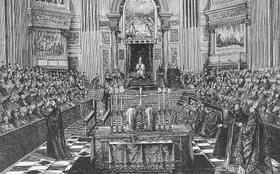
canonized 2017
Miracle

Sts. Francisco and Jacinta Marto, the shepherd children of Fatima

Dicastery for the Causes of Saints Profile of Sts. Francisco and Jacinta Marto, account of the cause (beatification)

“The Process on the alleged miracle (the prodigious healing of a woman from "paraplegia from probable transverse myelitis, lasting about 22 years, in the absence of psychiatric illness") was held at Leiria in 1995 and declared valid on 21 November 1997.”

Our translation. The words as written, in Italian:

“Il Processo sul presunto miracolo (prodigiosa guarigione di una donna da “paraplegia da probabile mielite trasversa, della durata di circa 22 anni, in assenza di patologia psichica”) fu istruito a Leiria nel 1995 e dichiarato valido il 21 novembre 1997.”

Case
A woman paralysed in the legs for about 22 years
Investigation
Process held at Leiria in 1995, declared valid on 21 November 1997

Read it in the source: Dicastery for the Causes of Saints

See it on the timeline: Saints of the modern age, 1800 to today
15 March 2017
Miracle

Ven. José Gregorio Hernández: a girl shot in the head in Venezuela

Dicastery for the Causes of Saints Profile of St. José Gregorio Hernández Cisneros, account of the cause

“The doctors informed the mother that, if the girl survived the operation, she would be left with neurological disorders and disability. On 15 March 2017, however, there was a sudden and unexpected improvement. On 30 March, she was discharged in a good state of health and with no neurological or cognitive deficits. … The Medical Board, in the session of 9 January 2020, recognized that the healing was swift, perfect and constant, as well as inexplicable according to the current knowledge of medicine.”

Our translation. The words as written, in Italian:

“I medici informarono la madre che, se la bambina avesse superato l’operazione, sarebbe rimasta con disturbi neurologici e disabilità. Il 15 marzo 2017, però, si verificò un improvviso e inatteso miglioramento. Il 30 marzo, venne dimessa in buono stato di salute e assenza di deficit neurologici e cognitivi. … La Consulta Medica, nella seduta del 9 gennaio 2020, ha riconosciuto che la guarigione fu veloce, perfetta e costante, nonché inspiegabile secondo le attuali conoscenze della medicina.”

Case
A girl born in 2006, shot on 10 March 2017; diagnosis "very severe cranio-encephalic trauma with cranio-cerebral wound from a firearm shot"
Witnesses
The mother, the sister and the anaesthetist commended the girl to the intercession of José Gregorio Hernández
Investigation
Diocesan inquiry at the Curia of San Fernando de Apure, 18 December 2018 to 11 January 2019, recognized as valid 1 March 2019
Medical finding
Medical Board, 9 January 2020: swift, perfect and constant, inexplicable according to the current knowledge of medicine
Church ruling
Theological consultors 17 March 2020; cardinals and bishops 17 June 2020; Pope Francis declared the miracle proven

Read it in the source: Dicastery for the Causes of Saints

See it on the timeline: Miracles approved for canonizations

6 November 2017
Miracle

Bl. Pier Giorgio Frassati: a seminarian's torn Achilles tendon

Dicastery for the Causes of Saints Profile of St. Pier Giorgio Frassati, account of the cause (text of the decree on the miracle)

“On 31 October 2017 he underwent an MRI of the right leg and ankle, which showed a "complete tear of the Achilles tendon, 4 cm above the insertion". Told of the need for a surgical operation, Juan Manuel, on 1 November 2017, began a novena of prayer to the Blessed and, on 6 November, while he was praying in the chapel of the Seminary, felt a strong warmth around the painful area of the ankle. From that moment he no longer had any painful symptoms. On 15 November 2017, he was examined by the orthopaedic surgeon, who found an intact Achilles tendon.”

Our translation. The words as written, in Italian:

“Il 31 ottobre 2017 si sottopose ad una RM alla gamba e caviglia destra; che evidenziò una “lacerazione completa del tendine di Achille, 4 cm sopra l’inserzione”. Avvisato della necessità di un intervento chirurgico, Juan Manuel, il 1° novembre 2017, iniziò una novena di preghiera al Beato e, il 6 novembre, mentre pregava nella cappella del Seminario, sentì un forte calore intorno alla zona dolente della caviglia. Da quel momento non accusò più alcuna sintomatologia dolorosa. Il 15 novembre 2017, venne visitato dal chirurgo ortopedico che evidenziò un tendine di Achille intatto.”

Case
Juan Manuel Gutiérrez, then a seminarian, injured playing basketball on 25 September 2017
Investigation
Diocesan inquiry at the Curia of Los Angeles, 1 to 19 September 2023, recognized as valid 27 October 2023
Medical finding
MRI of 31 October 2017 showed a complete tear; the orthopaedic surgeon found the tendon intact on 15 November 2017. Medical Board, 7 March 2024: the healing is not scientifically explicable
Church ruling
Theological consultors 28 May 2024; cardinals and bishops 5 November 2024; Pope Francis declared that the miracle is established

Read it in the source: Dicastery for the Causes of Saints

See it on the timeline: Miracles approved for canonizations

2017 to 2019
Church governance

McCarrick accused of abusing a minor, and dismissed from the priesthood

Secretariat of State of the Holy See Report on the Holy See's institutional knowledge and decision-making process related to former Cardinal Theodore Edgar McCarrick, 10 November 2020, Executive Summary

“In June 2017, the Archdiocese of New York learned of the first known allegation of sexual abuse by McCarrick of a victim under 18 years of age, which occurred in the early 1970s. … Shortly after the accusation was deemed credible, Pope Francis requested McCarrick’s resignation from the College of Cardinals. Following an administrative penal process by the Congregation for the Doctrine of the Faith, McCarrick was found culpable of acts in contravention of the Sixth Commandment of the Decalogue involving both minors and adults, and on that basis was dismissed from the clerical state.”

Read it in the source: vatican.va

See it on the timeline: Clergy sexual abuse and the Church's response

2018
Magisterium
Catechism of the Catholic Church CCC 2267, as revised in 2018

“Recourse to the death penalty on the part of legitimate authority, following a fair trial, was long considered an appropriate response to the gravity of certain crimes and an acceptable, albeit extreme, means of safeguarding the common good. … Consequently, the Church teaches, in the light of the Gospel, that “the death penalty is inadmissible because it is an attack on the inviolability and dignity of the person””

Read it in the source: vatican.va

See it on the timeline: Violence in the Church's history

2018
Miracle

A Vatican documentary on recent cases

Vatican News (Francesca Merlo) Eucharistic miracles: Faith is not humbled by science, 30 October 2018

“Science can be used, and has been used, to refute miracles. This was the case in one church in Poland, where red stains were discovered on a host. After having it tested, it was discovered that the red was simply fungus. Science is also used to accept miracles, as was the case in the situations explored in the documentary.”

Scientific study
In one church in Poland, testing showed that red stains on a host were fungus. The page does not name the church or the laboratory

Read it in the source: vaticannews.va

See it on the timeline: Eucharistic miracles

inquiry 2018
Miracle

Ven. Carlo Acutis: a boy in Brazil with a malformed pancreas

Dicastery for the Causes of Saints Profile of St. Carlo Acutis, account of the cause

“With a view to the beatification, the Postulation of the Cause presented a case of the healing of a boy suffering from "duodenal stenosis from incomplete annular pancreas, continual vomiting and severe malnutrition" which took place on 13 October 2023 in Brazil. The diocesan inquiry was held in the Archdiocese of Campo Grande, from 24 April 2018 to 12 June 2018. The validity of this process was recognized by Decree of the Congregation for the Causes of Saints on 15 March 2019. The Medical Board of 19 November 2019, with a unanimously favourable outcome, affirmed that the healing had been rapid, complete and lasting, scientifically inexplicable.”

Our translation. The words as written, in Italian:

“In vista della beatificazione, la Postulazione della Causa ha presentato un caso della guarigione di un bambino affetto da “stenosi duodenale da pancreas anulare incompleto, vomito continuo e malnutrizione grave” avvenuta il 13 ottobre 2023 in Brasile. L’inchiesta diocesana fu celebrata nell’Arcidiocesi di Campo Grande, dal 24 aprile 2018 al 12 giugno 2018. La validità di tale processo fu riconosciuta con Decreto della Congregazione delle Cause dei Santi il 15 marzo 2019. La Consulta Medica del 19 novembre 2019, con esito unanimemente favorevole, affermò che la guarigione era stata rapida, completa e duratura, scientificamente inspiegabile.”

Case
A boy in Brazil with duodenal stenosis from an incomplete annular pancreas
Investigation
Diocesan inquiry in the Archdiocese of Campo Grande, 24 April to 12 June 2018, recognized as valid 15 March 2019
Medical finding
Medical Board, 19 November 2019, unanimously: rapid, complete and lasting, scientifically inexplicable
Church ruling
Theological consultors 17 December 2019; cardinals and bishops 4 February 2020; decree on the miracle authorized by Pope Francis, 22 February 2020. Beatified 10 October 2020

Read it in the source: Dicastery for the Causes of Saints

See it on the timeline: Miracles approved for canonizations

2018
Church governance

The Pope admits his own errors over Chile

Pope Francis Letter to the Bishops of Chile following the report of Archbishop Charles J. Scicluna, 8 April 2018

“With regard to myself, I recognize, and I would like you to convey this faithfully, that I have made serious errors in the assessment and perception of the situation, in particular through the lack of reliable and balanced information. I now beg the forgiveness of all those whom I have offended and I hope to be able to do so personally, in the coming weeks, in the meetings that I will have with representatives of the people interviewed.”

Read it in the source: vatican.va

See it on the timeline: Clergy sexual abuse and the Church's response

31 May 2018
Church governance

Chile: "the culture of abuse and the system of cover-up"

Pope Francis Letter to the People of God that journeys in Chile, 31 May 2018, nos. 3 and 4 (Spanish; no English text on vatican.va)

“I believe that here lies one of our main faults and omissions: not knowing how to listen to the victims. In this way partial conclusions were built that lacked crucial elements for a sound and clear discernment. With shame I must say that we did not know how to listen and react in time. … The "never again" to the culture of abuse, and to the system of cover-up that allows it to perpetuate itself, requires all of us to work together to generate a culture of care that permeates our ways of relating”

Our translation. The words as written, in Spanish:

“Creo que aquí reside una de nuestras principales faltas y omisión: el no saber escuchar a las víctimas. Así se construyeron conclusiones parciales a las que les faltaban elementos cruciales para un sano y claro discernimiento. Con vergüenza debo decir que no supimos escuchar y reaccionar a tiempo. … El “nunca más” a la cultura del abuso, así como al sistema de encubrimiento que le permite perpetuarse, exige trabajar entre todos para generar una cultura del cuidado que impregne nuestras formas de relacionarnos”

Read it in the source: vatican.va

See it on the timeline: Clergy sexual abuse and the Church's response

5 July 2018
Saint

"Made perfect in a short time"

Congregation for the Causes of Saints (Cardinal Angelo Amato, prefect) Decree on the Virtues of the Servant of God Carlo Acutis, 5 July 2018, opening

“"Being made perfect in a short time, he fulfilled long years" (Wisdom 4:13). The reflection of the wise man of Israel is well suited to the Servant of God Carlo Acutis, who in only fifteen years reached the end of his life and the fullness of human and Christian perfection.”

Our translation. The words as written, in Italian:

“«Consummatus in brevi, explevit tempora multa» (Sp 4, 13). La riflessione del sapiente di Israele si adatta in modo appropriato al Servo di Dio Carlo Acutis, che in soli quindici anni giunse al termine della sua vita e alla pienezza della perfezione umana e cristiana.”

Read it in the source: Dicastery for the Causes of Saints

See it on the timeline: St. Carlo Acutis, 1991 to 2006

5 July 2018
Saint

Declared Venerable: his virtues judged heroic

Congregation for the Causes of Saints, recording the declaration of Pope Francis Decree on the Virtues of the Servant of God Carlo Acutis, 5 July 2018, conclusion

“His Holiness, receiving and ratifying the votes of the Congregation for the Causes of Saints, declared this day: It is established that the Servant of God Carlo Acutis, a lay member of Christ's faithful, practised to a heroic degree the theological virtues of Faith, Hope and Charity, towards God and towards his neighbour, and the cardinal virtues of Prudence, Justice, Temperance and Fortitude, and those joined to them, in the case and for the purpose in question.”

Our translation. The words as written, in Latin:

“Sanctitas Sua, vota Congregationis de Causis Sanctorum excipiens rataque habens, hodierno die declaravit: Constare de virtutibus theologalibus Fide, Spe et Caritate tum in Deum tum in proximum, necnon de cardinalibus Prudentia, Iustitia, Temperantia et Fortitudine, iisque adnexis, in gradu heroico, Servi Dei Caroli Acutis, Christifidelis Laici, in casu et ad effectum de quo agitur.”

Read it in the source: Dicastery for the Causes of Saints

See it on the timeline: St. Carlo Acutis, 1991 to 2006

14 August 2018
Civil inquiry

The Pennsylvania grand jury: over 300 priests, over 1,000 children

Pennsylvania 40th Statewide Investigating Grand Jury Report 1 (Interim, Redacted), released 14 August 2018, Introduction, p. 1

“We, the members of this grand jury, need you to hear this. We know some of you have heard some of it before. There have been other reports about child sex abuse within the Catholic Church. But never on this scale. For many of us, those earlier stories happened someplace else, someplace away. Now we know the truth: it happened everywhere. … We heard the testimony of dozens of witnesses concerning clergy sex abuse. We subpoenaed, and reviewed, half a million pages of internal diocesan documents. They contained credible allegations against over three hundred predator priests. Over one thousand child victims were identifiable, from the church's own records. We believe that the real number - of children whose records were lost, or who were afraid ever to come forward - is in the thousands.”

Read it in the source: Pennsylvania Courts

See it on the timeline: Clergy sexual abuse and the Church's response

14 August 2018
Civil inquiry

The Pennsylvania grand jury: "a playbook for concealing the truth"

Pennsylvania 40th Statewide Investigating Grand Jury Report 1 (Interim, Redacted), released 14 August 2018, Introduction, pp. 2-3

“The main thing was not to help children, but to avoid "scandal." That is not our word, but theirs; it appears over and over again in the documents we recovered. … It's like a playbook for concealing the truth: First, make sure to use euphemisms rather than real words to describe the sexual assaults in diocese documents. Never say "rape"; say "inappropriate contact" or "boundary issues." Second, don't conduct genuine investigations with properly trained personnel. Instead, assign fellow clergy members to ask inadequate questions and then make credibility determinations about the colleagues with whom they live and work. … Fourth, when a priest does have to be removed, don't say why. Tell his parishioners that he is on "sick leave," or suffering from "nervous exhaustion." Or say nothing at all. … Sixth, if a predator's conduct becomes known to the community, don't remove him from the priesthood to ensure that no more children will be victimized. Instead, transfer him to a new location where no one will know he is a child abuser. Finally and above all, don't tell the police. Child sexual abuse, even short of actual penetration, is and has for all relevant times been a crime. But don't treat it that way; handle it like a personnel matter, "in house."”

Read it in the source: Pennsylvania Courts

See it on the timeline: Clergy sexual abuse and the Church's response

14 August 2018
Civil inquiry

The Pennsylvania grand jury: two cases from the files

Pennsylvania 40th Statewide Investigating Grand Jury Report 1 (Interim, Redacted), released 14 August 2018, Introduction, p. 4

“In the Diocese of Allentown, for example, documents show that a priest was confronted about an abuse complaint. He admitted, "Please help me. I sexually molested a boy." The diocese concluded that "the experience will not necessarily be a horrendous trauma" for the victim, and that the family should just be given "an opportunity to ventilate." The priest was left in unrestricted ministry for several more years, despite his own confession. Similarly in the Diocese of Erie, despite a priest's admission to assaulting at least a dozen young boys, the bishop wrote to thank him for "all that you have done for God's people.... The Lord, who sees in private, will reward."”

Read it in the source: Pennsylvania Courts

See it on the timeline: Clergy sexual abuse and the Church's response

14 August 2018
Civil inquiry

The Pennsylvania grand jury: almost every case too old to prosecute

Pennsylvania 40th Statewide Investigating Grand Jury Report 1 (Interim, Redacted), released 14 August 2018, Introduction, p. 1

“As a consequence of the coverup, almost every instance of abuse we found is too old to be prosecuted. But that is not to say there are no more predators. This grand jury has issued presentments against a priest in the Greensburg diocese and a priest in the Erie Diocese, who has been sexually assaulting children within the last decade.”

Read it in the source: Pennsylvania Courts

See it on the timeline: Clergy sexual abuse and the Church's response

14 August 2018
Civil inquiry

The Pennsylvania grand jury: the leaders "largely escaped public accountability"

Pennsylvania 40th Statewide Investigating Grand Jury Report 1 (Interim, Redacted), released 14 August 2018, Introduction, p. 7

“What we can say, though, is that despite some institutional reform, individual leaders of the church have largely escaped public accountability. Priests were raping little boys and girls, and the men of God who were responsible for them not only did nothing; they hid it all. For decades. Monsignors, auxiliary bishops, bishops, archbishops, cardinals have mostly been protected; many, including some named in this report, have been promoted. Until that changes, we think it is too early to close the book on the Catholic Church sex scandal.”

Read it in the source: Pennsylvania Courts

See it on the timeline: Clergy sexual abuse and the Church's response

14 August 2018
Church governance

The American bishops answer the grand jury: "shamed by and sorry for"

Cardinal Daniel N. DiNardo and Bishop Timothy L. Doherty, for the United States Conference of Catholic Bishops Joint statement on the Pennsylvania grand jury report, 14 August 2018

“The report of the Pennsylvania grand jury again illustrates the pain of those who have been victims of the crime of sexual abuse by individual members of our clergy, and by those who shielded abusers and so facilitated an evil that continued for years or even decades. … As a body of bishops, we are shamed by and sorry for the sins and omissions by Catholic priests and Catholic bishops.”

Read it in the source: USCCB

See it on the timeline: Clergy sexual abuse and the Church's response

2018
Church governance

Letter to the People of God

Pope Francis Letter to the People of God, 20 August 2018, no. 1

“In recent days, a report was made public which detailed the experiences of at least a thousand survivors, victims of sexual abuse, the abuse of power and of conscience at the hands of priests over a period of approximately seventy years. … The heart-wrenching pain of these victims, which cries out to heaven, was long ignored, kept quiet or silenced. … With shame and repentance, we acknowledge as an ecclesial community that we were not where we should have been, that we did not act in a timely manner, realizing the magnitude and the gravity of the damage done to so many lives. We showed no care for the little ones; we abandoned them.”

Read it in the source: vatican.va

See it on the timeline: Clergy sexual abuse and the Church's response

13 November 2018
Church governance

The bishops' lay review board: "the faithful and the clergy do not trust many of you"

National Review Board (Francesco Cesareo, Chair) Special Report of the National Review Board to the Body of Bishops on the Sexual Abuse Crisis in the Church, 13 November 2018

“The Pennsylvania Grand Jury Report exposed the fact that some bishops have not been sufficiently open and transparent. It has taken the intervention of the state and the media to fully expose the darkness of abuse in our dioceses. It is shameful that the sin of abuse was hidden and allowed to fester until uncovered by the secular world. Even more unbearable is the fact that so many innocent children and young people suffered because of the inaction and silence of some bishops. … Today, the faithful and the clergy do not trust many of you. They are angry and frustrated, no longer satisfied with words and even with prayer.”

Read it in the source: USCCB

See it on the timeline: Clergy sexual abuse and the Church's response

2019A smiling pope in white waves with his right hand
Magisterium
Pope Francis General Audience, 3 April 2019

“…why does God allow many religions? God wanted to allow this: Scolastica theologians used to refer to God’s voluntas permissiva. He wanted to allow this reality: there are many religions. Some are born from culture, but they always look to heaven; they look to God. But what God wants is fraternity among us”

Read it in the source: vatican.va

See it on the timeline: Other religions

4 Feb. 2019
Magisterium

A joint declaration with the Grand Imam of Al-Azhar

Pope Francis and the Grand Imam of Al-Azhar, Ahmad al-Tayyeb Document on Human Fraternity for World Peace and Living Together, Abu Dhabi, 4 February 2019

“Freedom is a right of every person: each individual enjoys the freedom of belief, thought, expression and action. The pluralism and the diversity of religions, colour, sex, race and language are willed by God in His wisdom, through which He created human beings. This divine wisdom is the source from which the right to freedom of belief and the freedom to be different derives. Therefore, the fact that people are forced to adhere to a certain religion or culture must be rejected”

Read it in the source: vatican.va

See it on the timeline: Islam and the Church

23 February 2019
Church governance

A cardinal at the Vatican meeting: files destroyed, victims silenced

Cardinal Reinhard Marx Presentation at the Meeting on the Protection of Minors in the Church, Vatican, 23 February 2019

“The sexual abuse of children and youths is in no small measure due to the abuse of power in the area of administration. In this regard, administration has not contributed to fulfilling the mission of the Church, but on the contrary, has obscured, discredited and made it impossible. Files that could have documented the terrible deeds and named those responsible were destroyed, or not even created. Instead of the perpetrators, the victims were regulated and silence imposed on them. The stipulated procedures and processes for the prosecution of offences were deliberately not complied with, but instead cancelled or overridden. The rights of victims were effectively trampled underfoot, and left to the whims of individuals.”

Read it in the source: vatican.va

See it on the timeline: Clergy sexual abuse and the Church's response

2019
Church governance

The Vatican meeting on the protection of minors

Pope Francis Address at the end of the Eucharistic Concelebration, Meeting on the Protection of Minors in the Church, 24 February 2019, point 5

“No abuse should ever be covered up (as was often the case in the past) or not taken sufficiently seriously, since the covering up of abuses favours the spread of evil and adds a further level of scandal.”

Read it in the source: vatican.va

See it on the timeline: Clergy sexual abuse and the Church's response

25 March 2019
Saint

Pope Francis holds him up to the young of the whole Church

Pope Francis Apostolic Exhortation Christus Vivit, 104 to 106 (25 March 2019), quoting Carlo

“For example, it is true that the digital world can expose you to the risk of self-absorption, isolation and empty pleasure. But don’t forget that there are young people even there who show creativity and even genius. That was the case with the Venerable Carlo Acutis. … Yet he knew how to use the new communications technology to transmit the Gospel, to communicate values and beauty. … As a result, Carlo said, “everyone is born as an original, but many people end up dying as photocopies”. Don’t let that happen to you!”

Read it in the source: vatican.va

See it on the timeline: St. Carlo Acutis, 1991 to 2006

5 and 6 April 2019
Saint

His body is brought to the Shrine of the Renunciation in Assisi

Dicastery for the Causes of Saints Profile of St. Carlo Acutis, "Vita e opere", illness and death

“On 5 and 6 April 2019 the mortal remains of Carlo were moved to the Shrine of the Renunciation, the church of Santa Maria Maggiore, in Assisi.”

Our translation. The words as written, in Italian:

“Il 5-6 aprile 2019 i resti mortali di Carlo sono stati traslati nel Santuario della Spogliazione, chiesa di Santa Maria Maggiore, ad Assisi.”

Read it in the source: Dicastery for the Causes of Saints

See it on the timeline: St. Carlo Acutis, 1991 to 2006

2019
Church governance

Bishops made accountable: Vos estis lux mundi

Pope Francis Apostolic Letter motu proprio Vos estis lux mundi, 7 May 2019, art. 1 §1

“§1. These norms apply to reports regarding clerics or members of Institutes of Consecrated Life or Societies of Apostolic Life and concerning: a) delicts against the sixth commandment of the Decalogue consisting of: … ii. performing sexual acts with a minor or a vulnerable person; … b) conduct carried out by the subjects referred to in article 6, consisting of actions or omissions intended to interfere with or avoid civil investigations or canonical investigations, whether administrative or penal, against a cleric or a religious regarding the delicts referred to in letter a) of this paragraph.”

Read it in the source: vatican.va

See it on the timeline: Clergy sexual abuse and the Church's response

examined 2018 to 2019
Miracle

The first miracle: a boy in Brazil

Dicastery for the Causes of Saints Profile of St. Carlo Acutis, account of the cause, in view of the beatification

“The diocesan inquiry was held in the Archdiocese of Campo Grande, from 24 April 2018 to 12 June 2018. The validity of this process was recognized by Decree of the Congregation for the Causes of Saints on 15 March 2019. The Medical Board of 19 November 2019, with a unanimously favourable outcome, affirmed that the healing had been rapid, complete and lasting, and scientifically inexplicable.”

Our translation. The words as written, in Italian:

“L’inchiesta diocesana fu celebrata nell’Arcidiocesi di Campo Grande, dal 24 aprile 2018 al 12 giugno 2018. La validità di tale processo fu riconosciuta con Decreto della Congregazione delle Cause dei Santi il 15 marzo 2019. La Consulta Medica del 19 novembre 2019, con esito unanimemente favorevole, affermò che la guarigione era stata rapida, completa e duratura, scientificamente inspiegabile.”

Case
A boy in Brazil with a narrowing of the duodenum caused by an incomplete annular pancreas, with continual vomiting and severe malnutrition
Investigation
Diocesan inquiry in the Archdiocese of Campo Grande, 24 April to 12 June 2018, recognized as valid on 15 March 2019
Medical finding
Medical Board, 19 November 2019, unanimously: the healing was rapid, complete and lasting, and scientifically inexplicable

Read it in the source: Dicastery for the Causes of Saints

See it on the timeline: St. Carlo Acutis, 1991 to 2006

2019
Church governance

The pontifical secret lifted

Pope Francis Rescriptum ex audientia with the Instruction On the Confidentiality of Legal Proceedings, 6 December 2019, nos. 1, 4 and 5

“1. The pontifical secret does not apply to accusations, trials and decisions involving the offences referred to in: a) Article 1 of the Motu proprio “Vos estis lux mundi” (7 May 2019); … 4. Office confidentiality shall not prevent the fulfilment of the obligations laid down in all places by civil laws, including any reporting obligations, and the execution of enforceable requests of civil judicial authorities. 5. The person who files the report, the person who alleges to have been harmed and the witnesses shall not be bound by any obligation of silence with regard to matters involving the case.”

Read it in the source: vatican.va

See it on the timeline: Clergy sexual abuse and the Church's response

2020
Church governance

The McCarrick report published

Cardinal Pietro Parolin, Secretary of State Statement on the publication of the Report on the Holy See's institutional knowledge and decision-making related to former Cardinal Theodore Edgar McCarrick, 10 November 2020

“The Report on the Holy See’s institutional knowledge and decision-making process related to former Cardinal Theodore Edgar McCarrick, which the Secretariat of State drew up on the Pope’s mandate, is published today. … We publish the Report with sorrow for the wounds that these events have caused to the victims, their families, the Church in the United States, and the Universal Church.”

Read it in the source: vatican.va

See it on the timeline: Clergy sexual abuse and the Church's response

2019 to 2020A smiling pope in white waves with his right hand
Miracle

The first miracle: the Church's ruling

Pope Francis Apostolic Letter on the Beatification of Carlo Acutis, 10 October 2020

“For the beatification a healing held to be miraculous was presented, which the Medical Consultors of the Congregation for the Causes of Saints, meeting on 14 November 2019, judged to be inexplicable to science. The Theological Consultors, in a special Congress on 17 December following, attributed it to the intercession of the Venerable Servant of God, and the Cardinal and Bishop Fathers, in ordinary Session on 4 February 2020, judged the same.”

Our translation. The words as written, in Latin:

“Beatificationis causa sanatio exhibita est mira putata, quam Medici Consultores Congregationis de Causis Sanctorum, die XIV mensis Novembris anno MMXIX coadunati, ad scientiam inexplicabilem iudicarunt. Consultores Theologi, in Congressu peculiari die XVII subsequentis mensis Decembris intercessioni Venerabilis Servi Dei eam tribuerunt atque idem Patres Cardinales et Episcopi, in Sessione ordinaria die IV mensis Februarii anno MMXX censuerunt.”

Medical finding
The medical consultors judged the healing inexplicable to science
Church ruling
The theological consultors on 17 December 2019, and the cardinals and bishops on 4 February 2020, attributed the healing to Carlo's intercession

Read it in the source: Dicastery for the Causes of Saints

See it on the timeline: St. Carlo Acutis, 1991 to 2006

21 February 2020
Miracle

Pope Francis authorizes the decree on the miracle

Holy See Press Office Bulletin, Promulgation of Decrees of the Congregation for the Causes of Saints, 22 February 2020

“Yesterday, 21 February 2020, the Holy Father Francis received in audience His Eminence Cardinal Angelo Becciu, prefect of the Congregation for the Causes of Saints. During the audience, the Supreme Pontiff authorised the same Congregation to promulgate the decrees regarding: … the miracle attributed to the intercession of the Venerable Servant of God Carlo Acutis, layperson; born in London, England on 3 May 1991, and died in Monza, Italy on 12 October 2006”

Church ruling
Pope Francis authorized the decree recognizing the miracle on 21 February 2020; it was published the next day

Read it in the source: vatican.va

See it on the timeline: St. Carlo Acutis, 1991 to 2006

10 October 2020A smiling pope in white waves with his right hand
Saint

Beatified at Assisi

Pope Francis Apostolic Letter on the Beatification of Carlo Acutis, 10 October 2020, the formula of beatification

“We, fulfilling the wishes of Our Brother Domenico Sorrentino, Archbishop-Bishop of Assisi-Nocera Umbra-Gualdo Tadino, and of very many other Brothers in the Episcopate and of many of Christ's faithful, having consulted the Congregation for the Causes of Saints, by Our Apostolic authority grant that the Venerable Servant of God Carlo Acutis, layman, who with the ardour of a young heart cultivated friendship with the Lord Jesus, placing the Eucharist and the witness of charity at the centre of his life, may henceforth be called Blessed, and that his feast may be celebrated each year on the twelfth day of October, the day he was born to heaven, in the places and ways established by law.”

Our translation. The words as written, in Latin:

“Nos, vota Fratris Nostri Dominici Sorrentino, Archiepiscopi-Episcopi Assisiensis-Nucerini-Tadinensis necnon plurimorum aliorum Fratrum in Episcopatu multorumque christifidelium explentes, de Congregationis de Causis Sanctorum consulto, auctoritate Nostra Apostolica facultatem facimus ut Venerabilis Servus Dei Carolus Acutis, laicus, qui iuvenili animi ardore cum Domino Iesu amicitiam coluit, Eucharistiam caritatisque testimonium, in medio vitae suae ponens, Beatorum nomine in posterum appelletur atque die decima secunda mensis Octobris, qua in caelum ortus est, quotannis in locis et modis iure statutis celebrari possit.”

Read it in the source: Dicastery for the Causes of Saints

See it on the timeline: St. Carlo Acutis, 1991 to 2006

10 October 2020
Saint

The Bishop of Assisi gives thanks

Archbishop Domenico Sorrentino, Bishop of Assisi Words of thanks at the Beatification of Carlo Acutis, Assisi, 10 October 2020

“Today heaven has come closer. That Eucharistic "highway" which Carlo loved to travel at speed to reach heaven, today he has travelled in the other direction, to come back to us with his face radiant with blessedness. Thanks be to the Lord, who did such beautiful things in his short but intense life.”

Our translation. The words as written, in Italian:

“Oggi il Cielo si è fatto più vicino. Quell’«autostrada» eucaristica che Carlo amava percorrere in velocità per arrivare al Cielo, oggi egli l’ha percorsa in senso inverso per tornare a noi col volto raggiante di beatitudine. Grazie al Signore, che ha fatto cose tanto belle nella sua breve ma intensa vita.”

Read it in the source: Dicastery for the Causes of Saints

See it on the timeline: St. Carlo Acutis, 1991 to 2006

11 October 2020A smiling pope in white waves with his right hand
Saint

"A round of applause for the new young Blessed"

Pope Francis Angelus, St. Peter's Square, 11 October 2020, after the prayer

“Yesterday, in Assisi, Carlo Acutis, a 15-year-old youth enamoured of the Eucharist, was beatified. He did not ease into comfortable immobilism, but understood the needs of his time, because he saw the face of Christ in the weakest. His witness indicates to today’s young people that true happiness is found by putting God in first place and serving Him in our brothers and sisters, especially the least.”

Read it in the source: vatican.va

See it on the timeline: St. Carlo Acutis, 1991 to 2006

2021
Liturgy

The books of Paul VI and John Paul II as the rule of prayer of the Roman Rite

Pope Francis Traditionis Custodes, 16 July 2021, Art. 1

“The liturgical books promulgated by Saint Paul VI and Saint John Paul II, in conformity with the decrees of Vatican Council II, are the unique expression of the lex orandi of the Roman Rite.”

Read it in the source: vatican.va

See it on the timeline: The Mass through the centuries

2021
Church governance

The Church's penal law rewritten: Pascite gregem Dei

Pope Francis Apostolic Constitution Pascite gregem Dei, reforming Book VI of the Code of Canon Law, 23 May 2021

“In the past, great damage was done by a failure to appreciate the close relationship existing in the Church between the exercise of charity and recourse — where circumstances and justice so require — to disciplinary sanctions. This manner of thinking — as we have learned from experience — risks leading to tolerating immoral conduct, for which mere exhortations or suggestions are insufficient remedies. … Negligence on the part of a bishop in resorting to the penal system is a sign that he has failed to carry out his duties honestly and faithfully, as I have expressly pointed out in recent documents, including the Apostolic Letters issued Motu Proprio As a Loving Mother (4 June 2016) and Vos Estis Lux Mundi (7 May 2019).”

Read it in the source: vatican.va

See it on the timeline: Clergy sexual abuse and the Church's response

5 October 2021
Civil inquiry

France: an estimated 216,000 victims of clergy and religious since 1950

Independent Commission on Sexual Abuse in the Church (CIASE), France Summary of the Final Report, 5 October 2021, Introduction

“At the end of its work, the Commission drew up an inventory of sexual violence in the Church, which makes for particularly grim reading. In the over-eighteens of the population of France, the number of child victims who suffered at the hands of clergy and other religious workers is, in effect, estimated to be about 216 000. While, in absolute and relative terms, these acts of violence were in decline up until the early 1990s, the numbers have since stopped decreasing. The Catholic Church is the place where sexual violence is most prevalent, other than in family and friend circles. Faced with this scourge, for a very long time the Catholic Church’s immediate reaction was to protect itself as an institution and it has shown complete, even cruel, indifference to those having suffered abuse.”

Read it in the source: CIASE, France

See it on the timeline: Clergy sexual abuse and the Church's response

5 October 2021
Civil inquiry

France: between 2,900 and 3,200 abusers

Independent Commission on Sexual Abuse in the Church (CIASE), France Summary of the Final Report, 5 October 2021, Section I

“Research, conducted with great rigor and thoroughness by the EPHE, into the archives of the Church, the justice system and the press, completed by data gathered from the appeal for testimonials, leads to an estimation of between 2900 and 3200 aggressors. This bracket constitutes a lower limit in so far as not all cases of abuse are known to the Church and not all cases which are known have led to a file being opened. It indicates a ratio of 2.5% and 2.8% of clergy and other religious workers from 1950 to today (approximately 115 000 clergy and other religious workers).”

Read it in the source: CIASE, France

See it on the timeline: Clergy sexual abuse and the Church's response

5 October 2021
Civil inquiry

France: "concealment, relativization or even denial"

Independent Commission on Sexual Abuse in the Church (CIASE), France Summary of the Final Report, 5 October 2021, Section II

“Over the greater part of the period studied by the CIASE, its observations show that the Church’s attitude could be summarized as one of concealment, relativization or even denial, with only a very recent recognition, dating from 2015, and even then, unequally accepted by dioceses and religious institutions. If this analysis is combined with what has been said in the first section regarding the prevalence of sexual violence against children and vulnerable persons, the concept of a systemic phenomenon emerges. It is not that the violence was organized or accepted by the institution (although this did happen in a very small number of communities or institutions), rather that the Church did not have any clear idea how to prevent such violence or indeed even see it, let alone deal with it in a fair and determined manner.”

Read it in the source: CIASE, France

See it on the timeline: Clergy sexual abuse and the Church's response

6 October 2021
Church governance

The Pope on the French report: "my shame, our shame"

Pope Francis General Audience, 6 October 2021

“Brothers and sisters, yesterday, the Episcopal Conference and the Conference of men and women religious in France received the Independent Commission’s report regarding sexual abuse in the Church which was tasked to evaluate the extent of the phenomenon of sexual aggression and violence committed against minors from 1950 onwards. Unfortunately, a considerable number was revealed. I wish to express to the victims my sadness and my pain for the traumas they endured and my shame, our shame, my shame that for so long the Church has been incapable of putting this at the centre of her concerns, assuring them of my prayers.”

Read it in the source: vatican.va

See it on the timeline: Clergy sexual abuse and the Church's response

2022
Miracle

Bl. Carlo Acutis: a student from Costa Rica injured in Florence

Dicastery for the Causes of Saints Profile of St. Carlo Acutis, account of the cause

“The Postulation of the Cause presented to the Dicastery for the Causes of Saints the case of the survival and the subsequent rapid, complete and lasting healing of a young woman from Costa Rica, who was studying in Florence. Following a road accident, the young woman suffered a severe head injury with multiple cortico-subcortical lacerated-contused foci and homolateral sulcal subarachnoid haemorrhage. The event took place in 2022. … The Cardinals and Bishops in the Ordinary Session of 7 May 2024 judged the case under examination a true miracle, attributed to the intercession of Carlo.”

Our translation. The words as written, in Italian:

“La Postulazione della Causa presentò al Dicastero delle Cause dei Santi il caso della sopravvivenza e della successiva guarigione rapida, completa e duratura di una giovane del Costa Rica, che studiava a Firenze. A seguito di un incidente stradale, la giovane subì un trauma cranico severo con multipli focolai lacero-contusivi cortico-sottocorticali, emorragia subaracnoidea sulcale omolaterale. L’evento si verificò nel 2022. … I Cardinali e i Vescovi nella Sessione Ordinaria del 7 maggio 2024 giudicarono il caso in esame un vero miracolo, attribuito all’intercessione di Carlo.”

Case
A young woman from Costa Rica studying in Florence, 2022
Investigation
Diocesan inquiry in the Archdiocese of Florence, 11 May to 28 June 2023, recognized as valid 19 July 2023
Church ruling
Theological consultors, unanimously affirmative, 5 March 2024; cardinals and bishops 7 May 2024; Pope Francis authorized the decree on the miracle (the page gives no date)

Read it in the source: Dicastery for the Causes of Saints

See it on the timeline: Miracles approved for canonizations

2022
Miracle

The second miracle: a student injured in Florence

Dicastery for the Causes of Saints Profile of St. Carlo Acutis, account of the cause, in view of the canonization

“Following a road accident, the young woman suffered a severe head injury with multiple cortico-subcortical lacerated and contused foci and a sulcal subarachnoid haemorrhage on the same side. The event took place in 2022.”

Our translation. The words as written, in Italian:

“A seguito di un incidente stradale, la giovane subì un trauma cranico severo con multipli focolai lacero-contusivi cortico-sottocorticali, emorragia subaracnoidea sulcale omolaterale. L’evento si verificò nel 2022.”

Case
A young woman from Costa Rica who was studying in Florence; her survival and her rapid, complete and lasting healing were presented to the Dicastery

Read it in the source: Dicastery for the Causes of Saints

See it on the timeline: St. Carlo Acutis, 1991 to 2006

2023
Magisterium
Dicastery for the Doctrine of the Faith Declaration Fiducia Supplicans, 4

“This conviction is grounded in the perennial Catholic doctrine of marriage; it is only in this context that sexual relations find their natural, proper, and fully human meaning. The Church's doctrine on this point remains firm.”

Read it in the source: vatican.va

See it on the timeline: Homosexuality

2023
Church governance

Vos estis lux mundi reissued and extended

Pope Francis Apostolic Letter motu proprio Vos estis lux mundi (updated), 25 March 2023, art. 6

“The procedural norms referred to in this title concern the delicts referred to in article 1, carried out by: a) Cardinals, Patriarchs, Bishops and Legates of the Roman Pontiff; … f) lay faithful who are or who were Moderators of international associations of the faithful recognized or erected by the Apostolic See, for acts committed durante munere.”

Read it in the source: vatican.va

See it on the timeline: Clergy sexual abuse and the Church's response

2023 to 2024
Miracle

The second miracle: the inquiry and the theologians' judgment

Dicastery for the Causes of Saints Profile of St. Carlo Acutis, account of the cause, in view of the canonization

“The diocesan inquiry on the miracle was conducted in the Archdiocese of Florence from 11 May 2023 to 28 June 2023. The juridical validity of the inquiry was recognized by decree of the Dicastery for the Causes of Saints on 19 July 2023. On 5 March 2024 the special Congress of the Theological Consultors met to discuss the theological aspects of the presumed miracle. An affirmative opinion was given unanimously, so recognizing in the event under examination a miracle worked by God through the intercession of Carlo Acutis.”

Our translation. The words as written, in Italian:

“L’Inchiesta diocesana super miro venne istruita nell’Arcidiocesi di Firenze dall’11 maggio 2023 al 28 giugno 2023. La validità giuridica dell’Inchiesta fu riconosciuta con decreto del Dicastero delle Cause dei Santi il 19 luglio 2023. Il 5 marzo 2024 si riunì il Congresso peculiare dei Consultori Teologi per discutere gli aspetti teologici del presunto miracolo. All’unanimità fu espresso un parere affermativo, ravvisando così nell’evento in esame un miracolo operato da Dio per intercessione di Carlo Acutis.”

Investigation
Diocesan inquiry in the Archdiocese of Florence, 11 May to 28 June 2023, recognized as valid on 19 July 2023
Church ruling
Theological consultors, unanimously, 5 March 2024; the cardinals and bishops judged it a true miracle on 7 May 2024

Read it in the source: Dicastery for the Causes of Saints

See it on the timeline: St. Carlo Acutis, 1991 to 2006

2024A smiling pope in white waves with his right hand
Magisterium
Pope Francis Address at the Interreligious Meeting with Young People, Catholic Junior College, Singapore, 13 September 2024

“All religions are paths to God. I will use an analogy, they are like different languages that express the divine. But God is for everyone, and therefore, we are all God’s children. … There is only one God, and religions are like languages, paths to reach God.”

Read it in the source: vatican.va

See it on the timeline: Other religions

2024
Magisterium
Dicastery for the Doctrine of the Faith Dignitas Infinita, 47

“On account of the intangible value of human life, the Church's magisterium has always spoken out against abortion.”

Read it in the source: vatican.va

See it on the timeline: Abortion

canonized 2024
Miracle

St. Giuseppe Allamano, founder of the Consolata Missionaries

Dicastery for the Causes of Saints Profile of St. Giuseppe Allamano, decree on the miracle (canonization)

“the alleged miraculous healing of an indigenous Brazilian man of the Amazon forest who, on 7 February 1996, was attacked by a jaguar. With a blow of its paw the animal fractured his skull, causing brain matter to come out. The man attacked remained for some hours without proper medical care and, after first aid, was flown to the hospital of Boa Vista, where he arrived in a very grave condition. … From then on the man, awakened from the coma, began to improve rapidly, with no neurological after-effects. He returned to his village on 8 May completely healed and took up again his normal life as a dweller of the forest. … The Medical Board, in its session of 14 September 2023, declared that the healing was rapid, complete and lasting, as well as inexplicable in the light of present scientific knowledge.”

Our translation. The words as written, in Italian:

“la presunta guarigione miracolosa di un indigeno brasiliano della foresta amazzonica che, il 7 febbraio 1996 fu assalito da un giaguaro. Con una zampata l’animale gli fratturò la scatola cranica, causando la conseguente fuoriuscita di massa encefalica. L’aggredito restò per alcune ore senza valide cure mediche e, dopo i primi soccorsi, fu trasportato in aereo all’ospedale di Boa Vista, dove giunse in condizioni gravissime. … Da allora, l’uomo, risvegliato dal coma, cominciò rapidamente a migliorare, senza presentare esiti neurologici. Rientrò nel suo villaggio l’8 maggio completamente guarito e riprese la sua normale vita di abitante della foresta. … La Consulta Medica, nella seduta del 14 settembre 2023, ha dichiarato che la guarigione fu rapida, completa e duratura, nonché inspiegabile alla luce delle attuali conoscenze scientifiche.”

Case
An indigenous man of the Amazon forest in Brazil, attacked by a jaguar on 7 February 1996, with a fractured skull and loss of brain matter. He went home on 8 May
Witnesses
The Consolata Missionary Sisters who nursed him, prayed a novena to Blessed Allamano and placed a relic at his bedside
Investigation
Diocesan inquiry in 2021 at the Curia of Roraima, Brazil; validity recognized 23 June 2021
Medical finding
Medical Board, 14 September 2023: the healing was rapid, complete and lasting, and inexplicable in the light of present scientific knowledge
Church ruling
Theological consultors 5 March 2024; cardinals and bishops 21 May 2024. Pope Francis declared the miracle established

Read it in the source: Dicastery for the Causes of Saints

See it on the timeline: Saints of the modern age, 1800 to today
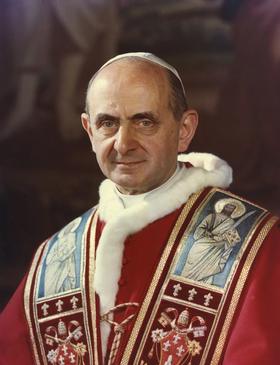
canonized 2024
Miracle

St. Giuseppe Allamano, founder of the Consolata Missionaries

Dicastery for the Causes of Saints Profile of St. Giuseppe Allamano, account of the cause (beatification)

“With a view to the beatification of Giuseppe Allamano, the Postulation presented the alleged healing, obtained through his intercession, of a lay missionary woman suffering from "acute viral hepatitis with a fulminant course". On this healing a canonical process of inquiry was held in 1975 at the Diocesan Curia of Nyeri in Kenya. The Medical Board, in its session of 25 October 1989, judged the healing scientifically inexplicable.”

Our translation. The words as written, in Italian:

“In vista della beatificazione di Giuseppe Allamano, la Postulazione ha presentato la presunta guarigione, ottenuta per sua intercessione, di una missionaria laica affetta da “epatite virale acuta a decorso fulminante”. Su questa guarigione fu istruito, nel 1975, presso la Curia Diocesana di Nyeri nel Kenya, un Processo Cognizionale. La Consulta Medica, nella seduta del 25 ottobre 1989, ritenne la guarigione scientificamente inspiegabile.”

Case
A lay missionary woman with acute viral hepatitis of fulminant course
Investigation
Process held in 1975 at the Diocesan Curia of Nyeri, Kenya
Medical finding
Medical Board, 25 October 1989: the healing judged scientifically inexplicable
Church ruling
Theological consultors 2 February 1990; cardinals and bishops 22 May 1990; decree on the miracle 10 July 1990. Beatified by John Paul II on 7 October 1990

Read it in the source: Dicastery for the Causes of Saints

See it on the timeline: Saints of the modern age, 1800 to today
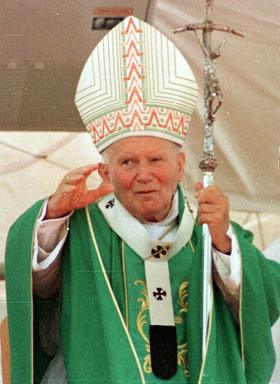
2024
Miracle

How the Church now rules on reported supernatural events

Dicastery for the Doctrine of the Faith Norms for Proceeding in the Discernment of Alleged Supernatural Phenomena, 17 May 2024, nn. 11-12

“it must be noted that, as a general rule, it is not foreseen in these Norms that ecclesiastical authority would give a positive recognition of the divine origin of alleged supernatural phenomena. 12. Whenever a Nihil obstat is granted by the Dicastery (cf. Par. 17, below), such phenomena do not become objects of faith, which means the faithful are not obliged to give an assent of faith to them.”

Read it in the source: vatican.va

See it on the timeline: Great miracles

2024
Miracle

The norms of 2024

Dicastery for the Doctrine of the Faith Norms for Proceeding in the Discernment of Alleged Supernatural Phenomena, Presentation (17 May 2024)

“As a rule, these potential conclusions do not include the possibility of declaring that the phenomenon under discernment is of supernatural origin—that is, affirming with moral certainty that it originates from a decision willed by God in a direct way. Instead, as Pope Benedict XVI explained, granting a Nihil obstat simply indicates that the faithful “are authorized to give [the phenomenon] their adhesion in a prudent manner.””

Read it in the source: vatican.va

See it on the timeline: Marian apparitions

2024
Miracle

The norms of 2024

Dicastery for the Doctrine of the Faith Norms for Proceeding in the Discernment of Alleged Supernatural Phenomena, I, 12 (17 May 2024)

“Whenever a Nihil obstat is granted by the Dicastery (cf. Par. 17, below), such phenomena do not become objects of faith, which means the faithful are not obliged to give an assent of faith to them.”

Read it in the source: vatican.va

See it on the timeline: Marian apparitions

2024
Miracle

How the Church now rules on reported supernatural events

Dicastery for the Doctrine of the Faith Norms for Proceeding in the Discernment of Alleged Supernatural Phenomena, I, 23 (17 May 2024)

“In light of the aforementioned points, it is reaffirmed that, as a rule, neither the Diocesan Bishop, nor the Episcopal Conferences, nor the Dicastery will declare that these phenomena are of supernatural origin, even if a Nihil obstat is granted (cf. Par. 11, above). It remains true, however, that the Holy Father can authorize a special procedure in this regard.”

Read it in the source: vatican.va

See it on the timeline: Eucharistic miracles

2023 to 2024
Church governance

The United States today: 902 allegations in one year, most through the courts

StoneBridge Business Partners, auditors, in the annual report of the United States Conference of Catholic Bishops Report on the Implementation of the Charter for the Protection of Children and Young People, 2024 Annual Report, Chapter Two

“Between July 1, 2023 and June 30, 2024, 902 allegations were reported by 855 victims/survivors of child sexual abuse by clergy throughout 195 Catholic dioceses and eparchies that reported information. … The abuse was alleged to have occurred primarily from the 1960’s to the present. … Allegations received as a result of lawsuits, compensation programs, and bankruptcies, make up approximately 61% of allegations during 2024.”

Read it in the source: USCCB

See it on the timeline: Clergy sexual abuse and the Church's response

2024
Protestant, Methodist

Protestants divided today: the United Methodist Church changes its teaching on homosexuality and marriage

Burton Edwards, for Ask The UMC, the United Methodist Information Service Ask The UMC, What's new in the Book of Discipline, Part 5: Human Sexuality, on the 2024 General Conference

“The Revised Social Principles approved by the 2024 General Conference took two substantial steps away from the position first declared in 1972 that “the practice of homosexuality is incompatible with Christian teaching.” Not only is that phrase no longer part of the Social Principles, but no mention of homosexuality is to be found there at all. … On marriage, the Revised Social Principles make this statement: “Within the church, we affirm marriage as a sacred, lifelong covenant that brings two people of faith, an adult man and woman of consenting age or two adult persons of consenting age, into union with one another and into deeper relationship with God and the religious community” (Paragraph 162.D).”

Read it in the source: umc.org

See it on the timeline: Protestantism

2023 to 2024
Church governance

The United States today: $242 million paid in one year

Center for Applied Research in the Apostolate (CARA), in the annual report of the United States Conference of Catholic Bishops Report on the Implementation of the Charter for the Protection of Children and Young People, 2024 Annual Report, Chapter Three

“Dioceses and eparchies that responded to the survey and reported costs related to allegations, paid out $242,799,401 between July 1, 2023 and June 30, 2024.”

Read it in the source: USCCB

See it on the timeline: Clergy sexual abuse and the Church's response

23 May 2024
Miracle

Pope Francis recognizes the second miracle

Holy See Press Office Bulletin, Promulgation of Decrees of the Dicastery for the Causes of Saints, 23 May 2024

“During the audience granted to His Eminence Cardinal Marcello Semeraro, prefect of the Dicastery for the Causes of Saints, the Supreme Pontiff has authorized the same Dicastery to promulgate the Decrees regarding: … the miracle attributed to the intercession of Blessed Carlo Acutis, lay faithful; born on 3 May 1991 in London, England, and died on 12 October 2006 in Monza, Italy”

Church ruling
Pope Francis authorized the decree recognizing the second miracle; announced 23 May 2024

Read it in the source: vatican.va

See it on the timeline: St. Carlo Acutis, 1991 to 2006

1 July 2024
Saint

The consistory: he will be enrolled among the saints

Holy See Press Office Bulletin, Ordinary Public Consistory for the vote on Causes of Canonization, 1 July 2024

“This morning, at 9.00, in the Consistory Hall of the Vatican Apostolic Palace, the Holy Father Francis presided over the celebration of Terce and the Ordinary Public Consistory for the Canonization of Blesseds: … Carlo Acutis, lay faithful. During the Consistory, the Pope decreed that Blesseds Manuel Ruiz López and seven companions and Francis, Abdel Mohti and Raphael Massabki, Giuseppe Allamano, Marie-Léonie Paradis and Elena Guerra be inscribed in the Book of Saints on Sunday 20 October 2024, whereas Blessed Carlo Acutis will be inscribed in the Book of Saints on a date yet to be announced.”

Read it in the source: vatican.va

See it on the timeline: St. Carlo Acutis, 1991 to 2006

20 November 2024A smiling pope in white waves with his right hand
Saint

"I will canonize Blessed Carlo Acutis"

Pope Francis General Audience, St. Peter's Square, 20 November 2024, as published in the Bulletin of the Holy See Press Office

“I want to say that next year, during the Jubilee for Adolescents, I will canonize Blessed Carlo Acutis, and that on the Jubilee for Young People, next year, I will canonize Blessed Pier Giorgio Frassati.”

Read it in the source: vatican.va

See it on the timeline: St. Carlo Acutis, 1991 to 2006

2025
Magisterium
Dicastery for the Doctrine of the Faith Mater Populi Fidelis, 24-25

“The biblical statement about Christ's exclusive mediation is conclusive. Christ is the only Mediator, … Given this clarity in the revealed Word of God, special prudence is required when applying the term "Mediatrix" to Mary. … the word "mediation" is commonly used in many areas of everyday life, where it is understood simply as cooperation, assistance, or intercession. As a result, it is inevitable that the term would be applied to Mary in a subordinate sense. Used in this way, it does not intend to add any efficacy or power to the unique mediation of Jesus Christ, true God and true man.”

Read it in the source: vatican.va

See it on the timeline: Mary as Mediatrix

2025A smiling pope in white sits in a white chair with his hands folded
Magisterium
Pope Leo XIV Homily at the Mass for the Beginning of the Pontificate, 18 May 2025

“The ministry of Peter is distinguished precisely by this self-sacrificing love, because the Church of Rome presides in charity and its true authority is the charity of Christ. … Moreover, if the rock is Christ, Peter must shepherd the flock without ever yielding to the temptation to be an autocrat, lording it over those entrusted to him (cf. 1 Pet 5:3).”

Read it in the source: vatican.va

See it on the timeline: Papal supremacy

18 May 2025
Magisterium

Leo XIV on his election

Pope Leo XIV Homily at the Mass for the Beginning of the Pontificate, 18 May 2025

“In this spirit of faith, the College of Cardinals met for the conclave. Coming from different backgrounds and experiences, we placed in God's hands our desire to elect the new Successor of Peter, the Bishop of Rome … I was chosen, without any merit of my own, and now, with fear and trembling, I come to you as a brother, who desires to be the servant of your faith and your joy”

Read it in the source: vatican.va

See it on the timeline: All the popes in order, from St. Peter to today

5 October 2025
Magisterium

Contemplating with Mary the mysteries of Christ

Pope Leo XIV Angelus, 5 October 2025

“Let us join ourselves spiritually with those gathered at the Shrine in Pompeii for the Supplication to the Virgin of the Holy Rosary. In this month of October, as we contemplate with Mary the mysteries of Christ our Savior, let us deepen our prayer for peace”

Read it in the source: vatican.va

See it on the timeline: The Rosary

canonized 2025
Miracle

St. Pier Giorgio Frassati, student of Turin

Dicastery for the Causes of Saints Profile of St. Pier Giorgio Frassati, decree on the miracle

“With a view to his canonization, the Postulation of the Cause submitted to the judgment of this Dicastery for the Causes of Saints the alleged miraculous healing of the priest of the Archdiocese of Los Angeles (United States of America) Juan Manuel Gutiérrez, from an injury to the Achilles tendon of the right foot. … The Medical Board of the Dicastery, in its session of 7 March 2024, declared that the healing of the patient is not scientifically explicable.”

Our translation. The words as written, in Italian:

“In vista della sua canonizzazione, la Postulazione della Causa ha sottoposto al giudizio di questo Dicastero delle Cause dei Santi la presunta guarigione miracolosa del sacerdote dell’arcidiocesi di Los Angeles (Stati Uniti d’America) Juan Manuel Gutiérrez, da una lesione del tendine d’Achille del piede destro. … La Consulta Medica del Dicastero, nella seduta del 7 marzo 2024, ha dichiarato che la guarigione del paziente non sia spiegabile scientificamente.”

Case
Juan Manuel Gutiérrez, a priest of the Archdiocese of Los Angeles: an injury to the right Achilles tendon
Investigation
Diocesan inquiry at Los Angeles, 1 to 19 September 2023; validity recognized by decree of 27 October 2023
Medical finding
Medical Board, 7 March 2024: the healing is not scientifically explicable
Church ruling
Theological consultors 28 May 2024 and cardinals and bishops 5 November 2024 both answered yes. Pope Francis then declared the miracle established

Read it in the source: Dicastery for the Causes of Saints

See it on the timeline: Saints of the modern age, 1800 to today
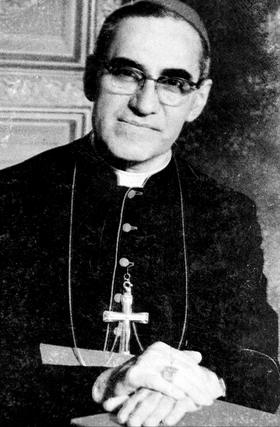
canonized 2025
Miracle

St. Maria Troncatti, Salesian missionary in Ecuador

Dicastery for the Causes of Saints Decree on the miracle, 25 November 2024, as printed in the profile of St. Maria Troncatti

“Mr. Juwa Juank Kankua Bosco, born in 1975 at Tuutinentsa in Ecuador, a member of the Shuar people of the community of Nunkui Nunka, province of Morona Santiago, on the morning of 2 February 2015, while sharpening the blade of the machine for planing wooden boards, was struck violently on the front of the head by a large fragment of stone thrown from the grinder, which had broken apart. Mr. Juwa lost consciousness and brain matter came out of his head. … Between the end of March and the beginning of April 2015, Mr. Juwa dreamed of a woman dressed in white who said she was Sr. Maria Troncatti and who reassured him about his healing. When the patient woke he felt a particular energy, so much so that he was able to move his leg and arm; with his wife's help he began to walk and managed to say a few words. From that moment there was a steady improvement. … The Medical Board, in its session of 7 March 2024, recognized that the healing was rapid, complete and lasting, as well as inexplicable according to the laws of science.”

Our translation. The words as written, in Italian:

“Il sig. Juwa Juank Kankua Bosco, nato nel 1975 a Tuutinentsa, in Ecuador, appartenente alla gente shuar della comunità di Nunkui Nunka, provincia di Morona Santiago, la mattina del 2 febbraio 2015, mentre affilava la lama della macchina per levigare assi di legno, fu colpito violentemente nella parte frontale della testa da un grosso frammento di pietra partito dalla smerigliatrice che si era spaccata. Il sig. Juwa perse conoscenza e dalla testa fuoriuscì della massa cerebrale. … Tra la fine di marzo e l’inizio di aprile 2015, il sig. Juwa sognò una donna vestita di bianco che disse di essere Sr. Maria Troncatti e che lo rassicurò circa la sua guarigione. Quando il paziente si svegliò avvertì una particolare energia, tanto che fu in grado di muovere la gamba e il braccio; con l’aiuto della moglie iniziò a camminare e riuscì a pronunciare qualche parola. Da quel momento ci fu un progressivo miglioramento. … La Consulta Medica, nella seduta del 7 marzo 2024, ha riconosciuto che la guarigione fu rapida, completa e duratura, nonché inspiegabile secondo le leggi della scienza.”

Case
Juwa Juank Kankua Bosco, a Shuar man born in 1975, struck on the head by a piece of a broken grinding stone on 2 February 2015, with an open skull fracture and loss of brain matter. After surgery at the hospital of Ambato the surgeon told his brother-in-law there was no hope
Witnesses
His brother-in-law and his sister, who began to call on Blessed Maria Troncatti; his wife, who helped him walk
Investigation
Diocesan inquiry at the Curia of the Apostolic Vicariate of Méndez, Ecuador, 2 to 10 September 2022; validity decreed 16 November 2022
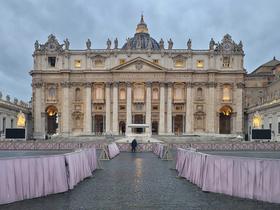
Medical finding
Medical Board, 7 March 2024: the healing rapid, complete and lasting, and inexplicable according to the laws of science
Church ruling
Theological consultors 28 May 2024 and cardinals and bishops 19 November 2024 answered yes. Pope Francis declared the miracle established on 25 November 2024

Read it in the source: Dicastery for the Causes of Saints

See it on the timeline: Saints of the modern age, 1800 to today

canonized 2025
Miracle

St. Maria Troncatti, Salesian missionary in Ecuador

Dicastery for the Causes of Saints Profile of St. Maria Troncatti, account of the cause (beatification)

“the alleged miraculous healing, which took place in the diocese of Portoviejo (Province of Manabí, Ecuador), of Mrs. Josefa Yolanda Solórzano Pisco, who in April 2002 began to feel symptoms of illness, which were taken for an ordinary bout of influenza. … the process of decline appeared irreversible, to the point that the patient went into a coma. In this situation, relatives and friends of Yolanda obtained her discharge from hospital, so that she "might die in her own home". There a Salesian priest told them about the Servant of God, urging those present to pray and ask, through her intercession, for the healing of the sick woman. At dawn on 10 May 2002 all noticed in Yolanda a first stirring of recovery.”

Our translation. The words as written, in Italian:

“la presunta guarigione miracolosa, avvenuta in diocesi di Portoviejo (Provincia di Manabí, Ecuador), della signora Josefa Yolanda Solórzano Pisco, la quale, nell’aprile 2002 iniziò ad avvertire dei sintomi di malessere, che furono interpretati come una normale affezione influenzale. … il processo degenerativo appariva irreversibile, al punto che la paziente entrò in coma. In questo contesto, parenti e amici di Yolanda ottennero le sue dimissioni dall’ospedale, affinché ella “potesse morire nella propria casa”. Qui un sacerdote salesiano presentò loro la figura della Serva di Dio, esortando i presenti a pregare per chiedere, mediante la sua intercessione, la guarigione dell’inferma. All’alba del 10 maggio 2002 tutti notarono in Yolanda un palpito di iniziale ripresa.”

Case
Josefa Yolanda Solórzano Pisco, of the diocese of Portoviejo in Ecuador, who fell ill in April 2002, went into a coma and was sent home from hospital to die
Witnesses
Her relatives and friends, and a Salesian priest who urged them to pray through the intercession of Maria Troncatti
Church ruling
Submitted to the Congregation for the Causes of Saints for her beatification. Beatified 24 November 2012

Read it in the source: Dicastery for the Causes of Saints

See it on the timeline: Saints of the modern age, 1800 to today

canonized 2025
Miracle

St. Carlo Acutis, schoolboy of Milan

Dicastery for the Causes of Saints Profile of St. Carlo Acutis, account of the cause (beatification)

“The special Congress of the Theological Consultors of 17 December 2019 and the Session of the Cardinals and Bishops of 4 February 2020 recognized that this miraculous healing had come about through the intercession of Carlo Acutis. On 22 February 2020, Pope Francis authorized the Dicastery for the Causes of Saints to promulgate the decree on the miracle.”

Our translation. The words as written, in Italian:

“Il Congresso peculiare dei Consultori Teologi del 17 dicembre 2019 e la Sessione dei Cardinali e Vescovi del 4 febbraio 2020 riconobbero che tale guarigione miracolosa era avvenuta per intercessione di Carlo Acutis. Il 22 febbraio 2020, Papa Francesco ha autorizzato il Dicastero delle Cause dei Santi a promulgare il decreto sul miracolo.”

Case
A child in Brazil with a malformed pancreas; diocesan inquiry at Campo Grande, 24 April to 12 June 2018
Medical finding
Medical Board, 19 November 2019: the healing rapid, complete and lasting, scientifically inexplicable
Church ruling
Theological consultors 17 December 2019; cardinals and bishops 4 February 2020; Pope Francis authorized the decree on 22 February 2020. Beatified at Assisi, 10 October 2020

Read it in the source: Dicastery for the Causes of Saints

See it on the timeline: Saints of the modern age, 1800 to today

current practiceA rock cave under trees with a white statue in a niche above it and people gathered in front
Miracle

Lourdes: how a cure is examined

Sanctuary of Our Lady of Lourdes The miracles of Lourdes, Declaration of a miracle: 4 decisive steps

“If the doctors collectively decide to continue the investigation, the cure is then subject to a long research process, which may last several years, and at the end of which the members of the International Medical Committee of Lourdes (CMIL) vote that the cure is “unexplained in the present state of our knowledge”. The result of the CMIL vote is then reported to the bishop of the cured person’s place of residence. It is then up to the bishop, as the representative of the Church hierarchy, to decide whether to declare a miracle.”

Investigation
The permanent doctor of the Medical Bureau, then the doctors present at Lourdes, then the International Medical Committee of Lourdes
Medical finding
The doctors vote only on whether the cure is “unexplained in the present state of our knowledge”
Church ruling
The bishop of the cured person's place of residence decides whether to declare a miracle

Read it in the source: lourdes-france.org

See it on the timeline: Great miracles

current practice
Miracle

Lourdes: the criteria the doctors apply

Sanctuary of Our Lady of Lourdes The miracles of Lourdes, Declaration of a miracle: 4 decisive steps

“The 1st criterion is that the disease is serious, with an unfavourable prognosis. Secondly, the disease must be known and recorded by medicine. Thirdly, this disease must be organic, lesional, that is to say, there must be objective, biological, radiological criteria, everything that currently exists in medicine; … Fourthly, there must not have been any treatment to which the cure could be attributed. The 5th criterion concerns the timing of the cure itself: recovery must be sudden, instantaneous, immediate and without convalescence. Finally, after the cure, there are two additional criteria: it must not simply be a regression of symptoms but a return of all vital functions, and finally, it must not simply be a remission but a cure, i.e. lasting and definitive.”

Medical finding
Seven criteria: a serious disease, known to medicine, organic with objective evidence, no treatment that could account for the cure, a sudden recovery, a return of all functions, and a lasting cure

Read it in the source: lourdes-france.org

See it on the timeline: Great miracles

to 2025
Miracle

Lourdes: 72 cures recognized out of more than 7,000 reported

Sanctuary of Our Lady of Lourdes Miraculous healings

“Of the more than 7,000 cases of healing reported at Lourdes since the apparitions, 72 have so far been recognised as miraculous by the Church. More than 80% of the cures recognised as miraculous have been women. The youngest person whose cure was recognised as miraculous was 2 years old.”

Investigation
More than 7,000 cases of healing reported at Lourdes since the apparitions
Church ruling
72 recognized as miraculous by the Church so far. The page lists each by name with the date of recognition

Read it in the source: lourdes-france.com

See it on the timeline: Great miracles

29 November 2025
Magisterium

Where things stand: the pope and the Ecumenical Patriarch

Pope Leo XIV and Ecumenical Patriarch Bartholomew I Joint Declaration, Istanbul, 29 November 2025

“Following the example of our venerable predecessors, and heeding the will of our Lord Jesus Christ, we continue to walk with firm determination on the path of dialogue, in love and truth (cf. Eph 4:15), towards the hoped-for restoration of full communion between our sister Churches.”

Read it in the source: vatican.va

See it on the timeline: The East-West Schism

3 February 2025A smiling pope in white waves with his right hand
Saint

The date is set for 27 April 2025

Pope Francis Address to the pilgrimage promoted by the Scandinavian Bishops' Conference, 3 February 2025

“As part of this year’s events, on 27 April we will celebrate the Canonization of Blessed Carlo Acutis. This young saint of and for our times shows you, and all of us, how possible it is in today’s world for young people to follow Jesus, share his teachings with others, and so find the fullness of life in joy, freedom and holiness.”

Read it in the source: vatican.va

See it on the timeline: St. Carlo Acutis, 1991 to 2006

21 April 2025
Saint

Pope Francis dies, and the canonization is suspended

Holy See Press Office Holy See Communiqué, 21 April 2025

“Following the death of the Supreme Pontiff Francis, it is announced that the Eucharistic Celebration and the Rite of canonization of Blessed Carlo Acutis, scheduled to take place on 27 April 2025, Second Sunday of Easter or Divine Mercy Sunday, on the occasion of the Jubilee of Teenagers, is suspended.”

Read it in the source: vatican.va

See it on the timeline: St. Carlo Acutis, 1991 to 2006

13 June 2025
Saint

Pope Leo XIV sets a new date

Holy See Press Office Bulletin, Ordinary Public Consistory for the vote on Causes for Canonization, 13 June 2025

“During the Consistory, the Pope decreed that Blessed Pier Giorgio Frassati, together with Blessed Carlo Acutis, be inscribed in the Book of Saints on Sunday 7 September 2025”

Read it in the source: vatican.va

See it on the timeline: St. Carlo Acutis, 1991 to 2006

7 September 2025A smiling pope in white sits in a white chair with his hands folded
Saint

Declared a saint in St. Peter's Square

Pope Leo XIV Formula of Canonization, in the Booklet for the Mass with the Rite of Canonization, St. Peter's Square, 7 September 2025

“For the honour of the Blessed Trinity, the exaltation of the Catholic faith and the increase of the Christian life, by the authority of our Lord Jesus Christ, and of the Holy Apostles Peter and Paul, and our own, after due deliberation and frequent prayer for divine assistance, and having sought the counsel of many of our brother Bishops, we declare and define … Blessed Pier Giorgio Frassati and Carlo Acutis … to be Saints and we enroll them among the Saints, decreeing that they are to be venerated as such by the whole Church. In the name of the Father, and of the Son, and of the Holy Spirit.”

Read it in the source: vatican.va

See it on the timeline: St. Carlo Acutis, 1991 to 2006

7 September 2025
Saint

His parents, brother and sister were there

Pope Leo XIV Homily at the Canonization of Pier Giorgio Frassati and Carlo Acutis, 7 September 2025

“Carlo, for his part, encountered Jesus in his family, thanks to his parents, Andrea and Antonia — who are here today with his two siblings, Francesca and Michele — and then at school, and above all in the sacraments celebrated in the parish community. He grew up naturally integrating prayer, sport, study and charity into his days as a child and young man.”

Read it in the source: vatican.va

See it on the timeline: St. Carlo Acutis, 1991 to 2006

7 September 2025
Saint

"Not I, but God"

Pope Leo XIV Homily at the Canonization of Pier Giorgio Frassati and Carlo Acutis, 7 September 2025, conclusion, quoting Carlo

“Dear friends, Saints Pier Giorgio Frassati and Carlo Acutis are an invitation to all of us, especially young people, not to squander our lives, but to direct them upwards and make them masterpieces. They encourage us with their words: “Not I, but God,” as Carlo used to say. And Pier Giorgio: “If you have God at the center of all your actions, then you will reach the end.” This is the simple but winning formula of their holiness.”

Read it in the source: vatican.va

See it on the timeline: St. Carlo Acutis, 1991 to 2006

8 September 2025
Saint

Humility, "the most beautiful thing about him"

Cardinal Marcello Semeraro, Prefect of the Dicastery for the Causes of Saints Homily at the Mass of thanksgiving for the canonization of Carlo Acutis, St. Peter's Basilica, 8 September 2025

“In the light of this virtue we can (perhaps we must) look also at St. Carlo Acutis, whose spiritual and human path was marked at every level by humility. The testimonies in the canonical process for his beatification and canonization tell us with one voice that this virtue was "the most beautiful thing about him", and that he practised it and gave an example of it to his companions. And it was this very humility that widened his gaze to the poverty and the needs of the weakest and the most needy.”

Our translation. The words as written, in Italian:

“In questa luce virtuosa possiamo (forse dobbiamo) guardare anche a san Carlo Acutis, il cui percorso spirituale e umana è stato segnato a tutti i livelli dall’umiltà. Le testimonianze nel processo canonico per la sua beatificazione e canonizzazione ci dicono unanimi che questa virtù è stata la sua «cosa più bella» e che l’ha praticata dandone esempio ai suoi compagni. Ed è stata proprio questa umiltà a fargli allargare lo sguardo sulle povertà e sulle necessità dei più deboli e bisognosi.”

Read it in the source: Dicastery for the Causes of Saints

See it on the timeline: St. Carlo Acutis, 1991 to 2006

2025
Saint

Why he was canonized: not a theologian, a young Christian who lived the faith whole

Fr. Arturo Elberti, S.J., theological consultor of the Dicastery for the Causes of Saints "Carlo Acutis", paper published on the Dicastery's website (undated), conclusion

“His canonization, strongly desired by Pope Francis, does not mean to raise to the honours of the altar a theologian, still less a Doctor of the Church. It means to show that today too young Christians can live the faith of the Gospel in a consistent and all-embracing way, and can have a relationship with the Sacrament of the Eucharist that lets them celebrate the saving Mystery of Christ and have a living relationship with him, present in our midst.”

Our translation. The words as written, in Italian:

“La sua canonizzazione fortemente voluta da papa Francesco, non intende elevare agli onori degli altari un teologo né tanto meno un dottore della Chiesa. Essa intende dimostrare che anche oggi i giovani cristiani possono vivere la fede evangelica in modo coerente e totalizzante ed avere un rapporto con il Sacramento dell’Eucaristia che permetta loro di celebrare il Mistero salvifico di Cristo ed avere un rapporto vivo con Lui presente in mezzo a noi.”

Read it in the source: Dicastery for the Causes of Saints

See it on the timeline: St. Carlo Acutis, 1991 to 2006

2025
Saint

What he leaves to the young

Dicastery for the Causes of Saints Profile of St. Carlo Acutis, "Vita e opere", Carlo's legacy

“The chief legacy that Carlo has left, above all to the new generations, is a life consistent with the values of the Gospel. Because of his ability to share the mysteries of the faith with others, Carlo can be called a true apostle in all the settings in which he lived, which are those typical of a teenager: family, school, sport, free time, travel, games.”

Our translation. The words as written, in Italian:

“La principale eredità che Carlo ha lasciato, soprattutto alle nuove generazioni, è la coerenza di vita con i valori del Vangelo. Proprio per la sua capacità di condivisione con gli altri dei misteri della fede, Carlo può essere definito un vero apostolo in tutti gli ambienti in cui è vissuto, che sono quelli tipici di un adolescente: famiglia, scuola, sport, tempo libero, viaggi, giochi.”

Read it in the source: Dicastery for the Causes of Saints

See it on the timeline: St. Carlo Acutis, 1991 to 2006

30 October 2025A smiling pope in white sits in a white chair with his hands folded
Saint

"He did not become a slave to the internet"

Pope Leo XIV Address to students taking part in the Jubilee of the World of Education, 30 October 2025

“In this regard, we have a very timely example of holiness: Saint Carlo Acutis. He was a young man who did not become a slave to the internet, but rather used it skillfully for good. Saint Carlo combined his beautiful faith with his passion for computers, creating a website on Eucharistic miracles and thus making the internet a tool for evangelization.”

Read it in the source: vatican.va

See it on the timeline: St. Carlo Acutis, 1991 to 2006

TodayRows of bishops in white mitres and copes sit in tiered stands hung with red and green cloth
Council

Five centuries on: many communities, differing among themselves

Second Vatican Council Unitatis Redintegratio, 19 (21 November 1964)

“In the great upheaval which began in the West toward the end of the Middle Ages, and in later times too, Churches and ecclesial Communities came to be separated from the Apostolic See of Rome. … However, since these Churches and ecclesial Communities, on account of their different origins, and different teachings in matters of doctrine on the spiritual life, vary considerably not only with us, but also among themselves, the task of describing them at all adequately is extremely difficult; and we have no intention of making such an attempt here.”

Read it in the source: vatican.va

See it on the timeline: Protestantism

TodayA thin man with a short beard, in a fur-collared black gown, holding an open book
Protestant, Lutheran

How is a person saved? The Lutheran answer

Philip Melanchthon and the Lutheran princes Augsburg Confession (1530), Article 4, Of Justification

“Also they teach that men can not be justified [obtain forgiveness of sins and righteousness] before God by their own powers, merits, or works; but are justified freely [of grace] for Christ's sake through faith, when they believe that they are received into favor, and their sins forgiven for Christ's sake, who by his death hath satisfied for our sins.”

Read it in the source: CCEL

See it on the timeline: Protestantism

Today
Protestant, Lutheran

Scripture: the Lutheran teaching

The authors of the Formula of Concord Formula of Concord (1576), Epitome, Of the Compendious Rule and Norm, I

“But other writings, whether of the fathers or of the moderns, with whatever name they come, are in nowise to be equalled to the Holy Scriptures, but are all to be esteemed inferior to them, so that they be not otherwise received than in the rank of witnesses, to show what doctrine was taught after the Apostles' times also, and in what parts of the world that more sound doctrine of the Prophets and Apostles has been preserved.”

Read it in the source: CCEL

See it on the timeline: Protestantism

TodayA portrait of a man in a black cap and black gown against a blue-green background
Protestant, Lutheran

Baptism: the Lutheran teaching

Martin Luther Small Catechism (1529), Part IV, The Sacrament of Holy Baptism, II

“It worketh forgiveness of sins, delivers from death and the devil, and gives everlasting salvation to all who believe, as the Word and promise of God declare.”

Read it in the source: CCEL

See it on the timeline: Protestantism

Today
Protestant, Lutheran

The Lord's Supper: the Lutheran teaching

Martin Luther Small Catechism (1529), Part V, The Sacrament of the Altar

“It is the true body and blood of our Lord Jesus Christ, under the bread and wine, given unto us Christians to eat and to drink, as it was instituted by Christ himself.”

Read it in the source: CCEL

See it on the timeline: Protestantism

TodayA crowded panelled chamber of men in black gowns and white collars, one of them standing to speak
Protestant, Reformed

How is a person saved? The Reformed and Presbyterian answer

Westminster Assembly of Divines Westminster Confession of Faith (1647), ch. 3, Of God's Eternal Decree, VI and VII

“Neither are any other redeemed by Christ, effectually called, justified, adopted, sanctified, and saved, but the elect only. … The rest of mankind God was pleased, according to the unsearchable counsel of his own will, whereby he extendeth or withholdeth mercy as he pleaseth, for the glory of his sovereign power over his creatures, to pass by, and to ordain them to dishonor and wrath for their sin, to the praise of his glorious justice.”

Read it in the source: CCEL

See it on the timeline: Protestantism

Today
Protestant, Reformed

Scripture: the Reformed and Presbyterian teaching

Westminster Assembly of Divines Westminster Confession of Faith (1647), ch. 1, Of the Holy Scripture, VI

“The whole counsel of God, concerning all things necessary for his own glory, man's salvation, faith, and life, is either expressly set down in Scripture, or by good and necessary consequence may be deduced from Scripture: unto which nothing at any time is to be added, whether by new revelations of the Spirit, or traditions of men.”

Read it in the source: CCEL

See it on the timeline: Protestantism

Today
Protestant, Reformed

Baptism: the Reformed and Presbyterian teaching

Westminster Assembly of Divines Westminster Confession of Faith (1647), ch. 28, Of Baptism, V

“Although it be a great sin to contemn or neglect this ordinance, … yet grace and salvation are not so inseparably annexed unto it, as that no person can be regenerated or saved without it, … or that all that are baptized are undoubtedly regenerated.”

Read it in the source: CCEL

See it on the timeline: Protestantism

Today
Protestant, Reformed

The Lord's Supper: the Reformed and Presbyterian teaching

Westminster Assembly of Divines Westminster Confession of Faith (1647), ch. 29, Of the Lord's Supper, VII

“Worthy receivers, outwardly partaking of the visible elements in this sacrament, … do then also inwardly by faith, really and indeed, yet not carnally and corporally, but spiritually, receive and feed upon Christ crucified, and all benefits of his death: the body and blood of Christ being then not corporally or carnally in, with, or under the bread and wine; yet as really, but spiritually, present to the faith of believers in that ordinance, as the elements themselves are, to their outward senses.”

Read it in the source: CCEL

See it on the timeline: Protestantism

28 March 2026A smiling pope in white sits in a white chair with his hands folded
Saint

Venerated as patron of the apostolate on the web

Pope Leo XIV Address to young people and catechumens, Church of Sainte-Dévote, Principality of Monaco, 28 March 2026

“In this church, the memory of the Holy Martyr Devota has recently been joined by that of Saint Carlo Acutis, another young person in love with Jesus and loyal to his friendship with Christ to the very end, albeit in completely different times and ways: through charity, through his apostolate on the web — of which we venerate him as patron — and finally through his illness.”

Read it in the source: vatican.va

See it on the timeline: St. Carlo Acutis, 1991 to 2006

Today
Protestant, Anglican

How is a person saved? The Anglican answer

Church of England Thirty-nine Articles of Religion (1571), Article 11, Of the Justification of Man

“We are accounted righteous before God, only for the merit of our Lord and Saviour Jesus Christ by Faith, and not for our own works or deservings. Wherefore, that we are justified by Faith only, is a most wholesome Doctrine, and very full of comfort, as more largely expressed in the Homily of Justification.”

Read it in the source: Fordham Sourcebook

See it on the timeline: Protestantism

Today
Protestant, Anglican

Scripture: the Anglican teaching

Church of England Thirty-nine Articles of Religion (1571), Article 6, Of the Sufficiency of the Holy Scriptures for Salvation

“Holy Scripture containeth all things necessary to salvation: so that whatsoever is not read therein, nor may be proved thereby, is not to be required of any man, that it should be believed as an article of the Faith, or be thought requisite or necessary to salvation.”

Read it in the source: Fordham Sourcebook

See it on the timeline: Protestantism

Today
Protestant, Anglican

Baptism: the Anglican teaching

Church of England Thirty-nine Articles of Religion (1571), Article 27, Of Baptism

“Baptism is not only a sign of profession, and mark of difference, whereby Christian men are discerned from others that be not christened, but it is also a sign of Regeneration or New-Birth, whereby, as by an instrument, they that receive Baptism rightly are grafted into the Church … The Baptism of young Children is in any wise to be retained in the Church, as most agreeable with the institution of Christ.”

Read it in the source: Fordham Sourcebook

See it on the timeline: Protestantism

Today
Protestant, Anglican

The Lord's Supper: the Anglican teaching

Church of England Thirty-nine Articles of Religion (1571), Article 28, Of the Lord's Supper

“Transubstantiation (or the change of the substance of Bread and Wine) in the Supper of the Lord, cannot be proved by Holy Writ; but is repugnant to the plain words of Scripture, overthroweth the nature of a Sacrament, and hath given occasion to many superstitions. The Body of Christ is given, taken, and eaten, in the Supper, only after an heavenly and spiritual manner. And the mean whereby the Body of Christ is received and eaten in the Supper, is Faith.”

Read it in the source: Fordham Sourcebook

See it on the timeline: Protestantism

TodayAn old man with long white hair in a black gown with white preaching bands
Protestant, Methodist

How is a person saved? The Methodist answer

John Wesley Methodist Articles of Religion (1784), Article 9, Of the Justification of Man

“We are accounted righteous before God only for the merit of our Lord and Saviour Jesus Christ by faith, and not for our own works or deservings. Wherefore, that we are justified by faith only is a most wholesome doctrine, and very full of comfort.”

Read it in the source: CCEL

See it on the timeline: Protestantism

Today
Protestant, Methodist

Scripture: the Methodist teaching

John Wesley Methodist Articles of Religion (1784), Article 5, The Sufficiency of the Holy Scriptures for Salvation

“The Holy Scriptures contain all things necessary to salvation; so that whatsoever is not read therein, nor may be proved thereby, is not to be required of any man that it should be believed as an article of faith, or be thought requisite or necessary to salvation.”

Read it in the source: CCEL

See it on the timeline: Protestantism

Today
Protestant, Methodist

Baptism: the Methodist teaching

John Wesley Methodist Articles of Religion (1784), Article 17, Of Baptism

“Baptism is not only a sign of profession, and mark of difference, whereby Christians are distinguished from others that are not baptized; but it is also a sign of regeneration, or the new birth. The baptism of young children is to be retained in the Church.”

Read it in the source: CCEL

See it on the timeline: Protestantism

Today
Protestant, Methodist

The Lord's Supper: the Methodist teaching

John Wesley Methodist Articles of Religion (1784), Article 18, Of the Lord's Supper

“Transubstantiation, or the change of the substance of bread and wine in the Supper of our Lord, can not be proved by Holy Writ, but is repugnant to the plain words of Scripture, overthroweth the nature of a sacrament, and hath given occasion to many superstitions. The body of Christ is given, taken, and eaten in the Supper only after a heavenly and spiritual manner. And the means whereby the body of Christ is received and eaten in the Supper is faith.”

Read it in the source: CCEL

See it on the timeline: Protestantism

Today
Protestant, Baptist

How is a person saved? The Southern Baptist answer

Southern Baptist Convention The Baptist Faith and Message 2000, Article IV, Salvation

“Salvation involves the redemption of the whole man, and is offered freely to all who accept Jesus Christ as Lord and Saviour, who by His own blood obtained eternal redemption for the believer. In its broadest sense salvation includes regeneration, justification, sanctification, and glorification. There is no salvation apart from personal faith in Jesus Christ as Lord.”

Read it in the source: bfm.sbc.net

See it on the timeline: Protestantism

Today
Protestant, Baptist

Scripture: the Southern Baptist teaching

Southern Baptist Convention The Baptist Faith and Message 2000, Article I, The Scriptures

“It reveals the principles by which God judges us, and therefore is, and will remain to the end of the world, the true center of Christian union, and the supreme standard by which all human conduct, creeds, and religious opinions should be tried.”

Read it in the source: bfm.sbc.net

See it on the timeline: Protestantism

Today
Protestant, Baptist

Baptism: the Southern Baptist teaching

Southern Baptist Convention The Baptist Faith and Message 2000, Article VII, Baptism and the Lord's Supper

“Christian baptism is the immersion of a believer in water in the name of the Father, the Son, and the Holy Spirit. It is an act of obedience symbolizing the believer’s faith in a crucified, buried, and risen Saviour, the believer’s death to sin, the burial of the old life, and the resurrection to walk in newness of life in Christ Jesus.”

Read it in the source: bfm.sbc.net

See it on the timeline: Protestantism

Today
Protestant, Baptist

The Lord's Supper: the Southern Baptist teaching

Southern Baptist Convention The Baptist Faith and Message 2000, Article VII, Baptism and the Lord's Supper

“The Lord’s Supper is a symbolic act of obedience whereby members of the church, through partaking of the bread and the fruit of the vine, memorialize the death of the Redeemer and anticipate His second coming.”

Read it in the source: bfm.sbc.net

See it on the timeline: Protestantism

Today
Protestant, Quaker

How is a person saved? The Quaker answer

Robert Barclay Theses Theologicae (the Confession of the Society of Friends, 1675), Seventh Proposition, Concerning Justification

“As many as resist not this light, but receive the same, in them is produced an holy, pure, and spiritual birth, bringing forth holiness, righteousness, purity, and all those other blessed fruits which are acceptable to God; by which holy birth, to wit, Jesus Christ formed within us, and working his works in us, as we are sanctified, so we are justified in the sight of God”

Read it in the source: CCEL

See it on the timeline: Protestantism

Today
Protestant, Quaker

Scripture: the Quaker teaching

Robert Barclay Theses Theologicae (the Confession of the Society of Friends, 1675), Third Proposition, Concerning the Scriptures

“nevertheless, because they are only a declaration of the fountain, and not the fountain itself, therefore they are not to be esteemed the principal ground of all truth and knowledge, nor yet the adequate primary rule of faith and manners.”

Read it in the source: CCEL

See it on the timeline: Protestantism

Today
Protestant, Quaker

Baptism: the Quaker teaching

Robert Barclay Theses Theologicae (the Confession of the Society of Friends, 1675), Twelfth Proposition, Concerning Baptism

“As there is one Lord and one faith, so there is 'one baptism; which is not the putting away the filth of the flesh, but the answer of a good conscience before God, by the resurrection of Jesus Christ.' And this baptism is a pure and spiritual thing, to wit, the baptism of the Spirit and Fire”

Read it in the source: CCEL

See it on the timeline: Protestantism

Today
Protestant, Quaker

The Lord's Supper: the Quaker teaching

Robert Barclay Theses Theologicae (the Confession of the Society of Friends, 1675), Thirteenth Proposition, Concerning the Communion

“The communion of the body and blood of Christ is inward and spiritual, which is the participation of his flesh and blood, by which the inward man is daily nourished in the hearts of those in whom Christ dwells”

Read it in the source: CCEL

See it on the timeline: Protestantism