Tradition Timeline Leave an objection

Start page / Offshoots

Judaism and the Church

Each mark is one quotation. Touch the timeline to read it.

The Church came out of Israel. Jesus and his apostles were Jews, and the Scriptures and promises she reads are Israel's. This timeline follows how the Church and the synagogue went separate ways in the first and second centuries, over three questions: whether Jesus is the Messiah and Son of God, whether Gentiles must keep the Law of Moses, and what the destruction of the Temple in AD 70 meant. It shows what Judaism teaches in the words of Jewish writers, and what the Church has said in reply and about the Jewish people, down to the Catechism and recent popes. Each side is quoted in its own words, in date order.

Where it starts with Jesus

Jesus, a Jew teaching Jews, says he has come to fulfil the law and the prophets and not to abolish them.

“Think not that I have come to abolish the law and the prophets; I have come not to abolish them but to fulfil them. For truly, I say to you, till heaven and earth pass away, not an iota, not a dot, will pass from the law until all is accomplished.”

JesusMatthew 5:17-18Read it in the source: Bible Gateway, RSV Catholic Edition

How it points to Jesus

The Church holds that Jesus is the Messiah of Israel, and so she reads the Law and the Prophets as his. Judaism does not hold this, and the two went separate ways over it. The documents below show both sides in their own words, and what the Church says today of the people to whom, in Paul's words, the covenants and the promises belong.

Drafted from primary sources. Every quotation is checked against the page it links to. The Jewish texts are on fallback hosts (ccel.org and fordham.edu), as is usual for this section, and they are the translations of those pages. The Mishnah, the Talmud, the Barcelona disputation of 1263 and any modern Jewish statement are not shown, because no approved page was found that carries them. The wrongs done to Jews in the name of Christians are on the timeline "The Church and the Jews" and are not repeated here.

24 quotations in date order

A work in progress. The quotations below are not all the evidence on this matter. More are being added.

What the Old Testament preparedbefore Christ
Old Testament
Scripture

The call of Abraham

The Book of Genesis Genesis 12:1-3

“Now the Lord said to Abram, “Go from your country and your kindred and your father’s house to the land that I will show you. And I will make of you a great nation, and I will bless you, and make your name great, so that you will be a blessing. I will bless those who bless you, and him who curses you I will curse; and by you all the families of the earth shall bless themselves.””

Read it in the source: Bible Gateway, RSV Catholic Edition

Old Testament
Scripture

Israel, God's own possession

The Book of Exodus Exodus 19:5-6

“Now therefore, if you will obey my voice and keep my covenant, you shall be my own possession among all peoples; for all the earth is mine, and you shall be to me a kingdom of priests and a holy nation.”

Read it in the source: Bible Gateway, RSV Catholic Edition

Old Testament
Scripture

The new covenant promised

The prophet Jeremiah Jeremiah 31:31-34

““Behold, the days are coming, says the Lord, when I will make a new covenant with the house of Israel and the house of Judah, not like the covenant which I made with their fathers when I took them by the hand to bring them out of the land of Egypt, my covenant which they broke, though I was their husband, says the Lord. But this is the covenant which I will make with the house of Israel after those days, says the Lord: I will put my law within them, and I will write it upon their hearts; and I will be their God, and they shall be my people. And no longer shall each man teach his neighbor and each his brother, saying, ‘Know the Lord,’ for they shall all know me, from the least of them to the greatest, says the Lord; for I will forgive their iniquity, and I will remember their sin no more.””

Read it in the source: Bible Gateway, RSV Catholic Edition
Out of IsraelThe first century: what the Church received, and the questions that divided
c. AD 30
Scripture

Followers of Jesus put out of the synagogue

St. John the Evangelist John 9:22

“His parents said this because they feared the Jews, for the Jews had already agreed that if any one should confess him to be Christ, he was to be put out of the synagogue.”

Read it in the source: Bible Gateway, RSV Catholic Edition
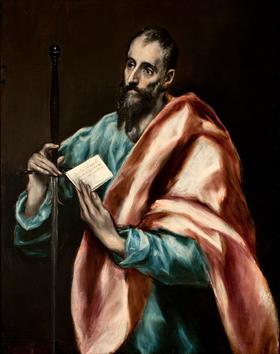
c. AD 49A dark-haired, bearded man in a green robe with a white collar, his head tilted, looking out at the viewer
Scripture

Must Gentiles keep the Law of Moses? The apostles meet at Jerusalem

St. Luke Acts 15:1, 10-11

“But some men came down from Judea and were teaching the brethren, “Unless you are circumcised according to the custom of Moses, you cannot be saved.” … Now therefore why do you make trial of God by putting a yoke upon the neck of the disciples which neither our fathers nor we have been able to bear? But we believe that we shall be saved through the grace of the Lord Jesus, just as they will.”

Read it in the source: Bible Gateway, RSV Catholic Edition
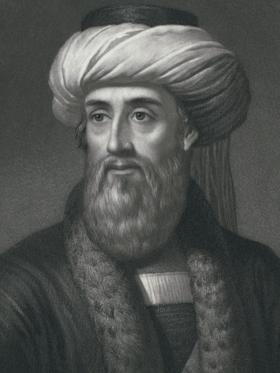
c. AD 57A bald, bearded apostle in a red cloak over a blue tunic, holding a folded letter in one hand and resting the other on a long sword
Scripture

What belongs to Israel

St. Paul Romans 9:4-5

“They are Israelites, and to them belong the sonship, the glory, the covenants, the giving of the law, the worship, and the promises; to them belong the patriarchs, and of their race, according to the flesh, is the Christ, who is God over all, blessed for ever. Amen.”

Read it in the source: Bible Gateway, RSV Catholic Edition
c. AD 57
Scripture

The wild olive grafted in

St. Paul Romans 11:17-18

“But if some of the branches were broken off, and you, a wild olive shoot, were grafted in their place to share the richness of the olive tree, do not boast over the branches. If you do boast, remember it is not you that support the root, but the root that supports you.”

Read it in the source: Bible Gateway, RSV Catholic Edition
After the Temple70 to c. 155: Judaism without the Temple, and the first Christian replies
70

Judaism: continued under the rabbis after the Temple fell. The Romans destroy the Temple in Jerusalem. Jewish life is rebuilt around the synagogue and the teaching of the rabbis, and in the generations that follow the Church and the synagogue go separate ways.

AD 70An engraved portrait of a bearded man in a large turban and a fur-trimmed robe
Jewish

The Temple burned

Flavius Josephus The Wars of the Jews, Book 6, ch. 4, sect. 8

“Now although any one would justly lament the destruction of such a work as this was, since it was the most admirable of all the works that we have seen or heard of, both for its curious structure and its magnitude, and also for the vast wealth bestowed upon it, as well as for the glorious reputation it had for its holiness; yet might such a one comfort himself with this thought, that it was fate that decreed it so to be, which is inevitable, both as to living creatures, and as to works and places also.”

Read it in the source: CCEL

c. AD 93
Jewish

The Pharisees, as a Jewish historian describes them

Flavius Josephus Antiquities of the Jews, Book 18, ch. 1, sect. 3

“Now, for the Pharisees, they live meanly, and despise delicacies in diet; and they follow the conduct of reason; and what that prescribes to them as good for them they do; and they think they ought earnestly to strive to observe reason's dictates for practice. They also pay a respect to such as are in years; nor are they so bold as to contradict them in any thing which they have introduced; … They also believe that souls have an immortal rigor in them, and that under the earth there will be rewards or punishments, according as they have lived virtuously or viciously in this life; and the latter are to be detained in an everlasting prison, but that the former shall have power to revive and live again; on account of which doctrines they are able greatly to persuade the body of the people; and whatsoever they do about Divine worship, prayers, and sacrifices, they perform them according to their direction;”

Read it in the source: CCEL

c. AD 95
Jewish

Which books the Jews hold to be divine

Flavius Josephus Against Apion, Book 1, sect. 8

“For we have not an innumerable multitude of books among us, disagreeing from and contradicting one another, [as the Greeks have,] but only twenty-two books, … which contain the records of all the past times; which are justly believed to be divine; and of them five belong to Moses, which contain his laws and the traditions of the origin of mankind till his death.”

Read it in the source: CCEL

c. 107A manuscript painting on a gold ground of clergy carrying a casket towards a church building
Church Father

A bishop writes to Gentile Christians about the Jewish law

St. Ignatius of Antioch Letter to the Magnesians, ch. 8

“For if we still live according to the Jewish law, we acknowledge that we have not received grace. For the divinest prophets lived according to Christ Jesus. On this account also they were persecuted, being inspired by His grace to fully convince the unbelieving that there is one God, who has manifested Himself by Jesus Christ His Son, who is His eternal Word, not proceeding forth from silence, and who in all things pleased Him that sent Him.”

Read it in the source: New Advent

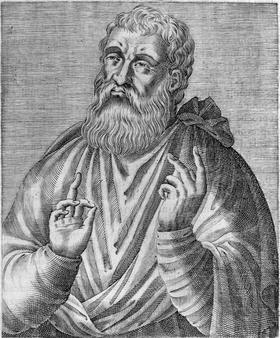
c. 155An engraving of an old man with a full beard in a cloak, with both hands raised as if explaining
Church Father

A Jewish objection as St. Justin records it: Trypho on the Christians

St. Justin Martyr (reporting Trypho) Dialogue with Trypho, ch. 10

“Trypho: This is what we are amazed at, but those things about which the multitude speak are not worthy of belief; for they are most repugnant to human nature. Moreover, I am aware that your precepts in the so-called Gospel are so wonderful and so great, that I suspect no one can keep them; for I have carefully read them. But this is what we are most at a loss about: that you, professing to be pious, and supposing yourselves better than others, are not in any particular separated from them, and do not alter your mode of living from the nations, in that you observe no festivals or sabbaths, and do not have the rite of circumcision; and further, resting your hopes on a man that was crucified, you yet expect to obtain some good thing from God, while you do not obey His commandments.”

Read it in the source: New Advent

c. 155
Church Father

Jewish believers who keep the Law, and Gentiles who do not

St. Justin Martyr Dialogue with Trypho, ch. 47

“But if some, through weak-mindedness, wish to observe such institutions as were given by Moses, from which they expect some virtue, but which we believe were appointed by reason of the hardness of the people's hearts, along with their hope in this Christ, and [wish to perform] the eternal and natural acts of righteousness and piety, yet choose to live with the Christians and the faithful, as I said before, not inducing them either to be circumcised like themselves, or to keep the Sabbath, or to observe any other such ceremonies, then I hold that we ought to join ourselves to such, and associate with them in all things as kinsmen and brethren.”

Read it in the source: New Advent

What Judaism teachesc. 1140 to 1271: the Jewish writers and the medieval Church
c. 1140
Jewish

What a Jewish rabbi says he believes

Judah Ha-Levi The Kuzari, Part I, sect. 11

“The Rabbi replied: I believe in the God of Abraham, Isaac and Israel, who led the children of Israel out of Egypt with signs and miracles; who fed them in the desert and gave them the land, after having made them traverse the sea and the Jordan in a miraculous way; who sent Moses with His law, and subsequently thousands of prophets, who confirmed His law by promises to the observant. and threats to the disobedient. Our belief is comprised in the Torah -- a very large domain.”

Read it in the source: Fordham Sourcebook

c. 1180
Jewish

The Messiah in Jewish law, and a Torah that does not change

Moses Maimonides Mishneh Torah, Laws of Kings, ch. 11 (Laws Concerning Mashiach)

“This Torah, with its statutes and laws, is everlasting. We may neither add to them nor detract from them. … If a king will arise from the House of David who delves deeply into the study of the Torah and, like David his ancestor, observes its mitzvos as prescribed by the Written Law and the Oral Law; if he will compel all of Israel to walk in [the way of the Torah] and repair the breaches [in its observance]; and if he will fight the wars of G-d; - we may, with assurance, consider him Mashiach. If he succeeds in the above, builds the [Beis Ha]Mikdash on its site, and gathers in the dispersed remnant of Israel, he is definitely the Mashiach.”

Read it in the source: Fordham Sourcebook

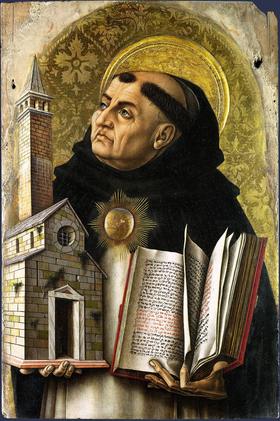
c. 1271A Dominican friar with a tonsure and a gold halo holds an open book and a small church, with a shining sun on his chest
Doctor of the Church

The Church's custom: no baptism of Jewish children against their parents' will

St. Thomas Aquinas Summa Theologiae II-II, q. 10, a. 12, I answer that

“Now it was never the custom of the Church to baptize the children of the Jews against the will of their parents, although at times past there have been many very powerful catholic princes like Constantine and Theodosius, with whom most holy bishops have been on most friendly terms, as Sylvester with Constantine, and Ambrose with Theodosius, who would certainly not have failed to obtain this favor from them if it had been at all reasonable. It seems therefore hazardous to repeat this assertion, that the children of Jews should be baptized against their parents' wishes, in contradiction to the Church's custom observed hitherto.”

Read it in the source: New Advent

Toward each other1965 to today
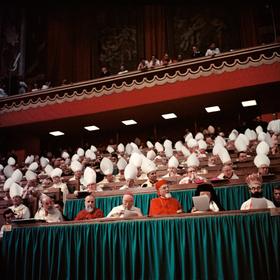
1965Rows of bishops in white mitres and copes sit in tiered stands hung with red and green cloth
Council

The Church received the Old Testament through Israel

Second Vatican Council Declaration Nostra Aetate, 28 October 1965, no. 4

“The Church, therefore, cannot forget that she received the revelation of the Old Testament through the people with whom God in His inexpressible mercy concluded the Ancient Covenant. Nor can she forget that she draws sustenance from the root of that well-cultivated olive tree onto which have been grafted the wild shoots, the Gentiles. Indeed, the Church believes that by His cross Christ, Our Peace, reconciled Jews and Gentiles. making both one in Himself.”

Read it in the source: vatican.va

1992
Magisterium

The chosen people, and the nations to be gathered

Catechism of the Catholic Church CCC 59-60

“In order to gather together scattered humanity God calls Abram from his country, his kindred and his father's house, and makes him Abraham, that is, "the father of a multitude of nations". "In you all the nations of the earth shall be blessed." … The people descended from Abraham would be the trustee of the promise made to the patriarchs, the chosen people, called to prepare for that day when God would gather all his children into the unity of the Church. They would be the root on to which the Gentiles would be grafted, once they came to believe.”

Read it in the source: vatican.va

1992
Magisterium

Israel the priestly people, and the covenant looked for

Catechism of the Catholic Church CCC 62-64

“After the patriarchs, God formed Israel as his people by freeing them from slavery in Egypt. He established with them the covenant of Mount Sinai and, through Moses, gave them his law so that they would recognize him and serve him as the one living and true God, the provident Father and just judge, and so that they would look for the promised Saviour. … Israel is the priestly people of God, "called by the name of the LORD", and "the first to hear the word of God", The people of "elder brethren" in the faith of Abraham. … Through the prophets, God forms his people in the hope of salvation, in the expectation of a new and everlasting Covenant intended for all, to be written on their hearts.”

Read it in the source: vatican.va

1992
Magisterium

The Jewish faith and the Church's faith

Catechism of the Catholic Church CCC 839

“The Jewish faith, unlike other non-Christian religions, is already a response to God's revelation in the Old Covenant.”

Read it in the source: vatican.va

1992
Magisterium

Two expectations of the Messiah

Catechism of the Catholic Church CCC 840

“But one awaits the return of the Messiah who died and rose from the dead and is recognized as Lord and Son of God; the other awaits the coming of a Messiah, whose features remain hidden till the end of time; and the latter waiting is accompanied by the drama of not knowing or of misunderstanding Christ Jesus.”

Read it in the source: vatican.va

2001
Magisterium

A Jewish reading of the Bible, and why Christians do not adopt it

Pontifical Biblical Commission The Jewish People and Their Sacred Scriptures in the Christian Bible, 12 February 2002 (approved 2001), no. 22

“In answer to the last question, a negative response must be given for hermeneutical reasons. For to read the Bible as Judaism does necessarily involves an implicit acceptance of all its presuppositions, that is, the full acceptance of what Judaism is, in particular, the authority of its writings and rabbinic traditions, which exclude faith in Jesus as Messiah and Son of God. As regards the first question, the situation is different, for Christians can and ought to admit that the Jewish reading of the Bible is a possible one, in continuity with the Jewish Sacred Scriptures from the Second Temple period, a reading analogous to the Christian reading which developed in parallel fashion. Both readings are bound up with the vision of their respective faiths, of which the readings are the result and expression. Consequently, both are irreducible.”

Read it in the source: vatican.va

2001
Magisterium

Jewish messianic expectation

Pontifical Biblical Commission The Jewish People and Their Sacred Scriptures in the Christian Bible, Part I, section 5

“Jewish messianic expectation is not in vain. It can become for us Christians a powerful stimulant to keep alive the eschatological dimension of our faith. Like them, we too live in expectation. The difference is that for us the One who is to come will have the traits of the Jesus who has already come and is already present and active among us.”

Read it in the source: vatican.va

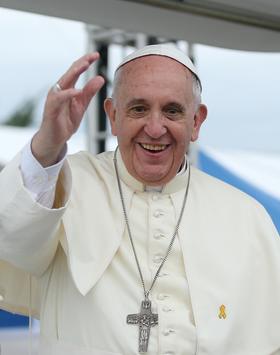
2013A smiling pope in white waves with his right hand
Magisterium

Judaism is not a foreign religion to the Church

Pope Francis Apostolic Exhortation Evangelii Gaudium, 24 November 2013, nos. 247 and 249

“We hold the Jewish people in special regard because their covenant with God has never been revoked, for “the gifts and the call of God are irrevocable” (Rom 11:29). The Church, which shares with Jews an important part of the sacred Scriptures, looks upon the people of the covenant and their faith as one of the sacred roots of her own Christian identity (cf. Rom 11:16-18). As Christians, we cannot consider Judaism as a foreign religion; nor do we include the Jews among those called to turn from idols and to serve the true God (cf. 1 Thes 1:9). … While it is true that certain Christian beliefs are unacceptable to Judaism, and that the Church cannot refrain from proclaiming Jesus as Lord and Messiah, there exists as well a rich complementarity which allows us to read the texts of the Hebrew Scriptures together and to help one another to mine the riches of God’s word.”

Read it in the source: vatican.va

Related timelines

Islam and the ChurchIslam began in Arabia in the seventh century, among peoples who knew Jews and Christians. Its calendar counts from 622, when Muhammad moved from Mecca to Medina. This timeline sets side by side what the Church already held about the Son of God and about revelation, what Muslim texts say about God, Jesus, Muhammad and the earlier Scriptures, and how Christians and Muslims have met, fought and spoken to each other since. The two sides agree that God is one and that Jesus is a figure of great importance. They differ on whether Jesus is the Son of God, on whether he died on the cross, and on whether revelation was completed in Christ. The Church holds that it was. The record also shows violence and contempt on the Christian side, and the Church's own later words about them. Muslim texts are quoted from the pages of the Fordham Sourcebooks, which carry only a few of them.25 quotations, from the Old Testament to 4 Feb. 2019The Church and the Jewish peopleFor many centuries Christians, among them Fathers, councils and popes, spoke of the Jews with contempt and placed them under laws that set them apart: a distinguishing dress, exclusion from public office, forced attendance at sermons, separate quarters. Popes also forbade forced baptism and rejected the charge of ritual murder. This timeline gives those texts in their own words, in date order, and then the Church's own later judgment on that history and her requests for forgiveness.19 quotations, from the Old Testament to 2010Islam and the one God“The Catholic Church teaches that Islam and Christianity have the same God. But Islam denies that Jesus is the Son of God, and Scripture says that no one who denies the Son has the Father.”17 quotations, from the Old Testament to 2000Other religions“The Catholic Church now teaches that all religions are paths to God. Jesus said that he is the way, and that no one comes to the Father except through him.”20 quotations, from the Old Testament to 2024The life of Jesus Christ: the record inside and outside the BibleJesus of Nazareth lived in Galilee and Judea and was crucified under Pontius Pilate about AD 30. This timeline sets out the record of his life, death and resurrection in date order. It begins with the Gospels and the letters of the apostles. Some of these writers say they saw him themselves. Luke says he wrote down what eyewitnesses had handed on, and an early report says Mark wrote down the preaching of Peter. It goes on to Roman, Jewish and Greek writers who were not Christians, and to the first Christian writers after the apostles. It goes on to what the Church says about the Gospels as history and what she confesses about him today, that he is one divine person, true God and true man, and ends with the Shroud of Turin, the linen cloth that is still being studied.53 quotations, from the Old Testament to 2010Violence in the Church's history“The Catholic Church has murdered more people than any other institution in the history of the world. A church with that much blood on its hands cannot be the Church of Christ.”19 quotations, from the Old Testament to 2018