Tradition Timeline Leave an objection

Start page / Scandals

The Church and the Jewish people

Each mark is one quotation. Touch the timeline to read it.
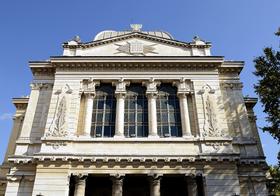
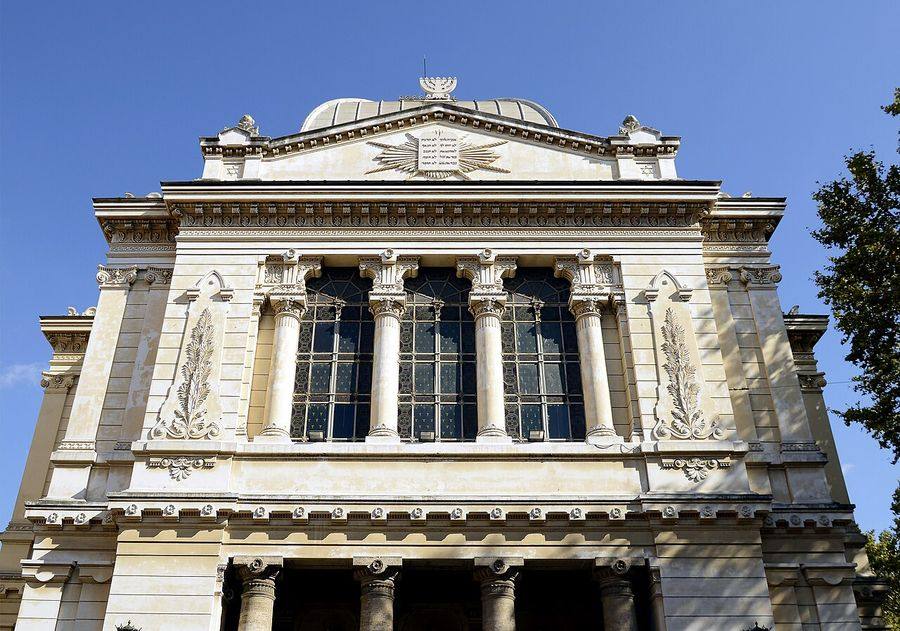
The stone front of a large synagogue with columns and tall windows against a blue sky
The Great Synagogue of Rome, where St. John Paul II in 1986 and Benedict XVI in 2010 came to meet the Jewish community of the city. Photo: Livioandronico2013, 2014, CC BY-SA 4.0, via Wikimedia Commons. Resized.

For many centuries Christians, among them Fathers, councils and popes, spoke of the Jews with contempt and placed them under laws that set them apart: a distinguishing dress, exclusion from public office, forced attendance at sermons, separate quarters. Popes also forbade forced baptism and rejected the charge of ritual murder. This timeline gives those texts in their own words, in date order, and then the Church's own later judgment on that history and her requests for forgiveness.

Where it starts with Jesus

Jesus was a Jew, and he tells the Samaritan woman that salvation is from the Jews.

“You worship what you do not know; we worship what we know, for salvation is from the Jews.”

JesusJohn 4:22Read it in the source: Bible Gateway, RSV Catholic Edition

How it points to Jesus

The contempt and the laws recorded on this timeline were turned against the people Jesus belonged to, as did his mother and his apostles. They are measured against him. When the Second Vatican Council spoke of the Jewish people, it recalled that Christ, his mother and the apostles came from them.

Drafted from primary sources. Every quotation is checked against the page it links to. The hostile passages are quoted as part of the record and are not the teaching of the Church today. This is a selection and not a full history. Paul IV's bull of 1555 that set up the Roman ghetto and the 1998 document We Remember are not quoted, because no approved page carrying their text could be found.

19 quotations in date order

A work in progress. The quotations below are not all the evidence on this matter. More are being added.

The Old Testamentbefore Christ
Old Testament
Scripture

The call of Abram: a blessing for all the families of the earth

The Book of Genesis Genesis 12:1-3

“Now the Lord said to Abram, “Go from your country and your kindred and your father’s house to the land that I will show you. And I will make of you a great nation, and I will bless you, and make your name great, so that you will be a blessing. I will bless those who bless you, and him who curses you I will curse; and by you all the families of the earth shall bless themselves.””
Read it in the source: Bible Gateway, RSV Catholic Edition

Old Testament
Scripture

Israel chosen as God's own people

The Book of Deuteronomy Deuteronomy 7:6-8

“For you are a people holy to the Lord your God; the Lord your God has chosen you to be a people for his own possession, out of all the peoples that are on the face of the earth. It was not because you were more in number than any other people that the Lord set his love upon you and chose you, for you were the fewest of all peoples; but it is because the Lord loves you, and is keeping the oath which he swore to your fathers.”

Read it in the source: Bible Gateway, RSV Catholic Edition

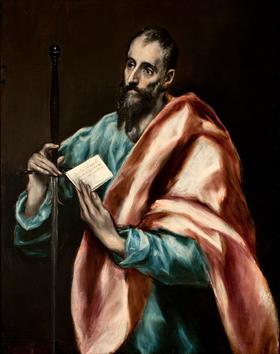
c. 55A bald, bearded apostle in a red cloak over a blue tunic, holding a folded letter in one hand and resting the other on a long sword
Scripture

St. Paul: the nations blessed with Abraham

St. Paul Galatians 3:7-9

“So you see that it is men of faith who are the sons of Abraham. And the scripture, foreseeing that God would justify the Gentiles by faith, preached the gospel beforehand to Abraham, saying, “In you shall all the nations be blessed.” So then, those who are men of faith are blessed with Abraham who had faith.”

Read it in the source: Bible Gateway, RSV Catholic Edition

c. 57
Scripture

St. Paul: God has not rejected his people

St. Paul Romans 11:1-2, 28-29

“I ask, then, has God rejected his people? By no means! I myself am an Israelite, a descendant of Abraham, a member of the tribe of Benjamin. God has not rejected his people whom he foreknew. … As regards the gospel they are enemies of God, for your sake; but as regards election they are beloved for the sake of their forefathers. For the gifts and the call of God are irrevocable.”

Read it in the source: Bible Gateway, RSV Catholic Edition

c. 386A gold mosaic of a bishop in white vestments marked with crosses, holding a book, with his name in Greek letters on either side
Church Father

St. John Chrysostom preaches against the Jews at Antioch

St. John Chrysostom Against the Jews, Homily 1, III, 1

“Many, I know, respect the Jews and think that their present way of life is a venerable one. This is why I hasten to uproot and tear out this deadly opinion. … But the synagogue is not only a brothel and a theater; it also is a den of robbers and a lodging for wild beasts. … But when God forsakes a people, what hope of salvation is left? When God forsakes a place, that place becomes the dwelling of demons.”

Read it in the source: tertullian.org

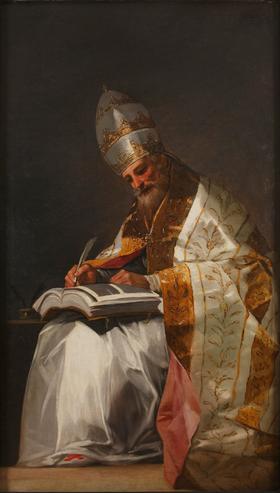
591A pope in a tiara and a pale cope bends over a large book, writing
Church Father

St. Gregory the Great forbids baptism by force

Pope St. Gregory the Great Registrum Epistolarum, Book 1, Letter 47, to Virgilius of Arles and Theodorus of Marseilles

“Very many, though indeed of the Jewish religion, resident in this province, and from time to time travelling for various matters of business to the regions of Massilia, have apprized us, that many of the Jews settled in those parts have been brought to the font of baptism more by force than by preaching. … For, when any one is brought to the font of baptism, not by the sweetness of preaching, but by compulsion, he returns to his former superstition, and dies the worse from having been born again.”

Read it in the source: New Advent

The Middle Ages800 to 1500
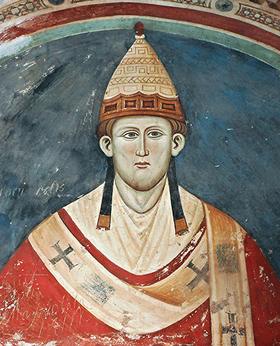
1215A medieval wall painting of a young beardless pope in a tall pointed tiara and a pallium marked with crosses
Council

Fourth Lateran Council: Jews to be marked out by their dress

Fourth Lateran Council Constitution 68, Jews appearing in public

“In order that the offence of such a damnable mixing may not spread further, under the excuse of a mistake of this kind, we decree that such persons of either sex, in every christian province and at all times, are to be distinguished in public from other people by the character of their dress … They shall not appear in public at all on the days of lamentation and on passion Sunday”

Read it in the source: Papal Encyclicals Online

1215
Council

Fourth Lateran Council: Jews barred from public office

Fourth Lateran Council Constitution 69, Jews not to hold public offices

“It would be too absurd for a blasphemer of Christ to exercise power over Christians. We therefore renew in this canon, on account of the boldness of the offenders, what the council of Toledo providently decreed in this matter : we forbid Jews to be appointed to public offices, since under cover of them they are very hostile to Christians.”

Read it in the source: Papal Encyclicals Online

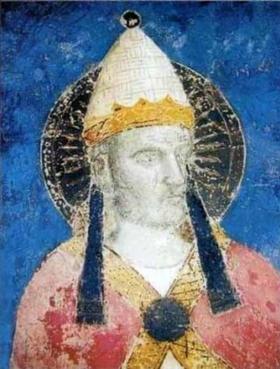
c. 1272A medieval wall painting of a pope's head in a tall white tiara with a jewelled band, against a blue ground
Magisterium

Gregory X rejects the charge of ritual murder

Pope Gregory X Letter on the Jews (issued between 1271 and 1276)

“And most falsely do these Christians claim that the Jews have secretly and furtively carried away these children and killed them, and that the Jews offer sacrifice from the heart and blood of these children, since their law in this matter precisely and expressly forbids Jews to sacrifice, eat, or drink the blood, or to eat the flesh of animals having claws. … We decree, therefore, that Christians need not be obeyed against Jews in a case or situation of this type, and we order that Jews seized under such a silly pretext be freed from imprisonment”

Read it in the source: Fordham Sourcebook

1434
Council

Council of Basel: forced sermons, distinguishing dress, separate quarters

Council of Basel Session 19, 7 September 1434, Decree on Jews and neophytes

“They should not be given other public offices, or admitted to any academic degrees, or allowed to have on lease lands or other ecclesiastical rents. … They are to be compelled, under severe penalties, to wear some garment whereby they can be clearly distinguished from Christians. In order to prevent too much intercourse, they should be made to dwell in areas, in the cities and towns, which are apart from the dwellings of Christians and as far distant as possible from churches.”

Read it in the source: Papal Encyclicals Online

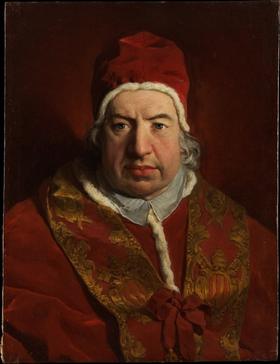
1751A pope in a red fur-lined cap and cape and a gold embroidered stole
Magisterium

Benedict XIV tells the Polish bishops to enforce the old restrictions

Pope Benedict XIV Encyclical A quo primum, 14 June 1751, no. 5

“In this matter, as in all others, We adopt the same norm of action as did the Roman Pontiffs who were Our venerable predecessors. … The same Pope [Innocent III] stated that it was fitting for Jews to serve Christians rather than vice versa and added: “Let not the sons of the free woman be servants of the sons of the handmaid; but as servants rejected by their lord for whose death they evilly conspired, let them realize that the result of this deed is to make them servants of those whom Christ’s death made free,” as we read in his decretal Etsi Judaeos.”

Read it in the source: Papal Encyclicals Online

The Modern Era1800 to today
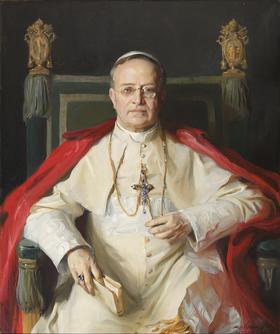
1937A pope in round spectacles sits in a red-backed chair, in a white cassock and a red cape, holding a small book
Magisterium

Pius XI condemns the idolatry of race

Pope Pius XI Encyclical Mit brennender Sorge, 14 March 1937, no. 8

“Whoever exalts race, or the people, or the State, or a particular form of State, or the depositories of power, or any other fundamental value of the human community - however necessary and honorable be their function in worldly things - whoever raises these notions above their standard value and divinizes them to an idolatrous level, distorts and perverts an order of the world planned and created by God; he is far from the true faith in God and from the concept of life which that faith upholds.”

Read it in the source: vatican.va

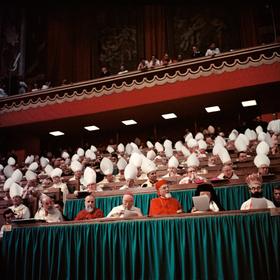
1965Rows of bishops in white mitres and copes sit in tiered stands hung with red and green cloth
Council

Second Vatican Council: Nostra Aetate

Second Vatican Council Declaration Nostra Aetate, 28 October 1965, no. 4

“True, the Jewish authorities and those who followed their lead pressed for the death of Christ; still, what happened in His passion cannot be charged against all the Jews, without distinction, then alive, nor against the Jews of today. Although the Church is the new people of God, the Jews should not be presented as rejected or accursed by God, as if this followed from the Holy Scriptures. … Furthermore, in her rejection of every persecution against any man, the Church, mindful of the patrimony she shares with the Jews and moved not by political reasons but by the Gospel's spiritual love, decries hatred, persecutions, displays of anti-Semitism, directed against Jews at any time and by anyone.”

Read it in the source: vatican.va

1986The stone front of a large synagogue with columns and tall windows against a blue sky
Magisterium

John Paul II at the Great Synagogue of Rome

Pope St. John Paul II Address at the Synagogue of Rome, 13 April 1986

“Nevertheless, a consideration of centuries-long cultural conditioning could not prevent us from recognizing that the acts of discrimination, unjustified limitation of religious freedom, oppression also on the level of civil freedom in regard to the Jews were, from an objective point of view, gravely deplorable manifestations. Yes, once again, through myself, the Church, in the words of the well-known Declaration Nostra Aetate (No. 4), «deplores the hatred, persecutions, and displays of anti-Semitism directed against the Jews at any time and by anyone"; I repeat: "by anyone».”

Read it in the source: vatican.va

1992
Magisterium

The Catechism: the Jews are not collectively guilty of the death of Jesus

Catechism of the Catholic Church CCC 597

“Hence we cannot lay responsibility for the trial on the Jews in Jerusalem as a whole, despite the outcry of a manipulated crowd and the global reproaches contained in the apostles' calls to conversion after Pentecost. … Still less can we extend responsibility to other Jews of different times and places, based merely on the crowd's cry: "His blood be on us and on our children!", a formula for ratifying a judicial sentence.”

Read it in the source: vatican.va

1992
Magisterium

The Catechism: sinners were the authors of Christ's Passion

Catechism of the Catholic Church CCC 598

“Taking into account the fact that our sins affect Christ himself, The Church does not hesitate to impute to Christians the gravest responsibility for the torments inflicted upon Jesus, a responsibility with which they have all too often burdened the Jews alone”

Read it in the source: vatican.va

2000
Magisterium

Memory and Reconciliation: Christians and the Shoah

International Theological Commission Memory and Reconciliation: The Church and the Faults of the Past, 5.4, quoting the Commission for Religious Relations with the Jews, We Remember: A Reflection on the Shoah (1998)

“The Shoah was certainly the result of the pagan ideology that was Nazism, animated by a merciless anti-Semitism that not only despised the faith of the Jewish people, but also denied their very human dignity. Nevertheless, “it may be asked whether the Nazi persecution of the Jews was not made easier by the anti-Jewish prejudices imbedded in some Christian minds and hearts... Did Christians give every possible assistance to those being persecuted, and in particular to the persecuted Jews?” There is no doubt that there were many Christians who risked their lives to save and to help their Jewish neighbors. It seems, however, also true that “alongside such courageous men and women, the spiritual resistance and concrete action of other Christians was not that which might have been expected from Christ’s followers.””

Read it in the source: vatican.va

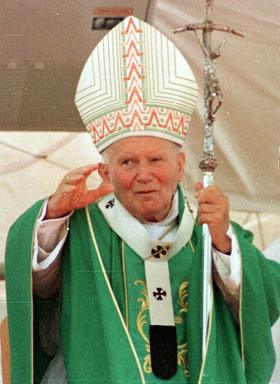
2000An elderly pope in green vestments and a white and gold mitre raises his hand in greeting, holding his staff with the crucifix
Liturgy

The Day of Pardon: confession of sins against the people of Israel

Pope St. John Paul II and a representative of the Roman Curia Universal Prayer, Confession of Sins and Asking for Forgiveness, IV, St. Peter's Basilica, 12 March 2000

“Let us pray that, in recalling the sufferings endured by the people of Israel throughout history, Christians will acknowledge the sins committed by not a few of their number against the people of the Covenant and the blessings, and in this way will purify their hearts. … God of our fathers, you chose Abraham and his descendants to bring your Name to the Nations: we are deeply saddened by the behaviour of those who in the course of history have caused these children of yours to suffer, and asking your forgiveness we wish to commit ourselves to genuine brotherhood with the people of the Covenant.”

Read it in the source: vatican.va

2010The stone front of a large synagogue with columns and tall windows against a blue sky
Magisterium

Benedict XVI at the Great Synagogue of Rome

Pope Benedict XVI Address at the Synagogue of Rome, 17 January 2010, no. 3

“The extermination of the people of the Covenant of Moses, at first announced, then systematically programmed and put into practice in Europe under the Nazi regime, on that day tragically reached as far as Rome. Unfortunately, many remained indifferent, but many, including Italian Catholics, sustained by their faith and by Christian teaching, reacted with courage, often at risk of their lives, opening their arms to assist the Jewish fugitives who were being hunted down, and earning perennial gratitude. The Apostolic See itself provided assistance, often in a hidden and discreet way.”

Read it in the source: vatican.va

Related timelines

Judaism and the ChurchThe Church came out of Israel. Jesus and his apostles were Jews, and the Scriptures and promises she reads are Israel's. This timeline follows how the Church and the synagogue went separate ways in the first and second centuries, over three questions: whether Jesus is the Messiah and Son of God, whether Gentiles must keep the Law of Moses, and what the destruction of the Temple in AD 70 meant. It shows what Judaism teaches in the words of Jewish writers, and what the Church has said in reply and about the Jewish people, down to the Catechism and recent popes. Each side is quoted in its own words, in date order.24 quotations, from the Old Testament to 2013Violence in the Church's history“The Catholic Church has murdered more people than any other institution in the history of the world. A church with that much blood on its hands cannot be the Church of Christ.”19 quotations, from the Old Testament to 2018Other religions“The Catholic Church now teaches that all religions are paths to God. Jesus said that he is the way, and that no one comes to the Father except through him.”20 quotations, from the Old Testament to 2024The Inquisition and the use of force against heresyEarly Christian writers said that religion cannot be forced. From the fourth century bishops came to accept the coercion of heretics by the state. In the Middle Ages councils and popes set up inquiries into heresy, handed the condemned to the secular power for punishment, and ordered rulers to force confessions. This timeline gives those texts in date order, and then the Church's later teaching on religious freedom and her requests for pardon.18 quotations, from the Old Testament to 2004Islam and the one God“The Catholic Church teaches that Islam and Christianity have the same God. But Islam denies that Jesus is the Son of God, and Scripture says that no one who denies the Son has the Father.”17 quotations, from the Old Testament to 2000No salvation outside the Church“The Catholic Church teaches "outside the Church there is no salvation", so it says Protestants and everyone else are damned. Either that is arrogant and false, or the Church has since reversed itself, which shows it is not infallible.”19 quotations, from the Old Testament to 1992