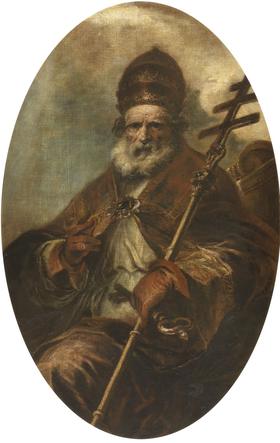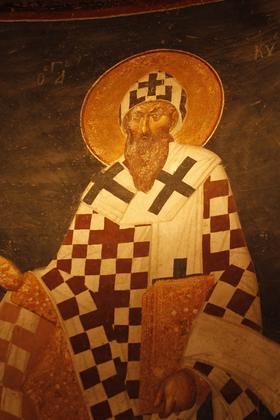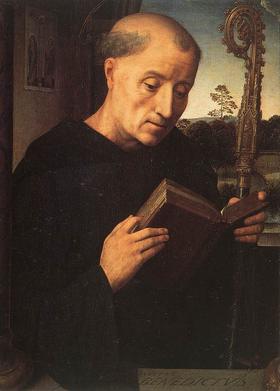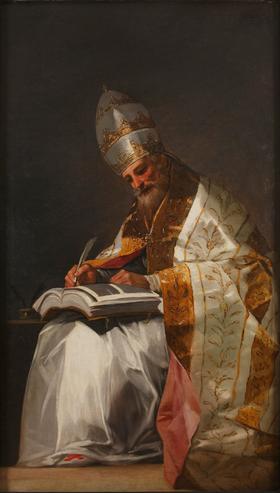
Tradition Timeline Leave an objection

Start page / Kinds of source

The Church Fathers

All 371 quotations on this site filed under “Church Father”, from every timeline, in date order.

Each mark is one quotation. Touch the timeline to read it.

Why the Church Fathers matter

The Church Fathers are the bishops and teachers of the first centuries after the apostles. The earliest of them were taught by the apostles or by men who had known them. Their writings show what the churches believed and how they read the Scriptures in the centuries just after the New Testament was written.

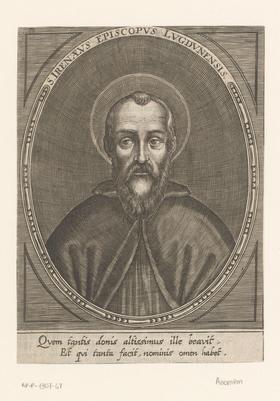
  1. An engraved oval portrait of a bearded bishop with a halo, with a Latin inscription around the frame

    Irenaeus, writing about 180, had as a boy seen Polycarp, who was taught by apostles.

    “But Polycarp also was not only instructed by apostles, and conversed with many who had seen Christ, but was also, by apostles in Asia, appointed bishop of the Church in Smyrna, whom I also saw in my early youth”

    St. Irenaeus of LyonsAgainst Heresies 3.3.4, c. 180Read it in the source: New Advent

  2. Christians who read the same Scriptures did not all read them alike. In 434 Vincent of Lerins gives this as the reason the Church's reading of them is needed.

    “But here some one perhaps will ask, Since the canon of Scripture is complete, and sufficient of itself for everything, and more than sufficient, what need is there to join with it the authority of the Church's interpretation? For this reason — because, owing to the depth of Holy Scripture, all do not accept it in one and the same sense, but one understands its words in one way, another in another; so that it seems to be capable of as many interpretations as there are interpreters.”

    St. Vincent of LerinsCommonitory, ch. 2, 5, 434Read it in the source: New Advent

When a Catholic teaching is said to be a late invention, the Fathers are the place to look. The Church does not hold that any one Father was free from error. Their witness weighs most where many of them, in different places and times, say the same thing. On this site the row runs to St. John Damascene, who died about 749.

Were Catholic teachings invented later?: all 17 quotations

371 quotations in date order

A work in progress. The quotations below are not all the evidence on this matter. More are being added.

c. 68
Church Father

Linus, the first after Peter

Eusebius of Caesarea Church History 3.2 (written c. 313-324)

“After the martyrdom of Paul and of Peter, Linus was the first to obtain the episcopate of the church at Rome. Paul mentions him, when writing to Timothy from Rome, in the salutation at the end of the epistle.”

Read it in the source: New Advent

See it on the timeline: All the popes in order, from St. Peter to today
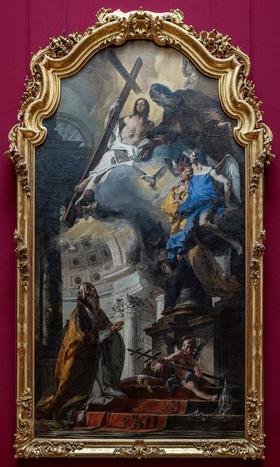
c. 96A painting in a gilded frame of an old pope kneeling on steps as the Father and the Son appear above him among angels
Church Father
St. Clement of Rome Letter to the Corinthians, ch. 55

“The blessed Judith, when her city was besieged, asked of the elders permission to go forth into the camp of the strangers; and, exposing herself to danger, she went out for the love which she bare to her country and people then besieged; and the Lord delivered Holofernes into the hands of a woman. [Judith 8:30] Esther also, being perfect in faith, exposed herself to no less danger, in order to deliver the twelve tribes of Israel from impending destruction.”

Read it in the source: New Advent

See it on the timeline: The Old Testament canon

c. 96
Church Father
St. Clement of Rome Letter to the Corinthians, ch. 42

“Christ therefore was sent forth by God, and the apostles by Christ. … And thus preaching through countries and cities, they appointed the first fruits [of their labours], having first proved them by the Spirit, to be bishops and deacons of those who should afterwards believe.”

Read it in the source: New Advent

See it on the timeline: Apostolic succession

c. 96
Church Father
St. Clement of Rome Letter to the Corinthians, ch. 5

“Let us set before our eyes the illustrious apostles. Peter, through unrighteous envy, endured not one or two, but numerous labours; and when he had at length suffered martyrdom, departed to the place of glory due to him.”

Read it in the source: New Advent

See it on the timeline: The office of Peter

c. 96
Church Father
St. Clement of Rome Letter to the Corinthians, ch. 59

“If, however, any shall disobey the words spoken by Him through us, let them know that they will involve themselves in transgression and serious danger”

Read it in the source: New Advent

See it on the timeline: Papal supremacy

c. 96
Church Father
St. Clement of Rome Letter to the Corinthians, ch. 40

“For his own peculiar services are assigned to the high priest, and their own proper place is prescribed to the priests, and their own special ministrations devolve on the Levites. The layman is bound by the laws that pertain to laymen.”

Read it in the source: New Advent

See it on the timeline: The ordained priesthood

c. 96
Church Father
St. Clement of Rome Letter to the Corinthians, ch. 40

“He has enjoined offerings [to be presented] and service to be performed [to Him], and that not thoughtlessly or irregularly, but at the appointed times and hours. Where and by whom He desires these things to be done, He Himself has fixed by His own supreme will, in order that all things, being piously done according to His good pleasure, may be acceptable unto Him.”

Read it in the source: New Advent

See it on the timeline: The priest and the Eucharist

c. 96
Church Father
St. Clement of Rome Letter to the Corinthians, ch. 32

“And we, too, being called by His will in Christ Jesus, are not justified by ourselves, nor by our own wisdom, or understanding, or godliness, or works which we have wrought in holiness of heart; but by that faith through which, from the beginning, Almighty God has justified all men;”

Read it in the source: New Advent

See it on the timeline: Faith and works

c. 96
Church Father
St. Clement of Rome Letter to the Corinthians, ch. 33

“What shall we do, then, brethren? Shall we become slothful in well-doing, and cease from the practice of love? God forbid that any such course should be followed by us! But rather let us hasten with all energy and readiness of mind to perform every good work.”

Read it in the source: New Advent

See it on the timeline: Faith and works

c. AD 96
Church Father

The church of Rome on the apostles

St. Clement of Rome Letter to the Corinthians, ch. 42

“Having therefore received their orders, and being fully assured by the resurrection of our Lord Jesus Christ, and established in the word of God, with full assurance of the Holy Ghost, they went forth proclaiming that the kingdom of God was at hand.”

Read it in the source: New Advent

See it on the timeline: The life of Jesus Christ: the record inside and outside the Bible

c. 96
Church Father

The church of Rome writes to settle a dispute in Corinth

St. Clement of Rome Letter to the Corinthians, ch. 59

“If, however, any shall disobey the words spoken by Him through us, let them know that they will involve themselves in transgression and serious danger”

Read it in the source: New Advent

See it on the timeline: The tradition of the papacy

c. 96
Church Father

The apostles provide for their successors

St. Clement of Rome Letter to the Corinthians, ch. 44

“Our apostles also knew, through our Lord Jesus Christ, that there would be strife on account of the office of the episcopate. For this reason, therefore, inasmuch as they had obtained a perfect fore-knowledge of this, they appointed those [ministers] already mentioned, and afterwards gave instructions, that when these should fall asleep, other approved men should succeed them in their ministry.”

Read it in the source: New Advent

See it on the timeline: All the popes in order, from St. Peter to today
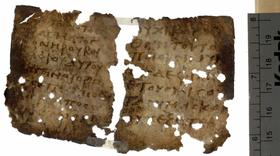
c. 96
Church Father
St. Clement of Rome Letter to the Corinthians, ch. 44

“Our apostles also knew, through our Lord Jesus Christ, that there would be strife on account of the office of the episcopate. For this reason, therefore, inasmuch as they had obtained a perfect fore-knowledge of this, they appointed those [ministers] already mentioned, and afterwards gave instructions, that when these should fall asleep, other approved men should succeed them in their ministry.”

Read it in the source: New Advent

See it on the timeline: Apostolic succession

c. 96
Church Father
St. Clement of Rome Letter to the Corinthians, ch. 44

“Our apostles also knew, through our Lord Jesus Christ, that there would be strife on account of the office of the episcopate. For this reason, therefore, inasmuch as they had obtained a perfect fore-knowledge of this, they appointed those [ministers] already mentioned, and afterwards gave instructions, that when these should fall asleep, other approved men should succeed them in their ministry.”

Read it in the source: New Advent

See it on the timeline: The office of Peter

c. 96
Church Father
St. Clement of Rome Letter to the Corinthians, ch. 43

“Men and brethren, the tribe whose rod shall blossom has God chosen to fulfil the office of the priesthood, and to minister unto Him. … And the rod of Aaron was found not only to have blossomed, but to bear fruit upon it.”

Read it in the source: New Advent

See it on the timeline: The priest and the Eucharist

c. 70-120Two small torn leaves of brown parchment covered with Greek writing, beside a ruler
Church Father
The Didache Didache, ch. 14

“But every Lord's day gather yourselves together, and break bread, and give thanksgiving after having confessed your transgressions, that your sacrifice may be pure. … For this is that which was spoken by the Lord: In every place and time offer to me a pure sacrifice; for I am a great King, says the Lord, and my name is wonderful among the nations.”

Read it in the source: New Advent

See it on the timeline: The Mass as sacrifice

c. 100
Church Father
The Didache Didache, ch. 14

“But every Lord's day gather yourselves together, and break bread, and give thanksgiving after having confessed your transgressions, that your sacrifice may be pure.”

Read it in the source: New Advent

See it on the timeline: The priest and the Eucharist

c. 100
Church Father
The Didache Didache, ch. 4

“In the church you shall acknowledge your transgressions, and you shall not come near for your prayer with an evil conscience.”

Read it in the source: New Advent

See it on the timeline: Confession to a priest

c. 70-120
Church Father
The Didache Didache, ch. 16

“But often shall you come together, seeking the things which are befitting to your souls: for the whole time of your faith will not profit you, if you be not made perfect in the last time.”

Read it in the source: New Advent

See it on the timeline: Eternal security

c. 100
Church Father
The Didache Didache, ch. 7

“And concerning baptism, baptize this way: Having first said all these things, baptize into the name of the Father, and of the Son, and of the Holy Spirit, … in living water. But if you have not living water, baptize into other water; and if you can not in cold, in warm. But if you have not either, pour out water thrice upon the head into the name of Father and Son and Holy Spirit.”

Read it in the source: New Advent

See it on the timeline: Baptism by pouring

c. 100
Church Father
The Didache Didache, ch. 2

“you shall not murder a child by abortion nor kill that which is begotten.”

Read it in the source: New Advent

See it on the timeline: Abortion

c. 107A manuscript painting on a gold ground of clergy carrying a casket towards a church building
Church Father
St. Ignatius of Antioch Letter to the Smyrnaeans, ch. 7

“They abstain from the Eucharist and from prayer, because they confess not the Eucharist to be the flesh of our Saviour Jesus Christ, which suffered for our sins, and which the Father, of His goodness, raised up again.”

Read it in the source: New Advent

See it on the timeline: The Real Presence

c. 107
Church Father
St. Ignatius of Antioch Letter to the Ephesians, ch. 5

“Let no man deceive himself: if any one be not within the altar, he is deprived of the bread of God. … He, therefore, that does not assemble with the Church, has even by this manifested his pride, and condemned himself.”

Read it in the source: New Advent

See it on the timeline: The Sunday Mass obligation

c. 107
Church Father
St. Ignatius of Antioch Letter to the Ephesians, ch. 6

“For we ought to receive every one whom the Master of the house sends to be over His household, [Matthew 24:45] as we would do Him that sent him. It is manifest, therefore, that we should look upon the bishop even as we would upon the Lord Himself.”

Read it in the source: New Advent

See it on the timeline: The Magisterium

c. 107
Church Father
St. Ignatius of Antioch Letter to the Romans, greeting

“…the Church which is beloved and enlightened by the will of Him that wills all things which are according to the love of Jesus Christ our God, which also presides in the place of the region of the Romans, worthy of God, worthy of honour, … and which presides over love, is named from Christ, and from the Father”

Read it in the source: New Advent

See it on the timeline: Papal supremacy

c. 107
Church Father
St. Ignatius of Antioch Letter to the Smyrnaeans, ch. 8

“Wherever the bishop shall appear, there let the multitude [of the people] also be; even as, wherever Jesus Christ is, there is the Catholic Church.”

Read it in the source: New Advent

See it on the timeline: Constantine and the Church

c. 107
Church Father
St. Ignatius of Antioch Letter to the Romans, ch. 3

“Only request in my behalf both inward and outward strength, that I may not only speak, but [truly] will; and that I may not merely be called a Christian, but really be found to be one. … For our God, Jesus Christ, now that He is with the Father, is all the more revealed [in His glory].”

Read it in the source: New Advent

See it on the timeline: Are Catholics Christians?

c. 107
Church Father
St. Ignatius of Antioch Letter to the Philadelphians, ch. 3

“For as many as are of God and of Jesus Christ are also with the bishop. And as many as shall, in the exercise of repentance, return into the unity of the Church, these, too, shall belong to God, that they may live according to Jesus Christ. Do not err, my brethren. If any man follows him that makes a schism in the Church, he shall not inherit the kingdom of God.”

Read it in the source: New Advent

See it on the timeline: The one Church

c. 107
Church Father
St. Ignatius of Antioch Letter to the Trallians, ch. 3

“In like manner, let all reverence the deacons as an appointment of Jesus Christ, and the bishop as Jesus Christ, who is the Son of the Father, and the presbyters as the sanhedrim of God, and assembly of the apostles. Apart from these, there is no Church.”

Read it in the source: New Advent

See it on the timeline: Was the Church corrupted early?

c. 107
Church Father
St. Ignatius of Antioch Letter to the Philadelphians, ch. 3

“And as many as shall, in the exercise of repentance, return into the unity of the Church, these, too, shall belong to God, that they may live according to Jesus Christ. Do not err, my brethren. If any man follows him that makes a schism in the Church, he shall not inherit the kingdom of God.”

Read it in the source: New Advent

See it on the timeline: No salvation outside the Church

c. 107
Church Father
St. Ignatius of Antioch Letter to the Trallians, ch. 3

“In like manner, let all reverence the deacons as an appointment of Jesus Christ, and the bishop as Jesus Christ, who is the Son of the Father, and the presbyters as the sanhedrim of God, and assembly of the apostles. Apart from these, there is no Church.”

Read it in the source: New Advent

See it on the timeline: The ordained priesthood

c. 107
Church Father
St. Ignatius of Antioch Letter to the Smyrnaeans, ch. 8

“Let no man do anything connected with the Church without the bishop. Let that be deemed a proper Eucharist, which is [administered] either by the bishop, or by one to whom he has entrusted it.”

Read it in the source: New Advent

See it on the timeline: The priest and the Eucharist

c. AD 107
Church Father

A bishop on his way to martyrdom: "truly born, truly crucified"

St. Ignatius of Antioch Letter to the Trallians, ch. 9

“Stop your ears, therefore, when any one speaks to you at variance with Jesus Christ, who was descended from David, and was also of Mary; who was truly born, and ate and drank. He was truly persecuted under Pontius Pilate; He was truly crucified, and [truly] died, in the sight of beings in heaven, and on earth, and under the earth. He was also truly raised from the dead,”

Read it in the source: New Advent

See it on the timeline: The life of Jesus Christ: the record inside and outside the Bible

c. 107
Church Father

Peter and Paul gave commands to the Romans

St. Ignatius of Antioch Letter to the Romans, ch. 4

“I do not, as Peter and Paul, issue commandments unto you. They were apostles; I am but a condemned man”

Read it in the source: New Advent

See it on the timeline: The tradition of the papacy

c. 107
Church Father
St. Ignatius of Antioch Letter to the Ephesians, ch. 20

“so that you obey the bishop and the presbytery with an undivided mind, breaking one and the same bread, which is the medicine of immortality, and the antidote to prevent us from dying, but [which causes] that we should live for ever in Jesus Christ.”

Read it in the source: New Advent

See it on the timeline: The Eucharist

c. 107
Church Father
St. Ignatius of Antioch Letter to the Magnesians, ch. 6

“I exhort you to study to do all things with a divine harmony, while your bishop presides in the place of God, and your presbyters in the place of the assembly of the apostles, along with your deacons, who are most dear to me, and are entrusted with the ministry of Jesus Christ”

Read it in the source: New Advent

See it on the timeline: Holy Orders

c. 107
Church Father
St. Ignatius of Antioch Letter to Polycarp, ch. 5

“But it becomes both men and women who marry, to form their union with the approval of the bishop, that their marriage may be according to God, and not after their own lust.”

Read it in the source: New Advent

See it on the timeline: Matrimony

c. 107
Church Father

A bishop writes to Gentile Christians about the Jewish law

St. Ignatius of Antioch Letter to the Magnesians, ch. 8

“For if we still live according to the Jewish law, we acknowledge that we have not received grace. For the divinest prophets lived according to Christ Jesus. On this account also they were persecuted, being inspired by His grace to fully convince the unbelieving that there is one God, who has manifested Himself by Jesus Christ His Son, who is His eternal Word, not proceeding forth from silence, and who in all things pleased Him that sent Him.”

Read it in the source: New Advent

See it on the timeline: Judaism and the Church

c. 107
Church Father
St. Ignatius of Antioch Letter to the Philadelphians, ch. 4

“Take heed, then, to have but one Eucharist. For there is one flesh of our Lord Jesus Christ, and one cup to [show forth ] the unity of His blood; one altar; as there is one bishop, along with the presbytery and deacons, my fellow-servants”

Read it in the source: New Advent

See it on the timeline: The Real Presence

c. 107
Church Father
St. Ignatius of Antioch Letter to the Magnesians, ch. 9

“If, therefore, those who were brought up in the ancient order of things have come to the possession of a new hope, no longer observing the Sabbath, but living in the observance of the Lord's Day, on which also our life has sprung up again by Him and by His death”

Read it in the source: New Advent

See it on the timeline: The Sunday Mass obligation

c. 110-135
Church Father
St. Polycarp of Smyrna Letter to the Philippians, ch. 10

“When you can do good, defer it not, because alms delivers from death.”

Read it in the source: New Advent

See it on the timeline: The Old Testament canon

c. 110-135
Church Father
St. Polycarp of Smyrna Letter to the Philippians 5

“For it is well that they should be cut off from the lusts that are in the world, since every lust wars against the spirit; [1 Peter 2:11] and neither fornicators, nor effeminate, nor abusers of themselves with mankind, shall inherit the kingdom of God”

Read it in the source: New Advent

See it on the timeline: Homosexuality

c. AD 110 to 130A bearded man with a halo leans on a stone window ledge with his hand to his cheek, a book beside him and a garland of fruit above
Church Father

How Mark's Gospel came from Peter's preaching

Papias of Hierapolis In Eusebius, Church History 3.39.15

“This also the presbyter said: Mark, having become the interpreter of Peter, wrote down accurately, though not in order, whatsoever he remembered of the things said or done by Christ. For he neither heard the Lord nor followed him, but afterward, as I said, he followed Peter, who adapted his teaching to the needs of his hearers, but with no intention of giving a connected account of the Lord's discourses, so that Mark committed no error while he thus wrote some things as he remembered them.”

Read it in the source: New Advent

See it on the timeline: The life of Jesus Christ: the record inside and outside the Bible

c. 110-130
Church Father
Papias of Hierapolis quoted in Eusebius, Church History 3.39.4

“If, then, any one came, who had been a follower of the elders, I questioned him in regard to the words of the elders — what Andrew or what Peter said, or what was said by Philip, or by Thomas, or by James, or by John, or by Matthew, or by any other of the disciples of the Lord … For I did not think that what was to be gotten from the books would profit me as much as what came from the living and abiding voice.”

Read it in the source: New Advent

See it on the timeline: Scripture and Tradition

c. AD 125
Church Father

"Some of them lived even to our day"

Quadratus Apology to the Emperor Hadrian, in Eusebius, Church History 4.3.2

“But the works of our Saviour were always present, for they were genuine:— those that were healed, and those that were raised from the dead, who were seen not only when they were healed and when they were raised, but were also always present; and not merely while the Saviour was on earth, but also after his death, they were alive for quite a while, so that some of them lived even to our day.”

Read it in the source: New Advent

See it on the timeline: The life of Jesus Christ: the record inside and outside the Bible

c. 140
Church Father
The Shepherd of Hermas The Shepherd, Book III, Similitude 9, ch. 16

“They were obliged, he answered, to ascend through water in order that they might be made alive; for, unless they laid aside the deadness of their life, they could not in any other way enter into the kingdom of God. … For, he continued, before a man bears the name of the Son of God he is dead; but when he receives the seal he lays aside his deadness, and obtains life. The seal, then, is the water: they descend into the water dead, and they arise alive.”

Read it in the source: New Advent

See it on the timeline: Baptism and salvation

c. 140-155
Church Father
Hermas The Shepherd, Commandment 4, ch. 3

“For to those who have been called before these days, the Lord has set repentance. For the Lord, knowing the heart, and foreknowing all things, knew the weakness of men and the manifold wiles of the devil … if any one is tempted by the devil, and sins after that great and holy calling in which the Lord has called His people to everlasting life, he has opportunity to repent but once. But if he should sin frequently after this, and then repent, to such a man his repentance will be of no avail”

Read it in the source: New Advent

See it on the timeline: Penance and Reconciliation

c. 155An engraving of an old man with a full beard in a cloak, with both hands raised as if explaining
Church Father
St. Justin Martyr Dialogue with Trypho, ch. 100

“For Eve, who was a virgin and undefiled, having conceived the word of the serpent, brought forth disobedience and death. But the Virgin Mary received faith and joy, when the angel Gabriel announced the good tidings to her.”

Read it in the source: New Advent

See it on the timeline: Honor given to Mary

c. 155
Church Father
St. Justin Martyr First Apology, ch. 66

“For not as common bread and common drink do we receive these; but in like manner as Jesus Christ our Saviour, having been made flesh by the Word of God, had both flesh and blood for our salvation, so likewise have we been taught that the food which is blessed by the prayer of His word, and from which our blood and flesh by transmutation are nourished, is the flesh and blood of that Jesus who was made flesh.”

Read it in the source: New Advent

See it on the timeline: The Real Presence

c. 155
Church Father
St. Justin Martyr Dialogue with Trypho, ch. 41

“He then speaks of those Gentiles, namely us, who in every place offer sacrifices to Him, i.e., the bread of the Eucharist, and also the cup of the Eucharist, affirming both that we glorify His name…”

Read it in the source: New Advent

See it on the timeline: The Mass as sacrifice

c. 155
Church Father
St. Justin Martyr First Apology, ch. 36

“But when you hear the utterances of the prophets spoken as it were personally, you must not suppose that they are spoken by the inspired themselves, but by the Divine Word who moves them. For sometimes He declares things that are to come to pass, in the manner of one who foretells the future; sometimes He speaks as from the person of God the Lord and Father of all; sometimes as from the person of Christ”

Read it in the source: New Advent

See it on the timeline: The inspiration of Scripture

c. 155
Church Father
The Church of Smyrna Martyrdom of Polycarp, ch. 16

“…this most admirable Polycarp was one, having in our own times been an apostolic and prophetic teacher, and bishop of the Catholic Church which is in Smyrna.”

Read it in the source: New Advent

See it on the timeline: Constantine and the Church

c. 155An engraving of an old man with a full beard in a cloak, with both hands raised as if explaining
Church Father
St. Justin Martyr First Apology, ch. 16

“And let those who are not found living as He taught, be understood to be no Christians, even though they profess with the lip the precepts of Christ; for not those who make profession, but those who do the works, shall be saved, according to His word: Not every one who says to Me, Lord, Lord, shall enter into the kingdom of heaven, but he that does the will of My Father which is in heaven.”

Read it in the source: New Advent

See it on the timeline: Are Catholics Christians?

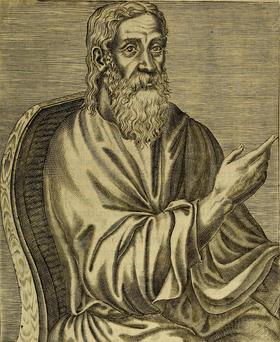
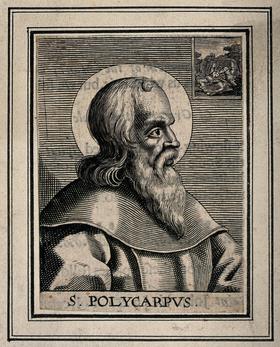
c. 155An engraved portrait in profile of an old man with a long beard and a halo, with the name S. Polycarpus beneath
Church Father
St. Polycarp of Smyrna, as recorded by the Church of Smyrna Martyrdom of Polycarp, ch. 9

“Then, the proconsul urging him, and saying, Swear, and I will set you at liberty, reproach Christ; Polycarp declared, Eighty and six years have I served Him, and He never did me any injury: how then can I blaspheme my King and my Saviour?”

Read it in the source: New Advent

See it on the timeline: Are Catholics Christians?

c. 155An engraving of an old man with a full beard in a cloak, with both hands raised as if explaining
Church Father
St. Justin Martyr First Apology, ch. 67

“…bread and wine and water are brought, and the president in like manner offers prayers and thanksgivings, according to his ability, and the people assent, saying Amen; and there is a distribution to each, and a participation of that over which thanks have been given, and to those who are absent a portion is sent by the deacons.”

Read it in the source: New Advent

See it on the timeline: The priest and the Eucharist

c. 155
Church Father
The Church of Smyrna Martyrdom of Polycarp, ch. 12

“…the whole multitude both of the heathen and Jews, who dwelt at Smyrna, cried out with uncontrollable fury, and in a loud voice, This is the teacher of Asia, the father of the Christians, and the overthrower of our gods”

Read it in the source: New Advent

See it on the timeline: Calling priests "Father"

c. 155An engraving of an old man with a full beard in a cloak, with both hands raised as if explaining
Church Father
St. Justin Martyr First Apology, ch. 61

“Then they are brought by us where there is water, and are regenerated in the same manner in which we were ourselves regenerated. For, in the name of God, the Father and Lord of the universe, and of our Saviour Jesus Christ, and of the Holy Spirit, they then receive the washing with water. For Christ also said, Unless you be born again, you shall not enter into the kingdom of heaven.”

Read it in the source: New Advent

See it on the timeline: Baptism and salvation

c. 155
Church Father
St. Justin Martyr Dialogue with Trypho, ch. 11

“Nor do we think that there is one God for us, another for you, but that He alone is God who led your fathers out from Egypt with a strong hand and a high arm. Nor have we trusted in any other (for there is no other), but in Him in whom you also have trusted, the God of Abraham, and of Isaac, and of Jacob.”

Read it in the source: New Advent

See it on the timeline: Islam and the one God

c. 155
Church Father
St. Justin Martyr Second Apology, ch. 13

“Whatever things were rightly said among all men, are the property of us Christians. … For all the writers were able to see realities darkly through the sowing of the implanted word that was in them. For the seed and imitation impacted according to capacity is one thing, and quite another is the thing itself”

Read it in the source: New Advent

See it on the timeline: Other religions

c. 155
Church Father
St. Justin Martyr First Apology, ch. 61

“As many as are persuaded and believe that what we teach and say is true, and undertake to be able to live accordingly, are instructed to pray and to entreat God with fasting, for the remission of their sins that are past, we praying and fasting with them.”

Read it in the source: New Advent

See it on the timeline: Baptism

c. 155
Church Father
St. Justin Martyr First Apology, ch. 66

“of which no one is allowed to partake but the man who believes that the things which we teach are true, and who has been washed with the washing that is for the remission of sins, and unto regeneration, and who is so living as Christ has enjoined.”

Read it in the source: New Advent

See it on the timeline: The Eucharist

c. 155
Church Father

A Jewish objection as St. Justin records it: Trypho on the Christians

St. Justin Martyr (reporting Trypho) Dialogue with Trypho, ch. 10

“Trypho: This is what we are amazed at, but those things about which the multitude speak are not worthy of belief; for they are most repugnant to human nature. Moreover, I am aware that your precepts in the so-called Gospel are so wonderful and so great, that I suspect no one can keep them; for I have carefully read them. But this is what we are most at a loss about: that you, professing to be pious, and supposing yourselves better than others, are not in any particular separated from them, and do not alter your mode of living from the nations, in that you observe no festivals or sabbaths, and do not have the rite of circumcision; and further, resting your hopes on a man that was crucified, you yet expect to obtain some good thing from God, while you do not obey His commandments.”

Read it in the source: New Advent

See it on the timeline: Judaism and the Church

c. 155
Church Father

Jewish believers who keep the Law, and Gentiles who do not

St. Justin Martyr Dialogue with Trypho, ch. 47

“But if some, through weak-mindedness, wish to observe such institutions as were given by Moses, from which they expect some virtue, but which we believe were appointed by reason of the hardness of the people's hearts, along with their hope in this Christ, and [wish to perform] the eternal and natural acts of righteousness and piety, yet choose to live with the Christians and the faithful, as I said before, not inducing them either to be circumcised like themselves, or to keep the Sabbath, or to observe any other such ceremonies, then I hold that we ought to join ourselves to such, and associate with them in all things as kinsmen and brethren.”

Read it in the source: New Advent

See it on the timeline: Judaism and the Church

c. AD 160
Church Father

Opponents still say the disciples stole the body

St. Justin Martyr Dialogue with Trypho, ch. 108

“you have sent chosen and ordained men throughout all the world to proclaim that a godless and lawless heresy had sprung from one Jesus, a Galilæan deceiver, whom we crucified, but his disciples stole him by night from the tomb, where he was laid when unfastened from the cross, and now deceive men by asserting that he has risen from the dead and ascended to heaven.”

Read it in the source: New Advent

See it on the timeline: The life of Jesus Christ: the record inside and outside the Bible

c. 170
Church Father

Dionysius of Corinth: Peter and Paul taught in Italy and died as martyrs

Dionysius of Corinth, in Eusebius Church History 2.25.8

“You have thus by such an admonition bound together the planting of Peter and of Paul at Rome and Corinth. For both of them planted and likewise taught us in our Corinth. And they taught together in like manner in Italy, and suffered martyrdom at the same time.”

Read it in the source: New Advent

See it on the timeline: The tradition of the papacy

c. 177
Church Father
Athenagoras of Athens A Plea for the Christians, ch. 35

“For when they know that we cannot endure even to see a man put to death, though justly; who of them can accuse us of murder or cannibalism? Who does not reckon among the things of greatest interest the contests of gladiators and wild beasts, especially those which are given by you? But we, deeming that to see a man put to death is much the same as killing him, have abjured such spectacles. How, then, when we do not even look on, lest we should contract guilt and pollution, can we put people to death?”

Read it in the source: New Advent

See it on the timeline: Violence in the Church's history

c. 177
Church Father
Athenagoras of Athens A Plea for the Christians, ch. 35

“And when we say that those women who use drugs to bring on abortion commit murder, and will have to give an account to God for the abortion, on what principle should we commit murder? For it does not belong to the same person to regard the very fœtus in the womb as a created being, and therefore an object of God's care, and when it has passed into life, to kill it”

Read it in the source: New Advent

See it on the timeline: Abortion

c. 180An engraved oval portrait of a bearded bishop with a halo, with a Latin inscription around the frame
Church Father
St. Irenaeus of Lyons Against Heresies 3.22.4

“And thus also it was that the knot of Eve's disobedience was loosed by the obedience of Mary. For what the virgin Eve had bound fast through unbelief, this did the virgin Mary set free through faith.”

Read it in the source: New Advent

See it on the timeline: Honor given to Mary

c. 180
Church Father
St. Irenaeus of Lyons Against Heresies 5.19.1

“For just as the former was led astray by the word of an angel, so that she fled from God when she had transgressed His word; so did the latter, by an angelic communication, receive the glad tidings that she should sustain (portaret) God, being obedient to His word. … And thus, as the human race fell into bondage to death by means of a virgin, so is it rescued by a virgin; virginal disobedience having been balanced in the opposite scale by virginal obedience.”

Read it in the source: New Advent

See it on the timeline: Mary without sin

c. 180
Church Father
St. Irenaeus of Lyons Against Heresies 3.22.4

“[Eve] … having become disobedient, was made the cause of death, both to herself and to the entire human race; so also did Mary, having a man betrothed [to her], and being nevertheless a virgin, by yielding obedience, become the cause of salvation, both to herself and the whole human race.”

Read it in the source: New Advent

See it on the timeline: Mary as Mediatrix

c. 180
Church Father
St. Irenaeus of Lyons Against Heresies 5.19.1

“And if the former did disobey God, yet the latter was persuaded to be obedient to God, in order that the Virgin Mary might become the patroness (advocata) of the virgin Eve.”

Read it in the source: New Advent

See it on the timeline: Mary as Mediatrix

c. 180
Church Father
St. Irenaeus of Lyons Against Heresies 4.18.5

“For as the bread, which is produced from the earth, when it receives the invocation of God, is no longer common bread, but the Eucharist, consisting of two realities, earthly and heavenly; so also our bodies, when they receive the Eucharist, are no longer corruptible, having the hope of the resurrection to eternity.”

Read it in the source: New Advent

See it on the timeline: The Real Presence

c. 180
Church Father
St. Irenaeus of Lyons Against Heresies 5.2.2

“He has acknowledged the cup (which is a part of the creation) as His own blood, from which He bedews our blood; and the bread (also a part of the creation) He has established as His own body, from which He gives increase to our bodies.”

Read it in the source: New Advent

See it on the timeline: The Real Presence and the Ascension

c. 180
Church Father
St. Irenaeus of Lyons Against Heresies 5.2.3

“When, therefore, the mingled cup and the manufactured bread receives the Word of God, and the Eucharist of the blood and the body of Christ is made, from which things the substance of our flesh is increased and supported, how can they affirm that the flesh is incapable of receiving the gift of God, which is life eternal, which [flesh] is nourished from the body and blood of the Lord, and is a member of Him?”

Read it in the source: New Advent

See it on the timeline: Transubstantiation

c. 180
Church Father
St. Irenaeus of Lyons Against Heresies 4.17.5

“He took that created thing, bread, and gave thanks, and said, This is My body. … And the cup likewise, which is part of that creation to which we belong, He confessed to be His blood, and taught the new oblation of the new covenant; which the Church receiving from the apostles, offers to God throughout all the world…”

Read it in the source: New Advent

See it on the timeline: The Mass as sacrifice

c. 180
Church Father
St. Theophilus of Antioch To Autolycus, Book 2, ch. 35

“And why should I recount the multitude of prophets, who are numerous, and said ten thousand things consistently and harmoniously? For those who desire it, can, by reading what they uttered, accurately understand the truth, and no longer be carried away by opinion and profitless labour. These, then, whom we have already mentioned, were prophets among the Hebrews, — illiterate, and shepherds, and uneducated.”

Read it in the source: New Advent

See it on the timeline: The inspiration of Scripture

c. 180An engraved oval portrait of a bearded bishop with a halo, with a Latin inscription around the frame
Church Father
St. Irenaeus of Lyons Against Heresies 3.4.1

“Suppose there arise a dispute relative to some important question among us, should we not have recourse to the most ancient Churches with which the apostles held constant intercourse, and learn from them what is certain and clear in regard to the present question? For how should it be if the apostles themselves had not left us writings? Would it not be necessary, [in that case,] to follow the course of the tradition which they handed down to those to whom they did commit the Churches?”

Read it in the source: New Advent

See it on the timeline: Scripture and Tradition

c. 180
Church Father
St. Irenaeus of Lyons Against Heresies 3.4.2

“To which course many nations of those barbarians who believe in Christ do assent, having salvation written in their hearts by the Spirit, without paper or ink, and, carefully preserving the ancient tradition, believing in one God, the Creator of heaven and earth, and all things therein, by means of Christ Jesus, the Son of God”

Read it in the source: New Advent

See it on the timeline: Scripture and Tradition

c. 180
Church Father
St. Irenaeus of Lyons Against Heresies 3.1.1

“We have learned from none others the plan of our salvation, than from those through whom the Gospel has come down to us, which they did at one time proclaim in public, and, at a later period, by the will of God, handed down to us in the Scriptures, to be the ground and pillar of our faith. For it is unlawful to assert that they preached before they possessed perfect knowledge, as some do even venture to say, boasting themselves as improvers of the apostles. For, after our Lord rose from the dead, [the apostles] were invested with power from on high when the Holy Spirit came down [upon them], were filled from all [His gifts], and had perfect knowledge”

Read it in the source: New Advent

See it on the timeline: The authority of the Fathers

c. 180
Church Father
St. Irenaeus of Lyons Against Heresies 4.26.2

“Wherefore it is incumbent to obey the presbyters who are in the Church — those who, as I have shown, possess the succession from the apostles; those who, together with the succession of the episcopate, have received the certain gift of truth, according to the good pleasure of the Father.”

Read it in the source: New Advent

See it on the timeline: The Magisterium

c. 180
Church Father
St. Irenaeus of Lyons Against Heresies 5.35.1

“And Jeremiah the prophet has pointed out, that as many believers as God has prepared for this purpose, to multiply those left upon earth, should both be under the rule of the saints to minister to this Jerusalem, and that [His] kingdom shall be in it, saying, Look around Jerusalem towards the east, and behold the joy which comes to you from God Himself. Behold, your sons shall come whom you have sent forth: they shall come in a band from the east even unto the west, by the word of that Holy One, rejoicing in that splendour which is from your God.”

Read it in the source: New Advent

See it on the timeline: The Old Testament canon

c. 180
Church Father
St. Irenaeus of Lyons Against Heresies 3.3.1, 3

“…we are in a position to reckon up those who were by the apostles instituted bishops in the Churches, and [to demonstrate] the succession of these men to our own times … The blessed apostles, then, having founded and built up the Church, committed into the hands of Linus the office of the episcopate. … To him succeeded Anacletus; and after him, in the third place from the apostles, Clement was allotted the bishopric. … In this order, and by this succession, the ecclesiastical tradition from the apostles, and the preaching of the truth, have come down to us.”

Read it in the source: New Advent

See it on the timeline: Apostolic succession

c. 180
Church Father
St. Irenaeus of Lyons Against Heresies 3.3.3

“The blessed apostles, then, having founded and built up the Church, committed into the hands of Linus the office of the episcopate. … To him succeeded Anacletus; and after him, in the third place from the apostles, Clement was allotted the bishopric. … In this order, and by this succession, the ecclesiastical tradition from the apostles, and the preaching of the truth, have come down to us.”

Read it in the source: New Advent

See it on the timeline: The office of Peter

c. 180
Church Father
St. Irenaeus of Lyons Against Heresies 3.3.2

“…the very great, the very ancient, and universally known Church founded and organized at Rome by the two most glorious apostles, Peter and Paul; … For it is a matter of necessity that every Church should agree with this Church, on account of its preeminent authority”

Read it in the source: New Advent

See it on the timeline: Papal supremacy

c. 180
Church Father
St. Irenaeus of Lyons Against Heresies 3.3.3

“The blessed apostles, then, having founded and built up the Church, committed into the hands of Linus the office of the episcopate. … Soter having succeeded Anicetus, Eleutherius does now, in the twelfth place from the apostles, hold the inheritance of the episcopate.”

Read it in the source: New Advent

See it on the timeline: Constantine and the Church

c. 180
Church Father
St. Irenaeus of Lyons Against Heresies 1.10.2

“Nor will any one of the rulers in the Churches, however highly gifted he may be in point of eloquence, teach doctrines different from these (for no one is greater than the Master); nor, on the other hand, will he who is deficient in power of expression inflict injury on the tradition. For the faith being ever one and the same, neither does one who is able at great length to discourse regarding it, make any addition to it, nor does one, who can say but little diminish it.”

Read it in the source: New Advent

See it on the timeline: Doctrines defined later

c. 180
Church Father
St. Irenaeus of Lyons Against Heresies 1.10.1

“The Church, though dispersed throughout the whole world, even to the ends of the earth, has received from the apostles and their disciples this faith: [She believes] in one God, the Father Almighty, Maker of heaven, and earth, and the sea, and all things that are in them; and in one Christ Jesus, the Son of God, who became incarnate for our salvation; and in the Holy Spirit … and to raise up anew all flesh of the whole human race, in order that to Christ Jesus, our Lord, and God, and Saviour, and King, according to the will of the invisible Father, every knee should bow”

Read it in the source: New Advent

See it on the timeline: Are Catholics Christians?

c. 180
Church Father
St. Irenaeus of Lyons Against Heresies 4.33.8

“True knowledge is [that which consists in] the doctrine of the apostles, and the ancient constitution of the Church throughout all the world, and the distinctive manifestation of the body of Christ according to the successions of the bishops, by which they have handed down that Church which exists in every place, and has come even unto us”

Read it in the source: New Advent

See it on the timeline: The one Church

c. 180
Church Father
St. Irenaeus of Lyons Against Heresies 3.4.1

“Since therefore we have such proofs, it is not necessary to seek the truth among others which it is easy to obtain from the Church; since the apostles, like a rich man [depositing his money] in a bank, lodged in her hands most copiously all things pertaining to the truth: so that every man, whosoever will, can draw from her the water of life.”

Read it in the source: New Advent

See it on the timeline: Was the Church corrupted early?

c. 180
Church Father
St. Irenaeus of Lyons Against Heresies 4.41.2

“For when any person has been taught from the mouth of another, he is termed the son of him who instructs him, and the latter [is called] his father.”

Read it in the source: New Advent

See it on the timeline: Calling priests "Father"

c. 180
Church Father
St. Irenaeus of Lyons Against Heresies 4.27.2

“We ought not, therefore, as that presbyter remarks, to be puffed up, nor be severe upon those of old time, but ought ourselves to fear, lest perchance, after [we have come to] the knowledge of Christ, if we do things displeasing to God, we obtain no further forgiveness of sins, but be shut out from His kingdom. And therefore it was that Paul said, For if [God] spared not the natural branches, [take heed] lest He also spare not you,”

Read it in the source: New Advent

See it on the timeline: Eternal security

c. 180
Church Father
St. Irenaeus of Lyons Against Heresies 2.22.4

“For He came to save all through means of Himself — all, I say, who through Him are born again to God — infants, and children, and boys, and youths, and old men. He therefore passed through every age, becoming an infant for infants, thus sanctifying infants”

Read it in the source: New Advent

See it on the timeline: Infant baptism

c. 180
Church Father
St. Irenaeus of Lyons Against Heresies 2.10.4

“While men, indeed, cannot make anything out of nothing, but only out of matter already existing, yet God is in this point pre-eminently superior to men, that He Himself called into being the substance of His creation, when previously it had no existence.”

Read it in the source: New Advent

See it on the timeline: Evolution and Genesis

c. 180
Church Father

Every church should agree with the church of Rome

St. Irenaeus of Lyons Against Heresies 3.3.2

“For it is a matter of necessity that every Church should agree with this Church, on account of its preeminent authority”

Read it in the source: New Advent

See it on the timeline: The tradition of the papacy

c. 180
Church Father

Irenaeus: Peter and Paul preached at Rome

St. Irenaeus of Lyons Against Heresies 3.1.1

“Matthew also issued a written Gospel among the Hebrews in their own dialect, while Peter and Paul were preaching at Rome, and laying the foundations of the Church. After their departure, Mark, the disciple and interpreter of Peter, did also hand down to us in writing what had been preached by Peter.”

Read it in the source: New Advent

See it on the timeline: The tradition of the papacy

c. 180
Church Father

The bishops of Rome down to Eleutherius

St. Irenaeus of Lyons Against Heresies 3.3.3

“To this Clement there succeeded Evaristus. Alexander followed Evaristus; then, sixth from the apostles, Sixtus was appointed; after him, Telephorus, who was gloriously martyred; then Hyginus; after him, Pius; then after him, Anicetus. Soter having succeeded Anicetus, Eleutherius does now, in the twelfth place from the apostles, hold the inheritance of the episcopate.”

Read it in the source: New Advent

See it on the timeline: All the popes in order, from St. Peter to today
c. 180
Church Father
St. Irenaeus of Lyons Against Heresies 2.28.3

“all Scripture, which has been given to us by God, shall be found by us perfectly consistent; and the parables shall harmonize with those passages which are perfectly plain; and those statements the meaning of which is clear, shall serve to explain the parables; and through the many diversified utterances [of Scripture] there shall be heard one harmonious melody in us, praising in hymns that God who created all things.”

Read it in the source: New Advent

See it on the timeline: The inspiration of Scripture

c. 180
Church Father
St. Irenaeus of Lyons Against Heresies 3.3.4

“But Polycarp also was not only instructed by apostles, and conversed with many who had seen Christ, but was also, by apostles in Asia, appointed bishop of the Church in Smyrna, whom I also saw in my early youth”

Read it in the source: New Advent

See it on the timeline: Apostolic succession

c. 180
Church Father
St. Irenaeus of Lyons Against Heresies 1.10.3

“It does not follow because men are endowed with greater and less degrees of intelligence, that they should therefore change the subject-matter [of the faith] itself … But the fact referred to simply implies this, that one may [more accurately than another] bring out the meaning of those things which have been spoken in parables, and accommodate them to the general scheme of the faith”

Read it in the source: New Advent

See it on the timeline: Doctrines defined later

c. 180
Church Father
Hegesippus, as quoted by Eusebius Eusebius, Church History 4.22.3

“And when I had come to Rome I remained there until Anicetus, whose deacon was Eleutherus. And Anicetus was succeeded by Soter, and he by Eleutherus. In every succession, and in every city that is held which is preached by the law and the prophets and the Lord.”

Read it in the source: New Advent

See it on the timeline: The office of Peter

c. 180-190An engraved oval portrait of a bearded bishop with a halo, with a Latin inscription around the frame
Church Father
St. Irenaeus of Lyons Fragment 34

“For as we are lepers in sin, we are made clean, by means of the sacred water and the invocation of the Lord, from our old transgressions; being spiritually regenerated as new-born babes, even as the Lord has declared: Unless a man be born again through water and the Spirit, he shall not enter into the kingdom of heaven.”

Read it in the source: New Advent

See it on the timeline: Baptism and salvation

c. AD 190
Church Father

One life between Irenaeus and the apostle John

St. Irenaeus of Lyons Letter to Florinus, in Eusebius, Church History 5.20.6

“I am able to describe the very place in which the blessed Polycarp sat as he discoursed, and his goings out and his comings in, and the manner of his life, and his physical appearance, and his discourses to the people, and the accounts which he gave of his intercourse with John and with the others who had seen the Lord. And as he remembered their words, and what he heard from them concerning the Lord, and concerning his miracles and his teaching, having received them from eyewitnesses”

Read it in the source: New Advent

See it on the timeline: The life of Jesus Christ: the record inside and outside the Bible

c. 190
Church Father

Pope Victor and the date of Easter

Eusebius of Caesarea Church History 5.24.9-10 (written c. 313-324)

“Thereupon Victor, who presided over the church at Rome, immediately attempted to cut off from the common unity the parishes of all Asia, with the churches that agreed with them, as heterodox; and he wrote letters and declared all the brethren there wholly excommunicate. … But this did not please all the bishops. And they besought him to consider the things of peace, and of neighborly unity and love.”

Read it in the source: New Advent

See it on the timeline: The tradition of the papacy

c. 197An engraving of a bearded man in a turban holding a scroll, set in a page of printed French text
Church Father
Tertullian To the Martyrs, ch. 1

“Some, not able to find this peace in the Church, have been used to seek it from the imprisoned martyrs. And so you ought to have it dwelling with you, and to cherish it, and to guard it, that you may be able perhaps to bestow it upon others.”

Read it in the source: New Advent

See it on the timeline: Indulgences

c. 197
Church Father
Tertullian Apology, ch. 9

“In our case, murder being once for all forbidden, we may not destroy even the fœtus in the womb, while as yet the human being derives blood from other parts of the body for its sustenance. To hinder a birth is merely a speedier man-killing; nor does it matter whether you take away a life that is born, or destroy one that is coming to the birth. That is a man which is going to be one; you have the fruit already in its seed.”

Read it in the source: New Advent

See it on the timeline: Abortion

c. 200
Church Father
Tertullian On Idolatry, ch. 7

“A whole day the zeal of faith will direct its pleadings to this quarter: bewailing that a Christian should come from idols into the Church; should come from an adversary workshop into the house of God; should raise to God the Father hands which are the mothers of idols; should pray to God with the hands which, out of doors, are prayed to in opposition to God; should apply to the Lord's body those hands which confer bodies on demons. … What hands more to be amputated than those in which scandal is done to the Lord's body?”

Read it in the source: New Advent

See it on the timeline: Adoring the Eucharist

c. 200
Church Father
Tertullian The Prescription Against Heretics, ch. 21

“Now, what that was which they preached — in other words, what it was which Christ revealed to them — can, as I must here likewise prescribe, properly be proved in no other way than by those very churches which the apostles founded in person, by declaring the gospel to them directly themselves, both vivâ voce, as the phrase is, and subsequently by their epistles.”

Read it in the source: New Advent

See it on the timeline: Scripture and Tradition

c. 200
Church Father
Tertullian The Prescription Against Heretics, ch. 28

“…is it likely that so many churches, and they so great, should have gone astray into one and the same faith? No casualty distributed among many men issues in one and the same result. Error of doctrine in the churches must necessarily have produced various issues. When, however, that which is deposited among many is found to be one and the same, it is not the result of error, but of tradition.”

Read it in the source: New Advent

See it on the timeline: The authority of the Fathers

c. 200
Church Father
Tertullian The Prescription Against Heretics, ch. 32

“Let them produce the original records of their churches; let them unfold the roll of their bishops, running down in due succession from the beginning in such a manner that [that first bishop of theirs] bishop shall be able to show for his ordainer and predecessor some one of the apostles or of apostolic men … For this is the manner in which the apostolic churches transmit their registers: as the church of Smyrna, which records that Polycarp was placed therein by John; as also the church of Rome, which makes Clement to have been ordained in like manner by Peter.”

Read it in the source: New Advent

See it on the timeline: Apostolic succession

c. 200An engraving of an old man with a long beard, wrapped in a cloak, raising one hand as he speaks
Church Father
St. Clement of Alexandria Who Is the Rich Man That Shall Be Saved? 21

“…the blessed Peter, the chosen, the pre-eminent, the first of the disciples, for whom alone and Himself the Saviour paid tribute…”

Read it in the source: New Advent

See it on the timeline: The office of Peter

c. 200An engraving of a bearded man in a turban holding a scroll, set in a page of printed French text
Church Father
Tertullian The Prescription Against Heretics, ch. 23

“Forasmuch, then, as Peter was rebuked because, after he had lived with the Gentiles, he proceeded to separate himself from their company out of respect for persons, the fault surely was one of conversation, not of preaching.”

Read it in the source: New Advent

See it on the timeline: Papal infallibility

c. 200An engraving of an old man with a long beard, wrapped in a cloak, raising one hand as he speaks
Church Father
Clement of Alexandria Stromata, Book 7, ch. 17

“From what has been said, then, it is my opinion that the true Church, that which is really ancient, is one … Therefore in substance and idea, in origin, in pre-eminence, we say that the ancient and Catholic Church is alone, collecting as it does into the unity of the one faith…”

Read it in the source: New Advent

See it on the timeline: Constantine and the Church

c. 200An engraving of a bearded man in a turban holding a scroll, set in a page of printed French text
Church Father
Tertullian The Prescription Against Heretics, ch. 28

“…is it likely that so many churches, and they so great, should have gone astray into one and the same faith? No casualty distributed among many men issues in one and the same result. Error of doctrine in the churches must necessarily have produced various issues. When, however, that which is deposited among many is found to be one and the same, it is not the result of error, but of tradition.”

Read it in the source: New Advent

See it on the timeline: Was the Church corrupted early?

c. 200
Church Father
Tertullian The Prescription Against Heretics, ch. 41

“And so it comes to pass that today one man is their bishop, tomorrow another; today he is a deacon who tomorrow is a reader; today he is a presbyter who tomorrow is a layman. For even on laymen do they impose the functions of priesthood.”

Read it in the source: New Advent

See it on the timeline: The ordained priesthood

c. 200
Church Father
Tertullian On Baptism, ch. 13

“And so they say, Baptism is not necessary for them to whom faith is sufficient; … But now that faith has been enlarged, and has become a faith which believes in His nativity, passion, and resurrection, there has been an amplification added to the sacrament, viz., the sealing act of baptism; the clothing, in some sense, of the faith which before was bare, and which cannot exist now without its proper law.”

Read it in the source: New Advent

See it on the timeline: Baptism and salvation

c. 200
Church Father
Tertullian On Baptism, ch. 18

“And so, according to the circumstances and disposition, and even age, of each individual, the delay of baptism is preferable; principally, however, in the case of little children. … The Lord does indeed say, Forbid them not to come unto me. Let them come, then, while they are growing up; let them come while they are learning, while they are learning whither to come; let them become Christians when they have become able to know Christ.”

Read it in the source: New Advent

See it on the timeline: Infant baptism

c. 200An engraving of an old man with a long beard, wrapped in a cloak, raising one hand as he speaks
Church Father
St. Clement of Alexandria Stromata 7.12

“He also prays in the society of angels, as being already of angelic rank, and he is never out of their holy keeping; and though he pray alone, he has the choir of the saints standing with him.”

Read it in the source: New Advent

See it on the timeline: Praying to saints

c. 200An engraving of a bearded man in a turban holding a scroll, set in a page of printed French text
Church Father

Tertullian: Peter suffered at Rome

Tertullian Prescription against Heretics 36

“Since, moreover, you are close upon Italy, you have Rome, from which there comes even into our own hands the very authority (of apostles themselves). How happy is its church, on which apostles poured forth all their doctrine along with their blood! Where Peter endures a passion like his Lord's! Where Paul wins his crown in a death like John's”

Read it in the source: New Advent

See it on the timeline: The tradition of the papacy

c. 200
Church Father
Tertullian On Baptism, ch. 16

“We have indeed, likewise, a second font, (itself withal one with the former,) of blood, to wit; concerning which the Lord said, I have to be baptized with a baptism, when He had been baptized already. … This is the baptism which both stands in lieu of the fontal bathing when that has not been received, and restores it when lost.”

Read it in the source: New Advent

See it on the timeline: Baptism

c. 200
Church Father
Tertullian On Baptism, ch. 19

“The Passover affords a more than usually solemn day for baptism; when, withal, the Lord's passion, in which we are baptized, was completed. … After that, Pentecost is a most joyous space for conferring baptisms”

Read it in the source: New Advent

See it on the timeline: Baptism

c. 200
Church Father
Tertullian On Baptism, ch. 8, Of the Imposition of Hands

“In the next place the hand is laid on us, invoking and inviting the Holy Spirit through benediction. … Then, over our cleansed and blessed bodies willingly descends from the Father that Holiest Spirit.”

Read it in the source: New Advent

See it on the timeline: Confirmation

c. 200
Church Father

Gaius: the trophies of the apostles at the Vatican and the Ostian way

Gaius of Rome, in Eusebius Church History 2.25.7

“But I can show the trophies of the apostles. For if you will go to the Vatican or to the Ostian way, you will find the trophies of those who laid the foundations of this church.”

Read it in the source: New Advent

See it on the timeline: The tradition of the papacy

c. 200An engraving of an old man with a long beard, wrapped in a cloak, raising one hand as he speaks
Church Father

Clement of Alexandria: Peter preached at Rome

Clement of Alexandria, in Eusebius Church History 6.14.6

“The Gospel according to Mark had this occasion. As Peter had preached the Word publicly at Rome, and declared the Gospel by the Spirit, many who were present requested that Mark, who had followed him for a long time and remembered his sayings, should write them out.”

Read it in the source: New Advent

See it on the timeline: The tradition of the papacy

c. 200An engraving of a bearded man in a turban holding a scroll, set in a page of printed French text
Church Father
Tertullian The Prescription Against Heretics, ch. 22

“Was anything withheld from the knowledge of Peter, who is called the rock on which the church should be built, who also obtained the keys of the kingdom of heaven, with the power of loosing and binding in heaven and on earth?”

Read it in the source: New Advent

See it on the timeline: The office of Peter

c. 202
Church Father
Tertullian On the Apparel of Women, Book II, ch. 2

“We ought indeed to walk so holily, and with so entire substantiality of faith, as to be confident and secure in regard of our own conscience, desiring that that (gift) may abide in us to the end, yet not presuming (that it will). For he who presumes feels less apprehension; he who feels less apprehension takes less precaution; he who takes less precaution runs more risk.”

Read it in the source: New Advent

See it on the timeline: Assurance of salvation

c. 202An engraved oval portrait of a bearded bishop with a halo, with a Latin inscription around the frame
Church Father

St. Irenaeus, bishop of Lyons

St. Irenaeus of Lyons Against Heresies 4.20.7

“For the glory of God is a living man; and the life of man consists in beholding God. For if the manifestation of God which is made by means of the creation, affords life to all living in the earth, much more does that revelation of the Father which comes through the Word, give life to those who see God.”

Read it in the source: New Advent

See it on the timeline: The Doctors of the Church

c. 203An engraving of a bearded man in a turban holding a scroll, set in a page of printed French text
Church Father
Tertullian On Repentance, ch. 9

“And thus exomologesis is a discipline for man's prostration and humiliation, enjoining a demeanor calculated to move mercy. With regard also to the very dress and food, it commands (the penitent) to lie in sackcloth and ashes … to groan, to weep and make outcries unto the Lord your God; to bow before the feet of the presbyters, and kneel to God's dear ones; to enjoin on all the brethren to be ambassadors to bear his deprecatory supplication (before God).”

Read it in the source: New Advent

See it on the timeline: Confession to a priest

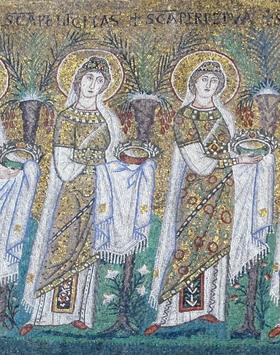
203A gold mosaic of two women in white and gold robes with halos, each carrying a crown, with their names in Latin above
Church Father
St. Perpetua The Passion of Perpetua and Felicity, ch. 2, 3-4

“But I trusted that my prayer would bring help to his suffering; and I prayed for him every day until we passed over into the prison of the camp, … I saw that that place which I had formerly observed to be in gloom was now bright; and Dinocrates, with a clean body well clad, was finding refreshment. … Then I understood that he was translated from the place of punishment.”

Read it in the source: New Advent

See it on the timeline: Purgatory

c. 203An engraving of a bearded man in a turban holding a scroll, set in a page of printed French text
Church Father
Tertullian On Repentance, ch. 7

“These poisons of his, therefore, God foreseeing, although the gate of forgiveness has been shut and fastened up with the bar of baptism, has permitted it still to stand somewhat open. In the vestibule He has stationed the second repentance for opening to such as knock: but now once for all, because now for the second time; but never more”

Read it in the source: New Advent

See it on the timeline: Penance and Reconciliation

c. 205
Church Father
Tertullian To His Wife, Book 2, ch. 8

“Whence are we to find (words) enough fully to tell the happiness of that marriage which the Church cements, and the oblation confirms, and the benediction signs and seals; (which) angels carry back the news of (to heaven), (which) the Father holds for ratified?”

Read it in the source: New Advent

See it on the timeline: Matrimony

c. 207
Church Father
Tertullian Against Marcion 2.22

“Likewise, when forbidding the similitude to be made of all things which are in heaven, and in earth, and in the waters, He declared also the reasons, as being prohibitory of all material exhibition of a latent idolatry. For He adds: You shall not bow down to them, nor serve them. The form, however, of the brazen serpent which the Lord afterwards commanded Moses to make, afforded no pretext for idolatry, but was meant for the cure of those who were plagued with the fiery serpents.”

Read it in the source: New Advent

See it on the timeline: Images and statues

c. 210
Church Father
Tertullian On the Resurrection of the Flesh, ch. 8

“…the flesh feeds on the body and blood of Christ, that the soul likewise may fatten on its God.”

Read it in the source: New Advent

See it on the timeline: The Real Presence

c. 211
Church Father
Tertullian De Corona, ch. 3

“We take also, in congregations before daybreak, and from the hand of none but the presidents, the sacrament of the Eucharist, which the Lord both commanded to be eaten at meal-times, and enjoined to be taken by all alike.”

Read it in the source: New Advent

See it on the timeline: The priest and the Eucharist

c. 212
Church Father

"It is no part of religion to compel religion"

Tertullian To Scapula, ch. 2

“However, it is a fundamental human right, a privilege of nature, that every man should worship according to his own convictions: one man's religion neither harms nor helps another man. It is assuredly no part of religion to compel religion — to which free-will and not force should lead us — the sacrificial victims even being required of a willing mind.”

Read it in the source: New Advent

See it on the timeline: The Inquisition and the use of force against heresy

c. 210-220
Church Father
Tertullian On Monogamy, ch. 8

“Peter alone do I find — through (the mention of) his mother-in-law — to have been married. Monogamist I am led to presume him by consideration of the Church, which, built upon him, was destined to appoint every grade of her Order from monogamists.”

Read it in the source: New Advent

See it on the timeline: Peter the rock

c. 217
Church Father
Tertullian On Monogamy, ch. 10

“Indeed, she prays for his soul, and requests refreshment for him meanwhile, and fellowship (with him) in the first resurrection; and she offers (her sacrifice) on the anniversaries of his falling asleep.”

Read it in the source: New Advent

See it on the timeline: Purgatory

c. AD 221
Church Father

An early historian's account of the darkness at the crucifixion

Julius Africanus Chronography, fragment 18.1

“On the whole world there pressed a most fearful darkness; and the rocks were rent by an earthquake, and many places in Judea and other districts were thrown down. This darkness Thallus, in the third book of his History, calls, as appears to me without reason, an eclipse of the sun. For the Hebrews celebrate the passover on the 14th day according to the moon, and the passion of our Saviour fails on the day before the passover; but an eclipse of the sun takes place only when the moon comes under the sun.”

Read it in the source: New Advent

See it on the timeline: The life of Jesus Christ: the record inside and outside the Bible

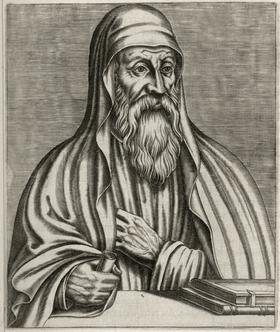
c. 225An engraving of an old bearded man in a hooded cloak writing in a book
Church Father
Origen De Principiis, Book IV, 16 (from the Latin of Rufinus)

“Now who is there, pray, possessed of understanding, that will regard the statement as appropriate, that the first day, and the second, and the third, in which also both evening and morning are mentioned, existed without sun, and moon, and stars — the first day even without a sky?”

Read it in the source: New Advent

See it on the timeline: Evolution and Genesis

c. 225
Church Father
St. Hippolytus of Rome Refutation of All Heresies, Book 9, ch. 7

“Whence women, reputed believers, began to resort to drugs for producing sterility, and to gird themselves round, so to expel what was being conceived on account of their not wishing to have a child either by a slave or by any paltry fellow, for the sake of their family and excessive wealth. Behold, into how great impiety that lawless one has proceeded, by inculcating adultery and murder at the same time!”

Read it in the source: New Advent

See it on the timeline: Contraception

c. 230An engraving of an old bearded man in a hooded cloak writing in a book
Church Father
Origen Commentary on the Gospel of John 1.6

“For if Mary, as those declare who with sound mind extol her, had no other son but Jesus, and yet Jesus says to His mother, Woman, behold your son, … and not Behold you have this son also, then He virtually said to her, Lo, this is Jesus, whom you bore.”

Read it in the source: New Advent

See it on the timeline: Perpetual virginity

c. 230
Church Father

Origen: Peter came to Rome and was crucified

Origen, in Eusebius Church History 3.1.2

“Peter appears to have preached in Pontus, Galatia, Bithynia, Cappadocia, and Asia to the Jews of the dispersion. And at last, having come to Rome, he was crucified head-downwards; for he had requested that he might suffer in this way.”

Read it in the source: New Advent

See it on the timeline: The tradition of the papacy

236
Church Father

The election of Fabian

Eusebius of Caesarea Church History 6.29 (written c. 313-324)

“Pontianus, who had been bishop of the church at Rome for six years, was succeeded by Anteros. After he had held the office for a month, Fabianus succeeded him. … For when all the brethren had assembled to select by vote him who should succeed to the episcopate of the church, several renowned and honorable men were in the minds of many, but Fabianus, although present, was in the mind of none.”

Read it in the source: New Advent

See it on the timeline: All the popes in order, from St. Peter to today
c. 240An engraving of an old bearded man in a hooded cloak writing in a book
Church Father
Origen Letter to Africanus, 13

“…Tobias (as also Judith), we ought to notice, the Jews do not use. They are not even found in the Hebrew Apocrypha, as I learned from the Jews themselves. However, since the Churches use Tobias, you must know that even in the captivity some of the captives were rich and well to do.”

Read it in the source: New Advent

See it on the timeline: The Old Testament canon

c. 248
Church Father
Origen Commentary on the Gospel of Matthew 10.17

“But some say, basing it on a tradition in the Gospel according to Peter, as it is entitled, or The Book of James, that the brethren of Jesus were sons of Joseph by a former wife, whom he married before Mary. Now those who say so wish to preserve the honour of Mary in virginity to the end, … And I think it in harmony with reason that Jesus was the first-fruit among men of the purity which consists in chastity, and Mary among women; for it were not pious to ascribe to any other than to her the first-fruit of virginity.”

Read it in the source: New Advent

See it on the timeline: Perpetual virginity

c. 248
Church Father
Origen Against Celsus 8.33

“But we give thanks to the Creator of all, and, along with thanksgiving and prayer for the blessings we have received, we also eat the bread presented to us; and this bread becomes by prayer a sacred body, which sanctifies those who sincerely partake of it.”

Read it in the source: New Advent

See it on the timeline: The Real Presence

c. 248
Church Father
Origen Commentary on Matthew 12.10

“And if we too have said like Peter, You are the Christ, the Son of the living God, not as if flesh and blood had revealed it unto us, but by light from the Father in heaven having shone in our heart, we become a Peter, and to us there might be said by the Word, You are Peter, etc. … For a rock is every disciple of Christ of whom those drank who drank of the spiritual rock which followed them”

Read it in the source: New Advent

See it on the timeline: Peter the rock

c. 248
Church Father
Origen Against Celsus 8.64

“…when we have the favour of God, we have also the good-will of all angels and spirits who are friends of God. For they know who are worthy of the divine approval, and they are not only well disposed to them, but they co-operate with them in their endeavours to please God: they seek His favour on their behalf; with their prayers they join their own prayers and intercessions for them. … These, even when not asked, pray with them”

Read it in the source: New Advent

See it on the timeline: Praying to saints

c. AD 248
Church Father

A pagan critic grants the works of Jesus and calls them magic

Origen Against Celsus, Book 1, ch. 38

“but he invents something altogether different, admitting somehow the miraculous works done by Jesus, by means of which He induced the multitude to follow Him as the Christ. And yet he desires to throw discredit on them, as being done by help of magic and not by divine power; for he asserts that he (Jesus), having been brought up as an illegitimate child, and having served for hire in Egypt, and then coming to the knowledge of certain miraculous powers, returned from thence to his own country, and by means of those powers proclaimed himself a god.”

Read it in the source: New Advent

See it on the timeline: The life of Jesus Christ: the record inside and outside the Bible

c. 250An engraving of a bearded man in robes holding an open book, standing like a statue in a niche, with a small scene in a landscape on the base below
Church Father
St. Cyprian of Carthage Epistle 65, 2

“The bishops our predecessors religiously considering this, and wholesomely providing for it, decided that no brother departing should name a cleric for executor or guardian; and if any one should do this, no offering should be made for him, nor any sacrifice be celebrated for his repose. For he does not deserve to be named at the altar of God in the prayer of the priests, who has wished to call away the priests and ministers from the altar.”

Read it in the source: New Advent

See it on the timeline: Purgatory

250
Church Father
St. Cyprian of Carthage Epistle 12, 1

“…they who have received certificates from the martyrs, and may be assisted by their privilege with God, if they should be seized with any misfortune and peril of sickness, should, without waiting for my presence, before any presbyter who might be present, or if a presbyter should not be found and death begins to be imminent, before even a deacon, be able to make confession of their sin, that, with the imposition of hands upon them for repentance, they should come to the Lord with the peace which the martyrs have desired, by their letters to us, to be granted to them.”

Read it in the source: New Advent

See it on the timeline: Indulgences

c. 250
Church Father
St. Cyprian of Carthage Epistle 9, 2

“For although in smaller sins sinners may do penance for a set time, and according to the rules of discipline come to public confession, and by imposition of the hand of the bishop and clergy receive the right of communion: now with their time still unfulfilled, while persecution is still raging, while the peace of the Church itself is not [yet] restored, they are admitted to communion”

Read it in the source: New Advent

See it on the timeline: Penance and Reconciliation

251
Church Father
St. Cyprian of Carthage On the Unity of the Church 4

“And although to all the apostles, after His resurrection, He gives an equal power … yet, that He might set forth unity, He arranged by His authority the origin of that unity, as beginning from one. Assuredly the rest of the apostles were also the same as was Peter, endowed with a like partnership both of honour and power; but the beginning proceeds from unity.”

Read it in the source: New Advent

See it on the timeline: The office of Peter

251
Church Father
Pope St. Cornelius, as quoted by Eusebius Eusebius, Church History 6.43.11

“This avenger of the Gospel then did not know that there should be one bishop in a catholic church; yet he was not ignorant (for how could he be?) that in it there were forty-six presbyters, seven deacons, seven sub-deacons, forty-two acolyths, fifty-two exorcists, readers, and janitors, and over fifteen hundred widows and persons in distress, all of whom the grace and kindness of the Master nourish.”

Read it in the source: New Advent

See it on the timeline: Constantine and the Church

251An engraving of a bearded man in robes holding an open book, standing like a statue in a niche, with a small scene in a landscape on the base below
Church Father
St. Cyprian of Carthage On the Unity of the Church 12

“Nor let any deceive themselves by a futile interpretation, in respect of the Lord having said, Wheresoever two or three are gathered together in my name, there am I in the midst of them. … When, therefore, in His commandments He lays it down, and says, Where two or three are gathered together in my name, I am with them, He does not divide men from the Church, seeing that He Himself ordained and made the Church”

Read it in the source: New Advent

See it on the timeline: The one Church

251
Church Father
St. Cyprian of Carthage On the Unity of the Church, 18

“Thus Korah, Dathan, and Abiram, who endeavoured to claim to themselves the power of sacrificing in opposition to Moses and Aaron the priest, underwent immediate punishment for their attempts.”

Read it in the source: New Advent

See it on the timeline: The ordained priesthood

251
Church Father
St. Cyprian of Carthage On the Lapsed, 29

“I entreat you, beloved brethren, that each one should confess his own sin, while he who has sinned is still in this world, while his confession may be received, while the satisfaction and remission made by the priests are pleasing to the Lord.”

Read it in the source: New Advent

See it on the timeline: Confession to a priest

251
Church Father
St. Cyprian of Carthage On the Unity of the Church, 20

“Whosoever that confessor is, he is not greater, or better, or dearer to God than Solomon, who, although so long as he walked in God's ways, retained that grace which he had received from the Lord, yet after he forsook the Lord's way he lost also the Lord's grace. And therefore it is written, Hold fast that which you have, lest another take your crown. … But assuredly the Lord would not threaten that the crown of righteousness might be taken away, were it not that, when righteousness departs, the crown must also depart.”

Read it in the source: New Advent

See it on the timeline: Eternal security

251
Church Father
St. Cyprian of Carthage On the Unity of the Church 6

“Whoever is separated from the Church and is joined to an adulteress, is separated from the promises of the Church; nor can he who forsakes the Church of Christ attain to the rewards of Christ. He is a stranger; he is profane; he is an enemy. He can no longer have God for his Father, who has not the Church for his mother.”

Read it in the source: New Advent

See it on the timeline: Other religions

251
Church Father

Cornelius takes the place of Fabian

St. Cyprian of Carthage Epistle 51, to Antonianus, 8

“Moreover, Cornelius was made bishop by the judgment of God and of His Christ, by the testimony of almost all the clergy, by the suffrage of the people who were then present, and by the assembly of ancient priests and good men, when no one had been made so before him, when the place of Fabian, that is, when the place of Peter and the degree of the sacerdotal throne was vacant”

Read it in the source: New Advent

See it on the timeline: All the popes in order, from St. Peter to today
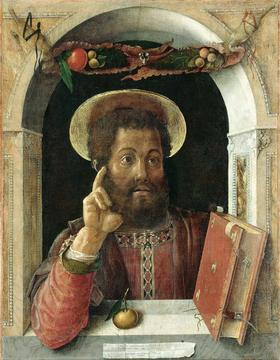
c. 251
Church Father
St. Cyprian of Carthage On the Lapsed, 28

“…how much are they both greater in faith and better in their fear, who, although bound by no crime of sacrifice to idols or of certificate, yet, since they have even thought of such things, with grief and simplicity confess this very thing to God's priests, and make the conscientious avowal, put off from them the load of their minds, and seek out the salutary medicine even for slight and moderate wounds”

Read it in the source: New Advent

See it on the timeline: Penance and Reconciliation

c. 252
Church Father
St. Cyprian of Carthage Letter 54.14, to Cornelius (numbering of the linked edition)

“…they still dare — a false bishop having been appointed for them by, heretics— to set sail and to bear letters from schismatic and profane persons to the throne of Peter, and to the chief church whence priestly unity takes its source; and not to consider that these were the Romans whose faith was praised in the preaching of the apostle, to whom faithlessness could have no access.”

Read it in the source: New Advent

See it on the timeline: Papal supremacy

c. 252
Church Father
St. Cyprian of Carthage On the Mortality (Treatise 7), 6

“If a grave and praiseworthy man should promise you anything, you would assuredly have faith in the promiser, and would not think that you should be cheated and deceived by him whom you knew to be steadfast in his words and his deeds. Now God is speaking with you; and do you faithlessly waver in your unbelieving mind? God promises to you, on your departure from this world, immortality and eternity; and do you doubt?”

Read it in the source: New Advent

See it on the timeline: Assurance of salvation

c. 252
Church Father
St. Cyprian of Carthage Epistle 56, to Cornelius, 5

“Let us on both sides always pray for one another. Let us relieve burdens and afflictions by mutual love, that if any one of us, by the swiftness of divine condescension, shall go hence the first, our love may continue in the presence of the Lord, and our prayers for our brethren and sisters not cease in the presence of the Father's mercy.”

Read it in the source: New Advent

See it on the timeline: Praying to saints

c. 252
Church Father
St. Cyprian of Carthage On the Lord's Prayer, 18

“we ask that this bread should be given to us daily, that we who are in Christ, and daily receive the Eucharist for the food of salvation, may not, by the interposition of some heinous sin, by being prevented, as withheld and not communicating, from partaking of the heavenly bread, be separated from Christ's body”

Read it in the source: New Advent

See it on the timeline: The Eucharist

c. 253
Church Father
St. Cyprian of Carthage Epistle 62, 17

“And because we make mention of His passion in all sacrifices (for the Lord's passion is the sacrifice which we offer), we ought to do nothing else than what He did.”

Read it in the source: New Advent

See it on the timeline: The Mass as sacrifice

c. 253
Church Father
St. Cyprian of Carthage Treatise 8, On Works and Alms, 2

“The Holy Spirit speaks in the sacred Scriptures, and says, By almsgiving and faith sins are purged. … Moreover, He says again, As water extinguishes fire, so almsgiving quenches sin. [Sirach 3:30]”

Read it in the source: New Advent

See it on the timeline: The Old Testament canon

c. 253
Church Father
St. Cyprian of Carthage Epistle 62, 14

“For if Jesus Christ, our Lord and God, is Himself the chief priest of God the Father, and has first offered Himself a sacrifice to the Father, and has commanded this to be done in commemoration of Himself, certainly that priest truly discharges the office of Christ, who imitates that which Christ did; and he then offers a true and full sacrifice in the Church to God the Father, when he proceeds to offer it according to what he sees Christ Himself to have offered.”

Read it in the source: New Advent

See it on the timeline: The priest and the Eucharist

c. 253
Church Father
St. Cyprian of Carthage Epistle 58, To Fidus, 2

“But in respect of the case of the infants, which you say ought not to be baptized within the second or third day after their birth, and that the law of ancient circumcision should be regarded, so that you think that one who is just born should not be baptized and sanctified within the eighth day, we all thought very differently in our council. For in this course which you thought was to be taken, no one agreed; but we all rather judge that the mercy and grace of God is not to be refused to any one born of man.”

Read it in the source: New Advent

See it on the timeline: Infant baptism

c. 255
Church Father
St. Cyprian of Carthage Epistle 75, 3

“…Novatian is not in the Church; nor can he be reckoned as a bishop, who, succeeding to no one, and despising the evangelical and apostolic tradition, sprang from himself. For he who has not been ordained in the Church can neither have nor hold to the Church in any way.”

Read it in the source: New Advent

See it on the timeline: Apostolic succession

c. 255
Church Father
St. Cyprian of Carthage Epistle 75, To Magnus, 12

“You have asked also, dearest son, what I thought of those who obtain God's grace in sickness and weakness, whether they are to be accounted legitimate Christians, for that they are not to be washed, but sprinkled, with the saving water. In this point, my diffidence and modesty prejudges none, … In the sacraments of salvation, when necessity compels, and God bestows His mercy, the divine methods confer the whole benefit on believers; nor ought it to trouble any one that sick people seem to be sprinkled or affused, when they obtain the Lord's grace”

Read it in the source: New Advent

See it on the timeline: Baptism by pouring

c. 255
Church Father
St. Cyprian of Carthage Epistle 72, to Jubaianus, sec. 9

“viz., that prayer being made for them, and hands being imposed, the Holy Spirit should be invoked and poured out upon them, which now too is done among us, so that they who are baptized in the Church are brought to the prelates of the Church, and by our prayers and by the imposition of hands obtain the Holy Spirit, and are perfected with the Lord's seal.”

Read it in the source: New Advent

See it on the timeline: Confirmation

c. 256
Church Father
St. Cyprian of Carthage Epistle 72, 21 (to Jubaianus)

“But if not even the baptism of a public confession and blood can profit a heretic to salvation, because there is no salvation out of the Church, how much less shall it be of advantage to him, if in a hiding-place and a cave of robbers, stained with the contagion of adulterous water, he has not only not put off his old sins, but rather heaped up still newer and greater ones!”

Read it in the source: New Advent

See it on the timeline: No salvation outside the Church

256
Church Father

Pope Stephen resisted over the baptism of heretics

Firmilian, Bishop of Caesarea in Cappadocia Letter to Cyprian, 17 (Epistle 74 among Cyprian's letters on the linked page)

“And in this respect I am justly indignant at this so open and manifest folly of Stephen, that he who so boasts of the place of his episcopate, and contends that he holds the succession from Peter, on whom the foundations of the Church were laid, should introduce many other rocks and establish new buildings of many churches; maintaining that there is baptism in them by his authority.”

Read it in the source: New Advent

See it on the timeline: The tradition of the papacy

256An engraving of a bearded man in robes holding an open book, standing like a statue in a niche, with a small scene in a landscape on the base below
Church Father
St. Cyprian of Carthage Epistle 72, To Jubaianus, 1

“And now also, when we had met together, bishops as well of the province of Africa as of Numidia, to the number of seventy-one, we established this same matter once more by our judgment, deciding that there is one baptism which is appointed in the Catholic Church; and that by this those are not re-baptized, but baptized by us, who at any time come from the adulterous and unhallowed water to be washed and sanctified by the truth of the saving water.”

Read it in the source: New Advent

See it on the timeline: Baptism

c. 257
Church Father

The martyrs of the Old Testament held up to Christian martyrs

St. Cyprian of Carthage Exhortation to Martyrdom, addressed to Fortunatus (Treatise 11), 11

“The three youths, Ananias, Azarias, and Misäel, equal in age, agreeing in love, steadfast in faith, constant in virtue, stronger than the flames and penalties that urged them, proclaim that they only obey God, that they know Him alone, that they worship Him alone … What, indeed, do we find in the Maccabees of seven brethren, equals alike in their lot of birth and virtues, filling up the number seven in the sacrament of a perfected completion? Seven brethren were thus associating in martyrdom.”

Read it in the source: New Advent

See it on the timeline: Saints of the early Church, to 313

c. 272
Church Father
Eusebius of Caesarea Church History 7.30.19

“But as Paul refused to surrender the church building, the Emperor Aurelian was petitioned; and he decided the matter most equitably, ordering the building to be given to those to whom the bishops of Italy and of the city of Rome should adjudge it.”

Read it in the source: New Advent

See it on the timeline: Constantine and the Church

c. 310
Church Father
Lactantius Divine Institutes, Book 6, ch. 20

“For when God forbids us to kill, He not only prohibits us from open violence, which is not even allowed by the public laws, but He warns us against the commission of those things which are esteemed lawful among men. Thus it will be neither lawful for a just man to engage in warfare, since his warfare is justice itself, nor to accuse any one of a capital charge, because it makes no difference whether you put a man to death by word, or rather by the sword, since it is the act of putting to death itself which is prohibited.”

Read it in the source: New Advent

See it on the timeline: Violence in the Church's history

c. 310
Church Father

Religion defended "not by putting to death, but by dying"

Lactantius Divine Institutes, Book 5, ch. 20

“There is no occasion for violence and injury, for religion cannot be imposed by force; the matter must be carried on by words rather than by blows, that the will may be affected. … For religion is to be defended, not by putting to death, but by dying; not by cruelty, but by patient endurance; not by guilt, but by good faith … For if you wish to defend religion by bloodshed, and by tortures, and by guilt, it will no longer be defended, but will be polluted and profaned. For nothing is so much a matter of free-will as religion; in which, if the mind of the worshipper is disinclined to it, religion is at once taken away, and ceases to exist.”

Read it in the source: New Advent

See it on the timeline: The Inquisition and the use of force against heresy

313A huge ancient bronze head of a clean-shaven man with a fringe of curled hair and wide eyes
Church Father
Emperors Constantine and Licinius, as quoted by Eusebius Eusebius, Church History 10.5.7

“We have resolved to communicate this most fully to your care, in order that you may know that we have granted to these same Christians freedom and full liberty to observe their own religion.”

Read it in the source: New Advent

See it on the timeline: Constantine and the Church

313
Church Father
Emperor Constantine, as quoted by Eusebius Eusebius, Church History 10.5.16

“Wherefore it is our will that when you receive this letter, if any such things belonged to the Catholic Church of the Christians, in any city or other place, but are now held by citizens or by any others, you shall cause them to be restored immediately to the said churches. For we have already determined that those things which these same churches formerly possessed shall be restored to them.”

Read it in the source: New Advent

See it on the timeline: Constantine and the Church

c. 325
Church Father

Eusebius: the record of Peter's death under Nero

Eusebius of Caesarea Church History 2.25.5

“It is, therefore, recorded that Paul was beheaded in Rome itself, and that Peter likewise was crucified under Nero. This account of Peter and Paul is substantiated by the fact that their names are preserved in the cemeteries of that place even to the present day.”

Read it in the source: New Advent

See it on the timeline: The tradition of the papacy

337A huge ancient bronze head of a clean-shaven man with a fringe of curled hair and wide eyes
Church Father
Emperor Constantine, as recorded by Eusebius Eusebius, Life of Constantine, Book 4, ch. 62

“The hour has come in which I too may have the blessing of that seal which confers immortality; the hour in which I may receive the seal of salvation. … After he had thus spoken, the prelates performed the sacred ceremonies in the usual manner, and, having given him the necessary instructions, made him a partaker of the mystic ordinance.”

Read it in the source: New Advent

See it on the timeline: Constantine and the Church

341
Church Father

Pope Julius asks why Rome was not written to first

Pope St. Julius I Letter to the Eusebian bishops at Antioch (341), in St. Athanasius, Defence against the Arians (Apologia contra Arianos) 35

“Are you ignorant that the custom has been for word to be written first to us, and then for a just decision to be passed from this place? If then any such suspicion rested upon the Bishop there, notice thereof ought to have been sent to the Church of this place”

Read it in the source: New Advent

See it on the timeline: The tradition of the papacy

c. 350An engraving of a bearded bishop in Eastern vestments holding a book and raising his right hand in blessing
Church Father
St. Cyril of Jerusalem Catechetical Lecture 23 (On the Mysteries 5), 21

“So then after having carefully hallowed your eyes by the touch of the Holy Body, partake of it; giving heed lest you lose any portion thereof … Will you not then much more carefully keep watch, that not a crumb fall from you of what is more precious than gold and precious stones?”

Read it in the source: New Advent

See it on the timeline: The Real Presence

c. 350
Church Father
St. Cyril of Jerusalem Catechetical Lecture 22 (On the Mysteries 4), 9

“Having learned these things, and been fully assured that the seeming bread is not bread, though sensible to taste, but the Body of Christ; and that the seeming wine is not wine, though the taste will have it so, but the Blood of Christ…”

Read it in the source: New Advent

See it on the timeline: Transubstantiation

c. 350
Church Father
St. Cyril of Jerusalem Catechetical Lecture 23 (On the Mysteries 5), 22

“Then after you have partaken of the Body of Christ, draw near also to the Cup of His Blood; not stretching forth your hands, but bending, and saying with an air of worship and reverence, Amen, hallow yourself by partaking also of the Blood of Christ.”

Read it in the source: New Advent

See it on the timeline: Adoring the Eucharist

c. 350
Church Father
St. Cyril of Jerusalem Catechetical Lecture 23 (On the Mysteries 5), 8

“Then, after the spiritual sacrifice, the bloodless service, is completed, over that sacrifice of propitiation we entreat God for the common peace of the Churches, for the welfare of the world … and, in a word, for all who stand in need of succour we all pray and offer this sacrifice.”

Read it in the source: New Advent

See it on the timeline: The Mass as sacrifice

c. 350
Church Father
St. Cyril of Jerusalem Catechetical Lecture 18, 26

“And if ever you are sojourning in cities, inquire not simply where the Lord's House is (for the other sects of the profane also attempt to call their own dens houses of the Lord), nor merely where the Church is, but where is the Catholic Church. For this is the peculiar name of this Holy Church, the mother of us all, which is the spouse of our Lord Jesus Christ, the Only-begotten Son of God”

Read it in the source: New Advent

See it on the timeline: Constantine and the Church

c. 350
Church Father
St. Cyril of Jerusalem Catechetical Lecture 23, 9

“Then on behalf also of the Holy Fathers and Bishops who have fallen asleep before us, and in a word of all who in past years have fallen asleep among us, believing that it will be a very great benefit to the souls, for whom the supplication is put up, while that holy and most awful sacrifice is set forth.”

Read it in the source: New Advent

See it on the timeline: Purgatory

c. 350
Church Father
St. Cyril of Jerusalem Catechetical Lecture 3, 10

“If any man receive not Baptism, he has not salvation; except only Martyrs, who even without the water receive the kingdom.”

Read it in the source: New Advent

See it on the timeline: Baptism and salvation

c. 350
Church Father
St. Cyril of Jerusalem Catechetical Lecture 20 (On the Mysteries II), 4

“After these things, you were led to the holy pool of Divine Baptism, as Christ was carried from the Cross to the Sepulchre which is before our eyes. And each of you was asked, whether he believed in the name of the Father, and of the Son, and of the Holy Ghost, and you made that saving confession, and descended three times into the water, and ascended again; here also hinting by a symbol at the three days burial of Christ.”

Read it in the source: New Advent

See it on the timeline: Baptism by pouring

c. 350
Church Father
St. Cyril of Jerusalem Catechetical Lecture 23.9

“Then we commemorate also those who have fallen asleep before us, first Patriarchs, Prophets, Apostles, Martyrs, that at their prayers and intercessions God would receive our petition.”

Read it in the source: New Advent

See it on the timeline: Praying to saints

c. 350
Church Father
St. Cyril of Jerusalem Catechetical Lecture 21 (Mystagogic Catechesis 3, On the Chrism), sec. 1

“And to you in like manner, after you had come up from the pool of the sacred streams, there was given an Unction, the anti-type of that wherewith Christ was anointed; and this is the Holy Ghost”

Read it in the source: New Advent

See it on the timeline: Confirmation

c. 352A worn icon of a bishop with a broad grey beard holding a jewelled book, on a red and gold ground
Church Father
St. Athanasius of Alexandria De Decretis (Defence of the Nicene Definition), ch. 5, section 21

“…if a person is interested in the question, let him know, that, even if the expressions are not in so many words in the Scriptures, yet, as was said before, they contain the sense of the Scriptures, and expressing it, they convey it to those who have their hearing unimpaired for religious doctrine.”

Read it in the source: New Advent

See it on the timeline: Doctrines defined later

c. 355
Church Father
Theodoret of Cyrus, reporting the exchange between Liberius and Constantius Ecclesiastical History 2.13

“I have already taken leave of the brethren who are in that city. The decrees of the Church are of greater importance than a residence in Rome. … Neither three days nor three months can change my sentiments. Send me wherever you please.”

Read it in the source: New Advent

See it on the timeline: Have popes been heretics?

c. 357A worn icon of a bishop with a broad grey beard holding a jewelled book, on a red and gold ground
Church Father
St. Athanasius History of the Arians, Part V, 41

“But Liberius after he had been in banishment two years gave way, and from fear of threatened death subscribed. Yet even this only shows their violent conduct, and the hatred of Liberius against the heresy, and his support of Athanasius, so long as he was suffered to exercise a free choice.”

Read it in the source: New Advent

See it on the timeline: Have popes been heretics?

c. 358
Church Father
St. Athanasius Discourse 2 Against the Arians, 70

“Therefore let those who deny that the Son is from the Father by nature and proper to His Essence, deny also that He took true human flesh of Mary Ever-Virgin…”

Read it in the source: New Advent

See it on the timeline: Perpetual virginity

c. 356-360
Church Father
St. Hilary of Poitiers On the Trinity 8.14

“As to the verity of the flesh and blood there is no room left for doubt. For now both from the declaration of the Lord Himself and our own faith, it is verily flesh and verily blood. And these when eaten and drunk, bring it to pass that both we are in Christ and Christ in us.”

Read it in the source: New Advent

See it on the timeline: The Real Presence

c. 360
Church Father
St. Hilary of Poitiers On the Trinity 6.37

“This faith it is which is the foundation of the Church; through this faith the gates of hell cannot prevail against her. This is the faith which has the keys of the kingdom of heaven.”

Read it in the source: New Advent

See it on the timeline: Peter the rock

c. 362A round gold mosaic of a balding bishop with a white beard, wearing a white stole marked with black crosses
Church Father
St. Gregory Nazianzen Oration 2 (In Defence of His Flight), 16

“But granted that a man is free from vice, and has reached the greatest heights of virtue: I do not see what knowledge or power would justify him in venturing upon this office. For the guiding of man, the most variable and manifold of creatures, seems to me in very deed to be the art of arts and science of sciences.”

Read it in the source: New Advent

See it on the timeline: Holy Orders

367A worn icon of a bishop with a broad grey beard holding a jewelled book, on a red and gold ground
Church Father
St. Athanasius of Alexandria Festal Letter 39, 5

“Again it is not tedious to speak of the [books] of the New Testament. These are, the four Gospels, according to Matthew, Mark, Luke, and John. Afterwards, the Acts of the Apostles and Epistles (called Catholic), seven, viz. of James, one; of Peter, two; of John, three; after these, one of Jude. In addition, there are fourteen Epistles of Paul, written in this order. The first, to the Romans; then two to the Corinthians; after these, to the Galatians; next, to the Ephesians; then to the Philippians; then to the Colossians; after these, two to the Thessalonians, and that to the Hebrews; and again, two to Timothy; one to Titus; and lastly, that to Philemon. And besides, the Revelation of John.”

Read it in the source: New Advent

See it on the timeline: The authority of the Fathers

367
Church Father
St. Athanasius of Alexandria Festal Letter 39, 7

“But for greater exactness I add this also, writing of necessity; that there are other books besides these not indeed included in the Canon, but appointed by the Fathers to be read by those who newly join us, and who wish for instruction in the word of godliness. The Wisdom of Solomon, and the Wisdom of Sirach, and Esther, and Judith, and Tobit, and that which is called the Teaching of the Apostles, and the Shepherd.”

Read it in the source: New Advent

See it on the timeline: The Old Testament canon

c. 367
Church Father

Optatus: the one chair of Peter at Rome

St. Optatus of Milevis Against the Donatists (Against Parmenian) 2.2

“You cannot then deny that you do know that upon Peter first in the City of Rome was bestowed the Episcopal Cathedra, on which sat Peter, the Head of all the Apostles … that, in this one Cathedra, unity should be preserved by all”

Read it in the source: tertullian.org

See it on the timeline: The tradition of the papacy

367
Church Father

St. Hilary of Poitiers, bishop and Doctor

St. Hilary of Poitiers On the Trinity 12, 57, as quoted by Benedict XVI, General Audience, 10 October 2007

“Obtain, O Lord … that I may keep ever faithful to what I have professed in the symbol of my regeneration, when I was baptized in the Father, in the Son and in the Holy Spirit. That I may worship you, our Father, and with you, your Son; that I may deserve your Holy Spirit, who proceeds from you through your Only Begotten Son”

Read it in the source: vatican.va

See it on the timeline: The Doctors of the Church

c. 370A tall icon of a bishop with a dark pointed beard holding a book, surrounded by many small painted scenes
Church Father
St. Basil the Great Hexaemeron, Homily 2, 8

“And the evening and the morning were one day. Why does Scripture say one day the first day? … If it therefore says one day, it is from a wish to determine the measure of day and night, and to combine the time that they contain. Now twenty-four hours fill up the space of one day — we mean of a day and of a night”

Read it in the source: New Advent

See it on the timeline: Evolution and Genesis

373A worn icon of a bishop with a broad grey beard holding a jewelled book, on a red and gold ground
Church Father

St. Athanasius of Alexandria, bishop and Doctor

St. Athanasius of Alexandria On the Incarnation of the Word 54.3

“For He was made man that we might be made God; and He manifested Himself by a body that we might receive the idea of the unseen Father; and He endured the insolence of men that we might inherit immortality.”

Read it in the source: New Advent

See it on the timeline: The Doctors of the Church

373A round gold mosaic of an old monk with a short beard holding a scroll of Greek text
Church Father

St. Ephrem the Syrian, deacon and Doctor

St. Ephrem the Syrian Hymns on the Nativity of Christ, as quoted by Benedict XVI, General Audience, 28 November 2007

“The Lord entered her and became a servant; the Word entered her, and became silent within her; thunder entered her and his voice was still; the Shepherd of all entered her; he became a Lamb in her, and came forth bleating.”

Read it in the source: vatican.va

See it on the timeline: The Doctors of the Church

374A tall icon of a bishop with a dark pointed beard holding a book, surrounded by many small painted scenes
Church Father
St. Basil the Great Letter 188, to Amphilochius, canon 2

“The woman who purposely destroys her unborn child is guilty of murder. With us there is no nice enquiry as to its being formed or unformed. In this case it is not only the being about to be born who is vindicated, but the woman in her attack upon herself; because in most cases women who make such attempts die. The destruction of the embryo is an additional crime, a second murder, at all events if we regard it as done with intent. The punishment, however, of these women should not be for life, but for the term of ten years. And let their treatment depend not on mere lapse of time, but on the character of their repentance.”

Read it in the source: New Advent

See it on the timeline: Abortion

c. 375
Church Father
St. Basil the Great On the Holy Spirit 27.66

“Of the beliefs and practices whether generally accepted or publicly enjoined which are preserved in the Church some we possess derived from written teaching; others we have received delivered to us in a mystery by the tradition of the apostles; and both of these in relation to true religion have the same force.”

Read it in the source: New Advent

See it on the timeline: Scripture and Tradition

375
Church Father
St. Basil the Great On the Holy Spirit 18.45

“Because we speak of a king, and of the king's image, and not of two kings. The majesty is not cloven in two, nor the glory divided. The sovereignty and authority over us is one, and so the doxology ascribed by us is not plural but one; because the honour paid to the image passes on to the prototype.”

Read it in the source: New Advent

See it on the timeline: Images and statues

c. 375
Church Father
St. Basil the Great Letter 217, canon 62

“He who is guilty of unseemliness with males will be under discipline for the same time as adulterers.”

Read it in the source: New Advent

See it on the timeline: Homosexuality

c. 376An old man with a bald head and a red cloak leans over a large book, pen in hand, with a skull resting on another book on the table
Church Father
St. Jerome Letter 15.2, to Pope Damasus

“As I follow no leader save Christ, so I communicate with none but your blessedness, that is with the chair of Peter. For this, I know, is the rock on which the church is built! … This is the house where alone the paschal lamb can be rightly eaten.”

Read it in the source: New Advent

See it on the timeline: Peter the rock

c. 377A bishop in a gold cope and mitre on the steps of a church holds out his hand to stop an emperor in armour and a red cloak
Church Father
St. Ambrose of Milan Concerning Virgins 2.2.7

“What is greater than the Mother of God? What more glorious than she whom Glory Itself chose? What more chaste than she who bore a body without contact with another body? For why should I speak of her other virtues? She was a virgin not only in body but also in mind, who stained the sincerity of its disposition by no guile, who was humble in heart, grave in speech, prudent in mind…”

Read it in the source: New Advent

See it on the timeline: Mary without sin

379A tall icon of a bishop with a dark pointed beard holding a book, surrounded by many small painted scenes
Church Father

St. Basil the Great, bishop and Doctor

St. Basil the Great On the Holy Spirit 15.36

“Through the Holy Spirit comes our restoration to paradise, our ascension into the kingdom of heaven, our return to the adoption of sons, our liberty to call God our Father, our being made partakers of the grace of Christ, our being called children of light, our sharing in eternal glory, and, in a word, our being brought into a state of all fullness of blessing”

Read it in the source: New Advent

See it on the timeline: The Doctors of the Church

c. 380
Church Father
The Apostolic Constitutions Book 2, section 7, ch. 59

“Be not careless of yourselves, neither deprive your Saviour of His own members, neither divide His body nor disperse His members, neither prefer the occasions of this life to the word of God; … And on the day of our Lord's resurrection, which is the Lord's day, meet more diligently, sending praise to God that made the universe by Jesus, and sent Him to us, and condescended to let Him suffer, and raised Him from the dead. Otherwise what apology will he make to God who does not assemble on that day to hear the saving word concerning the resurrection”

Read it in the source: New Advent

See it on the timeline: The Sunday Mass obligation

380A round gold mosaic of a balding bishop with a white beard, wearing a white stole marked with black crosses
Church Father
St. Gregory of Nazianzus Oration 31 (Fifth Theological Oration, On the Holy Spirit), 26

“The Old Testament proclaimed the Father openly, and the Son more obscurely. The New manifested the Son, and suggested the Deity of the Spirit. Now the Spirit Himself dwells among us, and supplies us with a clearer demonstration of Himself. For it was not safe, when the Godhead of the Father was not yet acknowledged, plainly to proclaim the Son; nor when that of the Son was not yet received to burden us further (if I may use so bold an expression) with the Holy Ghost”

Read it in the source: New Advent

See it on the timeline: Doctrines defined later

381
Church Father
St. Ambrose of Milan On the Holy Spirit 3.11.78-79

“And we read that nothing besides God is to be worshipped, for it is written: You shall worship the Lord your God, and Him only shall you serve. … And so, by footstool is understood earth, but by the earth the Flesh of Christ, which we this day also adore in the mysteries, and which the apostles, as we said above, adored in the Lord Jesus; for Christ is not divided but is one; nor, when He is adored as the Son of God, is He denied to have been born of the Virgin.”

Read it in the source: New Advent

See it on the timeline: Adoring the Eucharist

381A round gold mosaic of a balding bishop with a white beard, wearing a white stole marked with black crosses
Church Father
St. Gregory Nazianzen Oration 40, On Holy Baptism, 28

“Be it so, some will say, in the case of those who ask for Baptism; what have you to say about those who are still children, and conscious neither of the loss nor of the grace? Are we to baptize them too? Certainly, if any danger presses. For it is better that they should be unconsciously sanctified than that they should depart unsealed and uninitiated. A proof of this is found in the Circumcision on the eighth day, which was a sort of typical seal, and was conferred on children before they had the use of reason.”

Read it in the source: New Advent

See it on the timeline: Infant baptism

c. 382An old man with a bald head and a red cloak leans over a large book, pen in hand, with a skull resting on another book on the table
Church Father
St. Jerome Dialogue against the Luciferians, sec. 9 (spoken by Orthodoxus)

“But if you now ask how it is that a person baptized in the Church does not receive the Holy Ghost, Whom we declare to be given in true baptism, except by the hands of the bishop, let me tell you that our authority for the rule is the fact that after our Lord's ascension the Holy Ghost descended upon the Apostles. And in many places we find it the practice, more by way of honouring the episcopate than from any compulsory law.”

Read it in the source: New Advent

See it on the timeline: Confirmation

383
Church Father
St. Jerome The Perpetual Virginity of Blessed Mary, Against Helvidius, 6

“…the words knew and till in the language of Holy Scripture are capable of a double meaning. … And the Saviour in the Gospel tells the Apostles, … Lo, I am with you always, even unto the end of the world. Will the Lord then after the end of the world has come forsake His disciples…”

Read it in the source: New Advent

See it on the timeline: Perpetual virginity

383
Church Father
St. Jerome The Perpetual Virginity of Blessed Mary, Against Helvidius, 12

“Our position is this: Every only begotten son is a first-born son, but not every first-born is an only begotten. By first-born we understand not only one who is succeeded by others, but one who has had no predecessor.”

Read it in the source: New Advent

See it on the timeline: Perpetual virginity

383
Church Father
St. Jerome The Perpetual Virginity of Blessed Mary, Against Helvidius, 17

“The only alternative is to adopt the previous explanation and understand them to be called brethren in virtue of the bond of kindred, not of love and sympathy, nor by prerogative of race, nor yet by nature. Just as Lot was called Abraham's brother, and Jacob Laban's…”

Read it in the source: New Advent

See it on the timeline: Perpetual virginity

c. 383A damaged mosaic of a bishop with a dark beard holding a jewelled book
Church Father
St. Gregory of Nyssa The Great Catechism, ch. 37

“Rightly, then, do we believe that now also the bread which is consecrated by the Word of God is changed into the Body of God the Word.”

Read it in the source: CCEL

See it on the timeline: The Real Presence

384An old man with a bald head and a red cloak leans over a large book, pen in hand, with a skull resting on another book on the table
Church Father
St. Jerome Letter 22, to Eustochium, 13

“Some go so far as to take potions, that they may insure barrenness, and thus murder human beings almost before their conception. Some, when they find themselves with child through their sin, use drugs to procure abortion”

Read it in the source: New Advent

See it on the timeline: Contraception

c. 386A gold mosaic of a bishop in white vestments marked with crosses, holding a book, with his name in Greek letters on either side
Church Father
St. John Chrysostom On the Priesthood, Book 3, ch. 6

“For not only at the time of regeneration, but afterwards also, they have authority to forgive sins. Is any sick among you? it is said, let him call for the elders of the Church and let them pray over him, anointing him with oil in the name of the Lord. And the prayer of faith shall save the sick, and the Lord will raise him up: and if he have committed sins they shall be forgiven him.”

Read it in the source: New Advent

See it on the timeline: The Anointing of the Sick

c. 386
Church Father
St. John Chrysostom On the Priesthood, Book 3, ch. 4

“For the priestly office is indeed discharged on earth, but it ranks among heavenly ordinances; and very naturally so: for neither man, nor angel, nor archangel, nor any other created power, but the Paraclete Himself, instituted this vocation, and persuaded men while still abiding in the flesh to represent the ministry of angels.”

Read it in the source: New Advent

See it on the timeline: Holy Orders

c. 386An engraving of a bearded bishop in Eastern vestments holding a book and raising his right hand in blessing
Church Father

St. Cyril of Jerusalem, bishop and Doctor

St. Cyril of Jerusalem Catechetical Lecture 5.12

“But in learning the Faith and in professing it, acquire and keep that only, which is now delivered to you by the Church, and which has been built up strongly out of all the Scriptures. For since all cannot read the Scriptures, some being hindered as to the knowledge of them by want of learning, and others by a want of leisure, in order that the soul may not perish from ignorance, we comprise the whole doctrine of the Faith in a few lines.”

Read it in the source: New Advent

See it on the timeline: The Doctors of the Church

c. 386A gold mosaic of a bishop in white vestments marked with crosses, holding a book, with his name in Greek letters on either side
Church Father

St. John Chrysostom preaches against the Jews at Antioch

St. John Chrysostom Against the Jews, Homily 1, III, 1

“Many, I know, respect the Jews and think that their present way of life is a venerable one. This is why I hasten to uproot and tear out this deadly opinion. … But the synagogue is not only a brothel and a theater; it also is a den of robbers and a lodging for wild beasts. … But when God forsakes a people, what hope of salvation is left? When God forsakes a place, that place becomes the dwelling of demons.”

Read it in the source: tertullian.org

See it on the timeline: The Church and the Jewish people

387
Church Father
St. John Chrysostom Homilies on the Statues, Homily 2, 26

“For Elias left a sheepskin to his disciple, but the Son of God ascending left to us His own flesh! Elias indeed, cast off his mantle, before he went up; but Christ left it behind for our sakes; and yet retained it when He ascended.”

Read it in the source: New Advent

See it on the timeline: The Real Presence and the Ascension

c. 384-390A bishop in a gold cope and mitre on the steps of a church holds out his hand to stop an emperor in armour and a red cloak
Church Father
St. Ambrose of Milan Concerning Repentance, Book 1, ch. 2, 6-7

“They affirm that they are showing great reverence for God, to Whom alone they reserve the power of forgiving sins. But in truth none do Him greater injury than they who choose to prune His commandments and reject the office entrusted to them. … The Church holds fast its obedience on either side, by both retaining and remitting sin”

Read it in the source: New Advent

See it on the timeline: Confession to a priest

c. 387
Church Father
St. Ambrose of Milan On the Mysteries, ch. 1, 2

“The season now warns us to speak of the Mysteries, and to set forth the purport of the sacraments, which if we had thought it well to teach before baptism to those who were not yet initiated, we should be considered rather to have betrayed than to have portrayed the Mysteries.”

Read it in the source: New Advent

See it on the timeline: The seven sacraments

c. 386-390A gold mosaic of a bishop in white vestments marked with crosses, holding a book, with his name in Greek letters on either side
Church Father
St. John Chrysostom On the Priesthood, Book 3, 5

“For they who inhabit the earth and make their abode there are entrusted with the administration of things which are in Heaven, and have received an authority which God has not given to angels or archangels. … what priests do here below God ratifies above, and the Master confirms the sentence of his servants. For indeed what is it but all manner of heavenly authority which He has given them when He says, Whose sins ye remit they are remitted, and whose sins ye retain they are retained?”

Read it in the source: New Advent

See it on the timeline: Confession to a priest

c. 386-390
Church Father
St. John Chrysostom On the Priesthood, Book 3, 6

“The Jewish priests had authority to release the body from leprosy, or, rather, not to release it but only to examine those who were already released, and you know how much the office of priest was contended for at that time. But our priests have received authority to deal, not with bodily leprosy, but spiritual uncleanness — not to pronounce it removed after examination, but actually and absolutely to take it away.”

Read it in the source: New Advent

See it on the timeline: Confession to a priest

c. 390
Church Father
St. John Chrysostom Homilies on Matthew, Homily 19, 5

“…calling frivolousness, here, by the name of vain repetition: as when we ask of God things unsuitable, kingdoms, and glory, and to get the better of enemies, and abundance of wealth, and in general what does not at all concern us. … For perseverance indeed in the same requests is our duty: His word being, continuing instant in prayer.”

Read it in the source: New Advent

See it on the timeline: The Rosary

c. 390A bishop in a gold cope and mitre on the steps of a church holds out his hand to stop an emperor in armour and a red cloak
Church Father
St. Ambrose of Milan On the Mysteries 9.50, 54

“Let us prove that this is not what nature made, but what the blessing consecrated, and the power of blessing is greater than that of nature, because by blessing nature itself is changed. … The Lord Jesus Himself proclaims: This is My Body. … Before the blessing of the heavenly words another nature is spoken of, after the consecration the Body is signified.”

Read it in the source: New Advent

See it on the timeline: Transubstantiation

c. 390A gold mosaic of a bishop in white vestments marked with crosses, holding a book, with his name in Greek letters on either side
Church Father
St. John Chrysostom Homilies on Matthew 54.3

“And I say unto you, You are Peter, and upon this rock will I build my Church; … that is, on the faith of his confession. Hereby He signifies that many were now on the point of believing, and raises his spirit, and makes him a shepherd.”

Read it in the source: New Advent

See it on the timeline: Peter the rock

c. 390
Church Father
St. John Chrysostom Homily 72 on Matthew, 3

“Call not, father, … not that they should not call, but they may know whom they ought to call Father, in the highest sense. For like as the master is not a master principally; so neither is the father. For He is cause of all, both of the masters, and of the fathers.”

Read it in the source: New Advent

See it on the timeline: Calling priests "Father"

c. 390A bishop in a gold cope and mitre on the steps of a church holds out his hand to stop an emperor in armour and a red cloak
Church Father
St. Ambrose of Milan On the Mysteries, ch. 6, 29-30

“After this, you went up to the priest, consider what followed. Was it not that of which David speaks: Like the ointment upon the head, which went down to the beard, even Aaron's beard? … Consider now why this is done, for the eyes of a wise man are in his head; Ecclesiastes 2:14 therefore the ointment flows down to the beard, that is to say, to the beauty of youth; and therefore, Aaron's beard, that we, too, may become a chosen race, priestly and precious, for we are all anointed with spiritual grace for a share in the kingdom of God and in the priesthood.”

Read it in the source: New Advent

See it on the timeline: Baptism

c. 390
Church Father
St. Ambrose of Milan On the Mysteries, ch. 7, sec. 42

“And then remember that you received the seal of the Spirit; the spirit of wisdom and understanding, the spirit of counsel and strength, the spirit of knowledge and godliness, and the spirit of holy fear, … and preserved what you received. God the Father sealed you, Christ the Lord strengthened you, and gave the earnest of the Spirit in your heart”

Read it in the source: New Advent

See it on the timeline: Confirmation

c. 390
Church Father
St. Ambrose of Milan Concerning Repentance, Book 2, ch. 2, 12

“In like manner it seemed impossible that sins should be forgiven through repentance, but Christ gave this power to His apostles, which has been transmitted to the priestly office. That, then, has become possible which was impossible.”

Read it in the source: New Advent

See it on the timeline: Penance and Reconciliation

390A round gold mosaic of a balding bishop with a white beard, wearing a white stole marked with black crosses
Church Father

St. Gregory of Nazianzus, bishop and Doctor

St. Gregory of Nazianzus Oration 27 (First Theological Oration), 5

“For we ought to think of God even more often than we draw our breath; and if the expression is permissible, we ought to do nothing else.”

Read it in the source: New Advent

See it on the timeline: The Doctors of the Church

c. 390A gold mosaic of a bishop in white vestments marked with crosses, holding a book, with his name in Greek letters on either side
Church Father
St. John Chrysostom Homily 82 on Matthew, 4

“For His word cannot deceive, but our senses are easily beguiled. That has never failed, but this in most things goes wrong. Since then the word says, This is my body, let us both be persuaded and believe, and look at it with the eyes of the mind.”

Read it in the source: New Advent

See it on the timeline: Transubstantiation

c. 391An old man with a bald head and a red cloak leans over a large book, pen in hand, with a skull resting on another book on the table
Church Father
St. Jerome Preface to the Books of Samuel and Kings

“This preface to the Scriptures may serve as a “helmeted” introduction to all the books which we turn from Hebrew into Latin, so that we may be assured that what is not found in our list must be placed amongst the Apocryphal writings. Wisdom, therefore, which generally bears the name of Solomon, and the book of Jesus, the Son of Sirach, and Judith, and Tobias, and the Shepherd are not in the canon.”

Read it in the source: CCEL

See it on the timeline: The Old Testament canon

c. 391A gold mosaic of a bishop in white vestments marked with crosses, holding a book, with his name in Greek letters on either side
Church Father
St. John Chrysostom Homily 4 on Romans, on Romans 1:26-27

“All these affections then were vile, but chiefly the mad lust after males; for the soul is more the sufferer in sins, and more dishonored, than the body in diseases.”

Read it in the source: New Advent

See it on the timeline: Homosexuality

c. 391
Church Father
St. John Chrysostom Homily 24 on Romans

“Why sow where the ground makes it its care to destroy the fruit? Where there are many efforts at abortion? Where there is murder before the birth? … You see how drunkenness leads to whoredom, whoredom to adultery, adultery to murder; or rather to a something even worse than murder. For I have no name to give it, since it does not take off the thing born, but prevent its being born. Why then do you abuse the gift of God, and fight with His laws, and follow after what is a curse as if a blessing, and make the chamber of procreation a chamber for murder, and arm the woman that was given for childbearing unto slaughter?”

Read it in the source: New Advent

See it on the timeline: Contraception

c. 391
Church Father
St. John Chrysostom Homily 20 on Ephesians, on Ephesians 5:22-33

“A great mystery indeed! And one that contains some hidden wisdom. Such Moses prophetically showed it to be from the very first; such now also Paul proclaims it, where he says, concerning Christ and the Church.”

Read it in the source: New Advent

See it on the timeline: Matrimony

c. 391A boy carrying a fish walks arm in arm with a winged angel, with a small dog at their feet
Church Father

Why the seven books were set apart: the Hebrew list, as St. Jerome gave it

St. Jerome Preface to the Books of Samuel and Kings

“This preface to the Scriptures may serve as a “helmeted” introduction to all the books which we turn from Hebrew into Latin, so that we may be assured that what is not found in our list must be placed amongst the Apocryphal writings. Wisdom, therefore, which generally bears the name of Solomon, and the book of Jesus, the Son of Sirach, and Judith, and Tobias, and the Shepherd are not in the canon.”

Read it in the source: CCEL

See it on the timeline: Protestantism

The full Catholic answer: The Old Testament canon

c. 392A gold mosaic of a bishop in white vestments marked with crosses, holding a book, with his name in Greek letters on either side
Church Father
St. John Chrysostom Homily 24 on First Corinthians, 3

“The cup of blessing which we bless, is it not a communion of the Blood of Christ? Very persuasively spoke he, and awfully. For what he says is this: This which is in the cup is that which flowed from His side, and of that do we partake.”

Read it in the source: New Advent

See it on the timeline: The Real Presence

c. 392
Church Father
St. John Chrysostom Homily 24 on First Corinthians, 8

“This Body, even lying in a manger, Magi reverenced. Yea, men profane and barbarous, leaving their country and their home, both set out on a long journey, and when they came, with fear and great trembling worshipped Him. Let us, then, at least imitate those Barbarians, we who are citizens of heaven. For they indeed when they saw Him but in a manger, and in a hut, and no such thing was in sight as you behold now, drew near with great awe; but you behold Him not in the manger but on the altar, not a woman holding Him in her arms, but the priest standing by, and the Spirit with exceeding bounty hovering over the gifts set before us.”

Read it in the source: New Advent

See it on the timeline: Adoring the Eucharist

c. 392
Church Father
St. John Chrysostom Homily 11 on First Corinthians, 3

“And how could it be, if he knew nothing against himself that he was not justified? Because it was possible for him to have committed certain sins, not however, knowing that they were sins.”

Read it in the source: New Advent

See it on the timeline: Assurance of salvation

c. 392
Church Father
St. John Chrysostom Homily 41 on First Corinthians, 8

“Let us then give them aid and perform commemoration for them. For if the children of Job were purged by the sacrifice of their father, why do you doubt that when we too offer for the departed, some consolation arises to them?”

Read it in the source: New Advent

See it on the timeline: Purgatory

392An old man with a bald head and a red cloak leans over a large book, pen in hand, with a skull resting on another book on the table
Church Father

Jerome: Peter's years at Rome

St. Jerome On Illustrious Men 1

“…pushed on to Rome in the second year of Claudius to overthrow Simon Magus, and held the sacerdotal chair there for twenty-five years until the last, that is the fourteenth, year of Nero. At his hands he received the crown of martyrdom being nailed to the cross with his head towards the ground and his feet raised on high”

Read it in the source: New Advent

See it on the timeline: The tradition of the papacy

393A bishop in a gold cope sits at a desk with a quill in one hand and a flaming heart in the other, looking up at a burst of light
Church Father
St. Augustine of Hippo On Faith and the Creed, ch. 10, 21

“…we believe also in The Holy Church, [intending thereby] assuredly the Catholic. For both heretics and schismatics style their congregations churches. But heretics, in holding false opinions regarding God, do injury to the faith itself; while schismatics, on the other hand, in wicked separations break off from brotherly charity, although they may believe just what we believe.”

Read it in the source: New Advent

See it on the timeline: The one Church

393An old man with a bald head and a red cloak leans over a large book, pen in hand, with a skull resting on another book on the table
Church Father
St. Jerome Against Jovinianus, Book 1, 20

“…all the people when about to draw near to Mount Sinai, and to hear the voice speaking to them, were commanded to sanctify themselves in three days, and keep themselves from their wives. … the same thing was said by … Ahimelech the priest to David when he fled to Nob: If only the young men have kept themselves from women. … For the show-bread, like the body of Christ, might not be eaten by those who rose from the marriage bed.”

Read it in the source: New Advent

See it on the timeline: Priestly celibacy

late 4th c.A gold mosaic of a bishop in white vestments marked with crosses, holding a book, with his name in Greek letters on either side
Church Father
St. John Chrysostom Homily 10 on First Timothy

“A Bishop then, he says, must be blameless, the husband of one wife. This he does not lay down as a rule, as if he must not be without one, but as prohibiting his having more than one. For even the Jews were allowed to contract second marriages, and even to have two wives at one time. For marriage is honorable”

Read it in the source: New Advent

See it on the timeline: Priestly celibacy

c. 397A bishop in a gold cope sits at a desk with a quill in one hand and a flaming heart in the other, looking up at a burst of light
Church Father
St. Augustine of Hippo Against the Fundamental Epistle of Manichaeus, ch. 5, 6

“For my part, I should not believe the gospel except as moved by the authority of the Catholic Church.”

Read it in the source: New Advent

See it on the timeline: The Magisterium

c. 397
Church Father
St. Augustine of Hippo On Christian Doctrine 2.8.13

“Now the whole canon of Scripture on which we say this judgment is to be exercised, is contained in the following books … There are other books which seem to follow no regular order, and are connected neither with the order of the preceding books nor with one another, such as Job, and Tobias, and Esther, and Judith, and the two books of Maccabees, and the two of Ezra … For two books, one called Wisdom and the other Ecclesiasticus, are ascribed to Solomon from a certain resemblance of style, but the most likely opinion is that they were written by Jesus the son of Sirach. Still they are to be reckoned among the prophetical books, since they have attained recognition as being authoritative.”

Read it in the source: New Advent

See it on the timeline: The Old Testament canon

c. 397
Church Father
St. Augustine of Hippo Against the Fundamental Epistle of Manichaeus, ch. 4, 5

“The succession of priests keeps me, beginning from the very seat of the Apostle Peter, to whom the Lord, after His resurrection, gave it in charge to feed His sheep, down to the present episcopate.”

Read it in the source: New Advent

See it on the timeline: Apostolic succession

397
Church Father
St. Augustine of Hippo Letter 43, 1

“But though the doctrine which men hold be false and perverse, if they do not maintain it with passionate obstinacy, especially when they have not devised it by the rashness of their own presumption, but have accepted it from parents who had been misguided and had fallen into error, and if they are with anxiety seeking the truth, and are prepared to be set right when they have found it, such men are not to be counted heretics.”

Read it in the source: New Advent

See it on the timeline: No salvation outside the Church

397A bishop in a gold cope and mitre on the steps of a church holds out his hand to stop an emperor in armour and a red cloak
Church Father

St. Ambrose of Milan, bishop and Doctor

St. Ambrose of Milan On Virginity 16, 99, as quoted by Benedict XVI, General Audience, 24 October 2007

“If you have a wound to heal, he is the doctor; if you are parched by fever, he is the spring; if you are oppressed by injustice, he is justice; if you are in need of help, he is strength; if you fear death, he is life; if you desire Heaven, he is the way; if you are in the darkness, he is light”

Read it in the source: vatican.va

See it on the timeline: The Doctors of the Church

c. 398An old man with a bald head and a red cloak leans over a large book, pen in hand, with a skull resting on another book on the table
Church Father
St. Jerome, as given by St. Thomas Aquinas Catena Aurea on Matthew 23:8-12

“It is a difficulty that the Apostle against this command calls himself the teacher of the Gentiles; and that in monasteries in their common conversation, they call one another, Father. It is to be cleared thus. It is one thing to be father or master by nature, another by sufferance. Thus when we call any man our father, we do it to shew respect to his age, not as regarding him as the author of our being.”

Read it in the source: CCEL

See it on the timeline: Calling priests "Father"

c. 397-400A bishop in a gold cope sits at a desk with a quill in one hand and a flaming heart in the other, looking up at a burst of light
Church Father
St. Augustine Confessions, Book 3, 8.15

“Therefore those offenses which be contrary to nature are everywhere and at all times to be held in detestation and punished; such were those of the Sodomites, which should all nations commit, they should all be held guilty of the same crime by the divine law, which has not so made men that they should in that way abuse one another.”

Read it in the source: New Advent

See it on the timeline: Homosexuality

c. 397-400
Church Father

Augustine: knowledge of nature is not the doctrine of piety

St. Augustine Confessions, Book 5, 5.9

“For when I hear a Christian brother ignorant of these things, or in error concerning them, I can bear with patience to see that man hold to his opinions; nor can I apprehend that any want of knowledge as to the situation or nature of this material creation can be injurious to him, so long as he does not entertain belief in anything unworthy of You, O Lord, the Creator of all. But if he conceives it to pertain to the form of the doctrine of piety, and presumes to affirm with great obstinacy that whereof he is ignorant, therein lies the injury.”

Read it in the source: New Advent

See it on the timeline: The Galileo case

c. 397-400
Church Father
St. Augustine of Hippo Confessions 10.43.69

“How have You loved us, O good Father, who spared not Your only Son, but delivered Him up for us wicked ones! … Rightly, then, is my hope strongly fixed on Him, that You will heal all my diseases by Him who sits at Your right hand and makes intercession for us; … else should I utterly despair.”

Read it in the source: New Advent

See it on the timeline: Are Catholics Christians?

c. 400
Church Father
St. Augustine of Hippo Reply to Faustus the Manichaean 20.21

“What is properly divine worship, which the Greeks call latria, and for which there is no word in Latin, both in doctrine and in practice, we give only to God. … Accordingly we never offer, or require any one to offer, sacrifice to a martyr, or to a holy soul, or to any angel.”

Read it in the source: New Advent

See it on the timeline: Honor given to Mary

c. 400A gold mosaic of a bishop in white vestments marked with crosses, holding a book, with his name in Greek letters on either side
Church Father
St. John Chrysostom Homily 4 on Second Thessalonians, on 2:15

“Hence it is manifest, that they did not deliver all things by Epistle, but many things also unwritten, and in like manner both the one and the other are worthy of credit. Therefore let us think the tradition of the Church also worthy of credit. It is a tradition, seek no farther.”

Read it in the source: New Advent

See it on the timeline: Scripture and Tradition

c. 400
Church Father
St. John Chrysostom Homily 3 on Second Thessalonians, on 2:3-4

“Here he discourses concerning the Antichrist, and reveals great mysteries. What is the falling away? He calls him Apostasy, as being about to destroy many, and make them fall away.”

Read it in the source: New Advent

See it on the timeline: Was the Church corrupted early?

c. 400A bishop in a gold cope sits at a desk with a quill in one hand and a flaming heart in the other, looking up at a burst of light
Church Father
St. Augustine of Hippo On Baptism, Against the Donatists 4.21.29

“As, then, we ought not to depreciate a man's righteousness, which begins to exist before he is joined to the Church, as the righteousness of Cornelius began to exist before he was in the body of Christian men, — which righteousness was not thought worthless, or the angel would not have said to him, "Your prayers and your alms have come up as a memorial before God;" nor did it yet suffice for his obtaining the kingdom of heaven, or he would not have been told to send to Peter, Acts 10:4-5 — so neither ought we to depreciate the sacrament of baptism, even though it has been received outside the Church. But since it is of no avail for salvation unless he who has baptism indeed in full perfection be incorporated into the Church, correcting also his own depravity, let us therefore correct the error of the heretics, that we may recognize what in them is not their own but Christ's.”

Read it in the source: New Advent

See it on the timeline: No salvation outside the Church

c. 400
Church Father
St. Augustine of Hippo On Baptism, Against the Donatists 4.22.30

“I find that not only martyrdom for the sake of Christ may supply what was wanting of baptism, but also faith and conversion of heart, if recourse may not be had to the celebration of the mystery of baptism for want of time. … It was shown, therefore, in the case of that thief, how great is the power, even without the visible sacrament of baptism, of what the apostle says, "With the heart man believes unto righteousness, and with the mouth confession is made unto salvation." … But the want is supplied invisibly only when the administration of baptism is prevented, not by contempt for religion, but by the necessity of the moment.”

Read it in the source: New Advent

See it on the timeline: Baptism and salvation

c. 400
Church Father
St. Augustine of Hippo On Baptism, Against the Donatists 4.24.32

“And if any one seek for divine authority in this matter, though what is held by the whole Church, and that not as instituted by Councils, but as a matter of invariable custom, is rightly held to have been handed down by apostolic authority, still we can form a true conjecture of the value of the sacrament of baptism in the case of infants, from the parallel of circumcision, which was received by God's earlier people”

Read it in the source: New Advent

See it on the timeline: Infant baptism

c. 400
Church Father

The bishops of Rome down to Anastasius

St. Augustine of Hippo Letter 53, 2

“The successor of Peter was Linus, and his successors in unbroken continuity were these:— Clement, Anacletus, Evaristus, Alexander, Sixtus, Telesphorus, Iginus, Anicetus, Pius, Soter, Eleutherius, Victor, Zephirinus, Calixtus, Urbanus, Pontianus, Antherus, Fabianus, Cornelius, Lucius, Stephanus, Xystus, Dionysius, Felix, Eutychianus, Gaius, Marcellinus, Marcellus, Eusebius, Miltiades, Sylvester, Marcus, Julius, Liberius, Damasus, and Siricius, whose successor is the present Bishop Anastasius.”

Read it in the source: New Advent

See it on the timeline: All the popes in order, from St. Peter to today
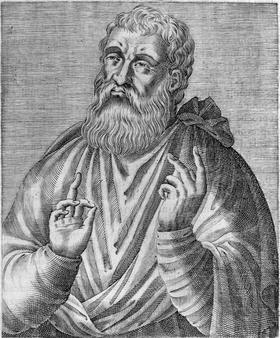
c. 400
Church Father

A monk counts his prayers with pebbles

Palladius The Lausiac History, ch. 20 (Paul), 1 (tr. W. K. Lowther Clarke, 1918)

“But his work and his asceticism consisted in ceaseless prayer. So he had 300 set prayers, and he collected as many pebbles and kept them in his lap and threw out of his lap one pebble at each prayer.”

Read it in the source: tertullian.org

See it on the timeline: The Rosary

c. 400A bishop in a gold cope sits at a desk with a quill in one hand and a flaming heart in the other, looking up at a burst of light
Church Father
St. Augustine On Baptism, Against the Donatists 5.8.9

“so any one who uses baptism unlawfully, either because he lives in heresy, or because he lives the worst of lives, yet cannot cause that the baptism should be otherwise than good, or altogether null and void. And so, when he is converted either to Catholic unity, or to a mode of living worthy of so great a sacrament, he begins to have not another and a lawful baptism, but that same baptism in a lawful manner.”

Read it in the source: New Advent

See it on the timeline: Baptism

c. 400
Church Father
St. Augustine of Hippo On Baptism, Against the Donatists, Book 1, ch. 1

“so those who return, having been ordained before their secession, are certainly not ordained again; but either they again exercise their former ministry, if the interests of the Church require it, or if they do not exercise it, at any rate they retain the sacrament of their ordination”

Read it in the source: New Advent

See it on the timeline: Holy Orders

c. 401
Church Father
St. Augustine of Hippo Of Holy Virginity, 4

“This is shown by the words which Mary spoke in answer to the Angel announcing to her her conception; How, says she, shall this be, seeing I know not a man? Which assuredly she would not say, unless she had before vowed herself unto God as a virgin.”

Read it in the source: New Advent

See it on the timeline: Perpetual virginity

c. 401
Church Father
St. Augustine of Hippo Of Holy Virginity, 6

“And a mother indeed in the Spirit, not of our Head, Which is the Saviour Himself, of Whom rather she was born after the Spirit: forasmuch as all, who have believed in Him, among whom is herself also, are rightly called children of the Bridegroom: but clearly the mother of His members, which are we: in that she wrought together by charity, that faithful ones should be born in the Church, who are members of That Head: but in the flesh, the mother of the Head Himself.”

Read it in the source: New Advent

See it on the timeline: Mary as Mediatrix

c. 401
Church Father
St. Augustine On the Good of Marriage, ch. 32

“Therefore that marriage takes place for the sake of begetting children, the Apostle is a witness thus, I will, says he, that the younger women be married. … But unto the sanctity of the Sacrament that saying, The wife not to depart from her husband, but, in case she shall have departed, to remain unmarried, or to be reconciled to her husband: and let not the husband put away his wife. All these are goods, on account of which marriage is a good; offspring, faith, sacrament.”

Read it in the source: New Advent

See it on the timeline: Matrimony

c. 402An old man with a bald head and a red cloak leans over a large book, pen in hand, with a skull resting on another book on the table
Church Father
St. Jerome Apology Against Rufinus 2.33

“The churches choose to read Daniel in the version of Theodotion. What sin have I committed in following the judgment of the churches? But when I repeat what the Jews say against the Story of Susanna and the Hymn of the Three Children, and the fables of Bel and the Dragon, which are not contained in the Hebrew Bible, the man who makes this a charge against me proves himself to be a fool and a slanderer; for I explained not what I thought but what they commonly say against us.”

Read it in the source: New Advent

See it on the timeline: The Old Testament canon

c. 403A gold mosaic of a bishop in white vestments marked with crosses, holding a book, with his name in Greek letters on either side
Church Father
St. John Chrysostom Homily 17 on Hebrews, 6

“What then? Do not we offer every day? We offer indeed, but making a remembrance of His death … For we always offer the same, not one sheep now and tomorrow another, but always the same thing: so that the sacrifice is one. … It is not another sacrifice, as the High Priest, but we offer always the same, or rather we perform a remembrance of a Sacrifice.”

Read it in the source: New Advent

See it on the timeline: The Mass as sacrifice

404
Church Father

The bishop of Constantinople appeals to the bishop of Rome

St. John Chrysostom Letter to Innocent, Bishop of Rome, 4 (the first letter on the linked page)

“Therefore to prevent such confusion overtaking the whole earth yield to our entreaties that you will signify by writing that these lawless transactions executed in our absence, and after hearing one side only, although we did not decline a trial, are invalid, as indeed they are by the very nature of the case, and that those who are convicted of having committed such iniquities must be subjected to the penalty of the ecclesiastical laws”

Read it in the source: New Advent

See it on the timeline: The East-West Schism

c. 392-418A bishop in a gold cope sits at a desk with a quill in one hand and a flaming heart in the other, looking up at a burst of light
Church Father
St. Augustine of Hippo Exposition on Psalm 99, 8

“For He took upon Him earth from earth; because flesh is from earth, and He received flesh from the flesh of Mary. And because He walked here in very flesh, and gave that very flesh to us to eat for our salvation; and no one eats that flesh, unless he has first worshipped: we have found out in what sense such a footstool of our Lord's may be worshipped, and not only that we sin not in worshipping it, but that we sin in not worshipping.”

Read it in the source: New Advent

See it on the timeline: The Real Presence

c. 392-418
Church Father
St. Augustine of Hippo Exposition on Psalm 34, 1

“And was carried in His Own Hands: how carried in His Own Hands? Because when He commended His Own Body and Blood, He took into His Hands that which the faithful know; and in a manner carried Himself, when He said, This is My Body.”

Read it in the source: New Advent

See it on the timeline: The Real Presence and the Ascension

c. 392-418
Church Father
St. Augustine of Hippo Exposition on Psalm 99, 8

“How then shall we worship the earth, when the Scripture says openly, You shall worship the Lord your God? … In hesitation I turn unto Christ, since I am herein seeking Himself: and I discover how the earth may be worshipped without impiety, how His footstool may be worshipped without impiety. For He took upon Him earth from earth; because flesh is from earth, and He received flesh from the flesh of Mary. And because He walked here in very flesh, and gave that very flesh to us to eat for our salvation; and no one eats that flesh, unless he has first worshipped: we have found out in what sense such a footstool of our Lord's may be worshipped, and not only that we sin not in worshipping it, but that we sin in not worshipping.”

Read it in the source: New Advent

See it on the timeline: Adoring the Eucharist

c. 405
Church Father
St. Augustine of Hippo Letter 82, ch. 1, section 3, to Jerome

“For I confess to your Charity that I have learned to yield this respect and honour only to the canonical books of Scripture: of these alone do I most firmly believe that the authors were completely free from error. … As to all other writings, in reading them, however great the superiority of the authors to myself in sanctity and learning, I do not accept their teaching as true on the mere ground of the opinion being held by them; but only because they have succeeded in convincing my judgment of its truth either by means of these canonical writings themselves, or by arguments addressed to my reason.”

Read it in the source: New Advent

See it on the timeline: The authority of the Fathers

c. 405
Church Father
St. Augustine of Hippo Letter 82, ch. 2, section 11, to Jerome

“For we do not deny that Peter was already of the same opinion in regard to this question as Paul himself was. Paul, therefore, was not teaching Peter what was the truth concerning that matter, but was reproving his dissimulation as a thing by which the Gentiles were compelled to act as Jews did”

Read it in the source: New Advent

See it on the timeline: Papal infallibility

c. 392-418
Church Father
St. Augustine of Hippo Exposition on Psalm 102, 26

“…why is it that you say that the Church has already perished from among all nations, when the Gospel is being preached for this purpose, that it may be in all nations? Therefore the Church remains even unto the end of the world, in all nations…”

Read it in the source: New Advent

See it on the timeline: Was the Church corrupted early?

c. 392-420
Church Father
St. Augustine of Hippo Exposition on Psalm 19 (Psalm 18 in the Vulgate), 13-14

“Who understands sins? … Yea, as darkness closes the eye, so do sins the mind, and suffer it not to see either the light, or itself. 14. Cleanse me, O Lord, from my secret faults. From the lusts which lie hidden in me, cleanse me, O Lord.”

Read it in the source: New Advent

See it on the timeline: Assurance of salvation

406An old man with a bald head and a red cloak leans over a large book, pen in hand, with a skull resting on another book on the table
Church Father
St. Jerome Against Vigilantius, 2

“What are the Churches of the East to do? What is to become of the Egyptian Churches and those belonging to the Apostolic Seat, which accept for the ministry only men who are virgins, or those who practice continency, or, if married, abandon their conjugal rights?”

Read it in the source: New Advent

See it on the timeline: Priestly celibacy

406
Church Father
St. Jerome Against Vigilantius 6

“If Apostles and martyrs while still in the body can pray for others, when they ought still to be anxious for themselves, how much more must they do so when once they have won their crowns, overcome, and triumphed?”

Read it in the source: New Advent

See it on the timeline: Praying to saints

407A gold mosaic of a bishop in white vestments marked with crosses, holding a book, with his name in Greek letters on either side
Church Father

St. John Chrysostom, bishop and Doctor

St. John Chrysostom Homilies on Matthew 50.4

“Would you do honor to Christ's body? Neglect Him not when naked; do not while here you honor Him with silken garments, neglect Him perishing without of cold and nakedness. For He that said, This is my body, and by His word confirmed the fact, This same said, You saw me an hungered, and fed me not”

Read it in the source: New Advent

See it on the timeline: The Doctors of the Church

408A bishop in a gold cope sits at a desk with a quill in one hand and a flaming heart in the other, looking up at a burst of light
Church Father

St. Augustine changes his mind and accepts coercion

St. Augustine Letter 93, to Vincentius, no. 17

“I have therefore yielded to the evidence afforded by these instances which my colleagues have laid before me. For originally my opinion was, that no one should be coerced into the unity of Christ, that we must act only by words, fight only by arguments, and prevail by force of reason, lest we should have those whom we knew as avowed heretics feigning themselves to be Catholics. But this opinion of mine was overcome not by the words of those who controverted it, but by the conclusive instances to which they could point. For, in the first place, there was set over against my opinion my own town, which, although it was once wholly on the side of Donatus, was brought over to the Catholic unity by fear of the imperial edicts”

Read it in the source: New Advent

See it on the timeline: The Inquisition and the use of force against heresy

409
Church Father
St. Augustine of Hippo Letter 102, 12

“Therefore, from the beginning of the human race, whosoever believed in Him, and in any way knew Him, and lived in a pious and just manner according to His precepts, was undoubtedly saved by Him, in whatever time and place he may have lived.”

Read it in the source: New Advent

See it on the timeline: Other religions

409
Church Father

St. Augustine asks that the Donatists not be put to death

St. Augustine Letter 100, to Donatus the proconsul, nos. 1-2

“It is not their death, but their deliverance from error, that we seek to accomplish by the help of the terror of judges and of laws, whereby they may be preserved from falling under the penalty of eternal judgment … We beg you, therefore, when you are pronouncing judgment in cases affecting the Church, how wicked soever the injuries may be which you shall ascertain to have been attempted or inflicted on the Church, to forget that you have the power of capital punishment, and not to forget our request.”

Read it in the source: New Advent

See it on the timeline: The Inquisition and the use of force against heresy

early 5th c.
Church Father
St. Augustine of Hippo Exposition on Psalm 45, 29

“The Apostles were sent to you as fathers, instead of the Apostles sons have been born to you: there have been appointed Bishops. For in the present day, whence do the Bishops, throughout all the world, derive their origin? The Church itself calls them fathers; the Church itself brought them forth, and placed them on the thrones of the fathers.”

Read it in the source: New Advent

See it on the timeline: Calling priests "Father"

412
Church Father
St. Augustine of Hippo Letter 130, to Proba, ch. 10, 20

“The brethren in Egypt are reported to have very frequent prayers, but these very brief, and, as it were, sudden and ejaculatory, lest the wakeful and aroused attention which is indispensable in prayer should by protracted exercises vanish or lose its keenness. … To use much speaking in prayer is to employ a superfluity of words in asking a necessary thing; but to prolong prayer is to have the heart throbbing with continued pious emotion towards Him to whom we pray.”

Read it in the source: New Advent

See it on the timeline: The Rosary

c. 412
Church Father
St. Augustine of Hippo On Merit and the Forgiveness of Sins, and the Baptism of Infants 1.25

“If they must not be called penitents because they have not the sense of repenting, neither must they be called believers, because they likewise have not the sense of believing. But if they are rightly called believers, because they in a certain sense profess faith by the words of their parents, why are they not also held to be before that penitents when they are shown to renounce the devil and this world by the profession again of the same parents? … But yet who knows not that the baptized infant fails to be benefited from what he received as a little child, if on coming to years of reason he fails to believe and to abstain from unlawful desires?”

Read it in the source: New Advent

See it on the timeline: Infant baptism

415
Church Father
St. Augustine of Hippo On Nature and Grace, ch. 42

“We must except the holy Virgin Mary, concerning whom I wish to raise no question when it touches the subject of sins, out of honour to the Lord; for from Him we know what abundance of grace for overcoming sin in every particular was conferred upon her who had the merit to conceive and bear Him who undoubtedly had no sin. … Well, then, if, with this exception of the Virgin, we could only assemble together all the forementioned holy men and women, and ask them whether they lived without sin while they were in this life, what can we suppose would be their answer? Would it be in the language of our author, or in the words of the Apostle John? … If we say we have no sin, we deceive ourselves, and the truth is not in us?”

Read it in the source: New Advent

See it on the timeline: Mary without sin

c. 416
Church Father
St. Augustine of Hippo Tractates on the Gospel of John, Tractate 48, 6

“But of those sheep of which the apostle says, The Lord knows them that are His; … there is none of such sheep as these that the wolf seizes, or the thief steals, or the robber slays. He, who knows what He gave for them, is sure of their number. And it is this that He says: No one shall pluck them out of my hand;”

Read it in the source: New Advent

See it on the timeline: Eternal security

c. 417
Church Father
St. Augustine of Hippo City of God 10.20

“Thus He is both the Priest who offers and the Sacrifice offered. And He designed that there should be a daily sign of this in the sacrifice of the Church, which, being His body, learns to offer herself through Him.”

Read it in the source: New Advent

See it on the timeline: The Mass as sacrifice

417
Church Father
St. Augustine of Hippo Sermon 81 on the New Testament, 10 (Sermon 131 in the Benedictine numbering)

“For already have two councils on this question been sent to the Apostolic see; and rescripts also have come from thence. The question has been brought to an issue; would that their error may sometime be brought to an issue too!”

Read it in the source: New Advent

See it on the timeline: Papal supremacy

c. 417
Church Father
St. Augustine of Hippo City of God 11.12

“These, though they are certain that they shall be rewarded if they persevere, are not certain that they will persevere. For what man can know that he will persevere to the end in the exercise and increase of grace, unless he has been certified by some revelation from Him who, in His just and secret judgment, while He deceives none, informs few regarding this matter?”

Read it in the source: New Advent

See it on the timeline: Assurance of salvation

c. 417
Church Father
St. Augustine of Hippo City of God 10.1

“But that service which is due to men, and in reference to which the apostle writes that servants must be subject to their own masters … is usually designated by another word in Greek, whereas the service which is paid to God alone by worship, is always, or almost always, called λατρεία in the usage of those who wrote from the divine oracles.”

Read it in the source: New Advent

See it on the timeline: Honoring the Pope

c. 417
Church Father
St. Augustine of Hippo The City of God 11.6

“For in these days the morning and evening are counted, until, on the sixth day, all things which God then made were finished, and on the seventh the rest of God was mysteriously and sublimely signalized. What kind of days these were it is extremely difficult, or perhaps impossible for us to conceive, and how much more to say!”

Read it in the source: New Advent

See it on the timeline: Evolution and Genesis

c. 417
Church Father
St. Augustine of Hippo Tractates on the Gospel of John, Tractate 26, 15

“And thus He would have this meat and drink to be understood as meaning the fellowship of His own body and members, which is the holy Church … The sacrament of this thing, namely, of the unity of the body and blood of Christ, is prepared on the Lord's table in some places daily, in some places at certain intervals of days, and from the Lord's table it is taken, by some to life, by some to destruction”

Read it in the source: New Advent

See it on the timeline: The Eucharist

c. 416-420
Church Father
St. Augustine of Hippo Tractates on the Gospel of John 124.5

“On this rock, therefore, He said, which you have confessed, I will build my Church. For the Rock (Petra) was Christ; … and on this foundation was Peter himself also built. For other foundation can no man lay than that is laid, which is Christ Jesus. … The Church, therefore, which is founded in Christ received from Him the keys of the kingdom of heaven in the person of Peter, that is to say, the power of binding and loosing sins.”

Read it in the source: New Advent

See it on the timeline: Peter the rock

c. 419
Church Father
St. Augustine On Marriage and Concupiscence, Book 1, ch. 17

“For although propagation of offspring is not the motive of the intercourse, there is still no attempt to prevent such propagation, either by wrong desire or evil appliance. They who resort to these, although called by the name of spouses, are really not such; they retain no vestige of true matrimony, but pretend the honourable designation as a cloak for criminal conduct. … Sometimes, indeed, this lustful cruelty, or, if you please, cruel lust, resorts to such extravagant methods as to use poisonous drugs to secure barrenness”

Read it in the source: New Advent

See it on the timeline: Contraception

c. 419
Church Father

St. Augustine: the Spirit proceeds from the Son also

St. Augustine On the Trinity, Book 15, ch. 17, 29

“And yet it is not to no purpose that in this Trinity the Son and none other is called the Word of God, and the Holy Spirit and none other the Gift of God, and God the Father alone is He from whom the Word is born, and from whom the Holy Spirit principally proceeds. And therefore I have added the word principally, because we find that the Holy Spirit proceeds from the Son also. But the Father gave Him this too, not as to one already existing, and not yet having it; but whatever He gave to the only-begotten Word, He gave by begetting Him.”

Read it in the source: New Advent

See it on the timeline: The East-West Schism

420An old man with a bald head and a red cloak leans over a large book, pen in hand, with a skull resting on another book on the table
Church Father

St. Jerome, priest and Doctor

St. Jerome Letter 30, 7, as quoted by Benedict XVI, General Audience, 14 November 2007

“How could one live without the knowledge of Scripture, through which one learns to know Christ himself, who is the life of believers?”

Read it in the source: vatican.va

See it on the timeline: The Doctors of the Church

c. 421A bishop in a gold cope sits at a desk with a quill in one hand and a flaming heart in the other, looking up at a burst of light
Church Father
St. Augustine of Hippo Enchiridion, ch. 110

“Nor can it be denied that the souls of the dead are benefited by the piety of their living friends, who offer the sacrifice of the Mediator, or give alms in the church on their behalf. But these services are of advantage only to those who during their lives have earned such merit, that services of this kind can help them. For there is a manner of life which is neither so good as not to require these services after death, nor so bad that such services are of no avail after death;”

Read it in the source: New Advent

See it on the timeline: Purgatory

c. 421
Church Father
St. Augustine Enchiridion, ch. 85-86

“Now who is there that is not rather disposed to think that unformed abortions perish, like seeds that have never fructified? … And therefore the following question may be very carefully inquired into and discussed by learned men, though I do not know whether it is in man's power to resolve it: At what time the infant begins to live in the womb: whether life exists in a latent form before it manifests itself in the motions of the living being. To deny that the young who are cut out limb by limb from the womb, lest if they were left there dead the mother should die too, have never been alive, seems too audacious.”

Read it in the source: New Advent

See it on the timeline: Abortion

c. 425
Church Father
St. Augustine City of God, Book 18, ch. 41

“Finally, let our authors, among whom the canon of the sacred books is fixed and bounded, be far from disagreeing in any respect. It is not without good reason, then, that not merely a few people prating in the schools and gymnasia in captious disputations, but so many and great people, both learned and unlearned, in countries and cities, have believed that God spoke to them or by them, i.e. the canonical writers, when they wrote these books. There ought, indeed, to be but few of them, lest on account of their multitude what ought to be religiously esteemed should grow cheap; and yet not so few that their agreement should not be wonderful.”

Read it in the source: New Advent

See it on the timeline: The inspiration of Scripture

c. 425
Church Father
St. Augustine of Hippo City of God 18.36

“From this time, when the temple was rebuilt, down to the time of Aristobulus, the Jews had not kings but princes; and the reckoning of their dates is found, not in the Holy Scriptures which are called canonical, but in others, among which are also the books of the Maccabees. These are held as canonical, not by the Jews, but by the Church, on account of the extreme and wonderful sufferings of certain martyrs, who, before Christ had come in the flesh, contended for the law of God even unto death, and endured most grievous and horrible evils.”

Read it in the source: New Advent

See it on the timeline: The Old Testament canon

c. 426
Church Father
St. John Cassian Conferences 10, ch. 10

“And so for keeping up continual recollection of God this pious formula is to be ever set before you. O God, make speed to save me: O Lord, make haste to help me, for this verse has not unreasonably been picked out from the whole of Scripture for this purpose. … Let the thought of this verse, I tell you, be conned over in your breast without ceasing.”

Read it in the source: New Advent

See it on the timeline: The Rosary

c. 426A bishop in a gold cope sits at a desk with a quill in one hand and a flaming heart in the other, looking up at a burst of light
Church Father
St. Augustine of Hippo The City of God 20.10

“…but they shall be priests of God and Christ, and shall reign with Him a thousand years; and this refers not to the bishops alone, and presbyters, who are now specially called priests in the Church; but as we call all believers Christians on account of the mystical chrism, so we call all priests because they are members of the one Priest.”

Read it in the source: New Advent

See it on the timeline: The ordained priesthood

c. 426
Church Father
St. Augustine of Hippo On Grace and Free Will, ch. 20

“And the apostle himself, after saying, By grace are you saved through faith; and that not of yourselves, it is the gift of God: not of works, lest any man should boast; … saw, of course, the possibility that men would think from this statement that good works are not necessary to those who believe, but that faith alone suffices for them; and again, the possibility of men's boasting of their good works, as if they were of themselves capable of performing them. To meet, therefore, these opinions on both sides, he immediately added, For we are His workmanship, created in Christ Jesus unto good works, which God has before ordained that we should walk in them. … It follows, then, dearly beloved, beyond all doubt, that as your good life is nothing else than God's grace, so also the eternal life which is the recompense of a good life is the grace of God;”

Read it in the source: New Advent

See it on the timeline: Faith and works

c. 426
Church Father
St. Augustine of Hippo City of God 21.13

“But temporary punishments are suffered by some in this life only, by others after death, by others both now and then; but all of them before that last and strictest judgment. But of those who suffer temporary punishments after death, all are not doomed to those everlasting pains which are to follow that judgment;”

Read it in the source: New Advent

See it on the timeline: Purgatory

c. 427
Church Father
St. Augustine of Hippo On Rebuke and Grace, ch. 18

“It is, indeed, to be wondered at, and greatly to be wondered at, that to some of His own children — whom He has regenerated in Christ — to whom He has given faith, hope, and love, God does not give perseverance also, when to children of another He forgives such wickedness, and, by the bestowal of His grace, makes them His own children.”

Read it in the source: New Advent

See it on the timeline: Eternal security

430
Church Father

St. Augustine of Hippo, bishop and Doctor

St. Augustine of Hippo Confessions 10.27.38

“Too late did I love You, O Fairness, so ancient, and yet so new! Too late did I love You! For behold, You were within, and I without, and there did I seek You; I, unlovely, rushed heedlessly among the things of beauty You made. You were with me, but I was not with You.”

Read it in the source: New Advent

See it on the timeline: The Doctors of the Church

434
Church Father
St. Vincent of Lerins Commonitory, ch. 1, 1

“I, Peregrinus, who am the least of all the servants of God, remembering the admonition of Scripture, Ask your fathers and they will tell you, your elders and they will declare unto you, Deuteronomy 32:7”

Read it in the source: New Advent

See it on the timeline: The authority of the Fathers

434
Church Father
St. Vincent of Lerins Commonitory, ch. 3, 8

“But what, if in antiquity itself there be found error on the part of two or three men, or at any rate of a city or even of a province? Then it will be his care by all means, to prefer the decrees, if such there be, of an ancient General Council to the rashness and ignorance of a few. But what, if some error should spring up on which no such decree is found to bear? Then he must collate and consult and interrogate the opinions of the ancients, of those, namely, who, though living in various times and places, yet continuing in the communion and faith of the one Catholic Church, stand forth acknowledged and approved authorities: and whatsoever he shall ascertain to have been held, written, taught, not by one or two of these only, but by all, equally, with one consent, openly, frequently, persistently, that he must understand that he himself also is to believe without any doubt or hesitation.”

Read it in the source: New Advent

See it on the timeline: The authority of the Fathers

434
Church Father
St. Vincent of Lerins Commonitory, ch. 2, 5

“But here some one perhaps will ask, Since the canon of Scripture is complete, and sufficient of itself for everything, and more than sufficient, what need is there to join with it the authority of the Church's interpretation? For this reason — because, owing to the depth of Holy Scripture, all do not accept it in one and the same sense, but one understands its words in one way, another in another; so that it seems to be capable of as many interpretations as there are interpreters.”

Read it in the source: New Advent

See it on the timeline: The Magisterium

434
Church Father
St. Vincent of Lerins Commonitory, ch. 23, 54

“But some one will say, perhaps, Shall there, then, be no progress in Christ's Church? Certainly; all possible progress. … Yet on condition that it be real progress, not alteration of the faith. … The intelligence, then, the knowledge, the wisdom, as well of individuals as of all, as well of one man as of the whole Church, ought, in the course of ages and centuries, to increase and make much and vigorous progress; but yet only in its own kind; that is to say, in the same doctrine, in the same sense, and in the same meaning.”

Read it in the source: New Advent

See it on the timeline: Doctrines defined later

434
Church Father
St. Vincent of Lerins Commonitory, ch. 28, 72

“Whom yet we are to believe in this condition, that that only is to be accounted indubitable, certain, established, which either all, or the more part, have supported and confirmed manifestly, frequently, persistently, in one and the same sense, forming, as it were, a consentient council of doctors, all receiving, holding, handing on the same doctrine. But whatsoever a teacher holds, other than all, or contrary to all, be he holy and learned, be he a bishop, be he a Confessor, be he a martyr, let that be regarded as a private fancy of his own, and be separated from the authority of common, public, general persuasion”

Read it in the source: New Advent

See it on the timeline: The authority of the Fathers

434
Church Father
St. Vincent of Lerins Commonitory, ch. 8, 22

“Why does he say Though we? Why not rather though I? He means, though Peter, though Andrew, though John, in a word, though the whole company of apostles, preach unto you other than we have preached unto you, let him be accursed. Tremendous severity! He spares neither himself nor his fellow apostles, so he may preserve unaltered the faith which was at first delivered.”

Read it in the source: New Advent

See it on the timeline: The Magisterium

434
Church Father
St. Vincent of Lerins Commonitory, ch. 23, 59

“But the Church of Christ, the careful and watchful guardian of the doctrines deposited in her charge, never changes anything in them, never diminishes, never adds … This, I say, is what the Catholic Church, roused by the novelties of heretics, has accomplished by the decrees of her Councils — this, and nothing else — she has thenceforward consigned to posterity in writing what she had received from those of olden times only by tradition, comprising a great amount of matter in a few words, and often, for the better understanding, designating an old article of the faith by the characteristic of a new name.”

Read it in the source: New Advent

See it on the timeline: Doctrines defined later

434
Church Father
St. Vincent of Lerins Commonitory, ch. 19, 47

“It behooves us, then, to give heed to these instances from Church History, so many and so great, and others of the same description, and to understand distinctly, in accordance with the rule laid down in Deuteronomy, that if at any time a Doctor in the Church have erred from the faith, Divine Providence permits it in order to make trial of us, whether or not we love God with all our heart and with all our mind.”

Read it in the source: New Advent

See it on the timeline: The authority of the Fathers

c. 441-445An oval painting of an old pope with a white beard in a tiara, holding a tall cross
Church Father
Pope St. Leo the Great Sermon 3, 1

“…those men are received by the Church as its rulers whom the Holy Ghost prepares: so that in the people of God's adoption, the whole body of which is priestly and royal, it is not the prerogative of earthly origin which obtains the unction, but the condescension of Divine grace which creates the bishop.”

Read it in the source: New Advent

See it on the timeline: The ordained priesthood

c. 441-445
Church Father

Peter still at work in his see

Pope St. Leo the Great Sermon 3, section 3, on the anniversary of his election

“And still today he more fully and effectually performs what is entrusted to him, and carries out every part of his duty and charge in Him and with Him, through Whom he has been glorified. And so if anything is rightly done and rightly decreed by us, if anything is won from the mercy of God by our daily supplications, it is of his work and merits whose power lives and whose authority prevails in his See.”

Read it in the source: New Advent

See it on the timeline: All the popes in order, from St. Peter to today
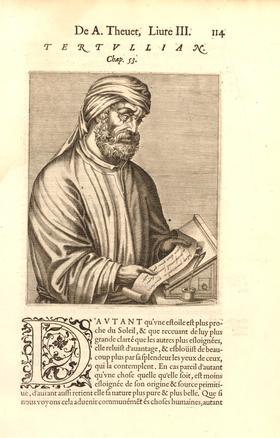
444A wall painting of a bishop with a pointed beard, in a cap and vestments patterned with crosses
Church Father

St. Cyril of Alexandria, bishop and Doctor

St. Cyril of Alexandria First Letter to Succensus, as quoted by Benedict XVI, General Audience, 3 October 2007

“Only one is the Son, only one the Lord Jesus Christ, both before the Incarnation and after the Incarnation. Indeed, the Logos born of God the Father was not one Son and the one born of the Blessed Virgin another; but we believe that the very One who was born before the ages was also born according to the flesh and of a woman”

Read it in the source: vatican.va

See it on the timeline: The Doctors of the Church

c. 440-450An oval painting of an old pope with a white beard in a tiara, holding a tall cross
Church Father
Pope St. Leo the Great Sermon 3, section 3

“…the blessed Peter persevering in the strength of the Rock, which he has received, has not abandoned the helm of the Church, which he undertook. For he was ordained before the rest in such a way that from his being called the Rock, from his being pronounced the Foundation, … we might know the nature of his association with Christ. … For this, dearly-beloved, was gained by that confession, which, inspired in the Apostle's heart by God the Father, transcended all the uncertainty of human opinions, and was endued with the firmness of a rock, which no assaults could shake.”

Read it in the source: New Advent

See it on the timeline: Peter the rock

c. 446
Church Father
Pope St. Leo the Great Letter 14, to Anastasius of Thessalonica, ch. 12

“…even among the blessed Apostles, notwithstanding the similarity of their honourable estate, there was a certain distinction of power, and while the election of them all was equal, yet it was given to one to take the lead of the rest. From which model has arisen a distinction between bishops also, … through whom the care of the universal Church should converge towards Peter's one seat, and nothing anywhere should be separated from its Head.”

Read it in the source: New Advent

See it on the timeline: Papal supremacy

c. 450
Church Father
Pope St. Leo the Great Sermon 21, 3

“Christian, acknowledge your dignity, and becoming a partner in the Divine nature, refuse to return to the old baseness by degenerate conduct. Remember the Head and the Body of which you are a member. Recollect that you were rescued from the power of darkness and brought out into God's light and kingdom.”

Read it in the source: New Advent

See it on the timeline: Are Catholics Christians?

c. 450
Church Father

St. Peter Chrysologus, bishop and Doctor

St. Peter Chrysologus Sermon 71, 3, as quoted in CCC 2777

“Our awareness of our status as slaves would make us sink into the ground and our earthly condition would dissolve into dust, if the authority of our Father himself and the Spirit of his Son had not impelled us to this cry . . . 'Abba, Father!' . . . When would a mortal dare call God 'Father,' if man's innermost being were not animated by power from on high?”

Read it in the source: vatican.va

See it on the timeline: The Doctors of the Church

452An oval painting of an old pope with a white beard in a tiara, holding a tall cross
Church Father
Pope St. Leo the Great Letter 108, 2

“For the Mediator between God and men, the Man Christ Jesus, has transmitted this power to those that are set over the Church that they should both grant a course of penitence to those who confess, and, when they are cleansed by wholesome correction admit them through the door of reconciliation to communion in the sacraments.”

Read it in the source: New Advent

See it on the timeline: Confession to a priest

452
Church Father

Leo the Great refuses canon 28

Pope St. Leo the Great Letter 105, to the Empress Pulcheria, ch. 3

“But the bishops' assents, which are opposed to the regulations of the holy canons composed at Nicæa in conjunction with your faithful Grace, we do not recognize, and by the blessed Apostle Peter's authority we absolutely dis-annul in comprehensive terms”

Read it in the source: New Advent

See it on the timeline: The tradition of the papacy

c. 458
Church Father
Pope St. Leo the Great Letter 167, Question 3

“The law of continence is the same for the ministers of the altar as for bishops and priests, who when they were laymen or readers, could lawfully marry and have offspring. But when they reached to the said ranks, what was before lawful ceased to be so. And hence, in order that their wedlock may become spiritual instead of carnal, it behooves them not to put away their wives but to have them as though they had them not”

Read it in the source: New Advent

See it on the timeline: Priestly celibacy

461
Church Father

St. Leo the Great, pope and Doctor

Pope St. Leo the Great Sermon 21, 1

“Our Saviour, dearly-beloved, was born today: let us be glad. For there is no proper place for sadness, when we keep the birthday of the Life, which destroys the fear of mortality and brings to us the joy of promised eternity. No one is kept from sharing in this happiness.”

Read it in the source: New Advent

See it on the timeline: The Doctors of the Church

494
Church Father

Pope Gelasius: two powers rule the world

Pope St. Gelasius I Letter to the Emperor Anastasius, 494

“There are two powers, august Emperor, by which this world is chiefly ruled, namely, the sacred authority of the priests and the royal power. Of these that of the priests is the more weighty, since they have to render an account for even the kings of men in the divine judgment.”

Read it in the source: Fordham Sourcebook

See it on the timeline: The tradition of the papacy

519
Church Father

The Acacian schism ends: the formula of Pope Hormisdas

Pope St. Hormisdas Formula of Hormisdas, as quoted by the First Vatican Council, Pastor Aeternus, ch. 4

“The first condition of salvation is to maintain the rule of the true faith. And since that saying of our lord Jesus Christ, You are Peter, and upon this rock I will build my church … cannot fail of its effect, the words spoken are confirmed by their consequences. For in the apostolic see the catholic religion has always been preserved unblemished, and sacred doctrine been held in honour. Since it is our earnest desire to be in no way separated from this faith and doctrine, we hope that we may deserve to remain in that one communion which the apostolic see preaches, for in it is the whole and true strength of the christian religion”

Read it in the source: Papal Encyclicals Online

See it on the timeline: The East-West Schism

c. 540A monk in a black habit reads a book, holding an abbot's staff, with a landscape behind him
Church Father
St. Benedict of Nursia Rule, ch. 2, What the Abbot Should Be Like

“An abbot who is worthy to preside over a monastery ought always to remember what he is called, and carry out with his deeds the name of a Superior. For he is believed to be Christ's representative, since he is called by His name, the apostle saying: "Ye have received the spirit of adoption of sons, whereby we call Abba, Father."”

Read it in the source: Fordham Sourcebook

See it on the timeline: Calling priests "Father"

c. 591A pope in a tiara and a pale cope bends over a large book, writing
Church Father
Pope St. Gregory the Great Registrum Epistolarum, Book I, Letter 43, to Leander of Seville

“But with respect to trine immersion in baptism, no truer answer can be given than what you have yourself felt to be right; namely that, where there is one faith, a diversity of usage does no harm to holy Church. Now we, in immersing thrice, signify the sacraments of the three days' sepulture; so that, when the infant is a third time lifted out of the water, the resurrection after a space of three days may be expressed.”

Read it in the source: New Advent

See it on the timeline: Baptism by pouring

591
Church Father

St. Gregory the Great forbids baptism by force

Pope St. Gregory the Great Registrum Epistolarum, Book 1, Letter 47, to Virgilius of Arles and Theodorus of Marseilles

“Very many, though indeed of the Jewish religion, resident in this province, and from time to time travelling for various matters of business to the regions of Massilia, have apprized us, that many of the Jews settled in those parts have been brought to the font of baptism more by force than by preaching. … For, when any one is brought to the font of baptism, not by the sweetness of preaching, but by compulsion, he returns to his former superstition, and dies the worse from having been born again.”

Read it in the source: New Advent

See it on the timeline: The Church and the Jewish people

c. 597
Church Father
St. Gregory the Great Letters, Book VII, Letter 25, to Gregoria

“…I know that you fervently love the Almighty Lord, and I trust in His mercy that the sentence which was pronounced with regard to a certain holy woman proceeds from the mouth of the Truth with regard to you: Her sins, which are many, are forgiven her, for she loved much … you have demanded a difficult, nay even an unprofitable thing; difficult indeed, because I am unworthy of having a revelation made to me; but unprofitable, because you ought not to become secure about your sins, except when in the last day of your life you shall be able no longer to bewail them.”

Read it in the source: New Advent

See it on the timeline: Assurance of salvation

c. 598
Church Father
Pope St. Gregory the Great Register of Letters, Book IX, Letter 12, to John of Syracuse

“For as to what they say about the Church of Constantinople, who can doubt that it is subject to the Apostolic See, as both the most pious lord the emperor and our brother the bishop of that city continually acknowledge? Yet, if this or any other Church has anything that is good, I am prepared in what is good to imitate even my inferiors”

Read it in the source: New Advent

See it on the timeline: Papal supremacy

c. 598
Church Father
Pope St. Gregory the Great Registrum, Book VIII, Letter 30, to Eulogius of Alexandria

“For as for me, I do not seek to be prospered by words but by my conduct. Nor do I regard that as an honour whereby I know that my brethren lose their honour. For my honour is the honour of the universal Church: my honour is the solid vigour of my brethren. Then am I truly honoured when the honour due to all and each is not denied them.”

Read it in the source: New Advent

See it on the timeline: Honoring the Pope

598
Church Father

Gregory the Great refuses the title "Universal Pope"

Pope St. Gregory the Great Register of Letters, Book VIII, Letter 30, to Eulogius of Alexandria

“For my honour is the honour of the universal Church: my honour is the solid vigour of my brethren. Then am I truly honoured when the honour due to all and each is not denied them. For if your Holiness calls me Universal Pope, you deny that you are yourself what you call me universally.”

Read it in the source: New Advent

See it on the timeline: The tradition of the papacy

c. 600
Church Father
Pope St. Gregory the Great Registrum, Book XI, Letter 13, to Serenus of Marseilles

“And indeed in that you forbade them to be adored, we altogether praise you; but we blame you for having broken them. … For to adore a picture is one thing, but to learn through the story of a picture what is to be adored is another.”

Read it in the source: New Advent

See it on the timeline: Images and statues

604
Church Father

St. Gregory the Great, pope and Doctor

Pope St. Gregory the Great Pastoral Rule, Book 1, ch. 1

“No one presumes to teach an art till he has first, with intent meditation, learned it. What rashness is it, then, for the unskilful to assume pastoral authority, since the government of souls is the art of arts!”

Read it in the source: New Advent

See it on the timeline: The Doctors of the Church

636An old bishop in white and gold vestments and a mitre sits reading a large book, holding a crozier
Church Father

St. Isidore of Seville, bishop and Doctor

St. Isidore of Seville Differentiarum Liber II, 34, 135, as quoted by Benedict XVI, General Audience, 18 June 2008

“Therefore let the servant of God, imitating Christ, dedicate himself to contemplation without denying himself active life. Behaving otherwise would not be right. Indeed, just as we must love God in contemplation, so we must love our neighbour with action.”

Read it in the source: vatican.va

See it on the timeline: The Doctors of the Church

c. 643
Church Father

St. Maximus the Confessor on communion with the Roman see

St. Maximus the Confessor Letter to Peter the Illustrious, as quoted by Pope Leo XIII, Satis Cognitum 13

“Therefore if a man does not want to be, or to be called, a heretic, let him not strive to please this or that man … but let him hasten before all things to be in communion with the Roman See. If he be in communion with it, he should be acknowledged by all and everywhere as faithful and orthodox. He speaks in vain who tries to persuade me of the orthodoxy of those who, like himself, refuse obedience to his Holiness the Pope of the most holy Church of Rome: that is to the Apostolic See.”

Read it in the source: vatican.va

See it on the timeline: The East-West Schism

c. 645
Church Father

St. Maximus explains the Latin wording to the Greeks

St. Maximus the Confessor Letter to Marinus of Cyprus, as quoted by the Pontifical Council for Promoting Christian Unity, The Greek and Latin Traditions Regarding the Procession of the Holy Spirit (1995)

“For the procession they [the Romans] brought the witness of the Latin Fathers, as well, of course, as that of St Cyril of Alexandria in his sacred study on the Gospel of St John. On this basis they showed that they themselves do not make the Son Cause (Aitia) of the Spirit. They know, indeed, that the Father is the sole Cause of the Son and of the Spirit … they explained that the latter comes (proienai) through the Son, and they showed in this way the unity and the immutability of the essence”

Read it in the source: EWTN Library

See it on the timeline: The East-West Schism

735An old monk sits propped in a chair, speaking, while a young monk kneels beside him writing on a scroll
Church Father

St. Bede the Venerable, priest and Doctor

St. Bede Ecclesiastical History of the English Nation, Book 5, ch. 24 (written c. 731)

“And now, I beseech thee, good Jesus, that to whom thou hast graciously granted sweetly to partake of the words of thy wisdom and knowledge, thou wilt also vouchsafe that he may some time or other come to thee, the fountain of all wisdom, and always appear before thy face, who livest and reignest world without end.”

Read it in the source: Fordham Sourcebook

See it on the timeline: The Doctors of the Church

c. 740A monk in a turban and brown robes with a halo holds an unrolled scroll of Greek text
Church Father
St. John Damascene Sermon II on the Assumption (Second Homily on the Dormition)

“It was fitting that the body of her, who preserved her virginity unsullied in her motherhood, should be kept from corruption even after death. She who nursed her Creator as an infant at her breast, had a right to be in the divine tabernacles. … It was fitting that she who saw her Son die on the cross, and received in her heart the sword of pain which she had not felt in childbirth, should gaze upon Him seated next to the Father.”

Read it in the source: Fordham Sourcebook

See it on the timeline: The Assumption

c. 743
Church Father
St. John Damascene Exposition of the Orthodox Faith 4.14

“Then planted in the House of God and increased by the Spirit, like a fruitful olive tree, she became the home of every virtue, turning her mind away from every secular and carnal desire, and thus keeping her soul as well as her body virginal, as was meet for her who was to receive God into her bosom: for as He is holy, He finds rest among the holy. Thus, therefore, she strove after holiness, and was declared a holy and wonderful temple fit for the most high God.”

Read it in the source: New Advent

See it on the timeline: Mary without sin

c. 743
Church Father
St. John Damascene Exposition of the Orthodox Faith 4.14

“The ever-virgin One thus remains even after the birth still virgin, having never at any time up till death consorted with a man. For although it is written, And knew her not till she had brought forth her first-born Son … yet note that he who is first-begotten is first-born even if he is only-begotten. For the word first-born means that he was born first but does not at all suggest the birth of others. And the word till signifies the limit of the appointed time but does not exclude the time thereafter.”

Read it in the source: New Advent

See it on the timeline: Perpetual virginity

c. 743
Church Father
St. John Damascene Exposition of the Orthodox Faith 4.13

“The body which is born of the holy Virgin is in truth body united with divinity, not that the body which was received up into the heavens descends, but that the bread itself and the wine are changed into God's body and blood.”

Read it in the source: New Advent

See it on the timeline: The Real Presence and the Ascension

c. 743
Church Father
St. John Damascene Exposition of the Orthodox Faith 4.13

“And now you ask, how the bread became Christ's body and the wine and water Christ's blood. And I say unto you, The Holy Spirit is present and does those things which surpass reason and thought.”

Read it in the source: New Advent

See it on the timeline: Transubstantiation

c. 743
Church Father
St. John Damascene An Exposition of the Orthodox Faith 4.16

“But besides this who can make an imitation of the invisible, incorporeal, uncircumscribed, formless God? Therefore to give form to the Deity is the height of folly and impiety. And hence it is that in the Old Testament the use of images was not common. But after God in His bowels of pity became in truth man for our salvation, not as He was seen by Abraham in the semblance of a man, nor as He was seen by the prophets, but in being truly man, and after He lived upon the earth and dwelt among men”

Read it in the source: New Advent

See it on the timeline: Images and statues

c. 743A tall icon of a bishop with a dark pointed beard holding a book, surrounded by many small painted scenes
Church Father

An Eastern Father on the procession of the Spirit

St. John Damascene An Exposition of the Orthodox Faith, Book 1, ch. 8

“And we speak likewise of the Holy Spirit as from the Father, and call Him the Spirit of the Father. And we do not speak of the Spirit as from the Son : but yet we call Him the Spirit of the Son. … And we confess that He is manifested and imparted to us through the Son.”

Read it in the source: New Advent

See it on the timeline: The East-West Schism