Tradition Timeline Leave an objection

Start page / Objections / The Church

“The true church is invisible. It is made up of all believers in every denomination. No single visible body, and certainly not the Catholic Church, can claim to be the one church Christ founded.”

Verses cited for this objection: Matt. 18:20, Eph. 4:4-6, Rev. 2-3

Each mark is one quotation. Touch the timeline to read it.
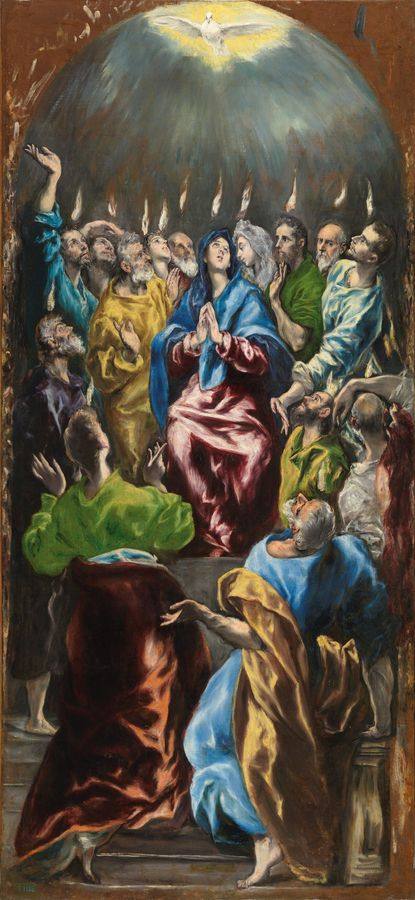
The Virgin Mary and the apostles look up as tongues of fire rest on their heads beneath a dove in a burst of light
Pentecost, by El Greco, in the Prado, Madrid. Painting: El Greco, about 1600, Public domain, via Wikimedia Commons. Resized.

Short answer

Jesus spoke of one flock and of a church that a dispute can be brought to and that can be heard. Christian writers of the second, third and fourth centuries wrote of one Church that can be found, gathered around its bishops, and they treated separation from it as a real loss. The Church teaches that this one Church of Christ, set up in the world as a society, subsists in the Catholic Church. She also teaches that many elements of sanctification and of truth are found outside her visible structure, and that the Spirit of Christ uses other Churches and communities as means of salvation.

Where it starts with Jesus

On the night before he died, Jesus prays that all who believe in him may be one, so that the world may believe that the Father sent him.

““I do not pray for these only, but also for those who believe in me through their word, that they may all be one; even as thou, Father, art in me, and I in thee, that they also may be in us, so that the world may believe that thou hast sent me.”

JesusJohn 17:20-21Read it in the source: Bible Gateway, RSV Catholic Edition

How it points to Jesus

The unity of the Church is his prayer, and he gives its purpose: that the world may believe in him. A Church that can be seen and found is a sign that points to Jesus. The Church holds that this unity is his gift.

Drafted from primary sources. Every quotation is checked against the page it links to.

20 quotations in date order

A work in progress. The quotations below are not all the evidence on this matter. More are being added.

The Old Testamentbefore Christ
Old Testament
Scripture
The Book of Exodus Exodus 19:5-6

“Now therefore, if you will obey my voice and keep my covenant, you shall be my own possession among all peoples; for all the earth is mine, and you shall be to me a kingdom of priests and a holy nation. These are the words which you shall speak to the children of Israel.””
Read it in the source: Bible Gateway, RSV Catholic Edition

Old Testament
Scripture
The Book of Genesis Genesis 12:2-3

“And I will make of you a great nation, and I will bless you, and make your name great, so that you will be a blessing. I will bless those who bless you, and him who curses you I will curse; and by you all the families of the earth shall bless themselves.””

Read it in the source: Bible Gateway, RSV Catholic Edition

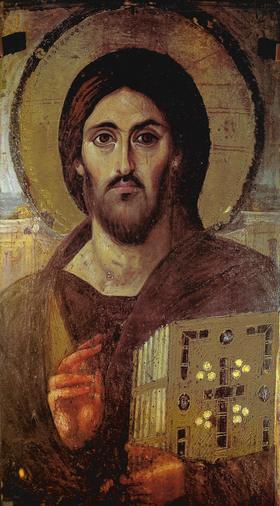
c. AD 30An ancient painted icon of Christ with a dark beard and a gold halo, his right hand raised in blessing and a jewelled book of the Gospels in his left
Scripture
Jesus John 10:16

“And I have other sheep, that are not of this fold; I must bring them also, and they will heed my voice. So there shall be one flock, one shepherd.”

Read it in the source: Bible Gateway, RSV Catholic Edition

c. AD 30
Scripture
Jesus Matthew 18:16-17, 20

“But if he does not listen, take one or two others along with you, that every word may be confirmed by the evidence of two or three witnesses. If he refuses to listen to them, tell it to the church; and if he refuses to listen even to the church, let him be to you as a Gentile and a tax collector. … For where two or three are gathered in my name, there am I in the midst of them.”

Read it in the source: Bible Gateway, RSV Catholic Edition

c. AD 30
Scripture
Jesus, praying to the Father John 17:20-21

“I do not pray for these only, but also for those who believe in me through their word, that they may all be one; even as thou, Father, art in me, and I in thee, that they also may be in us, so that the world may believe that thou hast sent me.”

Read it in the source: Bible Gateway, RSV Catholic Edition

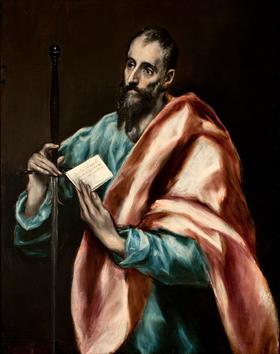
c. 60-62A bald, bearded apostle in a red cloak over a blue tunic, holding a folded letter in one hand and resting the other on a long sword
Scripture
St. Paul Ephesians 4:4-6

“There is one body and one Spirit, just as you were called to the one hope that belongs to your call, one Lord, one faith, one baptism, one God and Father of us all, who is above all and through all and in all.”

Read it in the source: Bible Gateway, RSV Catholic Edition

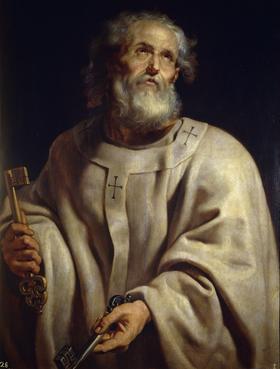
c. 64An old man with white hair and beard in a cream cloak and a pallium, looking upward and holding two large keys
Scripture
St. Peter 1 Peter 2:9-10

“But you are a chosen race, a royal priesthood, a holy nation, God’s own people, that you may declare the wonderful deeds of him who called you out of darkness into his marvelous light. Once you were no people but now you are God’s people; once you had not received mercy but now you have received mercy.”

Read it in the source: Bible Gateway, RSV Catholic Edition

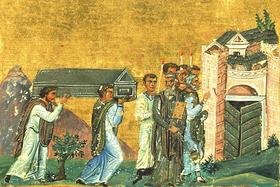
c. 107A manuscript painting on a gold ground of clergy carrying a casket towards a church building
Church Father
St. Ignatius of Antioch Letter to the Philadelphians, ch. 3

“For as many as are of God and of Jesus Christ are also with the bishop. And as many as shall, in the exercise of repentance, return into the unity of the Church, these, too, shall belong to God, that they may live according to Jesus Christ. Do not err, my brethren. If any man follows him that makes a schism in the Church, he shall not inherit the kingdom of God.”

Read it in the source: New Advent

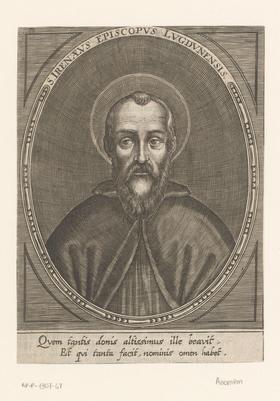
c. 180An engraved oval portrait of a bearded bishop with a halo, with a Latin inscription around the frame
Church Father
St. Irenaeus of Lyons Against Heresies 4.33.8

“True knowledge is [that which consists in] the doctrine of the apostles, and the ancient constitution of the Church throughout all the world, and the distinctive manifestation of the body of Christ according to the successions of the bishops, by which they have handed down that Church which exists in every place, and has come even unto us”

Read it in the source: New Advent

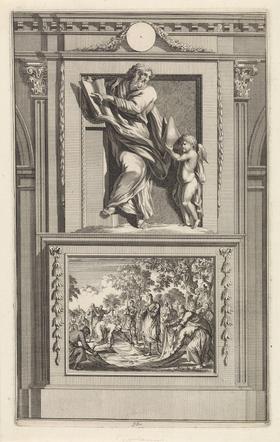
251An engraving of a bearded man in robes holding an open book, standing like a statue in a niche, with a small scene in a landscape on the base below
Church Father
St. Cyprian of Carthage On the Unity of the Church 12

“Nor let any deceive themselves by a futile interpretation, in respect of the Lord having said, Wheresoever two or three are gathered together in my name, there am I in the midst of them. … When, therefore, in His commandments He lays it down, and says, Where two or three are gathered together in my name, I am with them, He does not divide men from the Church, seeing that He Himself ordained and made the Church”

Read it in the source: New Advent

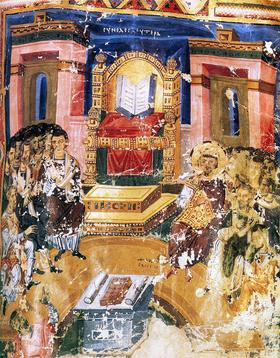
381A worn manuscript painting of bishops seated on either side of an empty throne that holds an open book
Council
First Council of Constantinople The creed of the council

“…in one, holy, catholic and apostolic church. We confess one baptism for the forgiving of sins.”

Read it in the source: Papal Encyclicals Online

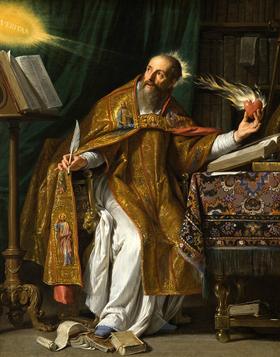
393A bishop in a gold cope sits at a desk with a quill in one hand and a flaming heart in the other, looking up at a burst of light
Church Father
St. Augustine of Hippo On Faith and the Creed, ch. 10, 21

“…we believe also in The Holy Church, [intending thereby] assuredly the Catholic. For both heretics and schismatics style their congregations churches. But heretics, in holding false opinions regarding God, do injury to the faith itself; while schismatics, on the other hand, in wicked separations break off from brotherly charity, although they may believe just what we believe.”

Read it in the source: New Advent

The Middle Ages800 to 1500
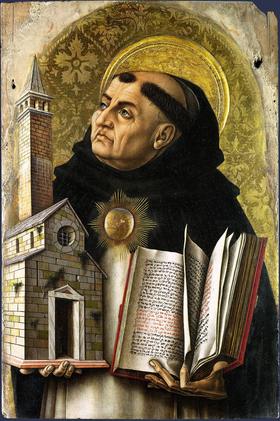
c. 1271A Dominican friar with a tonsure and a gold halo holds an open book and a small church, with a shining sun on his chest
Doctor of the Church
St. Thomas Aquinas Summa Theologiae II-II, q. 39, a. 1, body

“Now the unity of the Church consists in two things; namely, in the mutual connection or communion of the members of the Church, and again in the subordination of all the members of the Church to the one head … Now this Head is Christ Himself, Whose viceregent in the Church is the Sovereign Pontiff.”

Read it in the source: New Advent

The Modern Era1800 to today
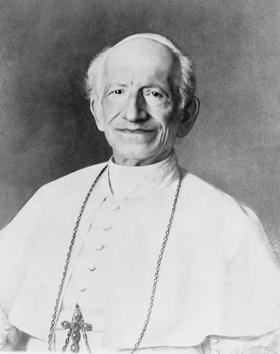
1896A black and white photograph of a very old, smiling pope in white with a pectoral cross
Magisterium
Pope Leo XIII Satis Cognitum 4

“But when we consider what was actually done we find that Jesus Christ did not, in point of fact, institute a Church to embrace several communities similar in nature, but in themselves distinct, and lacking those bonds which render the Church unique and indivisible after that manner in which in the symbol of our faith we profess: "I believe in one Church."”

Read it in the source: vatican.va

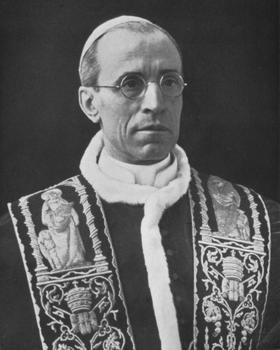
1943A black and white photograph of a thin pope in round spectacles wearing an embroidered stole
Magisterium
Pope Pius XII Mystici Corporis Christi 14

“Hence they err in a matter of divine truth, who imagine the Church to be invisible, intangible, a something merely “pneumatological” as they say, by which many Christian communities, though they differ from each other in their profession of faith, are united by an invisible bond.”

Read it in the source: Papal Encyclicals Online

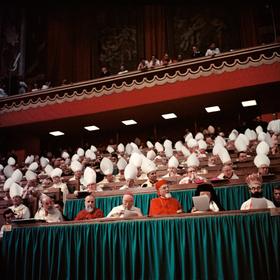
1964Rows of bishops in white mitres and copes sit in tiered stands hung with red and green cloth
Council
Second Vatican Council Lumen Gentium 8

“This Church constituted and organized in the world as a society, subsists in the Catholic Church, which is governed by the successor of Peter and by the Bishops in communion with him, … although many elements of sanctification and of truth are found outside of its visible structure. These elements, as gifts belonging to the Church of Christ, are forces impelling toward catholic unity.”

Read it in the source: vatican.va

1992
Magisterium
Catechism of the Catholic Church CCC 816

“"The sole Church of Christ [is that] which our Savior, after his Resurrection, entrusted to Peter's pastoral care, commissioning him and the other apostles to extend and rule it.... This Church, constituted and organized as a society in the present world, subsists in … the Catholic Church, which is governed by the successor of Peter and by the bishops in communion with him."”

Read it in the source: vatican.va

1992
Magisterium
Catechism of the Catholic Church CCC 762

“The remote preparation for this gathering together of the People of God begins when he calls Abraham and promises that he will become the father of a great people. Its immediate preparation begins with Israel's election as the People of God. By this election, Israel is to be the sign of the future gathering of All nations.”

Read it in the source: vatican.va

1992
Magisterium
Catechism of the Catholic Church CCC 819

“"Furthermore, many elements of sanctification and of truth" are found outside the visible confines of the Catholic Church: "the written Word of God; the life of grace; faith, hope, and charity, with the other interior gifts of the Holy Spirit, as well as visible elements." Christ's Spirit uses these Churches and ecclesial communities as means of salvation, whose power derives from the fullness of grace and truth that Christ has entrusted to the Catholic Church.”

Read it in the source: vatican.va

2007
Magisterium
Congregation for the Doctrine of the Faith Responses to Some Questions Regarding Certain Aspects of the Doctrine on the Church, Second Question

“It is possible, according to Catholic doctrine, to affirm correctly that the Church of Christ is present and operative in the churches and ecclesial Communities not yet fully in communion with the Catholic Church, on account of the elements of sanctification and truth that are present in them. Nevertheless, the word “subsists” can only be attributed to the Catholic Church alone precisely because it refers to the mark of unity that we profess in the symbols of the faith (I believe... in the “one” Church); and this “one” Church subsists in the Catholic Church.”

Read it in the source: vatican.va

Related timelines

Apostolic succession“True apostolic succession consists in preserving the apostles' teaching, not in an unbroken line of episcopal ordinations.”19 quotations, from the Old Testament to 1992Was the Church corrupted early?“The Church was corrupted early on, not long after the apostles died. The Reformation restored it to what Jesus meant it to be.”20 quotations, from the Old Testament to 1992The East-West SchismFor most of the first thousand years the churches of East and West were in one communion. This timeline follows the record in six parts. It starts with what both held: the Creed of 381, and what bishops and councils of the East said of the Roman see when they turned to it. It then shows the strains: the rank of Constantinople, the words "and the Son", differing customs, and breaks that were healed, as in the Acacian schism from 484 to 519. In 1054 the pope's legates and the patriarch of Constantinople excommunicated each other. In 1965 a pope and a patriarch said together that those sentences fell on persons and not on the Churches. The break hardened afterwards, above all when Western crusaders sacked Constantinople in 1204, and two councils of reunion, at Lyons in 1274 and at Florence in 1439, did not hold in the East. The later parts show the Orthodox Churches in their own confessions, the Eastern Christians who entered communion with Rome, and where the two sides stand today. On the question of who departed, each side appeals to the first thousand years. The Orthodox hold that the West added to the faith. The Catholic Church holds that the primacy the East once turned to is the one she still confesses. The quotations of both sides are here in date order.61 quotations, from the Old Testament to 29 November 2025Constantine and the Church“The Catholic Church was started by the emperor Constantine in the fourth century. It is not the church that Jesus and the apostles founded.”19 quotations, from the Old Testament to 1992ProtestantismIn 1517 Martin Luther published ninety-five theses on indulgences. This timeline begins with what led up to them: an old abuse that a council had warned against, Luther's years as an Augustinian friar and the struggle of conscience he describes, what he was writing before indulgences came up, and the indulgence preached for the building of St. Peter's. It then gives the theses, the Church's reply, what the Church later said had been wrong, and the reforms the Council of Trent made. After that it follows the teachings that set Protestants apart from the Catholic Church as each one is put forward. It also shows, step by step, how the Reformers and their confessions came to set seven books of the Old Testament outside the canon. Each of those entries links to the earliest witness on this site to what the Church already taught on that point, and to the full Catholic answer. It ends with how far the Protestant bodies came to differ among themselves, and with what each says today about how a person is saved, in the words of its own confession.93 quotations, from the Old Testament to TodayDoctrines defined later“Catholic doctrines were invented centuries after the apostles: the Immaculate Conception in 1854, papal infallibility in 1870, the Assumption in 1950. The faith was "once for all delivered to the saints", so anything defined later is an addition.”17 quotations, from the Old Testament to 1992