Tradition Timeline Leave an objection

Start page / Kinds of source

The Magisterium

All 352 quotations on this site filed under “Magisterium”, from every timeline, in date order.

Each mark is one quotation. Touch the timeline to read it.

Why the Magisterium matters

Magisterium is the Latin word for the office of teaching. It means the pope and the bishops in communion with him, teaching in the name of Christ. This row holds the letters and decrees of the popes, the Catechism of the Catholic Church and the documents of the Roman offices.

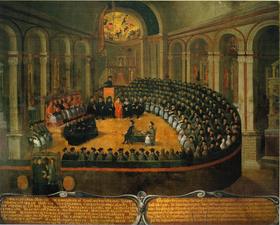
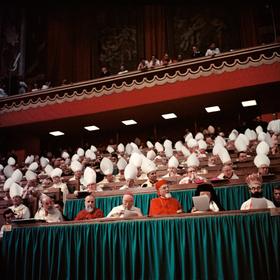
  1. Rows of bishops in white mitres and copes sit in tiered stands hung with red and green cloth

    The Church says this office is not above the word of God. It serves it, and teaches only what has been handed on.

    “But the task of authentically interpreting the word of God, whether written or handed on, has been entrusted exclusively to the living teaching office of the Church, whose authority is exercised in the name of Jesus Christ. This teaching office is not above the word of God, but serves it, teaching only what has been handed on, listening to it devoutly, guarding it scrupulously and explaining it faithfully in accord with a divine commission and with the help of the Holy Spirit, it draws from this one deposit of faith everything which it presents for belief as divinely revealed.”

    Second Vatican CouncilDei Verbum 10, 1965Read it in the source: vatican.va

  2. It speaks with its full authority when it defines a dogma.

    “The Church's Magisterium exercises the authority it holds from Christ to the fullest extent when it defines dogmas, that is, when it proposes truths contained in divine Revelation or also when it proposes in a definitive way truths having a necessary connection with them.”

    Catechism of the Catholic ChurchCCC 88, 1992Read it in the source: vatican.va

Not everything on this row carries the same weight. A solemn definition binds in a way that a letter or an address does not, and each entry names the document it is quoted from. Read beside the older rows, this one shows whether the Church today teaches what was taught before.

The Magisterium: all 18 quotations

Every pope in order from St. Peter is on a page of its own: All the popes in order, from St. Peter to today.

352 quotations in date order

A work in progress. The quotations below are not all the evidence on this matter. More are being added.

256
Magisterium
Pope St. Stephen I, as quoted by St. Cyprian Cyprian, Epistle 73, To Pompey, 1, quoting Stephen's letter

“If any one, therefore, come to you from any heresy whatever, let nothing be innovated (or done) which has not been handed down, to wit, that hands be imposed on him for repentance; since the heretics themselves, in their own proper character, do not baptize such as come to them from one another, but only admit them to communion.”

Read it in the source: New Advent

See it on the timeline: Baptism

416A colour photograph of a pope in a red cape trimmed with white fur and an embroidered stole
Magisterium

Innocent I writes to Decentius of Gubbio

Pope Paul VI Apostolic Constitution Sacram Unctionem Infirmorum (1972)

“From ancient times testimonies of the Anointing of the Sick are found in the Church's Tradition, particularly her liturgical Tradition, both in the East and in the West. Especially worthy of note in this regard are the Letter which Innocent I, our predecessor, addressed to Decentius, Bishop of Gubbio, and the venerable prayer used for blessing the Oil of the Sick: "Send forth, 0 Lord, your Holy Spirit, the Paraclete," which was inserted in the Eucharistic Prayer and is still preserved in the Roman Pontifical.”

Read it in the source: vatican.va

See it on the timeline: The Anointing of the Sick

680
Magisterium
Pope St. Agatho Letter to the Emperor, read at the Third Council of Constantinople

“…the Apostolic Church of Christ, has both in prosperity and in adversity always held and defended with energy; which, it will be proved, by the grace of Almighty God, has never erred from the path of the apostolic tradition, … and remains undefiled unto the end, according to the divine promise of the Lord and Saviour himself, which he uttered in the holy Gospels to the prince of his disciples: saying, Peter, Peter, behold, Satan has desired to have you, that he might sift you as wheat; but I have prayed for you, that (your) faith fail not. And when you are converted, strengthen your brethren.”

Read it in the source: New Advent

See it on the timeline: Papal infallibility

7th century
Magisterium

From public penance to private confession

Catechism of the Catholic Church CCC 1447

“Over the centuries the concrete form in which the Church has exercised this power received from the Lord has varied considerably. During the first centuries the reconciliation of Christians who had committed particularly grave sins after their Baptism (for example, idolatry, murder, or adultery) was tied to a very rigorous discipline, according to which penitents had to do public penance for their sins, often for years, before receiving reconciliation. To this "order of penitents" (which concerned only certain grave sins), one was only rarely admitted and in certain regions only once in a lifetime. During the seventh century Irish missionaries, inspired by the Eastern monastic tradition, took to continental Europe the "private" practice of penance, which does not require public and prolonged completion of penitential works before reconciliation with the Church. From that time on, the sacrament has been performed in secret between penitent and priest.”

Read it in the source: vatican.va

See it on the timeline: Penance and Reconciliation

787
Magisterium

Pope Hadrian's letter to the Second Council of Nicaea

Pope Adrian I (Hadrian) Letter to the Emperor Constantine and the Empress Irene, read at Session 2 of the Second Council of Nicaea, the part headed "As written by the Pope"

“For the blessed Peter himself, the chief of the Apostles, who first sat in the Apostolic See, left the chiefship of his Apostolate, and pastoral care, to his successors, who are to sit in his most holy seat forever. And that power of authority, which he received from the Lord God our Saviour, he too bestowed and delivered by divine command to the Pontiffs, his successors”

Read it in the source: New Advent

See it on the timeline: The tradition of the papacy

The Middle Ages800 to 1500
866
Magisterium
Pope Nicholas I Responses to the Questions of the Bulgars, ch. 41

“Therefore, no communion should be shared with those who do not believe and who adore idols. Yet, violence should by no means be inflicted upon them to make them believe. For everything which is not voluntary, cannot be good”

Read it in the source: Fordham Sourcebook

See it on the timeline: Violence in the Church's history

866
Magisterium

Pope Nicholas I on the see of Constantinople

Pope St. Nicholas I Responses to the Questions of the Bulgarians, ch. 92 (866)

“The bishops of Constantinople and of Jerusalem, although they are called patriarchs, do not possess as much authority as the above [sees]. For, as regards the church of Constantinople, none of the apostles founded it nor did the synod of Nicaea, which is more venerable and celebrated than all other synods, make any mention of it; rather its bishop was given the title of patriarch more through the favor of princes than by reason, since Constantinople was called "New Rome."”

Read it in the source: Fordham Sourcebook

See it on the timeline: The tradition of the papacy

866
Magisterium

Rome and Constantinople both send teachers to the Bulgarians

Pope St. Nicholas I Responses to the Questions of the Bulgarians, ch. 106 (866)

“you claim that many people from different places come into your country who say many different things according to their wishes, i.e. the Greeks, the Armenians, and those from other places. You therefore ask to be told whether you should obey all of them in their various senses or what you should do. Truly we are not enough in these matters, but our sufficiency is from God; … and the blessed Peter, who lives and presides in his see, offers the truth of the faith to those who seek it. Indeed, the holy Roman Church has always been without spot or wrinkle, obviously because it was established by the man whose confession of faith was divinely approved.”

Read it in the source: Fordham Sourcebook

See it on the timeline: The East-West Schism

1054A colour photograph of a pope in a red cape trimmed with white fur and an embroidered stole
Magisterium

The excommunications of 1054

Pope St. Paul VI and Ecumenical Patriarch Athenagoras I Joint Catholic-Orthodox Declaration, 7 December 1965, 2

“the decisions, actions and painful incidents which in 1054 resulted in the sentence of excommunication leveled against the Patriarch Michael Cerularius and two other persons by the legate of the Roman See under the leadership of Cardinal Humbertus, legates who then became the object of a similar sentence pronounced by the patriarch and the Synod of Constantinople.”

Read it in the source: vatican.va

See it on the timeline: The tradition of the papacy

1054
Magisterium

Each side excommunicated the other

Pope St. Paul VI Apostolic letter Ambulate in dilectione, 7 December 1965

“Indeed it came to this, that the papal legates pronounced a sentence of excommunication against Michael Cerularius, Patriarch of Constantinople, and two churchmen, and that he and his synod in like manner passed sentence on them. … we declare that We regret the words and deeds, which cannot be approved, that were said and done at that time. Moreover We wish to tear the sentence of excommunication then passed out of the memory of the Church and to remove it from her midst, and We wish it covered over and buried in oblivion.”

Our translation. The words as written, in Latin:

“Immo eo perventum est, ut Legati Pontificii adversus Michaelem Caerularium, Patriarcham Constantinopolitanum ac duos viros ecclesiasticos, excommunicationis sententiam pronuntiarent, hic vero eiusque Synodus pari modo in illos animadverterent. … affirmamus Nos aegre ferre ea verba et facta, quae probari non possunt, tempore illo dicta et patrata. Praeterea sententiam excommunicationis tunc latam ex Ecclesiae memoria evellere volumus ac de eius medio removere, atque eam volumus oblivione contectam et obrutam.”

Read it in the source: vatican.va

See it on the timeline: The East-West Schism

1054
Magisterium

The censures of 1054 were aimed at persons, not at the Churches

Pope St. Paul VI and Ecumenical Patriarch Athenagoras I Joint Catholic-Orthodox Declaration, 7 December 1965, 3

“Thus it is important to recognize the excesses which accompanied them and later led to consequences which, insofar as we can judge, went much further than their authors had intended and foreseen. They had directed their censures against the persons concerned and not the Churches. These censures were not intended to break ecclesiastical communion between the Sees of Rome and Constantinople.”

Read it in the source: vatican.va

See it on the timeline: The East-West Schism

1054
Magisterium

How communion came to be broken: events before and after 1054

Pope St. Paul VI and Ecumenical Patriarch Athenagoras I Joint Catholic-Orthodox Declaration, 7 December 1965, 4 C

“Finally, they deplore the preceding and later vexing events which, under the influence of various factors—among which, lack of understanding and mutual trust—eventually led to the effective rupture of ecclesiastical communion.”

Read it in the source: vatican.va

See it on the timeline: The East-West Schism

1074
Magisterium

Twenty years on, a pope calls the Christians of the East brethren

Pope St. Gregory VII Letter to all who are willing to defend the Christian faith, 1074 (Patrologia Latina 148:329)

“If we love God and wish to be recognized as Christians, we should be filled with grief at the misfortune of this great empire [the Greek] and the murder of so many Christians. But simply to grieve is not our whole duty. The example of our Redeemer and the bond of fraternal love demand that we should lay down our lives to liberate them.”

Read it in the source: Fordham Sourcebook

See it on the timeline: The East-West Schism

1075
Magisterium

The Dictatus Papae: the claims of the reforming popes

The register of Pope St. Gregory VII Dictatus Papae, 1075, the first statements

“That the Roman church was founded by God alone. That the Roman pontiff alone can with right be called universal. That he alone can depose or reinstate bishops. That, in a council his legate, even if a lower grade, is above all bishops, and can pass sentence of deposition against them.”

Read it in the source: Fordham Sourcebook

See it on the timeline: The tradition of the papacy

1076
Magisterium
Pope St. Gregory VII Letter of 1076 to a Muslim prince in North Africa, as quoted by Pope Benedict XVI, Address to the President of the Religious Affairs Directorate, Ankara, 28 November 2006

“because we believe in one God, albeit in a different manner, and because we praise him and worship him every day as the Creator and Ruler of the world.”

Read it in the source: vatican.va

See it on the timeline: Islam and the one God

1079
Magisterium
Pope St. Gregory VII Oath prescribed for Berengarius of Tours, as quoted by Pope St. Paul VI, Mysterium Fidei 52

“I believe in my heart and openly profess that the bread and wine that are placed on the altar are, through the mystery of the sacred prayer and the words of the Redeemer, substantially changed into the true and proper and lifegiving flesh and blood of Jesus Christ our Lord…”

Read it in the source: vatican.va

See it on the timeline: Transubstantiation

1095
Magisterium
Pope Urban II, as reported by Fulcher of Chartres Speech at the Council of Clermont, 27 November 1095

“On this account I, or rather the Lord, beseech you as Christ's heralds to publish this everywhere and to persuade all people of whatever rank, foot-soldiers and knights, poor and rich, to carry aid promptly to those Christians and to destroy that vile race from the lands of our friends. I say this to those who are present, it meant also for those who are absent. Moreover, Christ commands it. "All who die by the way, whether by land or by sea, or in battle against the pagans, shall have immediate remission of sins. This I grant them through the power of God with which I am invested.”

Read it in the source: Fordham Sourcebook

See it on the timeline: Violence in the Church's history

1095
Magisterium

Pope Urban II calls Christians to the East

Pope Urban II, as reported by Fulcher of Chartres Speech at the Council of Clermont, according to Fulcher of Chartres

“For your brethren who live in the east are in urgent need of your help, and you must hasten to give them the aid which has often been promised them. For, as the most of you have heard, the Turks and Arabs have attacked them and have conquered the territory of Romania [the Greek empire] as far west as the shore of the Mediterranean and the Hellespont, which is called the Arm of St. George. … O what a disgrace if such a despised and base race, which worships demons, should conquer a people which has the faith of omnipotent God and is made glorious with the name of Christ!”

Read it in the source: Fordham Sourcebook

See it on the timeline: Islam and the Church

Middle AgesA colour photograph of a pope in a red cape trimmed with white fur and an embroidered stole
Magisterium

The Roman custom of anointing the five senses

Pope Paul VI Apostolic Constitution Sacram Unctionem Infirmorum (1972)

“During the Middle Ages, in the Roman Church there prevailed the custom of anointing the sick on the five senses, using the formula: "Per istam Sanctam unctionem et suam Piissimam misericordiam, indulgeat tibi Dominus quidquid deliquisti," adapted to each sense.”

Read it in the source: vatican.va

See it on the timeline: The Anointing of the Sick

1204
Magisterium

Pope Innocent III rebukes his legate for the sack

Pope Innocent III Letter 136, to Peter, Cardinal Priest of St. Marcellus, Legate of the Apostolic See (12 July 1205)

“How, indeed, is the Greek church to be brought back into ecclesiastical union and to a devotion for the Apostolic See when she has been beset with so many afflictions and persecutions that she sees in the Latins only an example of perdition and the works of darkness, so that she now, and with reason, detests the Latins more than dogs? As for those who were supposed to be seeking the ends of Jesus Christ, not their own ends, whose swords, which they were supposed to use against the pagans, are now dripping with Christian blood, they have spared neither age nor sex.”

Read it in the source: Fordham Sourcebook

See it on the timeline: The East-West Schism

1204An elderly pope in green vestments and a white and gold mitre raises his hand in greeting, holding his staff with the crucifix
Magisterium

Pope John Paul II in Athens: deep regret for the sack

Pope St. John Paul II Address to His Beatitude Christodoulos, Archbishop of Athens and Primate of Greece, 4 May 2001, 2

“I am thinking of the disastrous sack of the imperial city of Constantinople, which was for so long the bastion of Christianity in the East. It is tragic that the assailants, who had set out to secure free access for Christians to the Holy Land, turned against their own brothers in the faith. The fact that they were Latin Christians fills Catholics with deep regret.”

Read it in the source: vatican.va

See it on the timeline: The East-West Schism

1219A smiling pope in white waves with his right hand
Magisterium

St. Francis of Assisi goes to the Sultan

Pope Francis Fratelli Tutti 3 (3 October 2020), on St. Francis's visit to Sultan Malik-el-Kamil in 1219

“It was his visit to Sultan Malik-el-Kamil, in Egypt, which entailed considerable hardship, given Francis’ poverty, his scarce resources, the great distances to be traveled and their differences of language, culture and religion. That journey, undertaken at the time of the Crusades, further demonstrated the breadth and grandeur of his love, which sought to embrace everyone.”

Read it in the source: vatican.va

See it on the timeline: Islam and the Church

13th century, by tradition
Magisterium

St. Dominic and the Rosary, as St. Pius V reports it in 1569

Pope St. Pius V Consueverunt Romani Pontifices (17 September 1569)

“And so Dominic looked to that simple way of praying and beseeching God, accessible to all and wholly pious, which is called the Rosary, or Psalter of the Blessed Virgin Mary, in which the same most Blessed Virgin is venerated by the angelic greeting repeated one hundred and fifty times, that is, according to the number of the Davidic Psalter, and by the Lord’s Prayer with each decade. Interposed with these prayers are certain meditations showing forth the entire life of Our Lord Jesus Christ”

Read it in the source: Papal Encyclicals Online

See it on the timeline: The Rosary

13th century, by tradition
Magisterium

St. Dominic and the Rosary, as Leo XIII reports it

Pope Leo XIII Supremi Apostolatus Officio, 3 (1 September 1883)

“Our merciful God, as you know, raised up against these most direful enemies a most holy man, the illustrious parent and founder of the Dominican Order. … he proceeded undauntedly to attack the enemies of the Catholic Church, not by force of arms; but trusting wholly to that devotion which he was the first to institute under the name of the Holy Rosary, which was disseminated through the length and breadth of the earth by him and his pupils.”

Read it in the source: vatican.va

See it on the timeline: The Rosary

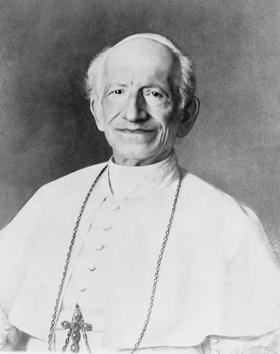
13th century, by traditionA black and white photograph of a very old, smiling pope in white with a pectoral cross
Magisterium

"By her command and counsel": Mary, St. Dominic and the Rosary

Pope Leo XIII Octobri Mense, 8 (22 September 1891)

“Moreover, we may well believe that the Queen of Heaven herself has granted an especial efficacy to this mode of supplication, for it was by her command and counsel that the devotion was begun and spread abroad by the holy Patriarch Dominic as a most potent weapon against the enemies of the faith at an epoch not, indeed, unlike our own, of great danger to our holy religion.”

Read it in the source: vatican.va

See it on the timeline: The Rosary

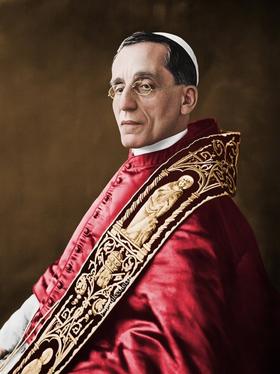
13th century, by traditionA thin pope in spectacles and a white skullcap, wearing a red cape and a gold embroidered stole
Magisterium

Mary teaches the Rosary to the Church through St. Dominic

Pope Benedict XV Fausto Appetente Die, 11 (29 June 1921)

“How pleased was the Heavenly Queen with her pious servant may be easily gathered from this, that she used his ministry to teach the Most Holy Rosary to the Church, the Spouse of her Son; that prayer which, being both vocal and mental, in the contemplation especially of the mysteries of religion, while the Lord's Prayer is fifteen times repeated together with as many decades of the Hail Mary, is most adapted to fostering widely piety and every virtue.”

Read it in the source: vatican.va

See it on the timeline: The Rosary

d. 1221
Magisterium

St. Dominic's legacy and the Rosary, as Benedict XVI puts it

Pope Benedict XVI General Audience, 3 February 2010

“In the very first place is Marian devotion which he fostered tenderly and left as a precious legacy to his spiritual sons who, in the history of the Church, have had the great merit of disseminating the prayer of the Holy Rosary, so dear to the Christian people and so rich in Gospel values: a true school of faith and piety.”

Read it in the source: vatican.va

See it on the timeline: The Rosary

1252
Magisterium

Ad extirpanda: rulers ordered to force confessions

Pope Innocent IV Bull Ad extirpanda, 15 May 1252, Law 25

“The head of state or ruler must force all the heretics whom he has in custody, … provided he does so without killing them or breaking their arms or legs, as actual robbers and murderers of souls and thieves of the sacraments of God and Christian faith, to confess their errors and accuse other heretics whom they know, and specify their motives, … and those whom they have seduced, and those who have lodged them and defended them, as thieves and robbers of material goods are made to accuse their accomplices and confess the crimes they have committed.”

Read it in the source: Documenta Catholica Omnia

See it on the timeline: The Inquisition and the use of force against heresy

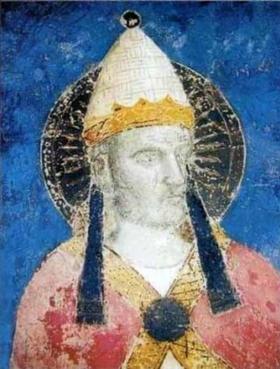
c. 1272A medieval wall painting of a pope's head in a tall white tiara with a jewelled band, against a blue ground
Magisterium

Gregory X rejects the charge of ritual murder

Pope Gregory X Letter on the Jews (issued between 1271 and 1276)

“And most falsely do these Christians claim that the Jews have secretly and furtively carried away these children and killed them, and that the Jews offer sacrifice from the heart and blood of these children, since their law in this matter precisely and expressly forbids Jews to sacrifice, eat, or drink the blood, or to eat the flesh of animals having claws. … We decree, therefore, that Christians need not be obeyed against Jews in a case or situation of this type, and we order that Jews seized under such a silly pretext be freed from imprisonment”

Read it in the source: Fordham Sourcebook

See it on the timeline: The Church and the Jewish people

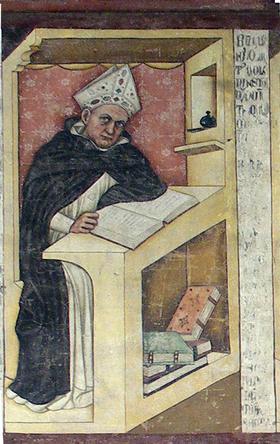
1280A wall painting of a Dominican bishop in a mitre seated at a desk with books
Magisterium

St. Albert the Great, bishop and Doctor

Pope Benedict XVI General Audience, 24 March 2010

“St Albert shows that there is no opposition between faith and science, despite certain episodes of misunderstanding that have been recorded in history. A man of faith and prayer, as was St Albert the Great, can serenely foster the study of the natural sciences and progress in knowledge of the micro- and macrocosm, discovering the laws proper to the subject, since all this contributes to fostering thirst for and love of God.”

Read it in the source: vatican.va

See it on the timeline: The Doctors of the Church

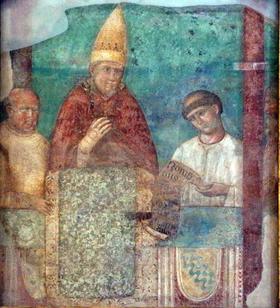
1302A worn wall painting of a pope in a tall tiara at a balcony hung with a patterned cloth, between two attendants
Magisterium
Pope Boniface VIII Unam Sanctam, opening and closing sentences

“Urged by faith, we are obliged to believe and to maintain that the Church is one, holy, catholic, and also apostolic. We believe in her firmly and we confess with simplicity that outside of her there is neither salvation nor the remission of sins … Furthermore, we declare, we proclaim, we define that it is absolutely necessary for salvation that every human creature be subject to the Roman Pontiff.”

Read it in the source: Papal Encyclicals Online

See it on the timeline: No salvation outside the Church

18 November 1302
Magisterium

Unam Sanctam

Pope Boniface VIII Bull Unam Sanctam, closing sentence

“Furthermore, we declare, we proclaim, we define that it is absolutely necessary for salvation that every human creature be subject to the Roman Pontiff.”

Read it in the source: Papal Encyclicals Online

See it on the timeline: The tradition of the papacy

1336
Magisterium
Pope Benedict XII Apostolic Constitution Benedictus Deus (1336)

“By this Constitution which is to remain in force for ever, we, with apostolic authority, define the following: According to the general disposition of God, the souls of all the saints who departed from this world before the passion of our Lord Jesus Christ … Since the passion and death of the Lord Jesus Christ, these souls have seen and see the divine essence with an intuitive vision and even face to face”

Read it in the source: EWTN Library

See it on the timeline: Have popes been heretics?

1336
Magisterium
Pope Benedict XII Benedictus Deus

“According to the general disposition of God, the souls of all the saints who departed from this world before the passion of our Lord Jesus Christ and also of the holy apostles, martyrs, confessors, virgins and other faithful who died after receiving the holy baptism of Christ- provided they were not in need of any purification when they died, or will not be in need of any when they die in the future, or else, if they then needed or will need some purification, after they have been purified after death … all these souls, immediately (mox) after death and, in the case of those in need of purification, after the purification mentioned above, since the ascension of our Lord and Saviour Jesus Christ into heaven, already before they take up their bodies again and before the general judgment, have been, are and will be with Christ in heaven, in the heavenly kingdom and paradise, joined to the company of the holy angels.”

Read it in the source: Papal Encyclicals Online

See it on the timeline: Purgatory

13th to 16th centuriesA black and white photograph of a very old, smiling pope in white with a pectoral cross
Magisterium

Popes before Pius V on the Rosary, as Leo XIII lists them

Pope Leo XIII Supremi Apostolatus Officio, 5 (1 September 1883)

“Thus Urban IV, testified that “every day the Rosary obtained fresh boon for Christianity.” Sixtus IV declared that this method of prayer “redounded to the honour of God and the Blessed Virgin, and was well suited to obviate impending dangers;” Leo X that “it was instituted to oppose pernicious heresiarchs and heresies;” while Julius III called it “the glory of the Church.””

Read it in the source: vatican.va

See it on the timeline: The Rosary

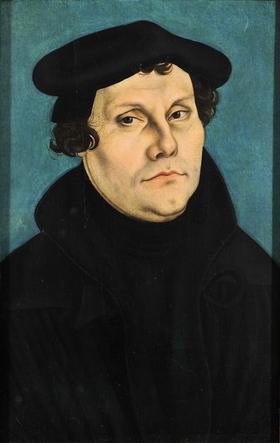
1505 to 1507A portrait of a man in a black cap and black gown against a blue-green background
Magisterium

Luther becomes an Augustinian friar and a priest

Pope Benedict XVI Address to representatives of the Evangelical Church in Germany, Augustinian convent, Erfurt, 23 September 2011

“As we have just heard, this is where Luther studied theology. This is where he celebrated his first Mass. Against his father's wishes, he did not continue the study of Law, but instead he studied theology and set off on the path towards priesthood in the Order of Saint Augustine. And on this path, he was not simply concerned with this or that. What constantly exercised him was the question of God, the deep passion and driving force of his whole life's journey. "How do I receive the grace of God?": this question struck him in the heart and lay at the foundation of all his theological searching and inner struggle.”

Read it in the source: vatican.va

See it on the timeline: Protestantism

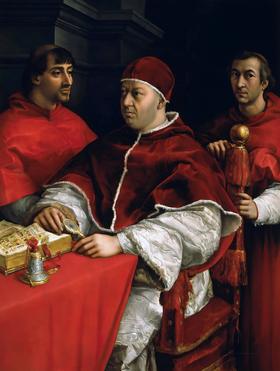
1520A heavy-set pope in a red cap and cape sits at a table with an illuminated book and a magnifying glass, with a cardinal standing on either side
Magisterium

Leo X condemns the proposition that burning heretics is against the Spirit

Pope Leo X Bull Exsurge Domine, 15 June 1520, condemned proposition 33 and the sentence on the propositions

“33. That heretics be burned is against the will of the Spirit. … we condemn, reprobate, and reject completely each of these theses or errors as either heretical, scandalous, false, offensive to pious ears or seductive of simple minds, and against Catholic truth.”

Read it in the source: Papal Encyclicals Online

See it on the timeline: The Inquisition and the use of force against heresy

15 June 1520Rows of bishops in mitres sit in a great semicircle of benches inside a church, facing the presiding cardinals
Magisterium

The Church's reply: Luther's propositions on indulgences

Pope Leo X Exsurge Domine, condemned propositions 17 to 20

“17. The treasures of the Church, from which the pope grants indulgences, are not the merits of Christ and of the saints. 18. Indulgences are pious frauds of the faithful, and remissions of good works; and they are among the number of those things which are allowed, and not of the number of those which are advantageous. 19. Indulgences are of no avail to those who truly gain them, for the remission of the penalty due to actual sin in the sight of divine justice. 20. They are seduced who believe that indulgences are salutary and useful for the fruit of the spirit.”

Read it in the source: Papal Encyclicals Online

See it on the timeline: Protestantism

15 June 1520
Magisterium

The Church's reply: the forty-one propositions condemned

Pope Leo X Exsurge Domine, the sentence of condemnation

“With the advice and consent of these our venerable brothers, with mature deliberation on each and every one of the above theses, and by the authority of almighty God, the blessed Apostles Peter and Paul, and our own authority, we condemn, reprobate, and reject completely each of these theses or errors as either heretical, scandalous, false, offensive to pious ears or seductive of simple minds, and against Catholic truth.”

Read it in the source: Papal Encyclicals Online

See it on the timeline: Protestantism

15 June 1520
Magisterium

The Church's reply to Luther: propositions on the pope, the Church and purgatory

Pope Leo X Exsurge Domine, condemned propositions 25, 27 and 37

“25. The Roman Pontiff, the successor of Peter, is not the vicar of Christ over all the churches of the entire world, instituted by Christ Himself in blessed Peter. … 27. It is certain that it is not in the power of the Church or the pope to decide upon the articles of faith, and much less concerning the laws for morals or for good works. … 37. Purgatory cannot be proved from Sacred Scripture which is in the canon.”

Read it in the source: Papal Encyclicals Online

See it on the timeline: Protestantism

The full Catholic answer: The office of Peter

3 January 1521A heavy-set pope in a red cap and cape sits at a table with an illuminated book and a magnifying glass, with a cardinal standing on either side
Magisterium

Luther is excommunicated

Pope Leo X Bull Decet Romanum Pontificem, II

“Nevertheless Martin himself—and it gives us grievous sorrow and perplexity to say this—the slave of a depraved mind, has scorned to revoke his errors within the prescribed interval and to send us word of such revocation, or to come to us himself; nay, like a stone of stumbling, he has feared not to write and preach worse things than before against us and this Holy See and the Catholic faith, and to lead others on to do the same. He has now been declared a heretic”

Read it in the source: Papal Encyclicals Online

See it on the timeline: Protestantism

1537
Magisterium
Pope Paul III Bull Sublimis Deus, 1537

“the said Indians and all other people who may later be discovered by Christians, are by no means to be deprived of their liberty or the possession of their property, even though they be outside the faith of Jesus Christ; and that they may and should, freely and legitimately, enjoy their liberty and the possession of their property; nor should they be in any way enslaved; should the contrary happen, it shall be null and have no effect.”

Read it in the source: Papal Encyclicals Online

See it on the timeline: Violence in the Church's history

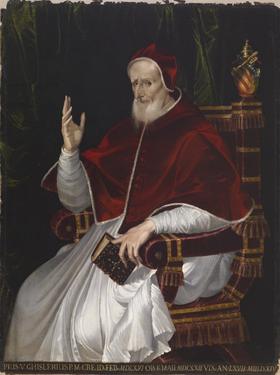
1569An old pope with a white beard, in a red cap and cape, sits on a throne and raises his right hand in blessing
Magisterium
Pope St. Pius V Consueverunt Romani Pontifices, 1

“And so Dominic looked to that simple way of praying and beseeching God, accessible to all and wholly pious, which is called the Rosary, or Psalter of the Blessed Virgin Mary, in which the same most Blessed Virgin is venerated by the angelic greeting repeated one hundred and fifty times, that is, according to the number of the Davidic Psalter, and by the Lord’s Prayer with each decade. Interposed with these prayers are certain meditations showing forth the entire life of Our Lord Jesus Christ…”

Read it in the source: Papal Encyclicals Online

See it on the timeline: The Rosary

7 October 1571A black and white photograph of a very old, smiling pope in white with a pectoral cross
Magisterium

Lepanto and the feast of the Rosary

Pope Leo XIII Supremi Apostolatus Officio, 4 (1 September 1883)

“The efficacy and power of this devotion was also wondrously exhibited in the sixteenth century, when the vast forces of the Turks threatened to impose on nearly the whole of Europe the yoke of superstition and barbarism. At that time the Supreme Pontiff, St. Pius V., after rousing the sentiment of a common defence among all the Christian princes, strove, above all, with the greatest zeal, to obtain for Christendom the favour of the most powerful Mother of God. … And it was to preserve the memory of this great boon thus granted, that the same Most Holy Pontiff desired that a feast in honour of Our Lady of Victories should celebrate the anniversary of so memorable a struggle, the feast which Gregory XIII. dedicated under the title of “The Holy Rosary.””

Read it in the source: vatican.va

See it on the timeline: The Rosary

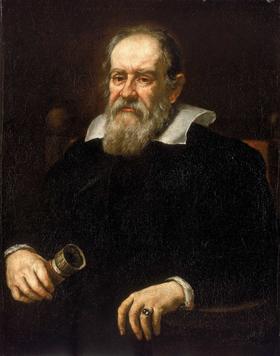
1616An old man with a white beard in a black gown and white collar, holding a telescope
Magisterium

The Congregation of the Index rules against the motion of the earth

Congregation of the Index Decree of the Congregation of the Index, 1616

“because it has come to the attention of this Congregation that the Pythagorean doctrine which is false and contrary to Holy Scripture, which teaches the motion of the earth and the immobility of the sun, and which is taught by Nicholas Copernicus in De Revolutionibus Orbium Caelestium and by Diego de Zuniga's On Job, is now being spread and accepted by many … Therefore, so that this opinion may not spread any further to the prejudice of Catholic truth, it ( the Sacred Congregation ) decrees that the said Nicholas Copernicus' De Revolutionibus Orbium, and Diego de Zuniga's On Job, be suspended until corrected; but that the book of the Carmelite Father, Paolo Foscarini, be prohibited and condemned, and that all other books likewise, in which the same is taught, be prohibited.”

Read it in the source: Fordham Sourcebook

See it on the timeline: The Galileo case

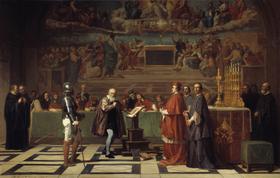
22 June 1633A man in black stands in a great hall before a long table of churchmen in red and white
Magisterium

Galileo judged vehemently suspected of heresy

The Cardinals of the Holy Office Sentence of the Tribunal of the Supreme Inquisition against Galileo Galilei, 22 June 1633

“We say, pronounce, sentence, and declare, that thou, the said Galileo, by the things deduced during this trial, and by thee confessed as above, hast rendered thyself vehemently suspected of heresy by this Holy Office, that is, of having believed and held a doctrine which is false, and contrary to the Holy Scriptures, to wit: that the Sun is the centre of the universe, and that it does not move from east to west, and that the Earth moves and is not the centre of the universe: and that an opinion may be held and defended as probable after having been declared and defined as contrary to Holy Scripture; and in consequence thou hast incurred all the censures and penalties of the Sacred Canons, and other Decrees both general and particular, against such offenders imposed and promulgated.”

Read it in the source: Fordham Sourcebook

See it on the timeline: The Galileo case

22 June 1633An old man with a white beard in a black gown and white collar, holding a telescope
Magisterium

The book banned and Galileo sentenced to prison

The Cardinals of the Holy Office Sentence of the Tribunal of the Supreme Inquisition against Galileo Galilei, 22 June 1633

“And to the end that this thy grave error and transgression remain not entirely unpunished, and that thou mayst be more cautious in the future, and an example to others to abstain from and avoid similar offences, "We order that by a public edict the book of DIALOGUES OF GALILEO GALILEI be prohibited, and We condemn thee to the prison of this Holy Office during Our will and pleasure; and as a salutary penance We enjoin on thee that for the space of three years thou shalt recite once a week the Seven Penitential Psalms”

Read it in the source: Fordham Sourcebook

See it on the timeline: The Galileo case

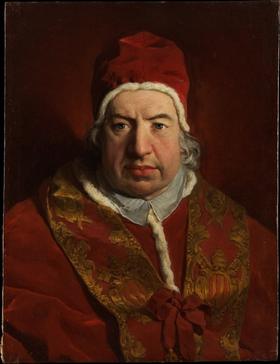
1751A pope in a red fur-lined cap and cape and a gold embroidered stole
Magisterium

Benedict XIV tells the Polish bishops to enforce the old restrictions

Pope Benedict XIV Encyclical A quo primum, 14 June 1751, no. 5

“In this matter, as in all others, We adopt the same norm of action as did the Roman Pontiffs who were Our venerable predecessors. … The same Pope [Innocent III] stated that it was fitting for Jews to serve Christians rather than vice versa and added: “Let not the sons of the free woman be servants of the sons of the handmaid; but as servants rejected by their lord for whose death they evilly conspired, let them realize that the result of this deed is to make them servants of those whom Christ’s death made free,” as we read in his decretal Etsi Judaeos.”

Read it in the source: Papal Encyclicals Online

See it on the timeline: The Church and the Jewish people

The Modern Era1800 to today
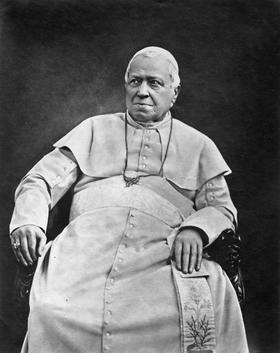
1854A black and white photograph of an old pope in a white cassock seated in an armchair
Magisterium
Pope Pius IX Ineffabilis Deus, the definition

“We declare, pronounce, and define that the doctrine which holds that the most Blessed Virgin Mary, in the first instance of her conception, by a singular grace and privilege granted by Almighty God, in view of the merits of Jesus Christ, the Savior of the human race, was preserved free from all stain of original sin, is a doctrine revealed by God and therefore to be believed firmly and constantly by all the faithful.”

Read it in the source: Papal Encyclicals Online

See it on the timeline: Mary without sin

1854
Magisterium
Pope Pius IX Ineffabilis Deus, Testimonies of Tradition

“…this doctrine always existed in the Church as a doctrine that has been received from our ancestors, and that has been stamped with the character of revealed doctrine. For the Church of Christ, watchful guardian that she is, and defender of the dogmas deposited with her, never changes anything, never diminishes anything, never adds anything to them”

Read it in the source: Papal Encyclicals Online

See it on the timeline: Doctrines defined later

1863
Magisterium
Pope Pius IX Quanto Conficiamur Moerore 7-8

“Because God knows, searches and clearly understands the minds, hearts, thoughts, and nature of all, his supreme kindness and clemency do not permit anyone at all who is not guilty of deliberate sin to suffer eternal punishments. … Also well known is the Catholic teaching that no one can be saved outside the Catholic Church. Eternal salvation cannot be obtained by those who oppose the authority and statements of the same Church and are stubbornly separated from the unity of the Church and also from the successor of Peter, the Roman Pontiff”

Read it in the source: Papal Encyclicals Online

See it on the timeline: No salvation outside the Church

1863
Magisterium
Pope Pius IX Quanto Conficiamur Moerore 7

“Here, too, our beloved sons and venerable brothers, it is again necessary to mention and censure a very grave error entrapping some Catholics who believe that it is possible to arrive at eternal salvation although living in error and alienated from the true faith and Catholic unity. Such belief is certainly opposed to Catholic teaching. There are, of course, those who are struggling with invincible ignorance about our most holy religion. Sincerely observing the natural law and its precepts inscribed by God on all hearts and ready to obey God, they live honest lives and are able to attain eternal life by the efficacious virtue of divine light and grace.”

Read it in the source: Papal Encyclicals Online

See it on the timeline: Other religions

1883A black and white photograph of a very old, smiling pope in white with a pectoral cross
Magisterium
Pope Leo XIII Supremi Apostolatus Officio, 8

“He therefore so composed the Rosary as to recall the mysteries of our salvation in succession, and the subject of meditation is mingled and, as it were, interlaced with the Angelic salutation and with the prayer addressed to God, the Father of Our Lord Jesus Christ.”

Read it in the source: vatican.va

See it on the timeline: The Rosary

1893
Magisterium
Pope Leo XIII Providentissimus Deus, 19

“The unshrinking defence of the Holy Scripture, however, does not require that we should equally uphold all the opinions which each of the Fathers or the more recent interpreters have put forth in explaining it; for it may be that, in commenting on passages where physical matters occur, they have sometimes expressed the ideas of their own times, and thus made statements which in these days have been abandoned as incorrect. Hence, in their interpretations, we must carefully note what they lay down as belonging to faith, or as intimately connected with faith-what they are unanimous in. For "in those things which do not come under the obligation of faith, the Saints were at liberty to hold divergent opinions, just as we ourselves are,"”

Read it in the source: vatican.va

See it on the timeline: The authority of the Fathers

1893
Magisterium
Pope Leo XIII Providentissimus Deus, 18

“There can never, indeed, be any real discrepancy between the theologian and the physicist, as long as each confines himself within his own lines, and both are careful, as St. Augustine warns us, "not to make rash assertions, or to assert what is not known as known." … the sacred writers, or to speak more accurately, the Holy Ghost "Who spoke by them, did not intend to teach men these things (that is to say, the essential nature of the things of the visible universe), things in no way profitable unto salvation." Hence they did not seek to penetrate the secrets of nature, but rather described and dealt with things in more or less figurative language, or in terms which were commonly used at the time”

Read it in the source: vatican.va

See it on the timeline: Evolution and Genesis

1893
Magisterium

What the Rosary consists of

Pope Leo XIII Laetitiae Sanctae, 6 (8 September 1893)

“For evils such as these let us seek a remedy in the Rosary, which consists in a fixed order of prayer combined with devout meditation on the life of Christ and His Blessed Mother.”

Read it in the source: vatican.va

See it on the timeline: The Rosary

1893
Magisterium

Leo XIII: the sacred writers did not intend to teach the nature of the visible universe

Pope Leo XIII Encyclical Providentissimus Deus, 18 November 1893, no. 18

“There can never, indeed, be any real discrepancy between the theologian and the physicist, as long as each confines himself within his own lines, and both are careful, as St. Augustine warns us, "not to make rash assertions, or to assert what is not known as known." … To understand how just is the rule here formulated we must remember, first, that the sacred writers, or to speak more accurately, the Holy Ghost "Who spoke by them, did not intend to teach men these things (that is to say, the essential nature of the things of the visible universe), things in no way profitable unto salvation." Hence they did not seek to penetrate the secrets of nature, but rather described and dealt with things in more or less figurative language, or in terms which were commonly used at the time, and which in many instances are in daily use at this day, even by the most eminent men of science.”

Read it in the source: vatican.va

See it on the timeline: The Galileo case

20 June 1894
Magisterium

Leo XIII calls the East to reunion

Pope Leo XIII Apostolic Letter Praeclara Gratulationis Publicae

“We hope it all the more, that the distance separating them from Us is not so great: nay, with some few exceptions, we agree so entirely on other heads that, in defense of the Catholic Faith, we often have recourse to reasons and testimony borrowed from the teaching, the Rites, and Customs of the East. The Principal subject of contention is the Primacy of the Roman Pontiff. But let them look back to the early years of their existence, let them consider the sentiments entertained by their forefathers, and examine what the oldest Traditions testify, and it will, indeed, become evident to them that Christ’s Divine Utterance, Thou art Peter, and upon this rock I will build My Church, has undoubtedly been realized in the Roman Pontiffs.”

Read it in the source: Papal Encyclicals Online

See it on the timeline: The East-West Schism

1896
Magisterium
Pope Leo XIII Fidentem piumque animum, 3

“Undoubtedly the name and attributes of the absolute Mediator belong to no other than to Christ, for being one person, and yet both man and God, He restored the human race to the favour of the Heavenly Father: … And yet, as the Angelic Doctor teaches, there is no reason why certain others should not be called in a certain way mediators between God and man, that is to say, in so far as they cooperate by predisposing and ministering in the union of man with God … Such are the angels and saints, the prophets and priests of both Testaments; but especially has the Blessed Virgin a claim to the glory of this title.”

Read it in the source: Papal Encyclicals Online

See it on the timeline: Mary as Mediatrix

1896
Magisterium
Pope Leo XIII Satis Cognitum 4

“But when we consider what was actually done we find that Jesus Christ did not, in point of fact, institute a Church to embrace several communities similar in nature, but in themselves distinct, and lacking those bonds which render the Church unique and indivisible after that manner in which in the symbol of our faith we profess: "I believe in one Church."”

Read it in the source: vatican.va

See it on the timeline: The one Church

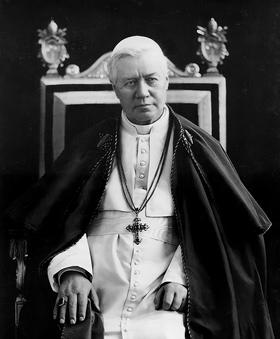
1904A black and white photograph of a white-haired pope seated on a throne, wearing a dark cape over a white cassock
Magisterium
Pope St. Pius X Ad diem illum laetissimum, 13-14

“It cannot, of course, be denied that the dispensation of these treasures is the particular and peculiar right of Jesus Christ, for they are the exclusive fruit of His Death, who by His nature is the mediator between God and man. Nevertheless, by this companionship in sorrow and suffering already mentioned between the Mother and the Son, it has been allowed to the august Virgin to be the most powerful mediatrix and advocate of the whole world with her Divine Son … We are then, it will be seen, very far from attributing to the Mother of God a productive power of grace - a power which belongs to God alone.”

Read it in the source: vatican.va

See it on the timeline: Mary as Mediatrix

1910
Magisterium
Sacred Congregation of the Discipline of the Sacraments, under St. Pius X Quam Singulari, 8 August 1910

“The Catholic Church, bearing this in mind, took care even from the beginning to bring the little ones to Christ through Eucharistic Communion, which was administered even to nursing infants. This, as was prescribed in almost all ancient Ritual books, was done at Baptism until the thirteenth century, and this custom prevailed in some places even later. It is still found in the Greek and Oriental Churches. But to remove the danger that infants might eject the Consecrated Host, the custom obtained from the beginning of administering the Eucharist to them under the species of wine only. … This practice later died out in the Latin Church, and children were not permitted to approach the Holy Table until they had come to the use of reason and had some knowledge of this august Sacrament.”

Read it in the source: Papal Encyclicals Online

See it on the timeline: The Eucharist

d. 1926A white-haired pope in a white cassock and skullcap, smiling
Magisterium

Bartolo Longo, apostle of the Rosary at Pompeii

Pope Benedict XVI Pastoral Visit to Pompeii, Recitation of the Holy Rosary and Meditation, 19 October 2008

“Before entering the Shrine to recite the Holy Rosary with you, I paused briefly before the tomb of Bl. Bartolo Longo and, praying, I asked myself: “Where did this great apostle of Mary find the energy and perseverance he needed to bring such an impressive work, now known across the world, to completion? Was it not in the Rosary, which he accepted as a true gift from Our Lady's Heart?” Yes, that truly was how it happened! The experience of the Saints bears witness to it: this popular Marian prayer is a precious spiritual means to grow in intimacy with Jesus, and to learn at the school of the Blessed Virgin always to fulfil the divine will.”

Read it in the source: vatican.va

See it on the timeline: The Rosary

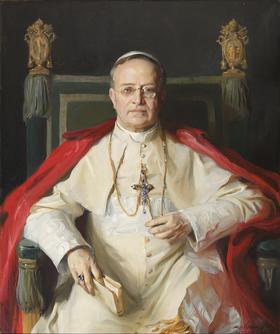
1928A pope in round spectacles sits in a red-backed chair, in a white cassock and a red cape, holding a small book
Magisterium
Pope Pius XI Mortalium Animos 2

“Certainly such attempts can nowise be approved by Catholics, founded as they are on that false opinion which considers all religions to be more or less good and praiseworthy, since they all in different ways manifest and signify that sense which is inborn in us all, and by which we are led to God and to the obedient acknowledgment of His rule.”

Read it in the source: vatican.va

See it on the timeline: Other religions

1930
Magisterium
Pope Pius XI Casti Connubii, 54

“But no reason, however grave, may be put forward by which anything intrinsically against nature may become conformable to nature and morally good. Since, therefore, the conjugal act is destined primarily by nature for the begetting of children, those who in exercising it deliberately frustrate its natural power and purpose sin against nature and commit a deed which is shameful and intrinsically vicious.”

Read it in the source: vatican.va

See it on the timeline: Contraception

1930
Magisterium
Pope Pius XI Casti Connubii, 63

“But another very grave crime is to be noted, Venerable Brethren, which regards the taking of the life of the offspring hidden in the mother's womb. Some wish it to be allowed and left to the will of the father or the mother; others say it is unlawful unless there are weighty reasons which they call by the name of medical, social, or eugenic "indication."”

Read it in the source: vatican.va

See it on the timeline: Abortion

1930
Magisterium
Pius XI Casti Connubii, 31

“But this accumulation of benefits is completed and, as it were, crowned by that blessing of Christian marriage which in the words of St. Augustine we have called the sacrament, by which is denoted both the indissolubility of the bond and the raising and hallowing of the contract by Christ Himself, whereby He made it an efficacious sign of grace.”

Read it in the source: vatican.va

See it on the timeline: Matrimony

1930A pope in round spectacles sits in a red-backed chair, in a white cassock and a red cape, holding a small book
Magisterium
Pope Pius XI Casti Connubii, 55

“Small wonder, therefore, if Holy Writ bears witness that the Divine Majesty regards with greatest detestation this horrible crime and at times has punished it with death. As St. Augustine notes, "Intercourse even with one's legitimate wife is unlawful and wicked where the conception of the offspring is prevented. Onan, the son of Juda, did this and the Lord killed him for it."”

Read it in the source: vatican.va

See it on the timeline: Contraception

1930
Magisterium
Pope Pius XI Casti Connubii, 56

“Since, therefore, openly departing from the uninterrupted Christian tradition some recently have judged it possible solemnly to declare another doctrine regarding this question, the Catholic Church … raises her voice in token of her divine ambassadorship and through Our mouth proclaims anew: any use whatsoever of matrimony exercised in such a way that the act is deliberately frustrated in its natural power to generate life is an offense against the law of God and of nature, and those who indulge in such are branded with the guilt of a grave sin.”

Read it in the source: vatican.va

See it on the timeline: Contraception

1937
Magisterium

"A powerful weapon to put the demons to flight"

Pope Pius XI Ingravescentibus Malis, 14 (29 September 1937)

“Nevertheless, if men in our century, with its derisive pride, refuse the Holy Rosary, there is an innumerable multitude of holy men of every age and every condition who have always held it dear. They have recited it with great devotion, and in every moment they have used it as a powerful weapon to put the demons to flight, to preserve the integrity of life, to acquire virtue more easily, and in a word to attain real peace among men.”

Read it in the source: vatican.va

See it on the timeline: The Rosary

1937
Magisterium

Pius XI condemns the idolatry of race

Pope Pius XI Encyclical Mit brennender Sorge, 14 March 1937, no. 8

“Whoever exalts race, or the people, or the State, or a particular form of State, or the depositories of power, or any other fundamental value of the human community - however necessary and honorable be their function in worldly things - whoever raises these notions above their standard value and divinizes them to an idolatrous level, distorts and perverts an order of the world planned and created by God; he is far from the true faith in God and from the concept of life which that faith upholds.”

Read it in the source: vatican.va

See it on the timeline: The Church and the Jewish people

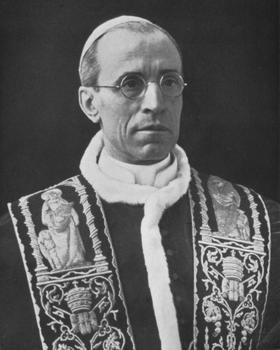
1943A black and white photograph of a thin pope in round spectacles wearing an embroidered stole
Magisterium
Pope Pius XII Mystici Corporis Christi 14

“Hence they err in a matter of divine truth, who imagine the Church to be invisible, intangible, a something merely “pneumatological” as they say, by which many Christian communities, though they differ from each other in their profession of faith, are united by an invisible bond.”

Read it in the source: Papal Encyclicals Online

See it on the timeline: The one Church

1943
Magisterium

Archaeology in the Holy Land and the Bible

Pope Pius XII Divino Afflante Spiritu 11

“when Our Predecessor published the Encyclical Letter Providentissimus Deus, hardly a single place in Palestine had begun to be explored by means of relevant excavations. Now, however, this kind of investigation is much more frequent and, since more precise methods and technical skill have been developed in the course of actual experience, it gives us information at once more abundant and more accurate. How much light has been derived from these explorations for the more correct and fuller understanding of the Sacred Books all experts know, as well as all those who devote themselves to these studies.”

Read it in the source: vatican.va

See it on the timeline: The life of Jesus Christ: the record inside and outside the Bible

March 1946A white-haired pope in a white cassock and skullcap, smiling
Magisterium

The Greek Catholic Church of Ukraine suppressed

Pope Benedict XVI Letter to Cardinal Lubomyr Husar, Major Archbishop of Kyiv-Halyč, 22 February 2006

“Unfortunately, in those sad days of March 1946, a group of clerics gathered in a Pseudo-Synod who unduly claimed to represent the Church seriously wounded ecclesial unity. Violence was intensified against those who remained faithful to unity with the Bishop of Rome, giving rise to further sufferings and forcing the Church to return underground.”

Read it in the source: vatican.va

See it on the timeline: The East-West Schism

30 November 1947A black and white photograph of a thin pope in round spectacles wearing an embroidered stole
Magisterium
Pope Pius XII Sacramentum Ordinis, Apostolic Constitution, 30 November 1947, 4

“Of the sacred orders of the diaconate, the presbyterate and the episcopate, the matter, and the only matter, is the laying on of hands. The form, likewise the only form, is the words that determine the application of this matter, by which the sacramental effects are unambiguously signified, namely the power of Order and the grace of the Holy Spirit, and which the Church receives and uses as such. It follows that we declare, to remove every controversy and to close the way to anxieties of conscience, by our apostolic authority, and, if anything has ever been legitimately ordered otherwise, we decree, that the handing over of the instruments is not necessary, at least in the future, for the validity of the sacred orders of the diaconate, the presbyterate and the episcopate.”

Our translation. The words as written, in Latin:

“Sacrorum Ordinum Diaconatus, Presbyteratus et Episcopatus materiam eamque unam esse manuum impositionem; formam vero itemque unam esse verba applicationem huius materiae determinantia, quibus univoce significantur effectus sacramentales, scilicet potestas Ordinis et gratia Spiritus Sancti, quaeque ab Ecclesia qua talia accipiuntur et usurpantur. Hinc consequitur ut declaremus, sicut revera ad omnem controversiam auferendam et ad conscientiarum anxietatibus viam praecludendam, Apostolica Nostra Auctoritate declaramus, et, si unquam aliter legitime dispositum fuerit, statuimus instrumentorum traditionem saltem in posterum non esse necessariam ad Sacrorum Diaconatus, Presbyteratus et Episcopatus Ordinum validitatem.”

Read it in the source: vatican.va

See it on the timeline: Holy Orders
1949
Magisterium
Holy Office Letter to the Archbishop of Boston, 8 August 1949

“Now, among those things which the Church has always preached and will never cease to preach is contained also that infallible statement by which we are taught that there is no salvation outside the Church. However, this dogma must be understood in that sense in which the Church herself understands it. … Therefore, no one will be saved who, knowing the Church to have been divinely established by Christ, nevertheless refuses to submit to the Church or withholds obedience from the Roman Pontiff, the Vicar of Christ on earth.”

Read it in the source: EWTN Library

See it on the timeline: No salvation outside the Church

1949
Magisterium
Holy Office Letter to the Archbishop of Boston, 8 August 1949

“Therefore, that one may obtain eternal salvation, it is not always required that he be incorporated into the Church actually as a member, but it is necessary that at least he be united to her by desire and longing. However, this desire need not always be explicit, as it is in catechumens; but when a person is involved in invincible ignorance God accepts also an implicit desire, so called because it is included in that good disposition of soul whereby a person wishes his will to be conformed to the will of God.”

Read it in the source: EWTN Library

See it on the timeline: No salvation outside the Church

1950A black and white photograph of a thin pope in round spectacles wearing an embroidered stole
Magisterium
Pope Pius XII Munificentissimus Deus, 4-5

“Yet, according to the general rule, God does not will to grant to the just the full effect of the victory over death until the end of time has come. And so it is that the bodies of even the just are corrupted after death, and only on the last day will they be joined, each to its own glorious soul. … Now God has willed that the Blessed Virgin Mary should be exempted from this general rule. She, by an entirely unique privilege, completely overcame sin by her Immaculate Conception, and as a result she was not subject to the law of remaining in the corruption of the grave, and she did not have to wait until the end of time for the redemption of her body.”

Read it in the source: vatican.va

See it on the timeline: The Assumption

1950
Magisterium
Pope Pius XII Munificentissimus Deus, 17

“Thus, to cite an illustrious example, this is set forth in that sacramentary which Adrian I, our predecessor of immortal memory, sent to the Emperor Charlemagne. These words are found in this volume: "Venerable to us, O Lord, is the festivity of this day on which the holy Mother of God suffered temporal death, but still could not be kept down by the bonds of death, who has begotten your Son our Lord incarnate from herself."”

Read it in the source: vatican.va

See it on the timeline: The Assumption

1950
Magisterium
Pope Pius XII Munificentissimus Deus, 39

“We must remember especially that, since the second century, the Virgin Mary has been designated by the holy Fathers as the new Eve, who, although subject to the new Adam, is most intimately associated with him in that struggle against the infernal foe which, as foretold in the protoevangelium, would finally result in that most complete victory over the sin and death which are always mentioned together in the writings of the Apostle of the Gentiles. Consequently, just as the glorious resurrection of Christ was an essential part and the final sign of this victory, so that struggle which was common to the Blessed Virgin and her divine Son should be brought to a close by the glorification of her virginal body…”

Read it in the source: vatican.va

See it on the timeline: The Assumption

1950
Magisterium
Pope Pius XII Munificentissimus Deus, 44

“…by the authority of our Lord Jesus Christ, of the Blessed Apostles Peter and Paul, and by our own authority, we pronounce, declare, and define it to be a divinely revealed dogma: that the Immaculate Mother of God, the ever Virgin Mary, having completed the course of her earthly life, was assumed body and soul into heavenly glory.”

Read it in the source: vatican.va

See it on the timeline: The Assumption

1950
Magisterium
Pope Pius XII Munificentissimus Deus, 12

“Certainly this teaching authority of the Church, not by any merely human effort but under the protection of the Spirit of Truth, and therefore absolutely without error, carries out the commission entrusted to it, that of preserving the revealed truths pure and entire throughout every age, in such a way that it presents them undefiled, adding nothing to them and taking nothing away from them.”

Read it in the source: vatican.va

See it on the timeline: Doctrines defined later

1950
Magisterium
Pope Pius XII Humani Generis, 36

“For these reasons the Teaching Authority of the Church does not forbid that, in conformity with the present state of human sciences and sacred theology, research and discussions, on the part of men experienced in both fields, take place with regard to the doctrine of evolution, in as far as it inquires into the origin of the human body as coming from pre-existent and living matter - for the Catholic faith obliges us to hold that souls are immediately created by God. However, this must be done in such a way that the reasons for both opinions, that is, those favorable and those unfavorable to evolution, be weighed and judged with the necessary seriousness, moderation and measure”

Read it in the source: vatican.va

See it on the timeline: Evolution and Genesis

1950
Magisterium
Pope Pius XII Humani Generis, 37

“For the faithful cannot embrace that opinion which maintains that either after Adam there existed on this earth true men who did not take their origin through natural generation from him as from the first parent of all, or that Adam represents a certain number of first parents. Now it is in no way apparent how such an opinion can be reconciled with that which the sources of revealed truth and the documents of the Teaching Authority of the Church propose with regard to original sin, which proceeds from a sin actually committed by an individual Adam and which, through generation, is passed on to all and is in everyone as his own.”

Read it in the source: vatican.va

See it on the timeline: Evolution and Genesis

1951
Magisterium
Pope Pius XII Address to Midwives, 29 October 1951

“Serious motives … may exempt husband and wife from the obligatory, positive debt for a long period or even for the entire period of matrimonial life. From this it follows that the observance of the natural sterile periods may be lawful, from the moral viewpoint: and it is lawful in the conditions mentioned.”

Read it in the source: EWTN Library

See it on the timeline: Contraception

1951
Magisterium

Its prayers and its meditation

Pope Pius XII Ingruentium Malorum, 8 (15 September 1951)

“What prayers are better adapted and more beautiful than the Lord's prayer and the angelic salutation, which are the flowers with which this mystical crown is formed? With meditation of the Sacred Mysteries added to the vocal prayers, there emerges another very great advantage, so that all, even the most simple and least educated, have in this a prompt and easy way to nourish and preserve their own faith.”

Read it in the source: vatican.va

See it on the timeline: The Rosary

1957
Magisterium
Pope Pius XII Encyclical Le Pèlerinage de Lourdes, 38

“But as was true for the crowds which pressed around Jesus, the healing of bodily ills is still a gesture of mercy and a sign of that power which the Son of Man has to forgive sins. The Virgin invites us to the blessed grotto in her Divine Son's name for the conversion of our hearts and in the hope of forgiveness.”

Read it in the source: vatican.va

See it on the timeline: Honor given to Mary

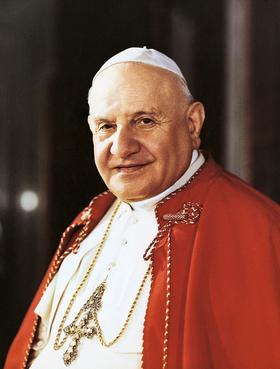
1959A colour photograph of a smiling elderly pope in a white skullcap and a red cape trimmed with white fur
Magisterium

A prayer of meditation on the Incarnation and the Redemption

Pope St. John XXIII Grata Recordatio, 2 (26 September 1959)

“For the rosary is a very commendable form of prayer and meditation. In saying it we weave a mystic garland of Ave Maria's, Pater Noster's, and Gloria Patri's. And as we recite these vocal prayers, we meditate upon the principal mysteries of our religion; the Incarnation of Jesus Christ and the Redemption of the human race are proposed, one event after another, for our consideration.”

Read it in the source: vatican.va

See it on the timeline: The Rosary

1959
Magisterium

St. John XXIII says the whole Rosary every day

Pope St. John XXIII Grata Recordatio, 3 (26 September 1959)

“These pleasant memories of Our younger days have not faded or vanished as the years of Our life have passed. On the contrary, We want to declare in complete frankness and simplicity that the years have made Mary's rosary all the dearer to Us. We never fail to recite it each day in its entirety and We intend to recite it with particular devotion during the coming month.”

Read it in the source: vatican.va

See it on the timeline: The Rosary

1964A colour photograph of a pope in a red cape trimmed with white fur and an embroidered stole
Magisterium
Pope St. Paul VI Ecclesiam Suam 107

“Then we have those worshipers who adhere to other monotheistic systems of religion, especially the Moslem religion. We do well to admire these people for all that is good and true in their worship of God. … Obviously we cannot agree with these various forms of religion, nor can we adopt an indifferent or uncritical attitude toward them on the assumption that they are all to be regarded as on an equal footing … Indeed, honesty compels us to declare openly our conviction that the Christian religion is the one and only true religion, and it is our hope that it will be acknowledged as such by all who look for God and worship Him.”

Read it in the source: vatican.va

See it on the timeline: Islam and the one God

1992
Magisterium

The call of Abraham

Catechism of the Catholic Church CCC 59

“In order to gather together scattered humanity God calls Abram from his country, his kindred and his father's house, and makes him Abraham, that is, "the father of a multitude of nations". "In you all the nations of the earth shall be blessed."”

Read it in the source: vatican.va

See it on the timeline: Islam and the Church

1965A colour photograph of a pope in a red cape trimmed with white fur and an embroidered stole
Magisterium
Pope St. Paul VI Mysterium Fidei 46

“For what now lies beneath the aforementioned species is not what was there before, but something completely different; and not just in the estimation of Church belief but in reality, since once the substance or nature of the bread and wine has been changed into the body and blood of Christ, nothing remains of the bread and the wine except for the species…”

Read it in the source: vatican.va

See it on the timeline: Transubstantiation

1965
Magisterium
Pope St. Paul VI Mysterium Fidei 55

“Moreover, the Catholic Church has held firm to this belief in the presence of Christ's Body and Blood in the Eucharist not only in her teaching but in her life as well, since she has at all times paid this great Sacrament the worship known as "latria," which may be given to God alone.”

Read it in the source: vatican.va

See it on the timeline: Adoring the Eucharist

7 December 1965
Magisterium

The excommunications of 1054 lifted

Pope St. Paul VI and Ecumenical Patriarch Athenagoras I Joint Catholic-Orthodox Declaration, 7 December 1965, 4

“They likewise regret and remove both from memory and from the midst of the Church the sentences of excommunication which followed these events, the memory of which has influenced actions up to our day and has hindered closer relations in charity; and they commit these excommunications to oblivion.”

Read it in the source: vatican.va

See it on the timeline: The East-West Schism

1967
Magisterium
Pope St. Paul VI Indulgentiarum Doctrina, 8

“Unfortunately, the practice of indulgences has at times been improperly used either through "untimely and superfluous indulgences" by which the power of the keys was humiliated and penitential satisfaction weakened, or through the collection of "illicit profits" by which indulgences were blasphemously defamed. But the Church, in deploring and correcting these improper uses "teaches and establishes that the use of indulgences must be preserved because it is supremely salutary for the Christian people and authoritatively approved by the sacred councils…"”

Read it in the source: vatican.va

See it on the timeline: Indulgences

1 January 1967
Magisterium

Pope Paul VI on the misuse of indulgences

Pope St. Paul VI Apostolic Constitution Indulgentiarum Doctrina, 8

“Unfortunately, the practice of indulgences has at times been improperly used either through "untimely and superfluous indulgences" by which the power of the keys was humiliated and penitential satisfaction weakened, or through the collection of "illicit profits" by which indulgences were blasphemously defamed.”

Read it in the source: vatican.va

See it on the timeline: Protestantism

1968
Magisterium
Pope St. Paul VI Credo of the People of God, 26

“The unique and indivisible existence of the Lord glorious in heaven is not multiplied, but is rendered present by the sacrament in the many places on earth where Mass is celebrated.”

Read it in the source: vatican.va

See it on the timeline: The Real Presence and the Ascension

1968
Magisterium
Pope St. Paul VI Humanae Vitae, 11-12

“The Church, nevertheless, in urging men to the observance of the precepts of the natural law, which it interprets by its constant doctrine, teaches that each and every marital act must of necessity retain its intrinsic relationship to the procreation of human life. … This particular doctrine, often expounded by the magisterium of the Church, is based on the inseparable connection, established by God, which man on his own initiative may not break, between the unitive significance and the procreative significance which are both inherent to the marriage act.”

Read it in the source: vatican.va

See it on the timeline: Contraception

1968
Magisterium

Paul VI: the relics of St. Peter identified

Pope St. Paul VI General Audience, 26 June 1968

“The reply given at that time by the venerated Pontiff left the matter in suspense, in doubt. … New most patient and accurate investigations have been subsequently pursued with a result that, relying on the judgement of worthy and prudent persons, We believe to be positive: The relics also of St. Peter have been identified in a manner that We cannot but accept as convincing”

Read it in the source: EWTN Library

See it on the timeline: The tradition of the papacy

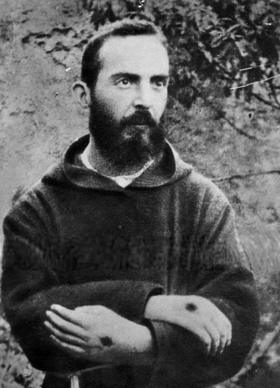
d. 1968A black and white photograph of a young bearded Capuchin friar with his arms crossed, a dark wound on the back of each hand
Magisterium

St. Pio of Pietrelcina: "His days were a Rosary lived"

Pope Benedict XVI Homily at San Giovanni Rotondo, 21 June 2009

“First of all prayer. Like all great men of God Padre Pio himself had become prayer, body and soul. His days were a Rosary lived, that is, a continuous meditation and assimilation of Christ's mysteries in spiritual union with the Virgin Mary.”

Read it in the source: vatican.va

See it on the timeline: The Rosary

1968A colour photograph of a pope in a red cape trimmed with white fur and an embroidered stole
Magisterium
Pope St. Paul VI Humanae Vitae, 16

“If therefore there are well-grounded reasons for spacing births, arising from the physical or psychological condition of husband or wife, or from external circumstances, the Church teaches that married people may then take advantage of the natural cycles immanent in the reproductive system and engage in marital intercourse only during those times that are infertile, thus controlling birth in a way which does not in the least offend the moral principles which We have just explained.”

Read it in the source: vatican.va

See it on the timeline: Contraception

27 September 1970
Magisterium

Paul VI applies Sirach to a Doctor

Pope St. Paul VI Apostolic Letter Multiformis Sapientia Dei, 27 September 1970

“A woman of simple customs and ignorant of literary culture, she excelled so much in words and writings that these words can be referred to her: “in the full assembly she opened her mouth” (Sir 15:5), and she was rightly proclaimed a saint by holy men and also was venerated as a very sure guide and teacher by doctors of sacred sciences.”

Read it in the source: vatican.va

See it on the timeline: The Doctors of the Church

1971
Magisterium
Pope Paul VI Apostolic Constitution Divinae consortium naturae, 15 August 1971

“we judge that the most ancient formula, proper to the Byzantine rite, should be preferred to it, by which the Gift of the Holy Spirit himself is expressed and the outpouring of the Spirit on the day of Pentecost is recalled (cf. Acts 2:1-4 and 38). … Therefore, so that the revision of the rite of Confirmation may also fittingly bear on the very essence of the sacramental rite, by Our supreme apostolic authority We decree and establish that the following be observed in the Latin Church from now on: The sacrament of Confirmation is conferred through the anointing with chrism on the forehead, which is done by the laying on of the hand, and through the words: "Be sealed with the Gift of the Holy Spirit."”

Our translation. The words as written, in Latin:

“ei tamen praeferendam censemus antiquissimam formulam ritus Byzantini propriam, qua Donum ipsius Spiritus Sancti exprimitur atque effusio Spiritus die Pentecostes peracta recolitur (cf Act 2,1-4 et 38). … Quapropter, ut ritus Confirmationis recognitio ad ipsam etiam ritus sacramentalis essentiam congruenter pertineat, Suprema Nostra Auctoritate Apostolica decernimus et constituimus, ut ea, quae sequuntur, in Ecclesia Latina in posterum serventur: SACRAMENTUM CONFIRMATIONIS CONFERTUR PER UNCTIONEM CHRISMATIS IN FRONTE, QUAE FIT MANUS IMPOSITIONE, ATQUE PER VERBA: «ACCIPE SIGNACULUM DONI SPIRITUS SANCTI».”

Read it in the source: vatican.va

See it on the timeline: Confirmation

1972
Magisterium
Pope Paul VI Apostolic Constitution Sacram Unctionem Infirmorum, 30 November 1972, as quoted in CCC 1513

“The sacrament of Anointing of the Sick is given to those who are seriously ill by anointing them on the forehead and hands with duly blessed oil - pressed from olives or from other plants - saying, only once: "Through this holy anointing may the Lord in his love and mercy help you with the grace of the Holy Spirit. May the Lord who frees you from sin save you and raise you up."”

Read it in the source: vatican.va

See it on the timeline: The Anointing of the Sick

1974
Magisterium
Pope St. Paul VI Marialis Cultus, 46

“As a Gospel prayer, centered on the mystery of the redemptive Incarnation, the Rosary is therefore a prayer with a clearly Christological orientation. Its most characteristic element, in fact, the litany-like succession of Hail Mary's, becomes in itself an unceasing praise of Christ, who is the ultimate object both of the angel's announcement and of the greeting of the mother of John the Baptist: "Blessed is the fruit of your womb" (Lk. 1:42).”

Read it in the source: vatican.va

See it on the timeline: The Rosary

1974
Magisterium
Sacred Congregation for the Doctrine of the Faith Declaration on Procured Abortion, 7

“In the course of history, the Fathers of the Church, her Pastors and her Doctors have taught the same doctrine - the various opinions on the infusion of the spiritual soul did not introduce any doubt about the illicitness of abortion. It is true that in the Middle Ages, when the opinion was generally held that the spiritual soul was not present until after the first few weeks, a distinction was made in the evaluation of the sin and the gravity of penal sanctions. Excellent authors allowed for this first period more lenient case solutions which they rejected for following periods. But it was never denied at that time that procured abortion, even during the first days, was objectively grave fault. This condemnation was in fact unanimous.”

Read it in the source: vatican.va

See it on the timeline: Abortion

2 February 1974A colour photograph of a pope in a red cape trimmed with white fur and an embroidered stole
Magisterium

A Gospel prayer

Pope St. Paul VI Marialis Cultus, 44

“Thus, for instance, the Gospel inspiration of the Rosary has appeared more clearly: the Rosary draws from the Gospel the presentation of the mysteries and its main formulas. As it moves from the angel's joyful greeting and the Virgin's pious assent, the Rosary takes its inspiration from the Gospel to suggest the attitude with which the faithful should recite it.”

Read it in the source: vatican.va

See it on the timeline: The Rosary

1974
Magisterium
Pope St. Paul VI Marialis Cultus, 47

“Without this the Rosary is a body without a soul, and its recitation is in danger of becoming a mechanical repetition of formulas and of going counter to the warning of Christ: "And in praying do not heap up empty phrases as the Gentiles do; for they think that they will be heard for their many words" (Mt. 6:7).”

Read it in the source: vatican.va

See it on the timeline: The Rosary

2 February 1974
Magisterium

The mysteries follow the life of Christ

Pope St. Paul VI Marialis Cultus, 45

“The Rosary considers in harmonious succession the principal salvific events accomplished in Christ, from His virginal conception and the mysteries of His childhood to the culminating moments of the Passover-the blessed passion and the glorious resurrection-and to the effects of this on the infant Church on the day of Pentecost, and on the Virgin Mary when at the end of her earthly life she was assumed body and soul into her heavenly home.”

Read it in the source: vatican.va

See it on the timeline: The Rosary

2 February 1974
Magisterium

The four elements of the Rosary

Pope St. Paul VI Marialis Cultus, 49

“b) The Lord's Prayer, or Our Father, which by reason of its immense value is at the basis of Christian prayer and ennobles that prayer in its various expressions. c) The litany-like succession of the Hail Mary, which is made up of the angel's greeting to the Virgin (cf. Lk. 1;28), and of Elizabeth's greeting (cf. Lk. 1:42), followed by the ecclesial supplication, Holy Mary. The continued series of Hail Mary's is the special characteristic of the Rosary, and their number, in the full and typical number of one hundred and fifty, presents a certain analogy with the Psalter and is an element that goes back to the very origin of the exercise of piety.”

Read it in the source: vatican.va

See it on the timeline: The Rosary

1975
Magisterium
Congregation for the Doctrine of the Faith Declaration Persona Humana, 8

“For according to the objective moral order, homosexual relations are acts which lack an essential and indispensable finality. In Sacred Scripture they are condemned as a serious depravity and even presented as the sad consequence of rejecting God. … This judgment of Scripture does not of course permit us to conclude that all those who suffer from this anomaly are personally responsible for it, but it does attest to the fact that homosexual acts are intrinsically disordered and can in no case be approved of.”

Read it in the source: vatican.va

See it on the timeline: Homosexuality

10 November 1979An elderly pope in green vestments and a white and gold mitre raises his hand in greeting, holding his staff with the crucifix
Magisterium

John Paul II: Galileo suffered at the hands of men and bodies of the Church

Pope St. John Paul II Address to the Pontifical Academy of Sciences for the centenary of the birth of Albert Einstein, 10 November 1979, no. 6

“The greatness of Galileo is known to all, like that of Einstein; but unlike the one whom we honour today before the College of Cardinals in the apostolic palace, the former had much to suffer, we cannot hide it, at the hands of men and bodies of the Church. … To go beyond this position taken by the Council, I wish that theologians, scholars and historians, moved by a spirit of sincere collaboration, would examine the Galileo case more deeply and, in a loyal recognition of wrongs from whatever side they come, would remove the mistrust that this affair still sets, in many minds, against a fruitful concord between science and faith, between Church and world.”

Our translation. The words as written, in French:

“La grandeur de Galilée est connue de tous, comme celle d’Einstein; mais à la différence de celui que nous honorons aujourd’hui devant le Collège cardinalice dans le palais apostolique, le premier eut beaucoup à souffrir – nous ne saurions le cacher – de la part d’hommes et d’organismes de l’Eglise. … Pour aller au-delà de cette prise de position du Concile, je souhaite que des théologiens, des savants et des historiens, animés par un esprit de sincère collaboration, approfondissent l’examen du cas Galilée et, dans une reconnaissance loyale des torts de quelque côté qu’ils viennent, fassent disparaître les défiances que cette affaire oppose encore, dans beaucoup d’esprits, à une concorde fructueuse entre science et foi, entre Eglise et monde.”

Read it in the source: vatican.va

See it on the timeline: The Galileo case

1980
Magisterium
Congregation for the Doctrine of the Faith Instruction on Infant Baptism (Pastoralis Actio), 18

“It is beyond doubt that the preaching of the Apostles was normally directed to adults, and the first to be baptized were people converted to the Christian Faith. … However, as was mentioned above, the practice of baptizing children rests on an immemorial tradition originating from the Apostles, the importance of which cannot be ignored; besides, Baptism is never administered without faith: in the case of infants, it is the faith of the Church.”

Read it in the source: vatican.va

See it on the timeline: Infant baptism

1981An elderly pope in green vestments and a white and gold mitre raises his hand in greeting, holding his staff with the crucifix
Magisterium
St. John Paul II Familiaris Consortio, 13

“Christ renews the first plan that the Creator inscribed in the hearts of man and woman, and in the celebration of the sacrament of matrimony offers a "new heart": thus the couples are not only able to overcome "hardness of heart," but also and above all they are able to share the full and definitive love of Christ, the new and eternal Covenant made flesh.”

Read it in the source: vatican.va

See it on the timeline: Matrimony

1983
Magisterium
Code of Canon Law Canon 1248 §2

“If participation in the eucharistic celebration becomes impossible because of the absence of a sacred minister or for another grave cause, it is strongly recommended that the faithful take part in a liturgy of the word if such a liturgy is celebrated in a parish church or other sacred place according to the prescripts of the diocesan bishop or that they devote themselves to prayer for a suitable time alone, as a family, or, as the occasion permits, in groups of families.”

Read it in the source: vatican.va

See it on the timeline: The Sunday Mass obligation

1983
Magisterium
Congregation for the Doctrine of the Faith Sacerdotium Ministeriale, III, 4

“Included among these powers which Christ entrusted exclusively to the Apostles and their successors is the power of confecting the Eucharist. To the Bishops alone, and to the priests they have made sharers in their ministry which they themselves have received, is reserved the power of renewing in the Mystery of the Eucharist what Christ did at the Last Supper.”

Read it in the source: vatican.va

See it on the timeline: The priest and the Eucharist

1984An elderly pope in green vestments and a white and gold mitre raises his hand in greeting, holding his staff with the crucifix
Magisterium
Pope St. John Paul II Reconciliatio et Paenitentia, 29

“Now this power to "forgive sins" Jesus confers through the Holy Spirit upon ordinary men, themselves subject to the snare of sin, namely his apostles: "Receive the Holy Spirit. Whose sins you shall forgive, they are forgiven; whose sins you shall retain, they are retained." This is one of the most awe-inspiring innovations of the Gospel!”

Read it in the source: vatican.va

See it on the timeline: Confession to a priest

1984
Magisterium
Pope St. John Paul II Reconciliatio et Paenitentia, 33

“The individual and integral confession of sins with individual absolution constitutes the only ordinary way in which the faithful who are conscious of serious sin are reconciled with God and with the church.”

Read it in the source: vatican.va

See it on the timeline: Penance and Reconciliation

1985
Magisterium
Pope St. John Paul II Address to Young Muslims, Casablanca, 19 August 1985, 10

“Both of us believe in one God the only God, who is all Justice and all Mercy … Loyalty demands also that we should recognize and respect our differences. Obviously the most fundamental is the view that we hold on the person and work of Jesus of Nazareth. You know that, for the Christians, this Jesus causes them to enter into an intimate knowledge of the mystery of God and into a filial communion by his gifts, so that they recognize him and proclaim him Lord and Saviour.”

Read it in the source: vatican.va

See it on the timeline: Islam and the one God

1986
Magisterium
Congregation for the Doctrine of the Faith Letter on the Pastoral Care of Homosexual Persons, 3

“Although the particular inclination of the homosexual person is not a sin, it is a more or less strong tendency ordered toward an intrinsic moral evil; and thus the inclination itself must be seen as an objective disorder.”

Read it in the source: vatican.va

See it on the timeline: Homosexuality

1986The stone front of a large synagogue with columns and tall windows against a blue sky
Magisterium

John Paul II at the Great Synagogue of Rome

Pope St. John Paul II Address at the Synagogue of Rome, 13 April 1986

“Nevertheless, a consideration of centuries-long cultural conditioning could not prevent us from recognizing that the acts of discrimination, unjustified limitation of religious freedom, oppression also on the level of civil freedom in regard to the Jews were, from an objective point of view, gravely deplorable manifestations. Yes, once again, through myself, the Church, in the words of the well-known Declaration Nostra Aetate (No. 4), «deplores the hatred, persecutions, and displays of anti-Semitism directed against the Jews at any time and by anyone"; I repeat: "by anyone».”

Read it in the source: vatican.va

See it on the timeline: The Church and the Jewish people

1986
Magisterium
Congregation for the Doctrine of the Faith Letter on the Pastoral Care of Homosexual Persons, 4

“One is a new exegesis of Sacred Scripture which claims variously that Scripture has nothing to say on the subject of homosexuality, or that it somehow tacitly approves of it, or that all of its moral injunctions are so culture-bound that they are no longer applicable to contemporary life. These views are gravely erroneous and call for particular attention here.”

Read it in the source: vatican.va

See it on the timeline: Homosexuality

1986
Magisterium
Congregation for the Doctrine of the Faith Letter on the Pastoral Care of Homosexual Persons, 10

“It is deplorable that homosexual persons have been and are the object of violent malice in speech or in action. Such treatment deserves condemnation from the Church's pastors wherever it occurs. It reveals a kind of disregard for others which endangers the most fundamental principles of a healthy society. The intrinsic dignity of each person must always be respected in word, in action and in law.”

Read it in the source: vatican.va

See it on the timeline: Homosexuality

1987An elderly pope in green vestments and a white and gold mitre raises his hand in greeting, holding his staff with the crucifix
Magisterium
Pope St. John Paul II Redemptoris Mater, 10

“According to the belief formulated in solemn documents of the Church, this "glory of grace" is manifested in the Mother of God through the fact that she has been "redeemed in a more sublime manner." By virtue of the richness of the grace of the beloved Son, by reason of the redemptive merits of him who willed to become her Son, Mary was preserved from the inheritance of original sin.”

Read it in the source: vatican.va

See it on the timeline: Mary without sin

1987
Magisterium
Pope St. John Paul II Redemptoris Mater, 38

“The Church knows and teaches with Saint Paul that there is only one mediator … In effect, Mary's mediation is intimately linked with her motherhood. It possesses a specifically maternal character, which distinguishes it from the mediation of the other creatures who in various and always subordinate ways share in the one mediation of Christ, although her own mediation is also a shared mediation.”

Read it in the source: vatican.va

See it on the timeline: Mary as Mediatrix

1992
Magisterium
Catechism of the Catholic Church CCC 297

“Scripture bears witness to faith in creation "out of nothing" as a truth full of promise and hope. Thus the mother of seven sons encourages them for martyrdom: … Look at the heaven and the earth and see everything that is in them, and recognize that God did not make them out of things that existed. Thus also mankind comes into being.”

Read it in the source: vatican.va

See it on the timeline: Evolution and Genesis

1992
Magisterium

The chosen people, and the nations to be gathered

Catechism of the Catholic Church CCC 59-60

“In order to gather together scattered humanity God calls Abram from his country, his kindred and his father's house, and makes him Abraham, that is, "the father of a multitude of nations". "In you all the nations of the earth shall be blessed." … The people descended from Abraham would be the trustee of the promise made to the patriarchs, the chosen people, called to prepare for that day when God would gather all his children into the unity of the Church. They would be the root on to which the Gentiles would be grafted, once they came to believe.”

Read it in the source: vatican.va

See it on the timeline: Judaism and the Church

1992
Magisterium
Catechism of the Catholic Church CCC 2175

“Sunday is expressly distinguished from the sabbath which it follows chronologically every week; for Christians its ceremonial observance replaces that of the sabbath. In Christ's Passover, Sunday fulfills the spiritual truth of the Jewish sabbath and announces man's eternal rest in God. For worship under the Law prepared for the mystery of Christ, and what was done there prefigured some aspects of Christ:”

Read it in the source: vatican.va

See it on the timeline: The Sunday Mass obligation

1992
Magisterium
Catechism of the Catholic Church CCC 59

“In order to gather together scattered humanity God calls Abram from his country, his kindred and his father's house, and makes him Abraham, that is, "the father of a multitude of nations". "In you all the nations of the earth shall be blessed."”

Read it in the source: vatican.va

See it on the timeline: Islam and the one God

1992
Magisterium
Catechism of the Catholic Church CCC 355

“"God created man in his own image, in the image of God he created him, male and female he created them." Man occupies a unique place in creation: (I) he is "in the image of God"; (II) in his own nature he unites the spiritual and material worlds; (III) he is created "male and female"; (IV) God established him in his friendship.”

Read it in the source: vatican.va

See it on the timeline: Evolution and Genesis

1992
Magisterium
Catechism of the Catholic Church CCC 2335

“the union of man and woman in marriage is a way of imitating in the flesh the Creator's generosity and fecundity: "Therefore a man leaves his father and his mother and cleaves to his wife, and they become one flesh." All human generations proceed from this union.”

Read it in the source: vatican.va

See it on the timeline: Homosexuality

1992
Magisterium
Catechism of the Catholic Church CCC 2331

“"God created man in his own image . . . male and female he created them"; He blessed them and said, "Be fruitful and multiply"”

Read it in the source: vatican.va

See it on the timeline: Contraception

1992
Magisterium

Israel the priestly people, and the covenant looked for

Catechism of the Catholic Church CCC 62-64

“After the patriarchs, God formed Israel as his people by freeing them from slavery in Egypt. He established with them the covenant of Mount Sinai and, through Moses, gave them his law so that they would recognize him and serve him as the one living and true God, the provident Father and just judge, and so that they would look for the promised Saviour. … Israel is the priestly people of God, "called by the name of the LORD", and "the first to hear the word of God", The people of "elder brethren" in the faith of Abraham. … Through the prophets, God forms his people in the hope of salvation, in the expectation of a new and everlasting Covenant intended for all, to be written on their hearts.”

Read it in the source: vatican.va

See it on the timeline: Judaism and the Church

1992
Magisterium
Catechism of the Catholic Church CCC 359

“St. Paul tells us that the human race takes its origin from two men: Adam and Christ. . . the first man, Adam, he says, became a living soul, the last Adam a life-giving spirit.”

Read it in the source: vatican.va

See it on the timeline: Evolution and Genesis

1992
Magisterium
Catechism of the Catholic Church CCC 971

“The Church's devotion to the Blessed Virgin is intrinsic to Christian worship. … This very special devotion … differs essentially from the adoration which is given to the incarnate Word and equally to the Father and the Holy Spirit, and greatly fosters this adoration.”

Read it in the source: vatican.va

See it on the timeline: Honor given to Mary

1992
Magisterium
Catechism of the Catholic Church CCC 411

“Furthermore many Fathers and Doctors of the Church have seen the woman announced in the "Proto-evangelium" as Mary, the mother of Christ, the "new Eve". Mary benefited first of all and uniquely from Christ's victory over sin: she was preserved from all stain of original sin and by a special grace of God committed no sin of any kind during her whole earthly life.”

Read it in the source: vatican.va

See it on the timeline: Mary without sin

1992
Magisterium
Catechism of the Catholic Church CCC 2676

“"Rejoice . . . O Daughter of Jerusalem . . . the Lord your God is in your midst." Mary, in whom the Lord himself has just made his dwelling, is the daughter of Zion in person, the ark of the covenant, the place where the glory of the Lord dwells.”

Read it in the source: vatican.va

See it on the timeline: Mary without sin

1992
Magisterium
Catechism of the Catholic Church CCC 492-493

“The "splendour of an entirely unique holiness" by which Mary is "enriched from the first instant of her conception" comes wholly from Christ: she is "redeemed, in a more exalted fashion, by reason of the merits of her Son". … By the grace of God Mary remained free of every personal sin her whole life long.”

Read it in the source: vatican.va

See it on the timeline: Mary without sin

1992
Magisterium
Catechism of the Catholic Church CCC 499-500

“The deepening of faith in the virginal motherhood led the Church to confess Mary's real and perpetual virginity even in the act of giving birth to the Son of God made man. … Against this doctrine the objection is sometimes raised that the Bible mentions brothers and sisters of Jesus. The Church has always understood these passages as not referring to other children of the Virgin Mary. In fact James and Joseph, "brothers of Jesus", are the sons of another Mary, a disciple of Christ, whom St. Matthew significantly calls "the other Mary". They are close relations of Jesus, according to an Old Testament expression.”

Read it in the source: vatican.va

See it on the timeline: Perpetual virginity

1992
Magisterium
Catechism of the Catholic Church CCC 966

“"Finally the Immaculate Virgin, preserved free from all stain of original sin, when the course of her earthly life was finished, was taken up body and soul into heavenly glory, and exalted by the Lord as Queen over all things, so that she might be the more fully conformed to her Son, the Lord of lords and conqueror of sin and death." The Assumption of the Blessed Virgin is a singular participation in her Son's Resurrection and an anticipation of the resurrection of other Christians…”

Read it in the source: vatican.va

See it on the timeline: The Assumption

1992
Magisterium
Catechism of the Catholic Church CCC 2635

“Since Abraham, intercession - asking on behalf of another has been characteristic of a heart attuned to God's mercy. In the age of the Church, Christian intercession participates in Christ's, as an expression of the communion of saints.”

Read it in the source: vatican.va

See it on the timeline: Mary as Mediatrix

1992
Magisterium
Catechism of the Catholic Church CCC 970

“No creature could ever be counted along with the Incarnate Word and Redeemer; but just as the priesthood of Christ is shared in various ways both by his ministers and the faithful, and as the one goodness of God is radiated in different ways among his creatures, so also the unique mediation of the Redeemer does not exclude but rather gives rise to a manifold cooperation which is but a sharing in this one source.”

Read it in the source: vatican.va

See it on the timeline: Mary as Mediatrix

1992
Magisterium
Catechism of the Catholic Church CCC 2678

“Medieval piety in the West developed the prayer of the rosary as a popular substitute for the Liturgy of the Hours.”

Read it in the source: vatican.va

See it on the timeline: The Rosary

1992
Magisterium
Catechism of the Catholic Church CCC 1374

“In the most blessed sacrament of the Eucharist "the body and blood, together with the soul and divinity, of our Lord Jesus Christ and, therefore, the whole Christ is truly, really, and substantially contained." "This presence is called 'real' - by which is not intended to exclude the other types of presence as if they could not be 'real' too, but because it is presence in the fullest sense: that is to say, it is a substantial presence by which Christ, God and man, makes himself wholly and entirely present."”

Read it in the source: vatican.va

See it on the timeline: The Real Presence

1992
Magisterium
Catechism of the Catholic Church CCC 663

“Henceforth Christ is seated at the right hand of the Father: "By 'the Father's right hand' we understand the glory and honour of divinity, where he who exists as Son of God before all ages, indeed as God, of one being with the Father, is seated bodily after he became incarnate and his flesh was glorified."”

Read it in the source: vatican.va

See it on the timeline: The Real Presence and the Ascension

1992
Magisterium
Catechism of the Catholic Church CCC 1333

“the signs of bread and wine become, in a way surpassing understanding, the Body and Blood of Christ; they continue also to signify the goodness of creation. … the Church sees in the gesture of the king-priest Melchizedek, who "brought out bread and wine," a prefiguring of her own offering.”

Read it in the source: vatican.va

See it on the timeline: Transubstantiation

1992
Magisterium
Catechism of the Catholic Church CCC 1413

“By the consecration the transubstantiation of the bread and wine into the Body and Blood of Christ is brought about. Under the consecrated species of bread and wine Christ himself, living and glorious, is present in a true, real, and substantial manner: his Body and his Blood, with his soul and his divinity”

Read it in the source: vatican.va

See it on the timeline: Transubstantiation

1992
Magisterium
Catechism of the Catholic Church CCC 2113

“Idolatry not only refers to false pagan worship. It remains a constant temptation to faith. Idolatry consists in divinizing what is not God. Man commits idolatry whenever he honors and reveres a creature in place of God, whether this be gods or demons (for example, satanism), power, pleasure, race, ancestors, the state, money, etc.”

Read it in the source: vatican.va

See it on the timeline: Adoring the Eucharist

1992
Magisterium
Catechism of the Catholic Church CCC 1367, quoting the Council of Trent, Session 22, ch. 2

“The sacrifice of Christ and the sacrifice of the Eucharist are one single sacrifice: "The victim is one and the same: the same now offers through the ministry of priests, who then offered himself on the cross; only the manner of offering is different." "In this divine sacrifice which is celebrated in the Mass, the same Christ who offered himself once in a bloody manner on the altar of the cross is contained and is offered in an unbloody manner."”

Read it in the source: vatican.va

See it on the timeline: The Mass as sacrifice

1992
Magisterium
Catechism of the Catholic Church CCC 2181

“The Sunday Eucharist is the foundation and confirmation of all Christian practice. For this reason the faithful are obliged to participate in the Eucharist on days of obligation, unless excused for a serious reason (for example, illness, the care of infants) or dispensed by their own pastor. Those who deliberately fail in this obligation commit a grave sin.”

Read it in the source: vatican.va

See it on the timeline: The Sunday Mass obligation

1992
Magisterium
Catechism of the Catholic Church CCC 112

“Be especially attentive "to the content and unity of the whole Scripture". Different as the books which compose it may be, Scripture is a unity by reason of the unity of God's plan, of which Christ Jesus is the center and heart, open since his Passover.”

Read it in the source: vatican.va

See it on the timeline: The inspiration of Scripture

1992
Magisterium
Catechism of the Catholic Church CCC 83

“The Tradition here in question comes from the apostles and hands on what they received from Jesus' teaching and example and what they learned from the Holy Spirit. … Tradition is to be distinguished from the various theological, disciplinary, liturgical or devotional traditions, born in the local churches over time. … In the light of Tradition, these traditions can be retained, modified or even abandoned under the guidance of the Church's Magisterium.”

Read it in the source: vatican.va

See it on the timeline: Scripture and Tradition

1992
Magisterium
Catechism of the Catholic Church CCC 688

“The Church, a communion living in the faith of the apostles which she transmits, is the place where we know the Holy Spirit: - in the Scriptures he inspired; - in the Tradition, to which the Church Fathers are always timely witnesses; - in the Church's Magisterium, which he assists”

Read it in the source: vatican.va

See it on the timeline: The authority of the Fathers

1992
Magisterium
Catechism of the Catholic Church CCC 890

“It is this Magisterium's task to preserve God's people from deviations and defections and to guarantee them the objective possibility of professing the true faith without error. Thus, the pastoral duty of the Magisterium is aimed at seeing to it that the People of God abides in the truth that liberates. To fulfill this service, Christ endowed the Church's shepherds with the charism of infallibility in matters of faith and morals.”

Read it in the source: vatican.va

See it on the timeline: The Magisterium

1992
Magisterium
Catechism of the Catholic Church CCC 120

“It was by the apostolic Tradition that the Church discerned which writings are to be included in the list of the sacred books. This complete list is called the canon of Scripture. It includes 46 books for the Old Testament (45 if we count Jeremiah and Lamentations as one) and 27 for the New.”

Read it in the source: vatican.va

See it on the timeline: The Old Testament canon

1992
Magisterium
Catechism of the Catholic Church CCC 857

“The Church is apostolic because she is founded on the apostles, in three ways: - she was and remains built on "the foundation of the Apostles," the witnesses chosen and sent on mission by Christ himself; - with the help of the Spirit dwelling in her, the Church keeps and hands on the teaching, the "good deposit," the salutary words she has heard from the apostles; - she continues to be taught, sanctified, and guided by the apostles until Christ's return, through their successors in pastoral office: the college of bishops”

Read it in the source: vatican.va

See it on the timeline: Apostolic succession

1992
Magisterium
Catechism of the Catholic Church CCC 424

“Moved by the grace of the Holy Spirit and drawn by the Father, we believe in Jesus and confess: 'You are the Christ, the Son of the living God.' On the rock of this faith confessed by St. Peter, Christ built his Church.”

Read it in the source: vatican.va

See it on the timeline: Peter the rock

1992
Magisterium
Catechism of the Catholic Church CCC 754

“It is also the flock of which God himself foretold that he would be the shepherd, and whose sheep, even though governed by human shepherds, are unfailingly nourished and led by Christ himself, the Good Shepherd and Prince of Shepherds, who gave his life for his sheep.”

Read it in the source: vatican.va

See it on the timeline: The office of Peter

1992
Magisterium
Catechism of the Catholic Church CCC 881

“The Lord made Simon alone, whom he named Peter, the "rock" of his Church. He gave him the keys of his Church and instituted him shepherd of the whole flock. … This pastoral office of Peter and the other apostles belongs to the Church's very foundation and is continued by the bishops under the primacy of the Pope.”

Read it in the source: vatican.va

See it on the timeline: The office of Peter

1992
Magisterium
Catechism of the Catholic Church CCC 882

“The Pope, Bishop of Rome and Peter's successor, "is the perpetual and visible source and foundation of the unity both of the bishops and of the whole company of the faithful." "For the Roman Pontiff, by reason of his office as Vicar of Christ, and as pastor of the entire Church has full, supreme, and universal power over the whole Church, a power which he can always exercise unhindered."”

Read it in the source: vatican.va

See it on the timeline: Papal supremacy

1992
Magisterium
Catechism of the Catholic Church CCC 891

“"The Roman Pontiff, head of the college of bishops, enjoys this infallibility in virtue of his office, when, as supreme pastor and teacher of all the faithful - who confirms his brethren in the faith he proclaims by a definitive act a doctrine pertaining to faith or morals.... the infallibility promised to the Church is also present in the body of bishops when, together with Peter's successor, they exercise the supreme Magisterium," above all in an Ecumenical Council. … This infallibility extends as far as the deposit of divine Revelation itself.”

Read it in the source: vatican.va

See it on the timeline: Papal infallibility

1992
Magisterium
Catechism of the Catholic Church CCC 765

“The Lord Jesus endowed his community with a structure that will remain until the Kingdom is fully achieved. Before all else there is the choice of the Twelve with Peter as their head.”

Read it in the source: vatican.va

See it on the timeline: Constantine and the Church

1992
Magisterium
Catechism of the Catholic Church CCC 66

“"The Christian economy, therefore, since it is the new and definitive Covenant, will never pass away; and no new public revelation is to be expected before the glorious manifestation of our Lord Jesus Christ." Yet even if Revelation is already complete, it has not been made completely explicit; it remains for Christian faith gradually to grasp its full significance over the course of the centuries.”

Read it in the source: vatican.va

See it on the timeline: Doctrines defined later

1992
Magisterium
Catechism of the Catholic Church CCC 426

“"At the heart of catechesis we find, in essence, a Person, the Person of Jesus of Nazareth, the only Son from the Father. . .who suffered and died for us and who now, after rising, is living with us forever." … Catechesis aims at putting "people . . . in communion . . . with Jesus Christ: only he can lead us to the love of the Father in the Spirit and make us share in the life of the Holy Trinity."”

Read it in the source: vatican.va

See it on the timeline: Are Catholics Christians?

1992
Magisterium
Catechism of the Catholic Church CCC 816

“"The sole Church of Christ [is that] which our Savior, after his Resurrection, entrusted to Peter's pastoral care, commissioning him and the other apostles to extend and rule it.... This Church, constituted and organized as a society in the present world, subsists in … the Catholic Church, which is governed by the successor of Peter and by the bishops in communion with him."”

Read it in the source: vatican.va

See it on the timeline: The one Church

1992
Magisterium
Catechism of the Catholic Church CCC 889

“In order to preserve the Church in the purity of the faith handed on by the apostles, Christ who is the Truth willed to confer on her a share in his own infallibility. By a "supernatural sense of faith" the People of God, under the guidance of the Church's living Magisterium, "unfailingly adheres to this faith."”

Read it in the source: vatican.va

See it on the timeline: Was the Church corrupted early?

1992
Magisterium
Catechism of the Catholic Church CCC 846-848

“How are we to understand this affirmation, often repeated by the Church Fathers? Re-formulated positively, it means that all salvation comes from Christ the Head through the Church which is his Body … This affirmation is not aimed at those who, through no fault of their own, do not know Christ and his Church … "Although in ways known to himself God can lead those who, through no fault of their own, are ignorant of the Gospel, to that faith without which it is impossible to please him, the Church still has the obligation and also the sacred right to evangelize all men."”

Read it in the source: vatican.va

See it on the timeline: No salvation outside the Church

1992
Magisterium
Catechism of the Catholic Church CCC 827

“All members of the Church, including her ministers, must acknowledge that they are sinners. In everyone, the weeds of sin will still be mixed with the good wheat of the Gospel until the end of time. Hence the Church gathers sinners already caught up in Christ's salvation but still on the way to holiness”

Read it in the source: vatican.va

See it on the timeline: Violence in the Church's history

1992
Magisterium
Catechism of the Catholic Church CCC 1546-1547

“The whole community of believers is, as such, priestly. … While the common priesthood of the faithful is exercised by the unfolding of baptismal grace, a life of faith, hope, and charity, a life according to the Spirit, the ministerial priesthood is at the service of the common priesthood.”

Read it in the source: vatican.va

See it on the timeline: The ordained priesthood

1992
Magisterium
Catechism of the Catholic Church CCC 1441-1442

“Only God forgives sins. … Further, by virtue of his divine authority he gives this power to men to exercise in his name. … But he entrusted the exercise of the power of absolution to the apostolic ministry which he charged with the "ministry of reconciliation."”

Read it in the source: vatican.va

See it on the timeline: Confession to a priest

1992
Magisterium
Catechism of the Catholic Church CCC 1579-1580

“All the ordained ministers of the Latin Church, with the exception of permanent deacons, are normally chosen from among men of faith who live a celibate life and who intend to remain celibate "for the sake of the kingdom of heaven." … In the Eastern Churches a different discipline has been in force for many centuries: while bishops are chosen solely from among celibates, married men can be ordained as deacons and priests. This practice has long been considered legitimate”

Read it in the source: vatican.va

See it on the timeline: Priestly celibacy

1992
Magisterium
Catechism of the Catholic Church CCC 2010-2011

“Since the initiative belongs to God in the order of grace, no one can merit the initial grace of forgiveness and justification, at the beginning of conversion. Moved by the Holy Spirit and by charity, we can then merit for ourselves and for others the graces needed for our sanctification, for the increase of grace and charity, and for the attainment of eternal life. … The charity of Christ is the source in us of all our merits before God.”

Read it in the source: vatican.va

See it on the timeline: Faith and works

1992
Magisterium
Catechism of the Catholic Church CCC 2005

“Since it belongs to the supernatural order, grace escapes our experience and cannot be known except by faith. We cannot therefore rely on our feelings or our works to conclude that we are justified and saved. … "Asked if she knew that she was in God's grace, she replied: 'If I am not, may it please God to put me in it; if I am, may it please God to keep me there.'"”

Read it in the source: vatican.va

See it on the timeline: Assurance of salvation

1992
Magisterium
Catechism of the Catholic Church CCC 1821

“We can therefore hope in the glory of heaven promised by God to those who love him and do his will. In every circumstance, each one of us should hope, with the grace of God, to persevere "to the end" and to obtain the joy of heaven, as God's eternal reward for the good works accomplished with the grace of Christ.”

Read it in the source: vatican.va

See it on the timeline: Assurance of salvation

1992
Magisterium
Catechism of the Catholic Church CCC 1861

“Mortal sin is a radical possibility of human freedom, as is love itself. It results in the loss of charity and the privation of sanctifying grace, that is, of the state of grace. If it is not redeemed by repentance and God's forgiveness, it causes exclusion from Christ's kingdom and the eternal death of hell, for our freedom has the power to make choices for ever, with no turning back.”

Read it in the source: vatican.va

See it on the timeline: Eternal security

1992
Magisterium
Catechism of the Catholic Church CCC 1030-1031

“All who die in God's grace and friendship, but still imperfectly purified, are indeed assured of their eternal salvation; but after death they undergo purification, so as to achieve the holiness necessary to enter the joy of heaven. … The Church gives the name Purgatory to this final purification of the elect, which is entirely different from the punishment of the damned.”

Read it in the source: vatican.va

See it on the timeline: Purgatory

1992
Magisterium
Catechism of the Catholic Church CCC 1434

“Scripture and the Fathers insist above all on three forms, fasting, prayer, and almsgiving, which express conversion in relation to oneself, to God, and to others. Alongside the radical purification brought about by Baptism or martyrdom they cite as means of obtaining forgiveness of sins: effort at reconciliation with one's neighbor, tears of repentance, concern for the salvation of one's neighbor, the intercession of the saints, and the practice of charity "which covers a multitude of sins."”

Read it in the source: vatican.va

See it on the timeline: Indulgences

1992
Magisterium
Catechism of the Catholic Church CCC 1471, 1478

“An indulgence is a remission before God of the temporal punishment due to sins whose guilt has already been forgiven, which the faithful Christian who is duly disposed gains under certain prescribed conditions through the action of the Church … An indulgence is obtained through the Church who, by virtue of the power of binding and loosing granted her by Christ Jesus, intervenes in favor of individual Christians and opens for them the treasury of the merits of Christ and the saints to obtain from the Father of mercies the remission of the temporal punishments due for their sins.”

Read it in the source: vatican.va

See it on the timeline: Indulgences

1992
Magisterium
Catechism of the Catholic Church CCC 1215

“This sacrament is also called "the washing of regeneration and renewal by the Holy Spirit," for it signifies and actually brings about the birth of water and the Spirit without which no one "can enter the kingdom of God."”

Read it in the source: vatican.va

See it on the timeline: Baptism and salvation

1992
Magisterium
Catechism of the Catholic Church CCC 1257

“The Lord himself affirms that Baptism is necessary for salvation. … Baptism is necessary for salvation for those to whom the Gospel has been proclaimed and who have had the possibility of asking for this sacrament. … God has bound salvation to the sacrament of Baptism, but he himself is not bound by his sacraments.”

Read it in the source: vatican.va

See it on the timeline: Baptism and salvation

1992
Magisterium
Catechism of the Catholic Church CCC 1250, 1252

“Born with a fallen human nature and tainted by original sin, children also have need of the new birth in Baptism … The sheer gratuitousness of the grace of salvation is particularly manifest in infant Baptism. … The practice of infant Baptism is an immemorial tradition of the Church. There is explicit testimony to this practice from the second century on, and it is quite possible that, from the beginning of the apostolic preaching, when whole "households" received baptism, infants may also have been baptized.”

Read it in the source: vatican.va

See it on the timeline: Infant baptism

1992
Magisterium
Catechism of the Catholic Church CCC 1239

“Baptism is performed in the most expressive way by triple immersion in the baptismal water. However, from ancient times it has also been able to be conferred by pouring the water three times over the candidate's head.”

Read it in the source: vatican.va

See it on the timeline: Baptism by pouring

1992
Magisterium
Catechism of the Catholic Church CCC 1278

“The essential rite of Baptism consists in immersing the candidate in water or pouring water on his head, while pronouncing the invocation of the Most Holy Trinity: the Father, the Son, and the Holy Spirit.”

Read it in the source: vatican.va

See it on the timeline: Baptism by pouring

1992
Magisterium
Catechism of the Catholic Church CCC 2116

“All forms of divination are to be rejected: recourse to Satan or demons, conjuring up the dead or other practices falsely supposed to "unveil" the future. … They contradict the honor, respect, and loving fear that we owe to God alone.”

Read it in the source: vatican.va

See it on the timeline: Praying to saints

1992
Magisterium
Catechism of the Catholic Church CCC 2129-2130

“The divine injunction included the prohibition of every representation of God by the hand of man. … Nevertheless, already in the Old Testament, God ordained or permitted the making of images that pointed symbolically toward salvation by the incarnate Word: so it was with the bronze serpent, the ark of the covenant, and the cherubim.”

Read it in the source: vatican.va

See it on the timeline: Images and statues

1992
Magisterium
Catechism of the Catholic Church CCC 2096

“Adoration is the first act of the virtue of religion. To adore God is to acknowledge him as God, as the Creator and Savior, the Lord and Master of everything that exists, as infinite and merciful Love. "You shall worship the Lord your God, and him only shall you serve," says Jesus, citing Deuteronomy.”

Read it in the source: vatican.va

See it on the timeline: Honoring the Pope

1992
Magisterium
Catechism of the Catholic Church CCC 841

“The Church's relationship with the Muslims. "The plan of salvation also includes those who acknowledge the Creator, in the first place amongst whom are the Muslims; these profess to hold the faith of Abraham, and together with us they adore the one, merciful God, mankind's judge on the last day."”

Read it in the source: vatican.va

See it on the timeline: Islam and the one God

1992
Magisterium
Catechism of the Catholic Church CCC 846-847

“Basing itself on Scripture and Tradition, the Council teaches that the Church, a pilgrim now on earth, is necessary for salvation: the one Christ is the mediator and the way of salvation; he is present to us in his body which is the Church. … Those who, through no fault of their own, do not know the Gospel of Christ or his Church, but who nevertheless seek God with a sincere heart, and, moved by grace, try in their actions to do his will as they know it through the dictates of their conscience - those too may achieve eternal salvation.”

Read it in the source: vatican.va

See it on the timeline: Other religions

1992
Magisterium
Catechism of the Catholic Church CCC 337

“God himself created the visible world in all its richness, diversity and order. Scripture presents the work of the Creator symbolically as a succession of six days of divine "work", concluded by the "rest" of the seventh day.”

Read it in the source: vatican.va

See it on the timeline: Evolution and Genesis

1992
Magisterium
Catechism of the Catholic Church CCC 2357

“Basing itself on Sacred Scripture, which presents homosexual acts as acts of grave depravity, tradition has always declared that "homosexual acts are intrinsically disordered." They are contrary to the natural law. They close the sexual act to the gift of life. They do not proceed from a genuine affective and sexual complementarity. Under no circumstances can they be approved.”

Read it in the source: vatican.va

See it on the timeline: Homosexuality

1992
Magisterium
Catechism of the Catholic Church CCC 2368

“A particular aspect of this responsibility concerns the regulation of procreation. For just reasons, spouses may wish to space the births of their children. It is their duty to make certain that their desire is not motivated by selfishness but is in conformity with the generosity appropriate to responsible parenthood.”

Read it in the source: vatican.va

See it on the timeline: Contraception

1992
Magisterium
Catechism of the Catholic Church CCC 2270-2271

“Human life must be respected and protected absolutely from the moment of conception. … Since the first century the Church has affirmed the moral evil of every procured abortion. This teaching has not changed and remains unchangeable. Direct abortion, that is to say, abortion willed either as an end or a means, is gravely contrary to the moral law”

Read it in the source: vatican.va

See it on the timeline: Abortion

1992
Magisterium

What the Church confesses about Jesus of Nazareth

Catechism of the Catholic Church CCC 423

“We believe and confess that Jesus of Nazareth, born a Jew of a daughter of Israel at Bethlehem at the time of King Herod the Great and the emperor Caesar Augustus, a carpenter by trade, who died crucified in Jerusalem under the procurator Pontius Pilate during the reign of the emperor Tiberius, is the eternal Son of God made man.”

Read it in the source: vatican.va

See it on the timeline: The life of Jesus Christ: the record inside and outside the Bible

1992
Magisterium

The Catechism: the seventy elders prefigure the ordained ministry

Catechism of the Catholic Church CCC 1541

“The liturgy of the Church, however, sees in the priesthood of Aaron and the service of the Levites, as in the institution of the seventy elders, a prefiguring of the ordained ministry of the New Covenant.”

Read it in the source: vatican.va

See it on the timeline: The ecumenical councils

1992
Magisterium

"An epitome of the whole Gospel"

Catechism of the Catholic Church CCC 971

“The liturgical feasts dedicated to the Mother of God and Marian prayer, such as the rosary, an “epitome of the whole Gospel,” express this devotion to the Virgin Mary.”

Read it in the source: vatican.va

See it on the timeline: The Rosary

1992
Magisterium
Catechism of the Catholic Church CCC 1117

“Thus the Church has discerned over the centuries that among liturgical celebrations there are seven that are, in the strict sense of the term, sacraments instituted by the Lord.”

Read it in the source: vatican.va

See it on the timeline: The seven sacraments

1992
Magisterium
Catechism of the Catholic Church CCC 1218

“Since the beginning of the world, water, so humble and wonderful a creature, has been the source of life and fruitfulness.”

Read it in the source: vatican.va

See it on the timeline: Baptism

1992
Magisterium
Catechism of the Catholic Church CCC 1221

“But above all, the crossing of the Red Sea, literally the liberation of Israel from the slavery of Egypt, announces the liberation wrought by Baptism”

Read it in the source: vatican.va

See it on the timeline: Baptism

1992
Magisterium
Catechism of the Catholic Church CCC 1258

“The Church has always held the firm conviction that those who suffer death for the sake of the faith without having received Baptism are baptized by their death for and with Christ. This Baptism of blood, like the desire for Baptism, brings about the fruits of Baptism without being a sacrament.”

Read it in the source: vatican.va

See it on the timeline: Baptism

1992
Magisterium
Catechism of the Catholic Church CCC 1272

“Incorporated into Christ by Baptism, the person baptized is configured to Christ. Baptism seals the Christian with the indelible spiritual mark (character) of his belonging to Christ. No sin can erase this mark, even if sin prevents Baptism from bearing the fruits of salvation. Given once for all, Baptism cannot be repeated.”

Read it in the source: vatican.va

See it on the timeline: Baptism

1992
Magisterium
Catechism of the Catholic Church CCC 1290

“In the first centuries Confirmation generally comprised one single celebration with Baptism, forming with it a "double sacrament," according to the expression of St. Cyprian. Among other reasons, the multiplication of infant baptisms all through the year, the increase of rural parishes, and the growth of dioceses often prevented the bishop from being present at all baptismal celebrations. In the West the desire to reserve the completion of Baptism to the bishop caused the temporal separation of the two sacraments. the East has kept them united, so that Confirmation is conferred by the priest who baptizes. But he can do so only with the "myron" consecrated by a bishop.”

Read it in the source: vatican.va

See it on the timeline: Confirmation

1992
Magisterium
Catechism of the Catholic Church CCC 1094

“This catechesis unveils what lay hidden under the letter of the Old Testament: the mystery of Christ. It is called "typological" because it reveals the newness of Christ on the basis of the "figures" (types) which announce him in the deeds, words, and symbols of the first covenant. … Water from the rock was the figure of the spiritual gifts of Christ, and manna in the desert prefigured the Eucharist, "the true bread from heaven."”

Read it in the source: vatican.va

See it on the timeline: The Eucharist

1992
Magisterium
Catechism of the Catholic Church CCC 1333

“the signs of bread and wine become, in a way surpassing understanding, the Body and Blood of Christ; they continue also to signify the goodness of creation. … the Church sees in the gesture of the king-priest Melchizedek, who "brought out bread and wine," a prefiguring of her own offering.”

Read it in the source: vatican.va

See it on the timeline: The Eucharist

1992
Magisterium
Catechism of the Catholic Church CCC 1340

“By celebrating the Last Supper with his apostles in the course of the Passover meal, Jesus gave the Jewish Passover its definitive meaning. Jesus' passing over to his father by his death and Resurrection, the new Passover, is anticipated in the Supper and celebrated in the Eucharist, which fulfills the Jewish Passover and anticipates the final Passover of the Church in the glory of the kingdom.”

Read it in the source: vatican.va

See it on the timeline: The Eucharist

1992
Magisterium
Catechism of the Catholic Church CCC 1389

“The Church obliges the faithful "to take part in the Divine Liturgy on Sundays and feast days" and, prepared by the sacrament of Reconciliation, to receive the Eucharist at least once a year, if possible during the Easter season. But the Church strongly encourages the faithful to receive the holy Eucharist on Sundays and feast days, or more often still, even daily.”

Read it in the source: vatican.va

See it on the timeline: The Eucharist

1992
Magisterium
Catechism of the Catholic Church CCC 1390

“Since Christ is sacramentally present under each of the species, communion under the species of bread alone makes it possible to receive all the fruit of Eucharistic grace. For pastoral reasons this manner of receiving communion has been legitimately established as the most common form in the Latin rite. But "the sign of communion is more complete when given under both kinds, since in that form the sign of the Eucharistic meal appears more clearly." This is the usual form of receiving communion in the Eastern rites.”

Read it in the source: vatican.va

See it on the timeline: The Eucharist

1992
Magisterium
Catechism of the Catholic Church CCC 1449

“The formula of absolution used in the Latin Church expresses the essential elements of this sacrament: the Father of mercies is the source of all forgiveness. He effects the reconciliation of sinners through the Passover of his Son and the gift of his Spirit, through the prayer and ministry of the Church”

Read it in the source: vatican.va

See it on the timeline: Penance and Reconciliation

1992
Magisterium
Catechism of the Catholic Church CCC 1512

“From ancient times in the liturgical traditions of both East and West, we have testimonies to the practice of anointings of the sick with blessed oil. Over the centuries the Anointing of the Sick was conferred more and more exclusively on those at the point of death. Because of this it received the name "Extreme Unction." Notwithstanding this evolution the liturgy has never failed to beg the Lord that the sick person may recover his health if it would be conducive to his salvation.”

Read it in the source: vatican.va

See it on the timeline: The Anointing of the Sick

1992
Magisterium
Catechism of the Catholic Church CCC 1536

“Holy Orders is the sacrament through which the mission entrusted by Christ to his apostles continues to be exercised in the Church until the end of time: thus it is the sacrament of apostolic ministry. It includes three degrees: episcopate, presbyterate, and diaconate.”

Read it in the source: vatican.va

See it on the timeline: Holy Orders
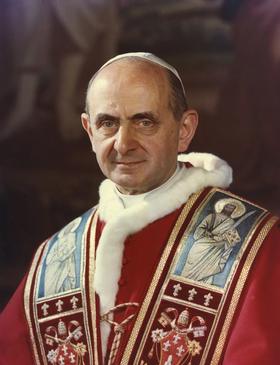
1992
Magisterium
Catechism of the Catholic Church CCC 1623

“In the Latin Church, it is ordinarily understood that the spouses, as ministers of Christ's grace, mutually confer upon each other the sacrament of Matrimony by expressing their consent before the Church. In the Eastern liturgies the minister of this sacrament (which is called "Crowning") is the priest or bishop who, after receiving the mutual consent of the spouses, successively crowns the bridegroom and the bride as a sign of the marriage covenant.”

Read it in the source: vatican.va

See it on the timeline: Matrimony

1992
Magisterium

The Catechism: the Jews are not collectively guilty of the death of Jesus

Catechism of the Catholic Church CCC 597

“Hence we cannot lay responsibility for the trial on the Jews in Jerusalem as a whole, despite the outcry of a manipulated crowd and the global reproaches contained in the apostles' calls to conversion after Pentecost. … Still less can we extend responsibility to other Jews of different times and places, based merely on the crowd's cry: "His blood be on us and on our children!", a formula for ratifying a judicial sentence.”

Read it in the source: vatican.va

See it on the timeline: The Church and the Jewish people

1992
Magisterium

The Catechism on torture in the Church's own tribunals

Catechism of the Catholic Church CCC 2298

“In times past, cruel practices were commonly used by legitimate governments to maintain law and order, often without protest from the Pastors of the Church, who themselves adopted in their own tribunals the prescriptions of Roman law concerning torture. Regrettable as these facts are, the Church always taught the duty of clemency and mercy. She forbade clerics to shed blood. In recent times it has become evident that these cruel practices were neither necessary for public order, nor in conformity with the legitimate rights of the human person. On the contrary, these practices led to ones even more degrading. It is necessary to work for their abolition. We must pray for the victims and their tormentors.”

Read it in the source: vatican.va

See it on the timeline: The Inquisition and the use of force against heresy

1992
Magisterium

The Jewish faith and the Church's faith

Catechism of the Catholic Church CCC 839

“The Jewish faith, unlike other non-Christian religions, is already a response to God's revelation in the Old Covenant.”

Read it in the source: vatican.va

See it on the timeline: Judaism and the Church

1992
Magisterium

What the Church teaches an indulgence is

Catechism of the Catholic Church CCC 1471

“An indulgence is a remission before God of the temporal punishment due to sins whose guilt has already been forgiven, which the faithful Christian who is duly disposed gains under certain prescribed conditions through the action of the Church which, as the minister of redemption, dispenses and applies with authority the treasury of the satisfactions of Christ and the saints.”

Read it in the source: vatican.va

See it on the timeline: Protestantism

1992
Magisterium

True God and true man

Catechism of the Catholic Church CCC 464

“The unique and altogether singular event of the Incarnation of the Son of God does not mean that Jesus Christ is part God and part man, nor does it imply that he is the result of a confused mixture of the divine and the human. He became truly man while remaining truly God. Jesus Christ is true God and true man.”

Read it in the source: vatican.va

See it on the timeline: The life of Jesus Christ: the record inside and outside the Bible

1992
Magisterium
Catechism of the Catholic Church CCC 129

“Besides, the New Testament has to be read in the light of the Old. Early Christian catechesis made constant use of the Old Testament. As an old saying put it, the New Testament lies hidden in the Old and the Old Testament is unveiled in the New.”

Read it in the source: vatican.va

See it on the timeline: The inspiration of Scripture

1992
Magisterium
Catechism of the Catholic Church CCC 762

“The remote preparation for this gathering together of the People of God begins when he calls Abraham and promises that he will become the father of a great people. Its immediate preparation begins with Israel's election as the People of God. By this election, Israel is to be the sign of the future gathering of All nations.”

Read it in the source: vatican.va

See it on the timeline: The one Church

1992
Magisterium
Catechism of the Catholic Church CCC 664

“Being seated at the Father's right hand signifies the inauguration of the Messiah's kingdom, the fulfilment of the prophet Daniel's vision concerning the Son of man: “To him was given dominion and glory and kingdom, that all peoples, nations, and languages should serve him; his dominion is an everlasting dominion, which shall not pass away, and his kingdom one that shall not be destroyed.””

Read it in the source: vatican.va

See it on the timeline: Was the Church corrupted early?

1992
Magisterium
Catechism of the Catholic Church CCC 845

“To reunite all his children, scattered and led astray by sin, the Father willed to call the whole of humanity together into his Son's Church. the Church is the place where humanity must rediscover its unity and salvation. the Church is "the world reconciled." She is that bark which "in the full sail of the Lord's cross, by the breath of the Holy Spirit, navigates safely in this world." According to another image dear to the Church Fathers, she is prefigured by Noah's ark, which alone saves from the flood.”

Read it in the source: vatican.va

See it on the timeline: No salvation outside the Church

1992
Magisterium

The first half of the Hail Mary

Catechism of the Catholic Church CCC 2676

“Hail Mary [or Rejoice, Mary]: the greeting of the angel Gabriel opens this prayer. It is God himself who, through his angel as intermediary, greets Mary. Our prayer dares to take up this greeting to Mary with the regard God had for the lowliness of his humble servant and to exult in the joy he finds in her. … After the angel's greeting, we make Elizabeth's greeting our own.”

Read it in the source: vatican.va

See it on the timeline: The Rosary

1992
Magisterium

One person, and that person is divine

Catechism of the Catholic Church CCC 466

“Christ's humanity has no other subject than the divine person of the Son of God, who assumed it and made it his own, from his conception.”

Read it in the source: vatican.va

See it on the timeline: The life of Jesus Christ: the record inside and outside the Bible

1992
Magisterium
Catechism of the Catholic Church CCC 2708

“Christian prayer tries above all to meditate on the mysteries of Christ, as in lectio divina or the rosary. This form of prayerful reflection is of great value, but Christian prayer should go further: to the knowledge of the love of the Lord Jesus, to union with him.”

Read it in the source: vatican.va

See it on the timeline: The Rosary

1992
Magisterium
Catechism of the Catholic Church CCC 1373

“"Christ Jesus, who died, yes, who was raised from the dead, who is at the right hand of God, who indeed intercedes for us," is present in many ways to his Church: in his word, in his Church's prayer, "where two or three are gathered in my name," in the poor, the sick, and the imprisoned, in the sacraments of which he is the author, in the sacrifice of the Mass, and in the person of the minister. But "he is present . . . most especially in the Eucharistic species."”

Read it in the source: vatican.va

See it on the timeline: The Real Presence and the Ascension

1992
Magisterium
Catechism of the Catholic Church CCC 1378

“In the liturgy of the Mass we express our faith in the real presence of Christ under the species of bread and wine by, among other ways, genuflecting or bowing deeply as a sign of adoration of the Lord. "The Catholic Church has always offered and still offers to the sacrament of the Eucharist the cult of adoration, not only during Mass, but also outside of it, reserving the consecrated hosts with the utmost care, exposing them to the solemn veneration of the faithful, and carrying them in procession."”

Read it in the source: vatican.va

See it on the timeline: Adoring the Eucharist

1992
Magisterium
Catechism of the Catholic Church CCC 1087

“By the power of the same Holy Spirit they entrusted this power to their successors. This "apostolic succession" structures the whole liturgical life of the Church and is itself sacramental, handed on by the sacrament of Holy Orders.”

Read it in the source: vatican.va

See it on the timeline: Apostolic succession

1992
Magisterium
Catechism of the Catholic Church CCC 552

“Our Lord then declared to him: "You are Peter, and on this rock I will build my Church, and the gates of Hades will not prevail against it." Christ, the "living Stone", thus assures his Church, built on Peter, of victory over the powers of death. Because of the faith he confessed Peter will remain the unshakeable rock of the Church.”

Read it in the source: vatican.va

See it on the timeline: Peter the rock

1992
Magisterium
Catechism of the Catholic Church CCC 830

“"Where there is Christ Jesus, there is the Catholic Church." In her subsists the fullness of Christ's body united with its head … the Church was, in this fundamental sense, catholic on the day of Pentecost and will always be so until the day of the Parousia.”

Read it in the source: vatican.va

See it on the timeline: Constantine and the Church

1992
Magisterium
Catechism of the Catholic Church CCC 88

“The Church's Magisterium exercises the authority it holds from Christ to the fullest extent when it defines dogmas, that is, when it proposes truths contained in divine Revelation or also when it proposes in a definitive way truths having a necessary connection with them.”

Read it in the source: vatican.va

See it on the timeline: Doctrines defined later

1992
Magisterium
Catechism of the Catholic Church CCC 819

“"Furthermore, many elements of sanctification and of truth" are found outside the visible confines of the Catholic Church: "the written Word of God; the life of grace; faith, hope, and charity, with the other interior gifts of the Holy Spirit, as well as visible elements." Christ's Spirit uses these Churches and ecclesial communities as means of salvation, whose power derives from the fullness of grace and truth that Christ has entrusted to the Catholic Church.”

Read it in the source: vatican.va

See it on the timeline: The one Church

1992
Magisterium
Catechism of the Catholic Church CCC 1544

“Everything that the priesthood of the Old Covenant prefigured finds its fulfillment in Christ Jesus, the "one mediator between God and men." The Christian tradition considers Melchizedek, "priest of God Most High," as a prefiguration of the priesthood of Christ, the unique "high priest after the order of Melchizedek"; "holy, blameless, unstained," "by a single offering he has perfected for all time those who are sanctified," that is, by the unique sacrifice of the cross.”

Read it in the source: vatican.va

See it on the timeline: The priest and the Eucharist

1992
Magisterium
Catechism of the Catholic Church CCC 1481

“The Byzantine Liturgy recognizes several formulas of absolution, in the form of invocation, which admirably express the mystery of forgiveness: "May the same God, who through the Prophet Nathan forgave David when he confessed his sins, who forgave Peter when he wept bitterly, the prostitute when she washed his feet with her tears, the Pharisee, and the prodigal son, through me, a sinner, forgive you both in this life and in the next”

Read it in the source: vatican.va

See it on the timeline: Confession to a priest

1992
Magisterium
Catechism of the Catholic Church CCC 1620

“Both the sacrament of Matrimony and virginity for the Kingdom of God come from the Lord himself. … Esteem of virginity for the sake of the kingdom and the Christian understanding of marriage are inseparable, and they reinforce each other”

Read it in the source: vatican.va

See it on the timeline: Priestly celibacy

1992
Magisterium
Catechism of the Catholic Church CCC 1032

“This teaching is also based on the practice of prayer for the dead, already mentioned in Sacred Scripture: “Therefore Judas Maccabeus] made atonement for the dead, that they might be delivered from their sin.” From the beginning the Church has honored the memory of the dead and offered prayers in suffrage for them, above all the Eucharistic sacrifice, so that, thus purified, they may attain the beatific vision of God.”

Read it in the source: vatican.va

See it on the timeline: Purgatory

1992
Magisterium
Catechism of the Catholic Church CCC 1473

“The forgiveness of sin and restoration of communion with God entail the remission of the eternal punishment of sin, but temporal punishment of sin remains.”

Read it in the source: vatican.va

See it on the timeline: Indulgences

1992
Magisterium
Catechism of the Catholic Church CCC 2358-2359

“They must be accepted with respect, compassion, and sensitivity. Every sign of unjust discrimination in their regard should be avoided. These persons are called to fulfill God's will in their lives and, if they are Christians, to unite to the sacrifice of the Lord's Cross the difficulties they may encounter from their condition. … Homosexual persons are called to chastity. By the virtues of self-mastery that teach them inner freedom, at times by the support of disinterested friendship, by prayer and sacramental grace, they can and should gradually and resolutely approach Christian perfection.”

Read it in the source: vatican.va

See it on the timeline: Homosexuality

1992
Magisterium
Catechism of the Catholic Church CCC 2370

“Periodic continence, that is, the methods of birth regulation based on self-observation and the use of infertile periods, is in conformity with the objective criteria of morality. These methods respect the bodies of the spouses, encourage tenderness between them, and favor the education of an authentic freedom. In contrast, "every action which, whether in anticipation of the conjugal act, or in its accomplishment, or in the development of its natural consequences, proposes, whether as an end or as a means, to render procreation impossible" is intrinsically evil”

Read it in the source: vatican.va

See it on the timeline: Contraception

1992
Magisterium
Catechism of the Catholic Church CCC 2272

“The Church attaches the canonical penalty of excommunication to this crime against human life. … The Church does not thereby intend to restrict the scope of mercy. Rather, she makes clear the gravity of the crime committed, the irreparable harm done to the innocent who is put to death, as well as to the parents and the whole of society.”

Read it in the source: vatican.va

See it on the timeline: Abortion

1992Christ, holding a white banner with a red cross, steps from the tomb above four sleeping soldiers
Magisterium

The Resurrection as a fact of history

Catechism of the Catholic Church CCC 643

“Given all these testimonies, Christ's Resurrection cannot be interpreted as something outside the physical order, and it is impossible not to acknowledge it as an historical fact. It is clear from the facts that the disciples' faith was drastically put to the test by their master's Passion and death on the cross, which he had foretold. The shock provoked by the Passion was so great that at least some of the disciples did not at once believe in the news of the Resurrection. Far from showing us a community seized by a mystical exaltation, the Gospels present us with disciples demoralized ("looking sad") and frightened.”

Read it in the source: vatican.va

See it on the timeline: The life of Jesus Christ: the record inside and outside the Bible

1992
Magisterium

The second half of the Hail Mary

Catechism of the Catholic Church CCC 2677

“Holy Mary, Mother of God: With Elizabeth we marvel, “and why is this granted me, that the mother of my Lord should come to me?” Because she gives us Jesus, her son, Mary is Mother of God and our mother; we can entrust all our cares and petitions to her: she prays for us as she prayed for herself: “Let it be to me according to your word.””

Read it in the source: vatican.va

See it on the timeline: The Rosary

1992
Magisterium
Catechism of the Catholic Church CCC 1286

“In the Old Testament the prophets announced that the Spirit of the Lord would rest on the hoped-for Messiah for his saving mission. The descent of the Holy Spirit on Jesus at his baptism by John was the sign that this was he who was to come, the Messiah, the Son of God. He was conceived of the Holy Spirit; his whole life and his whole mission are carried out in total communion with the Holy Spirit whom the Father gives him "without measure."”

Read it in the source: vatican.va

See it on the timeline: Confirmation

1992
Magisterium
Catechism of the Catholic Church CCC 1428

“Christ's call to conversion continues to resound in the lives of Christians. This second conversion is an uninterrupted task for the whole Church who, "clasping sinners to her bosom, (is) at once holy and always in need of purification, (and) follows constantly the path of penance and renewal." This endeavor of conversion is not just a human work. It is the movement of a "contrite heart," drawn and moved by grace to respond to the merciful love of God who loved us first.”

Read it in the source: vatican.va

See it on the timeline: Penance and Reconciliation

1992
Magisterium
Catechism of the Catholic Church CCC 1502

“The man of the Old Testament lives his sickness in the presence of God. It is before God that he laments his illness, and it is of God, Master of life and death, that he implores healing. Illness becomes a way to conversion; God's forgiveness initiates the healing. It is the experience of Israel that illness is mysteriously linked to sin and evil, and that faithfulness to God according to his law restores life: "For I am the Lord, your healer." The prophet intuits that suffering can also have a redemptive meaning for the sins of others. Finally Isaiah announces that God will usher in a time for Zion when he will pardon every offense and heal every illness.”

Read it in the source: vatican.va

See it on the timeline: The Anointing of the Sick

1992
Magisterium

The Old Testament roots of the ordained ministry

Catechism of the Catholic Church CCC 1539-1544

“…within the people of Israel, God chose one of the twelve tribes, that of Levi, and set it apart for liturgical service; God himself is its inheritance. A special rite consecrated the beginnings of the priesthood of the Old Covenant. … The liturgy of the Church, however, sees in the priesthood of Aaron and the service of the Levites, as in the institution of the seventy elders, a prefiguring of the ordained ministry of the New Covenant. … The Christian tradition considers Melchizedek, "priest of God Most High," as a prefiguration of the priesthood of Christ”

Read it in the source: vatican.va

See it on the timeline: Holy Orders
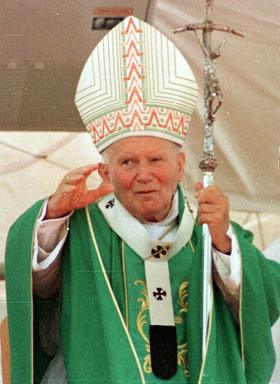
1992
Magisterium
Catechism of the Catholic Church CCC 1612

“The nuptial covenant between God and his people Israel had prepared the way for the new and everlasting covenant in which the Son of God, by becoming incarnate and giving his life, has united to himself in a certain way all mankind saved by him, thus preparing for "the wedding-feast of the Lamb."”

Read it in the source: vatican.va

See it on the timeline: Matrimony

1992
Magisterium

The Catechism: sinners were the authors of Christ's Passion

Catechism of the Catholic Church CCC 598

“Taking into account the fact that our sins affect Christ himself, The Church does not hesitate to impute to Christians the gravest responsibility for the torments inflicted upon Jesus, a responsibility with which they have all too often burdened the Jews alone”

Read it in the source: vatican.va

See it on the timeline: The Church and the Jewish people

31 October 1992An elderly pope in green vestments and a white and gold mitre raises his hand in greeting, holding his staff with the crucifix
Magisterium

John Paul II: most of the theologians did not know how to re-examine their reading of Scripture

Pope St. John Paul II Address to the Pontifical Academy of Sciences, 31 October 1992, no. 5

“Thus the new science, with its methods and the freedom of research that they imply, obliged the theologians to examine their own criteria for interpreting Scripture. Most of them did not know how to do so. Paradoxically, Galileo, a sincere believer, showed himself more perceptive on this point than his theologian adversaries.”

Our translation. The words as written, in French:

“Ainsi la science nouvelle, avec ses méthodes et la liberté de recherche qu’elles supposent, obligeait les théologiens à s’interroger sur leurs propres critères d’interprétation de l’Écriture. La plupart n’ont pas su le faire. Paradoxalement, Galilée, croyant sincère, s’est montré plus perspicace sur ce point que ses adversaires théologiens.”

Read it in the source: vatican.va

See it on the timeline: The Galileo case

1992
Magisterium

Two expectations of the Messiah

Catechism of the Catholic Church CCC 840

“But one awaits the return of the Messiah who died and rose from the dead and is recognized as Lord and Son of God; the other awaits the coming of a Messiah, whose features remain hidden till the end of time; and the latter waiting is accompanied by the drama of not knowing or of misunderstanding Christ Jesus.”

Read it in the source: vatican.va

See it on the timeline: Judaism and the Church

1992
Magisterium
Catechism of the Catholic Church CCC 2587

“The Psalter is the book in which the Word of God becomes man's prayer. … Christ will unite the two. In him, the psalms continue to teach us how to pray.”

Read it in the source: vatican.va

See it on the timeline: The Rosary

1992
Magisterium
Catechism of the Catholic Church CCC 1037

“God predestines no one to go to hell; for this, a willful turning away from God (a mortal sin) is necessary, and persistence in it until the end. In the Eucharistic liturgy and in the daily prayers of her faithful, the Church implores the mercy of God, who does not want "any to perish, but all to come to repentance"”

Read it in the source: vatican.va

See it on the timeline: The Sunday Mass obligation

1992
Magisterium
Catechism of the Catholic Church CCC 553

“Jesus entrusted a specific authority to Peter: "I will give you the keys of the kingdom of heaven, and whatever you bind on earth shall be bound in heaven, and whatever you loose on earth shall be loosed in heaven." The "power of the keys" designates authority to govern the house of God, which is the Church.”

Read it in the source: vatican.va

See it on the timeline: Peter the rock

1992
Magisterium
Catechism of the Catholic Church CCC 2089

“"Heresy is the obstinate post-baptismal denial of some truth which must be believed with divine and catholic faith, or it is likewise an obstinate doubt concerning the same; apostasy is the total repudiation of the Christian faith; schism is the refusal of submission to the Roman Pontiff or of communion with the members of the Church subject to him."”

Read it in the source: vatican.va

See it on the timeline: Have popes been heretics?

1992
Magisterium
Catechism of the Catholic Church CCC 1150

“Signs of the covenant. the Chosen People received from God distinctive signs and symbols that marked its liturgical life. These are no longer solely celebrations of cosmic cycles and social gestures, but signs of the covenant, symbols of God's mighty deeds for his people. Among these liturgical signs from the Old Covenant are circumcision, anointing and consecration of kings and priests, laying on of hands, sacrifices, and above all the Passover. the Church sees in these signs a prefiguring of the sacraments of the New Covenant.”

Read it in the source: vatican.va

See it on the timeline: The seven sacraments

1992
Magisterium
Catechism of the Catholic Church CCC 1287

“This fullness of the Spirit was not to remain uniquely the Messiah's, but was to be communicated to the whole messianic people. On several occasions Christ promised this outpouring of the Spirit, a promise which he fulfilled first on Easter Sunday and then more strikingly at Pentecost. Filled with the Holy Spirit the apostles began to proclaim "the mighty works of God," and Peter declared this outpouring of the Spirit to be the sign of the messianic age. Those who believed in the apostolic preaching and were baptized received the gift of the Holy Spirit in their turn.”

Read it in the source: vatican.va

See it on the timeline: Confirmation

1992
Magisterium
Catechism of the Catholic Church CCC 1432

“The human heart is heavy and hardened. God must give man a new heart. Conversion is first of all a work of the grace of God who makes our hearts return to him: "Restore us to thyself, O LORD, that we may be restored!" God gives us the strength to begin anew.”

Read it in the source: vatican.va

See it on the timeline: Penance and Reconciliation

1992
Magisterium
Catechism of the Catholic Church CCC 1505

“Moved by so much suffering Christ not only allows himself to be touched by the sick, but he makes their miseries his own: "He took our infirmities and bore our diseases." But he did not heal all the sick. His healings were signs of the coming of the Kingdom of God.”

Read it in the source: vatican.va

See it on the timeline: The Anointing of the Sick

31 October 1992An elderly pope in green vestments and a white and gold mitre raises his hand in greeting, holding his staff with the crucifix
Magisterium

John Paul II: a question of science was wrongly made a question of faith

Pope St. John Paul II Address to the Pontifical Academy of Sciences, 31 October 1992, no. 9

“The majority of theologians did not perceive the formal distinction between Holy Scripture and its interpretation, which led them to transpose unduly into the domain of the doctrine of the faith a question of fact belonging to scientific investigation. … Cardinal Poupard has also reminded us how the sentence of 1633 was not irreformable and how the debate, which had not ceased to evolve, was closed in 1820 with the imprimatur granted to the work of Canon Settele”

Our translation. The words as written, in French:

“La majorité des théologiens ne percevaient pas la distinction formelle entre l’Écriture sainte et son interprétation, ce qui les conduisit à transposer indûment dans le domaine de la doctrine de la foi une question de fait relevant de l’investigation scientifique. … Le Cardinal Poupard nous a également rappelé comment la sentence de l633 n’était pas irréformable et comment le débat, qui n’avait cessé d’évoluer, fut clos en 1820 avec l’imprimatur accordé à l’ouvrage du chanoine Settele”

Read it in the source: vatican.va

See it on the timeline: The Galileo case

1992
Magisterium

The flock God foretold

Catechism of the Catholic Church CCC 754

“It is also the flock of which God himself foretold that he would be the shepherd, and whose sheep, even though governed by human shepherds, are unfailingly nourished and led by Christ himself, the Good Shepherd and Prince of Shepherds, who gave his life for his sheep.”

Read it in the source: vatican.va

See it on the timeline: The tradition of the papacy

1992
Magisterium

The Catechism: the bishop of Rome is the successor of Peter

Catechism of the Catholic Church CCC 936

“The Lord made St. Peter the visible foundation of his Church. He entrusted the keys of the Church to him. the bishop of the Church of Rome, successor to St. Peter, is "head of the college of bishops, the Vicar of Christ and Pastor of the universal Church on earth"”

Read it in the source: vatican.va

See it on the timeline: The tradition of the papacy

1992
Magisterium

The Catechism on faith and science

Catechism of the Catholic Church CCC 159

“Consequently, methodical research in all branches of knowledge, provided it is carried out in a truly scientific manner and does not override moral laws, can never conflict with the faith, because the things of the world and the things of faith derive from the same God.”

Read it in the source: vatican.va

See it on the timeline: The Galileo case

1992
Magisterium
Catechism of the Catholic Church CCC 956

“They do not cease to intercede with the Father for us, as they proffer the merits which they acquired on earth through the one mediator between God and men, Christ Jesus”

Read it in the source: vatican.va

See it on the timeline: Praying to saints

1992
Magisterium
Catechism of the Catholic Church CCC 2132

“The Christian veneration of images is not contrary to the first commandment which proscribes idols. Indeed, "the honor rendered to an image passes to its prototype," and "whoever venerates an image venerates the person portrayed in it." The honor paid to sacred images is a "respectful veneration," not the adoration due to God alone”

Read it in the source: vatican.va

See it on the timeline: Images and statues

1992
Magisterium
Catechism of the Catholic Church CCC 2197

“God has willed that, after him, we should honor our parents to whom we owe life and who have handed on to us the knowledge of God. We are obliged to honor and respect all those whom God, for our good, has vested with his authority.”

Read it in the source: vatican.va

See it on the timeline: Honoring the Pope

1994An elderly pope in green vestments and a white and gold mitre raises his hand in greeting, holding his staff with the crucifix
Magisterium
Pope St. John Paul II Apostolic Letter Tertio Millennio Adveniente, 10 November 1994, no. 35

“Another painful chapter of history to which the sons and daughters of the Church must return with a spirit of repentance is that of the acquiescence given, especially in certain centuries, to intolerance and even the use of violence in the service of truth. … Yet the consideration of mitigating factors does not exonerate the Church from the obligation to express profound regret for the weaknesses of so many of her sons and daughters who sullied her face, preventing her from fully mirroring the image of her crucified Lord, the supreme witness of patient love and of humble meekness.”

Read it in the source: vatican.va

See it on the timeline: Violence in the Church's history

22 May 1994
Magisterium
Pope St. John Paul II Ordinatio Sacerdotalis, Apostolic Letter, 22 May 1994, 4

“Wherefore, in order that all doubt may be removed regarding a matter of great importance, a matter which pertains to the Church's divine constitution itself, in virtue of my ministry of confirming the brethren (cf. Lk 22:32) I declare that the Church has no authority whatsoever to confer priestly ordination on women and that this judgment is to be definitively held by all the Church's faithful.”

Read it in the source: vatican.va

See it on the timeline: Holy Orders
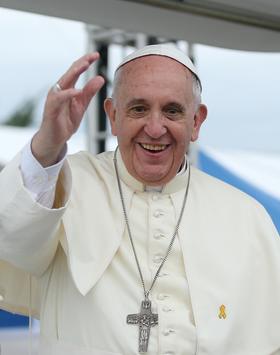
1995
Magisterium
Pope St. John Paul II Evangelium Vitae, 45

“And even more so, the value of the person from the moment of conception is celebrated in the meeting between the Virgin Mary and Elizabeth, and between the two children whom they are carrying in the womb. It is precisely the children who reveal the advent of the Messianic age: in their meeting, the redemptive power of the presence of the Son of God among men first becomes operative.”

Read it in the source: vatican.va

See it on the timeline: Abortion

1995
Magisterium
Pope St. John Paul II Evangelium Vitae, 61

“The texts of Sacred Scripture never address the question of deliberate abortion and so do not directly and specifically condemn it. But they show such great respect for the human being in the mother's womb that they require as a logical consequence that God's commandment "You shall not kill" be extended to the unborn child as well. … Even scientific and philosophical discussions about the precise moment of the infusion of the spiritual soul have never given rise to any hesitation about the moral condemnation of abortion.”

Read it in the source: vatican.va

See it on the timeline: Abortion

25 May 1995
Magisterium

John Paul II: a new way of exercising the primacy

Pope St. John Paul II Encyclical Ut Unum Sint, 95

“I am convinced that I have a particular responsibility in this regard, above all in acknowledging the ecumenical aspirations of the majority of the Christian Communities and in heeding the request made of me to find a way of exercising the primacy which, while in no way renouncing what is essential to its mission, is nonetheless open to a new situation.”

Read it in the source: vatican.va

See it on the timeline: The tradition of the papacy

1995
Magisterium

Where the question of the primacy stands

Pope St. John Paul II Ut Unum Sint, 95

“I am convinced that I have a particular responsibility in this regard, above all in acknowledging the ecumenical aspirations of the majority of the Christian Communities and in heeding the request made of me to find a way of exercising the primacy which, while in no way renouncing what is essential to its mission, is nonetheless open to a new situation. For a whole millennium Christians were united in "a brotherly fraternal communion of faith and sacramental life ... If disagreements in belief and discipline arose among them, the Roman See acted by common consent as moderator".”

Read it in the source: vatican.va

See it on the timeline: The East-West Schism

1995
Magisterium
Pope St. John Paul II Evangelium Vitae, 62

“Given such unanimity in the doctrinal and disciplinary tradition of the Church, Paul VI was able to declare that this tradition is unchanged and unchangeable. Therefore, by the authority which Christ conferred upon Peter and his Successors, in communion with the Bishops-who on various occasions have condemned abortion and who in the aforementioned consultation, albeit dispersed throughout the world, have shown unanimous agreement concerning this doctrine-I declare that direct abortion, that is, abortion willed as an end or as a means, always constitutes a grave moral disorder, since it is the deliberate killing of an innocent human being.”

Read it in the source: vatican.va

See it on the timeline: Abortion

1995
Magisterium
Pope St. John Paul II Evangelium Vitae, 99

“I would now like to say a special word to women who have had an abortion. The Church is aware of the many factors which may have influenced your decision, and she does not doubt that in many cases it was a painful and even shattering decision. The wound in your heart may not yet have healed. Certainly what happened was and remains terribly wrong. But do not give in to discouragement and do not lose hope. … The Father of mercies is ready to give you his forgiveness and his peace in the Sacrament of Reconciliation.”

Read it in the source: vatican.va

See it on the timeline: Abortion

September 1995
Magisterium

Rome clarifies the Filioque

Pontifical Council for Promoting Christian Unity The Greek and Latin Traditions regarding the Procession of the Holy Spirit (L'Osservatore Romano, English edition, 20 September 1995)

“The Catholic Church acknowledges the conciliar, ecumenical, normative and irrevocable value, as expression of the one common faith of the Church and of all Christians, of the Symbol professed in Greek at Constantinople in 381 by the Second Ecumenical Council. No profession of faith peculiar to a particular liturgical tradition can contradict this expression of the faith taught and professed by the undivided Church.”

Read it in the source: EWTN Library

See it on the timeline: The East-West Schism

1996An elderly pope in green vestments and a white and gold mitre raises his hand in greeting, holding his staff with the crucifix
Magisterium
Pope St. John Paul II Message to the Pontifical Academy of Sciences, 22 October 1996, no. 4

“Today, more than a half-century after the appearance of that encyclical, some new findings lead us toward the recognition of evolution as more than an hypothesis. … And to tell the truth, rather than speaking about the theory of evolution, it is more accurate to speak of the theories of evolution.”

Read it in the source: EWTN Library

See it on the timeline: Evolution and Genesis

1996
Magisterium
Pope St. John Paul II Message to the Pontifical Academy of Sciences, 22 October 1996, no. 5

“As a result, the theories of evolution which, because of the philosophies which inspire them, regard the spirit either as emerging from the forces of living matter, or as a simple epiphenomenon of that matter, are incompatible with the truth about man.”

Read it in the source: EWTN Library

See it on the timeline: Evolution and Genesis

22 February 1996
Magisterium

How a man becomes pope today

Pope St. John Paul II Apostolic Constitution Universi Dominici Gregis, 88

“After his acceptance, the person elected, if he has already received episcopal ordination, is immediately Bishop of the Church of Rome, true Pope and Head of the College of Bishops. He thus acquires and can exercise full and supreme power over the universal Church. If the person elected is not already a Bishop, he shall immediately be ordained Bishop.”

Read it in the source: vatican.va

See it on the timeline: All the popes in order, from St. Peter to today

22 June 1996
Magisterium

Pope John Paul II on the causes of the separation

Pope St. John Paul II Address at the ecumenical service in the Cathedral of Paderborn, 22 June 1996, 6

“Luther's call for the reform of the Church was, in its original intention, a call to repentance and renewal, which have to begin in the life of each individual. That separation nevertheless came out of this beginning has many causes. Among them is that failure in the Catholic Church which Pope Adrian VI already lamented in moving words, as well as the intrusion of political and economic interests, but also Luther's own passion, which drove him far beyond what he first intended into a radical criticism of the Catholic Church, of her order of life and of her teaching. We have all taken guilt upon ourselves.”

Our translation. The words as written, in German:

“Luthers Ruf nach Reform der Kirche war in seiner ursprünglichen Absicht ein Aufruf zu Buße und Erneuerung, die im Leben eines jeden einzelnen zu beginnen haben. Daß dennoch Trennung aus diesem Anfang geworden ist, hat viele Gründe. Dazu gehört jenes Versagen in der katholischen Kirche, das bereits Papst Hadrian VI. mit bewegenden Worten beklagt hat sowie das Hereintreten politischer und wirtschaftlicher Interessen, aber auch Luthers eigene Leidenschaft, die ihn weit über das anfangs Gewollte hinaus in eine radikale Kritik der katholischen Kirche, ihrer Lebensordnung und ihrer Lehre hineingetrieben hat. Wir alle haben Schuld auf uns geladen.”

Read it in the source: vatican.va

See it on the timeline: Protestantism

1997
Magisterium
Pope St. John Paul II General Audience, 25 June 1997, 1

“With this formula, the Dogmatic Constitution Lumen gentium, following my Venerable Predecessor Pius XII, made no pronouncement on the question of Mary's death. Nevertheless, Pius XII did not intend to deny the fact of her death, but merely did not judge it opportune to affirm solemnly the death of the Mother of God as a truth to be accepted by all believers. … a common tradition actually exists which sees Mary's death as her entry into heavenly glory.”

Read it in the source: vatican.va

See it on the timeline: The Assumption

1997
Magisterium
Pope St. John Paul II General Audience, 25 June 1997, 2

“One need only quote St Jacob of Sarug (†521), who wrote that when the time came for Mary "to walk on the way of all generations", the way, that is, of death, "the group of the Twelve Apostles" gathered to bury "the virginal body of the Blessed One" … St Modestus of Jerusalem (†634), after a lengthy discussion of "the most blessed dormition of the most glorious Mother of God", ends his eulogy by exalting the miraculous intervention of Christ who "raised her from the tomb", to take her up with him in glory…”

Read it in the source: vatican.va

See it on the timeline: The Assumption

1997
Magisterium
Pope St. John Paul II General Audience, 2 July 1997, 2

“The first trace of belief in the Virgin's Assumption can be found in the apocryphal accounts entitled Transitus Mariae, whose origin dates to the second and third centuries. These are popular and sometimes romanticized depictions, which in this case, however, pick up an intuition of faith on the part of God's People. Later, there was a long period of growing reflection on Mary's destiny in the next world. This gradually led the faithful to believe in the glorious raising of the Mother of Jesus, in body and soul, and to the institution in the East of the liturgical feasts of the Dormition and Assumption of Mary.”

Read it in the source: vatican.va

See it on the timeline: The Assumption

1998
Magisterium
Pope St. John Paul II Dies Domini 46

“When, during the persecution of Diocletian, their assemblies were banned with the greatest severity, many were courageous enough to defy the imperial decree and accepted death rather than miss the Sunday Eucharist. This was the case of the martyrs of Abitina, in Proconsular Africa, who replied to their accusers: "Without fear of any kind we have celebrated the Lord's Supper, because it cannot be missed; that is our law"; "We cannot live without the Lord's Supper".”

Read it in the source: vatican.va

See it on the timeline: The Sunday Mass obligation

1998An old photographic plate of a long cloth bearing the faint figure of a man, with a handwritten caption beneath
Magisterium

The Shroud of Turin: the Church leaves the question to science

Pope St. John Paul II Address in the Cathedral of Turin, 24 May 1998, no. 2

“The Shroud is a challenge to our intelligence. It first of all requires of every person, particularly the researcher, that he humbly grasp the profound message it sends to his reason and his life. The mysterious fascination of the Shroud forces questions to be raised about the sacred Linen and the historical life of Jesus. Since it is not a matter of faith, the Church has no specific competence to pronounce on these questions. She entrusts to scientists the task of continuing to investigate, so that satisfactory answers may be found to the questions connected with this Sheet, which, according to tradition, wrapped the body of our Redeemer after he had been taken down from the cross.”

Read it in the source: vatican.va

See it on the timeline: The life of Jesus Christ: the record inside and outside the Bible

1998An elderly pope in green vestments and a white and gold mitre raises his hand in greeting, holding his staff with the crucifix
Magisterium
Pope St. John Paul II Dies Domini 47

“It was only later, faced with the half-heartedness or negligence of some, that the Church had to make explicit the duty to attend Sunday Mass: more often than not, this was done in the form of exhortation, but at times the Church had to resort to specific canonical precepts. … The Code of Canon Law of 1917 for the first time gathered this tradition into a universal law. … This legislation has normally been understood as entailing a grave obligation”

Read it in the source: vatican.va

See it on the timeline: The Sunday Mass obligation

1998An old photographic plate of a long cloth bearing the faint figure of a man, with a handwritten caption beneath
Magisterium

The Shroud of Turin: "a mirror of the Gospel"

Pope St. John Paul II Address in the Cathedral of Turin, 24 May 1998, no. 3

“For the believer, what counts above all is that the Shroud is a mirror of the Gospel. In fact, if we reflect on the sacred Linen, we cannot escape the idea that the image it presents has such a profound relationship with what the Gospels tell of Jesus' passion and death, that every sensitive person feels inwardly touched and moved at beholding it. Whoever approaches it is also aware that the Shroud does not hold people's hearts to itself, but turns them to him, at whose service the Father's loving providence has put it. Therefore, it is right to foster an awareness of the precious value of this image, which everyone sees and no one at present can explain.”

Read it in the source: vatican.va

See it on the timeline: The life of Jesus Christ: the record inside and outside the Bible

1999An elderly pope in green vestments and a white and gold mitre raises his hand in greeting, holding his staff with the crucifix
Magisterium
Pope St. John Paul II Apostolic Exhortation Ecclesia in America, 11

“Mary is the sure path to our meeting with Christ. Devotion to the Mother of the Lord, when it is genuine, is always an impetus to a life guided by the spirit and values of the Gospel. … From the beginning — invoked as Our Lady of Guadalupe — Mary, by her motherly and merciful figure, was a great sign of the closeness of the Father and of Jesus Christ, with whom she invites us to enter into communion.”

Read it in the source: vatican.va

See it on the timeline: Honor given to Mary

1999
Magisterium
The Catholic Church and the Lutheran World Federation Joint Declaration on the Doctrine of Justification, 38

“According to Catholic understanding, good works, made possible by grace and the working of the Holy Spirit, contribute to growth in grace, so that the righteousness that comes from God is preserved and communion with Christ is deepened. When Catholics affirm the "meritorious" character of good works, they wish to say that, according to the biblical witness, a reward in heaven is promised to these works. Their intention is to emphasize the responsibility of persons for their actions, not to contest the character of those works as gifts, or far less to deny that justification always remains the unmerited gift of grace.”

Read it in the source: EWTN Library

See it on the timeline: Faith and works

1999An elderly pope in green vestments and a white and gold mitre raises his hand in greeting, holding his staff with the crucifix
Magisterium
Pope St. John Paul II General Audience, 5 May 1999, 2

“Today I would like to repeat what I said to young Muslims some years ago in Casablanca: “We believe in the same God, the one God, the living God, the God who created the world and brings his creatures to their perfection” … We know that in the light of the full Revelation in Christ, this mysterious oneness cannot be reduced to a numerical unity. The Christian mystery leads us to contemplate in God's substantial unity the persons of the Father, the Son and the Holy Spirit”

Read it in the source: vatican.va

See it on the timeline: Islam and the one God

31 October 1999
Magisterium

The Joint Declaration on the Doctrine of Justification

Pope St. John Paul II Angelus, 31 October 1999

“Representatives of the Catholic Church and the Lutheran World Federation are signing a Joint Declaration on one of the principal points which have divided Catholics and Lutherans: the doctrine of justification by faith. This is a milestone on the difficult path to re-establishing full unity among Christians, and it is highly significant that it is taking place in the exact city where in 1530 a decisive page in the Lutheran reform was written with the Augsburg Confession.”

Read it in the source: vatican.va

See it on the timeline: Protestantism

The full Catholic answer: Faith and works

2000
Magisterium
Pope St. John Paul II Homily, Day of Pardon, St. Peter's Basilica, 12 March 2000, no. 4

“we cannot fail to recognize the infidelities to the Gospel committed by some of our brethren, especially during the second millennium. Let us ask pardon for the divisions which have occurred among Christians, for the violence some have used in the service of the truth and for the distrustful and hostile attitudes sometimes taken towards the followers of other religions.”

Read it in the source: vatican.va

See it on the timeline: Violence in the Church's history

2000
Magisterium
Congregation for the Doctrine of the Faith Dominus Iesus 7

“For this reason, the distinction between theological faith and belief in the other religions, must be firmly held. … Thus, theological faith (the acceptance of the truth revealed by the One and Triune God) is often identified with belief in other religions, which is religious experience still in search of the absolute truth and still lacking assent to God who reveals himself.”

Read it in the source: vatican.va

See it on the timeline: Islam and the one God

2000
Magisterium
Congregation for the Doctrine of the Faith Dominus Iesus 21

“…it would be contrary to the faith to consider the Church as one way of salvation alongside those constituted by the other religions, seen as complementary to the Church or substantially equivalent to her, even if these are said to be converging with the Church toward the eschatological kingdom of God. Certainly, the various religious traditions contain and offer religious elements which come from God”

Read it in the source: vatican.va

See it on the timeline: Other religions

6 August 2000
Magisterium

True particular Churches

Congregation for the Doctrine of the Faith Declaration Dominus Iesus, 17

“The Churches which, while not existing in perfect communion with the Catholic Church, remain united to her by means of the closest bonds, that is, by apostolic succession and a valid Eucharist, are true particular Churches. Therefore, the Church of Christ is present and operative also in these Churches, even though they lack full communion with the Catholic Church, since they do not accept the Catholic doctrine of the Primacy, which, according to the will of God, the Bishop of Rome objectively has and exercises over the entire Church.”

Read it in the source: vatican.va

See it on the timeline: The East-West Schism

2000
Magisterium

Memory and Reconciliation: Christians and the Shoah

International Theological Commission Memory and Reconciliation: The Church and the Faults of the Past, 5.4, quoting the Commission for Religious Relations with the Jews, We Remember: A Reflection on the Shoah (1998)

“The Shoah was certainly the result of the pagan ideology that was Nazism, animated by a merciless anti-Semitism that not only despised the faith of the Jewish people, but also denied their very human dignity. Nevertheless, “it may be asked whether the Nazi persecution of the Jews was not made easier by the anti-Jewish prejudices imbedded in some Christian minds and hearts... Did Christians give every possible assistance to those being persecuted, and in particular to the persecuted Jews?” There is no doubt that there were many Christians who risked their lives to save and to help their Jewish neighbors. It seems, however, also true that “alongside such courageous men and women, the spiritual resistance and concrete action of other Christians was not that which might have been expected from Christ’s followers.””

Read it in the source: vatican.va

See it on the timeline: The Church and the Jewish people

December 2001
Magisterium

A biblically inspired prayer centred on Christ

Congregation for Divine Worship and the Discipline of the Sacraments Directory on Popular Piety and the Liturgy, 197

“The Rosary, or Psalter of the Blessed Virgin Mary, is one of the most excellent prayers to the Mother of God. Thus, “the Roman Pontiffs have repeatedly exhorted the faithful to the frequent recitation of this biblically inspired prayer which is centred on contemplation of the salvific events of Christ's life, and their close association with the his Virgin Mother. The value and efficacy of this prayer have often been attested by saintly Bishops and those advanced in holiness of life”.”

Read it in the source: vatican.va

See it on the timeline: The Rosary

2001
Magisterium

A Jewish reading of the Bible, and why Christians do not adopt it

Pontifical Biblical Commission The Jewish People and Their Sacred Scriptures in the Christian Bible, 12 February 2002 (approved 2001), no. 22

“In answer to the last question, a negative response must be given for hermeneutical reasons. For to read the Bible as Judaism does necessarily involves an implicit acceptance of all its presuppositions, that is, the full acceptance of what Judaism is, in particular, the authority of its writings and rabbinic traditions, which exclude faith in Jesus as Messiah and Son of God. As regards the first question, the situation is different, for Christians can and ought to admit that the Jewish reading of the Bible is a possible one, in continuity with the Jewish Sacred Scriptures from the Second Temple period, a reading analogous to the Christian reading which developed in parallel fashion. Both readings are bound up with the vision of their respective faiths, of which the readings are the result and expression. Consequently, both are irreducible.”

Read it in the source: vatican.va

See it on the timeline: Judaism and the Church

2001An elderly pope in green vestments and a white and gold mitre raises his hand in greeting, holding his staff with the crucifix
Magisterium

Pope John Paul II in the Umayyad Mosque at Damascus

Pope St. John Paul II Address at the Umayyad Mosque, Damascus, 6 May 2001, 3, 4 and 5

“When, on the occasion of weddings or funerals or other celebrations, Christians and Muslims remain in silent respect at the other’s prayer, they bear witness to what unites them, without disguising or denying the things that separate. … For all the times that Muslims and Christians have offended one another, we need to seek forgiveness from the Almighty and to offer each other forgiveness. … Islam too pays tribute to Mary and hails her as "chosen above the women of the world" (Quran, III:42).”

Read it in the source: vatican.va

See it on the timeline: Islam and the Church

The full Catholic answer: Islam and the one God

2001
Magisterium

Jewish messianic expectation

Pontifical Biblical Commission The Jewish People and Their Sacred Scriptures in the Christian Bible, Part I, section 5

“Jewish messianic expectation is not in vain. It can become for us Christians a powerful stimulant to keep alive the eschatological dimension of our faith. Like them, we too live in expectation. The difference is that for us the One who is to come will have the traits of the Jesus who has already come and is already present and active among us.”

Read it in the source: vatican.va

See it on the timeline: Judaism and the Church

2002An elderly pope in green vestments and a white and gold mitre raises his hand in greeting, holding his staff with the crucifix
Magisterium
Pope St. John Paul II Rosarium Virginis Mariae, 1

“The Rosary of the Virgin Mary, which gradually took form in the second millennium under the guidance of the Spirit of God, is a prayer loved by countless Saints and encouraged by the Magisterium. … The Rosary, though clearly Marian in character, is at heart a Christocentric prayer. In the sobriety of its elements, it has all the depth of the Gospel message in its entirety, of which it can be said to be a compendium.”

Read it in the source: vatican.va

See it on the timeline: The Rosary

16 October 2002
Magisterium

St. John Paul II: "my favourite prayer"

Pope St. John Paul II Rosarium Virginis Mariae, 2 (16 October 2002), quoting his own words of 29 October 1978

““The Rosary is my favourite prayer. A marvellous prayer! Marvellous in its simplicity and its depth. … Against the background of the words Ave Maria the principal events of the life of Jesus Christ pass before the eyes of the soul. They take shape in the complete series of the joyful, sorrowful and glorious mysteries, and they put us in living communion with Jesus through – we might say – the heart of his Mother.”

Read it in the source: vatican.va

See it on the timeline: The Rosary

2002
Magisterium
Pope St. John Paul II Rosarium Virginis Mariae, 26

“It is a method based on repetition. This applies above all to the Hail Mary, repeated ten times in each mystery. If this repetition is considered superficially, there could be a temptation to see the Rosary as a dry and boring exercise. It is quite another thing, however, when the Rosary is thought of as an outpouring of that love which tirelessly returns to the person loved with expressions similar in their content but ever fresh in terms of the feeling pervading them.”

Read it in the source: vatican.va

See it on the timeline: The Rosary

16 October 2002
Magisterium

To recite the Rosary is to contemplate the face of Christ

Pope St. John Paul II Rosarium Virginis Mariae, 3 (16 October 2002)

“To recite the Rosary is nothing other than to contemplate with Mary the face of Christ. As a way of highlighting this invitation, prompted by the forthcoming 120th anniversary of the aforementioned Encyclical of Leo XIII, I desire that during the course of this year the Rosary should be especially emphasized and promoted in the various Christian communities. I therefore proclaim the year from October 2002 to October 2003 the Year of the Rosary.”

Read it in the source: vatican.va

See it on the timeline: The Rosary

16 October 2002
Magisterium

The saints who found holiness in the Rosary

Pope St. John Paul II Rosarium Virginis Mariae, 8 (16 October 2002)

“It would be impossible to name all the many Saints who discovered in the Rosary a genuine path to growth in holiness. We need but mention Saint Louis Marie Grignion de Montfort, the author of an excellent work on the Rosary, … and, closer to ourselves, Padre Pio of Pietrelcina, whom I recently had the joy of canonizing. As a true apostle of the Rosary, Blessed Bartolo Longo had a special charism.”

Read it in the source: vatican.va

See it on the timeline: The Rosary

16 October 2002
Magisterium

The Luminous Mysteries

Pope St. John Paul II Rosarium Virginis Mariae, 21 (16 October 2002)

“Moving on from the infancy and the hidden life in Nazareth to the public life of Jesus, our contemplation brings us to those mysteries which may be called in a special way “mysteries of light”. … In proposing to the Christian community five significant moments – “luminous” mysteries – during this phase of Christ's life, I think that the following can be fittingly singled out: (1) his Baptism in the Jordan, (2) his self-manifestation at the wedding of Cana, (3) his proclamation of the Kingdom of God, with his call to conversion, (4) his Transfiguration, and finally, (5) his institution of the Eucharist, as the sacramental expression of the Paschal Mystery.”

Read it in the source: vatican.va

See it on the timeline: The Rosary

2003
Magisterium
Pope St. John Paul II Ecclesia de Eucharistia 25

“The worship of the Eucharist outside of the Mass is of inestimable value for the life of the Church. This worship is strictly linked to the celebration of the Eucharistic Sacrifice. The presence of Christ under the sacred species reserved after Mass – a presence which lasts as long as the species of bread and of wine remain – derives from the celebration of the sacrifice and is directed towards communion, both sacramental and spiritual. It is the responsibility of Pastors to encourage, also by their personal witness, the practice of Eucharistic adoration, and exposition of the Blessed Sacrament in particular, as well as prayer of adoration before Christ present under the Eucharistic species.”

Read it in the source: vatican.va

See it on the timeline: Adoring the Eucharist

2003
Magisterium
Pope St. John Paul II Ecclesia de Eucharistia 12

“The Mass makes present the sacrifice of the Cross; it does not add to that sacrifice nor does it multiply it. What is repeated is its memorial celebration, its "commemorative representation" (memorialis demonstratio), which makes Christ's one, definitive redemptive sacrifice always present in time.”

Read it in the source: vatican.va

See it on the timeline: The Mass as sacrifice

2004
Magisterium
Pope St. John Paul II Letter to the Montfort Religious Family, 1 (dated 8 December 2003, published 13 January 2004)

“I myself, in the years of my youth, found reading this book a great help. "There I found the answers to my questions", for at one point I had feared that if my devotion to Mary "became too great, it might end up compromising the supremacy of the worship owed to Christ" … Under the wise guidance of St Louis Marie, I realized that if one lives the mystery of Mary in Christ this risk does not exist.”

Read it in the source: vatican.va

See it on the timeline: Honor given to Mary

2004
Magisterium

John Paul II on the Inquisition

Pope St. John Paul II Letter to Cardinal Roger Etchegaray on the presentation of the volume "L'Inquisizione", 15 June 2004, nos. 1, 3 and 4

“In public opinion, the image of the Inquisition is as it were the symbol of such counter-witness and scandal. How faithful to reality is this image? Before asking for forgiveness it is necessary to have exact knowledge of the facts … The institution of the Inquisition has been abolished. As I had an opportunity to say to the participants in the Symposium, the children of the Church cannot but return with a spirit of repentance to "the acquiescence given, especially in certain centuries, to intolerance and even the use of violence in the service of the truth" … The prayer I addressed to God on that occasion contains the reasons for a request for forgiveness that can also be applied to the tragedies associated with the Inquisition, as well as to the injuries to memory that result from it.”

Read it in the source: vatican.va

See it on the timeline: The Inquisition and the use of force against heresy

2005A white-haired pope in a white cassock and skullcap, smiling
Magisterium
Pope Benedict XVI Deus Caritas Est, 1

“Being Christian is not the result of an ethical choice or a lofty idea, but the encounter with an event, a person, which gives life a new horizon and a decisive direction. Saint John's Gospel describes that event in these words: “God so loved the world that he gave his only Son, that whoever believes in him should ... have eternal life” (3:16).”

Read it in the source: vatican.va

See it on the timeline: Are Catholics Christians?

12 Sept. 2006
Magisterium

Pope Benedict XVI at Regensburg, quoting a Byzantine emperor

Pope Benedict XVI, quoting the Byzantine emperor Manuel II Paleologus Lecture at the University of Regensburg, 12 September 2006

“he addresses his interlocutor with a startling brusqueness, a brusqueness that we find unacceptable, on the central question about the relationship between religion and violence in general, saying: "Show me just what Mohammed brought that was new, and there you will find things only evil and inhuman, such as his command to spread by the sword the faith he preached." … The emperor, after having expressed himself so forcefully, goes on to explain in detail the reasons why spreading the faith through violence is something unreasonable.”

Read it in the source: vatican.va

See it on the timeline: Islam and the Church

23 November 2006
Magisterium

Protestants divided: ordination and moral teaching within the Anglican Communion

Pope Benedict XVI Address to the Archbishop of Canterbury, Dr Rowan Williams, 23 November 2006

“Over the last three years you have spoken openly about the strains and difficulties besetting the Anglican Communion and consequently about the uncertainty of the future of the Communion itself. Recent developments, especially concerning the ordained ministry and certain moral teachings, have affected not only internal relations within the Anglican Communion but also relations between the Anglican Communion and the Catholic Church.”

Read it in the source: vatican.va

See it on the timeline: Protestantism

17 Sept. 2006
Magisterium

Pope Benedict XVI on the reaction to Regensburg

Pope Benedict XVI Angelus, Castel Gandolfo, 17 September 2006

“I am deeply sorry for the reactions in some countries to a few passages of my address at the University of Regensburg, which were considered offensive to the sensibility of Muslims. These in fact were a quotation from a medieval text, which do not in any way express my personal thought.”

Read it in the source: vatican.va

See it on the timeline: Islam and the Church

2007
Magisterium
Congregation for the Doctrine of the Faith Responses to Some Questions Regarding Certain Aspects of the Doctrine on the Church, Second Question

“It is possible, according to Catholic doctrine, to affirm correctly that the Church of Christ is present and operative in the churches and ecclesial Communities not yet fully in communion with the Catholic Church, on account of the elements of sanctification and truth that are present in them. Nevertheless, the word “subsists” can only be attributed to the Catholic Church alone precisely because it refers to the mark of unity that we profess in the symbols of the faith (I believe... in the “one” Church); and this “one” Church subsists in the Catholic Church.”

Read it in the source: vatican.va

See it on the timeline: The one Church

2007A white-haired pope in a white cassock and skullcap, smiling
Magisterium
Pope Benedict XVI Spe Salvi, 1

“Redemption is offered to us in the sense that we have been given hope, trustworthy hope, by virtue of which we can face our present: the present, even if it is arduous, can be lived and accepted if it leads towards a goal, if we can be sure of this goal, and if this goal is great enough to justify the effort of the journey.”

Read it in the source: vatican.va

See it on the timeline: Assurance of salvation

2007
Magisterium
Pope Benedict XVI Spe Salvi, 47

“His gaze, the touch of his heart heals us through an undeniably painful transformation “as through fire”. But it is a blessed pain, in which the holy power of his love sears through us like a flame, enabling us to become totally ourselves and thus totally of God. … our defilement does not stain us for ever if we have at least continued to reach out towards Christ, towards truth and towards love. Indeed, it has already been burned away through Christ's Passion.”

Read it in the source: vatican.va

See it on the timeline: Purgatory

2008
Magisterium
Pope Benedict XVI General Audience, 19 November 2008

“For this reason Luther's phrase: "faith alone" is true, if it is not opposed to faith in charity, in love. Faith is looking at Christ, entrusting oneself to Christ, being united to Christ, conformed to Christ, to his life. And the form, the life of Christ, is love; hence to believe is to conform to Christ and to enter into his love.”

Read it in the source: vatican.va

See it on the timeline: Faith and works

2010An old photographic plate of a long cloth bearing the faint figure of a man, with a handwritten caption beneath
Magisterium

The Shroud of Turin: what the cloth shows

Pope Benedict XVI Meditation before the Shroud, Turin, 2 May 2010

“Indeed it is a winding-sheet that was wrapped round the body of a man who was crucified, corresponding in every way to what the Gospels tell us of Jesus … The Shroud is an Icon written in blood; the blood of a man who was scourged, crowned with thorns, crucified and whose right side was pierced. The Image impressed upon the Shroud is that of a dead man, but the blood speaks of his life.”

Read it in the source: vatican.va

See it on the timeline: The life of Jesus Christ: the record inside and outside the Bible

2010The stone front of a large synagogue with columns and tall windows against a blue sky
Magisterium

Benedict XVI at the Great Synagogue of Rome

Pope Benedict XVI Address at the Synagogue of Rome, 17 January 2010, no. 3

“The extermination of the people of the Covenant of Moses, at first announced, then systematically programmed and put into practice in Europe under the Nazi regime, on that day tragically reached as far as Rome. Unfortunately, many remained indifferent, but many, including Italian Catholics, sustained by their faith and by Christian teaching, reacted with courage, often at risk of their lives, opening their arms to assist the Jewish fugitives who were being hunted down, and earning perennial gratitude. The Apostolic See itself provided assistance, often in a hidden and discreet way.”

Read it in the source: vatican.va

See it on the timeline: The Church and the Jewish people

2011A white-haired pope in a white cassock and skullcap, smiling
Magisterium
Pope Benedict XVI Address at the Day of Reflection, Dialogue and Prayer for Peace, Assisi, 27 October 2011

“As a Christian I want to say at this point: yes, it is true, in the course of history, force has also been used in the name of the Christian faith. We acknowledge it with great shame. But it is utterly clear that this was an abuse of the Christian faith, one that evidently contradicts its true nature.”

Read it in the source: vatican.va

See it on the timeline: Violence in the Church's history

2011
Magisterium
Pope Benedict XVI Address at the Day of Reflection, Dialogue and Prayer for Peace, Assisi, 27 October 2011, a later paragraph

“The enemies of religion – as we said earlier – see in religion one of the principal sources of violence in the history of humanity and thus they demand that it disappear. But the denial of God has led to much cruelty and to a degree of violence that knows no bounds, which only becomes possible when man no longer recognizes any criterion or any judge above himself, now having only himself to take as a criterion. The horrors of the concentration camps reveal with utter clarity the consequences of God’s absence.”

Read it in the source: vatican.va

See it on the timeline: Violence in the Church's history

7 October 2012
Magisterium

Meditating on the mysteries of Christ with Mary

Pope Benedict XVI Angelus, 7 October 2012

“Through the Rosary we allow ourselves to be guided by Mary, the model of faith, in meditating on the mysteries of Christ. Day after day she helps us to assimilate the Gospel, so that it gives a form to our life as a whole.”

Read it in the source: vatican.va

See it on the timeline: The Rosary

2013A smiling pope in white waves with his right hand
Magisterium
Pope Francis Evangelii Gaudium 254

“Non-Christians, by God’s gracious initiative, when they are faithful to their own consciences, can live “justified by the grace of God”, and thus be “associated to the paschal mystery of Jesus Christ”. But due to the sacramental dimension of sanctifying grace, God’s working in them tends to produce signs and rites, sacred expressions which in turn bring others to a communitarian experience of journeying towards God. While these lack the meaning and efficacy of the sacraments instituted by Christ, they can be channels which the Holy Spirit raises up in order to liberate non-Christians from atheistic immanentism or from purely individual religious experiences.”

Read it in the source: vatican.va

See it on the timeline: Other religions

11 February 2013A white-haired pope in a white cassock and skullcap, smiling
Magisterium

Benedict XVI gives up the office

Pope Benedict XVI Declaratio, 11 February 2013

“For this reason, and well aware of the seriousness of this act, with full freedom I declare that I renounce the ministry of Bishop of Rome, Successor of Saint Peter, entrusted to me by the Cardinals on 19 April 2005, in such a way, that as from 28 February 2013, at 20:00 hours, the See of Rome, the See of Saint Peter, will be vacant and a Conclave to elect the new Supreme Pontiff will have to be convoked by those whose competence it is.”

Read it in the source: vatican.va

See it on the timeline: All the popes in order, from St. Peter to today

2013A smiling pope in white waves with his right hand
Magisterium

Judaism is not a foreign religion to the Church

Pope Francis Apostolic Exhortation Evangelii Gaudium, 24 November 2013, nos. 247 and 249

“We hold the Jewish people in special regard because their covenant with God has never been revoked, for “the gifts and the call of God are irrevocable” (Rom 11:29). The Church, which shares with Jews an important part of the sacred Scriptures, looks upon the people of the covenant and their faith as one of the sacred roots of her own Christian identity (cf. Rom 11:16-18). As Christians, we cannot consider Judaism as a foreign religion; nor do we include the Jews among those called to turn from idols and to serve the true God (cf. 1 Thes 1:9). … While it is true that certain Christian beliefs are unacceptable to Judaism, and that the Church cannot refrain from proclaiming Jesus as Lord and Messiah, there exists as well a rich complementarity which allows us to read the texts of the Hebrew Scriptures together and to help one another to mine the riches of God’s word.”

Read it in the source: vatican.va

See it on the timeline: Judaism and the Church

2013
Magisterium

Pope Francis on Islam, and on Christians in Muslim countries

Pope Francis Evangelii Gaudium 252-253

“The sacred writings of Islam have retained some Christian teachings; Jesus and Mary receive profound veneration and it is admirable to see how Muslims both young and old, men and women, make time for daily prayer and faithfully take part in religious services. … I ask and I humbly entreat those countries to grant Christians freedom to worship and to practice their faith, in light of the freedom which followers of Islam enjoy in Western countries!”

Read it in the source: vatican.va

See it on the timeline: Islam and the Church

8 October 2016
Magisterium

The Rosary and the history of God's mercy

Pope Francis Marian Vigil on the occasion of the Jubilee of Mercy, 8 October 2016

“The prayer of the rosary is, in many ways, the synthesis of the history of God's mercy, which becomes a history of salvation for all who let themselves be shaped by grace. The mysteries we have contemplated are concrete events by which God’s intervention on our behalf develops. Through prayer and meditation on the life of Jesus Christ, we see once more his merciful countenance, which he shows to everyone in all the many needs of life.”

Read it in the source: vatican.va

See it on the timeline: The Rosary

12 February 2016
Magisterium

The pope and the patriarch of Moscow meet for the first time

Pope Francis and Patriarch Kirill of Moscow and All Russia Joint Declaration, Havana, 12 February 2016, 5

“Notwithstanding this shared Tradition of the first ten centuries, for nearly one thousand years Catholics and Orthodox have been deprived of communion in the Eucharist. We have been divided by wounds caused by old and recent conflicts, by differences inherited from our ancestors, in the understanding and expression of our faith in God, one in three Persons – Father, Son and Holy Spirit. We are pained by the loss of unity, the outcome of human weakness and of sin”

Read it in the source: vatican.va

See it on the timeline: The East-West Schism

31 October 2016A smiling pope in white waves with his right hand
Magisterium

Catholics and Lutherans mark five hundred years

Pope Francis and Bishop Munib Younan, President of the Lutheran World Federation Joint Statement on the occasion of the Joint Catholic-Lutheran Commemoration of the Reformation, Lund

“While we are profoundly thankful for the spiritual and theological gifts received through the Reformation, we also confess and lament before Christ that Lutherans and Catholics have wounded the visible unity of the Church. Theological differences were accompanied by prejudice and conflicts, and religion was instrumentalized for political ends.”

Read it in the source: vatican.va

See it on the timeline: Protestantism

5 October 2016
Magisterium

New disagreements: the ordination of women and human sexuality

Pope Francis and Archbishop Justin Welby of Canterbury Common Declaration, Rome, 5 October 2016

“Yet new circumstances have presented new disagreements among us, particularly regarding the ordination of women and more recent questions regarding human sexuality. Behind these differences lies a perennial question about how authority is exercised in the Christian community.”

Read it in the source: vatican.va

See it on the timeline: Protestantism

12 February 2016
Magisterium

The Eastern Catholic Churches: a joint statement

Pope Francis and Patriarch Kirill of Moscow and All Russia Joint Declaration, Havana, 12 February 2016, 25

“It is today clear that the past method of “uniatism”, understood as the union of one community to the other, separating it from its Church, is not the way to re–establish unity. Nonetheless, the ecclesial communities which emerged in these historical circumstances have the right to exist and to undertake all that is necessary to meet the spiritual needs of their faithful, while seeking to live in peace with their neighbours.”

Read it in the source: vatican.va

See it on the timeline: The East-West Schism

2017A smiling pope in white waves with his right hand
Magisterium
Pope Francis Prayer to Mary Immaculate, Rome, 8 December 2017 (Holy See Press Office bulletin)

“Immaculate Virgin, 175 years ago, not far from here, in the church of Sant’Andrea delle Fratte, you touched the heart of Alphonse Ratisbonne, who at that moment, from being an atheist and enemy of the Church, became a Christian. … So, let us place our hand in yours and allow ourselves to be led back to Jesus, our Brother and Saviour, and to our Heavenly Father, who never tires of waiting for us and forgiving us when we return to Him.”

Read it in the source: vatican.va

See it on the timeline: Honor given to Mary

2018
Magisterium
Catechism of the Catholic Church CCC 2267, as revised in 2018

“Recourse to the death penalty on the part of legitimate authority, following a fair trial, was long considered an appropriate response to the gravity of certain crimes and an acceptable, albeit extreme, means of safeguarding the common good. … Consequently, the Church teaches, in the light of the Gospel, that “the death penalty is inadmissible because it is an attack on the inviolability and dignity of the person””

Read it in the source: vatican.va

See it on the timeline: Violence in the Church's history

2019A smiling pope in white waves with his right hand
Magisterium
Pope Francis General Audience, 3 April 2019

“…why does God allow many religions? God wanted to allow this: Scolastica theologians used to refer to God’s voluntas permissiva. He wanted to allow this reality: there are many religions. Some are born from culture, but they always look to heaven; they look to God. But what God wants is fraternity among us”

Read it in the source: vatican.va

See it on the timeline: Other religions

4 Feb. 2019
Magisterium

A joint declaration with the Grand Imam of Al-Azhar

Pope Francis and the Grand Imam of Al-Azhar, Ahmad al-Tayyeb Document on Human Fraternity for World Peace and Living Together, Abu Dhabi, 4 February 2019

“Freedom is a right of every person: each individual enjoys the freedom of belief, thought, expression and action. The pluralism and the diversity of religions, colour, sex, race and language are willed by God in His wisdom, through which He created human beings. This divine wisdom is the source from which the right to freedom of belief and the freedom to be different derives. Therefore, the fact that people are forced to adhere to a certain religion or culture must be rejected”

Read it in the source: vatican.va

See it on the timeline: Islam and the Church

2023
Magisterium
Dicastery for the Doctrine of the Faith Declaration Fiducia Supplicans, 4

“This conviction is grounded in the perennial Catholic doctrine of marriage; it is only in this context that sexual relations find their natural, proper, and fully human meaning. The Church's doctrine on this point remains firm.”

Read it in the source: vatican.va

See it on the timeline: Homosexuality

2024A smiling pope in white waves with his right hand
Magisterium
Pope Francis Address at the Interreligious Meeting with Young People, Catholic Junior College, Singapore, 13 September 2024

“All religions are paths to God. I will use an analogy, they are like different languages that express the divine. But God is for everyone, and therefore, we are all God’s children. … There is only one God, and religions are like languages, paths to reach God.”

Read it in the source: vatican.va

See it on the timeline: Other religions

2024
Magisterium
Dicastery for the Doctrine of the Faith Dignitas Infinita, 47

“On account of the intangible value of human life, the Church's magisterium has always spoken out against abortion.”

Read it in the source: vatican.va

See it on the timeline: Abortion

2025
Magisterium
Dicastery for the Doctrine of the Faith Mater Populi Fidelis, 24-25

“The biblical statement about Christ's exclusive mediation is conclusive. Christ is the only Mediator, … Given this clarity in the revealed Word of God, special prudence is required when applying the term "Mediatrix" to Mary. … the word "mediation" is commonly used in many areas of everyday life, where it is understood simply as cooperation, assistance, or intercession. As a result, it is inevitable that the term would be applied to Mary in a subordinate sense. Used in this way, it does not intend to add any efficacy or power to the unique mediation of Jesus Christ, true God and true man.”

Read it in the source: vatican.va

See it on the timeline: Mary as Mediatrix

2025A smiling pope in white sits in a white chair with his hands folded
Magisterium
Pope Leo XIV Homily at the Mass for the Beginning of the Pontificate, 18 May 2025

“The ministry of Peter is distinguished precisely by this self-sacrificing love, because the Church of Rome presides in charity and its true authority is the charity of Christ. … Moreover, if the rock is Christ, Peter must shepherd the flock without ever yielding to the temptation to be an autocrat, lording it over those entrusted to him (cf. 1 Pet 5:3).”

Read it in the source: vatican.va

See it on the timeline: Papal supremacy

18 May 2025
Magisterium

Leo XIV on his election

Pope Leo XIV Homily at the Mass for the Beginning of the Pontificate, 18 May 2025

“In this spirit of faith, the College of Cardinals met for the conclave. Coming from different backgrounds and experiences, we placed in God's hands our desire to elect the new Successor of Peter, the Bishop of Rome … I was chosen, without any merit of my own, and now, with fear and trembling, I come to you as a brother, who desires to be the servant of your faith and your joy”

Read it in the source: vatican.va

See it on the timeline: All the popes in order, from St. Peter to today

5 October 2025
Magisterium

Contemplating with Mary the mysteries of Christ

Pope Leo XIV Angelus, 5 October 2025

“Let us join ourselves spiritually with those gathered at the Shrine in Pompeii for the Supplication to the Virgin of the Holy Rosary. In this month of October, as we contemplate with Mary the mysteries of Christ our Savior, let us deepen our prayer for peace”

Read it in the source: vatican.va

See it on the timeline: The Rosary

29 November 2025
Magisterium

Where things stand: the pope and the Ecumenical Patriarch

Pope Leo XIV and Ecumenical Patriarch Bartholomew I Joint Declaration, Istanbul, 29 November 2025

“Following the example of our venerable predecessors, and heeding the will of our Lord Jesus Christ, we continue to walk with firm determination on the path of dialogue, in love and truth (cf. Eph 4:15), towards the hoped-for restoration of full communion between our sister Churches.”

Read it in the source: vatican.va

See it on the timeline: The East-West Schism