Tradition Timeline Leave an objection

Start page / Sacraments

The seven sacraments

Each mark is one quotation. Touch the timeline to read it.
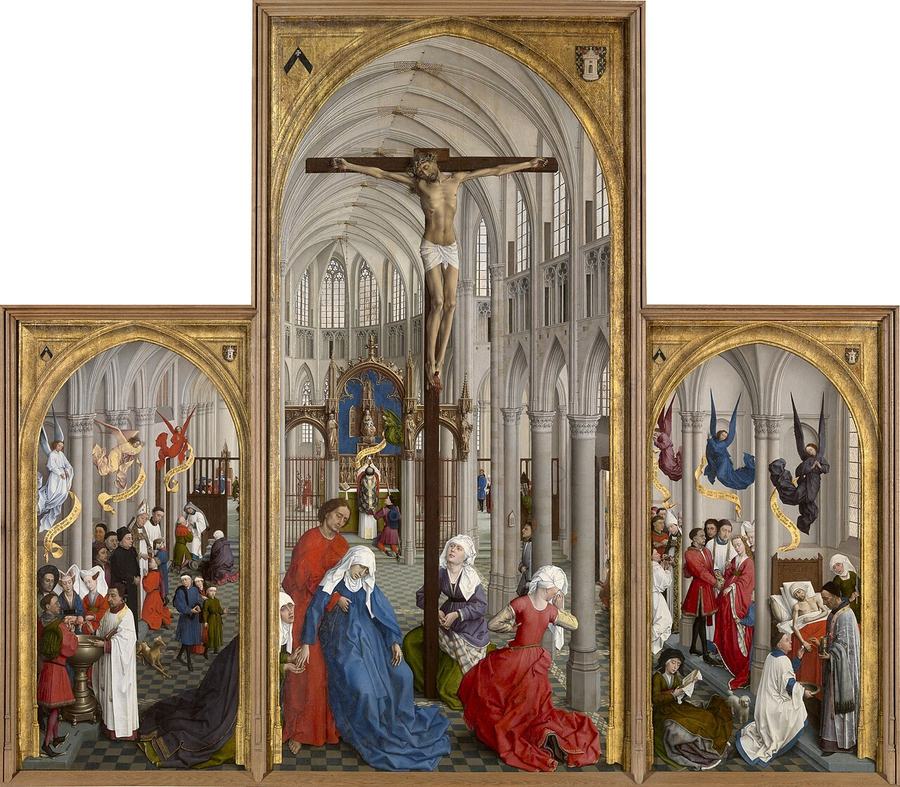
A three-part altarpiece set inside a Gothic church: in the tall middle panel Christ hangs on a cross that rises to the vault, with Mary and others grieving at its foot and a priest at an altar behind; in the side panels small groups receive the sacraments in the aisles
The Seven Sacraments Altarpiece, by Rogier van der Weyden. The sacraments are given in the aisles of a church, around Christ on the cross. Painting: Rogier van der Weyden, between 1445 and 1450, Public domain, via Wikimedia Commons. Resized.

The Church teaches that there are seven sacraments, that Christ instituted them, and that they give the grace they signify. This timeline begins with what Scripture shows of Christ acting through signs and sending the apostles. It then follows the early Fathers who spoke of the mysteries and the sacraments, the lists of seven in the Middle Ages, the definitions of Florence and Trent, and what the Second Vatican Council and the Catechism say today.

Where it starts with Jesus

Jesus tells the apostles to baptize in the name of the Father, the Son and the Holy Spirit, and promises to be with them always. Here a rite is given by him and tied to his own authority.

“All authority in heaven and on earth has been given to me. Go therefore and make disciples of all nations, baptizing them in the name of the Father and of the Son and of the Holy Spirit, teaching them to observe all that I have commanded you; and lo, I am with you always, to the close of the age.”

JesusMatthew 28:18-20Read it in the source: Bible Gateway, RSV Catholic Edition

How it points to Jesus

The Church teaches that a sacrament is an action of Christ himself, who gave it to his Church. The entries below show what she has said about that: that he instituted them, that he is at work in them, and that they give the grace they signify. The measure of every sacrament is whether it is what he gave.

Drafted from primary sources. Every quotation is checked against the page it links to. The rites themselves, such as baptism, the laying on of hands and the Lord's Supper, are older than the lists. The earliest list of seven quoted here is from 1274. The history of each sacrament is on its own timeline in this section. One text, the profession of faith of 1274, is quoted from the Fordham sourcebook, since no preferred host carries it.

19 quotations in date order

A work in progress. The quotations below are not all the evidence on this matter. More are being added.

The Old Testamentbefore Christ
Old Testament
Scripture

The sign of circumcision

The Book of Genesis Genesis 17:10-11

“This is my covenant, which you shall keep, between me and you and your descendants after you: Every male among you shall be circumcised. You shall be circumcised in the flesh of your foreskins, and it shall be a sign of the covenant between me and you.”
Read it in the source: Bible Gateway, RSV Catholic Edition

Old Testament
Scripture

The Passover

The Book of Exodus Exodus 12:13-14

“The blood shall be a sign for you, upon the houses where you are; and when I see the blood, I will pass over you, and no plague shall fall upon you to destroy you, when I smite the land of Egypt. “This day shall be for you a memorial day, and you shall keep it as a feast to the Lord; throughout your generations you shall observe it as an ordinance for ever.”

Read it in the source: Bible Gateway, RSV Catholic Edition

c. AD 30A dark-haired, bearded man in a green robe with a white collar, his head tilted, looking out at the viewer
Scripture
St. Luke Luke 6:19

“And all the crowd sought to touch him, for power came forth from him and healed them all.”

Read it in the source: Bible Gateway, RSV Catholic Edition

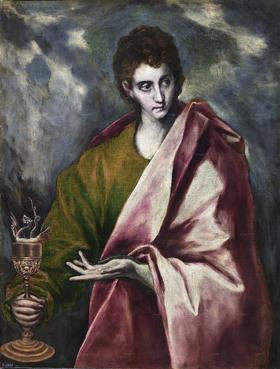
c. AD 30A young beardless apostle in a green tunic and rose cloak, holding a gold cup from which a small dragon rises
Scripture
St. John John 9:6-7

“he spat on the ground and made clay of the spittle and anointed the man’s eyes with the clay, saying to him, “Go, wash in the pool of Silo′am” (which means Sent). So he went and washed and came back seeing.”

Read it in the source: Bible Gateway, RSV Catholic Edition

c. AD 30
Scripture
St. John John 3:3-5

“Truly, truly, I say to you, unless one is born of water and the Spirit, he cannot enter the kingdom of God.”

Read it in the source: Bible Gateway, RSV Catholic Edition

c. AD 30
Scripture
St. John John 20:21-23

“As the Father has sent me, even so I send you.” And when he had said this, he breathed on them, and said to them, “Receive the Holy Spirit. If you forgive the sins of any, they are forgiven; if you retain the sins of any, they are retained.””

Read it in the source: Bible Gateway, RSV Catholic Edition

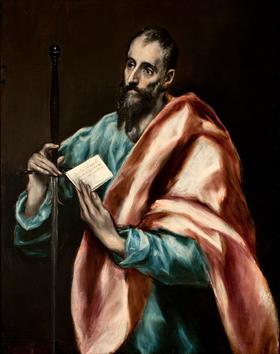
c. 55A bald, bearded apostle in a red cloak over a blue tunic, holding a folded letter in one hand and resting the other on a long sword
Scripture
St. Paul 1 Corinthians 4:1

“This is how one should regard us, as servants of Christ and stewards of the mysteries of God.”

Read it in the source: Bible Gateway, RSV Catholic Edition

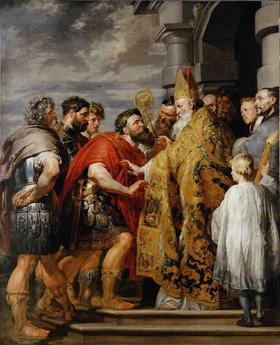
c. 387A bishop in a gold cope and mitre on the steps of a church holds out his hand to stop an emperor in armour and a red cloak
Church Father
St. Ambrose of Milan On the Mysteries, ch. 1, 2

“The season now warns us to speak of the Mysteries, and to set forth the purport of the sacraments, which if we had thought it well to teach before baptism to those who were not yet initiated, we should be considered rather to have betrayed than to have portrayed the Mysteries.”

Read it in the source: New Advent

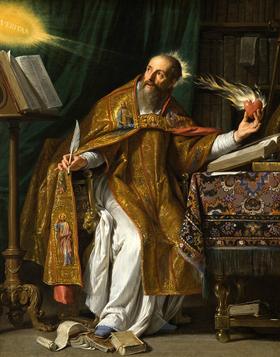
c. 416A bishop in a gold cope sits at a desk with a quill in one hand and a flaming heart in the other, looking up at a burst of light
Church Father
St. Augustine of Hippo Tractates on John, Tractate 80, ch. 3 (on John 15:3)

“The word is added to the element, and there results the Sacrament, as if itself also a kind of visible word.”

Read it in the source: New Advent

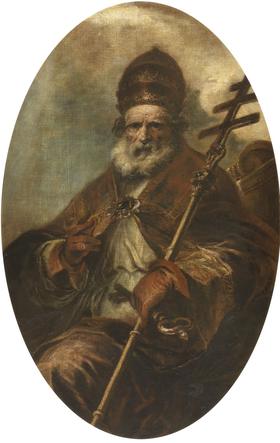
c. 450An oval painting of an old pope with a white beard in a tiara, holding a tall cross
Church Father
St. Leo the Great Sermon 74 (On the Lord's Ascension), ch. 2

“And so that which till then was visible of our Redeemer was changed into a sacramental presence”

Read it in the source: New Advent

The Middle Ages800 to 1500
1274
Council
Michael VIII Palaeologus, Emperor of the Romans Profession of faith, Second Council of Lyons, 1274 (DS 860)

“The same Holy Roman Church also holds and teaches that there are seven sacraments of the Church: one is baptism, which has been mentioned above; another is the sacrament of confirmation which bishops confer by the laying on of hands while they anoint the reborn; then penance, the Eucharist, the sacrament of order, matrimony and extreme unction which, according to the doctrine of the Blessed James, … is administered to the sick.”

Read it in the source: Fordham Sourcebook

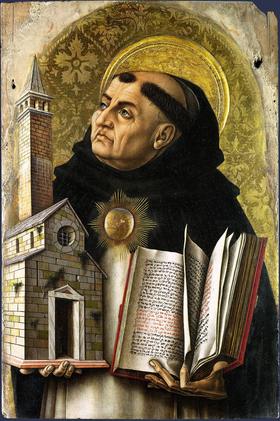
1274A Dominican friar with a tonsure and a gold halo holds an open book and a small church, with a shining sun on his chest
Doctor of the Church
St. Thomas Aquinas Summa Theologiae III, q. 65, a. 1, I answer that

“the sacraments of the Church were instituted for a twofold purpose: namely, in order to perfect man in things pertaining to the worship of God according to the religion of Christian life, and to be a remedy against the defects caused by sin. And in either way it is becoming that there should be seven sacraments.”

Read it in the source: New Advent

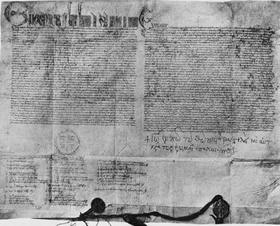
1439A black and white photograph of a large parchment charter written in two columns, with seals hanging from its lower edge
Council
Council of Florence, Pope Eugenius IV Bull Exsultate Deo (Decree for the Armenians), 22 November 1439

“There are seven sacraments of the new Law, namely baptism, confirmation, Eucharist, penance, extreme unction, orders and matrimony, which differ greatly from the sacraments of the old Law. The latter were not causes of grace, but only prefigured the grace to be given through the passion of Christ; whereas the former, ours, both contain grace and bestow it on those who worthily receive them.”

Read it in the source: Papal Encyclicals Online

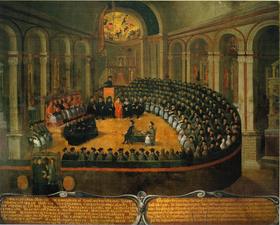
1547Rows of bishops in mitres sit in a great semicircle of benches inside a church, facing the presiding cardinals
Council
Council of Trent Session 7, Decree on the Sacraments, Canon 1 (3 March 1547)

“If any one saith, that the sacraments of the New Law were not all instituted by Jesus Christ, our Lord; or, that they are more, or less, than seven, to wit, Baptism, Confirmation, the Eucharist, Penance, Extreme Unction, Order, and Matrimony; or even that any one of these seven is not truly and properly a sacrament; let him be anathema.”

Read it in the source: Papal Encyclicals Online

1547
Council
Council of Trent Session 7, Decree on the Sacraments, Canon 6 (3 March 1547)

“If any one saith, that the sacraments of the New Law do not contain the grace which they signify; or, that they do not confer that grace on those who do not place an obstacle thereunto; as though they were merely outward signs of grace or justice received through faith, and certain marks of the Christian profession, whereby believers are distinguished amongst men from unbelievers; let him be anathema.”

Read it in the source: Papal Encyclicals Online

The Modern Era1800 to today
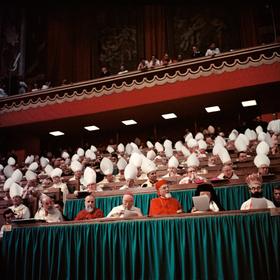
1963Rows of bishops in white mitres and copes sit in tiered stands hung with red and green cloth
Council
Second Vatican Council Sacrosanctum Concilium 59

“The purpose of the sacraments is to sanctify men, to build up the body of Christ, and, finally, to give worship to God; because they are signs they also instruct. They not only presuppose faith, but by words and objects they also nourish, strengthen, and express it; that is why they are called "sacraments of faith." They do indeed impart grace”

Read it in the source: vatican.va

1992
Magisterium
Catechism of the Catholic Church CCC 1117

“Thus the Church has discerned over the centuries that among liturgical celebrations there are seven that are, in the strict sense of the term, sacraments instituted by the Lord.”

Read it in the source: vatican.va

1992
Magisterium
Catechism of the Catholic Church CCC 1131

“The sacraments are efficacious signs of grace, instituted by Christ and entrusted to the Church, by which divine life is dispensed to us.”

Read it in the source: vatican.va

1992
Magisterium
Catechism of the Catholic Church CCC 1150

“Signs of the covenant. the Chosen People received from God distinctive signs and symbols that marked its liturgical life. These are no longer solely celebrations of cosmic cycles and social gestures, but signs of the covenant, symbols of God's mighty deeds for his people. Among these liturgical signs from the Old Covenant are circumcision, anointing and consecration of kings and priests, laying on of hands, sacrifices, and above all the Passover. the Church sees in these signs a prefiguring of the sacraments of the New Covenant.”

Read it in the source: vatican.va

Related timelines

ConfirmationConfirmation is the sacrament in which the baptized receive the gift of the Holy Spirit by the laying on of hands and anointing with chrism. This timeline begins with Christ's promise of the Spirit and the apostles' laying on of hands in Samaria and Ephesus. It follows the anointing after baptism in the early Church, then the way the West came to reserve the sacrament to the bishop and to separate it in time from Baptism, while the East kept the two together. It ends with the present rite and its words.21 quotations, from the Old Testament to 1992The Anointing of the SickThe Anointing of the Sick is the sacrament in which a priest anoints a seriously ill person with blessed oil and prays over him. This timeline begins with Christ's healing of the sick and the Twelve anointing with oil, and with the passage of James that the Council of Trent names as its promulgation. It then shows a Father of the fourth century, an early prayer for blessing the oil, the long period when the anointing was given mostly to the dying and was called Extreme Unction, the definitions of Florence and Trent, and the return at the Second Vatican Council to anointing the seriously ill, ending with the present rite and the Catechism.19 quotations, from the Old Testament to 1992MatrimonyMatrimony is the sacrament in which a baptized man and woman bind themselves to each other for life, in a covenant the Church sees as a sign of Christ's union with her. This timeline begins with marriage at creation, then with what Christ taught and did, and with Paul's words on the "great mystery". It follows the witness of the Fathers and the way the Church has counted marriage among the sacraments, from Florence and Aquinas to Trent. It shows plainly that Trent, in 1563, began to require that a marriage be made before the parish priest and witnesses. It ends with the modern popes, the Second Vatican Council and the Catechism.18 quotations, from the Old Testament to 1992Penance and ReconciliationPenance, also called Reconciliation or Confession, is the sacrament in which the Church, in the Lord's name, forgives sins committed after Baptism. This timeline starts with Christ forgiving sins and giving the apostles that power. It then shows how the Church dealt with grave sin in the first centuries, by a public penance that was often allowed only once, how private and repeated confession became the usual form, and what the councils, a Doctor and the popes have said about it since.20 quotations, from the Old Testament to 1992BaptismBaptism is the first sacrament, the gateway to life in the Spirit and to the other sacraments. This timeline begins with Christ's own baptism and his command to baptize. It then shows how the Church has baptized and taught baptism in each age: how she prepared those who came, the days she chose, the water and the Trinitarian words, who may baptize, and what the sacrament gives. It shows the dispute over the baptism of those outside the Church, where Pope Stephen and St. Cyprian took opposite sides, and how it was settled. It ends with the Council of Florence, Trent, the Second Vatican Council and the Catechism.20 quotations, from the Old Testament to 1992Contraception“The Bible nowhere forbids contraception. The ban is a man-made rule that celibate men invented in 1968. Onan was punished for refusing his duty to his brother, not for contraception, and nearly every Protestant church accepts it today.”17 quotations, from the Old Testament to 1992