Tradition Timeline Leave an objection

Start page / Sacraments

Penance and Reconciliation

Each mark is one quotation. Touch the timeline to read it.
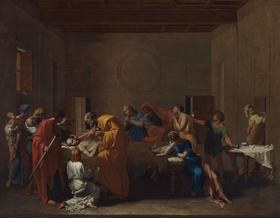
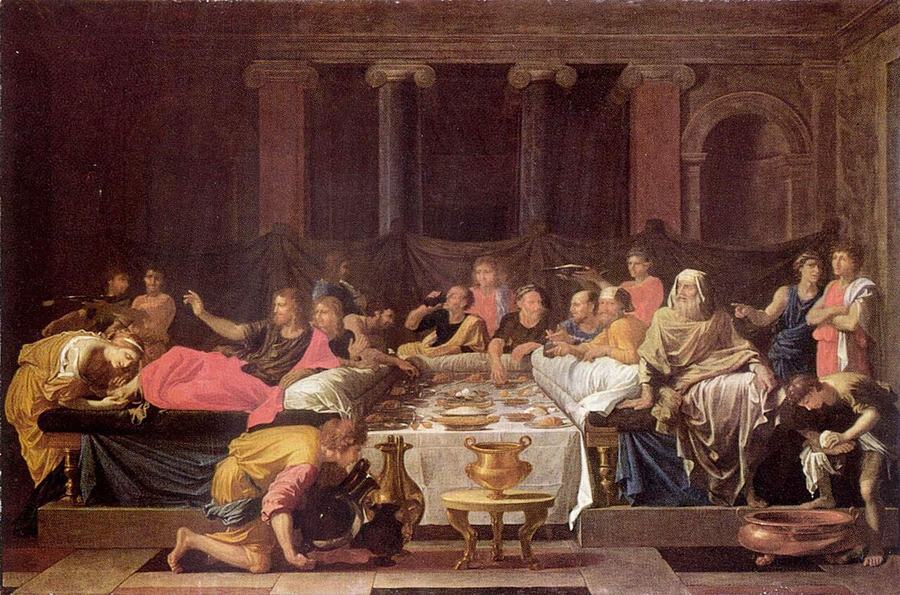
Guests recline at a banquet table; at the left a woman bends over the feet of Christ, who turns toward her with his hand raised
Penance, from the Seven Sacraments by Nicolas Poussin. The sacrament is shown as the sinful woman at the feet of Christ in the house of Simon the Pharisee. Painting: Nicolas Poussin, seventeenth century, Public domain, via Wikimedia Commons. Resized.

Penance, also called Reconciliation or Confession, is the sacrament in which the Church, in the Lord's name, forgives sins committed after Baptism. This timeline starts with Christ forgiving sins and giving the apostles that power. It then shows how the Church dealt with grave sin in the first centuries, by a public penance that was often allowed only once, how private and repeated confession became the usual form, and what the councils, a Doctor and the popes have said about it since.

Where it starts with Jesus

Jesus forgives sins himself, and on the evening of the day he rose he gives the apostles a share in that power, with the gift of the Holy Spirit.

“Jesus said to them again, “Peace be with you. As the Father has sent me, even so I send you.” And when he had said this, he breathed on them, and said to them, “Receive the Holy Spirit. If you forgive the sins of any, they are forgiven; if you retain the sins of any, they are retained.””

JesusJohn 20:21-23Read it in the source: Bible Gateway, RSV Catholic Edition

How it points to Jesus

The sacrament is Christ's own gift to his Church, and the Church says that it is he who forgives. The entries show the form of the celebration changing over the centuries, from public penance to private confession. What the texts keep is that the sinner is reconciled with God and the Church through Christ's ministers.

Drafted from primary sources. Every quotation is checked against the page it links to. The way of celebrating this sacrament changed a great deal, and the entries are placed to show it: the early texts speak of public penance, and the Catechism itself says that the private form came later. The question why a Catholic confesses to a priest is answered on the objection timeline on confession; this timeline tells the history of the sacrament itself.

20 quotations in date order

A work in progress. The quotations below are not all the evidence on this matter. More are being added.

The Old Testamentbefore Christ
Old Testament
Scripture

A broken and contrite heart

The Book of Psalms Psalm 51:16-17

“For thou hast no delight in sacrifice; were I to give a burnt offering, thou wouldst not be pleased. The sacrifice acceptable to God is a broken spirit; a broken and contrite heart, O God, thou wilt not despise.”

Read it in the source: Bible Gateway, RSV Catholic Edition

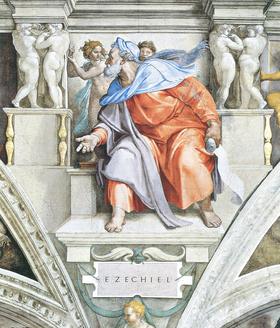
Old TestamentA seated old man in a red robe and blue scarf turns sharply, holding a scroll, with his open hand stretched out
Scripture

A new heart

The prophet Ezekiel Ezekiel 36:26-27

“A new heart I will give you, and a new spirit I will put within you; and I will take out of your flesh the heart of stone and give you a heart of flesh. And I will put my spirit within you, and cause you to walk in my statutes and be careful to observe my ordinances.”

Read it in the source: Bible Gateway, RSV Catholic Edition

c. AD 29
Scripture
Jesus and the woman who anointed his feet Luke 7:47-50

“Therefore I tell you, her sins, which are many, are forgiven, for she loved much; but he who is forgiven little, loves little.” And he said to her, “Your sins are forgiven.” Then those who were at table with him began to say among themselves, “Who is this, who even forgives sins?” And he said to the woman, “Your faith has saved you; go in peace.””

Read it in the source: Bible Gateway, RSV Catholic Edition

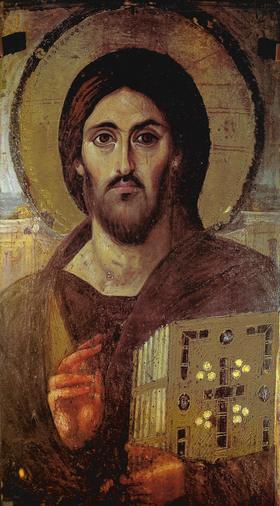
c. AD 30An ancient painted icon of Christ with a dark beard and a gold halo, his right hand raised in blessing and a jewelled book of the Gospels in his left
Scripture
The risen Jesus to the disciples John 20:21-23

““As the Father has sent me, even so I send you.” And when he had said this, he breathed on them, and said to them, “Receive the Holy Spirit. If you forgive the sins of any, they are forgiven; if you retain the sins of any, they are retained.””

Read it in the source: Bible Gateway, RSV Catholic Edition

c. 140-155
Church Father
Hermas The Shepherd, Commandment 4, ch. 3

“For to those who have been called before these days, the Lord has set repentance. For the Lord, knowing the heart, and foreknowing all things, knew the weakness of men and the manifold wiles of the devil … if any one is tempted by the devil, and sins after that great and holy calling in which the Lord has called His people to everlasting life, he has opportunity to repent but once. But if he should sin frequently after this, and then repent, to such a man his repentance will be of no avail”

Read it in the source: New Advent

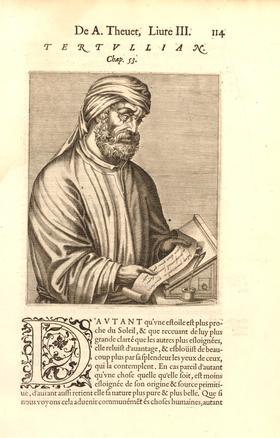
c. 203An engraving of a bearded man in a turban holding a scroll, set in a page of printed French text
Church Father
Tertullian On Repentance, ch. 7

“These poisons of his, therefore, God foreseeing, although the gate of forgiveness has been shut and fastened up with the bar of baptism, has permitted it still to stand somewhat open. In the vestibule He has stationed the second repentance for opening to such as knock: but now once for all, because now for the second time; but never more”

Read it in the source: New Advent

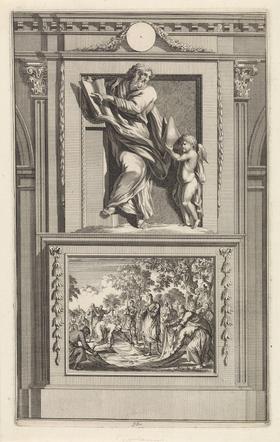
c. 250An engraving of a bearded man in robes holding an open book, standing like a statue in a niche, with a small scene in a landscape on the base below
Church Father
St. Cyprian of Carthage Epistle 9, 2

“For although in smaller sins sinners may do penance for a set time, and according to the rules of discipline come to public confession, and by imposition of the hand of the bishop and clergy receive the right of communion: now with their time still unfulfilled, while persecution is still raging, while the peace of the Church itself is not [yet] restored, they are admitted to communion”

Read it in the source: New Advent

c. 251
Church Father
St. Cyprian of Carthage On the Lapsed, 28

“…how much are they both greater in faith and better in their fear, who, although bound by no crime of sacrifice to idols or of certificate, yet, since they have even thought of such things, with grief and simplicity confess this very thing to God's priests, and make the conscientious avowal, put off from them the load of their minds, and seek out the salutary medicine even for slight and moderate wounds”

Read it in the source: New Advent

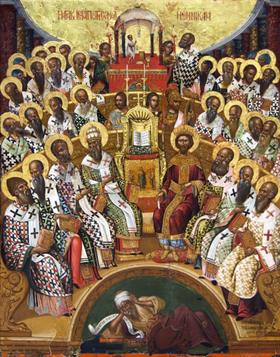
325A crowded icon of haloed bishops in bright vestments seated in rows around a throne that holds an open book
Council
First Council of Nicaea Canon 11

“Concerning those who have fallen without compulsion, without the spoiling of their property, without danger or the like, as happened during the tyranny of Licinius, the Synod declares that, though they have deserved no clemency, they shall be dealt with mercifully. As many as were communicants, if they heartily repent, shall pass three years among the hearers; for seven years they shall be prostrators; and for two years they shall communicate with the people in prayers, but without oblation.”

Read it in the source: New Advent

325
Council
First Council of Nicaea Canon 13

“Concerning the departing, the ancient canonical law is still to be maintained, to wit, that, if any man be at the point of death, he must not be deprived of the last and most indispensable Viaticum.”

Read it in the source: New Advent

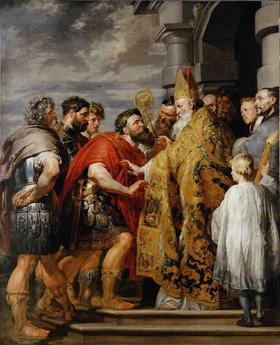
c. 390A bishop in a gold cope and mitre on the steps of a church holds out his hand to stop an emperor in armour and a red cloak
Church Father
St. Ambrose of Milan Concerning Repentance, Book 2, ch. 2, 12

“In like manner it seemed impossible that sins should be forgiven through repentance, but Christ gave this power to His apostles, which has been transmitted to the priestly office. That, then, has become possible which was impossible.”

Read it in the source: New Advent

7th century
Magisterium

From public penance to private confession

Catechism of the Catholic Church CCC 1447

“Over the centuries the concrete form in which the Church has exercised this power received from the Lord has varied considerably. During the first centuries the reconciliation of Christians who had committed particularly grave sins after their Baptism (for example, idolatry, murder, or adultery) was tied to a very rigorous discipline, according to which penitents had to do public penance for their sins, often for years, before receiving reconciliation. To this "order of penitents" (which concerned only certain grave sins), one was only rarely admitted and in certain regions only once in a lifetime. During the seventh century Irish missionaries, inspired by the Eastern monastic tradition, took to continental Europe the "private" practice of penance, which does not require public and prolonged completion of penitential works before reconciliation with the Church. From that time on, the sacrament has been performed in secret between penitent and priest.”

Read it in the source: vatican.va
The Middle Ages800 to 1500
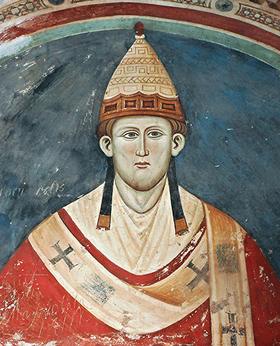
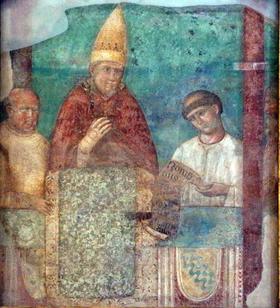
1215A medieval wall painting of a young beardless pope in a tall pointed tiara and a pallium marked with crosses
Council
Fourth Lateran Council Constitution 21

“Let him take the utmost care, however, not to betray the sinner at all by word or sign or in any other way. If the priest needs wise advice, let him seek it cautiously without any mention of the person concerned. For if anyone presumes to reveal a sin disclosed to him in confession, we decree that he is not only to be deposed from his priestly office but also to be confined to a strict monastery to do perpetual penance.”

Read it in the source: Papal Encyclicals Online

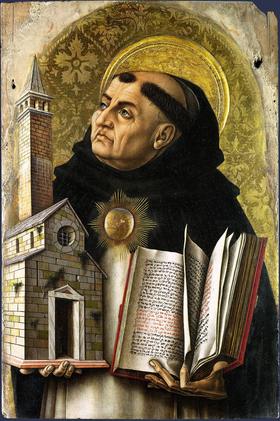
c. 1273A Dominican friar with a tonsure and a gold halo holds an open book and a small church, with a shining sun on his chest
Doctor of the Church
St. Thomas Aquinas Summa Theologiae III, q. 84, a. 3, I answer that

“…this sacrament is perfected by that which is done by the priest. Wherefore the part taken by the penitent, whether it consist of words or deeds, must needs be the matter of this sacrament, while the part taken by the priest, takes the place of the form. … This removal is expressed by the priest saying: "I absolve thee": because sins are fetters, according to Proverbs 5:22.”

Read it in the source: New Advent

1439A black and white photograph of a large parchment charter written in two columns, with seals hanging from its lower edge
Council
Council of Florence Exsultate Deo, Decree for the Armenians

“The fourth sacrament is penance. Its matter is the acts of the penitent, which are threefold. The first is contrition of heart, which includes sorrow for sin committed, with the resolve not to sin again. The second is oral confession, which implies integral confession to the priest of all sins that are remembered. The third is satisfaction for sins in accordance with the judgment of the priest which is ordinarily done by prayer, fasting and almsgiving. The form of this sacrament are the words of absolution which the priest pronounces when he says: I absolve you.”

Read it in the source: Papal Encyclicals Online

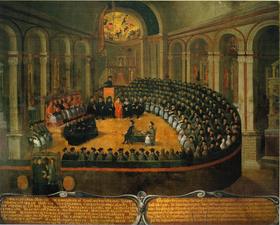
1551Rows of bishops in mitres sit in a great semicircle of benches inside a church, facing the presiding cardinals
Council
Council of Trent Session 14, On the Sacrament of Penance, ch. 5

“For the rest, as to the manner of confessing secretly to a priest alone, although Christ has not forbidden that a person may,–in punishment of his sins, and for his own [humiliation], as well for an example to others as for the edification of the Church that has been scandalized,–confess his sins publicly, nevertheless this is not commanded by a divine precept; neither would it very prudent to enjoin by any human law, that sins, especially such as are secret, should be made known by a public confession.”

Read it in the source: Papal Encyclicals Online

The Modern Era1800 to today
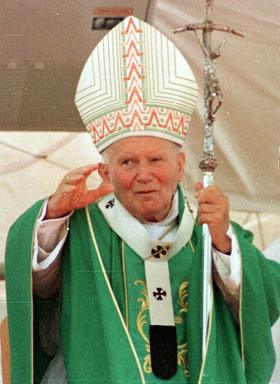
1984An elderly pope in green vestments and a white and gold mitre raises his hand in greeting, holding his staff with the crucifix
Magisterium
Pope St. John Paul II Reconciliatio et Paenitentia, 33

“The individual and integral confession of sins with individual absolution constitutes the only ordinary way in which the faithful who are conscious of serious sin are reconciled with God and with the church.”

Read it in the source: vatican.va

1992
Magisterium
Catechism of the Catholic Church CCC 1449

“The formula of absolution used in the Latin Church expresses the essential elements of this sacrament: the Father of mercies is the source of all forgiveness. He effects the reconciliation of sinners through the Passover of his Son and the gift of his Spirit, through the prayer and ministry of the Church”

Read it in the source: vatican.va

1992
Magisterium
Catechism of the Catholic Church CCC 1428

“Christ's call to conversion continues to resound in the lives of Christians. This second conversion is an uninterrupted task for the whole Church who, "clasping sinners to her bosom, (is) at once holy and always in need of purification, (and) follows constantly the path of penance and renewal." This endeavor of conversion is not just a human work. It is the movement of a "contrite heart," drawn and moved by grace to respond to the merciful love of God who loved us first.”

Read it in the source: vatican.va
1992
Magisterium
Catechism of the Catholic Church CCC 1432

“The human heart is heavy and hardened. God must give man a new heart. Conversion is first of all a work of the grace of God who makes our hearts return to him: "Restore us to thyself, O LORD, that we may be restored!" God gives us the strength to begin anew.”

Read it in the source: vatican.va
Related timelines

The Anointing of the SickThe Anointing of the Sick is the sacrament in which a priest anoints a seriously ill person with blessed oil and prays over him. This timeline begins with Christ's healing of the sick and the Twelve anointing with oil, and with the passage of James that the Council of Trent names as its promulgation. It then shows a Father of the fourth century, an early prayer for blessing the oil, the long period when the anointing was given mostly to the dying and was called Extreme Unction, the definitions of Florence and Trent, and the return at the Second Vatican Council to anointing the seriously ill, ending with the present rite and the Catechism.19 quotations, from the Old Testament to 1992The seven sacramentsThe Church teaches that there are seven sacraments, that Christ instituted them, and that they give the grace they signify. This timeline begins with what Scripture shows of Christ acting through signs and sending the apostles. It then follows the early Fathers who spoke of the mysteries and the sacraments, the lists of seven in the Middle Ages, the definitions of Florence and Trent, and what the Second Vatican Council and the Catechism say today.19 quotations, from the Old Testament to 1992Confession to a priest“We don't need to confess our sins to a priest. Christ is the one mediator, the veil was torn, and we can go straight to God for forgiveness.”20 quotations, from the Old Testament to 1992BaptismBaptism is the first sacrament, the gateway to life in the Spirit and to the other sacraments. This timeline begins with Christ's own baptism and his command to baptize. It then shows how the Church has baptized and taught baptism in each age: how she prepared those who came, the days she chose, the water and the Trinitarian words, who may baptize, and what the sacrament gives. It shows the dispute over the baptism of those outside the Church, where Pope Stephen and St. Cyprian took opposite sides, and how it was settled. It ends with the Council of Florence, Trent, the Second Vatican Council and the Catechism.20 quotations, from the Old Testament to 1992Indulgences“The Catholic Church sold forgiveness of sins for money, and still teaches that indulgences can buy your way out of punishment. Indulgences have no basis in Scripture.”19 quotations, from the Old Testament to 1992The EucharistThe Eucharist is the sacrament in which the Church receives the body and blood of Christ. This timeline follows the Eucharist as a sacrament received: what Christ gave at the Last Supper, who may come to Communion and how they should prepare, Communion as the bond of the Church, Communion for the dying, and how often the faithful received. It shows where the practice changed, for the age of first Communion, the cup and the frequency of Communion, and what the Church says has stayed the same.23 quotations, from the Old Testament to 1992