Tradition Timeline Leave an objection

Start page / Objections / The Eucharist

“Catholics bow down to a piece of bread and worship it. The Bible calls that idolatry.”

Verses cited for this objection: Exod. 20:4-5, Matt. 4:10

Each mark is one quotation. Touch the timeline to read it.

Short answer

The Church holds the commandment to worship God alone, and the Catechism defines idolatry as giving divine honor to what is not God. Catholics adore the Eucharist because they believe Jesus when he says "this is my body". The adoration is given to Christ, whom they believe to be present, and not to bread. St. Ambrose and St. Augustine met this same question in the fourth and fifth centuries, with the same verse in hand, and gave this answer.

Where it starts with Jesus

At the Last Supper Jesus takes bread, gives it to his disciples and says that it is his body.

“Now as they were eating, Jesus took bread, and blessed, and broke it, and gave it to the disciples and said, “Take, eat; this is my body.””

JesusMatthew 26:26Read it in the source: Bible Gateway, RSV Catholic Edition

How it points to Jesus

Adoration of the Eucharist rests on these words of his. The Church adores the Eucharist because she believes that he is present there, the same Lord whom the Magi and the disciples worshiped. The honor is given to him. If he were not present, the Church's own definition of idolatry would forbid it.

Drafted from primary sources. Every quotation is checked against the page it links to. Whether the adoration is rightly given depends on whether Christ is truly present, which is the subject of the timelines on the Real Presence and on transubstantiation.

17 quotations in date order

A work in progress. The quotations below are not all the evidence on this matter. More are being added.

The Old Testamentbefore Christ
Old Testament
Scripture
The Ten Commandments Exodus 20:2-5

“I am the Lord your God, who brought you out of the land of Egypt, out of the house of bondage. You shall have no other gods before me. You shall not make for yourself a graven image, or any likeness of anything that is in heaven above, or that is in the earth beneath, or that is in the water under the earth; you shall not bow down to them or serve them; for I the Lord your God am a jealous God”
Read it in the source: Bible Gateway, RSV Catholic Edition

Old Testament
Scripture
The Book of Psalms Psalm 99:5

“Extol the Lord our God; worship at his footstool! Holy is he!”

Read it in the source: Bible Gateway, RSV Catholic Edition

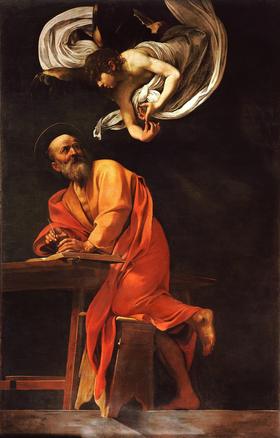
c. AD 1An old man in an orange robe kneels with one knee on a stool at a writing table and looks up at an angel in swirling white cloth above him
Scripture
St. Matthew, of the Magi Matthew 2:11

“and going into the house they saw the child with Mary his mother, and they fell down and worshiped him. Then, opening their treasures, they offered him gifts, gold and frankincense and myrrh.”

Read it in the source: Bible Gateway, RSV Catholic Edition

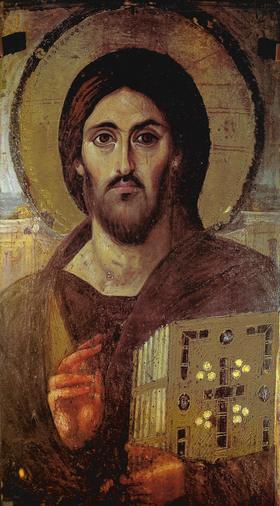
c. AD 30An ancient painted icon of Christ with a dark beard and a gold halo, his right hand raised in blessing and a jewelled book of the Gospels in his left
Scripture
Jesus Matthew 4:10

“Begone, Satan! for it is written, ‘You shall worship the Lord your God and him only shall you serve.’”

Read it in the source: Bible Gateway, RSV Catholic Edition

c. AD 30
Scripture
Jesus John 6:53-56

“Truly, truly, I say to you, unless you eat the flesh of the Son of man and drink his blood, you have no life in you; he who eats my flesh and drinks my blood has eternal life, and I will raise him up at the last day. For my flesh is food indeed, and my blood is drink indeed. He who eats my flesh and drinks my blood abides in me, and I in him.”

Read it in the source: Bible Gateway, RSV Catholic Edition

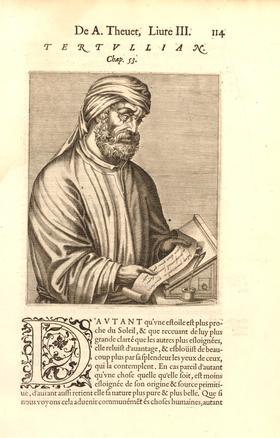
c. 200An engraving of a bearded man in a turban holding a scroll, set in a page of printed French text
Church Father
Tertullian On Idolatry, ch. 7

“A whole day the zeal of faith will direct its pleadings to this quarter: bewailing that a Christian should come from idols into the Church; should come from an adversary workshop into the house of God; should raise to God the Father hands which are the mothers of idols; should pray to God with the hands which, out of doors, are prayed to in opposition to God; should apply to the Lord's body those hands which confer bodies on demons. … What hands more to be amputated than those in which scandal is done to the Lord's body?”

Read it in the source: New Advent

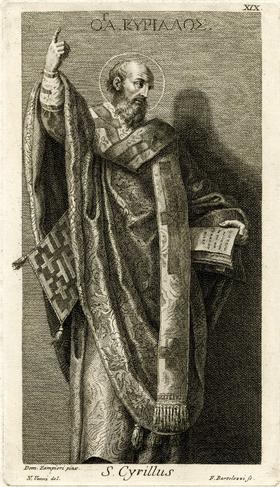
c. 350An engraving of a bearded bishop in Eastern vestments holding a book and raising his right hand in blessing
Church Father
St. Cyril of Jerusalem Catechetical Lecture 23 (On the Mysteries 5), 22

“Then after you have partaken of the Body of Christ, draw near also to the Cup of His Blood; not stretching forth your hands, but bending, and saying with an air of worship and reverence, Amen, hallow yourself by partaking also of the Blood of Christ.”

Read it in the source: New Advent

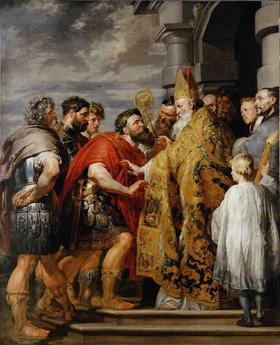
381A bishop in a gold cope and mitre on the steps of a church holds out his hand to stop an emperor in armour and a red cloak
Church Father
St. Ambrose of Milan On the Holy Spirit 3.11.78-79

“And we read that nothing besides God is to be worshipped, for it is written: You shall worship the Lord your God, and Him only shall you serve. … And so, by footstool is understood earth, but by the earth the Flesh of Christ, which we this day also adore in the mysteries, and which the apostles, as we said above, adored in the Lord Jesus; for Christ is not divided but is one; nor, when He is adored as the Son of God, is He denied to have been born of the Virgin.”

Read it in the source: New Advent

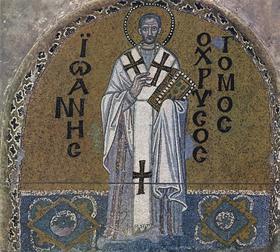
c. 392A gold mosaic of a bishop in white vestments marked with crosses, holding a book, with his name in Greek letters on either side
Church Father
St. John Chrysostom Homily 24 on First Corinthians, 8

“This Body, even lying in a manger, Magi reverenced. Yea, men profane and barbarous, leaving their country and their home, both set out on a long journey, and when they came, with fear and great trembling worshipped Him. Let us, then, at least imitate those Barbarians, we who are citizens of heaven. For they indeed when they saw Him but in a manger, and in a hut, and no such thing was in sight as you behold now, drew near with great awe; but you behold Him not in the manger but on the altar, not a woman holding Him in her arms, but the priest standing by, and the Spirit with exceeding bounty hovering over the gifts set before us.”

Read it in the source: New Advent

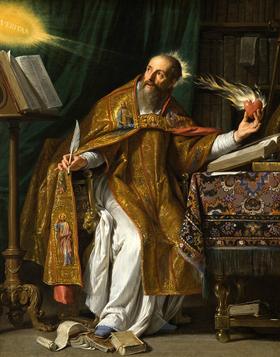
c. 392-418A bishop in a gold cope sits at a desk with a quill in one hand and a flaming heart in the other, looking up at a burst of light
Church Father
St. Augustine of Hippo Exposition on Psalm 99, 8

“How then shall we worship the earth, when the Scripture says openly, You shall worship the Lord your God? … In hesitation I turn unto Christ, since I am herein seeking Himself: and I discover how the earth may be worshipped without impiety, how His footstool may be worshipped without impiety. For He took upon Him earth from earth; because flesh is from earth, and He received flesh from the flesh of Mary. And because He walked here in very flesh, and gave that very flesh to us to eat for our salvation; and no one eats that flesh, unless he has first worshipped: we have found out in what sense such a footstool of our Lord's may be worshipped, and not only that we sin not in worshipping it, but that we sin in not worshipping.”

Read it in the source: New Advent

The Middle Ages800 to 1500
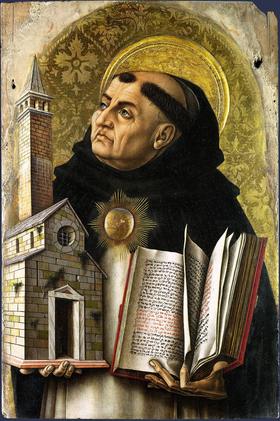
c. 1273A Dominican friar with a tonsure and a gold halo holds an open book and a small church, with a shining sun on his chest
Doctor of the Church
St. Thomas Aquinas Summa Theologiae III, q. 25, a. 2, body

“As stated above (Article 1) adoration is due to the subsisting hypostasis: yet the reason for honoring may be something non-subsistent, on account of which the person, in whom it is, is honored. And so the adoration of Christ's humanity may be understood in two ways. First, so that the humanity is the thing adored: and thus to adore the flesh of Christ is nothing else than to adore the incarnate Word of God: just as to adore a King's robe is nothing else than to adore a robed King. And in this sense the adoration of Christ's humanity is the adoration of "latria."”

Read it in the source: New Advent

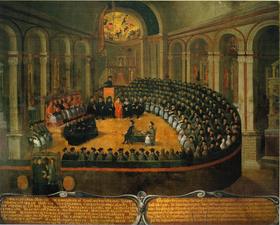
1551Rows of bishops in mitres sit in a great semicircle of benches inside a church, facing the presiding cardinals
Council
Council of Trent Session 13, Decree on the Eucharist, ch. 5

“Wherefore, there is no room left for doubt, that all the faithful of Christ may, according to the custom ever received in the Catholic Church, render in veneration the worship of latria, which is due to the true God, to this most holy sacrament. For not therefore is it the less to be adored on this account, that it was instituted by Christ, the Lord, in order to be received: for we believe that same God to be present therein, of whom the eternal Father, when introducing him into the world, says; And let all the angels of God adore him; whom the Magi falling down, adored; who, in fine, as the Scripture testifies, was adored by the apostles in Galilee.”

Read it in the source: Papal Encyclicals Online

1551
Council
Council of Trent Session 13, Canons on the Most Holy Sacrament of the Eucharist, canon 6

“If any one saith, that, in the holy sacrament of the Eucharist, Christ, the only-begotten Son of God, is not to be adored with the worship, even external of latria; and is, consequently, neither to be venerated with a special festive solemnity, nor to be solemnly borne about in processions, according to the laudable and universal rite and custom of holy church; or, is not to be proposed publicly to the people to be adored, and that the adorers thereof are idolators; let him be anathema.”

Read it in the source: Papal Encyclicals Online

The Modern Era1800 to today
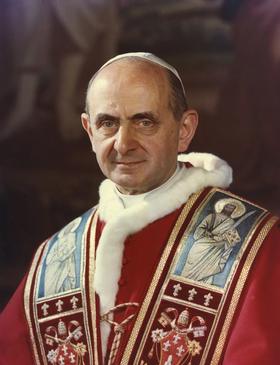
1965A colour photograph of a pope in a red cape trimmed with white fur and an embroidered stole
Magisterium
Pope St. Paul VI Mysterium Fidei 55

“Moreover, the Catholic Church has held firm to this belief in the presence of Christ's Body and Blood in the Eucharist not only in her teaching but in her life as well, since she has at all times paid this great Sacrament the worship known as "latria," which may be given to God alone.”

Read it in the source: vatican.va

1992
Magisterium
Catechism of the Catholic Church CCC 2113

“Idolatry not only refers to false pagan worship. It remains a constant temptation to faith. Idolatry consists in divinizing what is not God. Man commits idolatry whenever he honors and reveres a creature in place of God, whether this be gods or demons (for example, satanism), power, pleasure, race, ancestors, the state, money, etc.”

Read it in the source: vatican.va

1992
Magisterium
Catechism of the Catholic Church CCC 1378

“In the liturgy of the Mass we express our faith in the real presence of Christ under the species of bread and wine by, among other ways, genuflecting or bowing deeply as a sign of adoration of the Lord. "The Catholic Church has always offered and still offers to the sacrament of the Eucharist the cult of adoration, not only during Mass, but also outside of it, reserving the consecrated hosts with the utmost care, exposing them to the solemn veneration of the faithful, and carrying them in procession."”

Read it in the source: vatican.va

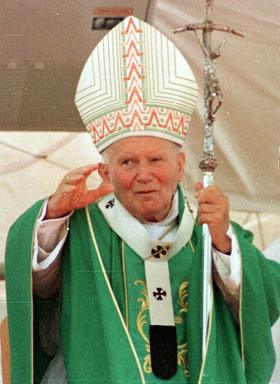
2003An elderly pope in green vestments and a white and gold mitre raises his hand in greeting, holding his staff with the crucifix
Magisterium
Pope St. John Paul II Ecclesia de Eucharistia 25

“The worship of the Eucharist outside of the Mass is of inestimable value for the life of the Church. This worship is strictly linked to the celebration of the Eucharistic Sacrifice. The presence of Christ under the sacred species reserved after Mass – a presence which lasts as long as the species of bread and of wine remain – derives from the celebration of the sacrifice and is directed towards communion, both sacramental and spiritual. It is the responsibility of Pastors to encourage, also by their personal witness, the practice of Eucharistic adoration, and exposition of the Blessed Sacrament in particular, as well as prayer of adoration before Christ present under the Eucharistic species.”

Read it in the source: vatican.va

Related timelines

The Real Presence“The Eucharist is only a symbol; it is not truly the Body and Blood of Jesus Christ.”20 quotations, from the Old Testament to 1992The EucharistThe Eucharist is the sacrament in which the Church receives the body and blood of Christ. This timeline follows the Eucharist as a sacrament received: what Christ gave at the Last Supper, who may come to Communion and how they should prepare, Communion as the bond of the Church, Communion for the dying, and how often the faithful received. It shows where the practice changed, for the age of first Communion, the cup and the frequency of Communion, and what the Church says has stayed the same.23 quotations, from the Old Testament to 1992Transubstantiation“After the blessing Jesus still calls the cup "the fruit of the vine," and Paul still calls the bread "bread." So nothing changed. Transubstantiation is a medieval word for a medieval idea.”17 quotations, from the Old Testament to 1992Images and statues“God forbids making graven images and bowing down to them. Catholic churches are full of statues and icons, and Catholics kneel and pray in front of them.”15 quotations, from the Old Testament to 1992The Real Presence and the Ascension“Jesus ascended bodily into heaven and sits at the right hand of the Father until he returns. His body is there, so it cannot be on Catholic altars.”16 quotations, from the Old Testament to 1992The Mass as sacrifice“Catholics teach that the Mass is a sacrifice offered again and again for the forgiveness of sins. Hebrews says Christ offered himself once for all, so there is no sacrifice left to offer.”20 quotations, from the Old Testament to 2003