Tradition Timeline Leave an objection

Start page / Scandals

The Galileo case

Each mark is one quotation. Touch the timeline to read it.
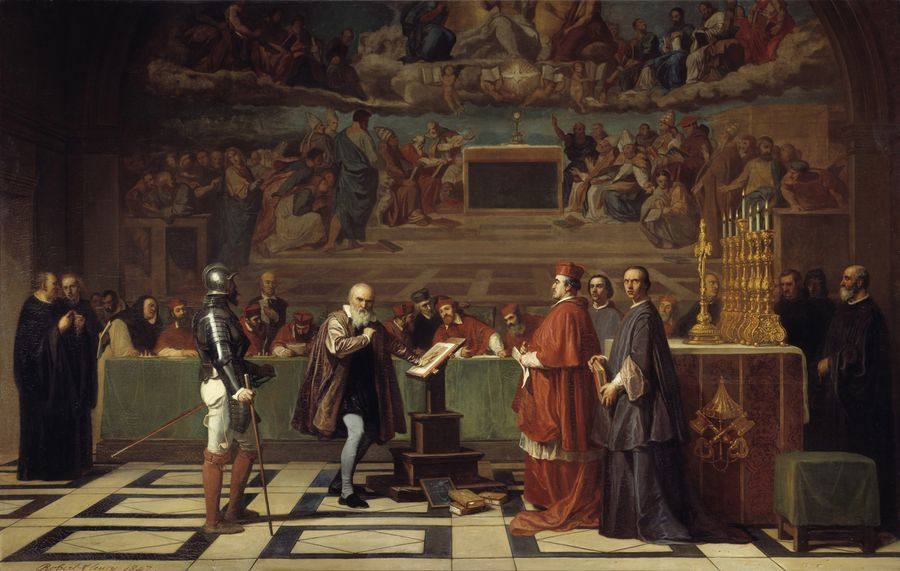
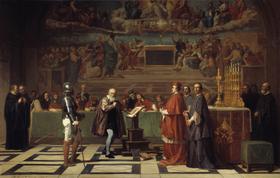
A man in black stands in a great hall before a long table of churchmen in red and white
Galileo before the Holy Office, by Joseph-Nicolas Robert-Fleury, painted two centuries after the trial of 1633. Painting: Joseph-Nicolas Robert-Fleury, 1847, Public domain, via Wikimedia Commons. Resized.

In 1616 the Congregation of the Index called the teaching that the earth moves false and contrary to Holy Scripture. In 1633 the cardinals of the Holy Office judged Galileo Galilei vehemently suspected of heresy for holding it, banned his book and sentenced him to prison. This timeline gives what the Church had taught before then about Scripture and the knowledge of nature, the two rulings in their own words, and what the Church has said about them since.

Where it starts with Jesus

Before Pilate, Jesus says that he came into the world to bear witness to the truth.

“Pilate said to him, “So you are a king?” Jesus answered, “You say that I am a king. For this I was born, and for this I have come into the world, to bear witness to the truth. Every one who is of the truth hears my voice.””

JesusJohn 18:37Read it in the source: Bible Gateway, RSV Catholic Edition

How it points to Jesus

The Church answers to that standard. In the Galileo case her judges called false something that was true, and this timeline records it together with what the Church said later. Those who follow the one who came to bear witness to the truth are bound to admit an error.

Drafted from primary documents. Every quotation is checked against the page it links to. The texts of 1615, 1616 and 1633 are English translations on the Fordham University sourcebook, a fallback host, and each of those entries carries a note on that page's own source. The two addresses of John Paul II are given in French, the language in which the Vatican publishes them, with our translation. Galileo's own writings and his abjuration are not quoted.

16 quotations in date order

A work in progress. The quotations below are not all the evidence on this matter. More are being added.

The Old Testamentbefore Christ
Old Testament
Scripture

A passage at the centre of the dispute

The Book of Joshua Joshua 10:12-13

“Then spoke Joshua to the Lord in the day when the Lord gave the Amorites over to the men of Israel; and he said in the sight of Israel, “Sun, stand thou still at Gibeon, and thou Moon in the valley of Ai′jalon.” And the sun stood still, and the moon stayed, until the nation took vengeance on their enemies.”

Read it in the source: Bible Gateway, RSV Catholic Edition

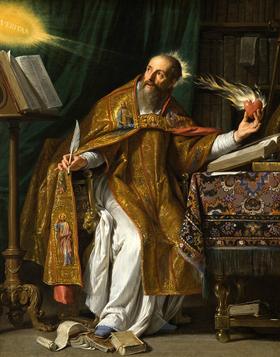
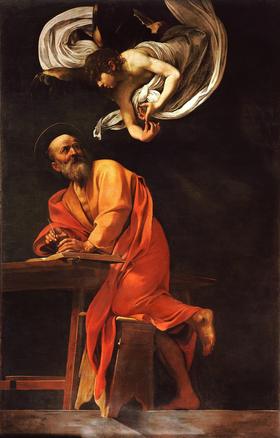
c. 397-400A bishop in a gold cope sits at a desk with a quill in one hand and a flaming heart in the other, looking up at a burst of light
Church Father

Augustine: knowledge of nature is not the doctrine of piety

St. Augustine Confessions, Book 5, 5.9

“For when I hear a Christian brother ignorant of these things, or in error concerning them, I can bear with patience to see that man hold to his opinions; nor can I apprehend that any want of knowledge as to the situation or nature of this material creation can be injurious to him, so long as he does not entertain belief in anything unworthy of You, O Lord, the Creator of all. But if he conceives it to pertain to the form of the doctrine of piety, and presumes to affirm with great obstinacy that whereof he is ignorant, therein lies the injury.”

Read it in the source: New Advent

The Middle Ages800 to 1500
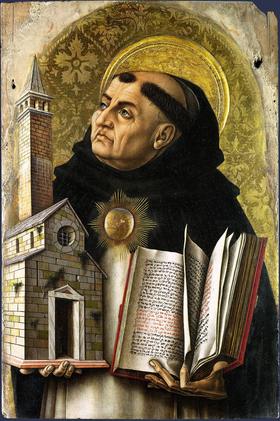
c. 1267A Dominican friar with a tonsure and a gold halo holds an open book and a small church, with a shining sun on his chest
Doctor of the Church

Aquinas: hold an explanation of Scripture ready to give it up

St. Thomas Aquinas Summa Theologiae I, q. 68, a. 1, I answer that

“In discussing questions of this kind two rules are to observed, as Augustine teaches (Gen. ad lit. i, 18). The first is, to hold the truth of Scripture without wavering. The second is that since Holy Scripture can be explained in a multiplicity of senses, one should adhere to a particular explanation, only in such measure as to be ready to abandon it, if it be proved with certainty to be false; lest Holy Scripture be exposed to the ridicule of unbelievers, and obstacles be placed to their believing.”

Read it in the source: New Advent

c. 1267
Doctor of the Church

Aquinas: Scripture describes what the senses see

St. Thomas Aquinas Summa Theologiae I, q. 70, a. 1, Reply to Objection 3

“In the opinion of Aristotle, however, the stars are fixed in their orbits, and in reality have no other movement but that of the spheres; and yet our senses perceive the movement of the luminaries and not that of the spheres (De Coel. ii, text. 43). But Moses describes what is obvious to sense, out of condescension to popular ignorance, as we have already said”

Read it in the source: New Advent

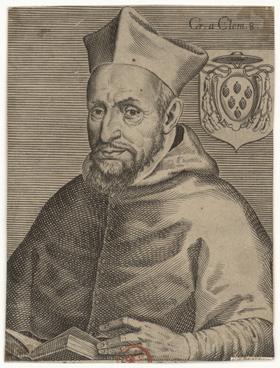
1615An engraved portrait of an elderly cardinal with a short beard wearing a biretta, his hand resting on a book
Doctor of the Church

Bellarmine: the Fathers read the sun as moving

St. Robert Bellarmine Letter to Paolo Antonio Foscarini, 12 April 1615, second point

“Second. I say that, as you know, the Council [of Trent] prohibits expounding the Scriptures contrary to the common agreement of the holy Fathers. And if Your Reverence would read not only the Fathers but also the commentaries of modern writers on Genesis, Psalms, Ecclesiastes and Josue, you would find that all agree in explaining literally (ad litteram) that the sun is in the heavens and moves swiftly around the earth, and that the earth is far from the heavens and stands immobile in the center of the universe. Now consider whether in all prudence the Church could encourage giving to Scripture a sense contrary to the holy Fathers and all the Latin and Greek commentators.”

Read it in the source: Fordham Sourcebook

1615
Doctor of the Church

Bellarmine: if it were demonstrated, Scripture would have to be explained with caution

St. Robert Bellarmine Letter to Paolo Antonio Foscarini, 12 April 1615, third point

“Third. I say that if there were a true demonstration that the sun was in the center of the universe and the earth in the third sphere, and that the sun did not travel around the earth but the earth circled the sun, then it would be necessary to proceed with great caution in explaining the passages of Scripture which seemed contrary, and we would rather have to say that we did not understand them than to say that something was false which has been demonstrated.But I do not believe that there is any such demonstration; none has been shown to me.”

Read it in the source: Fordham Sourcebook

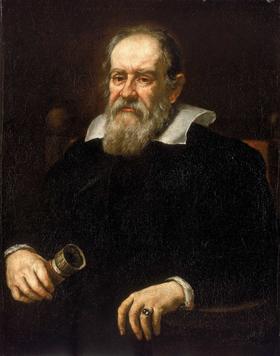
1616An old man with a white beard in a black gown and white collar, holding a telescope
Magisterium

The Congregation of the Index rules against the motion of the earth

Congregation of the Index Decree of the Congregation of the Index, 1616

“because it has come to the attention of this Congregation that the Pythagorean doctrine which is false and contrary to Holy Scripture, which teaches the motion of the earth and the immobility of the sun, and which is taught by Nicholas Copernicus in De Revolutionibus Orbium Caelestium and by Diego de Zuniga's On Job, is now being spread and accepted by many … Therefore, so that this opinion may not spread any further to the prejudice of Catholic truth, it ( the Sacred Congregation ) decrees that the said Nicholas Copernicus' De Revolutionibus Orbium, and Diego de Zuniga's On Job, be suspended until corrected; but that the book of the Carmelite Father, Paolo Foscarini, be prohibited and condemned, and that all other books likewise, in which the same is taught, be prohibited.”

Read it in the source: Fordham Sourcebook

22 June 1633A man in black stands in a great hall before a long table of churchmen in red and white
Magisterium

Galileo judged vehemently suspected of heresy

The Cardinals of the Holy Office Sentence of the Tribunal of the Supreme Inquisition against Galileo Galilei, 22 June 1633

“We say, pronounce, sentence, and declare, that thou, the said Galileo, by the things deduced during this trial, and by thee confessed as above, hast rendered thyself vehemently suspected of heresy by this Holy Office, that is, of having believed and held a doctrine which is false, and contrary to the Holy Scriptures, to wit: that the Sun is the centre of the universe, and that it does not move from east to west, and that the Earth moves and is not the centre of the universe: and that an opinion may be held and defended as probable after having been declared and defined as contrary to Holy Scripture; and in consequence thou hast incurred all the censures and penalties of the Sacred Canons, and other Decrees both general and particular, against such offenders imposed and promulgated.”

Read it in the source: Fordham Sourcebook

22 June 1633An old man with a white beard in a black gown and white collar, holding a telescope
Magisterium

The book banned and Galileo sentenced to prison

The Cardinals of the Holy Office Sentence of the Tribunal of the Supreme Inquisition against Galileo Galilei, 22 June 1633

“And to the end that this thy grave error and transgression remain not entirely unpunished, and that thou mayst be more cautious in the future, and an example to others to abstain from and avoid similar offences, "We order that by a public edict the book of DIALOGUES OF GALILEO GALILEI be prohibited, and We condemn thee to the prison of this Holy Office during Our will and pleasure; and as a salutary penance We enjoin on thee that for the space of three years thou shalt recite once a week the Seven Penitential Psalms”

Read it in the source: Fordham Sourcebook

The Modern Era1800 to today
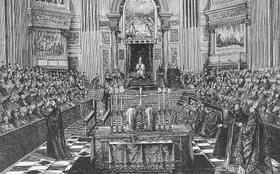
1870A black and white engraving of hundreds of bishops seated in tiers on either side of a hall, with the pope enthroned at the far end
Council

Vatican I: faith and reason cannot really disagree

First Vatican Council Dogmatic Constitution Dei Filius, chapter 4, On faith and reason

“Even though faith is above reason, there can never be any real disagreement between faith and reason, since it is the same God who reveals the mysteries and infuses faith, and who has endowed the human mind with the light of reason. God cannot deny himself, nor can truth ever be in opposition to truth. The appearance of this kind of specious contradiction is chiefly due to the fact that either the dogmas of faith are not understood and explained in accordance with the mind of the church, or unsound views are mistaken for the conclusions of reason.”

Read it in the source: Papal Encyclicals Online

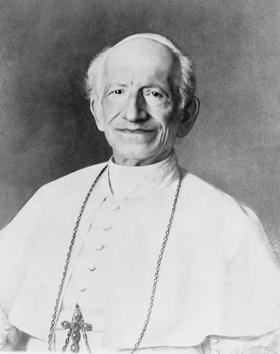
1893A black and white photograph of a very old, smiling pope in white with a pectoral cross
Magisterium

Leo XIII: the sacred writers did not intend to teach the nature of the visible universe

Pope Leo XIII Encyclical Providentissimus Deus, 18 November 1893, no. 18

“There can never, indeed, be any real discrepancy between the theologian and the physicist, as long as each confines himself within his own lines, and both are careful, as St. Augustine warns us, "not to make rash assertions, or to assert what is not known as known." … To understand how just is the rule here formulated we must remember, first, that the sacred writers, or to speak more accurately, the Holy Ghost "Who spoke by them, did not intend to teach men these things (that is to say, the essential nature of the things of the visible universe), things in no way profitable unto salvation." Hence they did not seek to penetrate the secrets of nature, but rather described and dealt with things in more or less figurative language, or in terms which were commonly used at the time, and which in many instances are in daily use at this day, even by the most eminent men of science.”

Read it in the source: vatican.va

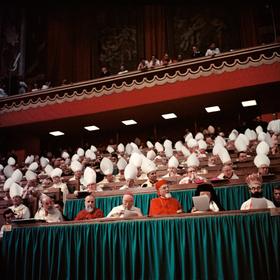
1965Rows of bishops in white mitres and copes sit in tiered stands hung with red and green cloth
Council

Vatican II deplores a failure to respect the independence of science

Second Vatican Council Pastoral Constitution Gaudium et Spes, 7 December 1965, no. 36

“Therefore if methodical investigation within every branch of learning is carried out in a genuinely scientific manner and in accord with moral norms, it never truly conflicts with faith, for earthly matters and the concerns of faith derive from the same God. … Consequently, we cannot but deplore certain habits of mind, which are sometimes found too among Christians, which do not sufficiently attend to the rightful independence of science and which, from the arguments and controversies they spark, lead many minds to conclude that faith and science are mutually opposed.”

Read it in the source: vatican.va

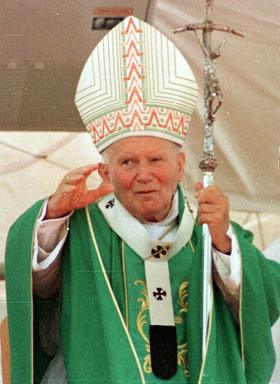
10 November 1979An elderly pope in green vestments and a white and gold mitre raises his hand in greeting, holding his staff with the crucifix
Magisterium

John Paul II: Galileo suffered at the hands of men and bodies of the Church

Pope St. John Paul II Address to the Pontifical Academy of Sciences for the centenary of the birth of Albert Einstein, 10 November 1979, no. 6

“The greatness of Galileo is known to all, like that of Einstein; but unlike the one whom we honour today before the College of Cardinals in the apostolic palace, the former had much to suffer, we cannot hide it, at the hands of men and bodies of the Church. … To go beyond this position taken by the Council, I wish that theologians, scholars and historians, moved by a spirit of sincere collaboration, would examine the Galileo case more deeply and, in a loyal recognition of wrongs from whatever side they come, would remove the mistrust that this affair still sets, in many minds, against a fruitful concord between science and faith, between Church and world.”

Our translation. The words as written, in French:

“La grandeur de Galilée est connue de tous, comme celle d’Einstein; mais à la différence de celui que nous honorons aujourd’hui devant le Collège cardinalice dans le palais apostolique, le premier eut beaucoup à souffrir – nous ne saurions le cacher – de la part d’hommes et d’organismes de l’Eglise. … Pour aller au-delà de cette prise de position du Concile, je souhaite que des théologiens, des savants et des historiens, animés par un esprit de sincère collaboration, approfondissent l’examen du cas Galilée et, dans une reconnaissance loyale des torts de quelque côté qu’ils viennent, fassent disparaître les défiances que cette affaire oppose encore, dans beaucoup d’esprits, à une concorde fructueuse entre science et foi, entre Eglise et monde.”

Read it in the source: vatican.va
31 October 1992
Magisterium

John Paul II: most of the theologians did not know how to re-examine their reading of Scripture

Pope St. John Paul II Address to the Pontifical Academy of Sciences, 31 October 1992, no. 5

“Thus the new science, with its methods and the freedom of research that they imply, obliged the theologians to examine their own criteria for interpreting Scripture. Most of them did not know how to do so. Paradoxically, Galileo, a sincere believer, showed himself more perceptive on this point than his theologian adversaries.”

Our translation. The words as written, in French:

“Ainsi la science nouvelle, avec ses méthodes et la liberté de recherche qu’elles supposent, obligeait les théologiens à s’interroger sur leurs propres critères d’interprétation de l’Écriture. La plupart n’ont pas su le faire. Paradoxalement, Galilée, croyant sincère, s’est montré plus perspicace sur ce point que ses adversaires théologiens.”

Read it in the source: vatican.va
31 October 1992
Magisterium

John Paul II: a question of science was wrongly made a question of faith

Pope St. John Paul II Address to the Pontifical Academy of Sciences, 31 October 1992, no. 9

“The majority of theologians did not perceive the formal distinction between Holy Scripture and its interpretation, which led them to transpose unduly into the domain of the doctrine of the faith a question of fact belonging to scientific investigation. … Cardinal Poupard has also reminded us how the sentence of 1633 was not irreformable and how the debate, which had not ceased to evolve, was closed in 1820 with the imprimatur granted to the work of Canon Settele”

Our translation. The words as written, in French:

“La majorité des théologiens ne percevaient pas la distinction formelle entre l’Écriture sainte et son interprétation, ce qui les conduisit à transposer indûment dans le domaine de la doctrine de la foi une question de fait relevant de l’investigation scientifique. … Le Cardinal Poupard nous a également rappelé comment la sentence de l633 n’était pas irréformable et comment le débat, qui n’avait cessé d’évoluer, fut clos en 1820 avec l’imprimatur accordé à l’ouvrage du chanoine Settele”

Read it in the source: vatican.va
1992
Magisterium

The Catechism on faith and science

Catechism of the Catholic Church CCC 159

“Consequently, methodical research in all branches of knowledge, provided it is carried out in a truly scientific manner and does not override moral laws, can never conflict with the faith, because the things of the world and the things of faith derive from the same God.”

Read it in the source: vatican.va
Related timelines

Evolution and Genesis“The Catholic Church teaches theistic evolution. That contradicts Genesis, which says God formed man from the dust and made them male and female from the beginning.”19 quotations, from the Old Testament to 1996Violence in the Church's history“The Catholic Church has murdered more people than any other institution in the history of the world. A church with that much blood on its hands cannot be the Church of Christ.”19 quotations, from the Old Testament to 2018The Inquisition and the use of force against heresyEarly Christian writers said that religion cannot be forced. From the fourth century bishops came to accept the coercion of heretics by the state. In the Middle Ages councils and popes set up inquiries into heresy, handed the condemned to the secular power for punishment, and ordered rulers to force confessions. This timeline gives those texts in date order, and then the Church's later teaching on religious freedom and her requests for pardon.18 quotations, from the Old Testament to 2004The inspiration of Scripture“The Bible was written by men, like any other book. Quoting the Bible to show that God inspired it is arguing in a circle.”20 quotations, from the Old Testament to 1992The Church and the Jewish peopleFor many centuries Christians, among them Fathers, councils and popes, spoke of the Jews with contempt and placed them under laws that set them apart: a distinguishing dress, exclusion from public office, forced attendance at sermons, separate quarters. Popes also forbade forced baptism and rejected the charge of ritual murder. This timeline gives those texts in their own words, in date order, and then the Church's own later judgment on that history and her requests for forgiveness.19 quotations, from the Old Testament to 2010Clergy sexual abuse and the Church's responsePriests, deacons and religious sexually abused children and young people, and in many places bishops and religious superiors knew and moved the abuser, kept it from the police and kept it quiet. This timeline first sets out what happened, in the words of the courts, grand juries and state inquiries that examined it and of the studies the Church herself commissioned. It then gives what the popes and bishops said and did in answer, in date order.61 quotations, from the Old Testament to 2023 to 2024