Tradition Timeline Leave an objection

Start page / Sacraments

Holy Orders

Each mark is one quotation. Touch the timeline to read it.
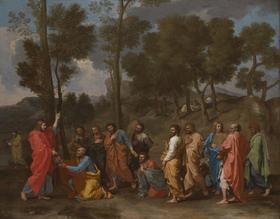
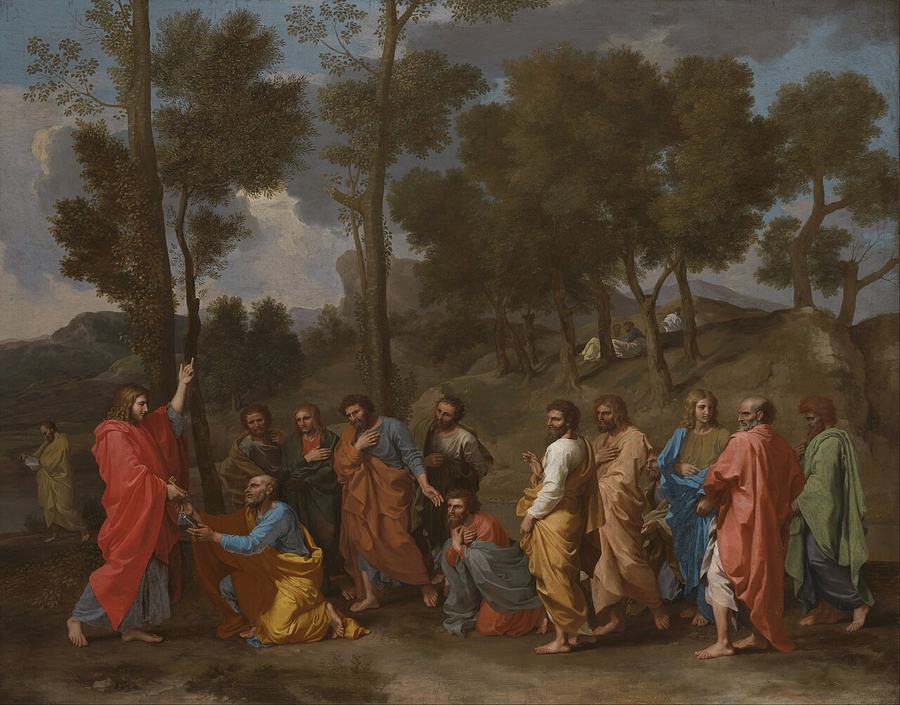
In a landscape with tall trees Christ, in a red cloak, hands keys to Peter, who kneels before him, while the other apostles stand around them
Ordination, from the Seven Sacraments by Nicolas Poussin. The sacrament is shown as Christ giving the keys to Peter. Painting: Nicolas Poussin, about 1636 to 1640, Public domain, via Wikimedia Commons. Resized.

The Catechism calls Holy Orders the sacrament through which the mission Christ gave his apostles continues in the Church until the end of time. It has three degrees: bishop, presbyter and deacon. This timeline begins with Christ choosing and sending the Twelve and the laying on of hands in the New Testament. It then follows the three degrees in the Fathers, the rule for ordaining a bishop at Nicaea, the Fathers on the weight of the office, and the teaching of Aquinas, Florence, Trent, Pius XII, the Second Vatican Council and the Catechism.

Where it starts with Jesus

The risen Jesus sends the apostles as the Father sent him, breathes on them and gives them the Holy Spirit.

“Jesus said to them again, “Peace be with you. As the Father has sent me, even so I send you.” And when he had said this, he breathed on them, and said to them, “Receive the Holy Spirit. If you forgive the sins of any, they are forgiven; if you retain the sins of any, they are retained.””

JesusJohn 20:21-23Read it in the source: Bible Gateway, RSV Catholic Edition

How it points to Jesus

Holy Orders rests on this sending. The Catechism says the sacrament is how the mission Christ gave his apostles goes on in the Church. On this timeline every degree of the ministry is shown as receiving its work from him, and the Fathers and councils quoted describe it as service.

Drafted from primary sources. Every quotation is checked against the page it links to. The Council of Florence (1439) names the handing over of the chalice and paten as the matter of the sacrament, and Pius XII (1947) decided that the matter is the laying on of hands alone; both are quoted here. Pius XII's constitution is quoted in Latin with our translation, since the Holy See's English page carries no text. The ordination prayers of the Apostolic Tradition ascribed to Hippolytus are left out, because no approved source carries a text that could be checked. The priesthood, apostolic succession, celibacy and the title of father are argued on the objection timelines.

20 quotations in date order

A work in progress. The quotations below are not all the evidence on this matter. More are being added.

The Old Testamentbefore Christ
Old Testament
Scripture

The ordination of Aaron and his sons

The Lord to Moses Exodus 29:4-9

“You shall bring Aaron and his sons to the door of the tent of meeting, and wash them with water. … And you shall take the anointing oil, and pour it on his head and anoint him. Then you shall bring his sons, and put coats on them, and you shall gird them with girdles and bind caps on them; and the priesthood shall be theirs by a perpetual statute. Thus you shall ordain Aaron and his sons.”

Read it in the source: Bible Gateway, RSV Catholic Edition

Old Testament
Scripture

The seventy elders

The Book of Numbers Numbers 11:24-25

“So Moses went out and told the people the words of the Lord; and he gathered seventy men of the elders of the people, and placed them round about the tent. Then the Lord came down in the cloud and spoke to him, and took some of the spirit that was upon him and put it upon the seventy elders”

Read it in the source: Bible Gateway, RSV Catholic Edition

Old Testament
Scripture

Melchizedek, priest of God Most High

The Book of Genesis Genesis 14:18-20

“And Melchiz′edek king of Salem brought out bread and wine; he was priest of God Most High. And he blessed him and said, “Blessed be Abram by God Most High, maker of heaven and earth”

Read it in the source: Bible Gateway, RSV Catholic Edition

c. AD 30A dark-haired, bearded man in a green robe with a white collar, his head tilted, looking out at the viewer
Scripture
St. Luke Luke 6:12-13

“In these days he went out into the hills to pray; and all night he continued in prayer to God. And when it was day, he called his disciples, and chose from them twelve, whom he named apostles;”

Read it in the source: Bible Gateway, RSV Catholic Edition

c. AD 46
Scripture
St. Luke Acts 13:2-3

“While they were worshiping the Lord and fasting, the Holy Spirit said, “Set apart for me Barnabas and Saul for the work to which I have called them.” Then after fasting and praying they laid their hands on them and sent them off.”

Read it in the source: Bible Gateway, RSV Catholic Edition

c. AD 65A bald, bearded apostle in a red cloak over a blue tunic, holding a folded letter in one hand and resting the other on a long sword
Scripture
St. Paul to Timothy 2 Timothy 1:6-7

“Hence I remind you to rekindle the gift of God that is within you through the laying on of my hands; for God did not give us a spirit of timidity but a spirit of power and love and self-control.”

Read it in the source: Bible Gateway, RSV Catholic Edition

c. 107A manuscript painting on a gold ground of clergy carrying a casket towards a church building
Church Father
St. Ignatius of Antioch Letter to the Magnesians, ch. 6

“I exhort you to study to do all things with a divine harmony, while your bishop presides in the place of God, and your presbyters in the place of the assembly of the apostles, along with your deacons, who are most dear to me, and are entrusted with the ministry of Jesus Christ”

Read it in the source: New Advent

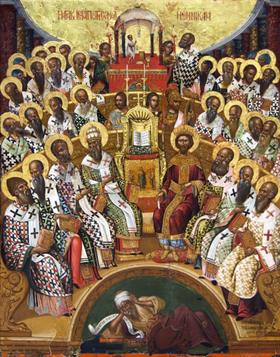
325A crowded icon of haloed bishops in bright vestments seated in rows around a throne that holds an open book
Council
First Council of Nicaea Canon 4

“It is by all means desirable that a bishop should be appointed by all the bishops of the province. But if this is difficult because of some pressing necessity or the length of the journey involved, let at least three come together and perform the ordination, but only after the absent bishops have taken part in the vote and given their written consent. But in each province the right of confirming the proceedings belongs to the metropolitan bishop.”

Read it in the source: Papal Encyclicals Online

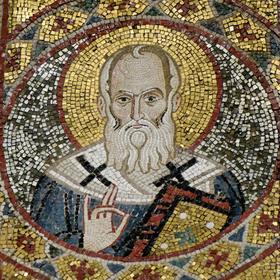
c. 362A round gold mosaic of a balding bishop with a white beard, wearing a white stole marked with black crosses
Church Father
St. Gregory Nazianzen Oration 2 (In Defence of His Flight), 16

“But granted that a man is free from vice, and has reached the greatest heights of virtue: I do not see what knowledge or power would justify him in venturing upon this office. For the guiding of man, the most variable and manifold of creatures, seems to me in very deed to be the art of arts and science of sciences.”

Read it in the source: New Advent

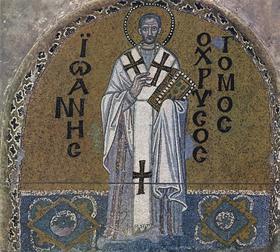
c. 386A gold mosaic of a bishop in white vestments marked with crosses, holding a book, with his name in Greek letters on either side
Church Father
St. John Chrysostom On the Priesthood, Book 3, ch. 4

“For the priestly office is indeed discharged on earth, but it ranks among heavenly ordinances; and very naturally so: for neither man, nor angel, nor archangel, nor any other created power, but the Paraclete Himself, instituted this vocation, and persuaded men while still abiding in the flesh to represent the ministry of angels.”

Read it in the source: New Advent

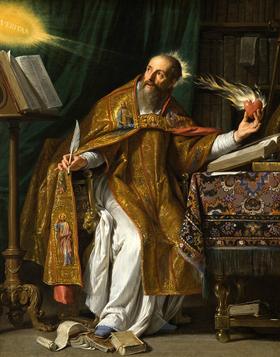
c. 400A bishop in a gold cope sits at a desk with a quill in one hand and a flaming heart in the other, looking up at a burst of light
Church Father
St. Augustine of Hippo On Baptism, Against the Donatists, Book 1, ch. 1

“so those who return, having been ordained before their secession, are certainly not ordained again; but either they again exercise their former ministry, if the interests of the Church require it, or if they do not exercise it, at any rate they retain the sacrament of their ordination”

Read it in the source: New Advent

The Middle Ages800 to 1500
13th centuryA Dominican friar with a tonsure and a gold halo holds an open book and a small church, with a shining sun on his chest
Doctor of the Church
St. Thomas Aquinas Summa Theologiae, Supplement, q. 34, a. 1, I answer that

“God wished to produce His works in likeness to Himself, as far as possible, in order that they might be perfect, and that He might be known through them. Hence, that He might be portrayed in His works, not only according to what He is in Himself, but also according as He acts on others, He laid this natural law on all things, that last things should be reduced and perfected by middle things, and middle things by the first, as Dionysius says (Eccl. Hier. v). Wherefore that this beauty might not be lacking to the Church, He established Order in her so that some should deliver the sacraments to others, being thus made like to God in their own way, as co-operating with God; even as in the natural body, some members act on others.”

Read it in the source: New Advent

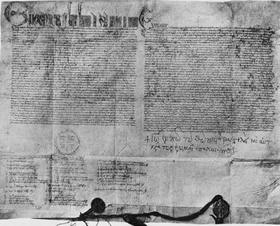
1439A black and white photograph of a large parchment charter written in two columns, with seals hanging from its lower edge
Council
Council of Florence Exsultate Deo, Decree for the Armenians, on the sacrament of orders

“The sixth is the sacrament of orders. Its matter is the object by whose handing over the order is conferred. So the priesthood is bestowed by the handing over of a chalice with wine and a paten with bread; the diaconate by the giving of the book of the gospels; the subdiaconate by the handing over of an empty chalice with an empty paten on it; and similarly for the other orders by allotting things connected with their ministry. The form for a priest is: Receive the power of offering sacrifice in the church for the living and the dead, in the name of the Father and of the Son and of the holy Spirit. The forms for the other orders are contained in full in the Roman pontifical. The ordinary minister of this sacrament is a bishop. The effect is an increase of grace to make the person a suitable minister of Christ.”

Read it in the source: Papal Encyclicals Online

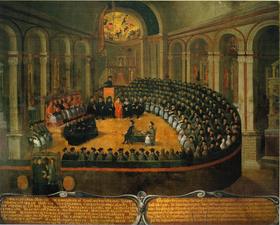
1563Rows of bishops in mitres sit in a great semicircle of benches inside a church, facing the presiding cardinals
Council
Council of Trent Session 23, Doctrine on the Sacrament of Order, ch. 3

“Whereas, by the testimony of Scripture, by Apostolic tradition, and the unanimous consent of the Fathers, it is clear that grace is conferred by sacred ordination, which is performed by words and outward signs, no one ought to doubt that Order is truly and properly one of the seven sacraments of holy Church. For the apostle says; I admonish thee that thou stir up the grace of God, which is in thee by the imposition of my hands.”

Read it in the source: Papal Encyclicals Online

The Modern Era1800 to today
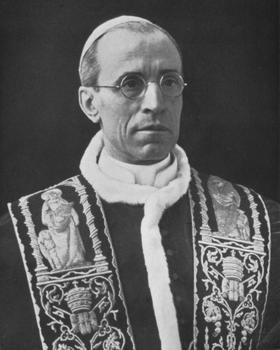
30 November 1947A black and white photograph of a thin pope in round spectacles wearing an embroidered stole
Magisterium
Pope Pius XII Sacramentum Ordinis, Apostolic Constitution, 30 November 1947, 4

“Of the sacred orders of the diaconate, the presbyterate and the episcopate, the matter, and the only matter, is the laying on of hands. The form, likewise the only form, is the words that determine the application of this matter, by which the sacramental effects are unambiguously signified, namely the power of Order and the grace of the Holy Spirit, and which the Church receives and uses as such. It follows that we declare, to remove every controversy and to close the way to anxieties of conscience, by our apostolic authority, and, if anything has ever been legitimately ordered otherwise, we decree, that the handing over of the instruments is not necessary, at least in the future, for the validity of the sacred orders of the diaconate, the presbyterate and the episcopate.”

Our translation. The words as written, in Latin:

“Sacrorum Ordinum Diaconatus, Presbyteratus et Episcopatus materiam eamque unam esse manuum impositionem; formam vero itemque unam esse verba applicationem huius materiae determinantia, quibus univoce significantur effectus sacramentales, scilicet potestas Ordinis et gratia Spiritus Sancti, quaeque ab Ecclesia qua talia accipiuntur et usurpantur. Hinc consequitur ut declaremus, sicut revera ad omnem controversiam auferendam et ad conscientiarum anxietatibus viam praecludendam, Apostolica Nostra Auctoritate declaramus, et, si unquam aliter legitime dispositum fuerit, statuimus instrumentorum traditionem saltem in posterum non esse necessariam ad Sacrorum Diaconatus, Presbyteratus et Episcopatus Ordinum validitatem.”

Read it in the source: vatican.va
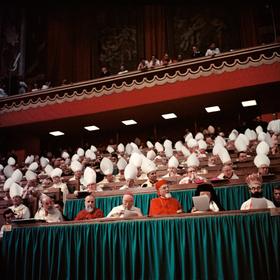
21 November 1964Rows of bishops in white mitres and copes sit in tiered stands hung with red and green cloth
Council
Second Vatican Council Lumen Gentium 21

“the apostles were enriched by Christ with a special outpouring of the Holy Spirit coming upon them, and they passed on this spiritual gift to their helpers by the imposition of hands, and it has been transmitted down to us in Episcopal consecration. … And the Sacred Council teaches that by Episcopal consecration the fullness of the sacrament of Orders is conferred, that fullness of power, namely, which both in the Church's liturgical practice and in the language of the Fathers of the Church is called the high priesthood, the supreme power of the sacred ministry.”

Read it in the source: vatican.va
21 November 1964
Council
Second Vatican Council Lumen Gentium 29

“the diaconate can in the future be restored as a proper and permanent rank of the hierarchy. It pertains to the competent territorial bodies of bishops, of one kind or another, with the approval of the Supreme Pontiff, to decide whether and where it is opportune for such deacons to be established for the care of souls. With the consent of the Roman Pontiff, this diaconate can, in the future, be conferred upon men of more mature age, even upon those living in the married state.”

Read it in the source: vatican.va
1992
Magisterium
Catechism of the Catholic Church CCC 1536

“Holy Orders is the sacrament through which the mission entrusted by Christ to his apostles continues to be exercised in the Church until the end of time: thus it is the sacrament of apostolic ministry. It includes three degrees: episcopate, presbyterate, and diaconate.”

Read it in the source: vatican.va
1992
Magisterium

The Old Testament roots of the ordained ministry

Catechism of the Catholic Church CCC 1539-1544

“…within the people of Israel, God chose one of the twelve tribes, that of Levi, and set it apart for liturgical service; God himself is its inheritance. A special rite consecrated the beginnings of the priesthood of the Old Covenant. … The liturgy of the Church, however, sees in the priesthood of Aaron and the service of the Levites, as in the institution of the seventy elders, a prefiguring of the ordained ministry of the New Covenant. … The Christian tradition considers Melchizedek, "priest of God Most High," as a prefiguration of the priesthood of Christ”

Read it in the source: vatican.va
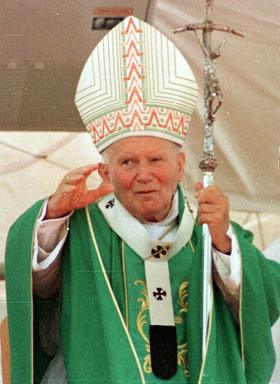
22 May 1994An elderly pope in green vestments and a white and gold mitre raises his hand in greeting, holding his staff with the crucifix
Magisterium
Pope St. John Paul II Ordinatio Sacerdotalis, Apostolic Letter, 22 May 1994, 4

“Wherefore, in order that all doubt may be removed regarding a matter of great importance, a matter which pertains to the Church's divine constitution itself, in virtue of my ministry of confirming the brethren (cf. Lk 22:32) I declare that the Church has no authority whatsoever to confer priestly ordination on women and that this judgment is to be definitively held by all the Church's faithful.”

Read it in the source: vatican.va
Related timelines

The seven sacramentsThe Church teaches that there are seven sacraments, that Christ instituted them, and that they give the grace they signify. This timeline begins with what Scripture shows of Christ acting through signs and sending the apostles. It then follows the early Fathers who spoke of the mysteries and the sacraments, the lists of seven in the Middle Ages, the definitions of Florence and Trent, and what the Second Vatican Council and the Catechism say today.19 quotations, from the Old Testament to 1992The ordained priesthood“The Bible says all believers are priests. There is no special ordained priesthood in the New Testament Church.”17 quotations, from the Old Testament to 1992BaptismBaptism is the first sacrament, the gateway to life in the Spirit and to the other sacraments. This timeline begins with Christ's own baptism and his command to baptize. It then shows how the Church has baptized and taught baptism in each age: how she prepared those who came, the days she chose, the water and the Trinitarian words, who may baptize, and what the sacrament gives. It shows the dispute over the baptism of those outside the Church, where Pope Stephen and St. Cyprian took opposite sides, and how it was settled. It ends with the Council of Florence, Trent, the Second Vatican Council and the Catechism.20 quotations, from the Old Testament to 1992Apostolic succession“True apostolic succession consists in preserving the apostles' teaching, not in an unbroken line of episcopal ordinations.”19 quotations, from the Old Testament to 1992ConfirmationConfirmation is the sacrament in which the baptized receive the gift of the Holy Spirit by the laying on of hands and anointing with chrism. This timeline begins with Christ's promise of the Spirit and the apostles' laying on of hands in Samaria and Ephesus. It follows the anointing after baptism in the early Church, then the way the West came to reserve the sacrament to the bishop and to separate it in time from Baptism, while the East kept the two together. It ends with the present rite and its words.21 quotations, from the Old Testament to 1992Priestly celibacy“The Bible says a bishop should be the husband of one wife, and Peter was married. Requiring priests to be celibate is unbiblical and treats marriage as something unholy.”19 quotations, from the Old Testament to 1992