
Tradition Timeline Leave an objection

Start page / Kinds of source

Non-Christian Writers

All 7 quotations on this site filed under “Non-Christian writer”, from every timeline, in date order.

Each mark is one quotation. Touch the timeline to read it.

Why writers who were not Christians are quoted

These are Roman, Jewish and Greek writers of the first and second centuries who did not believe in Jesus. They had no reason to help the Christian case, and some of them despised Christians. They are quoted only for what they record: that Jesus lived, that he was put to death, and that Christians worshipped him.

  1. Tacitus, a Roman historian, calls Christianity a mischievous superstition. In the same sentence he records that Christ was executed under Pontius Pilate.

    “Consequently, to get rid of the report, Nero fastened the guilt and inflicted the most exquisite tortures on a class hated for their abominations, called Christians by the populace. Christus, from whom the name had its origin, suffered the extreme penalty during the reign of Tiberius at the hands of one of our procurators, Pontius Pilatus, and a most mischievous superstition, thus checked for the moment, again broke out not only in Judaea, the first source of the evil, but even in Rome,”

    TacitusAnnals 15.44, c. AD 116Read it in the source: Fordham Sourcebook

Where scholars dispute a passage, a note under it says so.

The life of Jesus Christ: all 53 quotations

7 quotations in date order

A work in progress. The quotations below are not all the evidence on this matter. More are being added.

c. AD 93An engraved portrait of a bearded man in a large turban and a fur-trimmed robe
Non-Christian writer

A Jewish historian names James, "the brother of Jesus, who was called Christ"

Flavius Josephus Antiquities of the Jews, Book 20, ch. 9, sect. 1

“Festus was now dead, and Albinus was but upon the road; so he assembled the sanhedrim of judges, and brought before them the brother of Jesus, who was called Christ, whose name was James, and some others, [or, some of his companions]; and when he had formed an accusation against them as breakers of the law, he delivered them to be stoned:”

Read it in the source: CCEL

See it on the timeline: The life of Jesus Christ: the record inside and outside the Bible
c. AD 93
Non-Christian writer

Josephus on Jesus and his death under Pilate

Flavius Josephus Antiquities of the Jews, Book 18, ch. 3, sect. 3

“Now there was about this time Jesus, a wise man, if it be lawful to call him a man; for he was a doer of wonderful works, a teacher of such men as receive the truth with pleasure. He drew over to him both many of the Jews and many of the Gentiles. He was [the] Christ. And when Pilate, at the suggestion of the principal men amongst us, had condemned him to the cross, … those that loved him at the first did not forsake him; for he appeared to them alive again the third day; … as the divine prophets had foretold these and ten thousand other wonderful things concerning him. And the tribe of Christians, so named from him, are not extinct at this day.”

Read it in the source: CCEL

See it on the timeline: The life of Jesus Christ: the record inside and outside the Bible

After AD 73
Non-Christian writer

A Syrian father writes to his son of the Jews' "Wise King"

Mara, son of Serapion Letter to his son Serapion

“For what benefit did the Athenians obtain by putting Socrates to death, seeing that they received as retribution for it famine and pestilence? Or the people of Samos by the burning of Pythagoras, seeing that in one hour the whole of their country was covered with sand? Or the Jews by the murder of their Wise King, seeing that from that very time their kingdom was driven away from them? … Nay, Socrates did not die, because of Plato; nor yet Pythagoras, because of the statue of Hera; nor yet the Wise King, because of the new laws which he enacted.”

Read it in the source: New Advent

See it on the timeline: The life of Jesus Christ: the record inside and outside the Bible

c. AD 112
Non-Christian writer

A Roman governor reports on the Christians to the emperor

Pliny the Younger Letters 10.96, to the Emperor Trajan

“They asserted, however, that the sum and substance of their fault or error had been that they were accustomed to meet on a fixed day before dawn and sing responsively a hymn to Christ as to a god, and to bind themselves by oath, not to some crime, but not to commit fraud, theft, or adultery, not falsify their trust, nor to refuse to return a trust when called upon to do so.”

Read it in the source: Fordham Sourcebook

See it on the timeline: The life of Jesus Christ: the record inside and outside the Bible

c. AD 116
Non-Christian writer

A Roman historian records the execution under Pontius Pilate

Tacitus Annals 15.44

“Consequently, to get rid of the report, Nero fastened the guilt and inflicted the most exquisite tortures on a class hated for their abominations, called Christians by the populace. Christus, from whom the name had its origin, suffered the extreme penalty during the reign of Tiberius at the hands of one of our procurators, Pontius Pilatus, and a most mischievous superstition, thus checked for the moment, again broke out not only in Judaea, the first source of the evil, but even in Rome,”

Read it in the source: Fordham Sourcebook

See it on the timeline: The life of Jesus Christ: the record inside and outside the Bible

c. AD 121
Non-Christian writer

A Roman biographer mentions "Chrestus"

Suetonius Life of Claudius, 25

“Since the Jews constantly made disturbances at the instigation of Chrestus … he expelled them from Rome.”

Read it in the source: Fordham Sourcebook

See it on the timeline: The life of Jesus Christ: the record inside and outside the Bible

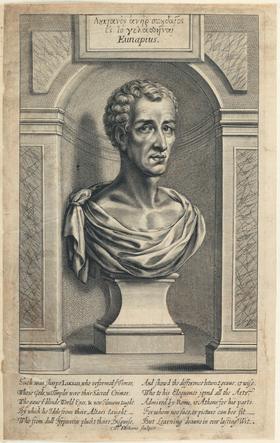
c. AD 165An engraving of a marble bust of a man with a lined face set in an arched niche, with verses printed beneath
Non-Christian writer

A Greek satirist mocks the Christians and their founder

Lucian of Samosata The Passing of Peregrinus, 11

“they revered him [Peregrinus] as a god, made use of him as a lawgiver, and set him down as a protector, next after that other, to be sure, whom they still worship, the man who was crucified in Palestine because he introduced this new cult into the world.”

Read it in the source: tertullian.org

See it on the timeline: The life of Jesus Christ: the record inside and outside the Bible