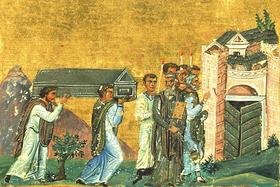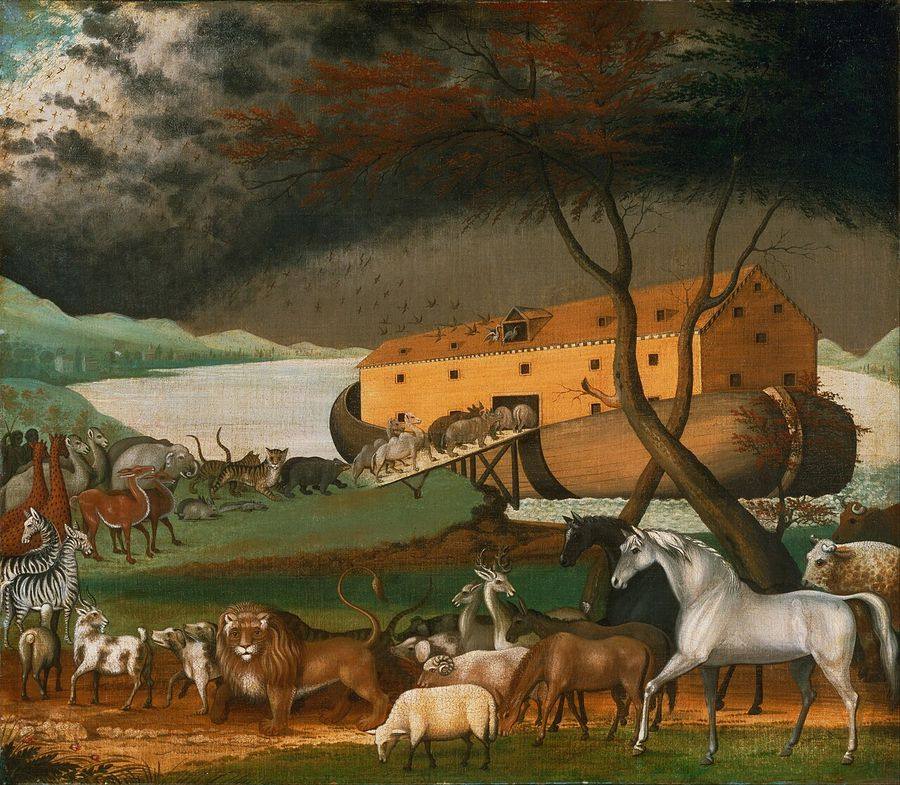
“The flood continued forty days upon the earth; and the waters increased, and bore up the ark, and it rose high above the earth. The waters prevailed and increased greatly upon the earth; and the ark floated on the face of the waters. And the waters prevailed so mightily upon the earth that all the high mountains under the whole heaven were covered; the waters prevailed above the mountains, covering them fifteen cubits deep. And all flesh died that moved upon the earth, birds, cattle, beasts, all swarming creatures that swarm upon the earth, and every man; everything on the dry land in whose nostrils was the breath of life died. He blotted out every living thing that was upon the face of the ground, man and animals and creeping things and birds of the air; they were blotted out from the earth. Only Noah was left, and those that were with him in the ark.”

Short answer
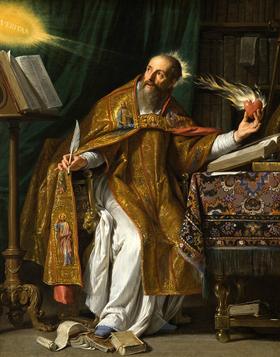
The Church does teach that there is no salvation outside her, and popes and councils have said so in severe words, which are quoted below. The Holy Office in 1949 called the formula an infallible statement and said it must be understood in the sense in which the Church herself understands it. As the Second Vatican Council and the Catechism state it, a person who knows that Christ made the Church necessary and refuses to enter or to remain in it cannot be saved. The formula is not aimed at those who, through no fault of their own, do not know Christ and his Church. St. Augustine in 397 and Pope Pius IX in 1863 drew the same line between stubborn separation and ignorance that is not a person's fault. The Council says of Christians born into separated communities that they cannot be accused of the sin of the separation.
Where it starts with Jesus
Jesus calls himself the door, and says that whoever enters by him will be saved.
“I am the door; if any one enters by me, he will be saved, and will go in and out and find pasture.”
JesusJohn 10:9Read it in the source: Bible Gateway, RSV Catholic Edition
How it points to Jesus
The teaching about the Church is a teaching about Christ. He is the one who saves, and the Church is his body, where he is present to us. The Church teaches that those who do not know him through no fault of their own can be saved, and when they are, it is by him.
Drafted from primary sources. Every quotation is checked against the page it links to.
19 quotations in date order
A work in progress. The quotations below are not all the evidence on this matter. More are being added.
“For God so loved the world that he gave his only Son, that whoever believes in him should not perish but have eternal life. For God sent the Son into the world, not to condemn the world, but that the world might be saved through him. He who believes in him is not condemned; he who does not believe is condemned already, because he has not believed in the name of the only Son of God.”
“If I had not come and spoken to them, they would not have sin; but now they have no excuse for their sin.”
“For, “every one who calls upon the name of the Lord will be saved.” But how are men to call upon him in whom they have not believed? And how are they to believe in him of whom they have never heard? And how are they to hear without a preacher?”
“This is good, and it is acceptable in the sight of God our Savior, who desires all men to be saved and to come to the knowledge of the truth. For there is one God, and there is one mediator between God and men, the man Christ Jesus, who gave himself as a ransom for all”
“And as many as shall, in the exercise of repentance, return into the unity of the Church, these, too, shall belong to God, that they may live according to Jesus Christ. Do not err, my brethren. If any man follows him that makes a schism in the Church, he shall not inherit the kingdom of God.”
“But if not even the baptism of a public confession and blood can profit a heretic to salvation, because there is no salvation out of the Church, how much less shall it be of advantage to him, if in a hiding-place and a cave of robbers, stained with the contagion of adulterous water, he has not only not put off his old sins, but rather heaped up still newer and greater ones!”
“But though the doctrine which men hold be false and perverse, if they do not maintain it with passionate obstinacy, especially when they have not devised it by the rashness of their own presumption, but have accepted it from parents who had been misguided and had fallen into error, and if they are with anxiety seeking the truth, and are prepared to be set right when they have found it, such men are not to be counted heretics.”
“As, then, we ought not to depreciate a man's righteousness, which begins to exist before he is joined to the Church, as the righteousness of Cornelius began to exist before he was in the body of Christian men, — which righteousness was not thought worthless, or the angel would not have said to him, "Your prayers and your alms have come up as a memorial before God;" nor did it yet suffice for his obtaining the kingdom of heaven, or he would not have been told to send to Peter, Acts 10:4-5 — so neither ought we to depreciate the sacrament of baptism, even though it has been received outside the Church. But since it is of no avail for salvation unless he who has baptism indeed in full perfection be incorporated into the Church, correcting also his own depravity, let us therefore correct the error of the heretics, that we may recognize what in them is not their own but Christ's.”
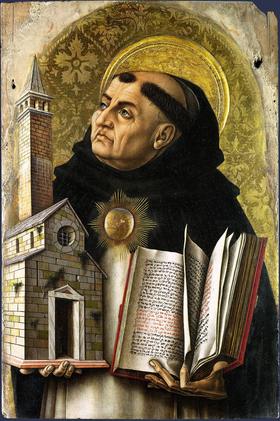
“…the reality of the sacrament is the unity of the mystical body, without which there can be no salvation; for there is no entering into salvation outside the Church, just as in the time of the deluge there was none outside the Ark, which denotes the Church, according to 1 Peter 3:20-21. And it has been said above (III:68:2), that before receiving a sacrament, the reality of the sacrament can be had through the very desire of receiving the sacrament.”
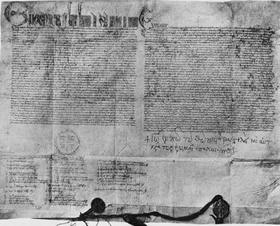
“Urged by faith, we are obliged to believe and to maintain that the Church is one, holy, catholic, and also apostolic. We believe in her firmly and we confess with simplicity that outside of her there is neither salvation nor the remission of sins … Furthermore, we declare, we proclaim, we define that it is absolutely necessary for salvation that every human creature be subject to the Roman Pontiff.”
“It firmly believes, professes and preaches that all those who are outside the catholic church, not only pagans but also Jews or heretics and schismatics, cannot share in eternal life and will go into the everlasting fire which was prepared for the devil and his angels, unless they are joined to the catholic church before the end of their lives … and that nobody can be saved, no matter how much he has given away in alms and even if he has shed his blood in the name of Christ, unless he has persevered in the bosom and the unity of the catholic church.”
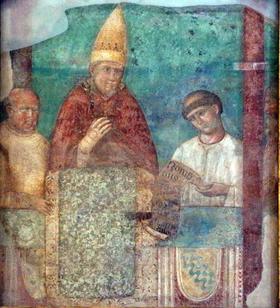
“Because God knows, searches and clearly understands the minds, hearts, thoughts, and nature of all, his supreme kindness and clemency do not permit anyone at all who is not guilty of deliberate sin to suffer eternal punishments. … Also well known is the Catholic teaching that no one can be saved outside the Catholic Church. Eternal salvation cannot be obtained by those who oppose the authority and statements of the same Church and are stubbornly separated from the unity of the Church and also from the successor of Peter, the Roman Pontiff”
“Now, among those things which the Church has always preached and will never cease to preach is contained also that infallible statement by which we are taught that there is no salvation outside the Church. However, this dogma must be understood in that sense in which the Church herself understands it. … Therefore, no one will be saved who, knowing the Church to have been divinely established by Christ, nevertheless refuses to submit to the Church or withholds obedience from the Roman Pontiff, the Vicar of Christ on earth.”
“Therefore, that one may obtain eternal salvation, it is not always required that he be incorporated into the Church actually as a member, but it is necessary that at least he be united to her by desire and longing. However, this desire need not always be explicit, as it is in catechumens; but when a person is involved in invincible ignorance God accepts also an implicit desire, so called because it is included in that good disposition of soul whereby a person wishes his will to be conformed to the will of God.”
“Whosoever, therefore, knowing that the Catholic Church was made necessary by Christ, would refuse to enter or to remain in it, could not be saved. … Nor does Divine Providence deny the helps necessary for salvation to those who, without blame on their part, have not yet arrived at an explicit knowledge of God and with His grace strive to live a good life.”
“The children who are born into these Communities and who grow up believing in Christ cannot be accused of the sin involved in the separation, and the Catholic Church embraces upon them as brothers, with respect and affection. For men who believe in Christ and have been truly baptized are in communion with the Catholic Church even though this communion is imperfect. … For it is only through Christ's Catholic Church, which is "the all-embracing means of salvation," that they can benefit fully from the means of salvation.”
“How are we to understand this affirmation, often repeated by the Church Fathers? Re-formulated positively, it means that all salvation comes from Christ the Head through the Church which is his Body … This affirmation is not aimed at those who, through no fault of their own, do not know Christ and his Church … "Although in ways known to himself God can lead those who, through no fault of their own, are ignorant of the Gospel, to that faith without which it is impossible to please him, the Church still has the obligation and also the sacred right to evangelize all men."”
“To reunite all his children, scattered and led astray by sin, the Father willed to call the whole of humanity together into his Son's Church. the Church is the place where humanity must rediscover its unity and salvation. the Church is "the world reconciled." She is that bark which "in the full sail of the Lord's cross, by the breath of the Holy Spirit, navigates safely in this world." According to another image dear to the Church Fathers, she is prefigured by Noah's ark, which alone saves from the flood.”
Related timelines
Other religions“The Catholic Church now teaches that all religions are paths to God. Jesus said that he is the way, and that no one comes to the Father except through him.”
Apostolic succession“True apostolic succession consists in preserving the apostles' teaching, not in an unbroken line of episcopal ordinations.”
Islam and the one God“The Catholic Church teaches that Islam and Christianity have the same God. But Islam denies that Jesus is the Son of God, and Scripture says that no one who denies the Son has the Father.”
Constantine and the Church“The Catholic Church was started by the emperor Constantine in the fourth century. It is not the church that Jesus and the apostles founded.”
The one Church“The true church is invisible. It is made up of all believers in every denomination. No single visible body, and certainly not the Catholic Church, can claim to be the one church Christ founded.”
The Church and the Jewish peopleFor many centuries Christians, among them Fathers, councils and popes, spoke of the Jews with contempt and placed them under laws that set them apart: a distinguishing dress, exclusion from public office, forced attendance at sermons, separate quarters. Popes also forbade forced baptism and rejected the charge of ritual murder. This timeline gives those texts in their own words, in date order, and then the Church's own later judgment on that history and her requests for forgiveness.